

Summary: Crate training a puppy overnight is one of the most effective strategies for establishing a safe sleep routine, preventing destructive behavior, and accelerating house training — but it requires patience, consistency, and a step-by-step approach. This guide covers everything from choosing the right crate and setting it up correctly to managing nighttime crying, building a bedtime routine, and troubleshooting common overnight challenges so both you and your puppy can get the restful sleep you deserve.
Table of Contents
- Why Crate Training Overnight Works (and What the Science Says)
- Choosing the Right Crate for Overnight Success
- Setting Up the Perfect Sleep Environment Inside the Crate
- How to Introduce the Crate Before the First Night
- The Ideal Puppy Bedtime Routine
- What to Expect on the First Few Nights
- How to Handle Nighttime Crying and Whining
- Nighttime Potty Breaks: Schedules by Age
- Common Overnight Crate Training Mistakes to Avoid
- Advanced Tips: Speeding Up the Process
- When to Stop Using the Crate at Night
- FAQs About Overnight Crate Training
1. Why Crate Training Overnight Works (and What the Science Says)
Crate training a puppy overnight taps into one of the most powerful instincts dogs possess: the denning instinct. In the wild, canines naturally seek out small, enclosed spaces to sleep — spaces that feel secure, warm, and protected from potential threats. A properly introduced crate mimics this environment, creating a personal den your puppy associates with safety and calm.
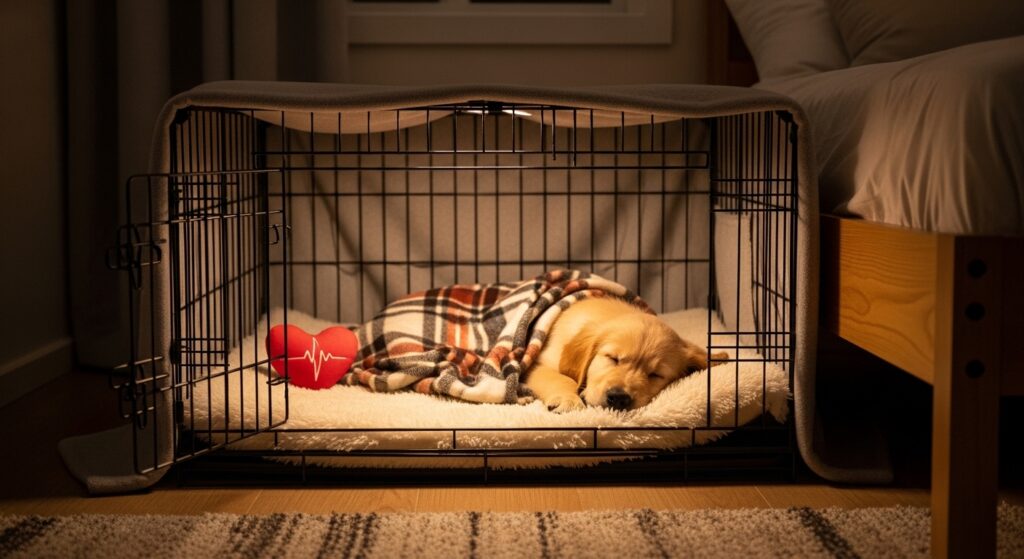
From a behavioral science perspective, crate training works through a process known as operant conditioning and classical conditioning. When a puppy experiences positive associations with the crate (comfort, treats, warmth, your scent), it begins to voluntarily seek out that space. This is why the introduction phase — before the first overnight attempt — is so critical.
The Benefits of Overnight Crate Training
- Accelerated housebreaking: Puppies instinctively avoid soiling their sleeping space, which teaches them to hold their bladder for progressively longer periods.
- Prevention of destructive behavior: Unsupervised puppies chew cables, furniture, and household items. A crate eliminates overnight access to dangerous objects.
- Improved sleep quality: Contrary to what many new owners fear, puppies who are properly crate trained sleep more soundly — and so do their owners.
- Reduced separation anxiety: A crate provides a consistent, predictable space that reduces generalized anxiety over time.
- Safety: A crate prevents ingestion of harmful materials, falls down stairs, and other nighttime accidents.
What Veterinary Behaviorists Say
According to the American Veterinary Society of Animal Behavior (AVSAB), crate training — when done humanely and positively — is one of the most recommended tools for new puppy owners. The key distinction is that a crate should never be used as punishment. It should always be introduced as a place of reward and rest.
2. Choosing the Right Crate for Overnight Success
The crate you choose has a direct impact on how quickly and comfortably your puppy adapts to overnight training. There is no universal “best crate” — the ideal option depends on your puppy’s breed, size, temperament, and your living situation.
Types of Crates
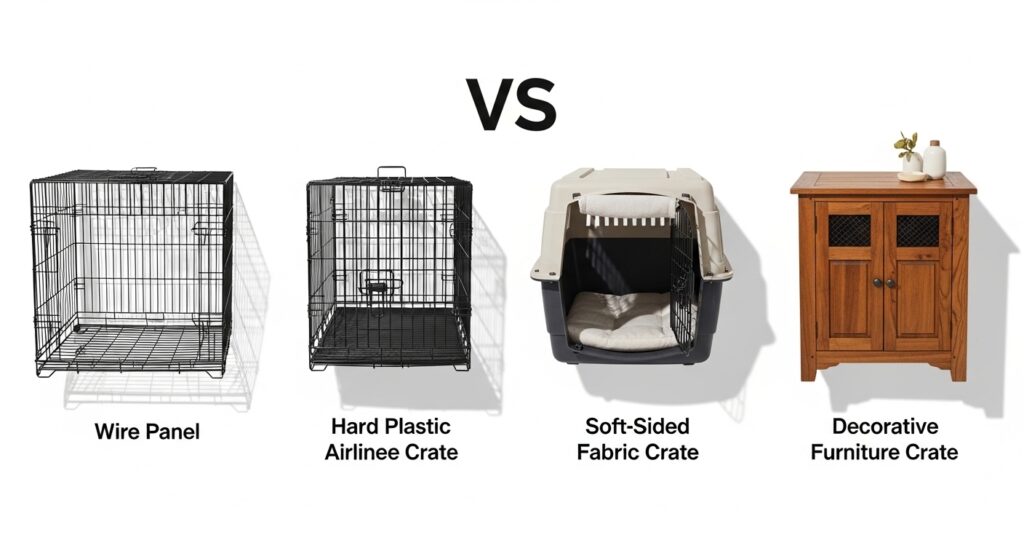
Wire Crates (Open-panel crates) Wire crates offer maximum ventilation and visibility, which helps some puppies feel less isolated. They often come with a divider panel — a critical feature for overnight training. Wire crates are easy to clean and fold flat for storage or travel.
Plastic Crates (Airline-style crates) Plastic crates create a darker, more enclosed den-like atmosphere that some puppies find immediately calming. They are the standard for air travel and work especially well for breeds that prefer a more cave-like sleep space.
Soft-sided Crates: These are lightweight and portable, but not suitable for puppies who are not yet crate trained. A determined or anxious puppy can chew through the fabric or push out the zippers. Reserve soft crates for fully trained adult dogs.
Furniture-style Crates: These wooden, decorative crates blend into your home and look like end tables or nightstands. They work well once your puppy is trained, but offer fewer adjustment options during the training phase.
Sizing the Crate Correctly
This is where many new puppy owners make a costly mistake. Bigger is not better when crate training overnight.
A crate that is too large removes the core behavioral incentive for housebreaking: puppies will simply eliminate in one corner and sleep in another. The crate should be large enough for your puppy to stand up fully, turn around comfortably, and lie down stretched out — but no larger.
For growing breeds, a wire crate with a divider panel is the smartest investment. You can start with a smaller sleeping space and expand the divider as your puppy grows, rather than buying multiple crates.
Placement of the Crate
Where you place the crate matters enormously for overnight success. During the initial training phase, place the crate in your bedroom — ideally close to your bed. This positioning:
- Reduces your puppy’s anxiety from separation
- Allows you to hear nighttime signals that indicate a potty break is needed
- Helps your puppy adjust more quickly because they can hear, smell, and occasionally see you
Once training is solid (typically 4–8 weeks), you can gradually move the crate to its permanent location.
3. Setting Up the Perfect Sleep Environment Inside the Crate
The interior of your puppy’s crate should feel like a five-star den: warm, familiar-smelling, and inviting. Getting this right dramatically reduces the first-night anxiety response.
Bedding and Comfort
Use a washable crate pad or a folded blanket as the base. Avoid thick, plush bedding in the early stages if your puppy has a tendency to chew — ingested stuffing can cause dangerous intestinal blockages.
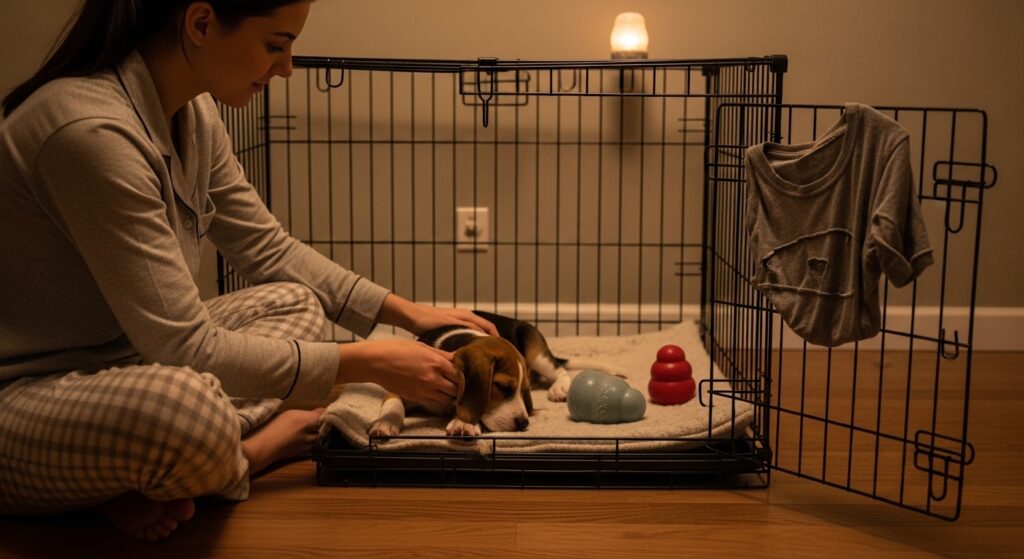
A powerful tip: place a worn T-shirt or pillowcase (something that carries your scent) inside the crate. Your scent is profoundly reassuring to a puppy and mimics the warmth and smell of the litter.
The Heartbeat Puppy Technique
A heartbeat toy — a plush toy containing a battery-operated device that mimics a heartbeat — has been shown to reduce whining and stress in newly separated puppies. The simulated heartbeat reminds them of sleeping close to their mother and littermates, triggering a soothing neurological response.
Temperature Regulation
Puppies are more sensitive to temperature fluctuations than adult dogs. The crate environment should be kept between 65–75°F (18–24°C). In colder months, a self-warming crate mat (one that reflects body heat without electricity) adds comfort. Avoid placing the crate near drafts, vents, or direct sunlight.
White Noise
Ambient noise — a fan, a white noise machine, or even soft classical music — can mask startling household sounds that might wake your puppy or trigger barking. Studies on canine stress responses have shown that classical music and reggae specifically tend to reduce cortisol levels in dogs.
4. How to Introduce the Crate Before the First Night
Rushing straight to overnight crating without a proper introduction phase is the single most common reason crate training fails. Puppies that are forced into a crate before building a positive association will develop fear, anxiety, and resistance that make every subsequent night harder.
Phase 1: Open Door Exploration (Day 1–2)
Place the crate in the living area with the door open and completely remove any pressure. Let your puppy explore voluntarily. Toss high-value treats just inside the entrance — not deep inside yet. Let them go in and come back out freely.
Phase 2: Feeding Near and Inside the Crate (Day 2–4)
Begin feeding meals just inside the crate entrance, then progressively move the bowl deeper inside with each meal. Once your puppy walks fully inside to eat without hesitation, start gently closing the door while they eat and opening it as soon as they finish.
Phase 3: Short-Timed Closures (Day 4–7)
With your puppy inside and a treat-stuffed Kong or chew, close the door for 10 minutes. Stay in the room initially. Gradually extend this to 30 minutes while you’re present, then 30 minutes while you leave the room.
Phase 4: Daytime Naps in the Crate
Once your puppy naps in the crate voluntarily during the day without protest, they are ready for overnight crating. Do not attempt overnight crating before reaching this stage.
5. The Ideal Puppy Bedtime Routine
Routines are the backbone of successful overnight crate training. Puppies thrive on predictability — when the same sequence of events signals “sleep time,” their nervous system begins to wind down automatically.
2–3 Hours Before Bed
- Offer the last large meal of the day (avoid feeding right before bed, which increases the need to eliminate during the night).
- Engage in moderate play — not overstimulating roughhousing, but enough activity to tire your puppy physically.
30–60 Minutes Before Bed
- Wind down play. Switch to calm petting, gentle grooming, or puzzle toys that engage the mind without elevating arousal.
- Dim lights in the room. This signals the circadian shift toward rest.
15–20 Minutes Before Bed
- Take your puppy outside for a final elimination opportunity. Wait patiently — do not rush this step. The longer and more thoroughly they eliminate outside, the longer they can sleep undisturbed.
- Use a consistent verbal cue like “go potty” to build a stimulus-response association over time.
Bedtime Crating
- Guide your puppy into the crate with a calm, cheerful voice and a small, low-calorie treat.
- Provide a frozen Kong stuffed with a small amount of peanut butter or wet food — this gives them something rewarding to engage with as they settle.
- Cover three sides of the crate with a lightweight blanket to create a den-like darkness (leave the front open for airflow).
- Say a consistent, calm phrase like “bedtime” or “settle” as you close the door.
- Do not make a dramatic production of leaving. Calm, brief farewells reduce separation anxiety.
For more information on keeping your puppy healthy and happy with the right nutrition, check out this guide on safe fruits and foods for dogs — a helpful resource for puppy parents building a healthy routine.
6. What to Expect on the First Few Nights
Setting realistic expectations prevents frustration and helps you respond to your puppy with patience rather than reactivity.
Night 1–3: The Adjustment Phase
The first three nights are typically the hardest. Most puppies will whine, cry, or bark at some point during the first night. This is a completely normal stress response to a new environment and the absence of littermates. Do not interpret this as failure.
Key things that may happen:
- Whining within the first 30–60 minutes of settling
- One or two wake-ups requiring a potty break
- Early morning restlessness (4–6 AM is common)
Night 4–7: The Beginning of Adaptation
By the end of the first week, most puppies who have been handled consistently will begin to show a reduction in initial whining. They may still need overnight potty breaks but will often return to sleep more readily.
Week 2–4: Consolidation
Nighttime awakenings become more predictable and shorter in duration. Many puppies in this phase begin to sleep 4–6 hour stretches without waking.
Week 4–8: Solid Overnight Routine
With consistency, most healthy puppies between 12–16 weeks old can be reliably sleeping through the night (with one potty break) by 6–8 weeks of training.
7. How to Handle Nighttime Crying and Whining
This is the question every new puppy owner loses sleep over — sometimes literally. Nighttime crying is one of the most emotionally challenging aspects of crate training because it triggers our natural caregiver instincts.
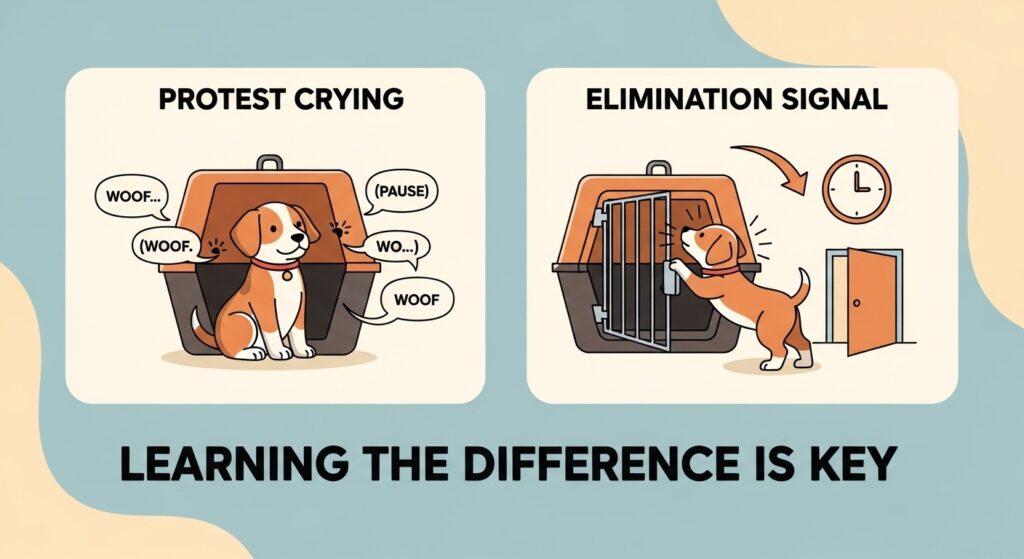
Distinguishing Types of Crying
Not all puppy vocalizations mean the same thing. Learning to differentiate them is crucial:
Protest crying: Intermittent whines or yelps that pause, then restart. This is your puppy testing whether crying produces a response. If it does not produce a consistent reward (your attention), it extinguishes over time.
Distress crying: Continuous, escalating, high-pitched crying that does not pause. This may indicate genuine fear, discomfort, or a need to eliminate.
Elimination signaling: Sudden, urgent whining or scratching after a period of quiet. This almost always means your puppy needs a potty break.
The Golden Rule: Do Not Reward Protest Crying
If you take your puppy out of the crate every time they cry, you are teaching a powerful lesson: crying produces freedom. This can entrench the behavior for months. However, this does not mean you should ignore your puppy completely — particularly in the first few weeks.
The Middle-Ground Approach
- If your puppy has been asleep and suddenly starts crying at night, take them outside quietly for a potty break. Use minimal light, no play, and no praise — just a calm “good potty” and straight back to the crate.
- If your puppy starts crying immediately after being crated (protest crying), wait 5 minutes before responding. If the crying escalates rather than subsides, briefly check on them without taking them out.
- Avoid eye contact, extended touching, or talking during overnight check-ins, as these are highly stimulating and reward the waking behavior.
Techniques That Help Reduce Nighttime Crying
- Place the crate next to your bed so your puppy can smell and hear you
- Using a heartbeat toy or a warm water bottle wrapped in a cloth
- White noise to mask triggering environmental sounds
- Ensuring your puppy has adequate physical and mental exercise before bed
- A recently worn T-shirt or item with your scent
According to the American Kennel Club’s crate training guidelines, the most effective approach combines consistency, positive reinforcement, and age-appropriate expectations — never punishment.
8. Nighttime Potty Breaks: Schedules by Age
One of the most overlooked aspects of overnight crate training is calibrating your expectations to your puppy’s physiological ability to hold their bladder. Expecting an 8-week-old puppy to sleep 8 hours without a potty break is not just unrealistic — it sets them up for failure and creates negative associations with the crate.
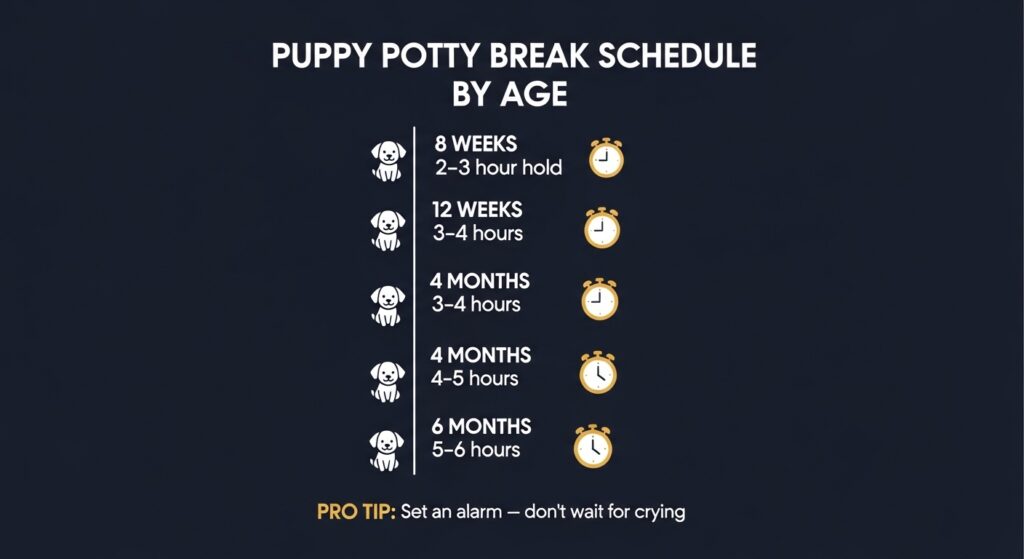
General Bladder Capacity by Age
A commonly used formula is: puppy’s age in months + 1 = maximum hours they can hold their bladder. This is a rough guideline, not an absolute rule.
- 8 weeks old: Can hold approximately 2–3 hours (maximum)
- 10–12 weeks old: Can hold approximately 3–4 hours
- 3–4 months old: Can hold approximately 4–5 hours
- 5–6 months old: Can hold approximately 5–6 hours
- 7+ months old: Can often hold 6–8 hours overnight
Setting an Alarm vs. Waiting for Signals
In the early weeks, set an alarm to proactively take your puppy out before they reach their limit. This prevents accidents in the crate, which would undermine housetraining. As your puppy matures, you can begin to rely on their overnight signals rather than a fixed alarm schedule.
The Overnight Potty Break Protocol
When you hear your puppy signal (or your alarm goes off):
- Quietly take your puppy out of the crate without making it a social event.
- Go directly to the potty spot — same spot every time.
- Wait up to 5 minutes. If they don’t go, return to the crate and try again in 20 minutes.
- If they eliminate, praise calmly and return immediately to the crate.
- No play. No extended petting. Straight back to sleep.
This protocol teaches your puppy that nighttime exits are for elimination only, not for playtime or extended social interaction. Over time, this reduces the incentive to wake up unnecessarily.
9. Common Overnight Crate Training Mistakes to Avoid
Even well-intentioned puppy owners make these errors. Recognizing them in advance can save weeks of frustration.
Mistake 1: Crating Too Soon Without Introduction
Placing a puppy in a crate on the first night — without a proper introduction phase — often results in intense fear responses that are difficult to undo. The introduction phase (described in Section 4) is not optional.
Mistake 2: Using the Crate as Punishment
If the crate becomes associated with time-outs, scolding, or negative events, your puppy will resist entering it. The crate must always be associated with positive experiences.
Mistake 3: Crate Too Large
As discussed in Section 2, oversized crates remove the housetraining incentive and can make puppies feel exposed rather than secure.
Mistake 4: Responding to Every Whimper
Inconsistent responses to protest crying teach puppies that persistence pays off. If you ignore crying 80% of the time and respond 20% of the time, you have actually created an intermittent reinforcement schedule — the most powerful behavioral reinforcer known to behavioral science, and the hardest to extinguish.
Mistake 5: Letting Puppies “Cry It Out” Completely Without Assessment
The opposite extreme — ignoring all crying regardless of intensity — can create genuine trauma and erode trust. Balance is essential.
Mistake 6: Exercising Too Close to Bedtime
Vigorous exercise within 30 minutes of bedtime can elevate cortisol and adrenaline, making it harder for your puppy to settle. Time exercise appropriately.
Mistake 7: Inconsistent Bedtime Timing
Dogs have circadian rhythms. Inconsistent sleep schedules disrupt their biological clock and make overnight training take longer. Aim for the same bedtime within 30 minutes each night.
Mistake 8: Feeding a Large Meal Right Before Bed
This increases gut motility and raises the likelihood of needing a bathroom break within 1–2 hours of sleeping. Aim for the last meal at least 2–3 hours before bed.
10. Advanced Tips: Speeding Up the Process
For puppy owners who want to accelerate the overnight crate training timeline, these evidence-based strategies can help.
Day Crating = Faster Night Crating
The more your puppy naps in the crate during the day, the faster they accept it at night. Daytime crating for naps (1–2 hours) builds familiarity and positive associations that transfer directly to overnight comfort.
Crate Games During Waking Hours
Voluntarily entering the crate for treats, meals, and toys during the day builds enthusiasm for the crate space. Try tossing a treat inside and letting your puppy run in to get it, then run out. Over time, start closing the door briefly between throws.
Scent Familiarity
Rotate scent items (your worn clothing) inside the crate regularly so your scent remains fresh and reassuring. Some owners also place a lightly used blanket from the puppy’s breeder in the crate initially to retain littermate scent.
Mental Exhaustion Before Bed
A mentally tired puppy sleeps faster and more soundly than a merely physically tired one. Puzzle feeders, sniff walks, basic training sessions (5–10 minutes), and lick mats all provide mental stimulation that accelerates sleep onset.
Melatonin (With Veterinary Guidance)
In cases of intense first-night anxiety, some veterinarians recommend a small dose of dog-appropriate melatonin to ease the transition. Always consult your vet before using any supplement.
For additional guidance on recognizing stress signals and health issues in young puppies, the Cornell University College of Veterinary Medicine’s puppy care resources offer science-backed information trusted by veterinarians worldwide.
11. When to Stop Using the Crate at Night
Overnight crate training is a temporary tool for most dog owners, not a permanent lifestyle choice — though some dogs genuinely prefer their crate throughout their lives.
Signs Your Dog Is Ready for More Freedom at Night
- No accidents in the crate for at least 8 consecutive weeks
- Calm, settled behavior during the night without whining or restlessness
- Demonstrated ability to be left unsupervised for extended periods without destructive behavior
- Full house training completion (no indoor accidents at all)
The Transition Process
Do not simply leave the crate door open overnight without a transition period. Instead:
- Start by leaving the crate door open during naps while you supervise.
- Move to leaving the door open at night while keeping your puppy in the bedroom.
- Gradually expand freedom to larger areas of the home over 2–4 weeks.
Many owners find that even after removing the overnight restriction, their dogs voluntarily return to their crate to sleep — because it has become their preferred den space.
12. FAQs About Overnight Crate Training
Should I put water in my puppy’s crate overnight?
In most cases, no. A healthy puppy that has had adequate access to water throughout the day does not need a water bowl overnight — particularly in the early training phase when water intake directly increases the need to eliminate. An exception may be made during very hot weather or for puppies with specific medical conditions; consult your veterinarian.
Is it cruel to crate a puppy overnight?
When done humanely, with positive introduction and age-appropriate duration, crating is not cruel. It mirrors a puppy’s natural denning instinct and provides security. What is harmful is using the crate as punishment, leaving puppies crated for excessively long periods, or forcing them into the crate without proper introduction.
How long will a puppy cry in a crate at night?
This varies enormously by puppy temperament and how thoroughly the introduction phase was completed. Some puppies settle within 15–30 minutes on the first night; others may cry intermittently for 1–2 hours. Most puppies show meaningful improvement by night 3–5 when the approach is consistent.
My puppy won’t stop barking in the crate at night. What do I do?
First, rule out genuine distress (hunger, temperature issues, need to eliminate). If those are satisfied, the barking is likely protest behavior. Avoid responding immediately — wait for a pause in barking, even a brief one, before checking on your puppy. Responding during peak barking teaches the behavior to continue.
Can I use a playpen instead of a crate overnight?
A playpen allows more movement but removes the denning effect that makes crate training uniquely effective for housebreaking. Many owners use a combination: a crate inside a playpen, with a pee pad in the outer area for very young puppies who cannot hold their bladder all night.