

Summary
House training a puppy in 7 days is possible as a jump-start framework, not a guaranteed finish line for every dog. The fastest results usually come from a mix of crate training, strict supervision, a predictable potty schedule, reward-based reinforcement, scent cleanup, and consistency across the household. Major training organizations emphasize routine, supervision, positive reinforcement, and realistic expectations, especially for very young puppies.
Outline
- What “House Training a Puppy in 7 Days” Really Means
- Before You Start: What You Need for Fast Puppy House Training
- The Core Principles of Puppy Potty Training
- The 7-Day Puppy House Training Plan
- Best Puppy Potty Schedule by Age
- How Often Should You Take a Puppy Out?
- Crate Training and House Training: Why They Work Together
- How to Handle Puppy Accidents the Right Way
- Indoor Potty Options: Puppy Pads, Grass Patches, and Small Spaces
- Common Puppy Potty Training Problems
- Signs Your Puppy Is Learning
- Mistakes That Make House Training Take Longer
- When to Call a Vet or Trainer
- Final Takeaway: How to Make House Training Stick
How to House Train a Puppy in 7 Days: A Practical, Realistic Plan That Works
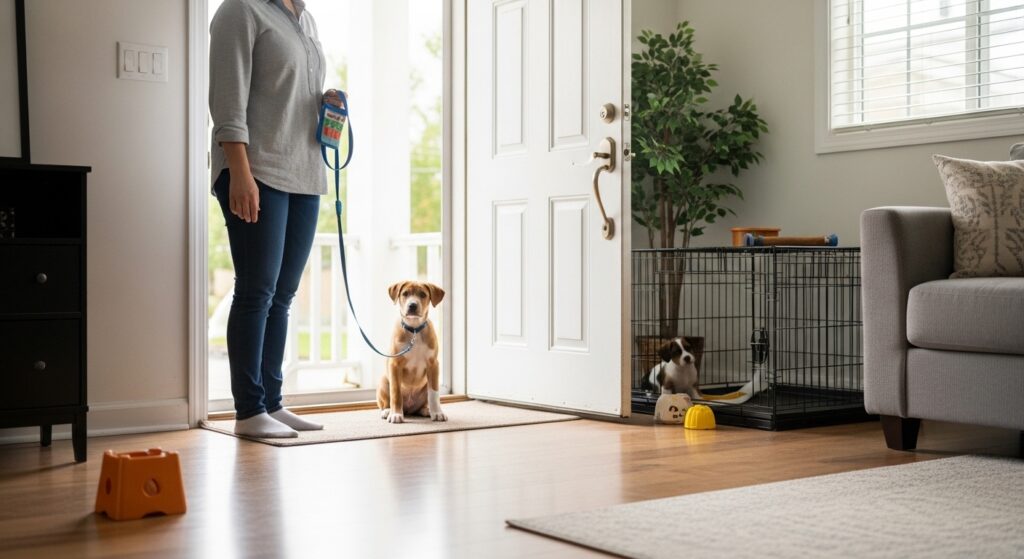
House training a puppy in 7 days is one of the most searched puppy-training goals because new dog owners want a plan that is fast, practical, and easy to follow. The good news is that you can make serious progress in one week. The important part is understanding the intent behind the phrase. In most cases, “house train a puppy in 7 days” means creating a reliable routine, reducing accidents sharply, and teaching the puppy where to go potty. It does not always mean your puppy will be 100% accident-free forever by day seven.
That distinction matters. Puppies learn through repetition, reinforcement, consistency, habit formation, environmental management, and timing. Those are the real drivers of success. A 7-day method works best as a structured reset that teaches your puppy a predictable elimination routine.
According to guidance from the ASPCA, AKC, and Humane Society, the most effective housebreaking systems all revolve around supervision, scheduling, positive reinforcement, confinement when needed, and patience.
What “House Training a Puppy in 7 Days” Really Means
Can a puppy truly be potty trained in one week?
Yes and no. A healthy puppy can absolutely learn the foundation of potty training in 7 days. Many puppies can start going to the same potty spot, responding to a verbal cue, and having noticeably fewer indoor accidents within that time. But complete reliability depends on age, bladder development, prior habits, consistency, and household routine.
The difference between a 7-day jump-start and full reliability
A 7-day house training plan is best viewed as an intensive conditioning phase. During this week, you build:
- a fixed potty schedule
- a designated bathroom area
- a reward association for outdoor elimination
- better supervision habits
- faster recognition of potty signals
Full house training usually takes longer than 7 days, especially for very young puppies.
Factors that affect potty training speed
Several variables influence how fast your puppy learns:
- age and bladder capacity
- breed size and metabolism
- consistency of feeding and water timing
- prior exposure to crates or pads
- number of caregivers involved
- apartment vs. house setup
- weather and access to the outdoors
Before You Start: What You Need for Fast Puppy House Training
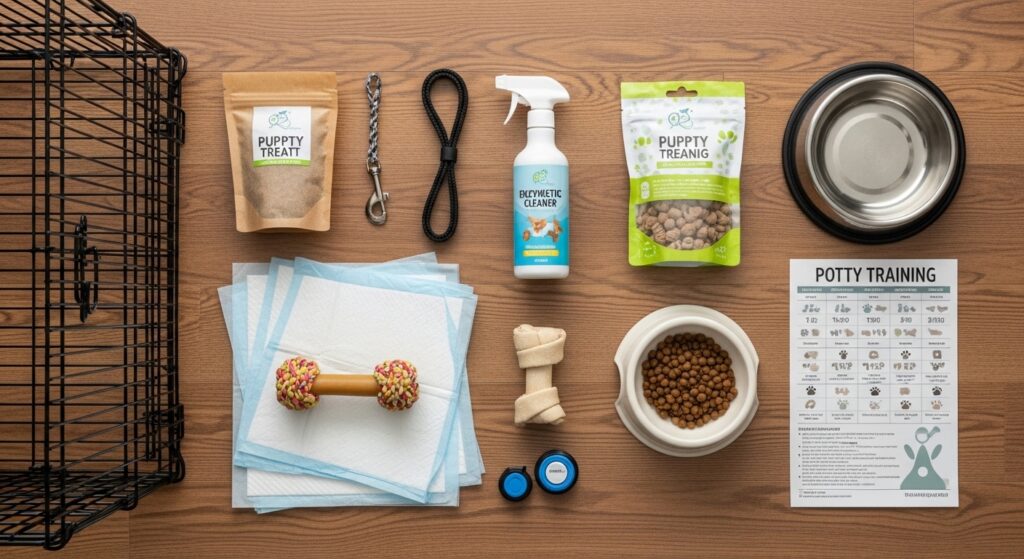
Crate, leash, treats, enzymatic cleaner, and schedule
If you want fast results, gather your tools before day one:
- properly sized crate
- leash for potty trips
- high-value training treats
- enzymatic urine cleaner
- timer or phone reminders
- notebook or an app to track potty times
These tools matter because potty training is less about luck and more about management systems.
Choosing a puppy potty spot
Pick one outdoor area and stick with it. Repetition builds location association. Puppies learn faster when scent, surface, and context stay the same. Take your puppy to the same patch of grass every time.
Setting realistic expectations by age and breed
An 8-week-old puppy will not hold it like a 5-month-old puppy. Small breeds may need more frequent outings because they often have smaller bladders and faster metabolisms. Large breeds may progress faster, but they still need repetition.
The Core Principles of Puppy Potty Training
Consistency and repetition
Potty training relies on pattern recognition. The more predictable the routine, the faster the learning. Feeding, play, sleep, crate time, and bathroom breaks should happen on a repeatable schedule.
Positive reinforcement and reward timing
Reward your puppy immediately after they finish pottying in the correct place. Not when you get back inside. Not 2 minutes later. Immediate reinforcement helps the puppy connect the exact behavior to the reward. AKC guidance strongly emphasizes this kind of timely reinforcement.
Supervision, confinement, and management
When you cannot supervise, your puppy should be in a crate, pen, or small safe area. Too much freedom too early is one of the biggest reasons potty training fails.
Reading puppy potty signals
Common potty signals include:
- sniffing the floor
- circling
- wandering away suddenly
- whining near the door
- pausing play and looking restless
- returning to a previously soiled area
The faster you identify these signals, the fewer accidents you will have.
The 7-Day Puppy House Training Plan
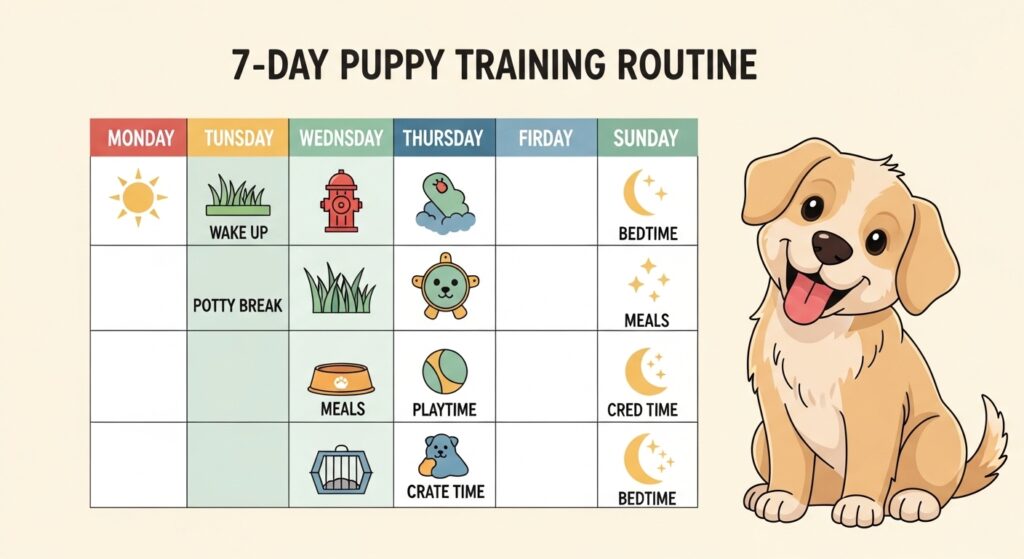
Day 1: Build the routine
Your goal on day one is structure. Take your puppy out:
- first thing in the morning
- after every meal
- after every nap
- after playtime
- after training
- before bedtime
- Every 1 to 2 hours for very young puppies
Use one cue phrase like “go potty.” Stay boring outside until the puppy eliminates. The second they finish, reward with praise and a treat.
Day 2: Introduce cue words and reward patterns
Now start pairing the act with a verbal cue. Calmly say “go potty” when your puppy is sniffing and about to eliminate. This creates cue conditioning. Keep using the same treat and the same reward phrase.
Day 3: Reduce accidents through tighter supervision
On day three, most owners discover they were giving too much freedom. Use the leash indoors if needed. This is called the umbilical cord method in dog training circles: keeping the puppy attached to you so you spot signals early.
Day 4: Improve bladder timing and transitions
By day four, you should see patterns. Maybe your puppy always needs to poop 15 minutes after breakfast or pee 10 minutes after intense play. Use those patterns to predict elimination windows.
Day 5: Add independence carefully
If your puppy has done well, allow a little more supervised freedom in one room only. Do not suddenly give access to the whole house. That often causes regression.
Day 6: Strengthen reliability in different situations
Practice potty trips at slightly different times of day, after visitors arrive, or after a short car ride. The goal is generalization, helping your puppy understand that the potty rule applies in more than one context.
Day 7: Test progress and set the next 2-week plan
By day seven, assess:
- How many accidents happened this week
- whether your puppy is signaling
- whether the puppy understands the potty area
- How long do they stay dry between trips
If accidents are decreasing and the routine is working, you are on track.
Best Puppy Potty Schedule by Age
8 to 10 weeks
This age group needs the most frequent bathroom breaks. Expect outings every 60 to 90 minutes when awake.
10 to 12 weeks
You may be able to stretch intervals slightly, but you still need close supervision and frequent post-nap, post-play, and post-meal trips.
3 to 4 months
Many puppies at this stage show better control and start signaling more clearly.
4 to 6 months
Bladder capacity often improves, but routine still matters. Do not assume your puppy is fully trained just because accidents have slowed down.
Recent AKC guidance highlights structured daily scheduling as a major factor in a successful potty-training timeline.
How Often Should You Take a Puppy Out?
After waking up
Always take your puppy out immediately after waking. This is one of the most reliable elimination triggers.
After eating and drinking
Most puppies need to potty soon after meals. Scheduled feeding helps you predict bathroom timing better than free-feeding.
After playtime and training
Excitement stimulates elimination. Puppies often need to pee after active play.
Before bedtime and during the night
Nighttime potty breaks may still be necessary for younger puppies. Set an alarm if needed during the first phase of training.
Crate Training and House Training: Why They Work Together
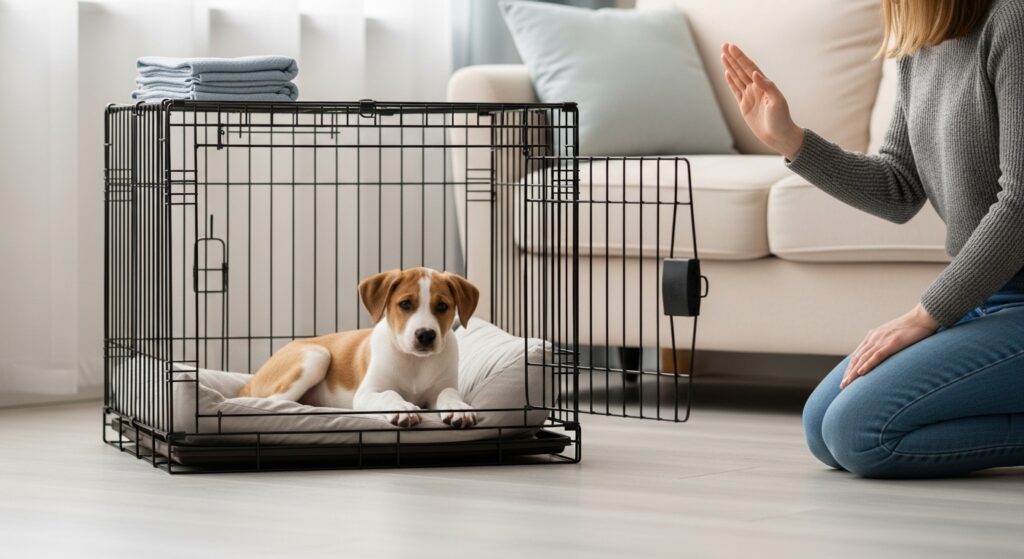
How a crate supports bladder control
Dogs naturally avoid soiling a properly sized sleeping area, which is why crates can speed up house training. AKC notes that crates are one of the most effective potty-training tools when used correctly.
Correct crate size and setup
The crate should be big enough for your puppy to stand up, turn around, and lie down comfortably, but not so large that one end becomes a bathroom corner.
Common crate mistakes to avoid
Avoid these errors:
- using the crate as punishment
- Leaving the puppy crated too long
- choosing a crate that is too large
- ignoring whining that signals a real potty need
How to Handle Puppy Accidents the Right Way
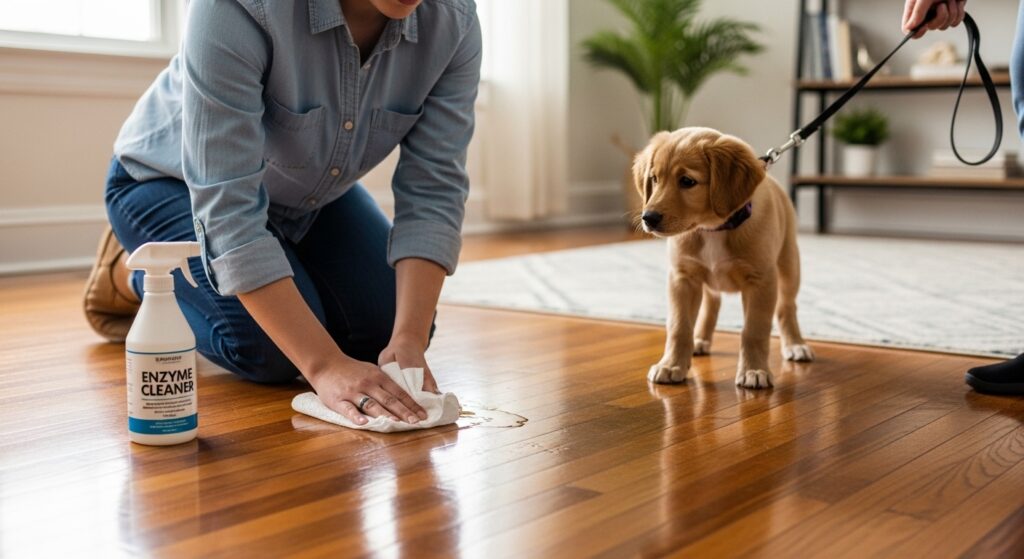
What to do if you catch your puppy in the act
Interrupt gently with a calm clap or neutral “outside,” then immediately take your puppy to the potty area. If they finish there, reward them.
Why punishment slows learning
Do not yell, rub their nose in it, or punish after the fact. The Humane Society and ASPCA both advise against punishment-based approaches because they can create fear and confusion instead of learning.
How to remove odor with enzymatic cleaners
Use an enzymatic cleaner, not just soap or scented spray. If the smell remains, your puppy may continue returning to the same spot because scent cues reinforce the old habit.
Indoor Potty Options: Puppy Pads, Grass Patches, and Small Spaces
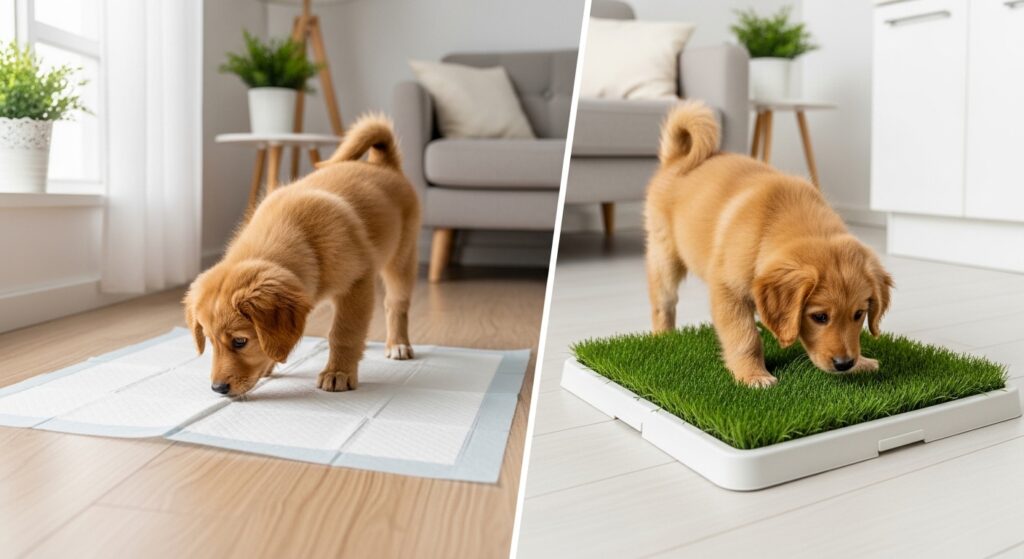
When puppy pads make sense
Pads can be useful if:
- You live in a high-rise apartment
- Your puppy is very young
- weather conditions are extreme
- You work on a gradual outdoor transition plan
Potential downsides of pad training
Indoor potty options can make outdoor housebreaking take longer because they teach your puppy that eliminating indoors is sometimes acceptable. Humane Society guidance notes this tradeoff directly.
Transitioning from pads to outdoors
If you want to include an internal resource on this topic, use this anchor text naturally in the article:
For owners using indoor training tools, this guide to potty training a puppy with puppy pads can help you build a smoother transition plan.
Common Puppy Potty Training Problems
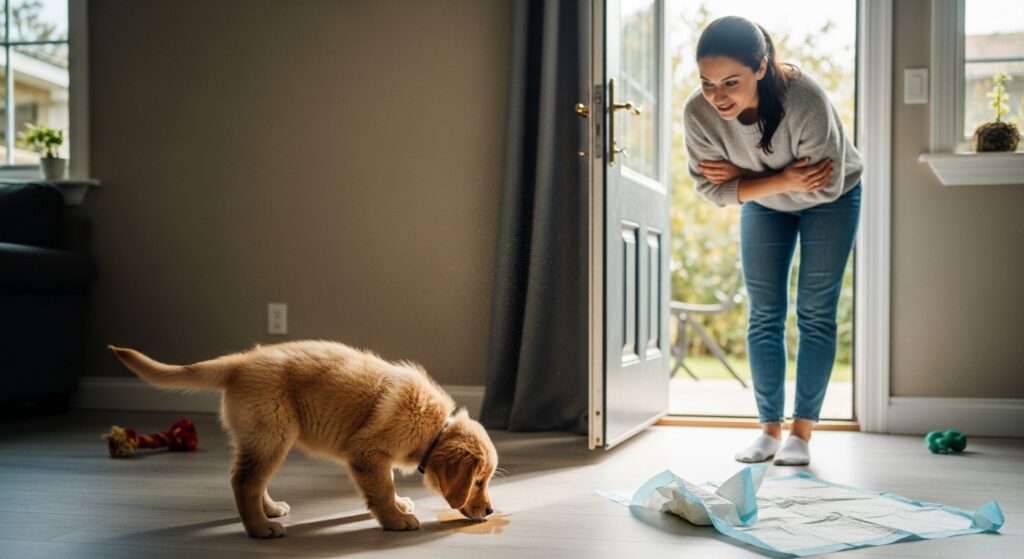
Puppy pees in the crate
Possible reasons include:
- crate is too large
- puppy was left too long
- breeder or shelter history, normalized soiling sleeping space
- medical issue such as UTI
Puppy has accidents right after going outside
Usually, the puppy did not fully empty because the trip was too stimulating. Keep potty trips calm and focused until they finish.
Puppy won’t potty outside
Some puppies are distracted, scared, or unfamiliar with outdoor textures and sounds. Stay patient, keep trips boring, and reward heavily for success.
Puppy regresses after early success
Regression is common after schedule changes, travel, illness, or too much freedom too soon. Go back to basics for a few days.
Puppy urinates when excited or scared
This may not be a standard house-training issue. Excitement urination and submissive urination can happen in young puppies and usually need calm handling, not punishment.
Signs Your Puppy Is Learning
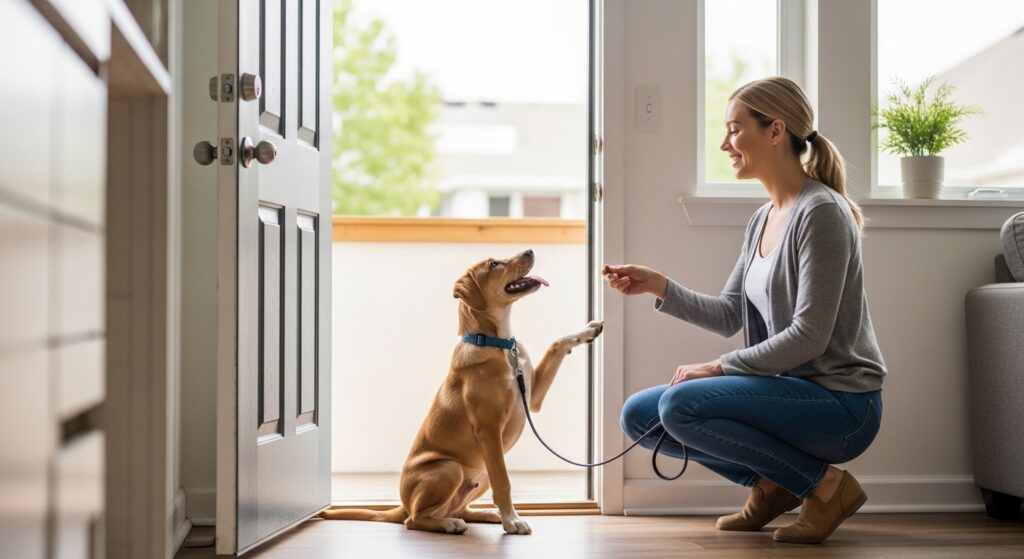
Fewer accidents
The first sign of progress is not perfection. It is a clear drop in accidents.
11.2 Going to the door or signaling
Many puppies begin to stand near the door, whine, or look at you before they need to go.
Longer dry periods between potty breaks
Improved bladder control and better routine awareness usually show up as longer dry intervals.
Mistakes That Make House Training Take Longer
Free roaming too soon
Giving your puppy access to multiple rooms before they are ready creates hidden accident zones.
Inconsistent feeding times
Scheduled meals help regulate elimination timing. Random feeding makes prediction harder.
Missing reward windows
Late rewards weaken the behavior-reward connection.
Cleaning with the wrong products
If odor remains, the behavior often repeats.
When to Call a Vet or Trainer
Medical causes of potty issues
Talk to your vet if your puppy has:
- very frequent urination
- straining
- diarrhea
- sudden regression
- accidents despite strong routine and supervision
- excessive thirst
When professional training help is worth it
A qualified positive-reinforcement trainer can help if your puppy is anxious outside, resistant to the crate, or showing confusing elimination patterns.
Red flags you should not ignore
Never assume every potty problem is behavioral. Medical issues can look like training failure.
Final Takeaway: How to Make House Training Stick
The habits that create long-term success
If you want to house train a puppy in 7 days, think in terms of habit loops, not shortcuts. The fastest route is:
- strict schedule
- one potty area
- immediate rewards
- close supervision
- crate or pen when unsupervised
- calm accident handling
- thorough odor cleanup
What to do after the first 7 days
Continue the same routine for at least 2 to 4 more weeks, then gradually increase freedom only after your puppy is consistently successful.
A simple success checklist
Your puppy is moving in the right direction if they:
- have fewer accidents than on day one
- potty faster in the designated area
- Respond to the cue phrase
- Stay dry longer indoors
- begin signaling before they need to go
For additional authenticity, you can also naturally reference these external resources in the article:
- The American Kennel Club offers a solid overview of how to potty train a puppy.
- The ASPCA also shares practical advice on house training your dog or puppy.
The bottom line is simple: you may not create a flawless puppy in 7 days, but you can absolutely create a clear system, strong potty habits, and a huge reduction in accidents. That is what successful puppy house training really looks like.