

Summary: Dog chewing is a natural, instinct-driven behavior rooted in teething, exploration, anxiety, boredom, and nutritional deficiencies. While puppies chew as a sensory and developmental activity, adult dogs that chew destructively are almost always communicating an unmet physical or psychological need. This guide covers every major cause of excessive chewing — from separation anxiety and under-stimulation to pica and compulsive disorders — and provides evidence-based, trainer-endorsed solutions including environmental management, appropriate chew enrichment, positive reinforcement training, and when to seek professional help.
Table of Contents
- Understanding Dog Chewing Behavior: The Big Picture
- Root Causes of Destructive Chewing in Dogs
- Age, Breed, and Chewing Intensity
- Proven Solutions to Stop Destructive Chewing
- Best Chew Toys and Products That Actually Help
- When to See a Vet or Certified Behaviorist
- Common Mistakes Dog Owners Make
Understanding Dog Chewing Behavior: The Big Picture
Why Chewing Is Natural and Necessary
Long before dogs became our companions, their wild ancestors depended on strong, active jaws to survive — stripping meat from bone, cracking marrow for nutrients, and carrying objects. Chewing, in the canine world, is not misbehavior. It is deeply embedded neurological programming. When a dog chews, the act itself stimulates the release of endorphins, producing a self-soothing, pleasurable feedback loop that reinforces the behavior.
From an ethological standpoint, chewing serves several critical functions: jaw muscle maintenance, dental hygiene through mechanical tartar removal, stress regulation, and cognitive engagement. Dogs explore the world largely through their mouths, much as human infants use their hands. Oropharyngeal exploration — the technical term for oral investigation — is how dogs assess texture, temperature, and scent composition of novel objects in their environment.
A few numbers that put this into perspective:
- Puppies lose 28 baby teeth between 3 and 6 months of age
- Adult dogs eventually develop 42 permanent teeth
- 67% of dog owners report some form of destructive chewing in their pet’s lifetime
- Behavioral problems — including destructive chewing — are the number one reason dogs are surrendered to shelters
When Does Chewing Become a Problem?
The line between normal and destructive chewing lies in target selection and frequency. A dog chewing its designated bone for 30 minutes is healthy. A dog systematically dismantling furniture, baseboards, electrical cords, clothing, and shoes — especially in the owner’s absence — signals a behavioral pattern that needs addressing. The clinical term for this is destructive oral behavior, and identifying the specific trigger is essential before any intervention begins.
⚠ Safety Note: If your dog chews electrical cords, toxic plants, sharp objects, or items containing small parts, physical danger must be managed through environmental control immediately — before any training approach is attempted.
Root Causes of Destructive Chewing in Dogs
Effective solutions always start with accurate diagnosis. Here are the six primary causes of dog chewing, each with distinct behavioral markers that help identify which is driving the problem.

1. Teething in Puppies: The Developmental Chewing Phase
Between three and seven months of age, puppies undergo a significant dental transition. Baby teeth (deciduous teeth) fall out and 42 permanent adult teeth erupt — a process that causes genuine gum discomfort. Chewing provides counterpressure that alleviates this pain, making it a biologically driven imperative rather than a choice the puppy is making consciously.
During this teething window, the puppy’s bite inhibition is also still developing. This period overlaps directly with what trainers call the critical socialization window (8–16 weeks), meaning the same period when puppies are most impressionable for learning is also when their mouths are the most active. For a deeper look at managing oral behaviors in young dogs, read our guide on puppy biting: what it means and how to stop it — which covers the important behavioral overlap between nipping and early chewing impulses.
2. Boredom and Insufficient Mental Stimulation
Dogs are cognitively complex animals. Working and sporting breeds especially — Border Collies, Belgian Malinois, German Shepherds, Huskies — were selectively bred for high-intensity, sustained mental output. When that cognitive demand goes unmet, surplus energy finds its own outlet. Chewing is almost always the path of least resistance.
Research in animal behavior science supports the concept of behavioral displacement: when a high-priority motivational system — like herding, hunting, or problem-solving — cannot be expressed, the animal redirects into a related but available behavior. For dogs, that behavior is frequently oral. This is why under-exercised dogs often chew more, and why puzzle feeders, nose work, and structured play can dramatically reduce destruction even without direct anti-chew training.
3. Separation Anxiety and Stress-Related Chewing
Separation anxiety is one of the most misunderstood conditions in companion dogs. It is not “acting out” or “spite.” It is a genuine panic response triggered by the departure or anticipated departure of attachment figures. Physiologically, it involves elevated cortisol, increased heart rate, panting, pacing, and — critically — redirected oral behavior.
Dogs with true separation anxiety almost exclusively chew at entry and exit points (doors, window frames) or at objects bearing the owner’s scent (shoes, clothing, couch cushions). This distinguishes anxiety chewing from boredom chewing, which tends to target items more randomly. According to the ASPCA’s guidance on canine separation anxiety, approximately 20–40% of dogs referred to veterinary behavior specialists are diagnosed with some form of separation-related disorder.
💡 Key Distinction: Boredom chewing happens throughout the day and targets random household items. Anxiety chewing clusters around departure and arrival times, targeting items with owner scent or exit points like doors and window frames.
4. Nutritional Deficiencies and Pica
Pica — the persistent consumption of non-nutritive substances — can be triggered by dietary imbalances. Dogs lacking adequate fiber, calcium, iron, or overall caloric density may chew and ingest soil, wood, fabric, or drywall as instinctive compensation. This is particularly common in dogs fed low-quality commercial diets or in pregnant and nursing females with elevated mineral demands.
Pica differs from typical destructive chewing in one critical way: the dog often swallows the material rather than simply destroying it. This is medically important, as ingested foreign bodies can cause intestinal blockages requiring surgical intervention.
5. Compulsive Chewing Disorders
In a subset of dogs — particularly those with genetic predisposition or histories of early deprivation such as shelter or puppy mill backgrounds — chewing crosses from a behavior into a compulsive disorder. Compulsive chewing is characterized by stereotyped, repetitive movements; difficulty being interrupted; continuation despite consequences; and escalating intensity over time. The neurological underpinning is similar to OCD in humans, involving dysregulation in dopaminergic and serotonergic pathways.
6. Attention-Seeking Behavior: The Accidental Training Loop
Dogs are exquisitely sensitive to human response patterns. If a dog picks up a shoe and the owner immediately stands up, raises their voice, and rushes over — the dog has received a guaranteed, high-intensity social reward. Over multiple repetitions, the dog learns a reliable equation: pick up forbidden item → owner responds. This is operant conditioning at work, entirely created by the human’s inadvertent reactions.
The solution is counterintuitive: minimize response to inappropriate chewing while maximizing reward for chewing appropriate items.
Age, Breed, and Chewing Intensity
Not all dogs chew with the same intensity, frequency, or motivation. Age and breed lineage are two of the strongest predictors of chewing behavior, and understanding them helps set realistic expectations and choose the right intervention.
| Life Stage | Age Range | Primary Chewing Driver | Expected Duration |
|---|---|---|---|
| Puppy (teething) | 3–7 months | Gum discomfort, exploration | Resolves as dentition completes |
| Adolescent | 6–18 months | Energy surplus, testing limits | Improves with exercise and training |
| Young Adult | 1–3 years | Boredom, anxiety, habits formed | Persistent without intervention |
| Mature Adult | 3–7 years | Anxiety, compulsion, habit | Requires targeted behavior work |
| Senior Dog | 7+ years | Dental pain, cognitive decline | Vet evaluation recommended |
“Chewing is not defiance. It is communication. The question is never ‘how do I stop my dog chewing?’ — it is ‘what is my dog trying to tell me?'”— Applied Animal Behavior Principle
High-drive breeds — Labradors, Golden Retrievers, Belgian Malinois, Jack Russell Terriers, Beagles — have been selectively bred for traits including high oral motivation (retrievers) or intense prey drive (terriers) that manifest as more intense and persistent chewing. These dogs are not problematic — they simply have higher enrichment thresholds that must be actively met every single day.
Proven Solutions to Stop Destructive Chewing
Step 1: Management and Environmental Dog-Proofing
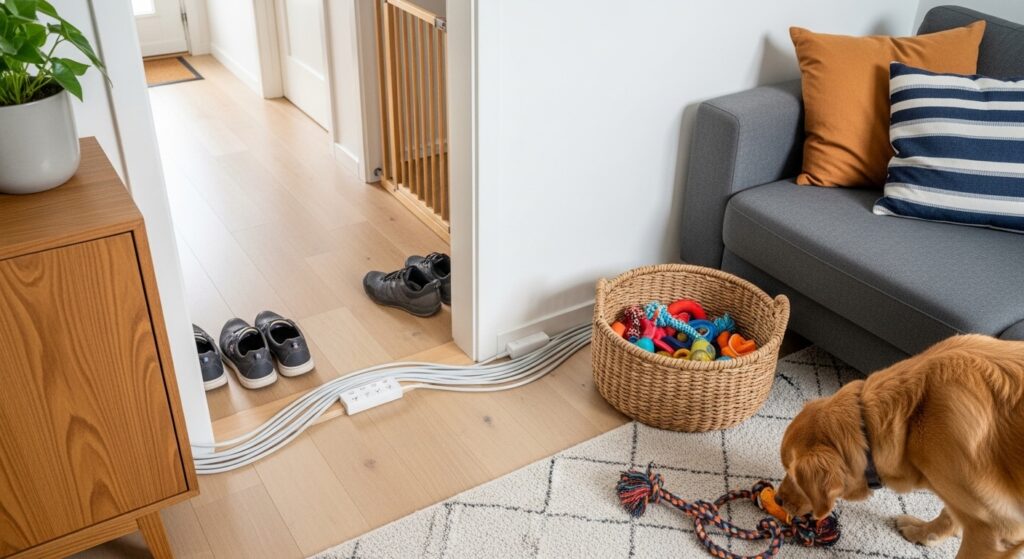
Before any training can succeed, you must eliminate your dog’s access to inappropriate items. Management is not a failure — it is a prerequisite. Every time your dog successfully chews a forbidden item, that behavior is self-reinforced through the endorphin reward. Prevention literally prevents the habit from deepening in neural pathways.
- Use crates or exercise pens for unsupervised time — these are safety environments, not punishment
- Rotate room access with baby gates until consistent trust is established
- Use cord management solutions such as split loom tubing or cord covers on all electrical wires
- Store shoes, clothing, and leather items in closed wardrobes or rooms
- Apply bitter apple spray to furniture legs, baseboards, and stationary targets — the taste aversion deters most dogs effectively
Step 2: Provide Appropriate and Appealing Chew Outlets
The single most powerful anti-chew intervention is providing better alternatives. Dogs don’t stop needing to chew — they need to redirect that impulse to sanctioned items. The key is making legal chew items more rewarding than forbidden ones.
- Match chew type to chew style. Power chewers such as Staffies, Rottweilers, and Labs need dense rubber or nylon. Soft-mouthed dogs like Spaniels and Poodles do well with rope or pressed rawhide alternatives.
- Rotate toys regularly to maintain novelty — the same toy loses its appeal within days.
- Use food-stuffed chews like frozen Kongs loaded with peanut butter, pumpkin, or wet food to increase engagement time and build a positive reward association.
- Introduce long-lasting natural chews — bully sticks, yak milk chews, split antlers — under close supervision.
Step 3: Positive Reinforcement Training Protocol
- Teach “Leave It” and “Drop It” as foundational commands. These give you reliable verbal control over what is in your dog’s mouth. Start with low-value items and high-value treats, building duration and reliability before generalizing to real-world situations.
- Redirect immediately, then reward the correct behavior. The moment your dog begins chewing something inappropriate: calmly interrupt (don’t yell), redirect to an appropriate chew, and reward with praise or a treat the instant they engage with the correct item.
- Practice “trade up” exchanges consistently. Approach your dog with a high-value treat, offer the trade, let them drop the item, then reward generously. Never simply take items away without compensation — this creates resource guarding over time.
- Reinforce calm, appropriate chewing with intermittent rewards. Walk past your dog while they chew their toy and occasionally drop a treat nearby. This teaches that chewing the right item sometimes earns bonuses — dramatically increasing toy engagement.
- Never punish after the fact. Dogs cannot connect delayed punishment with past behavior. Coming home to a destroyed pillow and scolding your dog only teaches them that your arrivals are unpredictable and frightening — which directly worsens anxiety-related chewing.
Step 4: Exercise and Cognitive Enrichment Protocols
Physical exercise alone is often insufficient. Mental fatigue is equally — and sometimes more — important. A one-hour sniff walk tires a dog more effectively than a thirty-minute jog because sniffing activates vastly more brain tissue. Structured enrichment must be a daily commitment, not an occasional supplement.
- Sniff walks — let the dog lead and set the pace; sniffing activates approximately 40x more brain tissue than visual processing alone
- Puzzle feeders and lick mats — replace breakfast in a bowl with 20–30 minutes of cognitive work
- Hide-and-seek games with kibble, toys, or family members scattered around the house
- Short obedience training sessions of 5–10 minutes: mentally exhausting and relationship-building simultaneously
- Nose work classes — the most cognitively demanding canine sport, accessible to every breed and age
Pro Tip — The 5-Minute Rule: For every 5 minutes of physical exercise, add 2 minutes of structured mental enrichment. Dogs who meet both thresholds daily show significantly lower rates of destructive behavior, regardless of breed or energy level.
Step 5: Treating Separation Anxiety at Its Root
If separation anxiety is the driver, generic chew-redirection will not solve the problem. Anxiety must be addressed through structured behavior modification — most effectively Systematic Desensitization combined with Counter-Conditioning (DS/CC). This involves:
- Breaking departure cues into tiny, non-triggering components such as picking up keys, putting on a coat, or touching the door handle
- Associating each component with high-value treats so they become predictors of good things, not panic
- Gradually increasing departure duration starting from seconds — never progressing faster than the dog’s anxiety threshold
- Using calming adjuncts such as L-theanine or adaptil pheromone diffusers as supplements to behavior work, not replacements for it
According to guidelines from the American College of Veterinary Behaviorists, severe separation anxiety often requires pharmacological support alongside behavior modification for meaningful, lasting improvement — a conversation well worth having with your veterinarian.
Best Chew Toys and Products That Actually Help
Not all chew toys are created equal. The right product depends on your dog’s chew intensity, age, jaw size, and the underlying motivation for chewing.
| Chewer Type | Best Products | Why It Works | Watch Out For |
|---|---|---|---|
| Power Chewer | KONG Extreme, Benebone, Nylabone Dura Chew | Dense material withstands heavy jaw pressure and won’t splinter | Monitor for small pieces; replace when worn down |
| Teething Puppy | KONG Puppy (frozen), Nylabone Puppy, chilled carrot | Soft on erupting teeth; cold reduces gum inflammation | Avoid hard nylon for puppies under 4 months |
| Anxious Chewer | Frozen stuffed KONG, lick mat, snuffle mat | Extended licking and chewing provides sustained calming effect | Introduce before anxiety triggers for best results |
| Gentle or Elderly Dog | Bully sticks, yak chews, rope toys | Appropriate hardness for older or smaller jaws | Supervise bully sticks; remove final piece to prevent gulping |
| Smart or Bored Dog | Puzzle feeders, treat-dispensing balls, snuffle mats | Adds cognitive challenge to the foraging experience | Start at easy difficulty to avoid frustration |
⚠ Items to Always Avoid: cooked bones (splinter into sharp shards), antlers for power chewers (tooth fracture risk), tennis balls used long-term (abrasive fuzz destroys enamel), ice cubes for aggressive chewers (tooth fracture risk), or any toy small enough to fit fully in your dog’s mouth.
When to See a Vet or Certified Behaviorist
Most chewing problems respond well to the strategies above. However, these presentations warrant professional support rather than continued self-management:
- Chewing escalates despite consistent management and enrichment — may indicate an underlying anxiety disorder or compulsive condition
- The dog chews and ingests non-food items such as wood, fabric, soil, or rocks — pica requires dietary and medical investigation
- Chewing is accompanied by self-directed licking, flank-sucking, or tail-chasing — points toward a compulsive disorder
- Sudden onset chewing in a previously non-destructive adult dog — rule out pain, cognitive dysfunction syndrome, or thyroid imbalance
- Extreme panic behaviors on departure including self-injury, prolonged vocalization, or elimination — true separation anxiety requires veterinary and behavioral co-treatment
A veterinarian can rule out medical contributors, assess for pain, and discuss pharmacological adjuncts such as fluoxetine or clomipramine where anxiety disorders are confirmed. A Certified Applied Animal Behaviorist (CAAB) or Diplomate of the American College of Veterinary Behaviorists (DACVB) can design structured behavior modification protocols tailored specifically to your dog.
Common Mistakes Dog Owners Make
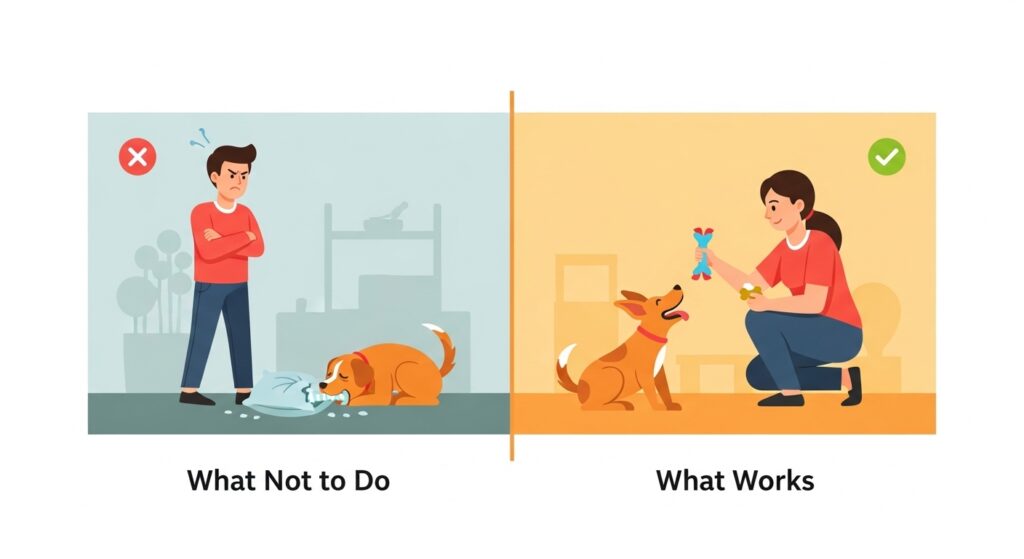
- Punishing after the fact. Dogs cannot connect delayed punishment with past actions. Post-fact scolding creates confusion and fear — not understanding or deterrence.
- Giving old shoes or clothing as toys. Dogs cannot distinguish “old shoe I’m allowed to chew” from “new shoe I’m not.” Once any shoe is permitted, all shoes become fair game.
- Providing too many toys at once. Novelty drives toy engagement. Rotate a pool of 8–10 toys, offering only 3–4 at any one time for sustained interest.
- Relying solely on verbal correction without redirection. Saying “no” removes a behavior but provides no information about what to do instead. Always replace — never simply remove.
- Assuming the dog “knows better.” Dogs operate on reinforcement history, not moral reasoning. If chewing has been reliably rewarding, the behavior continues until something more rewarding replaces it.
- Skipping the vet for suspected anxiety or pica. Behavioral interventions alone are often insufficient for clinical anxiety disorders or nutritional pica — professional guidance fundamentally changes outcomes.