


Summary
Dog barking behavior in male and female dogs can look different, but sex alone does not explain why a dog barks. A male dog may seem louder, more territorial, or more reactive in certain situations, while a female dog may bark more around nesting instincts, social boundaries, anxiety, or changes in routine. However, barking is shaped by many factors, including breed, training, hormones, reproductive status, early socialization, environment, age, health, and daily mental stimulation.
This guide explains how male and female dogs may differ in barking patterns, why those differences happen, and how dog owners can respond in a calm, humane, and effective way. It also covers territorial barking, alert barking, fear barking, demand barking, separation-related barking, social barking, and hormonal barking so you can understand what your dog is trying to communicate.
Table of Content
- Introduction to Dog Barking Behavior
- What Barking Means in Dogs
- Dog Barking Behavior in Male and Female Dogs: Key Differences
- Dog Barking Behavior in Male and Female Dogs by Trigger Type
- Why Male Dogs May Bark Differently
- Why Female Dogs May Bark Differently
- Hormones, Neutering, Spaying, and Barking
- Breed, Training, and Environment Matter More Than Sex
- Barking Differences by Age
- How to Read Your Dog’s Barking Context
- Training Tips for Male and Female Dogs
- When Barking May Signal a Health Problem
- Conclusion
- FAQs
Introduction to Dog Barking Behavior
Barking is one of the most common ways dogs communicate with people, other dogs, and the world around them. A bark can mean “someone is at the door,” “I am scared,” “play with me,” “do not come closer,” “I am bored,” “I need help,” or “something feels wrong.” Because dogs cannot explain their feelings in words, barking becomes part of their emotional and social language.
Many dog owners notice differences between male and female dogs. Some people say male dogs bark more at strangers, other dogs, or outdoor movement. Others say female dogs are sharper, more watchful, or more emotionally sensitive. These observations can be true in some cases, but they are not universal rules.
A dog’s barking behavior is not controlled by gender alone. A male Labrador, a female German Shepherd, a neutered terrier, an intact guard dog, a rescue dog with anxiety, and a well-socialized family dog may all bark for different reasons. The real question is not simply whether male or female dogs bark more. The better question is why the dog is barking, what emotion is driving it, and what pattern appears over time.
Understanding barking differences between male and female dogs helps owners avoid unfair assumptions. It also helps them choose better training methods, reduce excessive barking, and support their dog’s emotional well-being.
What Barking Means in Dogs
Dogs bark because barking works. It attracts attention, creates distance, warns others, invites play, expresses stress, or releases excitement. In many homes, barking becomes stronger because the dog learns that barking produces a result.
For example, a dog barks at the window, and the delivery person walks away. From the dog’s point of view, barking worked. A dog barks for food, and someone gives a treat to stop the noise. Again, barking worked. A dog barks at another dog on a walk, and the owner pulls away. The barking helped the dog escape an uncomfortable situation.
Common types of dog barking include:
- Alert barking
- Territorial barking
- Fear barking
- Anxiety barking
- Attention-seeking barking
- Demand barking
- Greeting barking
- Play barking
- Socially triggered barking
- Frustration barking
- Pain-related barking
- Compulsive barking
A useful external behavior reference is the ASPCA guide on why dogs bark, which explains several barking categories and why identifying the cause matters before trying to correct the behavior.
Dog Barking Behavior in Male and Female Dogs: Key Differences
Male and female dogs can show different barking patterns, especially when hormones, social behavior, and reproductive status are involved. Still, these differences are tendencies, not fixed rules.
Male Dogs May Bark More at Territory and Competition
Male dogs, especially intact males, may be more likely to bark at perceived social challenges. This may include barking at other male dogs, strangers near the home, animals passing the yard, or unfamiliar people approaching the owner.
This does not mean all male dogs are aggressive or noisy. Many male dogs are calm, quiet, and gentle. But when a male dog has strong territorial instincts, poor socialization, or high arousal, barking may become his first response.
Male barking may sound deeper, stronger, or more repetitive because many males are larger and have a heavier vocal tone. Owners may perceive this as more intense, even when the emotional trigger is similar to a female dog’s trigger.
Female Dogs May Bark More Around Social Boundaries
Female dogs may bark when they feel their space, routine, puppies, resources, or trusted people are being disturbed. Some female dogs are highly observant and may react quickly to changes inside the home, such as unfamiliar sounds, visitors, new pets, or changes in household movement.
Some owners describe female dogs as more selective. A female may ignore many things but bark sharply when something feels unusual. This pattern can happen in male dogs, too, but it is often noticed in females that are naturally watchful or sensitive to routine.
Intact Dogs May Bark Differently Than Neutered or Spayed Dogs
Reproductive status can influence barking. An intact male may bark more when he smells a female in heat nearby. He may also bark from frustration if he cannot reach another dog. An intact female may bark more during hormonal changes, especially if she becomes restless, sensitive, clingy, or protective.
Spaying or neutering may reduce some hormone-driven behaviors, but it does not automatically stop barking. If barking is learned, fear-based, breed-related, or reinforced by the environment, surgery alone will not solve it.
Dog Barking Behavior in Male and Female Dogs by Trigger Type
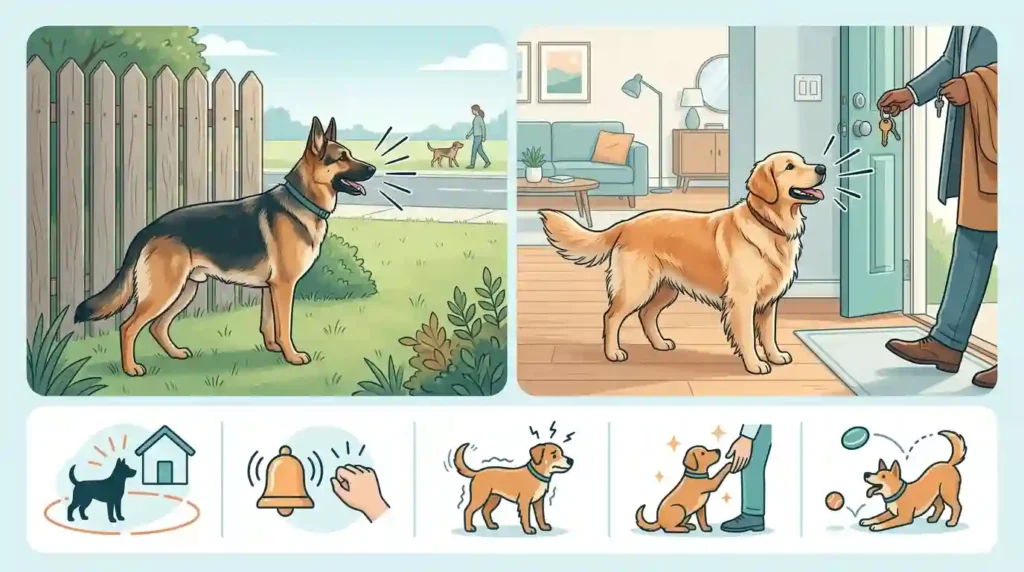
The clearest way to compare male and female dog barking is to look at the trigger behind the bark. The same sound may come from different emotions.
Territorial Barking
Territorial barking happens when a dog believes someone or something is entering its space. This may include the home, yard, car, crate, bed, owner, or walking route.
Male dogs may show stronger territorial barking in some households, especially if they are intact, under-socialized, or naturally protective. They may bark at mail carriers, neighbors, other dogs, delivery drivers, or visitors near gates and windows.
Female dogs can also be highly territorial. Some female dogs are especially protective of the home environment, their resting area, their puppies, or their trusted family members.
Signs of territorial barking include:
- Barking at doors, windows, fences, or gates
- Stiff body posture
- Forward movement
- Raised tail or raised hackles
- Intense staring
- Barking that stops when the person or animal leaves
The goal is not to punish the dog for noticing movement. The goal is to teach a calmer response.
Alert Barking
Alert barking is different from territorial barking. A dog may alert bark at any unusual sight or sound, even outside its normal territory. This may include a car door, thunder, footsteps, children playing, another dog barking, or a strange object in the room.
Both male and female dogs alert bark. Female dogs with sensitive temperaments may alert quickly to subtle household changes. Male dogs may alert loudly when they perceive movement or unfamiliar activity.
Alert barking often means, “Pay attention. Something changed.”
Fear Barking
Fear barking happens when a dog feels unsafe. It may occur during vet visits, grooming, storms, fireworks, new environments, unfamiliar dogs, or sudden noises.
Sex is less important than temperament and history in fear barking. A poorly socialized male dog and a poorly socialized female dog may both bark from fear. Rescue dogs, dogs with traumatic experiences, and dogs raised with limited exposure may show strong fear barking regardless of sex.
Fear barking may include:
- Backing away while barking
- Tucked tail
- Whale eye
- Lip licking
- Trembling
- Avoidance
- Growling mixed with barking
- Barking when cornered
This type of barking should not be handled with punishment. Fear usually gets worse when the dog feels more threatened.
Attention-Seeking Barking
Attention-seeking barking occurs when a dog barks to get a response from people. The response may be eye contact, talking, touching, scolding, food, toys, or being let outside.
Male and female dogs both learn this pattern quickly. A male dog may bark for play or interaction. A female dog may bark to request attention, access, or comfort. The difference is usually not biological. It is based on what the dog has learned.
If barking brings results, barking increases.
Demand Barking
Demand barking is more specific than attention barking. It usually means the dog wants something right now. This could be food, a walk, a toy, the door opened, the couch, a person’s attention, or another dog’s attention.
Some male dogs bark during play because they become excited and frustrated. Some female dogs demand to bark when routines are predictable, and they expect a certain response at a certain time.
Examples include:
- Barking at the food bowl
- Barking when the owner holds a leash
- Barking when play stops
- Barking at a closed door
- Barking at another dog to initiate play
The solution is consistent training. Reward quiet behavior before the barking starts, and avoid giving the reward while the dog is barking.
Separation-Related Barking
Separation barking happens when a dog becomes distressed after being left alone or separated from a specific person. This behavior can affect both male and female dogs.
Some female dogs may be more attached to household routines and may bark when those routines change. Some male dogs may become highly dependent on one person and bark when separated. But again, sex is not the main cause. Attachment style, early experience, confidence, and daily structure matter more.
Separation-related barking may come with:
- Pacing
- Drooling
- Destructive behavior
- Scratching doors
- Howling
- Accidents indoors
- Refusal to eat when alone
- Panic when departure cues appear
If barking is driven by anxiety, training must focus on gradual independence and emotional safety. In more serious cases, veterinary guidance may be needed. You can also read more about this topic here: Anxiety Medication Helps Dogs That Bark Excessively.
Social Barking
Social barking happens when dogs bark because other dogs are barking. It can spread quickly in neighborhoods, dog parks, kennels, or multi-dog homes.
Male dogs may join in barking when they hear another dog challenge or alert. Female dogs may join if they are socially responsive, protective, or anxious. In multi-dog households, one dog often starts, and the others follow.
Social barking is not always a problem. But if it becomes excessive, owners should identify the dog that starts the pattern and train calm behavior before the whole group becomes aroused.
Greeting Barking
Greeting barking is usually friendly and excited. The dog may bark when family members come home, guests enter, or another dog appears.
Male dogs may show louder greeting barking because they are often physically larger and more outwardly playful. Female dogs may show excited barking with jumping, spinning, whining, or fast tail movement.
Signs of greeting barking include:
- Loose body
- Wagging tail
- Playful movement
- Relaxed face
- Excited whining
- Barking that happens with approach rather than avoidance
This barking can be reduced by teaching calm greetings, rewarding four paws on the floor, and practicing controlled visitor routines.
Why Male Dogs May Bark Differently
Male dogs may bark differently because of physical size, hormones, social confidence, territorial behavior, and learned patterns. These factors do not apply to every male dog, but they can influence behavior.
Testosterone and Arousal
Intact male dogs may be more reactive in certain situations because testosterone can influence roaming, mating interest, competition, and territorial responses. If an intact male smells a female in heat, sees another male dog, or feels blocked from reaching a stimulus, barking may increase.
This barking may sound intense because it often comes with frustration. The dog is not simply making noise. He is emotionally activated.
Territorial Confidence
Some male dogs show strong confidence around boundaries such as fences, doors, cars, and yards. If barking repeatedly makes people, animals, or vehicles move away, the behavior becomes stronger.
For example, a male dog barks at people walking past the fence. The people continue walking and disappear. The dog learns that barking removes them. Over time, the fence becomes a bark station.
Competition With Other Dogs
Male dogs, especially intact males, may bark more at other males if they feel challenged. This can happen during walks, at dog parks, near gates, or through windows.
Not all male-to-male barking is dominance. Often, it is frustration, poor leash skills, fear, lack of socialization, or overexcitement. Owners should avoid labeling it too quickly.
Deeper Vocal Sound
Male dogs are often larger than females of the same breed, although this varies. A larger body can create a deeper bark. A deep bark may seem more aggressive to humans, even when the dog is only alerting or greeting.
This is important because the owner’s interpretation affects training. If a male dog’s bark sounds scary, the owner may react with tension, which can increase the dog’s arousal.
Why Female Dogs May Bark Differently
Female dogs may bark differently because of social sensitivity, protective instincts, hormonal cycles, maternal behavior, and environmental awareness.
Sensitivity to Routine
Many female dogs are highly tuned into daily patterns. They may notice when someone comes home at the wrong time, furniture moves, a new person visits, or a familiar sound changes.
This can lead to sharp alert barking. The dog may not be trying to dominate or control the home. She may simply be saying, “This is unusual.”
Protective Behavior
Female dogs can be very protective of people, puppies, sleeping areas, and familiar spaces. A mother dog may bark if she feels her puppies are being approached too quickly. A female dog without puppies may still guard valued spaces or people.
Protective barking can be calm and controlled, or it can become excessive if the dog feels constantly responsible for safety.
Hormonal Changes
An intact female dog may show barking changes during her heat cycle. She may become restless, more alert, more clingy, more irritable, or more reactive. Some females bark more when male dogs are nearby. Others bark because they are uncomfortable or unsettled.
False pregnancy can also affect behavior in some dogs. A female may guard toys, bedding, or quiet spaces and bark when disturbed.
Social Selectiveness
Some female dogs are socially selective. They may tolerate certain dogs but bark at others. They may accept familiar guests but bark at unfamiliar visitors. This selectiveness is not necessarily a problem unless it becomes fear-based, aggressive, or difficult to manage.
Owners should respect the dog’s comfort level while still teaching safe, calm behavior.
Hormones, Neutering, Spaying, and Barking

Hormones can influence barking, but they are not the only cause. This is where many owners become confused.
Will Neutering Stop a Male Dog From Barking?
Neutering may reduce barking that is linked to mating frustration, roaming desire, or competition with other intact males. However, it may not reduce barking caused by fear, boredom, separation anxiety, poor training, breed traits, or learned attention-seeking behavior.
If a male dog has barked at the front window for three years, neutering alone is unlikely to erase the habit. The dog has practiced that behavior many times. Training and environmental management are still needed.
Will Spaying Stop a Female Dog From Barking?
Spaying may reduce barking linked to heat cycles, hormonal restlessness, or false pregnancy. It may not stop alert barking, fear barking, territorial barking, or demand barking.
A spayed female can still bark at the door, at other dogs, or when left alone if the underlying cause remains.
Learned Barking Can Continue After Surgery
Once barking becomes a habit, the dog may continue even after hormonal influence is reduced. This is because barking has become part of the dog’s response pattern.
For this reason, owners should combine veterinary advice with behavior training, positive reinforcement, and changes to the dog’s environment.
Breed, Training, and Environment Matter More Than Sex
The difference between male and female barking is often smaller than the difference between breeds, training histories, and living conditions.
Breed Traits
Some breeds are naturally more vocal. Herding breeds, guard breeds, scent hounds, terriers, and small companion breeds may bark more because humans historically selected them for alerting, chasing, guarding, or communication.
For example:
- Beagles may bark and howl because of scent-tracking instincts.
- German Shepherds may bark from guarding and alerting instincts.
- Terriers may bark at movement and small animals.
- Chihuahuas may bark due to sensitivity and confidence.
- Border Collies may bark from frustration if under-stimulated.
- Dachshunds may bark at sounds, visitors, or movement.
In many cases, breed explains barking more accurately than sex.
Early Socialization
A dog exposed calmly to people, animals, sounds, surfaces, handling, and environments during early development is usually better prepared for everyday life. A dog with poor socialization may bark at normal things because they feel unfamiliar or threatening.
This applies to both male and female dogs.
Owner Response
Dogs repeat behaviors that work. If barking earns attention, distance, food, play, or access, barking becomes useful.
Sometimes owners accidentally train barking by:
- Yelling at the dog
- Giving treats while the dog is barking
- Opening the door only after barking
- Letting the dog rush the window
- Picking up small dogs every time they bark
- Pulling away from every dog on walks
- Comforting fear barking in a way that increases dependency
The goal is not to ignore real distress. The goal is to reward calm behavior and teach better communication.
Daily Exercise and Mental Stimulation
A bored dog barks more. A dog with unused energy may bark at every sound, shadow, bird, or neighbor. This is true for males and females.
Helpful activities include:
- Sniff walks
- Puzzle feeders
- Training games
- Chew toys
- Tug with rules
- Fetch with breaks
- Scent work
- Calm settle training
- Short obedience sessions
Mental exercise is especially helpful for dogs that bark from frustration.
Barking Differences by Age
Age changes barking behavior. A puppy, adolescent dog, adult dog, and senior dog may bark for different reasons.
Puppies
Puppies bark during play, fear, frustration, loneliness, and exploration. Male and female puppies may both bark when learning how the world works.
Puppy barking should be guided gently. The goal is to teach confidence, not silence.
Adolescent Dogs
Adolescence is when barking often becomes more noticeable. Dogs may test boundaries, become more reactive, notice other dogs more intensely, or show stronger territorial behavior.
Male adolescent dogs may bark more at other dogs, especially if intact. Female adolescent dogs may bark more during confidence changes or heat cycles.
This stage needs patience, structure, and consistent training.
Adult Dogs
Adult barking patterns are usually more predictable. By adulthood, owners can often identify specific triggers: the doorbell, the window, visitors, dogs, trucks, storms, or being left alone.
At this stage, training focuses on replacing practiced habits with calmer responses.
Senior Dogs
Older dogs may bark more because of hearing loss, vision changes, pain, confusion, cognitive decline, or increased anxiety. A senior male or female dog that suddenly barks more should be checked by a veterinarian.
Sudden barking changes should never be dismissed as stubbornness.
How to Read Your Dog’s Barking Context

To understand barking, watch the whole dog, not just the sound.
Look at Body Language
A relaxed barking dog looks different from a fearful barking dog.
Signs of relaxed barking:
- Loose body
- Soft eyes
- Wagging tail
- Play bow
- Bouncy movement
Signs of stressed barking:
- Stiff posture
- Raised hackles
- Tucked tail
- Hard stare
- Lip licking
- Trembling
- Pacing
- Ears pinned back
Notice the Trigger
Ask yourself:
- What happened right before the barking?
- Was the dog alone?
- Did someone approach the home?
- Did another dog appear?
- Was there a loud sound?
- Was the dog hungry, bored, or tired?
- Did the barking stop when something changed?
- Did the dog get rewarded after barking?
The trigger gives you the real answer.
Track Patterns
A barking diary can help. Write down the time, trigger, location, people present, dog’s body language, and what happened after the barking.
After a week, patterns usually appear. You may discover that the barking is not random at all.
If your dog barks at odd places inside the home, read this related guide: Why Does My Dog Bark at Empty Corners of the Room.
Training Tips for Male and Female Dogs

Training should focus on the reason behind the barking. The same method will not work for every dog.
Reduce Window and Fence Triggers
If your dog barks at windows or fences, limit rehearsal. Use curtains, window film, baby gates, or supervised yard time.
Practice rewarding quiet behavior before the dog explodes into barking.
Teach a Quiet Cue
A quiet cue should not be shouted during chaos. First, teach it in easy situations.
Steps:
- Wait for a mild bark or create a low-level trigger.
- Let the dog bark once or twice.
- Say “quiet” calmly.
- When the dog pauses, reward immediately.
- Practice often with low difficulty.
- Slowly increase distractions.
The reward must come during silence, not during barking.
Reward Calm Observation
Many dogs need to learn that seeing something does not require barking.
When your dog sees a person, dog, or sound trigger and stays quiet, reward quickly. This teaches the dog that calm watching pays.
Do Not Punish Fear Barking
Punishment can suppress barking without fixing fear. The dog may stop barking, but still feel unsafe. In some cases, the dog may escalate to growling, lunging, snapping, or biting because warning signals were punished.
Use distance, positive associations, and gradual exposure instead.
Use “Go to Place” Training
Teach your dog to go to a mat, bed, or crate when visitors arrive. This gives the dog a job and creates structure.
This is helpful for both male and female dogs that bark at the door.
Give Better Outlets
A dog that barks from boredom needs enrichment. A dog that barks from anxiety needs safety and confidence. A dog that barks from territorial triggers needs management and training.
Good barking control is not just about stopping sound. It is about meeting the dog’s real needs.
When Barking May Signal a Health Problem
Barking can sometimes point to medical discomfort. A dog that suddenly starts barking more may be in pain, confused, losing hearing, losing vision, or experiencing anxiety linked to health changes.
Call a veterinarian if barking is:
- Sudden and unusual
- Paired with aggression
- Paired with confusion
- Happening at night
- Paired with pacing or restlessness
- Paired with appetite changes
- Paired with hiding or trembling
- Happening when touched
- More common in an older dog
A health check is especially important before assuming the issue is behavioral.
Conclusion
Male and female dogs may show different barking patterns, but barking is never explained by sex alone. Male dogs may be more likely to bark from territorial arousal, competition, or mating frustration, especially if intact. Female dogs may bark more around routine changes, social boundaries, protective instincts, or hormonal cycles. Still, breed, training, environment, confidence, socialization, age, and health often matter more than whether a dog is male or female.
The best way to understand barking is to study the context. What happened before the bark? What did the dog’s body language show? What result did the barking create? Once you know the cause, you can respond with better training, better management, and more compassion.
A barking dog is not simply being difficult. The dog is communicating. Your job is to understand the message and teach a calmer way forward.
FAQs
1. Do male dogs bark more than female dogs?
Some male dogs may bark more, especially if they are intact, territorial, frustrated, or reactive around other dogs. However, many female dogs bark just as much or more, depending on breed, training, anxiety, and environment. Sex alone does not determine barking level.
2. Are female dogs quieter than male dogs?
Not always. Some female dogs are quiet and calm, while others are sharp, alert barkers. Female dogs may bark at visitors, unfamiliar sounds, changes in routine, or perceived threats. Personality and training matter more than sex.
3. Why does my male dog bark at other male dogs?
A male dog may bark at other male dogs because of excitement, fear, frustration, poor socialization, territorial behavior, or hormone-driven competition. It does not always mean dominance or aggression. Watch body language and distance from the trigger.
4. Why does my female dog bark at strangers?
A female dog may bark at strangers because she is alerting, protecting her space, feeling uncertain, or reacting to unfamiliar movement. If she relaxes after a proper introduction, it may be alert barking. If she backs away or trembles, it may be fear barking.
5. Does neutering stop barking in male dogs?
Neutering may reduce barking linked to mating frustration, roaming, or competition with other intact males. It usually does not stop barking caused by boredom, anxiety, fear, learned habits, or territorial triggers.
6. Does spaying reduce barking in female dogs?
Spaying may reduce barking linked to heat cycles or hormonal restlessness. It may not reduce barking caused by alertness, fear, separation anxiety, or learned behavior.
7. Why does my dog bark more after maturity?
Dogs may bark more after maturity because territorial instincts, confidence, social awareness, and protective behavior become stronger. This can happen in both male and female dogs, especially during adolescence and early adulthood.
8. Is barking a sign of aggression?
Not always. Barking can mean excitement, fear, greeting, play, alertness, frustration, or anxiety. Aggression is more likely when barking comes with stiff posture, hard staring, lunging, growling, snapping, or attempts to bite.
9. How can I stop excessive barking humanely?
First, identify the trigger. Then use management, positive reinforcement, calm cues, enrichment, and gradual exposure. Reward quiet behavior, reduce repeated triggers, and avoid punishment, especially if the barking is fear-based.
10. When should I ask a vet about barking?
Ask a veterinarian if barking starts suddenly, worsens quickly, happens at night, appears with pain, confusion, aggression, appetite changes, or affects a senior dog. Medical problems can sometimes cause behavior changes.