

Summary
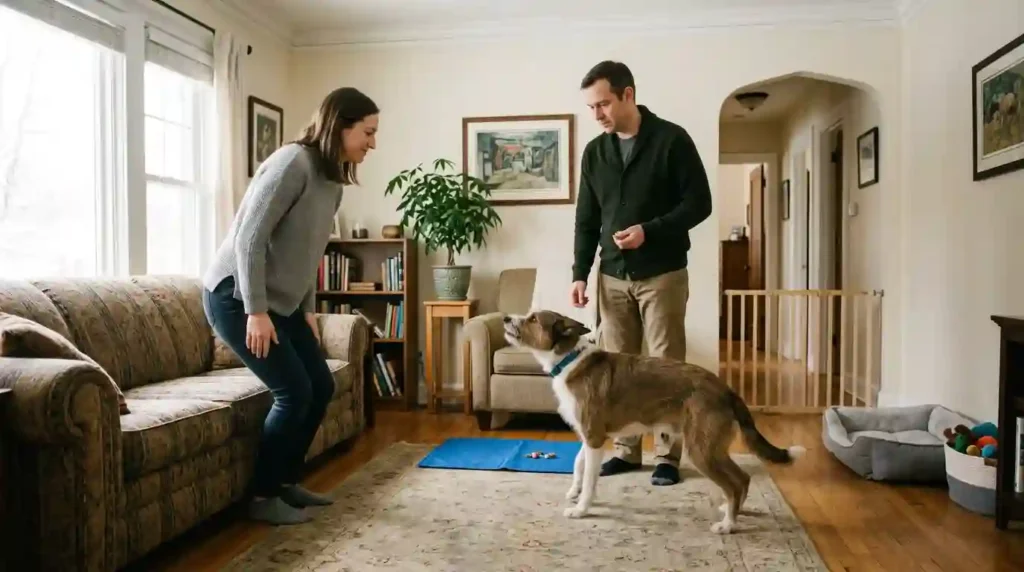
When a dog barks when someone stands up, the behavior usually has more to do with emotion than disobedience. A seated visitor may seem small and predictable, but the same person can look taller, more authoritative, and less familiar the moment they rise. That sudden movement may trigger fear, excitement, territorial barking, or a learned barking habit. The good news is that careful observation, smart management, and reward-based training can help your dog feel safer and respond more calmly. This guide explains what your dog may be communicating, how to recognize bite-risk warning signs, and how to practice a practical step-by-step plan without punishment or forced interaction.
Table of Contents
- Why a Dog Barks When Someone Stands Up
- How to Read the Body Language Around the Bark
- How to Respond When Your Dog Barks When Someone Stands Up
- A Step-by-Step Training Plan
- Common Mistakes That Can Make Barking Worse
- When to Get Professional Help
- Conclusion
- FAQs
Why a Dog Barks When Someone Stands Up
Dog barking is a form of canine communication. Your dog is not necessarily trying to dominate the room or challenge your authority. More often, the bark means, “That change concerns me,” “Please give me space,” or “I think something exciting is about to happen.”
The trigger is not always the person. It may be the transition from a seated visitor to an upright, moving figure. While sitting, a guest is relatively still and predictable. Standing up changes the person’s height, outline, direction, and proximity in a second. To a worried dog, that authoritative standing position can feel like a perceived threat.
Fear, nervousness, and a startle response
Fear is one of the most common explanations. A dog may tolerate seated visitors but react to sudden movement because it raises uncertainty. The person may lean forward, push off the couch, make eye contact, and begin walking in one quick sequence. A nervous dog can experience this guest movement as several behavioral triggers arriving at once.
This is especially likely when the dog shows anxiety, hypervigilance, or a lack of trust around strangers. Barking may be a distance-increasing behavior: the dog barks, the person pauses or moves away, and the dog experiences relief. That consequence reinforces the response. From the dog’s perspective, barking worked.
Over time, the emotional response can become a learned behavior. Visitor stands, dog barks, visitor stops—then the same pattern repeats. What began as a startle response can develop into a reliable barking habit, even when the visitor never intended to approach the dog.
Territorial barking and protective behavior
A dog may also react because the event happens within its home territory. Visitor arrival, knocking, and the doorbell can already elevate arousal. The dog may settle after everyone sits, but it has not necessarily decided the situation is safe. When someone stands, the dog may interpret the movement as renewed activity inside a space it feels responsible for monitoring.
Territorial barking and alarm barking can look similar. Both may involve a stiff body posture, focused staring, and repeated vocalization. The dog might move forward because it wants the person to leave, not because it wants contact. Protective behavior can intensify if the visitor moves toward the front door, kitchen, stairs, a child, or the dog’s favorite person.
Excitement, anticipation, and frustration
Not every bark is fearful. Some dogs connect standing up with something enjoyable: a walk, food, play, a trip outside, or attention. In that case, the behavioral trigger produces excitement rather than discomfort. The dog may bounce, wag its tail broadly, bring a toy, or run toward the door.
Frustration can appear when the dog expects an activity but cannot access it. A leash, baby gate, crate, or exercise pen may prevent the dog from following the person, causing barking that sounds intense even though the motivation is social or playful. If the barking occurs mainly during energetic interaction, this guide to Dog Barking During Play can help you distinguish playful vocalization from stress-based reactivity.
Attention-seeking and accidental reinforcement
Attention-seeking barking develops when noise reliably produces a response. If someone stands and the dog barks, people may look at the dog, repeat its name, offer reassurance, yell, or throw a treat after the barking begins. Even negative attention can function as reinforcement.
That does not mean you should ignore fear. It means you should identify the cause before deciding how to respond. A fearful dog needs distance and a safer emotional association; an excited dog may need impulse control and an alternative behavior; an attention-seeking dog needs a consistent way to earn interaction without barking.
Socialization, past experience, and individual sensitivity
Dogs with limited socialization may be less comfortable with different body types, mobility aids, clothing, voices, or movement patterns. A past negative experience can also create a negative association with a particular kind of person or action. For example, a dog may be relaxed around one familiar guest but alarmed by an unfamiliar visitor who stands quickly, reaches overhead, or walks directly toward it.
Personality and genetics matter too. Dogs bred for guarding or herding may be quick to notice movement, although breed alone never explains the whole behavior. Pain, fatigue, overstimulation, and the events of the day can lower a dog’s behavioral threshold. A reaction that appears “out of nowhere” may actually reflect accumulated stress.
How to Read the Body Language Around the Bark
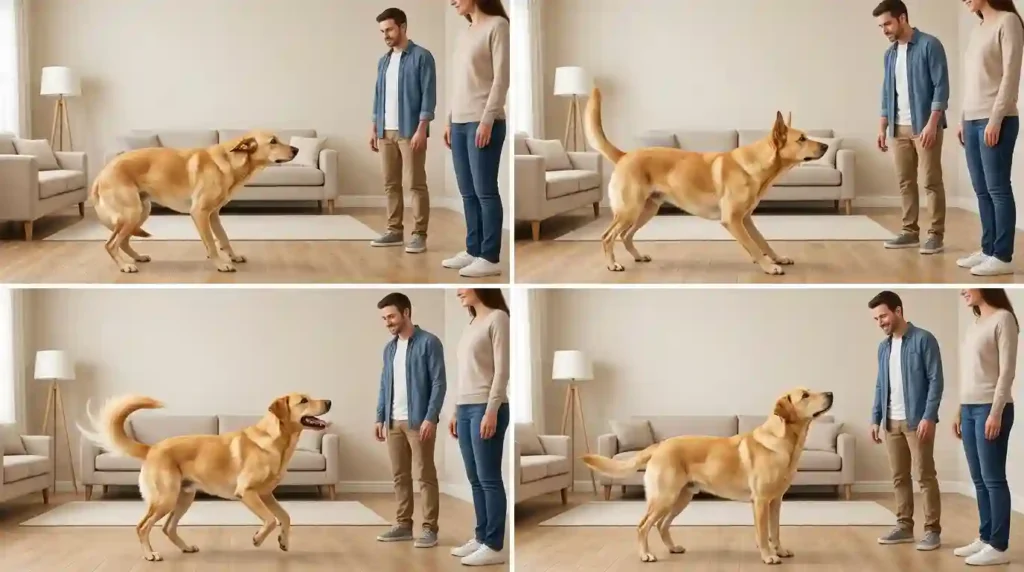
The sound of the bark matters less than the full context. Observe what happens before, during, and after the person stands. A trigger diary can reveal patterns that memory misses.
Record who stood, how quickly they moved, how far they were from the dog, what direction they walked, and whether the dog had already reacted to the doorbell or visitor arrival. Also note the dog’s arousal level, access to a safe place, and whether food, toys, sleep, pain, or household commotion may have influenced the event.
Signs the dog may be worried
Common stress signals include:
- A stiff body posture or sudden freezing
- Weight shifted backward or an attempt to retreat
- Ears held back, a tucked or rigid tail, or a closed mouth
- Lip licking, yawning, panting, trembling, or repeated scanning
- Hard staring followed by growling, lunging, snapping, or biting
- Refusal of high-value treats that the dog normally enjoys
- Barking that becomes faster or more intense as the visitor approaches
These signals suggest fear, anxiety, discomfort, or defensive reactivity. Growling is valuable information, not bad behavior to punish. Suppressing a warning can increase bite risk because the dog may learn that quieter stress signals do not work.
Signs the dog may be excited or seeking interaction
A relaxed body language pattern looks different. The dog may have a loose, wiggly body, soft eyes, a sweeping tail wag, playful movement, and an open mouth. It may bring a toy or move happily toward the person rather than trying to make them retreat.
Still, excitement can become overstimulation. Jumping, mouthing, and frantic greeting barking can overwhelm visitors or create unsafe situations around children and older adults. Calm behavior should be taught and reinforced even when the underlying emotion is friendly.
Look for other context-specific barking
Some vocal behavior occurs around predictable routines rather than people. A dog may bark before play, meals, walks, elimination, or access to the yard. If the pattern happens near bathroom trips, see Dog Barks Before Pooping for a more specific explanation. You can also explore the broader Dog Barking resource collection to compare common triggers and solutions.
How to Respond When Your Dog Barks When Someone Stands Up
Your immediate goal is safety and emotional regulation, not perfect obedience. If your dog is already over its behavioral threshold, it is not in an ideal state for learning. Reduce pressure first; train later at an easier intensity.
Create distance without drama
Ask the visitor to pause, turn slightly sideways, and avoid direct eye contact. Do not have the person lean over the dog, reach toward its head, or insist on petting. Overhead petting and forced interaction can make an uncertain dog feel trapped.
Use calm distance management. Guide the dog away with a treat toss, leash, or familiar place cue. A mat, dog bed, crate, baby gate, or separate room can provide physical separation. The safe place should not feel like punishment. Pair it with something valuable, such as a chew toy, puzzle toy, or stuffed Kong.
For noise-sensitive dogs, a white noise machine may soften the sound of conversation and movement. Some dogs also relax with a calming wrap or dog-appeasing pheromone diffuser. These tools can support environmental management, but they do not replace behavior modification.
Avoid yelling and punishment
Yelling adds sound, tension, and negative attention to an already charged event. The dog may think you are joining the alarm or may connect the visitor with punishment. Physical corrections, leash jerks, intimidation, and shock-based tools can increase fear or suppress warnings without changing the underlying emotional response.
Remain neutral and predictable. If the dog cannot recover, move it to a quiet area with something calming to do. Ending an interaction early is safer than pushing through a training session after the dog has stopped learning.
Reinforce the behavior you want
Positive reinforcement works best when it is timely. Reward the dog for noticing the visitor’s movement while remaining quiet, turning back toward you, going to its mat, or holding a sit cue, stay cue, or settle cue.
A clicker or marker word, such as “yes,” can identify the exact moment of calm behavior. Then deliver high-value treats. The sequence should be clear: visitor begins a small movement, dog remains under threshold, marker happens, food follows. This creates a positive association between human movement and good outcomes.
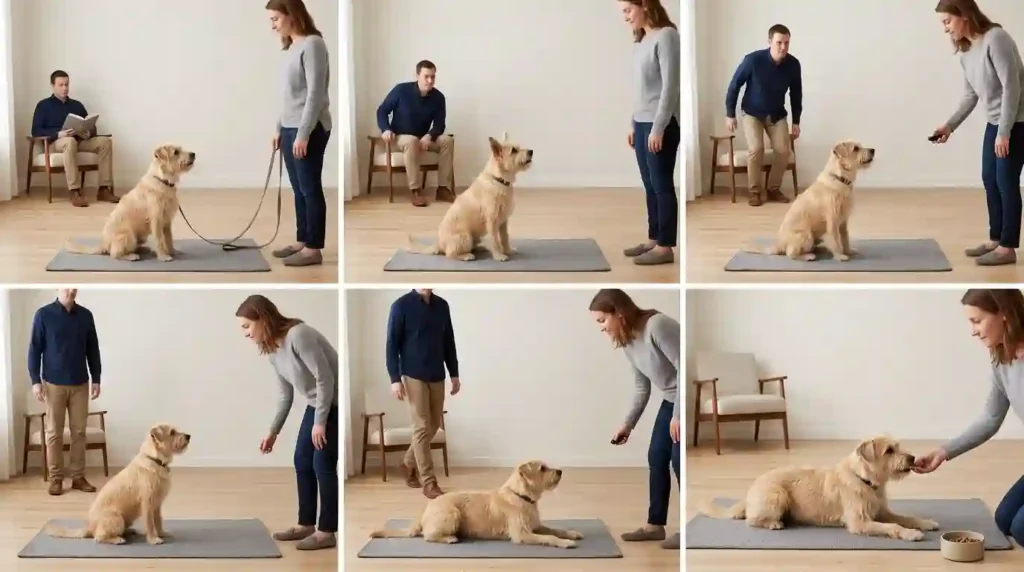
A Step-by-Step Training Plan
Practice with a trusted helper, not during a crowded party. Begin after the dog has had appropriate physical exercise and mental stimulation, but before it is exhausted. Keep the leash loose and make sure the dog has room to move away.
Step 1: Teach foundation behaviors without visitors
Start in a quiet room. Practice the dog’s name, eye contact, a place cue, sit cue, stay cue, and settle cue. Reward voluntary calm behavior on a mat or dog bed. The goal is not rigid obedience training; it is to build familiar, incompatible behavior that the dog can perform instead of barking.
Short, successful repetitions are more useful than a long session. Add enrichment between sessions so the dog’s daily needs are met. Sniffing walks, food puzzles, and appropriate chew time can reduce frustration and support impulse control.
Step 2: Find the easiest version of the trigger
Have the helper sit at a comfortable distance. The person should avoid staring at or reaching for the dog. Begin with a tiny movement, such as leaning forward slightly, rather than fully standing.
If the dog stays relaxed, use your marker word or clicker and provide a treat. If the dog stiffens, growls, or barks, the movement was too difficult. Increase distance, reduce the size of the movement, or end the repetition. Training below threshold is not “letting the dog win”; it is how desensitization remains safe and productive.
Step 3: Pair standing with high-value food
Once small movements are easy, the helper can rise only an inch from the chair. Mark and reward calm behavior. Gradually build toward a half-stand and then a full stand.
Food pairing should occur as the movement begins, before barking. Depending on the dog, you can feed several tiny treats, use treat tossing away from the visitor, or create a short treat trail toward the dog’s safe place. Treat tossing can also relieve social pressure because the dog moves away to collect food rather than being lured closer to a person it does not trust.
Step 4: Add one step of guest movement
When the dog can watch the person stand calmly, add one slow step. Then have the visitor sit again. Over repeated introductions, increase to two steps, a turn, or a short walk across the room.
Do not increase distance, speed, duration, and distraction at the same time. Gradual exposure works when only one variable becomes harder. If barking returns, make the next repetition easier.
Step 5: Practice realistic but controlled situations
Once the dog succeeds with a familiar helper, vary the chair, room, clothing, and direction of movement. Practice a controlled introduction after an outdoor greeting or short walk. Some dogs find it easier to enter the house with a guest than to watch a stranger cross the doorway.
Later, practice with seated visitors who stand to get water, walk toward the door, or move to another chair. Keep sessions brief, and use physical separation when you are not actively training. Repetition, consistency, and patience matter more than speed.
Step 6: Fade food carefully
Do not stop rewards as soon as the dog improves. First, make the behavior reliable across several easy sessions. Then vary how often food appears while continuing praise, access to a safe place, and other real-life rewards.
The final goal is not to force the dog to love every visitor. A neutral dog that can notice movement, remain calm, and disengage is successful. Confidence grows when the dog repeatedly learns that people can move without approaching, grabbing, or frightening it.
Common Mistakes That Can Make Barking Worse
Moving too quickly
If the dog barks repeatedly during practice, the exercise is too hard. Continuing at that intensity rehearses the unwanted response. Reduce the challenge until the dog can notice the movement and still eat, think, and respond.
Using food to force proximity
Do not lure a fearful dog into touching distance and then allow the visitor to pet it. Taking food does not equal consent. Use treats to change the emotional association, not to trap the dog near something it fears.
Punishing growling
Growling is a warning and a stress signal. Punishment may stop the sound while leaving fear intact. Respect the warning, increase distance, and reconsider the setup.
Letting visitors improvise
Well-meaning guests may stare, lean over the dog, extend a hand, or say, “Dogs love me.” Give clear instructions before the dog enters. Visitors should remain calm, avoid pressure, and let the dog choose whether to approach.
Expecting the quiet cue to solve fear
A quiet cue can interrupt or limit barking, but silence alone does not resolve anxiety. Pair cue training with environmental management, desensitization, and positive association work.
Practicing only during real visits
Real visitor arrival is unpredictable. The doorbell, knocking, conversation, coats, bags, and multiple people can push the dog over the threshold before training begins. Controlled practice lets you adjust the challenge and reward at the right moment.
When to Get Professional Help
Contact a qualified professional if the dog has bitten, attempted to bite, repeatedly lunges at people, guards access to family members, or cannot recover after a trigger. A Certified Professional Dog Trainer (CPDT) with experience in fear and aggression can help with a structured plan. More complex cases may require a Certified Applied Animal Behaviorist (CAAB) or a board-certified veterinary behaviorist (Dip ACVB).
Seek a veterinarian promptly when barking begins suddenly, especially in an older dog or when you notice pain, confusion, sleep changes, sound sensitivity, or unusual irritability. A medical condition can reduce tolerance for movement or handling. Treatment may involve pain control, management changes, or—in appropriate anxiety cases—medication alongside training.
For a broad overview of barking types and the importance of ruling out illness or injury, consult the ASPCA guide to barking. Professional help is particularly important when children, vulnerable adults, or frequent visitors may be exposed to a bite risk.

Conclusion
When a dog reacts to someone rising from a chair, the standing person is often a change in the environment rather than the true problem. Fear, territorial concern, excitement, frustration, past experience, and reinforcement can all influence the response. Your dog’s body language and the events surrounding the bark will tell you more than the bark alone.
Start with safety. Give the dog distance, prevent forced interaction, and use a mat, gate, crate, or separate room when necessary. Then practice small, predictable movements below the dog’s threshold. Mark’s quiet observation, pair movement with high-value food, and build toward realistic guest activity gradually.
Progress may take days for a mild barking habit or weeks to months for established fear and reactivity. Consistency matters, but so does compassion. The goal is not instant silence. It is a dog that feels safe enough to make a calmer choice when someone stands up.
FAQs
Should I ignore my dog when he barks at me?
Ignore barking only when it clearly seeks attention. Fearful, territorial, or pain-related barking requires trigger management and a safer emotional response.
What to do instead of yelling at the dog?
Stay calm, create distance, cue an easy alternative behavior, and reward quiet engagement. Yelling can increase arousal and fear.
What do vets recommend to stop barking?
Veterinarians generally recommend identifying the cause, ruling out medical problems, using reward-based training, and seeking behavior support for serious reactivity.
Is barking when someone stands up a sign of aggression?
Not always. It may reflect fear, excitement, frustration, or alarm, but lunging, snapping, hard staring, and biting warrant professional assessment.
How long will training take?
Mild cases may improve within a few weeks; entrenched fear can take months. Short sessions, gradual exposure, and consistency produce the safest progress.