
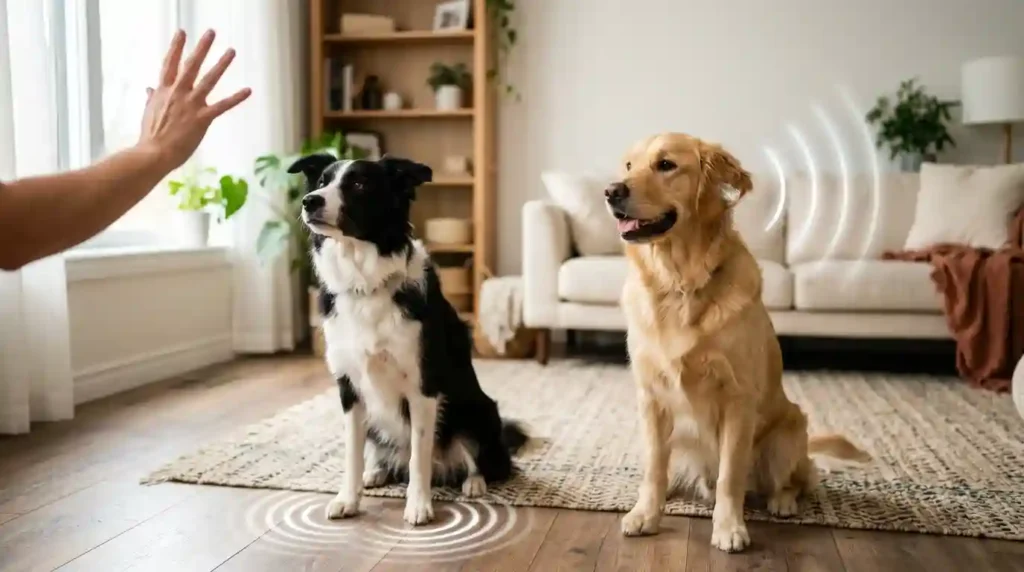

Summary
Deafimarily because they cannot hear all or part of their own vocalizations. Without normal auditory feedback, some deaf dogs have difficulty regulating bark volume, pitch, duration, and rhythm. Deafness also changes which environmental signals trigger barking. A hearing dog may react to a doorbell, thunder, or another dog barking, while a deaf dog may respond more strongly to movement, vibration, light, scent, routine changes, or visual social cues.
These differences are not universal. Some deaf dogs have ordinary-sounding barks, some become louder or more repetitive, and others bark less because they do not hear common sound-based triggers. Breed, body size, temperament, training history, emotional state, and the type of hearing loss also affect how a dog vocalizes.
Table of Contents
- Why deafness can change a dog’s bark
- How canine barking and auditory feedback work
- Common differences in a deaf dog’s bark
- Barking triggers in deaf and hearing dogs
- Congenital deafness versus acquired hearing loss
- What a different bark can and cannot reveal
- How to identify the reason for barking
- Training methods for excessive barking
- When to seek veterinary or professional help
- Frequently asked questions
Why Deaf Dogs Bark Differently Than Hearing Dogs: The Core Reasons
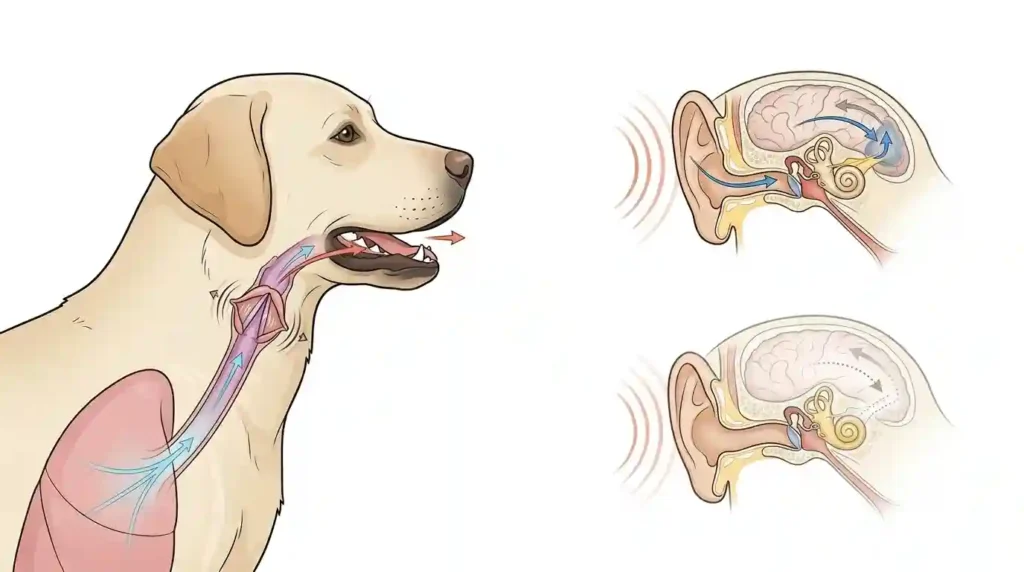
A dog does not need to hear in order to bark. Barking is produced physically through the respiratory system and larynx, not through the ears. Air moves from the lungs through the larynx, causing the vocal folds to vibrate. The throat, mouth, tongue, and surrounding structures then shape the resulting sound.
Hearing, however, gives a dog information about the sound being produced. A hearing dog can detect its own bark and receive immediate feedback about its loudness, pitch, timing, and repetition. A deaf dog may receive little or none of that acoustic information.
That difference can influence vocal control, but it is only part of the explanation. Deafness also changes how a dog perceives its surroundings, responds to other animals, and learns which behaviors attract attention.
Auditory feedback helps regulate vocalization
Auditory feedback is the process of hearing and monitoring one’s own voice. In humans, a sudden reduction in auditory feedback often changes speaking volume or vocal control. A comparable principle may contribute to vocal differences in dogs, although direct research comparing the acoustic structure of deaf and hearing dogs’ barks remains limited.
A dog with normal hearing can potentially notice that a bark is loud, sharp, prolonged, or followed by barking from another dog. A profoundly deaf dog cannot make the same sound-based comparison. As a result, some deaf dogs produce vocalizations that owners describe as unusually loud, high-pitched, muffled, prolonged, or inconsistent.
The important word is “some.” Deafness does not create a single, recognizable bark shared by every deaf dog.
Deafness changes the dog’s trigger environment
Hearing dogs constantly receive auditory information. Footsteps in a hallway, a delivery vehicle, a closing gate, wildlife outside, another dog whining, or a family member approaching can all cause barking.
A deaf dog may not detect those sounds. Instead, the dog may rely more heavily on:
- Movement in windows or doorways
- Changes in light and shadows
- Floor or furniture vibrations
- Scent
- Air movement
- The behavior of other household animals
- Human facial expressions and gestures
- Predictable routines
This means a deaf dog may remain quiet during a thunderstorm but bark intensely when headlights move across a wall. The bark itself may sound different, but the context in which it occurs may be even more distinctive.
Social feedback is different
Dogs learn partly by observing how people and other animals respond to their behavior. A hearing puppy may bark, hear another dog respond, pause, and then adjust its behavior. A deaf puppy can still see the other dog’s posture and movement, but it misses the auditory part of the interaction.
Human responses matter as well. Suppose a deaf dog barks and the owner immediately enters the room, waves, touches the dog, offers food, or begins playing. The dog may learn that barking reliably produces attention. Because the dog cannot hear how intense or repetitive the bark has become, the behavior may continue longer than the owner expects.
Emotional arousal affects the bark
Excitement, frustration, fear, isolation, anticipation, and play can all change canine vocalizations. Deaf dogs experience these emotional states just as hearing dogs do.
A dog that cannot locate a family member by sound may become frustrated and bark while searching. A deaf dog that wakes unexpectedly may vocalize from surprise. Another may bark during play because movement and physical contact have increased arousal.
The emotional cause often explains more about a bark than deafness alone.
How a Deaf Dog’s Bark May Sound Different
Owners often describe recognizable differences in their deaf dogs’ vocalizations. These observations are useful, but they should not be treated as a diagnostic test. Bark characteristics vary substantially among individual dogs.
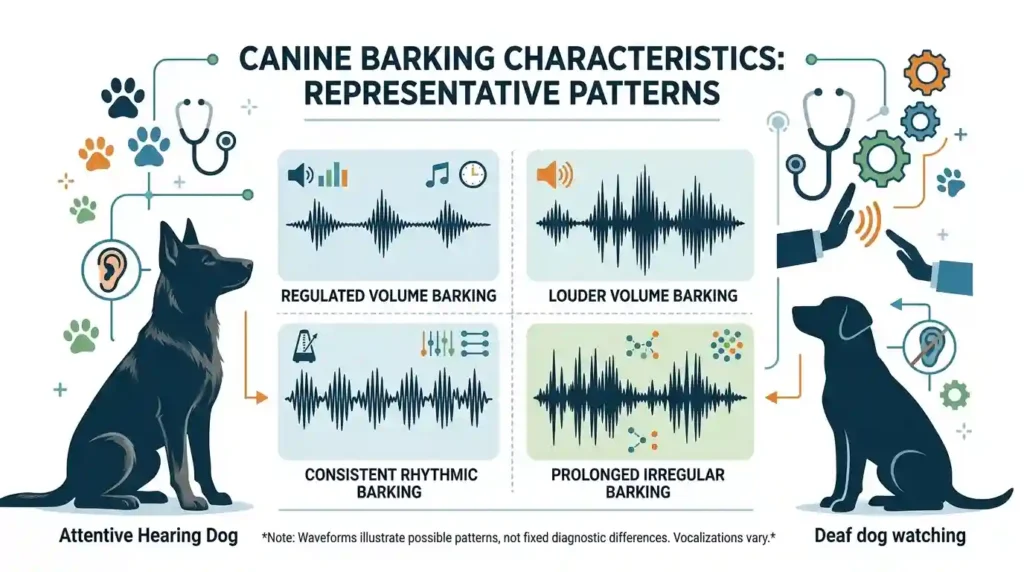
Louder or poorly regulated volume
One of the most commonly reported differences is excessive volume. A deaf dog may bark with greater force because it cannot hear the intensity of its own voice.
The dog is not necessarily trying to be disruptive. From its perspective, the bark does not produce the same sensory experience that it produces for a hearing dog. A dog with partial hearing may also increase its vocal effort in an attempt to obtain auditory feedback.
Loudness is still influenced by anatomy. A large, deep-chested dog will naturally sound different from a small terrier, regardless of hearing status.
Unusual or inconsistent pitch
Some deaf dogs produce higher, flatter, rougher, or less consistent pitches. A bark may begin sharply and then drift, or a dog may alternate between barking, whining, squealing, and howling.
Possible influences include:
- Limited auditory self-monitoring
- Breed and body size
- Degree of residual hearing
- Emotional intensity
- Age
- Previous vocal learning
- Laryngeal structure
A strange pitch should not automatically be attributed to deafness. Sudden hoarseness, coughing, gagging, labored breathing, or an abrupt change in voice warrants veterinary attention.
Longer barking episodes
A hearing dog may stop barking after hearing the owner’s voice, another dog’s response, or the disappearance of a sound. A deaf dog cannot respond to a verbal interruption that it does not perceive.
This can make a barking episode seem unusually long. The dog may continue until it sees a person, feels a vibration, notices a visual cue, or becomes physically calmer.
Different rhythm and spacing
Some deaf dogs bark in repetitive bursts with little variation. Others produce isolated, forceful barks or vocalize with irregular pauses.
Hearing dogs can coordinate vocal exchanges using sound. One dog barks, listens, and then responds again. A deaf dog may rely on visible movement instead, so the timing of its barking may not match the auditory exchange occurring around it.
More whining, howling, or mixed vocalization
Barking is only one form of canine communication. Deaf dogs may also whine, grunt, yelp, howl, or make blended sounds, especially during high arousal.
A deaf dog that cannot hear another dog howl may be less likely to join a sound-triggered chorus. However, the same dog may howl during isolation, frustration, excitement, or an established routine.
Why Deaf Dogs Bark Differently Than Hearing Dogs in Daily Situations
The difference between deaf and hearing dogs is often most noticeable when owners examine what happens immediately before and after the barking.
Alert barking
A hearing dog may alert to a knock, doorbell, vehicle, or unfamiliar voice. A deaf dog may not notice any of these sounds.
However, the deaf dog might react to:
- A person appearing suddenly
- A moving curtain
- Reflections on a window
- Vibrations from a door closing
- Another dog is becoming tense
- A change in household movement
Because the dog may notice the event later than everyone else, its reaction can appear abrupt or intense.
Attention-seeking barking
Deaf dogs quickly learn which actions make people look at them. Barking can become an effective attention signal, particularly when an owner responds consistently.
Attention-seeking barking may occur when the dog wants food, play, access to a room, physical contact, or help locating a family member. The dog may repeat the bark because it cannot hear how often it has vocalized.
Owners should avoid unintentionally rewarding every demand bark. That does not mean ignoring genuine needs. It means teaching a clear, quieter replacement behavior, such as sitting on a mat, making eye contact, touching a target, or bringing a toy.
Frustration barking
Communication failures can create frustration. A deaf dog may see an owner moving but not understand why the person has turned away. The dog may also become frustrated when separated by a gate, unable to follow another animal, or uncertain about a changing routine.
Frustration barking is often accompanied by pacing, jumping, pawing, spinning, scratching, or repeated attempts to regain visual contact.
Separation-related barking
Deafness does not automatically cause separation anxiety. Still, some deaf dogs depend heavily on visual proximity to their caregivers. When the person disappears, the dog cannot use footsteps or a familiar voice to determine where the person has gone.
A camera can help distinguish occasional barking from persistent distress. Warning signs of a separation problem include prolonged vocalization, frantic pacing, destructive escape behavior, heavy panting, drooling, elimination, or refusal to eat when alone.
Play and excitement barking
Many deaf dogs are highly expressive during play. They may bark when chasing another dog, anticipating a toy, greeting a family member, or participating in a familiar game.
This is not necessarily a problem. Play barking becomes concerning when arousal repeatedly escalates into rough behavior, the dog cannot disengage, or other animals are showing avoidance signals.
Reactive barking around animals
A deaf dog may miss growls, warning barks, or other auditory signals from nearby animals. The dog must depend more heavily on posture, facial tension, movement, scent, and prior experience.
Owners should create distance before the dog becomes overwhelmed and reward calm visual check-ins. Similar principles apply when managing Dog Barking at Other Animals in Pet Stores, where close aisles, unfamiliar smells, restricted movement, and visual exposure can intensify reactivity.
Congenital Deafness Versus Acquired Hearing Loss
The age at which hearing is lost can influence vocal behavior.
Dogs born deaf
A congenitally deaf puppy develops without normal auditory feedback. The puppy can still bark instinctively, but it may not hear its mother, littermates, people, or its own voice.
These dogs often learn communication through:
- Body movement
- Facial expressions
- Touch
- Visual gestures
- Routine
- Scent
- Vibration
- The behavior of other dogs
Because they have never experienced normal hearing, their barking style may develop differently from the beginning. Some produce unusual-sounding vocalizations, while others sound much like hearing dogs.
Congenital deafness can affect one ear or both ears. A unilaterally deaf dog still has auditory input through the functioning ear and may show few obvious signs.
Dogs that lose hearing later
A dog with acquired hearing loss has already heard its own bark and learned sound-based communication. Early in the hearing-loss process, its vocalization may remain unchanged.
As hearing declines, owners may notice:
- Louder barking
- More frequent barking
- Failure to stop after verbal correction
- Barking when apparently disoriented
- Increased startle responses
- Vocalization during sleep or at night
- Reduced response to familiar sounds
Senior dogs may also experience pain, vision loss, sleep disruption, or canine cognitive dysfunction. Those conditions can contribute to vocal changes independently of hearing loss.
Partial and frequency-specific hearing loss
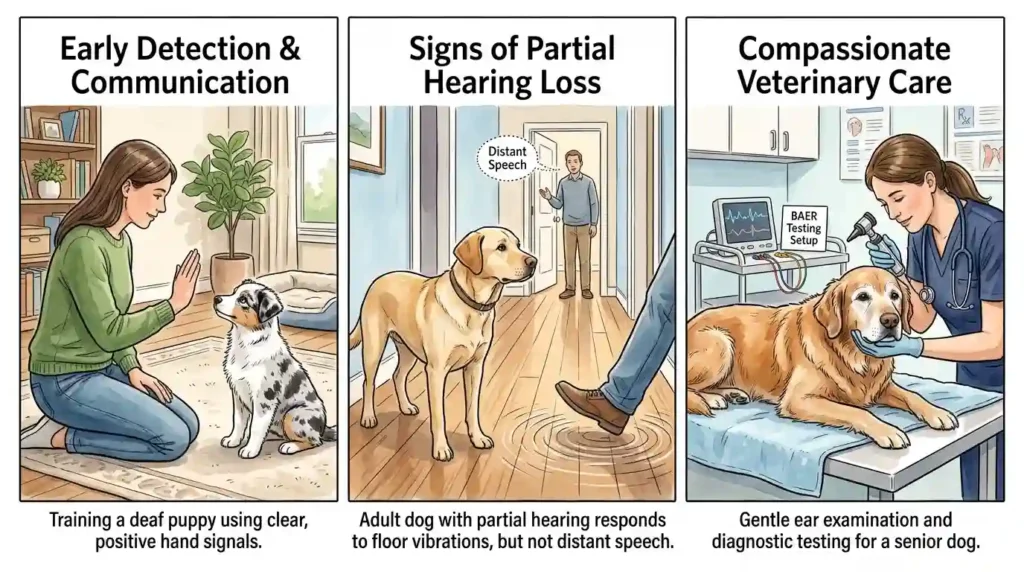
Deafness is not always complete. Some dogs can detect certain frequencies or louder sounds while missing others. A dog may respond to a deep clap or floor vibration but not to speech.
Because residual hearing varies, two dogs described as deaf can have very different reactions and vocal patterns.
Confirming deafness with a BAER test
Behavioral observations can suggest hearing loss, but do not reliably determine its severity. A dog may ignore a sound because it is asleep, distracted, anxious, or accustomed to the noise.
The brainstem auditory evoked response test, commonly called a BAER test, records electrical activity along the auditory pathway after sounds are delivered through earphones. It can evaluate each ear separately and help identify unilateral or bilateral deafness.
The Merck Veterinary Manual’s overview of deafness in dogs notes that increased barking and voice changes can be associated with canine deafness. A veterinarian can determine whether formal hearing testing or treatment for an underlying ear condition is appropriate.
What a Different Bark Can and Cannot Tell You
A distinctive bark can support an owner’s suspicion that a dog is not hearing normally, but it cannot diagnose deafness.
Bark quality is affected by many factors:
- Breed and genetic background
- Body size
- Shape of the skull and airway
- Age
- Sex
- Excitement level
- Fear or pain
- Learned behavior
- Respiratory health
- Laryngeal disease
- Social environment
A deaf dog can have a completely ordinary bark. A hearing dog can have an unusually loud, flat, repetitive, or high-pitched bark.
The most useful signs of hearing loss involve responses to sound. Owners may notice that a dog no longer wakes when called, fails to orient toward noises, sleeps more deeply, does not move its ears toward sound, or appears surprised when approached.
Avoid testing the dog’s hearing by creating extremely loud noises close to the dog. This can frighten the animal, harm residual hearing, and produce misleading reactions to air movement or vibration.
How to Identify the Reason Behind a Deaf Dog’s Barking
Before trying to stop barking, determine what the dog is communicating. Treating every bark as disobedience can increase stress and obscure the actual cause.
Observe the complete body language
Look beyond the mouth and listen less to the sound itself. A dog’s posture often reveals the emotional state behind the bark.
Signs of relaxed excitement may include:
- Loose muscles
- Curved body movement
- Play bows
- An open mouth
- Bouncy movement
- Voluntary return to the owner
Signs of stress or fear may include:
- A lowered or tightly held body
- Weight shifted backward
- Repeated lip licking
- Panting without heat or exercise
- Pacing
- Trembling
- Dilated pupils
- Attempts to hide or escape
- Inability to take food
A stiff body, fixed stare, closed mouth between barks, raised posture, or repeated lunging can indicate a need for immediate distance and careful professional assessment.
Record the antecedent and consequence
Keep a simple barking log for several days. Record:
- What occurred immediately before the barking
- Where the dog was positioned
- Who or what was present
- The dog’s visible body language
- How long did the episode last
- What people did in response
- What caused the barking to stop
Patterns usually become clearer when the behavior is documented rather than recalled from memory.
For example, a dog may appear to bark randomly every evening. A written log may reveal that the barking begins when outdoor shadows cross a particular window or when the owner starts preparing to leave the room.
Use video when the dog is alone
A camera is especially helpful for nighttime or separation-related barking. It may show that the dog is reacting to headlights, another pet’s movement, discomfort, or the disappearance of a caregiver.
Video also allows a veterinarian or qualified behavior professional to evaluate body language that may not be visible when an owner enters after hearing the bark.
Rule out medical causes
Arrange a veterinary examination when barking changes suddenly or is accompanied by:
- Ear discharge, odor, redness, or scratching
- Head shaking
- Head tilt or balance problems
- Coughing, gagging, or voice loss
- Labored breathing
- Pain or reluctance to move
- Nighttime confusion
- House-soiling changes
- Altered appetite or thirst
- New irritability
- Significant sleep disruption
Ear infections, neurologic conditions, pain, laryngeal disorders, and age-related cognitive changes can all affect vocal behavior.
How to Reduce Excessive Barking in Deaf Dogs
Training should focus on communication, emotional regulation, and replacement behaviors. Punishment does not teach a dog what to do instead and may increase fear, frustration, or defensive behavior.
Teach a visual “quiet” cue
Begin when the dog is only mildly excited, not during the most intense barking episode.
- Allow one or two barks.
- Present a clear visual cue, such as placing one finger gently in front of your lips.
- The moment the dog pauses, mark the pause with a visual signal. A thumbs-up gesture can serve as a visual marker.
- Deliver a small reward.
- Repeat in short sessions.
- Gradually reward longer periods of quiet.
The visual cue should be consistent across household members. It must also be given where the dog can see it.
Avoid waving hands rapidly or moving toward the dog in a threatening manner. Those actions can increase arousal.
Build voluntary visual check-ins
Reward the dog whenever it looks toward you voluntarily. Frequent check-ins make communication easier because you do not have to chase, touch, or startle the dog to gain attention.
Practice in quiet rooms before adding distractions. Over time, the dog learns that looking toward the handler produces useful information and positive outcomes.
Teach a calm replacement behavior
A replacement behavior gives the dog a specific action that is incompatible with continuous barking.
Useful options include:
- Going to a mat
- Sitting and making eye contact
- Touching the owner’s hand
- Retrieving a toy
- Lying down
- Moving behind a visual barrier
- Entering a quiet resting area
Reward the replacement behavior generously at first. Once it is established, practice it around low-level versions of the barking trigger.
For persistent, rehearsed behavior, the principles described in How Professional Trainers Stop Compulsive Barking can help owners understand trigger management, reinforcement patterns, and structured behavior modification.
Manage visual and vibration triggers
Training is more effective when the dog is not repeatedly pushed beyond its coping ability.
Depending on the trigger, management may include:
- Applying privacy film to lower windows
- Closing curtains during busy periods
- Moving the resting area away from the doors
- Placing a mat beneath furniture to reduce vibration
- Using baby gates to create a comfortable distance
- Preventing unsupervised fence-line barking
- Giving the dog a quiet room during visitors
- Maintaining a predictable daily routine
Management is not a failure. It prevents repeated rehearsal while new habits are being taught.
Provide appropriate physical and mental activity
Understimulation can contribute to attention-seeking and repetitive barking. Deaf dogs benefit from the same species-appropriate activities as hearing dogs, including sniffing, exploration, play, food-search games, and positive training.
Useful activities include:
- Snuffle mats
- Treat searches
- Food-dispensing toys
- Scent trails
- Short-hand signal training sessions
- Controlled tug games
- Decompression walks
- Safe social play with compatible dogs
Exercise should match the dog’s age, health, and physical condition. More activity is not always better. An overtired or highly aroused dog may bark more.
Address separation distress carefully
Do not use a “cry it out” approach when a dog is showing panic. Repeated exposure to overwhelming isolation can intensify the problem.
Instead, work below the dog’s distress threshold. Practice very brief departures, return before panic begins, and increase duration gradually. Visual departure cues may need to be desensitized because a deaf dog can become highly observant of shoes, keys, bags, and movement toward the door.
Moderate or severe separation distress should be discussed with a veterinarian or qualified separation-anxiety professional. Medication may be appropriate when anxiety prevents learning.
Introduce tactile or vibration cues positively
Some owners use a gentle floor tap, light touch, or conditioned vibration device to gain a deaf dog’s attention. The cue must predict something safe and positive.
A vibration collar should never be assumed to be harmless simply because it does not deliver an electric shock. An unexpected vibration can frighten a dog if it has not been introduced through careful conditioning. It should be used only as an attention signal, not as punishment for barking.
Avoid startling the dog
Approach within the dog’s visual field whenever possible. To wake a sleeping deaf dog, create a gentle floor vibration, move nearby bedding, or place a treat close enough for the scent to reach the dog.
Repeatedly grabbing or touching a sleeping dog can create defensive responses. Family members, visitors, and children should understand how to approach safely.

When to Seek Professional Help
Seek veterinary or behavioral assistance when barking is sudden, severe, escalating, or associated with distress.
Professional help is particularly important when the dog:
- Panics when left alone
- Cannot settle or sleep
- Injures itself during barking episodes
- Shows aggression or intense defensive behavior
- Has a sudden change in voice
- Displays signs of pain or illness
- Becomes confused, especially at night
- Does not improve with consistent management
- Creates a serious household or neighborhood problem
Begin with a veterinarian to rule out medical causes and evaluate hearing. Depending on the findings, the veterinarian may recommend a veterinary behaviorist or a reward-based trainer experienced with deaf dogs.
A trainer should be able to explain the purpose of each technique, identify measurable goals, and avoid methods based on intimidation, pain, or startling the dog.
Conclusion
Deafness can influence a dog’s bark by removing some or all of the auditory feedback used to monitor vocalization. It can also change the signals that cause barking and the way a dog communicates with people and other animals.
Some deaf dogs bark more loudly, use unusual pitches, or continue vocalizing for longer periods. Others bark less because they do not hear doorbells, traffic, storms, or neighboring animals. Many sound no different from hearing dogs.
The most accurate interpretation comes from considering the whole dog: hearing ability, breed, age, physical health, emotional state, body language, environment, and learning history. A different bark is a clue, not a diagnosis.
With visual communication, predictable routines, trigger management, positive reinforcement, and appropriate veterinary support, deaf dogs can learn excellent barking control and communicate successfully with their families.
Frequently Asked Questions
Do deaf dogs know they are barking?
Deaf dogs understand the physical action and consequences of barking, even when they cannot hear the resulting sound. They can feel muscular movement and vibration, see people react, and learn that barking produces attention or access to something they want.
A profoundly deaf dog may not understand the bark’s volume or acoustic quality in the same way a hearing dog does.
Do all deaf dogs bark loudly?
No. Some deaf dogs bark loudly, while others have average or quiet vocalizations. Bark volume depends on residual hearing, anatomy, breed, emotional arousal, learning history, and individual temperament.
A dog that loses hearing gradually may begin barking more loudly as auditory feedback declines, but this does not happen in every case.
Can a dog’s bark confirm that it is deaf?
No. Bark sound alone cannot diagnose hearing loss. Many hearing dogs have unusual barks, and many deaf dogs sound typical.
A veterinary examination and BAER test provide more reliable information about whether one or both ears can detect sound.
Why does my deaf dog bark at nothing?
The dog may be reacting to information that is not obvious to you, including vibration, scent, reflected light, movement outside, another animal’s posture, discomfort, or anticipation of a routine.
Record the behavior on video and keep a trigger log. Veterinary assessment is advisable when the barking begins suddenly, occurs with confusion, or regularly disrupts sleep.
Do deaf dogs bark less than hearing dogs?
Some do. A deaf dog may not react to common auditory triggers such as doorbells, sirens, voices, thunder, or other dogs barking.
Other deaf dogs bark more because of visual reactivity, frustration, attention-seeking, uncertainty, or difficulty recognizing that a barking episode has produced a response.
Can deaf puppies learn not to bark excessively?
Yes. Deaf puppies can learn through hand signals, body language, visual markers, touch, routine, and positive reinforcement. Training should reward quiet behavior and teach a clear alternative, such as looking at the owner or going to a mat.
Early socialization and consistent household signals make communication easier.
Is a deaf dog more likely to be aggressive?
Deafness itself does not make a dog aggressive. However, a deaf dog may be startled by an unexpected touch or become defensive when it cannot predict an approach.
Safe handling, visual communication, positive associations, and teaching people not to disturb a sleeping dog abruptly can reduce these risks.
How can I get a deaf dog’s attention without frightening it?
Use a cue that has been positively conditioned, such as a gentle floor tap, a light flashed indirectly, a broad hand movement within the dog’s visual field, or a gentle touch when the dog is already aware of your presence.
Reward the dog after the cue so it develops a positive meaning. Avoid throwing objects, rushing toward the dog, or using intense vibration as punishment.
Can hearing loss cause nighttime barking in senior dogs?
Hearing loss may contribute, particularly when a senior dog becomes uncertain about where family members are. However, nighttime barking can also be related to pain, vision loss, urinary needs, sleep disruption, medication effects, or canine cognitive dysfunction.
A new nighttime vocalization pattern in an older dog should be evaluated by a veterinarian.
Will training change the sound of a deaf dog’s bark?
Training may reduce bark frequency, duration, and emotional intensity, but it may not change the dog’s natural pitch or vocal quality. The primary goal is functional communication and emotional comfort, not making the dog sound like a hearing dog.