
Summary
Dog barking at other animals in pet stores is usually a sign that your dog is overwhelmed, excited, fearful, frustrated, under-socialized, or unsure how to behave around unfamiliar animals in a busy indoor environment. Pet stores can be intense places for dogs because they combine tight aisles, strange smells, squeaky toys, small animals, other leashed dogs, carts, people, food, and high-pitched sounds. The good news is that barking in this setting can often be reduced with patient training, better leash handling, distance management, positive reinforcement, desensitization, and a clear understanding of your dog’s body language.
Table of Content
- Why Dogs Bark at Other Animals in Pet Stores
- Common Triggers Behind Dog Barking at Other Animals in Pet Stores
- Understanding Your Dog’s Body Language
- Is the Barking Fear, Excitement, or Frustration?
- How to Prepare Before Visiting a Pet Store
- Step-by-Step Training Plan for Pet Store Barking
- Mistakes That Make Barking Worse
- When to Leave the Pet Store
- How Puppies, Adult Dogs, and Senior Dogs React Differently
- Conclusion
- FAQs
Why Dogs Bark at Other Animals in Pet Stores
Pet stores are exciting, crowded, and sensory-rich spaces. For many dogs, they are not just shopping locations. They are environments full of unfamiliar animals, strong scents, narrow walking paths, reflective surfaces, crinkly bags, squeaky toys, birds, cats, hamsters, rabbits, fish tanks, other dogs, and people who may want to interact.
When a dog starts barking at other animals in a pet store, many owners immediately assume the dog is being “bad” or “aggressive.” In reality, barking is communication. Your dog may be saying, “I am excited,” “I am worried,” “I want to get closer,” “I need space,” or “I do not know what to do.”
The first step is to stop seeing barking as disobedience and start seeing it as information. Once you understand what your dog is communicating, you can respond in a way that helps instead of accidentally making the behavior stronger.
Dogs bark at animals in pet stores for several common reasons:
- They are overstimulated by the environment.
- They have not been properly socialized with other species.
- They are frustrated because the leash prevents them from approaching.
- They are fearful of unfamiliar movement, sounds, or smells.
- They have a strong prey drive toward small animals.
- They are reactive around other dogs.
- They are practicing a learned behavior that has worked before.
For more dog barking behavior guides, visit the Dog Barking category.
Common Triggers Behind Dog Barking at Other Animals in Pet Stores
Dog barking at other animals in pet stores often happens because the environment combines multiple triggers at once. A dog that behaves calmly on a sidewalk may suddenly bark indoors because the pet store feels tighter, louder, and less predictable.
Other Dogs on Leashes
Leash reactivity is one of the most common reasons dogs bark in pet stores. When two leashed dogs meet in a narrow aisle, neither dog has much freedom to move naturally. This can create tension.
A dog may bark because it wants to greet the other dog. Another may bark because it wants the other dog to move away. Some dogs bark because they feel trapped between shelving, carts, and people.
A tight leash can make this worse. When an owner pulls back sharply, the dog may feel more restricted and more defensive. Over time, the dog learns that seeing another dog in a store predicts tension, pulling, and frustration.
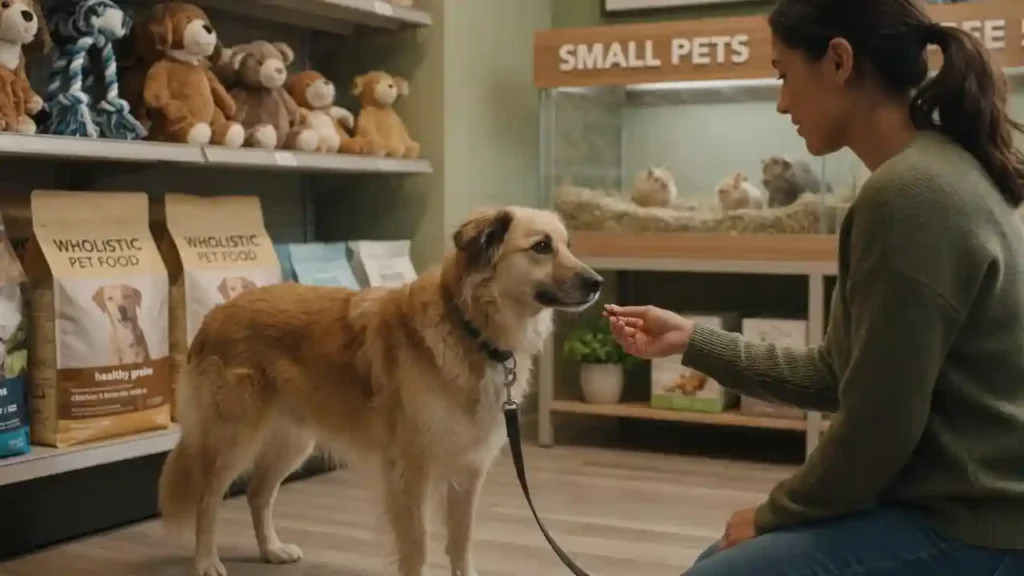
Small Animals in Cages
Pet stores often have rabbits, guinea pigs, hamsters, mice, birds, reptiles, or cats. These animals may move quickly, make sudden sounds, or smell very different from anything your dog normally encounters.
For dogs with high prey drive, small animal movement can trigger intense staring, whining, lunging, barking, or fixating. This does not necessarily mean your dog is aggressive toward people or other dogs. It means your dog’s natural chase instinct has been activated.
Breeds originally developed for hunting, herding, or terrier work may be especially sensitive to small, fast-moving animals.
Birds and High-Pitched Sounds
Birds can be particularly exciting or confusing for dogs. Flapping wings, chirping, hopping, and cage movement can trigger barking. Some dogs are startled by the sound. Others are fascinated by the movement.
If your dog barks at birds in a pet store, avoid standing close to the bird area while trying to “make your dog get used to it.” That can push your dog over the threshold and make future visits worse.
Cats in Adoption Areas
Some pet stores host cat adoption events or have cat enclosures. Dogs that rarely see cats may become alert, excited, fearful, or predatory. A dog that lives peacefully with one household cat may still react to unfamiliar cats in a store because the context is different.
The best approach is distance. Let your dog notice the cat from far enough away that your dog can still take treats, respond to cues, and disengage.
Strong Smells and Food Displays
Pet stores are full of scent. Dog treats, chews, bones, kibble, cat food, animal bedding, grooming products, and other pets all create a scent-heavy environment. Dogs process the world through smell, so the store may feel emotionally intense before another animal even appears.
A dog that is already aroused by smell may be more likely to bark when another animal comes into view.
Understanding Your Dog’s Body Language
Before you can fix barking, you need to read what happens before the bark. Most dogs show subtle signs of stress, excitement, or fixation before they become loud.
Watch for these early signals:
- Stiff body posture
- Forward-leaning stance
- Closed mouth
- Hard staring
- Raised hackles
- High tail carriage
- Low tucked tail
- Whale eye
- Lip licking
- Yawning
- Panting when not hot
- Pulling toward or away from an animal
- Sudden refusal to take treats
- Whining or trembling
These signs tell you your dog is approaching the threshold. Threshold is the point where your dog becomes too emotionally activated to think clearly or respond well to cues.
A dog under threshold can notice another animal and still listen. A dog over threshold may bark, lunge, ignore treats, and become difficult to redirect.
The goal is not to wait until your dog barks and then correct the barking. The goal is to notice the earlier signs and help your dog succeed before barking begins.
Calm Curiosity vs. Fixation
A calm dog may glance at another animal, sniff the air, and then look back at you. That is healthy curiosity.
A fixated dog may freeze, stare, lean forward, ignore food, and become still before exploding into barking. Fixation is a warning sign. When you see it, increase the distance immediately.
Why Treat Refusal Matters
If your dog usually loves treats but refuses them in a pet store, that is useful information. It often means your dog is too stressed, excited, or distracted. Do not assume your dog is being stubborn. Move farther away from the trigger and try again.
High-value rewards such as small pieces of chicken, cheese, freeze-dried meat, or soft training treats may work better than regular kibble in difficult environments.
Is the Barking Fear, Excitement, or Frustration?
Not all barking has the same emotional cause. The training plan depends on why your dog is barking.
Fear-Based Barking
Fearful barking often sounds sharp, intense, or defensive. The dog may back away, tuck its tail, crouch, raise hackles, or bark while trying to create distance.
A fearful dog should never be forced closer to the animal. Flooding, which means overwhelming the dog with too much exposure, can make fear worse. Instead, use distance and counter-conditioning.
Counter-conditioning means changing your dog’s emotional response. For example, your dog sees a rabbit from far away and immediately receives a tasty treat. Over time, your dog learns that seeing the rabbit predicts something good.
Excitement Barking
Some dogs bark because they are thrilled. They want to meet every dog, sniff every cage, and investigate every sound. Excitement barking may come with a wagging tail, bouncing, whining, spinning, or pulling forward.
This type of barking still needs training. A friendly dog can still overwhelm other animals, customers, and staff. The goal is to teach calm observation, polite walking, and impulse control.
Frustration Barking
Frustration barking happens when your dog wants access but cannot get it. The leash, cart, glass enclosure, or your body prevents the dog from moving closer.
This is common in social dogs that are used to greeting other dogs freely. When they cannot greet, they bark out of frustration.
The solution is not to let the dog greet every animal. That can reward the barking. Instead, teach your dog that calm behavior earns movement, treats, praise, or permission to continue walking.
Predatory Barking or Fixation
Some dogs become intensely focused on small animals. They may lower their body, stare, tremble, whine, bark, or lunge. This can be driven by prey drive rather than fear or social interest.
Predatory behavior needs careful management. Do not allow your dog to approach cages, sniff small animals, or rehearse stalking behavior. Keep distance, use strong leash control, and reward disengagement.
For humane, science-based training principles, the American Veterinary Society of Animal Behavior offers helpful guidance on reward-based training and behavior modification through its position statements on humane dog training.
How to Prepare Before Visiting a Pet Store
The best training starts before you enter the store. If your dog is already overexcited in the parking lot, the store visit will likely be difficult.
Choose the Right Time
Visit during quiet hours. Avoid weekends, adoption events, holiday sales, and busy evenings. A calm weekday morning is usually better for training.
The goal is not to test your dog in the hardest situation. The goal is to build success gradually.
Exercise First, But Do Not Exhaust Your Dog
A short walk before the visit can help reduce excess energy. However, do not over-exercise your dog to the point of exhaustion. A tired dog can become irritable, impatient, or less able to cope with stress.
Aim for balanced physical and mental activity before entering the store.
Bring Better Rewards
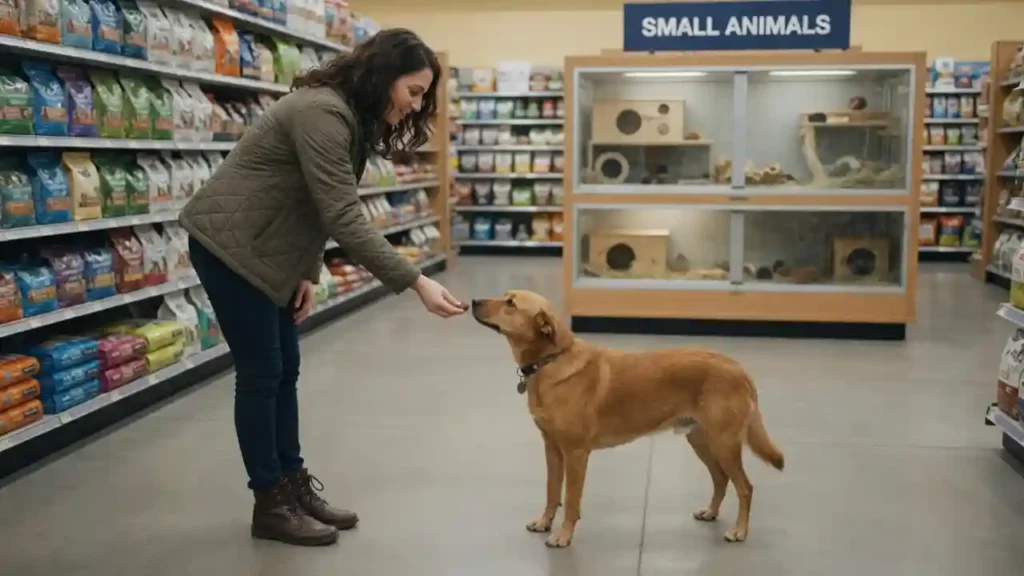
Pet stores are highly distracting. Bring treats that are more valuable than what you use at home. Use small, soft pieces that your dog can eat quickly.
Good options may include:
- Cooked chicken
- Turkey pieces
- Freeze-dried liver
- Soft training treats
- Low-fat cheese pieces
- Dog-safe meat rolls
Keep treats ready before your dog sees another animal. Timing matters.
Use Proper Equipment
A well-fitted harness can help reduce pressure on your dog’s neck and give you better control. Avoid retractable leashes in pet stores. They can create unsafe distances, tangling, and poor control around other animals.
A standard 4 to 6-foot leash is usually best. For dogs with a history of lunging, a front-clip harness may help with management while you work on training.
Start Outside the Store
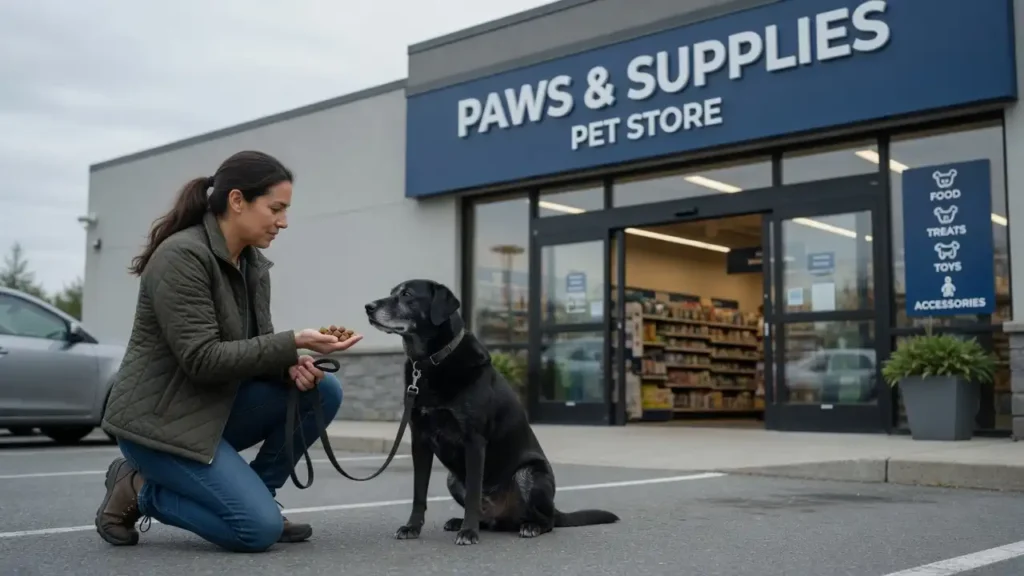
Practice in the parking lot or near the entrance before going inside. Reward your dog for checking in with you, walking calmly, and responding to simple cues.
If your dog is already barking outside, do not go inside yet. Move farther away and work at a calmer distance.
Step-by-Step Training Plan for Dog Barking at Other Animals in Pet Stores
Reducing dog barking at other animals in pet stores takes consistency. You are teaching your dog that other animals are not a reason to panic, explode, chase, or pull. They are simply part of the environment.
Step 1: Find Your Dog’s Safe Distance
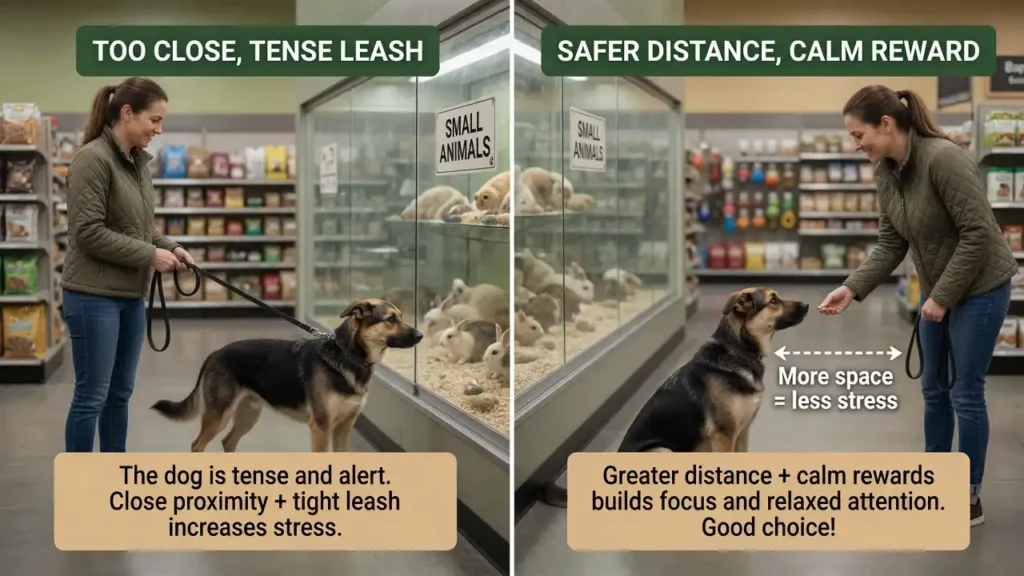
Your dog’s safe distance is the distance from another animal where your dog can notice the animal without barking, lunging, or refusing treats.
For some dogs, this may be 30 feet. For others, it may be across the store. For reactive dogs, it may be outside the building at first.
Start farther away than you think you need to. Distance is not failure. Distance is how you create a learning zone.
Step 2: Reward Looking Without Barking
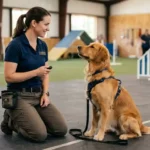
When your dog notices another animal and stays quiet, mark the moment with a word like “yes” or use a clicker. Then give a treat.
This teaches your dog that calm noticing is valuable.
The sequence is simple:
The dog sees an animal.
The dog stays quiet.
You mark the behavior.
The dog gets a reward.
Repeat this many times. Over time, your dog may start looking at the animal and then automatically look back at you. That is excellent progress.
Step 3: Teach “Look at That”
“Look at that” is a useful cue for reactive or excitable dogs. Instead of punishing your dog for noticing something, you teach controlled observation.
Here is how it works:
- Your dog sees another animal from a safe distance.
- You calmly say, “Look at that.”
- Your dog glances at the animal.
- You mark and reward when your dog turns back to you.
This turns the trigger into a training opportunity. It also reduces the pressure your dog may feel when seeing another animal.
Step 4: Practice Pattern Games
Pattern games help dogs feel safe because they create predictability. One simple pattern is “1-2-3 treat.”
Say “one, two, three,” then give a treat on three. Practice at home first. Then use it in the parking lot, store entrance, and eventually inside the store.
Patterns can help your dog move past distracting areas without building into a barking episode.
Step 5: Use U-Turns
A trained U-turn is one of the most useful skills for pet stores. If another dog suddenly appears at the end of an aisle, you do not need to panic or drag your dog away. You can calmly say your U-turn cue and move in the opposite direction.
Practice this at home:
Say “this way.”
Turn around.
Reward your dog for following.
Then practice outside, in quiet stores, and eventually in pet stores.
Step 6: Keep Sessions Short
A good training visit may only last 5 to 10 minutes. Leave while your dog is still successful. Do not wait until your dog melts down.
Short, positive visits are better than long, stressful trips.
Step 7: Gradually Decrease Distance
Only move closer when your dog can remain calm at the current distance. If barking returns, you moved too fast. Increase the distance again.
Training is not a straight line. Some days will be easier than others. Your dog’s sleep, age, health, previous stress, and the store environment can all affect progress.
For age-related barking patterns, see How Age Affects Barking Frequency in Dogs.
Mistakes That Make Barking Worse
Many owners accidentally reinforce or intensify barking without realizing it. The goal is not blame. The goal is awareness.
Correcting Too Harshly
Yelling “no,” jerking the leash, or using physical punishment can increase stress. Your dog may begin to associate other animals with discomfort or fear. That can make barking worse over time.
A dog that barks at a rabbit and then gets punished may not think, “I should be quiet.” The dog may think, “Rabbits make bad things happen.” That emotional association can increase reactivity.
Letting Barking Lead to Greetings
If your dog barks at another dog and then gets to greet that dog, barking may become a strategy. Your dog learns that loud behavior creates access.
Instead, calm behavior should earn access, movement, or rewards. Barking should not be the ticket to interaction.
Standing Too Close to Triggers
Many owners stay near the animal area too long because they want the dog to “get used to it.” Unfortunately, repeated over-threshold exposure can sensitize a dog, making the reaction stronger.
The better approach is controlled exposure at a distance where your dog can succeed.
Using Low-Value Treats
Dry biscuits may not compete with the excitement of live animals, strong smells, and other dogs. If your dog ignores treats, increase the distance and use higher-value rewards.
Ignoring Early Warning Signs
If your dog freezes, stares, stiffens, or stops responding, barking may be seconds away. Interrupt early with movement, treats, or a U-turn.
Waiting until the dog is barking makes training harder.
When to Leave the Pet Store
Sometimes the best training decision is to leave. This is especially true if your dog is over threshold.
Leave the store if your dog:
- Will not take high-value treats
- Cannot respond to familiar cues
- Is barking repeatedly
- Is lunging or pulling hard
- Is trembling, hiding, or panicking
- Is fixated on small animals
- Is disturbing other pets or customers
- Seems unable to settle after the distance is increased
Leaving is not giving up. It is preventing rehearsal of behavior you do not want. Every barking episode can strengthen the habit, especially if your dog finds barking emotionally satisfying or effective.
Once outside, give your dog space. Let your dog sniff, decompress, and recover. Do not lecture or punish. Calm recovery matters.
Should You Bring a Reactive Dog Into a Pet Store?
It depends on the dog, the store, and your ability to manage the situation.
Some reactive dogs can benefit from carefully planned, quiet, short training visits. Others are not ready yet. If your dog has a history of intense barking, lunging, snapping, or redirecting onto the leash or handler, start training in easier environments first.
Good starter locations include:
- Quiet parking lots
- Open sidewalks far from other dogs
- Outdoor shopping areas
- Large parks with plenty of distance
- Training facilities with controlled setups
Pet stores are advanced environments because triggers can appear suddenly and close by. Do not rush the process.
If your dog’s barking includes aggression, severe fear, or loss of control, consider working with a certified professional dog trainer, veterinary behaviorist, or qualified behavior consultant who uses humane, reward-based methods.
How Puppies, Adult Dogs, and Senior Dogs React Differently
Age can affect how dogs respond to animals in pet stores.
Puppies
Puppies may bark because they are curious, excited, or unsure. Early socialization is important, but it must be positive and controlled. A puppy should not be dragged close to strange animals or overwhelmed by a busy store.
Short visits, treats, calm observation, and gentle exposure work best.
Adolescent Dogs
Adolescent dogs are often more impulsive. They may bark because they want to greet, play, chase, or investigate. This stage can be challenging because the dog may look physically mature but still lack emotional control.
Impulse-control games, loose-leash walking, and focus exercises are especially helpful for adolescent dogs.
Adult Dogs
Adult dogs may bark due to learned patterns. If they have practiced barking in stores for months or years, behavior change may take longer. However, adult dogs can absolutely improve with consistent training.
The key is to stop rehearsing the old behavior and build a new response.
Senior Dogs
Senior dogs may bark because of discomfort, reduced vision, hearing changes, cognitive decline, or lower tolerance for busy environments. A senior dog that suddenly starts barking more should be evaluated for pain, sensory changes, or medical issues.
Do not assume an older dog is simply being difficult. Health and comfort matter.
Pet Store Etiquette for Dogs That Bark
Good etiquette protects your dog, other animals, store staff, and customers.
Keep Distance from Other Pets
Do not allow your dog to rush up to other dogs, cats, birds, or small animal enclosures. Even friendly dogs can scare smaller animals.
Ask Before Greetings
Never assume another dog wants to meet. Ask the owner first. Even then, a pet store aisle may not be the best place for greetings.
Avoid Blocking Aisles
If your dog is reacting, move out of the aisle. Give others room to pass.
Do Not Use the Store as a Dog Park
A pet store is a public shopping environment, not a play area. Your dog should be under control, on leash, and respectful of the space.
Reward Quiet Behavior Often
Do not only pay attention when your dog barks. Reward the quiet moments. Reward check-ins, loose leash walking, calm glances, and disengagement from animals.
Training Exercises to Practice at Home
Pet store behavior improves faster when you practice foundation skills outside the store.
Name Response
Say your dog’s name once. When your dog looks at you, mark and reward. Practice until your dog responds quickly in different rooms, then outside, then near mild distractions.
Hand Target
Teach your dog to touch their nose to your palm. This can redirect attention and help guide movement through aisles.
Settle on Mat
A mat teaches relaxation. Practice at home, then in the car, then outside quiet places. Eventually, this skill can help your dog relax in public spaces.
Leave It
“Leave it” helps when your dog notices food, toys, or animals. Teach it positively, not as a threat. Reward your dog for disengaging.
Loose-Leash Walking
A dog that pulls constantly is more likely to become frustrated in a pet store. Practice walking with a soft leash and frequent check-ins.
What Not to Do Around Small Animals
Small animals in pet stores are vulnerable. Even if they are behind glass or wire, a barking dog can frighten them.
Avoid:
- Letting your dog press against cages
- Allowing intense staring
- Encouraging sniffing through enclosure openings
- Laughing at barking or chasing behavior
- Taking photos while your dog is stressed or fixated
- Using small animals as training “bait” at close range
Instead, keep your dog at a respectful distance and reward calm disengagement.
When Professional Help Is Needed
Some barking is manageable with basic training. Other cases need professional support.
Get help if your dog:
- Lunges with force
- Growls, snaps, or redirects aggression
- Cannot calm down after leaving
- Has injured another animal
- Shows severe fear or panic
- Barks uncontrollably at every store visit
- Has a sudden behavior change
- Seems painful, confused, or unusually irritable
A certified trainer or veterinary behavior professional can help identify the emotional cause and build a safe behavior modification plan.
Medical issues should also be considered. Pain, thyroid problems, sensory decline, neurological changes, or anxiety disorders can influence barking and reactivity.
Conclusion
Dog barking at other animals in pet stores is not simply a manners problem. It is a communication signal shaped by emotion, environment, learning history, breed tendencies, socialization, impulse control, and the intensity of the store itself.
The most effective solution is not punishment. It is preparation, distance, calm handling, positive reinforcement, and gradual exposure. Watch your dog’s body language, reward quiet observation, avoid forcing close interactions, and leave before your dog becomes overwhelmed.
Pet stores can become manageable training environments, but only when your dog is ready. Start with easy visits, choose quiet times, bring high-value treats, and focus on progress rather than perfection. A calm dog in a pet store is not created in one trip. It is built through many small, successful experiences.
FAQs
Why does my dog bark at other animals in pet stores?
Your dog may bark because of excitement, fear, frustration, prey drive, overstimulation, or leash reactivity. Pet stores are full of animals, smells, sounds, and tight spaces, which can make barking more likely.
Is my dog aggressive if it barks at animals in a pet store?
Not necessarily. Barking can mean many things, including excitement, stress, curiosity, or frustration. Look at your dog’s full body language to understand the cause. If barking includes lunging, growling, snapping, or loss of control, seek professional guidance.
Should I correct my dog for barking in a pet store?
Harsh corrections can increase stress and make reactivity worse. A better approach is to create distance, reward calm behavior, and train your dog to look at animals without barking.
How do I stop my dog from barking at small animals in cages?
Keep your dog at a safe distance, reward calm glances, interrupt fixation early, and avoid letting your dog approach cages. Dogs with strong prey drive may need extra management around small animals.
Can I train my dog to be calm in pet stores?
Yes, many dogs can improve with gradual training. Start during quiet hours, use high-value treats, practice at a distance, and keep visits short. Build calm behavior step by step.
Why does my dog bark at other dogs only inside pet stores?
Indoor spaces can make dogs feel trapped. Narrow aisles, tight leashes, strong smells, and sudden close encounters can increase leash reactivity, even if your dog is calmer outdoors.
Should I let my dog greet other dogs in pet stores?
Only if both dogs are calm and both owners agree. Even then, greetings in narrow aisles can be tense. Many dogs do better when they simply pass calmly without greeting.
What should I do if my dog starts barking suddenly?
Increase the distance immediately. Use a calm voice, guide your dog away, and reward once your dog can focus again. If your dog cannot calm down, leave the store and try another day.
Are some breeds more likely to bark at animals in pet stores?
Some dogs may be more reactive due to breed tendencies such as herding, guarding, hunting, or terrier instincts. However, training, socialization, health, and environment matter just as much as breed.
When should I get professional help?
Get help if your dog lunges, snaps, growls intensely, redirects onto the leash or handler, panics, or cannot recover after seeing other animals. A qualified reward-based trainer or veterinary behavior professional can create a safer plan.