

Summary
Dog barking when children visit the home is often caused by fear, excitement, territorial instincts, insufficient socialization, or discomfort with children’s fast movements and high-pitched voices. The safest response is not to punish the barking, but to manage the environment, study the dog’s body language, create distance from triggers, and gradually build positive associations with calm children. With structured introductions, reward-based training, a secure retreat area, and careful adult supervision, many dogs can learn to remain settled when young guests arrive.
Table of Contents
- Why dogs bark at visiting children
- Understanding the type of barking
- Reading canine body language
- Immediate safety and management
- Preparing before children arrive
- Introducing a dog to visiting children
- Training methods that reduce barking
- Mistakes that can make barking worse
- When professional help is necessary
- Conclusion
- Frequently asked questions
Why Dog Barking When Children Visit the Home Happens
Children can be confusing or intimidating to dogs. They move quickly, change direction without warning, speak in high-pitched voices, laugh loudly, run through rooms, drop objects, and sometimes approach animals directly. A dog that is relaxed around familiar adults may react very differently when an unfamiliar child enters its territory.
Barking is communication. It can mean, “Someone is here,” “I am excited,” “Please move away,” “I do not understand this situation,” or “I want to join the activity.” The sound alone does not reveal the dog’s emotional state. Owners need to examine the dog’s posture, facial expression, movement, environment, and distance from the child.
Several causes may also overlap. A dog might initially bark because the doorbell predicts a visitor, then continue because the child moves unpredictably, and finally become frustrated because a leash or gate prevents investigation.
Territorial and alert barking
Many dogs naturally react when unfamiliar people enter their home. The doorbell, knocking, footsteps, and opening door can trigger an established alert-barking sequence before the dog has even seen the visitor.
Once a child enters, the dog may continue barking because the visitor has crossed what the dog perceives as a territorial boundary. Territorial barking often appears more intense near doors, windows, hallways, fences, and entryways.
A territorial dog may:
- Rush toward the entrance
- Bark with a forward body posture
- Patrol between the visitor and the door
- Stare at the child
- React whenever the child stands or moves
- Settle after the visitor has been present for some time
Territorial behavior should not automatically be described as protectiveness. A dog may simply be attempting to create distance from an unfamiliar person.
Fear or uncertainty around children
Some dogs have had little positive exposure to children. Others may have experienced grabbing, chasing, cornering, rough handling, or frightening noise in the past. Even without a negative event, a dog may find children unfamiliar and difficult to predict.
Fear-based barking is frequently accompanied by distance-increasing behavior. The dog may bark while leaning backward, retreat behind furniture, move away when approached, or alternate between stepping forward and backing away.
The purpose of the barking may be to make the child leave. If the child moves away, the dog learns that barking works. This can strengthen the behavior over time.
Excitement and frustrated greeting
Not all barking at children is defensive. Social dogs may become intensely excited when guests arrive. A dog may want to greet, chase, play, sniff, jump, or participate in the children’s activity.
When restrained by a leash, gate, closed door, or adult, the dog may experience barrier frustration. Barking then becomes louder because the dog cannot reach the visitor.
Excitement-based barking is often accompanied by:
- A loose, wiggling body
- Rapid tail movement
- Play bows
- Jumping or spinning
- Pulling toward the child
- Whining between barks
- Difficulty responding to familiar cues
A friendly intention does not make the situation automatically safe. A large, highly aroused dog can frighten or knock down a child without intending harm.
Overstimulation
A house full of movement, conversation, toys, food, and unfamiliar smells may exceed a dog’s ability to settle. A dog that can manage one quiet child may struggle with three children running through the home.
Overstimulation can cause barking, jumping, grabbing clothing, chasing, mouthing, pacing, and an inability to rest. These behaviors are signs that the dog needs less stimulation, not more social interaction.
Attention-seeking behavior
Dogs notice what produces a response. If barking causes adults to speak, touch, look at, restrain, or repeatedly command the dog, the behavior may gain an attention-seeking component.
Even negative attention can reinforce barking. An owner who repeatedly says “stop,” pushes the dog away, or argues with the dog may unintentionally turn the arrival of children into an energetic interaction.
Pain, sensory changes, or medical discomfort
A dog that suddenly begins barking at children despite previously being comfortable should receive a veterinary assessment. Pain can reduce tolerance for noise, touch, and unpredictable movement. Vision loss, hearing changes, cognitive decline, and neurological conditions may also alter a dog’s response to visitors.
A dog with hearing impairment may react differently to approaching guests because it cannot locate sounds normally. For additional context, read Deaf Dogs Bark Differently Than Hearing Dogs.
Understanding What the Barking Means
Before starting a training plan, identify when the barking begins, what maintains it, and what causes it to stop.
Keep a simple record of several visits. Note:
- What happened immediately before the barking
- Where the dog was located
- How far the child was from the dog
- Whether the child was moving, speaking, eating, or holding a toy
- The dog’s body posture
- Whether food could interrupt the behavior
- How long recovery took after the trigger disappeared
Patterns often become clear. The dog may react only when a child runs, enters a particular room, approaches the owner, touches a toy, or makes direct eye contact.
Alert barking versus fear-based reactivity
Alert barking often begins with a sound or arrival cue. The dog may bark several times and then investigate. Fear-based reactivity usually continues as long as the child remains too close or behaves in a way the dog considers threatening.
A fearful dog may refuse treats, retreat, freeze, growl, or bark more intensely when approached. These signals indicate that the dog is over its behavioral threshold.
The threshold is the point at which a dog becomes too emotionally aroused to learn effectively. Training should occur at a distance where the dog notices the child but can still eat, respond to cues, and disengage.
Barking versus aggression
Barking does not always mean that a dog will bite. However, barking can occur alongside aggressive behavior, and repeated warnings should never be ignored.
Concerning signs include:
- A rigid or frozen body
- Hard staring
- Lips pushed forward
- Growling
- Showing teeth
- Lunging
- Snapping
- Blocking the child’s movement
- Guarding food, toys, furniture, doorways, or adults
- Following the child closely while remaining tense
A wagging tail does not guarantee friendliness. Tail movement can reflect excitement, tension, conflict, or arousal. The entire body must be evaluated.
Read the Dog’s Body Language Before Intervening
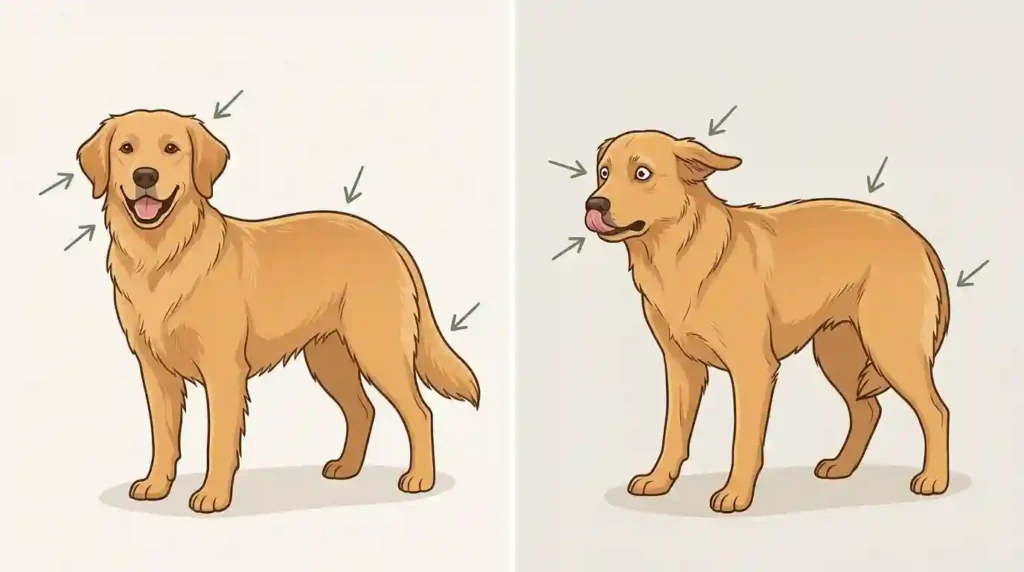
Dogs frequently communicate discomfort before barking becomes intense. Recognizing early stress signals allows an adult to increase distance before the dog escalates.
Early signs of stress
Watch for:
- Turning the head away
- Lip licking when no food is present
- Yawning outside a resting context
- Showing the whites of the eyes
- Sudden scratching or sniffing
- Closed mouth and facial tension
- Ears held back
- Lowered posture
- Repeatedly moving away
- Refusing treats
- Shaking off when not wet
These behaviors do not prove that a bite will occur, but they indicate discomfort or internal conflict.
Signs that the dog needs immediate space
Stop the interaction and separate the dog when you see freezing, sustained staring, growling, snarling, air snapping, lunging, or repeated attempts to escape.
Never punish a growl. A growl is valuable warning information. Punishing it may suppress the warning without changing the fear, discomfort, or guarding behavior underneath it.
Immediate Safety Steps When Children Arrive
Training cannot succeed if the dog is repeatedly pushed beyond its coping ability. Management should come first.
Management is not failure. It prevents rehearsals of unwanted behavior, protects children, and creates conditions in which learning can occur.
Separate first and assess second
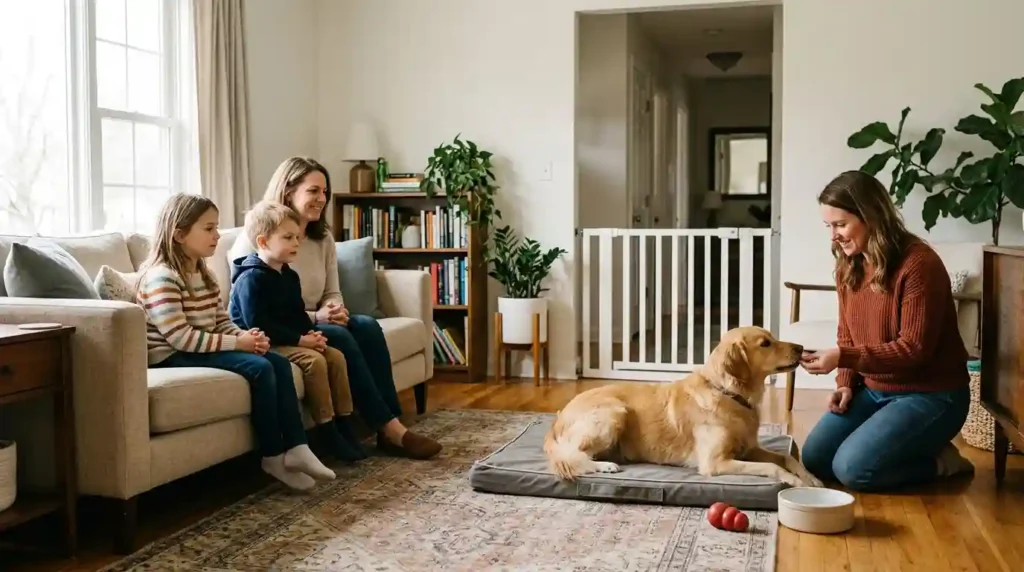
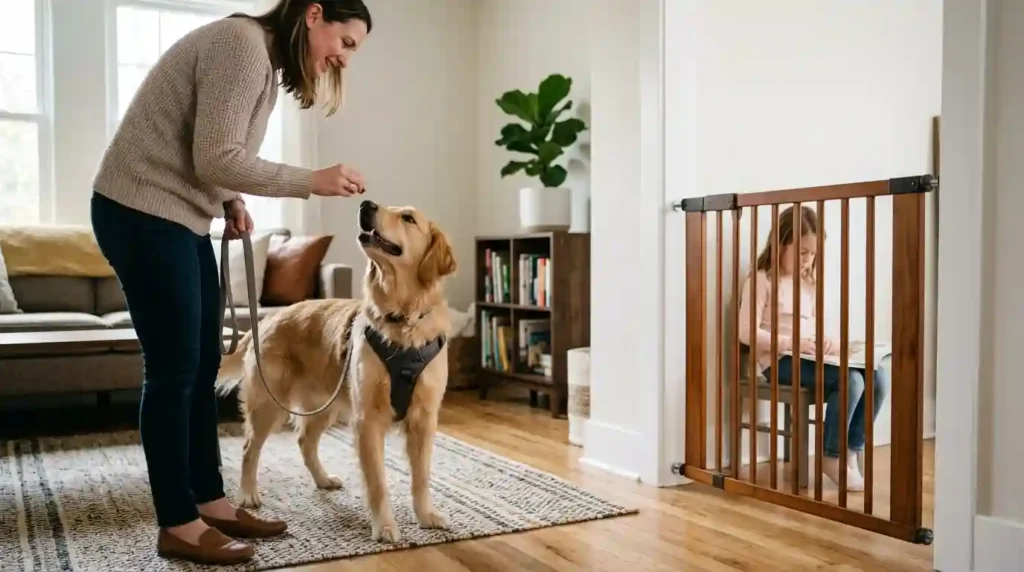
Before opening the door, place the dog behind a secure baby gate, in another room, or in a comfortable exercise pen. Provide water, bedding, and a long-lasting food toy if the dog can safely use one.
Allow the children to enter and settle before deciding whether the dog should be introduced. The dog does not have to meet every visitor.
For broader household safety, review the dog bite prevention guidance from the American Veterinary Medical Association.
Maintain active adult supervision
Adult supervision means more than being somewhere in the room. A responsible adult should be close enough to intervene, watching both the child and the dog, and not distracted by a phone, cooking, conversation, or another task.
Babies and young children should never be left alone with a dog, including a familiar family pet.
Use physical barriers correctly
Baby gates, closed doors, pens, and leashes can create safe distance. The barrier must be secure enough that neither the child nor the dog can push through it.
Remember that barriers may increase frustration in some dogs. If the dog barks, charges, or fixates through a gate, move the dog farther away or use a solid door.
Give the dog an escape route
A dog should always be able to move away. Do not corner the dog between furniture, walls, or people. Do not let children follow the dog into its bed, crate, feeding area, or quiet room.
A retreat area should be treated as off-limits to children.
How to Stop Dog Barking When Children Visit the Home Safely
Reducing barking requires a combination of preparation, environmental management, skill training, desensitization, and counterconditioning. The goal is not merely to silence the dog. The goal is to help the dog feel and behave more safely around the trigger.
Prepare before the visit
Give the dog an appropriate walk, sniffing session, or enrichment activity earlier in the day. Exercise should reduce restlessness without creating exhaustion or physical discomfort.
Prepare the following items:
- High-value treats cut into small pieces
- A secure leash and comfortable harness
- A mat or dog bed
- A stuffed food toy or safe chew
- A baby gate or separate room
- White noise, a fan, or quiet background audio
- Clear instructions for the visiting adults and children
Avoid waiting until the doorbell rings to find equipment or food.
Reduce the impact of arrival triggers
For many dogs, barking begins before the child enters. Ask visitors to text instead of ringing the doorbell. Close curtains if the dog reacts to people approaching the house. Use background sound to reduce footsteps and voices near the entrance.
Place the dog away from the doorway before opening it. A dog that starts the visit in a highly aroused state will find it harder to settle later.
Teach a reliable “go to mat” behavior
Mat training gives the dog a clear alternative to rushing toward visitors.
Begin without guests:
- Place the mat in a quiet room.
- Reward the dog for looking at or stepping toward it.
- Reward all four paws on the mat.
- Add a down position when the dog is comfortable.
- Deliver several treats slowly while the dog remains there.
- Release the dog with a consistent word.
- Gradually add duration, distance, and mild distractions.
Once the behavior is reliable, practise with recorded knocking, quiet adult visitors, and eventually calm children at a safe distance.
The mat should not become a punishment location. It should predict relaxation and reinforcement.
Use desensitization and counterconditioning
Desensitization means exposing the dog to a low-intensity version of the trigger that does not produce an overwhelming reaction. Counterconditioning means pairing that trigger with something the dog values, usually high-quality food.
A basic session might work like this:
- The dog remains behind a gate or on a leash at a comfortable distance.
- A calm child becomes visible.
- The adult immediately feeds several small treats.
- The child moves out of sight.
- The treats stop.
- The sequence is repeated for a few minutes.
The child’s appearance begins to predict food. Over time, the dog may respond to the child by looking toward the handler instead of barking.
The child should not approach, reach out, stare, or attempt to hand-feed the dog during early sessions.
Work below the dog’s threshold
If the dog cannot eat, respond to its name, or look away from the child, the exercise is too difficult. Increase distance, reduce movement, lower noise, or end the session.
Successful training often looks uneventful. The dog notices the child, receives reinforcement, and remains capable of thinking.
Trying to force rapid progress may produce flooding, which occurs when a dog is exposed to a frightening stimulus without an adequate way to escape. Flooding can intensify fear and create greater bite risk.
Reward quiet observation
Do not wait for barking before offering guidance. Reward the dog when it notices a child and remains quiet, turns back toward the handler, relaxes on its mat, sniffs the ground, or chooses to move away.
This approach teaches the dog what to do rather than focusing only on what not to do.
Teach an emergency exit cue
An exit cue helps move the dog away from a developing problem.
Choose a phrase such as “this way.” Practise it during calm walks:
- Say the phrase in a cheerful voice.
- Turn and move several steps away.
- Reward the dog for following.
- Repeat until the dog responds quickly.
During a visit, use the cue at the earliest sign of tension. Do not wait until the dog is lunging or unable to disengage.
Creating Rules for Visiting Children
Children should receive simple instructions before interacting with the dog. Adults must enforce these rules consistently rather than expecting a young child to remember them independently.
Ask children to ignore the dog initially
Ignoring the dog reduces social pressure. Ask the child to:
- Avoid staring at the dog
- Keep hands close to the body
- Walk rather than run
- Use a quiet voice
- Avoid squealing
- Allow the dog to maintain distance
- Never follow the dog into its retreat area
A nervous dog may feel safer when it is not the focus of attention.
Avoid hugging and face-to-face contact
Many dogs tolerate hugs rather than enjoy them. Hugging restricts movement and places the child’s face close to the dog’s mouth.
Children should also avoid kissing the dog, leaning over it, climbing on it, or placing their face near its food, toys, bed, or crate.
Do not force petting
A dog that approaches may be gathering information, not requesting touch. Let the dog sniff without requiring an interaction.
When petting is appropriate, an older child can gently touch the dog’s shoulder or chest for a few seconds and then stop. If the dog moves closer with a loose body, another brief interaction may be possible. If the dog turns away or leaves, the interaction is over.
Keep food and toys controlled
Children carrying snacks can increase jumping, barking, stealing, and guarding. Keep human food away from the dog and supervise all dog treats.
Remove high-value chews, bones, and toys if the dog has any history of resource guarding. Do not ask a child to take an object from the dog.
Building a Predictable Visitor Routine
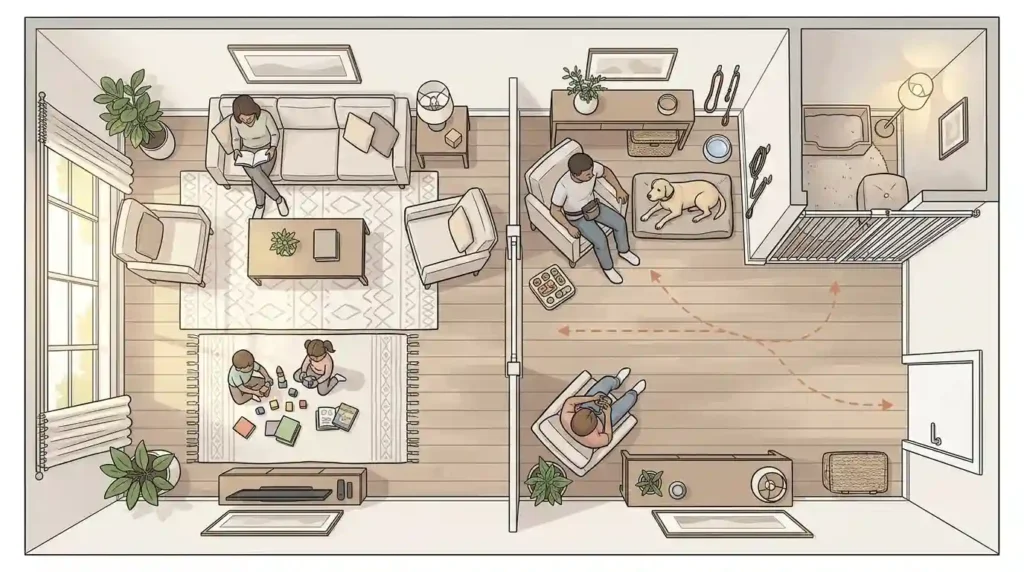
Predictability lowers uncertainty. Use the same general routine each time children visit.
A practical routine may include:
- Exercise and enrichment before the visit.
- The dog moves to a prepared safe area.
- Visitors enter without ringing the bell.
- Children settle in one room.
- The dog remains separated until calm.
- A controlled visual exposure occurs at a safe distance.
- The dog receives rewards for quiet behavior.
- The dog takes regular breaks away from visitors.
- The dog is separated before the children become active or tired.
- The visit ends without a crowded doorway interaction.
Not every step needs to progress during every visit. Some dogs are safest and happiest remaining in a quiet room for the entire event.
Schedule decompression breaks
A dog that appears calm at first may accumulate stress. Give the dog regular periods in a quiet area with no contact from visitors.
Stress hormones and emotional arousal do not disappear immediately. A dog may need substantial quiet time after a busy visit.
Keep sessions brief
Several two-minute successful exposures are more useful than one prolonged session that ends in barking. Stop while the dog is still comfortable.
Common Mistakes That Make Barking Worse
Yelling over the barking
Shouting adds noise and emotional intensity. The dog may interpret the owner’s voice as participation in the alarm or may become more anxious.
Use calm movement, increase distance, and guide the dog to a lower-stimulation area.
Punishing fear-based behavior
Leash corrections, physical intimidation, shouting, shock collars, and other aversive methods may suppress visible behavior without improving the dog’s emotional response.
A dog that associates punishment with the presence of children may become more fearful when children appear. The dog may also stop giving early warning signals while remaining uncomfortable.
Forcing the dog to “get used to it”
Placing a fearful dog in the middle of noisy play does not guarantee socialization. It may overwhelm the dog and strengthen the association between children and distress.
Effective exposure is gradual, controlled, and paired with outcomes the dog values.
Letting children give commands repeatedly
Several children calling the dog, waving treats, or repeating cues can create confusion and frustration. One adult should manage the training session.
Allowing uncontrolled greetings
Opening the door while the dog is loose can produce rehearsed rushing, jumping, barking, and chasing. Once these behaviors begin, the owner is reacting rather than directing.
Correcting the warning but ignoring the cause
Stopping the sound is not the same as resolving the emotion. Owners should ask what the dog needs: more distance, less movement, protection of a resting area, relief from pain, or a clearer routine.
Persistent or compulsive vocalization may require a more structured behavioral assessment. Read How Professional Trainers Stop Compulsive Barking for a closer look at professional approaches.
When to Contact a Professional
Seek qualified help when the dog:
- Has snapped at or bitten a child
- Lunges while barking
- Freezes or growls when children approach
- Guards food, toys, furniture, rooms, or people
- Cannot recover after the child leaves
- Redirects aggression toward the owner or another animal
- Shows increasingly intense reactions
- Has begun barking suddenly without an obvious explanation
- Is too distressed to eat during controlled exposure
- Lives with children or encounters them frequently
Begin with a veterinarian when behavior changes suddenly, when the dog is older, or when pain and illness may be contributing factors.
For behavioral assistance, look for a qualified reward-based trainer, certified behavior consultant, certified applied animal behaviorist, or board-certified veterinary behaviorist. Ask about experience with fear, aggression, visitor reactivity, and households with children.
Avoid professionals who guarantee a complete cure, minimize growling or snapping, or rely primarily on physical punishment.
What information to give the professional
Provide:
- The dog’s age, breed or mix, and medical history
- The age and behavior of visiting children
- A detailed description of each incident
- The distance at which barking starts
- Known bite or snap history
- Videos recorded from a safe position, when appropriate
- The dog’s response to gates, leashes, food, and cues
- Previous training methods and equipment
Accurate information helps the professional assess risk and design a realistic plan.
Conclusion
A dog that barks when children enter the home is communicating arousal, uncertainty, frustration, fear, territorial concern, or a combination of these emotions. The behavior should not be dismissed, but it should not automatically be interpreted as disobedience or aggression either.
Begin with safety. Separate the dog during arrivals, supervise every interaction, provide a child-free retreat, and prevent running, hugging, chasing, or forced contact. Once the environment is controlled, identify the dog’s triggers and practise calm behavior below its reaction threshold.
Reward-based mat training, gradual desensitization, counterconditioning, quiet visitor routines, and regular breaks can change how a dog responds. Progress should be measured by improved relaxation and recovery, not simply by the absence of sound.
Some dogs can eventually share space comfortably with calm children. Others may always need separation during energetic visits. A management plan that protects the dog and the children is a successful outcome, even when direct interaction is not appropriate.
Frequently Asked Questions
Why does my dog bark only at children and not adults?
Children move, sound, smell, and behave differently from adults. Their running, direct approaches, high-pitched voices, unsteady movement, and sudden gestures may trigger fear, excitement, herding behavior, or prey-related chasing. A lack of early positive exposure to children can also contribute.
Should I let a barking dog sniff the visiting child?
Not while the dog is highly aroused, pulling forward, freezing, growling, or unable to respond to the handler. Create distance first. A controlled introduction may be considered only when the dog has relaxed body language and an adult can manage the interaction safely.
Will my dog eventually stop barking if I ignore the behavior?
Ignoring alone may not resolve barking driven by fear, territorial behavior, overstimulation, or frustration. The dog may continue practising the response and become more efficient at it. Environmental management and reinforcement of alternative behavior are usually necessary.
Can children give my dog treats to build trust?
Direct hand-feeding may place a child too close to an uncomfortable dog. During early training, an adult should provide the treats while the child remains at a safe distance. A professional can advise whether tossing treats away from the child is appropriate at a later stage.
Is it safe to put my dog in a crate when children visit?
A crate can be useful if the dog already views it as a secure resting place and children cannot approach or disturb it. It should not be used to trap a distressed dog in the same room as the trigger. A quiet room behind a closed door may be more appropriate.
Why does my dog stop barking and then start again when the child moves?
Movement may be the main trigger. A dog can become comfortable while a child is seated but react when the child stands, runs, waves, or enters another room. Movement should be introduced gradually during controlled training.
Does a wagging tail mean the dog is safe around children?
No. Tail wagging indicates emotional arousal and can occur during excitement, uncertainty, tension, or conflict. Evaluate the dog’s entire body, including posture, facial muscles, eyes, ears, mouth, movement, and ability to disengage.
Should I punish my dog for growling at a child?
No. Growling is a warning that the dog is uncomfortable. Immediately create safe distance and identify what triggered the response. Punishment may suppress the warning while leaving the underlying fear or guarding behavior unchanged.
How long does it take to reduce barking around children?
The timeline depends on the cause, severity, rehearsal history, frequency of exposure, medical factors, and consistency of management. Mild excitement may improve relatively quickly, while fear-based reactivity can require months of careful work. Progress should never be rushed where child safety is involved.
What should I do if my dog has already snapped at a child?
Separate the dog from children immediately and prevent further contact. Arrange a veterinary examination and consult a qualified behavior professional with experience in aggression and child safety. Do not recreate the incident to test the dog.
Can some dogs remain separated for every child visit?
Yes. Permanent or long-term visitor separation can be the safest and least stressful option for some dogs. The dog can stay in a secure, comfortable room with water, bedding, enrichment, and background sound. Direct interaction is not required for successful household management.
Could barking at children be caused by pain?
Yes. Pain and physical discomfort can lower a dog’s tolerance for movement, noise, proximity, and touch. Sudden behavior changes should be discussed with a veterinarian, particularly in older dogs or dogs showing stiffness, sleep changes, reduced activity, or sensitivity to handling.