

Summary
Dog barking near swimming pools or water bodies can happen because of excitement, fear, prey drive, protective instincts, sensory overload, or confusion about moving water. Some dogs bark when they see splashing, hear children playing, notice reflections, or feel anxious because a family member is in the pool, lake, pond, river, or beach water. The good news is that poolside barking can often be reduced with safety management, desensitization, counterconditioning, calm leash work, and positive reinforcement training.
Table of Content
- Why Dog barking near swimming pools or water bodies Happens
- Common Triggers Around Pools, Lakes, Ponds, and Beaches
- Is Your Dog Barking From Fear, Excitement, or Protection?
- Safety Comes First Around Water
- How to Stop Dog barking near swimming pools or water bodies Safely
- Training Exercises for Poolside Calmness
- Mistakes That Make Water-Related Barking Worse
- When to Call a Professional Trainer or Veterinarian
- Conclusion
- FAQs
Why Dog barking near swimming pools or water bodies Happens
Dogs do not bark randomly. Barking is communication. When a dog barks near a swimming pool, lake, pond, beach, fountain, river, or canal, it is usually responding to something it sees, hears, smells, or feels. Water creates a very stimulating environment for many dogs. It moves, reflects light, makes unusual sounds, carries scents, and often involves people laughing, splashing, shouting, swimming, or throwing toys.
For some dogs, water is exciting. A Labrador Retriever, Golden Retriever, Poodle, Spaniel, Portuguese Water Dog, or mixed breed that loves swimming may bark because it wants to jump in. For other dogs, water is confusing or scary. A Bulldog, Pug, Dachshund, senior dog, small breed, or dog with little water exposure may bark because it feels unsure or trapped.
A dog may also bark because it thinks someone in the pool is in danger. From the dog’s point of view, a person moving strangely in water, disappearing under the surface, or splashing loudly may look alarming. This is especially common in protective dogs, herding breeds, guardian breeds, and dogs that are closely bonded to their owners.
Poolside barking can also be connected to visual triggers. Moving reflections, sunlight on water, pool lights, floating toys, ripples, waves, and shadows may activate a dog’s prey drive or chase instinct. If your dog is already sensitive to visual stimulation, you may also find it helpful to read this related guide on Dog Bark at Certain Colors or Lights.
Common Triggers Around Pools, Lakes, Ponds, and Beaches
Splashing and Sudden Movement
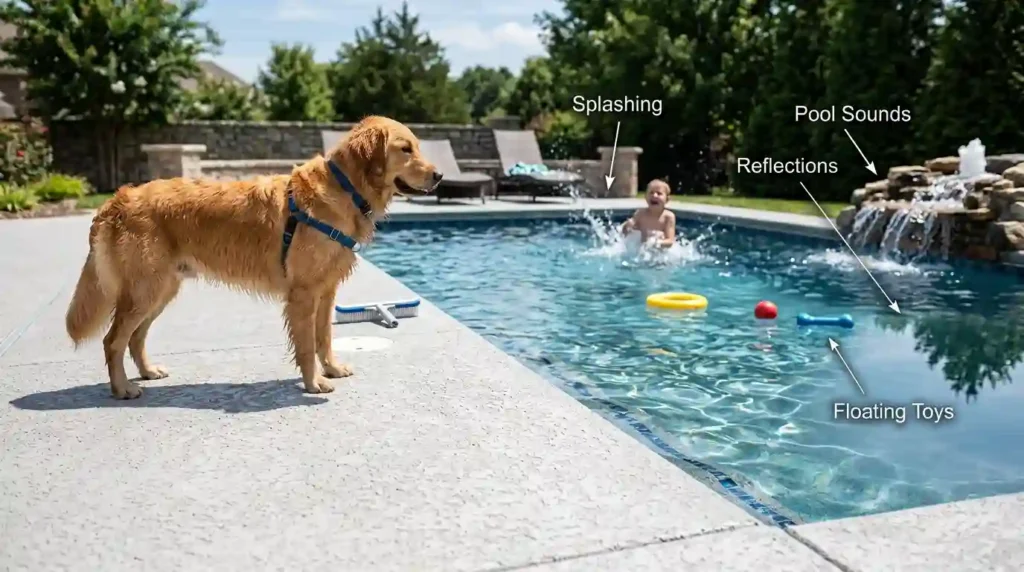
Splashing is one of the biggest reasons dogs bark near water. Dogs are highly sensitive to movement. When water jumps, ripples, or breaks suddenly, it can trigger alert barking, chase behavior, or frustration barking. A dog that watches children jump into a pool may become overstimulated within seconds.
This barking may sound sharp, repetitive, and urgent. The dog may lean forward, pull on the leash, jump, whine, spin, or try to run toward the water.
People Swimming
Some dogs bark when people swim because swimming looks unnatural to them. A person’s arms may slap the water, their head may disappear, and their voice may sound different across the pool or lake. A worried dog may think the swimmer needs help.
This type of barking is common in loyal family dogs. They may pace along the pool edge, bark at every stroke, and become especially upset when children are in the water.
Pool Equipment and Water Sounds
Pool pumps, waterfalls, fountains, filters, jets, drains, sprinklers, and bubbling hot tubs can all create unfamiliar noises. Dogs with sound sensitivity may bark at these mechanical or rushing-water sounds the same way they bark at traffic, lawn mowers, or construction work.
If your dog reacts to loud or repetitive environmental sounds, this article on Dog Barking at Construction Sounds Nearb may help you understand similar sound-triggered barking patterns.
Reflections, Lights, and Shadows
Water reflects sunlight, pool lights, trees, birds, people, and moving objects. These reflections can look like fast-moving prey to some dogs. Border Collies, Australian Shepherds, Terriers, German Shepherds, and high-drive working breeds may become fixated on the surface of the water.
A dog that barks at reflections may stare intensely, freeze, crouch, chase light patterns, or snap at the water.
Wildlife Near Natural Water Bodies
Near ponds, rivers, lakes, marshes, and beaches, dogs may bark at ducks, fish, frogs, turtles, birds, crabs, insects, or unfamiliar scents. In this situation, barking may be driven by prey drive, curiosity, territorial behavior, or frustration because the dog cannot reach the animal.
Fear of Slippery Surfaces
Pool decks, boat docks, wet rocks, and muddy banks can feel unstable. A dog may bark because it is uncomfortable walking near the edge or is afraid of falling. This is more common in puppies, senior dogs, dogs with arthritis, and dogs that have slipped before.
Is Your Dog Barking From Fear, Excitement, or Protection?
Understanding the emotional reason behind the barking matters. The right training plan depends on whether your dog is scared, excited, protective, frustrated, or overstimulated.
Signs of Fear-Based Barking
A fearful dog may bark while backing away, tucking its tail, lowering its body, licking its lips, yawning, trembling, or refusing treats. The bark may sound high-pitched or panicked. Fearful barking near water should never be punished because punishment can increase anxiety and make the dog associate pools or lakes with danger.
Signs of Excitement: Barking
An excited dog usually has loose, bouncy body language. It may wag its tail, jump, spin, bark rhythmically, pull toward the pool, or grab toys. This dog may want to swim, chase splashes, or join the activity.
Excitement barking is not “bad behavior” in a moral sense. It is poor impulse control in a highly stimulating environment.
Signs of Protective Barking
A protective dog may bark when a specific person enters the water. It may run along the pool edge, stare at the swimmer, ignore treats, and become frantic when the person splashes or goes underwater. The dog may calm down only when the person exits the water.
This type of barking often looks caring, but it can become dangerous if the dog jumps in unexpectedly or interferes with swimmers.
Signs of Frustration: Barking
Frustration barking happens when the dog wants access to the water but cannot get there. A leash, fence, closed gate, pool cover, or verbal restriction may increase frustration. The dog may bark, whine, paw, dig, chew the leash, or redirect energy onto nearby objects.
Safety Comes First Around Water
Before working on training, make the environment safe. Barking near water is not just noisy; it can create real risks. A barking dog may distract swimmers, fall into a pool, slip on wet surfaces, jump on children, damage pool covers, or panic in deep water.
The American Animal Hospital Association recommends supervising pets around water, teaching dogs how to exit pools, using fences or barriers, being careful with water quality, and preventing dogs from drinking large amounts of pool, lake, or salt water. Their guide on water safety tips for pets is a useful external resource for dog owners.
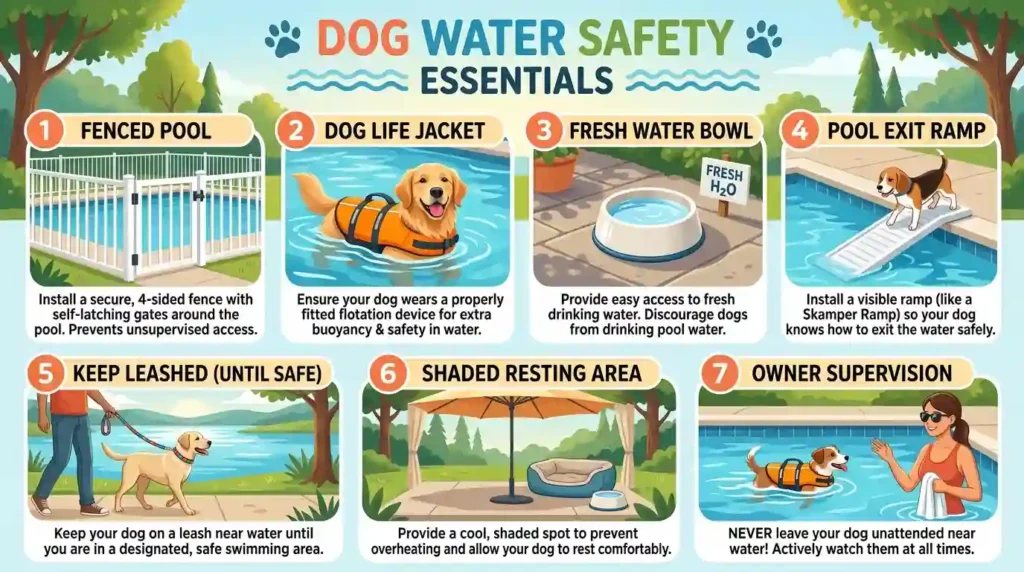
Use Barriers and Leashes
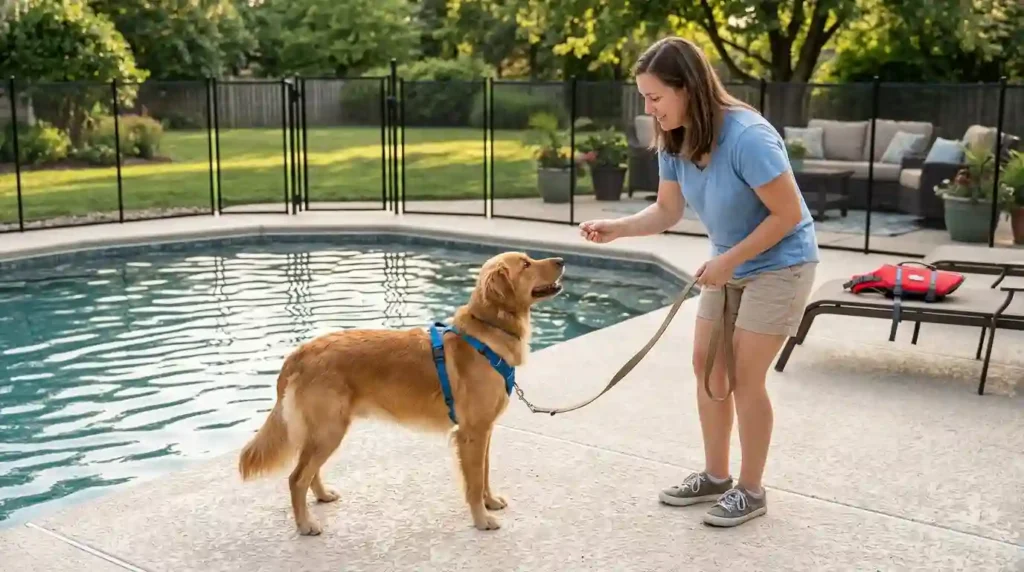
Use a secure fence, baby gate, exercise pen, long line, or leash when your dog is near a pool or natural water body. A leash is not only for control; it also prevents sudden jumps into unsafe water.
Teach Pool Exits
If your dog is allowed near a swimming pool, teach it how to leave the pool using steps, a ramp, or a shallow exit. Practice calmly and repeatedly. A dog that knows the exit route is safer if it accidentally falls in.
Consider a Dog Life Jacket
A canine life jacket is helpful for boating, beach trips, lake visits, and dogs that are not strong swimmers. Choose a well-fitted jacket with a handle and visible material.
Avoid Forced Swimming
Never throw, push, or drag a dog into water. Forced exposure can create lasting fear and increase barking, panic, or defensive behavior. Let the dog explore at its own pace.
Watch Water Quality
Natural water bodies may contain algae, bacteria, sharp rocks, fishing hooks, strong currents, or wildlife. Pools may contain chlorine or other chemicals. Fresh drinking water should always be available so your dog is not tempted to drink from the pool, pond, lake, or ocean.
How to Stop Dog barking near swimming pools or water bodies Safely
The goal is not to silence your dog through fear. The goal is to teach calm behavior around water. This requires distance, patience, rewards, and gradual exposure.
Start Far Enough Away
Begin training at a distance where your dog notices the water but can still respond to you. For some dogs, this may be 10 feet from a pool. For others, it may be across the yard or far from the lake shore.
If your dog is already barking, lunging, or ignoring food, you are too close. Move farther away.
Reward Calm Observation
Let your dog look at the pool or the water body. When it looks calmly without barking, mark the behavior with “yes” or a clicker and reward with a treat. You are teaching: “Seeing water calmly earns good things.”
Do not wait for perfection. Reward small moments of quiet, relaxed body language, soft eye contact, or turning away from the water.
Use Counterconditioning
Counterconditioning means changing your dog’s emotional response. Instead of water predicting stress or frustration, water begins to predict rewards.
For example:
- The dog sees a person splash in the pool.
- You immediately feed a high-value treat.
- The dog looks back at the water.
- You reward again before barking starts.
Over time, your dog learns that splashing is not a threat or a reason to explode. It is a cue to stay calm and check in with you.
Practice Desensitization
Desensitization means exposing your dog to a low level of the trigger and increasing intensity slowly. Start with still water before moving water. Start with one calm adult near the pool before children jump and play. Start with quiet pool time before parties or family gatherings.
Teach an Alternative Behavior
A dog cannot bark, pull, and relax on a mat at the same time. Teach your dog what to do instead.
Good alternatives include:
- Lie on a mat.
- Sit beside you.
- Look at you.
- Carry a toy.
- Walk away from the pool.
- Go to a shaded resting spot.
- Follow a “leave it” cue.
- Respond to “quiet” after learning calmness first.
Use a Calm Settle Station
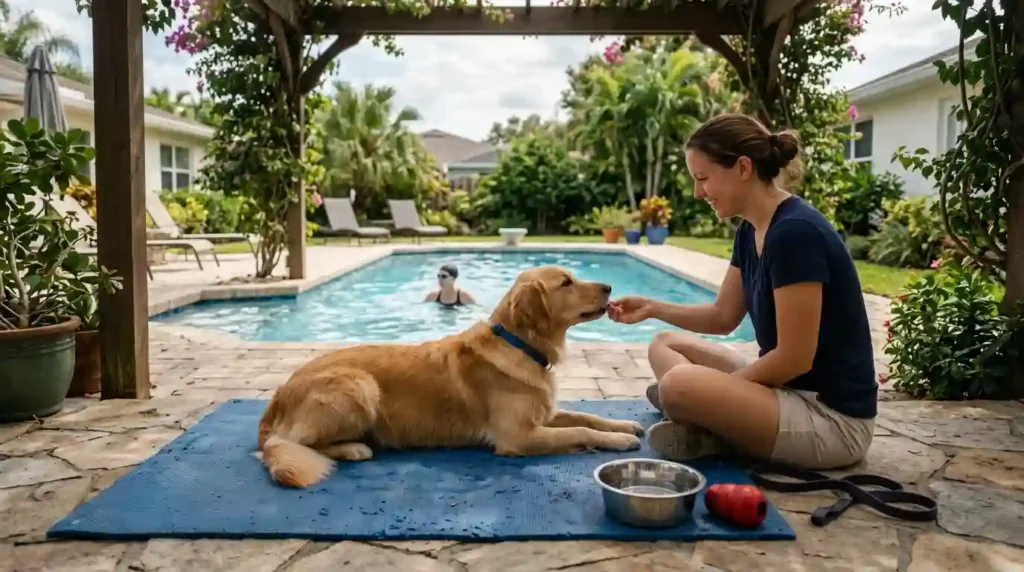
Create a comfortable station away from the pool. Add a mat, shade, water bowl, chew toy, and tether if needed. Reward your dog for resting there while people are near the water.
This is especially useful during pool parties, barbecue events, beach picnics, lake trips, and family swim days.
Training Exercises for Poolside Calmness
Exercise 1: Look at That
The “Look at That” game helps dogs notice triggers without reacting.
Stand at a safe distance from the pool. When your dog looks at the water, say “yes” and give a treat. The goal is not to force eye contact. The goal is to reward calm noticing.
Repeat until your dog looks at the water and then looks back to you, expecting a reward.
Exercise 2: Quiet Mark and Reward
Wait for a tiny pause in barking. The moment your dog is quiet, mark it with “yes” and reward. At first, the quiet moment may last only half a second. That is enough.
Do not yell “quiet” repeatedly. Yelling often sounds like barking to your dog and may increase arousal.
Exercise 3: Pool Walk-By
Walk your dog past the pool at a distance where it can stay calm. Reward every few steps. Gradually move closer over multiple sessions.
Keep sessions short. Five calm minutes are better than thirty stressful minutes.
Exercise 4: Splash Control
Ask one person to make a very small splash. Reward your dog before it barks. If your dog stays calm, repeat. If it barks, make the splash smaller or increase the distance.
Build slowly from tiny ripples to gentle swimming, then louder play.
Exercise 5: Mat Relaxation
Teach mat relaxation away from the pool first. Once your dog understands that the mat means calm behavior, move the mat near the pool area. Reward lying down, relaxed breathing, and staying settled.
Exercise 6: Emergency Recall
A strong recall is essential around water. Practice calling your dog away from mild distractions and rewarding heavily. Never use recall only to end fun. Sometimes call your dog, reward it, and release it back to safe play.
Mistakes That Make Water-Related Barking Worse
Punishing the Barking
Yelling, leash jerks, shock collars, spray bottles, or harsh corrections may stop barking temporarily, but they do not solve the emotional cause. If your dog is scared, punishment can confirm that water areas are dangerous. If your dog is excited, punishment may add frustration.
Letting the Dog Rehearse Barking
Every time a dog barks intensely near the pool, the behavior becomes more practiced. If barking gets the dog access to the water, attention, or movement from people, it may become stronger.
Management is important. Use barriers, distance, and calm training before the dog loses control.
Starting Too Close
Many owners begin training right beside the pool. That is often too hard. Start farther away and make success easy.
Training During Pool Parties
A busy pool party is not the best training environment. Start during quiet times with controlled triggers. Once your dog improves, slowly practice around more activity.
Ignoring Physical Discomfort
Some dogs bark because they are uncomfortable. Wet surfaces, heat, ear pain, arthritis, poor vision, or anxiety can all make water environments harder. If barking suddenly appears in an older dog or after a bad experience, consider a veterinary check.
Breed and Personality Factors
Some breeds are more likely to react strongly around water because of their instincts.
Herding Breeds
Border Collies, Australian Shepherds, Corgis, and Heelers may bark at running children, splashing, and fast movement. Their instincts tell them to control motion.
Retrievers and Water Dogs
Labradors, Golden Retrievers, Newfoundlands, Portuguese Water Dogs, and Spaniels may bark because they want to swim, retrieve toys, or join the activity.
Guardian Breeds
German Shepherds, Rottweilers, Dobermans, Great Pyrenees, and other protective dogs may bark when family members are in the water because they interpret splashing as distress.
Small or Short-Nosed Breeds
Pugs, Bulldogs, French Bulldogs, and some small breeds may feel vulnerable near water because swimming is physically harder for them. Barking may be anxiety-based.
Breed can influence behavior, but it does not determine everything. Training history, socialization, confidence, health, and past experiences matter just as much.
What to Do During a Barking Episode
When your dog is already barking near water, avoid arguing with it. Instead, reduce intensity.
First, calmly move your dog farther from the trigger. Use a happy voice and guide it away without dragging. Once your dog can think again, ask for a simple behavior like sit, hand target, or eye contact. Reward generously.
If your dog is too worked up to take treats, leave the area for a short break. This is not failure. It is good management.
Do not let your dog run loose beside a pool while overstimulated. A frantic dog can fall, jump on swimmers, or create a safety hazard.
When to Call a Professional Trainer or Veterinarian
Consider getting help if your dog’s barking is intense, sudden, aggressive, obsessive, or impossible to interrupt. A certified positive reinforcement trainer, veterinary behaviorist, or behavior consultant can create a customized plan.
You should also speak with a veterinarian if your dog shows signs of pain, confusion, hearing loss, vision problems, anxiety, compulsive behavior, or panic around water. Medical issues can change behavior, especially in senior dogs.
Professional help is also wise if children are involved. A barking, jumping, or lunging dog near a swimming pool can become dangerous quickly, even if the dog is friendly.
Conclusion
Dog barking near swimming pools, lakes, ponds, rivers, beaches, fountains, or other water bodies is usually a sign of excitement, fear, frustration, protection, prey drive, or sensory overload. Water creates movement, sound, reflections, smells, and social activity that can overwhelm a dog’s nervous system.
The best solution is a combination of safety management and positive training. Use distance, leashes, barriers, pool exits, life jackets, calm observation, counterconditioning, desensitization, and alternative behaviors like mat relaxation. Avoid punishment and do not force your dog into water.
With patience and consistency, many dogs can learn that pools and water bodies are not something to bark at, chase, guard, or fear. Instead, they can become places where your dog feels safe, calm, and connected to you.
FAQs
1. Why does my dog bark when people are in the swimming pool?
Your dog may bark because it is excited, worried, protective, or confused by splashing and swimming movements. Some dogs think people in water are in danger, while others simply want to join the fun.
2. Why does my dog bark at pool water but not at other places?
Pool water creates unique triggers such as reflections, chlorine smells, floating toys, pump sounds, splashes, and people moving in unusual ways. Your dog may find these triggers more intense than ordinary environments.
3. Should I let my dog jump into the pool when it barks?
Not while barking or overexcited. Letting your dog jump in after barking may reward the behavior. Wait for calm behavior first, then allow safe access if swimming is appropriate for your dog.
4. Can fear of water cause barking?
Yes. Fearful dogs may bark to create distance from the water or express discomfort. Signs include backing away, trembling, tucked tail, stiff posture, lip licking, or refusing treats.
5. How do I stop my dog barking at swimmers?
Start at a distance where your dog can stay calm. Reward quiet observation, use counterconditioning, and gradually expose your dog to gentle swimming sounds and movement. Keep sessions short and positive.
6. Is barking near lakes and ponds different from barking near pools?
It can be. Lakes and ponds may include wildlife, mud, waves, algae smells, boats, fishing gear, birds, and unknown sounds. These natural triggers may increase prey drive, curiosity, or fear.
7. Can dogs become obsessed with water reflections?
Yes. Some dogs become fixated on reflections, ripples, lights, or shadows on water. This is common in high-drive or visually sensitive dogs. Interrupt gently, redirect to a calm activity, and reduce access to intense visual triggers.
8. Should I punish my dog for barking near water?
No. Punishment can increase fear, frustration, or excitement. Instead, use distance, reward-based training, calm redirection, and controlled exposure.
9. Are some breeds more likely to bark near water?
Yes. Herding breeds may react to movement, retrievers may bark from excitement, guardian breeds may bark protectively, and short-nosed breeds may bark from discomfort or anxiety. However, any dog can develop water-related barking.
10. When should I get professional help?
Get help if the barking is severe, aggressive, obsessive, sudden, or unsafe around children and swimmers. A positive reinforcement trainer or veterinary behaviorist can help identify the cause and create a safe plan.