


Summary
Dog barking at the sound of other dogs on YouTube is usually a response to excitement, uncertainty, territorial instincts, frustration, or a learned association with real dogs. Although the barking comes through a television, phone, tablet, or computer speaker, your dog may interpret the sound as meaningful canine communication.
The best way to reduce this behavior is not to punish or overpower the barking. Instead, identify what your dog is feeling, lower the intensity of the recording, reward calm responses, and gradually expose your dog to the sound at a manageable level. With consistent desensitization, counterconditioning, environmental management, and appropriate reward timing, many dogs can learn to hear recorded barking without becoming overwhelmed.
Table of Contents
- Why do recorded dog sounds trigger barking
- How to interpret your dog’s body language
- Common reasons dogs react to YouTube videos
- Whether the behavior is normal or concerning
- Immediate steps to stop a barking episode
- A gradual training plan for recorded barking
- How to use treats without rewarding barking
- Mistakes that can make the reaction worse
- When professional help may be necessary
- Conclusion
- Frequently asked questions
A quiet evening can change quickly when a YouTube video includes a barking dog. Your dog may jump up, rush toward the screen, bark repeatedly, search behind the television, or run from one window to another. Some dogs recover as soon as the sound ends. Others remain alert long after the video has stopped.
This response can seem confusing because there is no real dog in the room. However, dogs do not need to see or smell another animal before reacting to its vocalizations. A recording can preserve enough of the rhythm, pitch, repetition, and emotional quality of a bark to capture a dog’s attention.
Your dog may believe another dog is nearby, or the sound may simply activate an established pattern. For example, a dog that regularly barks when neighborhood dogs vocalize may respond similarly when barking comes through a speaker.
Understanding the reason behind the reaction is essential. A dog barking from playful excitement requires a different approach from a dog barking because it feels threatened.
Dog Barking at the Sound of Other Dogs on YouTube: Why It Happens
Recorded barking can trigger several emotional and behavioral responses. The sound itself may be the immediate trigger, but the motivation behind your dog’s reaction can include social interest, fear, alarm, frustration, or anticipation.
Dogs Recognize Meaningful Vocal Patterns
Dogs communicate through more than one type of bark. Their vocalizations vary depending on context, arousal, distance, and emotional state. A greeting bark may sound different from an alarm bark, a play invitation, or a frustrated demand for attention.
A recording is not identical to hearing a live dog. Speakers alter sound quality, and the video cannot provide accompanying scent or normal social feedback. Even so, the recording may contain enough recognizable information to produce an emotional response.
Your dog does not necessarily believe that a dog lives inside the television. It may simply hear a biologically relevant sound and respond before determining where it came from.
The Sound May Activate Territorial Behavior
Dogs that regularly monitor doors, windows, hallways, balconies, or garden boundaries may treat recorded barking as evidence of an approaching animal.
A territorial dog may:
- Run toward an exterior door or window
- Bark with a deep or repetitive tone
- Stand with its weight shifted forward
- Raise its tail or hold it rigidly
- Scan the room after the video stops
- Continue patrolling for several minutes
The dog may not focus on the screen because its priority is locating the supposed intruder.
Excitement Can Look Like Aggression
Not every loud reaction is aggressive. Some socially enthusiastic dogs bark because they want to investigate, greet, or play with the animal they hear.
An excited dog may wag its entire body, alternate between the screen and its owner, whine, bounce, play-bow, or bring a toy. The barking may be sharp and repetitive, but the dog’s muscles remain relatively loose.
Frustration can develop because the dog hears a potential playmate but cannot approach it. This is sometimes called barrier frustration. The television, phone, or speaker acts as an invisible barrier between the dog and the source of the sound.
Fear and Uncertainty Can Cause Defensive Barking
A nervous dog may respond to unfamiliar barking as a warning. It cannot see the full situation, identify the other animal, or move through a normal greeting sequence. This lack of information can make the sound feel unpredictable.
Signs of fear or discomfort may include:
- Moving away while continuing to bark
- Lowering the body or tail
- Pinning the ears back
- Pacing or hiding behind a person
- Lip licking, yawning, or panting
- Refusing food
- Growling when approached
- Taking an unusually long time to settle
A fearful response should not be treated as stubbornness. The dog is communicating that the situation exceeds its current ability to cope.
The Behavior May Have Been Reinforced Accidentally
Behavior that produces a meaningful result tends to be repeated. When a dog barks at a video, several things may happen:
- The owner speaks to the dog
- Someone touches or picks up the dog
- The video is stopped
- The dog receives a treat as a distraction
- Family members laugh or become animated
- The dog is allowed to rush toward a window
From the dog’s perspective, barking may make the strange sound disappear or cause people to provide attention. This does not mean you should ignore a distressed dog. It means the timing of your response matters.
Social Facilitation May Play a Role
Dogs can become more likely to perform a behavior when another dog is performing it. In a multi-dog household, one dog may react to the recording and trigger barking from the others.
The second or third dog may not be responding directly to the video. They may be responding to the arousal, movement, and vocalization of the first dog. This can create a rapid chain reaction.
Training several dogs together is usually harder than working with each dog individually. Begin with the most reactive dog in a separate, quiet space whenever possible.
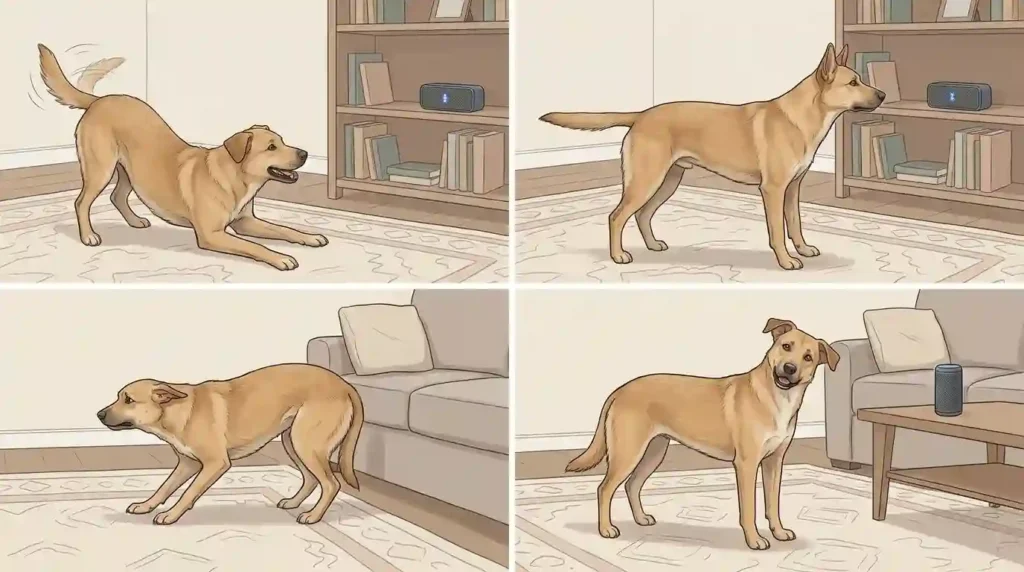
How to Read Your Dog’s Reaction
Before starting training, observe the entire dog rather than focusing only on the volume of the bark. Body posture often reveals more than vocal intensity.
Ask the following questions:
- Is the body loose or stiff?
- Is the dog moving toward the sound or retreating from it?
- Can the dog look away from the screen?
- Will the dog respond to its name?
- Can it eat a familiar treat?
- How quickly does it recover when the sound ends?
- Does the reaction happen only with barking, or with all animal sounds?
A dog that can look away, eat, and respond to a simple cue is usually still capable of learning. A dog that lunges, trembles, hides, refuses food, or remains distressed is probably too close to its emotional threshold.
The threshold is the point at which the stimulus becomes too intense for the dog to remain calm and process information. Effective training takes place below that point.
Is Barking at YouTube Videos Normal?
An occasional alert bark is generally not unusual. Barking is a natural form of canine communication, and dogs often respond to sounds they consider important. The ASPCA’s overview of barking behavior explains that barking may be associated with alarm, territorial behavior, attention, greeting, frustration, or reactions to other barking dogs.
The behavior becomes more concerning when it is intense, difficult to interrupt, or part of a broader pattern of anxiety or reactivity.
Pay closer attention when your dog:
- Throws itself against the television or furniture
- Redirects aggression toward people or other pets
- Cannot recover after the sound stops
- Reacts to very low-volume recordings
- Begins monitoring the room for long periods
- Shows panic, trembling, hiding, or escape attempts
- Suddenly develops the behavior after previously ignoring videos
- Becomes increasingly reactive to dogs outside the home
A sudden behavioral change may justify a veterinary examination, particularly in an older dog or a dog showing changes in sleep, appetite, movement, awareness, or general temperament.
What to Do During an Active Barking Episode
When barking has already started, your immediate goal is to lower arousal. This is not the ideal moment to conduct a difficult training exercise.
First, pause or mute the video. Remain calm and avoid shouting. Loud corrections can add more noise and emotional intensity to the situation.
Create distance from the screen by calmly guiding your dog into another part of the room. You can scatter a few treats away from the television if the dog is still able to eat. Sniffing and searching may help redirect attention.
Once the dog is quiet, encourage a familiar calming activity, such as lying on a mat, licking a food-filled toy, chewing an appropriate item, or resting in a quieter room.
Avoid repeatedly playing the sound to “prove” that nothing is there. Unplanned repetition can sensitize the dog, causing stronger reactions instead of helping it adjust.
Dog Barking at the Sound of Other Dogs on YouTube: Step-by-Step Training Plan
The most useful training method combines desensitization and counterconditioning.
Desensitization means presenting the trigger at an intensity low enough that the dog can remain composed. Counterconditioning means pairing that manageable version of the trigger with something the dog values, such as food, play, or calm interaction.
The purpose is not merely to stop noise. The goal is to change how the dog feels and behaves when it hears another dog.
Step 1: Prepare the Training Environment
Choose a quiet room with minimal distractions. Close curtains if outdoor dogs or passing pedestrians may add additional triggers. Keep other pets outside the room during early sessions.
Prepare small, high-value treats that your dog can eat quickly. The pieces should be small enough to allow several repetitions without providing a full meal.
Position your dog far enough from the screen or speaker that it can remain relaxed. A dog bed or training mat can provide a clear place to settle.
Keep the remote control within reach so you can pause the recording immediately.
Step 2: Find a Safe Starting Volume
Begin with the device muted. Allow your dog to settle on its mat or near you. Start the video at the lowest audible volume.
Watch for subtle signs of concern. An ear movement or a brief glance is acceptable. Stiffening, sustained staring, whining, pacing, or barking indicates that the sound is too intense.
The correct starting level may seem extremely quiet. That is not a problem. Training at a low intensity creates opportunities for successful repetition.
Step 3: Pair the Sound With a Reward
Play one or two seconds of recorded barking at a safe volume. As soon as your dog hears the sound, provide a treat.
The sequence should be:
A barking sound appears, then food appears.
Pause the recording after the brief sound. Wait several seconds and repeat.
The treat should not be used to lure a barking dog away after a prolonged outburst. Ideally, it appears when the dog notices the sound but remains quiet or quickly redirects attention to you.
For more detailed guidance on reward timing, read Use Treats Correctly to Stop Barking Without Rewarding It.
Step 4: Reward Orientation Toward You
After several repetitions, your dog may hear the bark and immediately turn toward you in anticipation of a reward. This is a valuable change.
The recorded bark is beginning to function as a cue to check in rather than a signal to charge toward the screen.
Mark this response with a calm word such as “yes,” then provide the treat. Continue rewarding voluntary attention, relaxed posture, and disengagement from the speaker.
Do not require prolonged eye contact. A quick check-in is sufficient.
Step 5: Add a Calm Alternative Behavior
Once the dog can hear the low-volume sound without barking, introduce a simple behavior that is incompatible with rushing at the television.
Useful alternatives include:
- Looking at you
- Touching your hand with its nose
- Going to a mat
- Lying down
- Finding scattered treats
- Holding or retrieving a toy
A mat behavior is particularly useful because it gives the dog a predictable location and activity.
Practice the alternative behavior without any barking sounds first. Add the recording only after the dog understands the cue.

Step 6: Increase Difficulty Gradually
Increase only one variable at a time. Possible variables include:
- Volume
- Length of the barking clip
- Number of dogs in the video
- Intensity of the barking
- Visual movement on the screen
- Distance between the dog and the device
- Presence of another household dog
Do not raise the volume and extend the clip during the same session. Small changes make it easier to determine what your dog can handle.
A successful session may last only three to five minutes. Several calm repetitions are more valuable than a long session that ends in an outburst.
If barking begins, pause the video and make the next repetition easier. Lower the volume, shorten the clip, or increase the distance.
This is information, not failure. Your dog is showing you that the training step was too difficult.
Step 7: Practice With Different Recordings
Dogs do not always generalize learning automatically. A dog that remains calm during one recording may react to another dog with a deeper bark, faster repetition, or more intense movement.
Once your dog succeeds with the original video, introduce other recordings at a low volume. Use different dog sizes, environments, and vocal patterns.
Always return to an easy level when adding a new sound.
Step 8: Gradually Reduce Food Rewards
Food is useful for creating a new emotional association, but it does not need to follow every sound forever.
Once your dog consistently hears recorded barking and remains calm, begin varying the reward. Sometimes provide food, sometimes praise calmly, and sometimes allow the dog to continue resting.
Continue rewarding especially good choices, such as looking away from an intense sound, returning to the mat independently, or remaining relaxed during a new recording.
Teaching a Quiet Cue
A quiet cue can be useful, but it should not be the only strategy. Saying “quiet” repeatedly while the dog continues barking teaches the dog that the word has little meaning.
Begin in an easier context. Allow one brief bark during a controlled activity, then wait for a pause. Say “quiet” once, mark the silence, and reward.
Over time, the cue can be introduced during mild reactions to recorded sounds. It is less likely to work when the dog is frightened or highly aroused.
The cue should be delivered calmly. Shouting “quiet” can sound like additional barking from the dog’s perspective.
Use Environmental Management During Training
Training takes time, so prevent unnecessary rehearsal of the unwanted behavior.
Practical management may include:
- Muting videos before animal scenes
- Using headphones when watching dog-related content
- Lowering the device volume
- Moving the dog to another room temporarily
- Blocking access to the television
- Closing curtains to prevent combined audio and visual triggers
- Providing a chew or enrichment activity before watching videos
Management is not avoidance in a negative sense. It prevents repeated high-intensity reactions while you teach a more appropriate response.

Common Training Mistakes
Playing the Video Too Loudly
Starting at normal viewing volume is one of the most common mistakes. If the dog immediately barks, lunges, or refuses food, meaningful learning is unlikely to occur.
Lower the intensity until the dog can notice the sound without losing control.
Repeating the Trigger Until the Dog Gives Up
Flooding involves exposing an animal to an intense trigger without a practical way to escape. A dog may eventually stop reacting because it is exhausted or has shut down, not because it feels safe.
Calm-looking behavior after overwhelming exposure should not automatically be interpreted as successful learning.
Punishing Warning Signals
Yelling, spraying water, shaking objects, or using painful equipment may interrupt barking temporarily. However, punishment can increase fear and may teach the dog that the sound of another dog predicts discomfort.
Suppressing a warning signal also does not resolve the underlying emotion.
Giving Treats Too Late
If a treat appears only after a long barking episode, the training sequence becomes unclear. Reward the dog when it notices the sound and remains under control, or when it disengages and returns to calm behavior.
Prepare treats before starting the video so you are not searching for them after the reaction begins.
Progressing Too Quickly
A few calm sessions at low volume do not necessarily mean the dog is ready for full-volume barking. Progress should be based on consistent body language and recovery, not simply the absence of noise.
Expecting Every Dog to Respond Identically
Age, genetics, past experiences, hearing ability, social history, and temperament can all influence how a dog responds. A confident adult dog may adjust quickly, while a fearful rescue dog may require a slower process.
Supporting Your Dog’s Overall Emotional Health
A dog that lacks exercise, sleep, enrichment, or predictable routines may react more strongly to minor triggers. Training works best when the dog’s broader needs are also being met.
Provide suitable physical activity based on your dog’s age and health. Include sniffing walks, food puzzles, problem-solving games, appropriate chewing, and sufficient quiet rest.
Avoid scheduling sound training immediately after an exciting event. A dog that has just barked at a delivery person or encountered another dog outside may still have elevated arousal.
Choose a time when your dog is comfortable, rested, and able to concentrate.
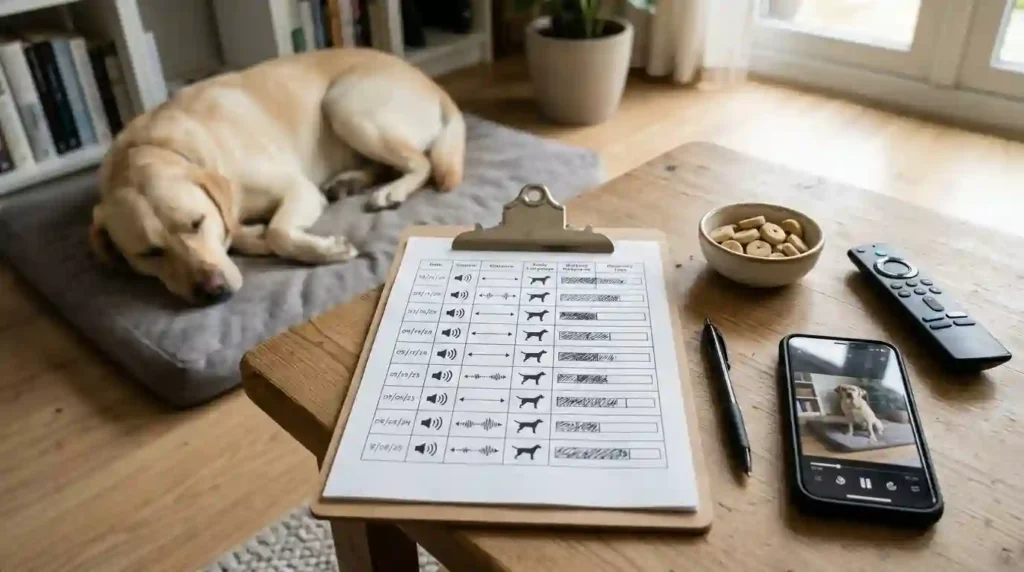
Keep a Simple Progress Record
A written record can help identify patterns that are difficult to notice from memory.
Record:
- Date and time
- Video or sound used
- Starting volume
- Distance from the device
- Dog’s body-language response
- Whether the dog accepted food
- Number of barks, if any
- Recovery time
- Adjustment needed for the next session
Progress is not always linear. A dog may react more strongly when tired, uncomfortable, startled, or exposed to other triggers earlier in the day.
When to Consult a Professional
Consider professional support when the reaction is severe, worsening, or connected to other behavioral concerns.
Seek help when your dog:
- Attempts to bite people or other animals during an episode
- Redirects aggression when restrained
- Panics or tries to escape
- Cannot eat even at extremely low volume
- Reacts strongly to many ordinary household sounds
- Has a history of serious fear or aggression
- Shows no improvement despite careful training
- Experiences a sudden or unexplained behavioral change
A qualified reward-based trainer or behavior consultant can observe the response directly and design a plan around your dog’s threshold. Severe anxiety, aggression, or sudden behavioral change may also require evaluation by a veterinarian or veterinary behavior specialist.
Conclusion
A dog reacting to recorded barking is not necessarily confused, disobedient, or aggressive. The sound may activate social interest, territorial behavior, fear, frustration, or a familiar alarm response.
Successful training begins by determining what the dog is communicating. Once you understand the emotional motivation, you can reduce the sound to a manageable level and pair it with calm, rewarding experiences.
Keep sessions brief, begin at a very low volume, reward the moment your dog notices the sound without escalating, and increase difficulty gradually. Avoid punishment, forced exposure, and repeated testing at full volume.
The most meaningful sign of improvement is not simply silence. It is a dog that can hear recorded barking, remain physically relaxed, respond to its owner, and return to normal behavior without prolonged distress.
Frequently Asked Questions
Why does my dog bark at dogs on YouTube but ignore dogs outside?
The recording may contain a particular pitch, rhythm, or type of bark that attracts your dog’s attention. The indoor sound can also be confusing because the dog cannot locate its source through normal visual and scent information. In other cases, the dog may feel safer reacting indoors than it does around real dogs.
Does my dog think the dog on the screen is real?
Possibly, but that is not the only explanation. Some dogs appear to respond to the image, while others react only to the sound. A dog can recognize the barking as relevant without believing a real dog is physically inside the screen.
Should I let my dog watch videos of other dogs?
Yes, provided the experience does not cause significant stress or uncontrolled reactivity. Begin with muted or low-volume content and observe body language. Stop the video if the dog becomes frightened, highly aroused, or unable to disengage.
Can dog videos help socialize a puppy?
Videos cannot replace safe, controlled experiences with suitable dogs. Socialization involves learning through real environments, movement, scent, distance, and interaction. Recordings may be used as gentle sound exposure, but they should not be treated as complete socialization.
Why does my dog search behind the television?
The dog may hear the barking but be unable to identify its source. Looking behind the television is a reasonable attempt to locate the animal producing the sound. Avoid laughing, chasing the dog, or turning the search into an exciting game.
Should I say “no” when my dog barks at YouTube?
A calm interruption may stop a mild reaction, but repeatedly saying “no” does not teach the dog what to do instead. Redirect the dog to a clear alternative behavior, such as looking at you, touching your hand, or settling on a mat.
Can I use a bark collar for this problem?
A bark collar does not address why the dog is reacting. It may suppress vocal behavior while leaving fear, frustration, or territorial arousal unchanged. A gradual reward-based training plan is generally more useful for changing the underlying response.
How long does desensitization training take?
The timeline varies. Mild reactions may improve after several consistent sessions, while fearful or highly reactive dogs may require weeks or longer. Progress depends on the dog’s history, emotional intensity, training frequency, and whether high-volume reactions continue outside planned sessions.
What should I do if my dog refuses treats during training?
Refusing familiar food often suggests that the dog is too aroused, anxious, or distracted to learn effectively. Pause the recording, increase the distance, lower the volume, and allow the dog to recover. Begin the next session at a much easier level.
Why did my dog suddenly start reacting to animal sounds on television?
The dog may have experienced a frightening encounter, become more alert to outside animals, or developed changes in hearing, vision, pain, or general health. Sudden behavior changes should be discussed with a veterinarian, particularly when accompanied by other physical or behavioral symptoms.
Will ignoring the barking make it stop?
Ignoring may reduce attention-seeking barking, but it will not necessarily resolve fear, alarm, or territorial behavior. The appropriate response depends on the motivation. Manage the sound, lower arousal, and teach a calm alternative rather than relying on ignoring alone.
Can I train multiple dogs at the same time?
Individual training is usually easier at first. One dog’s reaction can increase the arousal of the others. Train each dog separately until it can remain calm, then conduct short group sessions at an easier sound level.