


Summary
If you are asking what’s the best dog food for Labradors, choose a complete and balanced diet for your Lab’s life stage, then control the portion closely. Most healthy adult Labradors do well on high-quality dog food with a named animal protein, moderate fat, useful dietary fiber, and enough omega-3 fatty acids to support skin, coat, and joints. Puppies need large-breed puppy food with controlled calcium and calories, while less-active adults and seniors often benefit from a lower-calorie formula that protects muscle without encouraging weight gain.
The label matters, but the amount in the bowl matters just as much. Labradors are enthusiastic, food-motivated eaters, and some carry a POMC gene mutation associated with greater appetite and obesity risk. That means a Lab may act hungry even after receiving enough energy. Instead of feeding by pleading eyes or bowl volume alone, calculate portions from calories per cup, divide the daily amount into measured meals, count treats, and adjust according to body condition. This guide shows you how.
Table of Contents
- What makes a dog food suitable for Labradors?
- The most important nutrients for Labs
- Puppy, adult, and senior food choices
- Dry, wet, fresh, raw, and home-cooked diets
- Labrador calorie and portion guide
- How much to feed a black Lab
- Obesity, joint health, bloat, and other concerns
- Food allergies and sensitive digestion
- How to compare labels and popular formulas
- Safe food transitions and common mistakes
- Frequently asked questions
What’s the Best Dog Food for Labradors? The Short Answer
A Labrador Retriever is a sturdy, athletic, large-breed dog developed as a working retriever. Field-bred Labs may spend hours training, swimming, or retrieving, while many family Labs get a couple of walks and plenty of sofa time. Both dogs may love food equally, but they do not have equal energy needs.
For most healthy Labradors, a strong starting choice has six characteristics:
- Complete and balanced nutrition for the correct life stage
- Appropriate calories for the dog’s actual activity level
- Quality meat-based protein from a named protein source
- Moderate fat unless the dog performs sustained work
- Fiber and digestible carbohydrates that support satiety and stool quality
- Transparent formulation, manufacturing, and quality-control practices
Start with the AAFCO statement, sometimes called the nutritional adequacy statement. The official AAFCO guidance on selecting pet food explains that “complete” food supplies all required nutrients and “balanced” food provides those nutrients in appropriate ratios. The statement should identify growth, adult maintenance, gestation/lactation, or all life stages.
AAFCO establishes nutrient profiles and feeding protocols, but it does not award an “AAFCO-approved” seal to individual products. A food may substantiate nutritional adequacy through AAFCO nutrient profiles or animal feeding trials. Both are recognized routes; feeding trials add information about how dogs perform while eating the finished product.
Price, ingredient poetry, and a Labrador photograph on the bag do not answer the central question. A breed-specific formula can be convenient, but a well-made general large-breed formula may fit just as well. The right diet is the one that meets nutritional standards, fits your budget, agrees with your dog, and maintains a lean, muscular body.
Food routines also shape behavior. Labs quickly learn that staring, nudging, barking, or carrying the empty bowl may produce another snack. The Dog Behavior resource can help owners separate genuine nutritional needs from reinforced food-seeking habits.
Why Labrador Nutrition Requires Portion Discipline
A powerful appetite is part biology and part learning
Labradors have a reputation for eating first and asking questions later. That food-motivated appetite is helpful during training, but it also makes overfeeding easy. Research has identified a POMC gene deletion in a portion of Labrador Retrievers. The variant is associated with increased appetite, food motivation, and weight risk; it does not mean every Lab carries the mutation or that weight gain is inevitable.
Environment still matters. Free-feeding, large treats, table scraps, missed exercise, and oversized scoops can turn a modest biological tendency into obesity. Conversely, measured portions, structured meals, suitable exercise, and careful treat allowance can keep a genetically hungry Lab in excellent condition.
Satiety is not measured by how long your dog looks at the cupboard. If a Lab receives enough calories but continues to solicit food, more food is not necessarily the answer. A weight-management diet with moderate fat and higher fiber may provide more volume or fullness for fewer calories, but portion control remains essential.
Black, yellow, and chocolate Labs have the same feeding principles
Coat color does not determine nutritional requirements. When someone asks how much to feed a black Lab, the answer depends on body weight, age, neuter status, activity, health, body condition, and the food’s calorie density—not whether the coat is black, yellow, or chocolate.
An active 55-pound black female may need more energy than an inactive 80-pound male. A growing puppy, pregnant dog, field retriever, senior, and overweight pet each require different calorie targets even if they are the same color. Use the individual dog as your guide.
Essential Nutrients in a High-Quality Labrador Diet
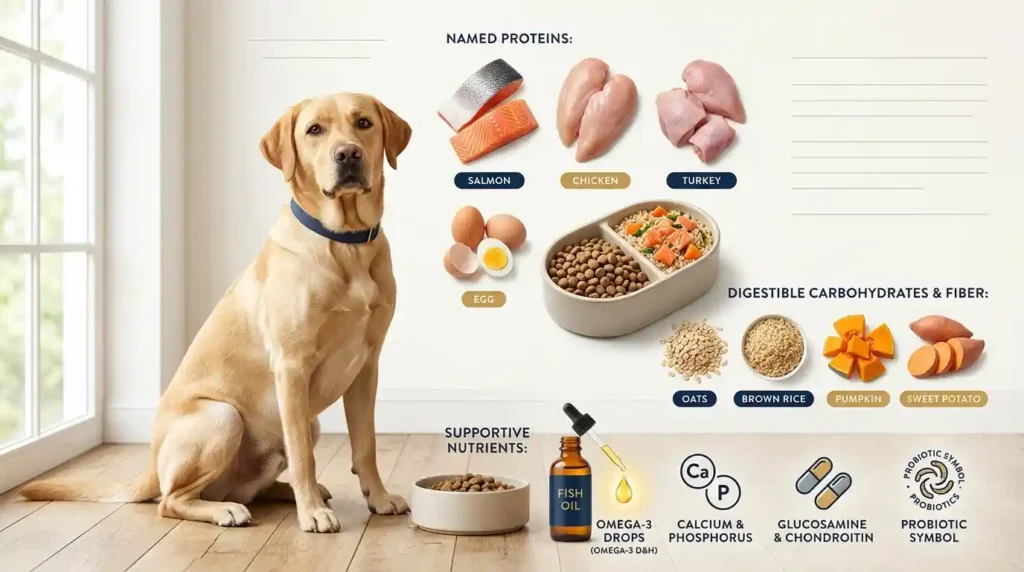
Protein for lean muscle and tissue repair
Animal protein supplies essential amino acids used to build and repair muscle, skin, enzymes, hormones, and other tissues. Growing puppies need protein for muscle development, active adults need it for recovery, and seniors need adequate protein for muscle maintenance.
Look for a named protein source such as chicken, beef, turkey, lamb, salmon, duck, whitefish, eggs, or a named meat meal. A term such as “chicken meal” is more informative than a vague phrase such as “animal protein.” Meat meal is concentrated because much of its water has been removed; it is not automatically inferior to fresh meat.
Crude protein on the guaranteed analysis is a quantity measure, not a complete quality rating. It does not reveal the digestibility or balanced amino acid profile of the food. High protein also does not cancel excess calories. A calorie-dense, protein-rich food can still promote unwanted weight gain if the portion is too large.
Moderate fat for energy without calorie overload
Fat supports palatability, cell membranes, hormone production, and absorption of fat-soluble vitamins. Saturated fat and unsaturated fat can both appear in a balanced diet. Essential fatty acids, including omega-3 fatty acids and omega-6 fatty acids, contribute to skin health, coat health, brain function, and normal inflammatory responses.
EPA and DHA from fish oil are especially relevant for joint comfort and skin. Flaxseed supplies ALA, another omega-3 fatty acid, although dogs convert ALA to EPA and DHA inefficiently. Chicken fat and other named animal fats can supply energy and palatability.
A working retriever may use a higher-fat, higher-calorie diet efficiently. A typical household Lab often needs moderate fat because fat is energy-dense. Compare crude fat alongside kcal per cup; a small-looking serving of rich dry kibble can deliver more energy than a larger portion of lower-calorie food.
Carbohydrates, whole foods, and fiber
Dogs can digest properly cooked carbohydrates. Oats, brown rice, sweet potatoes, pumpkin, potatoes, and quinoa can supply energy and dietary fiber. Complex carbohydrates are not automatically filler ingredients, and a grain-inclusive diet is not inherently lower quality than a grain-free diet.
Fiber is especially useful for Labs because it can add bulk, support normal stool, and help with satiety. Prebiotics nourish selected gut bacteria, while probiotics introduce beneficial microorganisms. These additions may support digestive health, but they do not replace diagnosis when a dog has persistent diarrhea, vomiting, or weight loss.
Some recipes add vegetables, fruit, carrots, leafy greens, or coconut oil. Those ingredients can contribute nutrients, but their presence does not prove that the finished food is balanced. The total formulation matters more than a few ingredients featured on the front of the package.
Vitamins, minerals, and supportive compounds
Calcium and phosphorus support bone growth and many other body functions. Large-breed puppies need controlled calcium and an appropriate calcium-to-phosphorus relationship so growth proceeds steadily. More calcium is not better. Adding bone meal, calcium powder, vitamin D, or broad mineral products to complete large-breed puppy food can disrupt the intended balance.
Vitamin A, vitamin B compounds, vitamin D, and vitamin E contribute to vision, metabolism, tissue maintenance, and antioxidant systems. Iron, copper, selenium, zinc, magnesium, and iodine are also essential in suitable amounts. Organ meat can supply protein, fat, vitamins, and minerals, but feeding organ meat alone would not provide a complete diet.
L-carnitine supports fat metabolism and appears in some breed-specific and weight-management formulas. Taurine contributes to cardiovascular and other functions. Glucosamine and chondroitin are commonly included for cartilage and joint support. These nutrients may complement a healthy-weight plan, but none can reverse hip dysplasia or offset obesity.
Clean, fresh water is essential for hydration, digestion, temperature control, and normal organ function. Wet dog food and fresh dog food contain more moisture than kibble, but dogs eating dry food can remain well hydrated when water is always available.
What’s the Best Dog Food for Labradors at Each Life Stage?
Labrador puppies
Large-breed puppy food is the appropriate default for a growing Lab. Confirm that the AAFCO statement covers growth, including growth of large-size dogs. This wording is more meaningful than a puppy image or “premium growth” claim.
The aim is controlled growth, not the fastest possible bone growth. A calorie-dense general puppy formula, overfeeding, or extra supplementation may push growth too quickly and increase developmental orthopedic disease risk. Labrador puppies can be vulnerable to hip dysplasia, elbow dysplasia, and osteochondrosis, so maintaining a lean condition matters from the beginning.
Puppies generally need several meals because their daily food must be divided into manageable portions. Very young puppies commonly eat three or four times daily, moving toward two meals as they approach adulthood. Follow the exact formula’s feeding guidelines, assess growth and body condition, and ask your veterinarian when to transition.
Orijen Puppy Large and large-breed puppy foods from companies such as Purina, Hill’s, Royal Canin, Eukanuba, Wellness, and Open Farm represent different approaches. Never assume every formula from a brand has the same nutritional adequacy or calorie content; check the exact product.
Adult Labradors
Adult maintenance food should preserve lean muscle mass while keeping calories under control. Many pet Labs do well with a large-breed adult food containing moderate fat, useful fiber, a named protein source, and omega-3 fatty acids. An adult that trains, hunts, retrieves, or runs for long periods may need a higher-energy formula and larger portion.
Most adult Labs benefit from twice-daily feeding. Splitting the daily ration makes portioning easier, prevents one very large meal, and creates two predictable training opportunities. A slow-feeder bowl may help a rapid eater take more time.
Senior Labradors
Senior dog food is not defined by one universal nutrient profile. The best choice depends on activity, muscle condition, dental comfort, digestion, and disease. Many older Labs need fewer calories but still require adequate protein. Cutting calories by choosing a food that is also unnecessarily low in protein can work against muscle maintenance.
An older dog with osteoarthritis may benefit from a weight-management diet, fish oil, or a veterinarian-approved joint product such as Dasuquin or Cosequin. Glucosamine and chondroitin in food may offer support, but therapeutic doses, product quality, medication interactions, and total calories should be discussed with a veterinarian.
Explore Dogs Breeds Feeding for more life-stage and breed-specific guidance. Large breeds share some principles, but appetite, activity, body structure, and inherited risk shape each feeding plan. For comparison, the guide to Dog Food for German Shepherds focuses on another athletic large breed with different digestive and working-dog considerations.
What Do Labradors Eat? Comparing Food Formats
Dry kibble
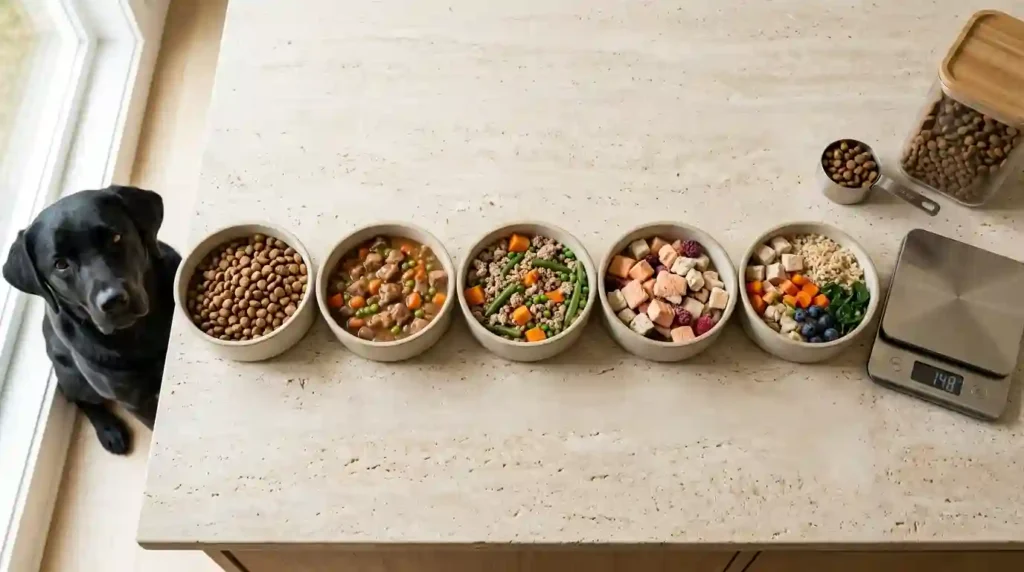
Dry kibble is convenient, economical, shelf-stable, and easy to measure. Many thoroughly researched foods are available in this format. Kibble also works in training toys and slow feeders, but calorie density varies widely. Measuring by eye is one of the easiest ways to overfeed.
Kibble does not reliably clean teeth well enough to replace dental hygiene. Store it sealed, cool, and dry, and use it within the manufacturer’s freshness window so fats do not become stale.
Wet dog food
Wet dog food provides additional moisture and may be easier to chew or more palatable. It can be fed as a complete meal or a measured topper, provided the label states the intended use. Compare kcal per can or tray with kcal per cup of dry food before combining them.
Fresh dog food
Fresh services such as The Farmer’s Dog, Open Farm, and Nom Nom Fresh may offer lightly cooked, pre-portioned meals. Freshness and appearance do not automatically guarantee complete and balanced nutrition. Confirm the AAFCO statement, refrigeration requirements, calorie content, and portion assumptions.
Raw diet (BARF)
A raw diet may include meat, organs, and bones. It requires careful nutritional formulation, freezer and refrigeration space, hygienic preparation, and attention to pathogens that can affect pets and people. Growing puppies are especially vulnerable to calcium, phosphorus, and other nutrient errors.
Raw bones can fracture teeth, obstruct the digestive tract, or cause injury. Households with young children, older adults, pregnant people, or immunocompromised family members should discuss microbiological risks with their veterinarian before handling raw pet food.
Home-cooked diet
A home-cooked diet can be appropriate when formulated for a specific dog, but chicken and rice, meat and vegetables, or internet recipes are rarely complete for long-term feeding. Work with a board-certified veterinary nutritionist—often identified by the DACVN credential or another recognized specialty qualification—and follow the recipe exactly. Ingredient substitutions and skipped supplements can unbalance a carefully designed plan.
Grain-free and limited-ingredient diets
A grain-free diet replaces grains with other carbohydrate sources, often peas, lentils, or potatoes. It is not necessarily lower in carbohydrates or more digestible. Choose it for a clear nutritional or medical reason, not because “grain-free” sounds more natural.
A limited-ingredient diet reduces recipe complexity and may help some dogs, but retail products are not automatically appropriate for diagnosing a food allergy. Cross-contact and unlisted trace proteins can interfere with an elimination trial. A veterinarian or veterinary dermatologist may recommend a controlled novel-protein or hydrolyzed therapeutic diet instead.
How Much to Feed a Labrador Retriever
There is no universal answer in cups. Food energy can range dramatically, so how much a Labrador eats must be calculated from both daily calorie need and calorie density. Three cups of one food may provide the same energy as four cups of another.
Start with calories, then convert to cups
A common starting equation is resting energy requirement:
RER = 70 × body weight in kilograms^0.75
For many neutered or moderately active adults, an illustrative maintenance range is roughly 1.4 to 1.8 times RER. Individuals can fall below or above this range. Puppies, intact adults, field dogs, pregnant or lactating dogs, seniors, and dogs with medical conditions use different factors.
| Labrador weight | Approximate RER | Illustrative adult maintenance range |
| 50 lb | 730 kcal/day | 1,020–1,310 kcal/day |
| 55 lb | 785 kcal/day | 1,100–1,410 kcal/day |
| 60 lb | 835 kcal/day | 1,170–1,500 kcal/day |
| 70 lb | 940 kcal/day | 1,315–1,690 kcal/day |
| 80 lb | 1,035 kcal/day | 1,450–1,865 kcal/day |
These figures are starting estimates, not prescriptions. A sedentary 70-pound Lab carrying extra fat may require fewer calories than the table, while a lean working retriever may require substantially more.
Now find kcal per cup, can, tray, or gram on the package:
Daily food quantity = target daily calories ÷ calories per food unit
If a dog’s target is 1,350 kcal and the food contains 375 kcal per cup:
1,350 ÷ 375 = 3.6 cups per day
Split the 3.6 cups into two measured meals. If training treats contribute 120 kcal, subtract those calories from the meal ration or use part of the measured kibble as rewards.
How much do Labs eat by life stage?
| Life stage | Typical meal frequency | Portion priority |
| 8–12-week puppy | 3–4 meals daily | Small portions and steady growth |
| 3–6-month puppy | 3 meals daily | Controlled calories and weekly monitoring |
| 6–12-month puppy | Usually 2 meals daily | Large-breed growth and lean condition |
| Adult | 2 measured meals daily | Calorie control and treat tracking |
| Senior | 2 or more smaller meals if useful | Muscle preservation and lower energy needs |
Puppies should be fed according to the growth chart for the exact food, expected adult weight, current condition, and veterinary advice. Adult cup estimates from a generic chart should not be applied to growing puppies.
Measuring accurately
Use a standard eight-fluid-ounce measuring cup, level the food, and avoid household mugs or unmarked scoops. A kitchen scale is even more consistent because grams do not depend on kibble shape. Weigh a day’s allowance in the morning, then take meals and training rewards from that container.
A feeding calculator or portion converter can create a starting figure, but the dog’s weight trend closes the loop. Recheck body weight and body condition every two to four weeks after changing food or portions.
How Much Should a Black Lab Eat?
A black Lab should eat the same calculated amount as a yellow or chocolate Lab of the same weight, life stage, activity, neuter status, body condition, and health. Coat color is not a multiplier in a calorie equation.
Owners searching “how much should I feed my black Lab” should collect four numbers:
- The dog’s current weight
- The dog’s body condition score
- The daily calorie target
- The food’s kcal per cup or gram
For example, two black Labs may both weigh 70 pounds. One is a lean field dog working several days each week; the other is a low-activity pet with no visible waist. Feeding them equal portions because they share color and weight would ignore the most important differences.
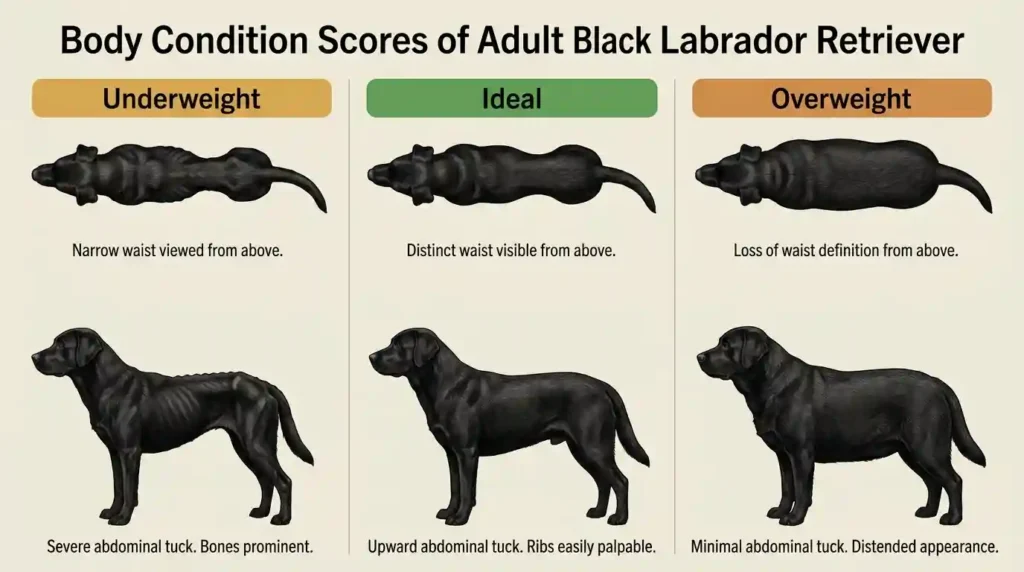
If you are asking how much food a black Lab should eat because the dog always seems hungry, assess condition before adding food. You should be able to feel the ribs under a light fat covering, see a waist from above, and observe an abdominal tuck from the side. If the dog is already ideal or heavy, hunger behavior is not evidence that the calorie allowance is insufficient.
Adjusting Portions With Body Condition and Weight Trends
The feeding directions on a package are estimates designed for a broad population. Your Lab’s body condition is the practical feedback system.
Signs the portion may be too large
- Ribs are difficult to feel
- Waist is disappearing when viewed from above
- Abdomen hangs rather than tucking upward
- Weight increases over several checks
- Exercise tolerance declines
- Treats and chews are not included in daily calorie intake
Signs the portion or plan needs reassessment
- Ribs, spine, or hips become too prominent
- Unplanned weight loss continues
- Muscle mass decreases
- Hunger is paired with diarrhea or large stool volume
- Energy declines despite normal activity
- The dog loses weight while eating eagerly
Adjust calories in modest steps, often around 5% to 10%, and reassess rather than making dramatic changes each day. Unexpected weight loss, persistent excessive hunger, or rapid weight gain warrants a veterinarian’s evaluation. Hypothyroidism, digestive disease, medication, pain, and other conditions can influence weight or activity.
Labrador Health Risks That Food and Portions Can Influence
Obesity and impaired satiety
Obesity is the most obvious nutrition-related risk in Labradors. Excess weight increases stress on hips, elbows, knees, and the spine. It can reduce mobility and complicate osteoarthritis, cruciate ligament injury, and other joint disease.
A high-quality food does not prevent obesity when overfed. Calorie control, measured portions, exercise, and treat discipline are the decisive tools. Treats are best kept to a modest share of the daily energy budget—often no more than about 10%—so complete food remains the primary source of nutrition.
Training can use tiny treats, pieces of vegetables approved for dogs, or part of the daily kibble allowance. Avoid assuming that a dental chew, stuffed toy, or slice of cheese is calorie-free.
Hip dysplasia, elbow dysplasia, and osteoarthritis
Hip dysplasia and elbow dysplasia have genetic and developmental components. Food cannot reshape an abnormal joint, but controlled growth and a healthy weight reduce unnecessary joint stress. Protein supports the muscle that stabilizes joints; EPA and DHA may help normal inflammatory balance and joint comfort.
Glucosamine, chondroitin, and fish oil are commonly included in joint diets and supplements. Ask a veterinarian about dose and product quality before adding them, particularly if the dog takes medications or has another medical condition. More supplements are not always better.
Gastric dilatation-volvulus
Labradors are deep-chested dogs and may develop gastric dilatation-volvulus (GDV), often called bloat. GDV is a life-threatening emergency in which the stomach fills and can twist.
Feed two or more smaller frequent meals rather than one very large meal. Use a slow-feeder bowl when rapid eating is a problem, and avoid vigorous exercise immediately after eating. An elevated bowl should not be used as a preventive strategy unless a veterinarian recommends it for another need.
Unproductive retching, abdominal swelling, drooling, agitation, weakness, or collapse requires immediate emergency care. No dog food can treat GDV.
Exercise-induced collapse
Exercise-induced collapse is an inherited neuromuscular condition identified in some Labradors. Affected dogs may become weak or collapse after intense activity. Nutrition should support normal energy needs and hydration, but food does not replace diagnosis, exercise management, or veterinary care.
Dietary indiscretion and foreign-body ingestion
Many Labs swallow items that are not food. Socks, toys, wrappers, rocks, and trash can cause poisoning, stomach upset, or foreign-body obstruction. Portioning more food will not cure scavenging. Supervision, secure storage, training, and enrichment are essential.
Food Allergy, Food Sensitivity, and Digestive Problems
A food allergy triggers an immune response. A food sensitivity or intolerance can cause digestive or skin signs without the same immune mechanism. Symptoms overlap with environmental allergies, parasites, infection, and other diseases, so ingredients should not be blamed automatically.
Possible signs include itching, atopic dermatitis, recurring ear infection, foot irritation, vomiting, diarrhea, and gas. Commonly discussed food triggers include beef, dairy, wheat, eggs, chicken, lamb, soy, pork, rabbit, and fish. A list of common triggers does not tell you which ingredient affects an individual dog.
If symptoms are chronic, work with a veterinarian or a dermatology veterinarian. A controlled elimination trial may use a hydrolyzed or genuinely novel protein formula for a defined period. Randomly rotating among retail foods can make diagnosis harder.
For mild digestive sensitivity after medical causes are excluded, a consistent diet with moderate fat, digestible carbohydrates, and appropriate fiber may help. Prebiotics and probiotics can support gut bacteria, but severe vomiting, blood in stool, dehydration, pain, or weight loss requires prompt care.
The Dogs Food section offers more guidance on ingredients and food formats. Use those comparisons to understand a label, not to self-diagnose allergy or prescribe a therapeutic diet.
How to Read a Labrador Dog Food Label
Confirm the intended life stage
Read the AAFCO statement before the marketing copy. A puppy needs a growth or suitable all-life-stages statement that includes large-size growth. A healthy adult usually needs adult maintenance. Therapeutic veterinary foods may carry different directions and should be used as prescribed.
Find calorie density
Calorie density is commonly listed as kcal per cup and kcal per kilogram. It determines how much energy a scoop delivers. When switching foods, do not transfer the old cup amount automatically; calculate the new serving from calories.
Interpret the guaranteed analysis
The guaranteed analysis typically lists minimum crude protein and crude fat plus maximum crude fiber and moisture. These are “as fed” values. Comparing wet and dry food fairly may require conversion to a dry matter basis, which removes moisture from the calculation.
Dry matter comparisons are useful, but they still do not measure protein quality, amino acid balance, digestibility, manufacturer expertise, or clinical suitability.
Read the ingredient list in context
Ingredients appear in descending order by weight before processing. Fresh chicken contains substantial water, while chicken meal is concentrated. The first ingredient is informative, but no single line can prove that the finished food delivers balanced nutrition.
Artificial colors have no nutritional benefit for the dog. Preservatives protect fats from spoilage, so the relevant question is which preservative system the food uses and whether the finished product remains stable and safe. “Natural” is not a substitute for evidence.
Evaluate the manufacturer
Useful questions include:
- Who formulates the food, and what are their credentials?
- Does the company employ a board-certified veterinary nutritionist?
- Are recipes validated through feeding trials or only formulated on paper?
- Does the manufacturer test the finished product?
- Can it provide typical nutrient data beyond guaranteed minimums?
- Where is the product made?
- How are suppliers audited and recalls handled?
WSAVA manufacturer guidelines are a question framework, not a brand certification list. Look for transparent answers rather than a claim that a food is “WSAVA approved.”
Popular Labrador Dog Food Options to Compare
Owners often want one winner, but product lines change, and individual needs differ. The following foods illustrate common approaches; they are not personal prescriptions.
Royal Canin Labrador Retriever Adult
This breed-specific formula uses a kibble shape intended to influence eating behavior and includes nutrients aimed at weight, skin, coat, and joint support. Compare its calorie content and ingredients with general large-breed foods rather than assuming breed-specific automatically means best.
Purina Pro Plan Large Breed Adult Chicken & Rice
This is a widely available, research-backed large-breed option with chicken, probiotics in selected versions, and feeding-trial support. Confirm the exact recipe because similarly named products can differ in calories and intended use.
Hill’s Science Diet Large Breed and Perfect Weight
Hill’s Science Diet Large Breed targets general adult needs, while Hill’s Science Diet Perfect Weight emphasizes calorie control and satiety. A weight-management formula may help an overweight Lab, but the measured portion still determines the result.
Orijen Original and Orijen Puppy Large
Orijen products tend to be protein-rich and calorie-dense. Orijen Puppy Large is positioned for large-breed growth, while Orijen Original is commonly considered for adults. Rich food demands accurate portions, especially in a low-activity Lab.
Wellness CORE Large Breed
Wellness CORE Large Breed is a protein-forward option available in different grain configurations. Review calories, fat, legumes, and the AAFCO statement on the current package.
Diamond Naturals Large Breed
Diamond Naturals Large Breed is often considered by budget-conscious owners seeking a large-breed recipe. Compare cost per day, not only cost per bag, because calorie density affects how long the food lasts.
Eukanuba Large Breed Adult
Eukanuba Large Breed Adult is frequently considered for active dogs. Match energy density to real exercise; a sporting image on the bag does not make every household Lab a working athlete.
Fresh-food services
The Farmer’s Dog, Open Farm, and Nom Nom Fresh offer fresh or gently cooked formats. Check nutritional adequacy, calorie calculations, storage, delivery reliability, and price per day. Pre-portioned packaging can help, but body condition still determines whether the suggested amount is right.
The best food may be the current food if your Lab has firm stool, comfortable skin, stable energy, a healthy coat, good muscle condition, and an ideal weight. Changing a successful diet solely because another product has trendier ingredients may add cost and digestive disruption without benefit.
How to Transition to a New Dog Food
An abrupt food change can cause diarrhea, gas, vomiting, or refusal even when the new diet is suitable. Unless a veterinarian instructs otherwise, use a gradual food transition over seven to ten days.
| Transition days | Current food | New food |
| 1–2 | 75% | 25% |
| 3–4 | 50% | 50% |
| 5–6 | 25% | 75% |
| 7 onward | 0% | 100% |
Sensitive dogs may need a slower schedule. When calorie density differs substantially, compare calories rather than mixing equal cup volumes. Keep toppers and treats consistent so you can identify the cause of any reaction.
Monitor stool, appetite, skin, ears, energy, and weight. Facial swelling, hives, breathing difficulty, repeated vomiting, bloody diarrhea, severe weakness, or collapse needs immediate veterinary attention.
Common Labrador Feeding Mistakes
Feeding according to appetite alone
A Lab may finish a meal instantly and ask for more. Appetite does not measure energy requirement, especially in a breed with strong food motivation and possible impaired satiety.
Guessing the portion
An overfilled scoop repeated twice daily can add significant calories. Measure cups level or weigh food in grams, and count every topper, treat, and chew.
Using exercise to outrun overfeeding
Exercise is essential, but a few calorie-dense extras can erase the energy used on a walk. Adjust intake and activity together instead of relying on exercise to compensate for unrestricted food.
Adding extra supplements to balanced food
Healthy dogs eating complete and balanced nutrition often do not need extra supplementation. Added calcium is especially risky for growing large-breed puppies. Discuss fish oil, joint products, vitamins, or minerals with a veterinarian.
Switching food every time stool changes
Rapid changes can create the digestive instability owners are trying to solve. Keep the diet consistent, investigate persistent symptoms, and transition methodically when a change is justified.
Treating grain-free as a quality guarantee
Grain-free describes what is absent, not whether the food is complete, digestible, safe, or appropriate. Evaluate the entire formulation and manufacturer.
Confusing a full bowl with good care
For an obesity-prone Lab, love looks like a measured ration, a healthy waist, daily activity, and the ability to move comfortably—not unlimited access to food.

Conclusion
What is the best food for Labradors? It is a complete and balanced, life-stage-appropriate diet that preserves muscle, supports joints and skin, agrees with digestion, and makes healthy weight achievable. For puppies, that usually means large-breed puppy food with controlled calcium and calories. For adults, it often means quality protein, moderate fat, helpful fiber, and disciplined portions. Seniors may need fewer calories but should not lose adequate protein without a medical reason.
Portion is part of the food choice. Calculate a starting calorie target, convert it using kcal per cup or gram, divide the ration into two or more meals, and track treats. Then let body condition and weight trends guide careful adjustments.
If your Lab has unexplained weight change, chronic digestive signs, suspected food allergy, hypothyroidism, exercise-induced collapse, pancreatitis, orthopedic disease, or another medical concern, involve a veterinarian. A board-certified veterinary nutritionist can provide a personalized commercial-food recommendation or formulate a balanced home-cooked diet. The goal is not to satisfy every request for food; it is to keep your Labrador lean, strong, comfortable, and eager for the next adventure.
Frequently Asked Questions
What is a good dog food for Labs?
Choose complete and balanced food for the correct life stage, with named protein, appropriate calories, moderate fat, useful fiber, and transparent manufacturing.
What does a Labrador dog eat?
A Labrador can eat balanced kibble, wet, fresh, or properly formulated home-cooked food. The exact format matters less than nutritional adequacy and portions.
What do Labrador Retrievers eat as puppies?
Feed large-breed puppy food labeled for growth, including growth of large-size dogs. Control calories and avoid adding calcium supplements.
How much to feed a Labrador?
Divide the dog’s daily calorie target by the food’s kcal per cup or gram. Adjust the result using weight and body condition, not appetite alone.
How much should a Labrador eat each day?
Many adults eat roughly two measured meals daily, but the total varies with weight, activity, age, and calorie density. There is no universal cup amount.
How much to feed a black Lab?
Use the same calorie and body-condition method used for any Labrador. Black coat color does not increase or decrease nutritional needs.
How much should a black Lab eat if it always seems hungry?
Check weight and body condition before adding food. Strong food motivation or a POMC variant can make a well-fed Lab continue asking for more.
How much should I feed my black Lab puppy?
Follow the exact large-breed puppy food’s growth chart and your veterinarian’s advice. Divide the daily amount into multiple meals and monitor weekly growth.
How much food should a black Lab eat after neutering?
Energy needs may decrease after neutering. Monitor weight closely and reduce calories if body condition begins to rise, ideally with veterinary guidance.
How much do Labs eat when working in the field?
Working Labs may need considerably more energy than household pets. Increase calories based on workload, weight trend, weather, and professional guidance.
Should Labradors eat grain-free food?
Not by default. Grain-free food is appropriate only when the complete formula and the individual dog’s needs justify it.
Is raw food good for Labradors?
Raw diets can carry pathogen, bone, and nutrient-balance risks. Consult a veterinarian or veterinary nutritionist before using one long-term.
How often should an adult Labrador eat?
Most adults do well with twice-daily feeding. Smaller frequent meals can help manage rapid eating and avoid one oversized meal.
When should a Labrador switch to adult food?
Many Labs transition around 12 to 18 months, depending on growth and formula. Ask your veterinarian to assess your dog’s development.
Can I give my Labrador table scraps?
Occasional dog-safe extras must fit the calorie budget, but rich scraps can cause stomach upset and promote obesity. Some human foods are toxic to dogs.