


Summary: Excessive barking in dogs is one of the most common behavioral complaints among pet owners, and while training is essential, the most overlooked solution is consistent, appropriate physical exercise. This guide How Exercise Reduces Dog Barking explores the deep connection between a dog’s activity level and its tendency to bark excessively — covering the neuroscience, best exercise types, breed-specific needs, sample routines, and how to combine movement with training to create a calmer, quieter, and happier dog.
Table of Contents
- Understanding Problem Barking in Dogs
- The Science Behind Exercise and Canine Behavior
- How Exercise Directly Reduces Problem Barking
- Best Types of Exercise to Reduce Barking
- Building a Daily Exercise Routine for a Quieter Dog
- Combining Exercise with Training for Maximum Results
- Common Mistakes Dog Owners Make
- When Exercise Alone Isn’t Enough
- FAQs About Exercise and Dog Barking
Understanding Problem Barking in Dogs
What Is Problem Barking?
Barking is a completely natural form of communication for dogs. From a brief alert bark to a playful yip, vocalizations are woven into canine social behavior. However, problem barking — also called excessive, nuisance, or compulsive barking — refers to barking that is prolonged, repetitive, disproportionate to the trigger, or uncontrollable by the owner.
It becomes a welfare issue (for the dog, the owner, and the neighbors) when it occurs for extended periods, disrupts daily life, or signals underlying psychological distress. Recognizing the difference between normal communication and compulsive vocalization is the first step toward addressing the root cause.
Common Types of Excessive Barking
Understanding the type of barking matters enormously because it determines the correct intervention. The most common categories include:
- Boredom barking: Monotonous, repetitive barking that happens when a dog is left alone or unstimulated for long periods.
- Anxiety-driven barking: High-pitched, frantic barking often associated with separation anxiety or fear responses.
- Territorial/alert barking: Triggered by stimuli like strangers, other dogs, or vehicles approaching the home.
- Attention-seeking barking: Deliberate barking directed at the owner to solicit play, food, or interaction.
- Frustration barking: Occurs when a dog is restrained, leashed near stimuli it wants to reach, or blocked from something it desires.
If your dog barks frantically the moment guests arrive and won’t settle, read our in-depth resource on Dog Barking When Guests Arrive and Won’t Stop for targeted solutions for that specific trigger.
Why Dogs Bark Excessively — Root Causes
The most important concept to internalize: excessive barking is almost never random. It is always a symptom of an unmet need or an unresolved emotional state. The most common root causes are:
- Insufficient physical exercise — the single most correctable cause
- Lack of mental stimulation
- Anxiety disorders (separation anxiety, generalized anxiety)
- Learned behavior (rewarded by attention, even negative attention)
- Medical issues (pain, cognitive dysfunction in senior dogs)
- Inadequate socialization during the critical developmental window
The Science Behind Exercise and Canine Behavior
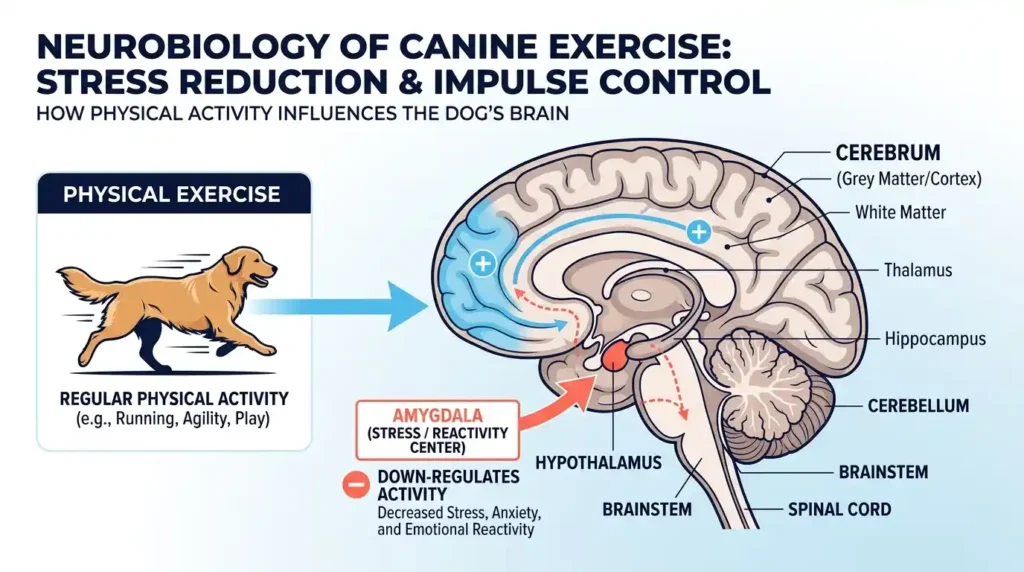
How Physical Activity Affects the Canine Brain
To understand why exercise works, we need to look at what happens inside a dog’s brain during and after physical activity. Dogs, like humans, have a limbic system that governs emotional responses. When a dog is chronically under-exercised, the limbic system — particularly the amygdala (the brain’s threat-detection center) — becomes hyperactive. This means the dog is more reactive, more easily triggered, and more likely to vocalize.
Physical activity engages the prefrontal cortex (responsible for impulse control) and simultaneously down-regulates amygdala reactivity. In behavioral science terms, exercise shifts a dog from a state of hyperarousal (high reactivity, low threshold for triggering) to a state of calm alertness — the optimal behavioral baseline.
The Role of Cortisol and Stress Hormones
Cortisol is the primary stress hormone in dogs, just as it is in humans. Chronically elevated cortisol — caused by boredom, confinement, or anxiety — directly increases reactivity and impulsive behavior, including barking. Studies in applied animal behavior consistently show that dogs with regular aerobic exercise maintain significantly lower baseline cortisol levels than sedentary dogs.
Lower cortisol means a lower resting state of arousal. A dog with a lower arousal baseline simply does not react as intensely to everyday triggers like a passing car, a knocking door, or a squirrel in the yard.
Endorphins, Dopamine, and the Calm Dog Effect
During aerobic exercise, a dog’s body releases endorphins (natural pain and stress relievers) and dopamine (the reward neurotransmitter). This neurochemical cocktail creates what dog trainers and behaviorists colloquially call the “calm dog effect” — a post-exercise window of 2 to 6 hours during which dogs are measurably less reactive, more trainable, and less prone to nuisance barking.
This is not anecdotal. It is the same neurobiological mechanism behind the “runner’s high” in humans, adapted to canine physiology. Understanding this mechanism helps owners time their training sessions strategically — right after exercise, when the dog’s brain is in its most receptive, calm state.
How Exercise Directly Reduces Problem Barking
Burning Off Excess Energy
The most intuitive mechanism is the simplest: a tired dog is a quiet dog. Many dogs — particularly high-drive working breeds like Border Collies, Huskies, Belgian Malinois, and Jack Russell Terriers — have energy reserves that far exceed what a typical suburban lifestyle can accommodate.
When that energy has no appropriate outlet, it spills into destructive behavior, anxiety, and incessant barking. Regular aerobic exercise depletes this energy reserve in a healthy, constructive way. The dog simply doesn’t have the physiological fuel to sustain prolonged, frantic barking when it has genuinely been exercised.
Reducing Anxiety-Driven Barking
Anxiety is one of the most powerful drivers of excessive barking. Whether it’s separation anxiety, noise phobia, or generalized fear, anxious dogs bark as a self-soothing and communication mechanism. Exercise addresses anxiety through three converging pathways:
- Neurochemical regulation — increased serotonin and endorphins reduce baseline anxiety
- Cortisol reduction — lowers the dog’s physiological stress response
- Confidence building — navigating varied environments during exercise builds resilience and reduces fear reactivity
Breaking the Boredom-Bark Cycle
Boredom barking is a self-reinforcing cycle: the dog barks → nothing changes → the dog barks more out of frustration → the owner eventually responds (even to scold) → the behavior is reinforced. Exercise breaks this cycle at the neurological level by providing genuine fulfillment. A dog that has had a satisfying run, game of fetch, or swimming session returns home and genuinely wants to rest. The motivational state that drives boredom barking — a restless, seeking, undischarged drive — is neutralized.
Best Types of Exercise to Reduce Barking

Aerobic Exercise (Running, Fetch, Swimming)
High-intensity aerobic exercise is the most effective at reducing cortisol and depleting energy reserves. The best options include:
- Running or jogging alongside the owner (ideal for medium to large breeds)
- Fetch games with a ball or frisbee — high-intensity bursts that engage the prey drive constructively
- Swimming — particularly excellent for senior dogs or those with joint issues, as it provides full-body aerobic exercise with minimal impact
- Dog park play — combines aerobic activity with socialization
Mental Exercise and Enrichment Activities
Physical exercise alone addresses only half the equation. Dogs also need cognitive stimulation — often called “mental exercise” — to reach a fully satisfied behavioral state. Mental exercise can be as tiring as physical exercise for many breeds. Effective mental enrichment includes:
- Puzzle feeders and Kong toys — engage the dog’s problem-solving drive
- Nose work and scent games — tapping into the olfactory system, which is deeply satisfying for dogs
- Obedience training sessions — 10–15 minutes of focused training engages the dog cognitively
- Hide-and-seek games — with toys, treats, or the owner
Structured Leash Walking vs. Off-Leash Play
A structured leash walk — where the dog walks calmly at your side, is asked to sit at crossings, and is not permitted to pull or lunge — is more mentally demanding than a loose, meandering sniff walk. Both have value, but they serve different purposes. Structured walks build impulse control (directly relevant to reducing reactive barking), while off-leash free play maximizes aerobic output and social development.
Ideally, a dog’s daily exercise includes both: structured movement for discipline and off-leash time for authentic expression of canine behavior.
Breed-Specific Exercise Needs
This is critical and frequently underestimated. A Labrador Retriever and a Basset Hound do not have the same exercise requirements, and treating them identically is a recipe for either over-exercise or chronic under-stimulation.
- High-energy working breeds (Huskies, Border Collies, Vizslas): 90–120+ minutes of vigorous daily exercise
- Sporting breeds (Labradors, Golden Retrievers, Spaniels): 60–90 minutes of active play and walking
- Terriers: High-intensity but shorter bursts; strong need for mental challenge
- Brachycephalic breeds (Bulldogs, Pugs): Low-intensity, frequent short walks; prone to overheating
- Toy breeds (Chihuahuas, Maltese): 20–30 minutes daily, with indoor play supplementing outdoor activity
Matching exercise type and intensity to the dog’s breed, age, and health status is fundamental to success. According to the American Kennel Club’s guidelines on exercise for dogs, breed characteristics should always guide exercise planning to avoid injury and maximize behavioral benefit.
Building a Daily Exercise Routine for a Quieter Dog
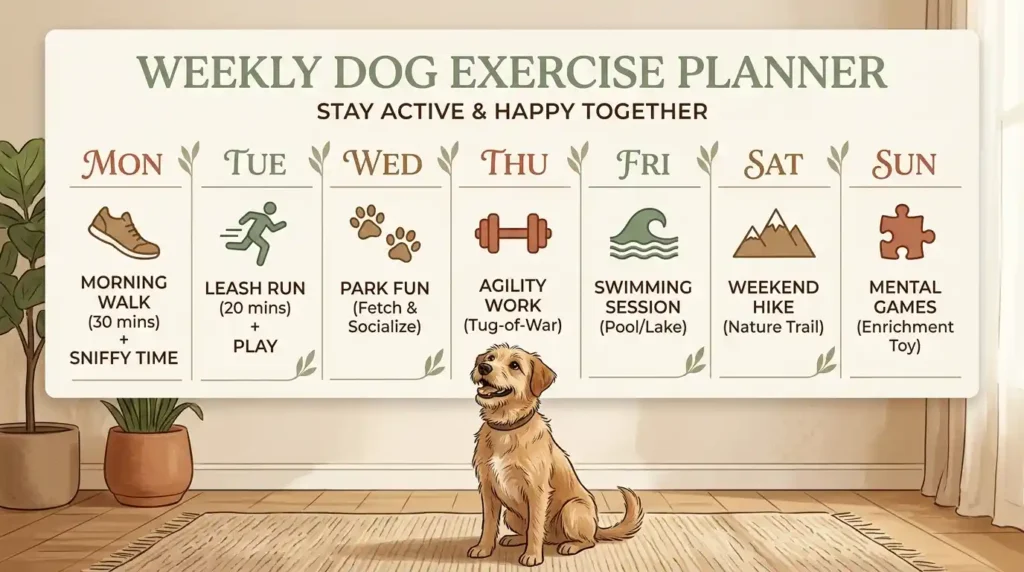
How Much Exercise Does Your Dog Really Need?
A commonly cited rule of thumb is at least 30 minutes of moderate exercise per day for average adult dogs, with high-energy breeds needing significantly more. However, this is a minimum baseline, not an optimal target. For dogs with established barking problems, 60–90 minutes of varied daily exercise is a more realistic therapeutic goal.
Puppies should not be over-exercised (risk of growth plate damage), while senior dogs benefit from frequent, shorter, lower-impact sessions to maintain mobility without strain.
Morning vs. Evening Exercise — Which Is Better?
Both matter, but morning exercise offers a distinct behavioral advantage. Starting the day with exercise reduces your dog’s arousal baseline for the entire day — including during the peak triggers of mail delivery, neighborhood activity, and daytime alone time. A morning walk or play session can dramatically reduce daytime barking, particularly for dogs with separation anxiety.
Evening exercise, meanwhile, helps dogs sleep more soundly through the night, reducing night-time barking and restlessness.
Sample Weekly Exercise Schedule
| Day | Morning | Afternoon/Evening |
| Monday | 30-min structured walk | 20-min fetch/play |
| Tuesday | 45-min run/jog | Puzzle feeder + obedience |
| Wednesday | 30-min sniff walk | Dog park (30 min) |
| Thursday | 45-min fetch session | 15-min training session |
| Friday | 30-min structured walk | 30-min swim or free play |
| Saturday | 60-min hike or long walk | Rest + Kong enrichment |
| Sunday | 30-min walk | 20-min nose work game |
Combining Exercise with Training for Maximum Results

Using Positive Reinforcement Alongside Physical Activity
Exercise creates the neurological conditions for learning; training capitalizes on them. The most effective behavioral modification protocol uses exercise first, training second. In the post-exercise window, the dog’s dopamine system is primed, cortisol is low, and attention span is at its peak. This is when positive reinforcement training — rewarding calm, quiet behavior — is most effective.
Teaching the “Quiet” Command Post-Exercise
The “quiet” cue is best introduced and reinforced when the dog is already in a calm, relaxed state — i.e., after exercise. The process:
- Wait for a natural moment of quiet.
- Mark the silence with a clicker or verbal marker (“yes!”).
- Reward immediately with a high-value treat.
- Add the verbal cue “quiet” as the dog begins associating the word with silence.
- Gradually extend the duration of quiet required before rewarding.
Socialization During Exercise
Exercising your dog in varied environments — parks, busy streets, pet-friendly stores — doubles as socialization, which directly reduces alert and territorial barking. According to the ASPCA’s comprehensive behavioral resource on dog barking and how to manage it, dogs that are well-socialized to a wide range of stimuli show markedly lower reactivity and territorial barking compared to dogs with limited exposure histories.
Common Mistakes Dog Owners Make
Over-Exercising or Under-Exercising
Both extremes are harmful. Over-exercise — particularly in young dogs or working breeds pushed beyond healthy limits — can create an exercise-induced arousal state where the dog becomes more reactive, not less. Puppies under 12–18 months (breed dependent) should avoid high-impact repetitive exercise to protect developing joints.
Under-exercise is the more common mistake: owners believing that a 10-minute backyard potty break constitutes adequate daily activity.
Ignoring Mental Stimulation
Many owners exercise their dogs physically but neglect cognitive enrichment. A Border Collie that runs 5 miles but has nothing to think about will still exhibit problem barking because its working intelligence is unstimulated. Mental and physical exercise must work in tandem.
Inconsistency in Routine
Dogs are creatures of routine. Inconsistent exercise schedules — active on weekends, sedentary on weekdays — fail to normalize the dog’s arousal baseline. Daily consistency is far more effective than sporadic intense sessions.
When Exercise Alone Isn’t Enough
Separation Anxiety Barking
True separation anxiety — a clinical anxiety disorder where the dog panics in the absence of its owner — requires a multimodal approach beyond exercise alone. It typically involves behavioral modification protocols (systematic desensitization and counterconditioning), environmental management, and sometimes veterinary-prescribed anxiolytic medications.
Exercise is a crucial component of the management plan, but it is not a standalone cure for clinical separation anxiety.
Territorial and Alert Barking
Some dogs have strong genetic predispositions to alert and territorial barking (guardian breeds like German Shepherds, Dobermans, and Rottweilers). Exercise reduces the intensity and frequency of this barking but may not eliminate it. Management strategies — blocking visual access to triggers, structured threshold training, desensitization — must complement an exercise routine.
When to Consult a Veterinarian or Behaviorist
Consult a professional if:
- The barking began suddenly in an adult dog with no change in environment (rule out medical causes, including pain or cognitive dysfunction)
- The barking is accompanied by aggression, self-harm, or destruction
- Exercise and training have produced no improvement after 4–6 weeks
- The dog shows signs of clinical anxiety (trembling, panting, inability to settle)
A Certified Applied Animal Behaviorist (CAAB) or Veterinary Behaviorist (Dip. ACVB) can provide a structured, evidence-based behavior modification plan tailored to the individual dog.
FAQs About Exercise and Dog Barking
Q: How quickly will exercise reduce my dog’s barking? Most owners notice meaningful improvement within 2–4 weeks of consistent daily exercise. The neurochemical changes are not immediate; they require sustained, regular activity to normalize the dog’s baseline arousal.
Q: Can I use a dog treadmill instead of outdoor exercise? A treadmill addresses physical energy depletion but eliminates the mental stimulation of outdoor environments. It can supplement outdoor exercise during bad weather but should not replace it entirely.
Q: My dog seems tired but still barks. Why? Physical fatigue and neurological calm are not identical. A dog can be physically tired but mentally overstimulated (high-arousal play can actually increase reactivity in some dogs). Ensure exercise is paired with calm-down time and mental enrichment, not just high-intensity play.
Q: Does exercise help with barking at other dogs? Yes, particularly when that exercise includes structured, positive exposure to other dogs. Reactivity-based barking at other dogs is often rooted in anxiety or frustration — both of which exercise directly addresses.
Q: At what age should I start exercising my puppy to prevent barking habits? Start with short, gentle, low-impact play and socialization from 8 weeks onward. Avoid sustained, high-impact exercise (long runs, repetitive jumping) until growth plates close — typically 12–18 months depending on breed size.