

Summary: Dogs bark when you talk on the phone due to a fascinating mix of canine psychology, learned behavior, and sensory confusion. Your dog hears only your voice, cannot detect a second person, and interprets your one-sided conversation as social communication directed at them — triggering excitement, anxiety, or attention-seeking responses. This guide, Why Does My Dog Bark When I Talk on the Phone, explores every dimension of this behavior: from the neurological and evolutionary roots of canine vocalization to practical, science-backed training methods that will restore peace during your calls.
Table of Content
- Understanding the Canine Brain and Social Communication
- Top Reasons Why Your Dog Barks During Phone Calls
- Breed-Specific Barking Tendencies
- The Psychology of Reinforcement: Are You Making It Worse?
- How to Stop Your Dog from Barking During Phone Calls
- When Barking Signals a Deeper Problem
- Frequently Asked Questions
- Final Thoughts
You pick up your phone, dial a number, and within seconds your dog is at your side — barking, whining, pawing at you, or circling your feet. Sound familiar? You are far from alone. This is one of the most commonly reported dog behavior complaints among pet owners, and it makes sense why: phone calls happen multiple times a day, they demand your full attention, and they seem to reliably trigger vocalization in even the most well-behaved dogs.
Understanding why your dog barks when you talk on the phone is the first step toward addressing it. The behavior is rooted in a complex interplay of canine cognition, emotional states, social instincts, and — often — learned patterns that owners have inadvertently reinforced over time. This comprehensive guide covers all of those angles using key concepts from applied animal behavior science, including stimulus-response conditioning, operant learning theory, emotional regulation, and canine communication ethology.
Understanding the Canine Brain and Social Communication
Before diagnosing why your dog barks during phone calls, it helps to understand how dogs perceive the world and process social signals. Dogs are intensely social animals whose evolutionary history as pack-living predators has shaped every aspect of their sensory and cognitive architecture.
How Dogs Process Human Speech and Voice Tone
Dogs do not understand language in the way humans do, but they are remarkably attuned to prosodic features — the rhythm, pitch, speed, and emotional coloring of speech. Research from the Family Dog Project at Eötvös Loránd University in Budapest has shown that dogs process verbal content in their left hemisphere and emotional tone in their right hemisphere, closely mirroring human neural organization.
When you speak on the phone, your dog picks up on several auditory cues that mean something to them: elevated pitch (often used when excited), frequent pauses, and changes in vocal tone. These prosodic signals are strong behavioral triggers. Your dog does not know you are talking to another human — they only know you are producing social vocalizations, and they cannot figure out the context.
The Role of Mirror Neurons and Empathy in Dogs
Dogs possess a well-documented capacity for emotional contagion — they ‘catch’ emotional states from the humans around them. This is partly mediated by mirror neuron systems that activate when observing the behavior of others. When you appear to be in a heightened state of social engagement (talking on the phone animatedly), your dog’s mirroring systems fire, and they become aroused or anxious in response.
This emotional contagion is one reason dogs that are highly bonded to their owners are especially prone to phone-call barking. The stronger the attachment, the more sensitive the dog is to fluctuations in your emotional state — and a phone call is a reliable source of those fluctuations.
Top Reasons Why Your Dog Barks During Phone Calls
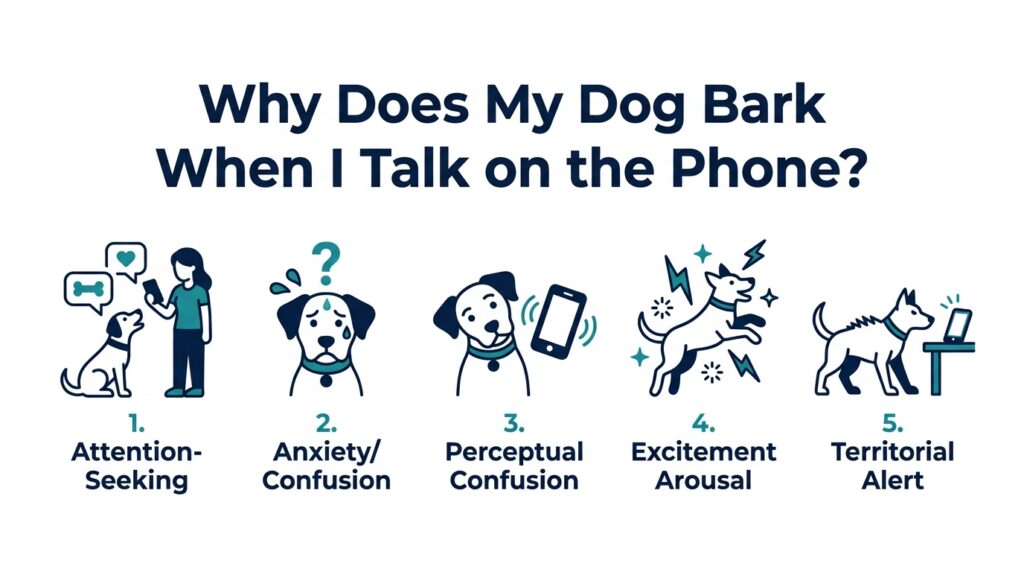
Dog barking behavior is rarely monolithic. When your dog barks at your phone calls, one or more of the following behavioral mechanisms are typically at play. Identifying the correct driver is essential to choosing the right intervention.
Attention-Seeking Behavior and Demand Barking
This is the most common cause. Your dog has learned — through trial and error — that barking when you are on the phone produces a predictable result: you look at them, speak to them, or touch them. Even a brief “shush” or frustrated glance counts as attention and reinforces the behavior.
Demand barking is a form of operant behavior maintained by positive reinforcement. The dog performs the behavior (barking), receives a consequence (attention), and the behavior increases in frequency and intensity over time. If your dog seems to stare directly at you and bark persistently, demand barking is almost certainly the mechanism at work.
Anxiety and Separation Distress Triggers
Phone calls can trigger low-grade separation anxiety responses in some dogs. When you are on the phone, you are physically present but psychologically unavailable. You are not making eye contact, you are not responding to your dog’s social overtures, and your body language is closed off. For dogs with attachment insecurity or a history of separation-related problems, this partial psychological absence can be genuinely distressing.
Signs that anxiety is driving the barking include: the dog cannot settle even with attention, panting or trembling accompanies the vocalization, the dog follows you from room to room during calls, or the behavior escalates rather than diminishing. If your dog also struggles when you physically leave the home, you may want to read our guide on
Dog barking after moving new home for insights on how environmental changes compound canine anxiety.
Confusion Over One-Sided Conversations
One fascinating and widely-documented explanation is simple perceptual confusion. Dogs have no concept of telecommunication. From your dog’s perspective, you are producing social speech directed at no one they can detect. There is no second person in the room, no body to smell, no visual cues to read. Your dog may be attempting to figure out what social event is occurring — and barking is one way they seek more information or signal their own presence.
Studies on dog cognition confirm that dogs use a combination of olfactory, auditory, and visual cues to interpret social situations. Remove two of those three modalities (as a phone call does), and the dog’s interpretive system becomes confused. Barking in this context may be communicative — a sort of “I don’t understand what’s happening” signal.
Excitement and Arousal Barking
Some dogs associate phone calls with positive outcomes. Perhaps you have a habit of getting up and walking around during calls, which the dog interprets as a prelude to activity. Or your voice rises in excitement during certain calls, and that tonal shift triggers an excited arousal response. Arousal barking is typically high-pitched, repetitive, and accompanies physical restlessness — spinning, jumping, and nudging.
Territorial and Alert Barking
If your phone call involves sounds — ringtones, the voice of the other caller audible from the speaker, notification sounds — your dog may be responding with territorial or alert barking. Dogs have a hearing range of approximately 40 Hz to 65,000 Hz (compared to humans’ 20 Hz–20,000 Hz), which means they may pick up frequencies from your phone speaker that you barely register. A voice coming from a small device can seem like an unidentified intrusion to a vigilant dog.
Breed-Specific Barking Tendencies
Not all dogs are equally prone to phone-call barking. Breed genetics play a significant role in baseline vocalization tendency. Understanding your dog’s breed history can help you calibrate your expectations and training approach.
- Herding breeds (Border Collies, Australian Shepherds): Highly alert and responsive to any perceived break in routine. Phone calls interrupt their usual patterns of owner interaction.
- Toy breeds (Chihuahuas, Pomeranians, Yorkies): Often prone to demand barking and separation-related anxiety due to strong owner bonding and small size instincts.
- Scenthounds (Beagles, Basset Hounds): Have a strong instinct to vocalize. Any unusual auditory stimulus — including a ringing phone or muffled voice — can trigger howling or baying.
- Working breeds (German Shepherds, Dobermans): Highly alert and territorial. Phone calls that produce unfamiliar sounds can trigger protective barking.
- Companion breeds (Cavalier King Charles Spaniels, Bichon Frises): May bark from attachment anxiety when owner’s attention is redirected.
Knowing your dog’s breed tendencies helps you understand whether the root is vigilance, anxiety, or demand, and that shapes which training protocol will be most effective.
The Psychology of Reinforcement: Are You Making It Worse?
One of the most important insights from behavioral science is that owners frequently maintain and intensify the very behaviors they want to eliminate. Phone-call barking is a textbook case.
Accidental Positive Reinforcement
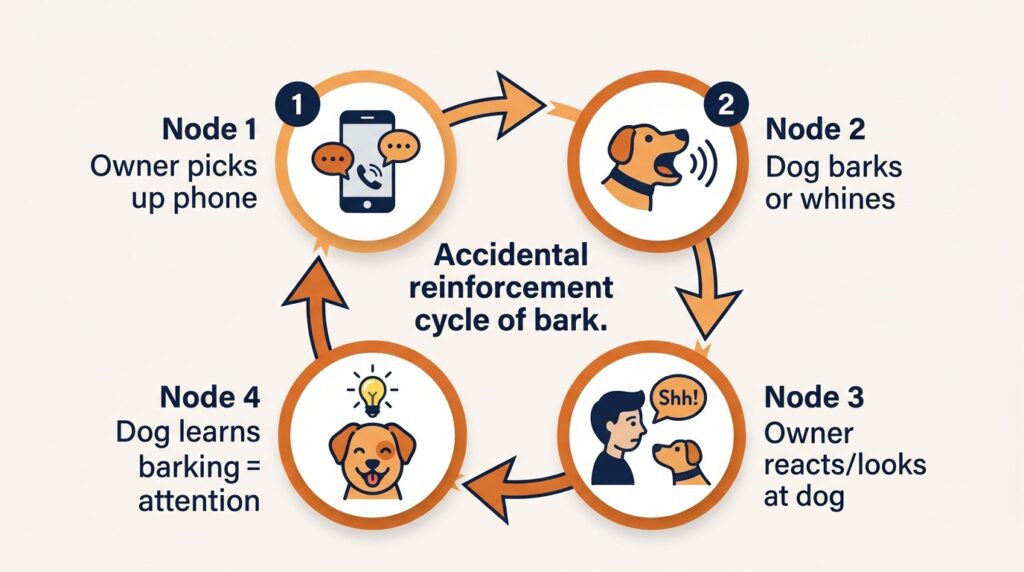
Every time you shush your dog, look at them, put your hand on their head, or apologize to the person on the phone while briefly addressing your dog, you are delivering a reinforcer. The dog has successfully disrupted your call and obtained your attention. This is operant conditioning at its most basic — behavior + consequence = increased behavior.
The variable reinforcement schedule makes it even more powerful. If you sometimes ignore the barking and sometimes respond, you create the most resistant-to-extinction type of conditioning known in behavioral psychology: variable ratio reinforcement. This is the same mechanism that makes slot machines so compelling. Your inconsistency literally makes the barking harder to extinguish.
Negative Reinforcement Cycles
In some households, the dog barks, the owner ends the phone call to deal with the dog, and the barking stops. From the dog’s perspective, barking caused the aversive stimulus (the phone call, which removes the owner’s attention) to go away. This is a textbook negative reinforcement loop, and it powerfully strengthens barking as a strategy for restoring the owner’s full presence.
How to Stop Your Dog from Barking During Phone Calls
Armed with an understanding of the mechanisms, you can now apply targeted, science-based interventions. The appropriate strategy depends on which behavioral driver is primary for your dog.
Management Strategies for Immediate Relief
Management is not training — it does not change the dog’s underlying behavior — but it provides immediate relief while training protocols take effect. Effective management strategies include:
- Give your dog a long-lasting chew (bully stick, frozen Kong, lick mat) before or at the start of calls. This occupies the dog’s mouth and engages their soothing licking/chewing behaviors.
- Confining the dog to a comfortable space (crate, exercise pen, or baby-gated room) during calls to prevent rehearsal of the barking behavior.
- Stepping outside or into a room with a closed door when taking calls removes the dog’s ability to solicit attention.
- Pre-emptively exercising the dog before anticipated call windows to reduce baseline arousal.
Desensitization and Counter-Conditioning Techniques
Desensitization involves gradually exposing the dog to the trigger (you talking on the phone) at a sub-threshold intensity while pairing the experience with something positive. Counter-conditioning changes the emotional association from negative (agitated, anxious) or demand-driven to calm and positive.
Here is a step-by-step protocol:
- Step 1 — Simulate phone calls. Pretend to talk on the phone for 5 seconds while your dog is in a calm state. Immediately deliver a high-value treat. End the ‘call.’ Repeat many times.
- Step 2 — Extend duration. Gradually increase simulated call length over days and weeks, always delivering rewards when the dog is calm.
- Step 3 — Add real calls. Make short real calls while a helper rewards the dog for calmness. Gradually phase out the helper.
- Step 4 — Generalize. Practice in different rooms and at different times of day to ensure the calm response is not context-specific.
This process requires patience and consistency. Do not rush the steps — moving too fast will stall progress. Behavioral science tells us that the rate of desensitization is limited by the dog’s emotional processing speed, not by our schedule.
Teaching the ‘Quiet’ Command
The ‘Quiet’ command is a cued incompatible behavior — it asks the dog to perform an action (being silent) that is physically incompatible with the problem behavior (barking). Teaching it requires first having a consistent ‘Speak’ cue so you can deliberately elicit barking, then reward cessation.
Protocol: Cue ‘Speak,’ wait for barking, then say ‘Quiet’ in a calm, firm tone. The moment the dog stops — even for one second — mark the silence with a clicker or verbal marker and deliver a treat. Gradually extend the required duration of silence before rewarding.
For a detailed approach using positive marker training, see our guide on Clicker to stop dog barking — an effective method that works especially well for demand barkers.
Using Enrichment to Reduce Boredom Barking
A mentally and physically fulfilled dog is a quieter dog. Environmental enrichment addresses the root cause of many attention-seeking behaviors by providing appropriate outlets for cognitive and physical energy. Enrichment strategies include:
- Puzzle feeders and snuffle mats for meal times
- Nose work games and scent trails
- Regular off-leash play or dog park visits
- Training sessions (even 5-minute sessions provide significant mental stimulation)
- Rotating toy selection to maintain novelty
According to the American Kennel Club’s canine behavioral guidelines, dogs that receive adequate physical exercise (30–120 minutes daily, depending on breed) and cognitive engagement are significantly less likely to develop nuisance barking behaviors. Addressing under-stimulation is not optional — it is foundational.
When Barking Signals a Deeper Problem
While most phone-call barking is a nuisance-level behavioral issue easily addressed with consistent training, in some cases, the barking signals a more serious underlying condition that warrants professional attention.
Separation Anxiety vs. Isolation Distress
True separation anxiety is a clinical diagnosis characterized by a panic response triggered specifically by separation from the owner. Dogs with separation anxiety may bark, howl, destroy property, self-harm, or lose bladder control when the owner leaves — and they may show pre-departure anxiety (pacing, panting, salivating) even before the owner is gone.
Isolation distress is different: the dog panics when left alone, but is fine with any human present. Both conditions can be exacerbated by phone calls that simulate partial psychological absence. If you suspect either condition, a structured assessment by a Certified Applied Animal Behaviorist (CAAB) or board-certified veterinary behaviorist (DACVB) is strongly recommended.
Research published in the Journal of Veterinary Behavior confirms that separation anxiety affects approximately 14–20% of companion dogs and is one of the leading causes of owner relinquishment. Early intervention dramatically improves outcomes.
When to Consult a Veterinary Behaviorist
Seek professional help if:
- The barking is severe, sustained, and accompanied by physical distress signs (panting, trembling, destruction)
- Standard training protocols have failed after 6–8 weeks of consistent application
- The dog shows aggression toward you during calls (snapping, growling)
- The problem is new and sudden in an older dog (which may suggest a cognitive or neurological change)
- The dog’s quality of life seems significantly impaired by anxiety
A board-certified veterinary behaviorist can assess whether medication — such as SSRIs (fluoxetine), TCAs (clomipramine), or situational anxiolytics (alprazolam) — may be warranted alongside behavior modification. For authoritative guidance on canine behavioral health, the American College of Veterinary Behaviorists maintains a directory of certified professionals and owner-facing educational resources.
Frequently Asked Questions

Why does my dog only bark when I’m on speakerphone?
On speakerphone, the other caller’s voice is audible. Your dog detects a human voice with no corresponding visual or olfactory signals, which can trigger territorial alert barking — they cannot place the unknown voice in their social space.
My dog doesn’t bark when I talk to people in person. Why is the phone different?
In-person conversations include full multimodal cues: the visual presence of the other person, their scent, and coherent reciprocal interaction that your dog can follow. Phone calls remove all of those confirming cues, creating a cognitively unusual situation that the dog cannot easily categorize.
Does the breed of my dog affect how much they bark during calls?
Yes, significantly. Vocal breeds (Beagles, Siberian Huskies, Miniature Schnauzers, Shetland Sheepdogs) have a lower threshold for vocalization generally, and this extends to phone-call barking. Training takes longer with these breeds but remains achievable with consistency.
Could my dog be barking at something in the phone’s audio?
Yes. A dog’s hearing extends to ultrasonic frequencies. Electronic interference, data transmission sounds, or high-frequency audio artifacts from phone speakers may be audible to your dog even when you hear nothing unusual. Try a wired headset or earbuds to eliminate this possibility.
Is ignoring the barking the best strategy?
Ignoring (extinction) works for demand barking but must be completely consistent — any intermittent response prolongs the extinction burst. For anxiety-driven barking, ignoring is insufficient and may worsen distress. Accurately identifying the driver is critical before applying extinction.
Final Thoughts
Your dog barks during phone calls because they are a highly social, emotionally intelligent animal doing exactly what evolution designed them to do: seek connection, monitor social events, and communicate their state to the beings they care most about — you.
The good news is that this behavior is genuinely trainable. Whether the root is demand barking, arousal, perceptual confusion, or low-level anxiety, there is a clear, evidence-based pathway to resolution. The key ingredients are accurate diagnosis (identifying the behavioral driver), consistent management (preventing rehearsal during training), systematic desensitization and counter-conditioning, and sufficient enrichment to meet your dog’s cognitive and physical needs.
Start with the management strategies for immediate relief, build your training protocol around the specific mechanism driving your dog’s barking, and be patient — behavioral change in dogs follows an S-curve: slow at first, then rapid, then stable. Most owners see meaningful improvement within 3–6 weeks of consistent work.
Your dog is not trying to frustrate you. They simply have not yet learned that phone calls are benign — and it is your job, as their trusted teacher, to show them.