


Summary: Nuisance barking is one of the most common behavioral complaints among dog owners, and clicker training offers a science-backed, humane solution to address it at the root. This comprehensive guide, How to Use a Clicker to Stop Dog Barking, walks you through every aspect of using a clicker to reduce excessive barking — from understanding the psychological mechanisms behind why dogs bark, to conditioning the clicker, identifying bark triggers, and applying proven positive reinforcement protocols. Whether your dog barks at strangers, reacts to outside noises, or vocalizes out of anxiety or boredom, clicker training empowers you to reshape that behavior systematically, replacing unwanted vocalization with calm, desirable responses.
Table of Contents
- Understanding Nuisance Barking: What It Is and Why It Happens
- What Is Clicker Training and How Does It Work?
- Charging the Clicker (Clicker Conditioning)
- Identifying and Managing Bark Triggers
- Core Clicker Techniques to Reduce Nuisance Barking
- Advanced Clicker Protocols for Specific Barking Scenarios
- Building a Training Routine: Consistency and Progression
- What Not to Do: Mistakes That Make Barking Worse
- Frequently Asked Questions About Clicker Training for Barking
Understanding Nuisance Barking: What It Is and Why It Happens

Before picking up a clicker, every dog owner needs to understand the underlying nature of nuisance barking. Barking is a natural, hardwired communication behavior in dogs — it is how they express excitement, alert their pack, signal discomfort, or respond to perceived threats. The challenge arises when barking becomes excessive, uncontrollable, or context-inappropriate, turning what is a normal canine vocalization into a disruptive behavioral problem.
Types of Nuisance Barking
Dog behavior science identifies several distinct categories of nuisance barking, each driven by a different motivation:
Alert or Territorial Barking occurs when a dog perceives an intrusion into its space — a passerby, a delivery person, or even a neighbor’s cat. This type is often repetitive and intense, driven by a strong protective instinct.
Demand or Attention-Seeking Barking is learned behavior. The dog has discovered that barking produces a desirable outcome — food, play, or human attention — and repeats it to get what it wants.
Boredom or Frustration Barking stems from under-stimulation. Dogs with high energy needs who are left alone or under-exercised often develop habitual, repetitive barking patterns.
Fear-Based Barking occurs in response to stimuli that the dog perceives as threatening — loud noises, unfamiliar environments, or strangers approaching too quickly.
Anxiety-Driven Barking, including separation anxiety barking, is perhaps the most emotionally charged form. The dog vocalizes as a stress response rather than a deliberate communication.
The Psychology and Triggers Behind Excessive Barking
From a behavioral science perspective, nuisance barking is almost always a conditioned or reinforced behavior. Using NLP (Neuro-Linguistic Processing) parallels in animal behavior, dogs develop associations between certain stimuli and their emotional states. A dog that barks at the doorbell has formed a neural association between the sound and either excitement or threat — and that association, once formed, is powerful.
When Barking Becomes a Problem
Barking becomes “nuisance barking” when it occurs excessively (lasting longer than necessary), is triggered by benign stimuli, disrupts household routines, causes neighbor complaints, or indicates underlying emotional distress in the dog. At this point, behavior modification — specifically positive reinforcement through clicker training — becomes the recommended intervention.
What Is Clicker Training and How Does It Work?
Clicker training is a form of positive reinforcement-based behavioral conditioning rooted in the scientific principles of operant conditioning and classical conditioning. It uses a small mechanical device — the clicker — that produces a distinct, consistent sound to “mark” the exact moment a dog performs a desired behavior, followed immediately by a reward.
The Science of Operant Conditioning
Operant conditioning, first formalized by B.F. Skinner and later applied to animal training by pioneers like Karen Pryor, establishes that behavior followed by a positive outcome is more likely to be repeated. The clicker functions as a secondary reinforcer or conditioned reinforcer — it becomes associated with reward through repeated pairings until the sound itself carries motivational value.
In the context of barking reduction, clicker training works by systematically rewarding the absence of barking or the performance of a calm, incompatible behavior, thereby shifting the dog’s conditioned response away from vocalization and toward stillness or quiet.
According to the Association of Professional Dog Trainers (APDT), positive reinforcement-based training methods are not only more humane but also produce more durable, generalized behavioral change than aversive or punishment-based methods — making clicker training the gold standard for nuisance barking.
Why the Clicker Is More Effective Than Verbal Cues
The clicker’s precision is its greatest asset. Human verbal cues — like saying “good boy” — vary in tone, timing, and emotional coloring, creating inconsistency in the dog’s learning process. The clicker’s sharp, neutral, mechanically consistent sound removes these variables. It bridges the gap between the behavior and the reward with pinpoint accuracy, which is critical when you are trying to capture split-second moments of calm during a barking episode.
Additionally, the clicker is non-emotional. Dogs are exquisitely sensitive to human emotional states. When an owner verbally praises during a stressful barking moment, their excited or relieved tone can inadvertently increase the dog’s arousal. The clicker remains flat, consistent, and clear.
Tools You Need to Get Started
To begin clicker training for nuisance barking, you will need: a standard box clicker or a button clicker (some trainers prefer a softer-sounding i-Click for noise-sensitive dogs), high-value small treats (small enough to be consumed in 2–3 seconds), a treat pouch or bait bag for quick access, a six-foot standard leash for controlled training sessions, and optionally, a mat or designated “calm spot” for place training.
Charging the Clicker (Clicker Conditioning)
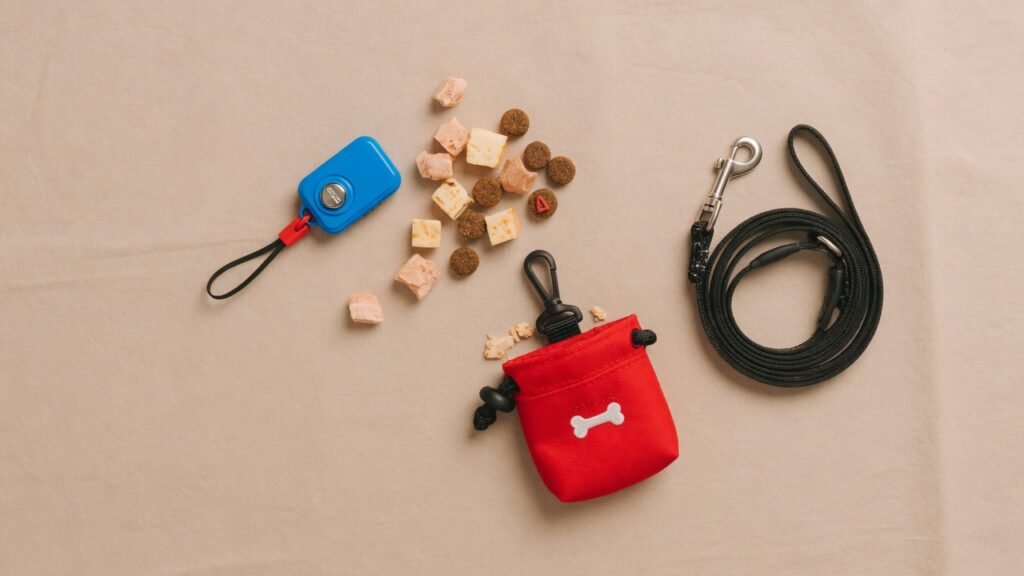
Before the clicker can be used to address barking, the dog must first learn what it means. This foundational step is called “charging the clicker” or “loading the clicker.”
Step-by-Step: How to Charge a Clicker
Begin in a quiet, distraction-free environment. Click the clicker once, then immediately (within half a second) offer a small, high-value treat. Repeat this sequence 10–15 times in a row. Do not ask the dog to do anything yet — there is no behavior required. The only goal is to create the association: click = good thing is coming.
After 2–3 sessions of 10–15 repetitions, you should notice your dog’s ears perk up and their attention snap toward you the moment they hear the click. This is the conditioned emotional response you are looking for. The clicker is now “charged” and ready to use in training.
Timing Is Everything: The 0.5-Second Rule
The single most important technical principle in clicker training is timing. Research in learning theory shows that the reinforcement window — the gap between behavior and consequence that the animal can meaningfully associate — is approximately half a second. Click even two seconds late, and you may be rewarding the behavior that occurred after the one you intended to mark. For barking reduction specifically, this means clicking the instant the dog stops vocalizing, not several seconds later when they’ve settled.
Common Mistakes During Clicker Conditioning
Many trainers accidentally click multiple times in a row (only one click per behavior is needed), click too late or too early, use the clicker to get the dog’s attention rather than to mark behavior, or run out of treats after clicking, which erodes the clicker’s value. Consistency and preparation are key.
Identifying and Managing Bark Triggers
Effective clicker training for nuisance barking requires a detailed understanding of exactly what sets your dog off. Generic training plans rarely work because barking is trigger-specific.
How to Create a Bark Trigger Journal
For one full week, document every barking episode. Record the time of day, the environmental context, what stimulus appeared to trigger the bark, the dog’s body language before and during the bark, and how long the episode lasted. After a week, patterns will emerge. You may discover your dog consistently barks at dogs passing the front window between 4–5 PM, or erupts into demand barking when you sit down to eat. This data becomes the roadmap for your training protocols.
Threshold Awareness and Reactivity Levels
In behavioral science, a dog’s “threshold” is the point at which a stimulus triggers a reactive response — in this case, barking. Dogs who are “over threshold” are in a high-arousal emotional state and are not capable of learning in that moment. Effective clicker training happens sub-threshold — close enough to the trigger to practice, but not so close that the dog is already reacting. As training progresses and desensitization occurs, the dog’s threshold rises, meaning it takes a more intense or closer stimulus to trigger barking.
Environmental Management as a Complementary Strategy
Management — reducing the dog’s access to bark triggers while training is in progress — is not a replacement for training but a necessary partner to it. Blocking visual access to the street with frosted window film, using white noise machines to muffle outside sounds, or confining the dog to a back room when visitors arrive all reduce the frequency of barking episodes and prevent the further rehearsal of the behavior, which reinforces it.
Core Clicker Techniques to Reduce Nuisance Barking
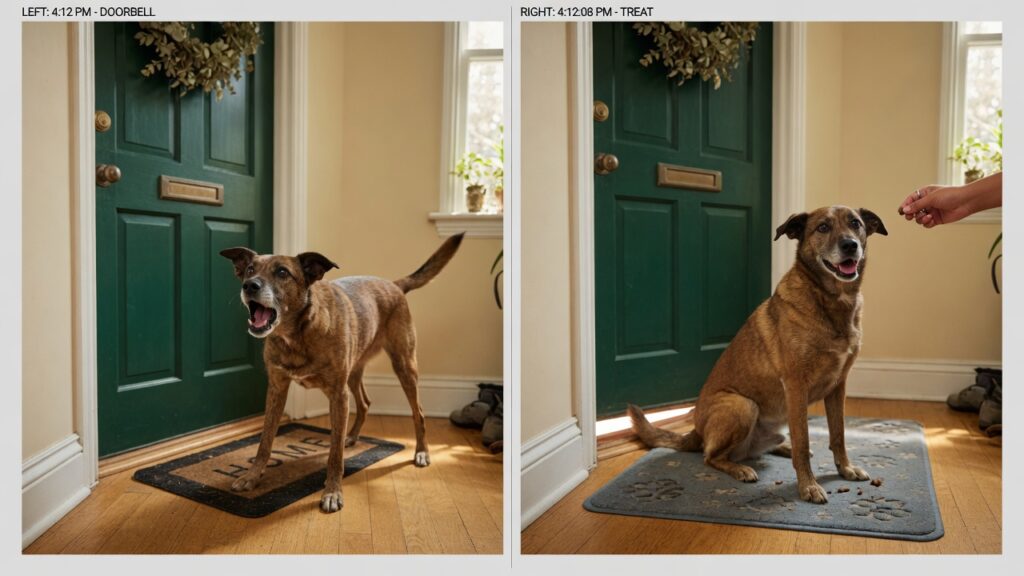
With a charged clicker, a trigger journal, and an understanding of threshold, you are ready to implement training protocols.
The “Quiet” Cue Method
This is one of the most widely used protocols. Begin by letting your dog bark 2–3 times in response to a controlled trigger. Then, calmly say “quiet” once (do not shout — raised voices increase arousal). Wait silently. The moment the dog pauses — even for one second — click immediately and deliver a high-value treat. Repeat with a gradually increasing duration of quiet before the click. Over many repetitions, the dog learns that “quiet” is a cue that predicts reward for silence.
Important: Never repeat the cue multiple times in a row. One calm “quiet” — then wait. Repeating it teaches the dog to ignore it.
Counter-Conditioning and Desensitization
Counter-conditioning changes the dog’s emotional association with a trigger from negative/aroused to positive/calm. Present the trigger at a sub-threshold distance or intensity. The moment your dog notices the trigger but before barking begins, click and treat. Repeat many times. Gradually decrease the distance or increase the intensity of the trigger over multiple sessions. The dog begins to associate the stimulus with “good things happen” rather than with alarm or threat.
Desensitization involves systematic, incremental exposure to the trigger at low enough levels that no barking response is elicited, allowing the nervous system to habituate. Used together, these two techniques are the backbone of behavior modification for reactive and alert barking.
Capturing Calm Behavior
“Capturing” is a clicker training concept where you click and reward a behavior the dog offers naturally, without prompting. For barking reduction, this means clicking moments of genuine calm — when your dog is lying quietly, relaxing without vocalizing, or calmly watching a stimulus that would normally trigger barking. Over time, this builds a strong reinforcement history around the emotional state of calm, making it more accessible and self-reinforcing.
Incompatible Behavior Substitution
An incompatible behavior is one that physically cannot occur at the same time as the problem behavior. A dog cannot simultaneously bark and perform a sustained “down-stay” or “go to your place” behavior. Teaching a solid “place” command — where the dog goes to a mat and lies down — and gradually introducing it in the presence of bark triggers gives the dog a competing behavioral response to perform instead of vocalizing. The clicker marks the dog successfully staying on the mat while the trigger is present.
Advanced Clicker Protocols for Specific Barking Scenarios
Doorbell and Visitor Barking
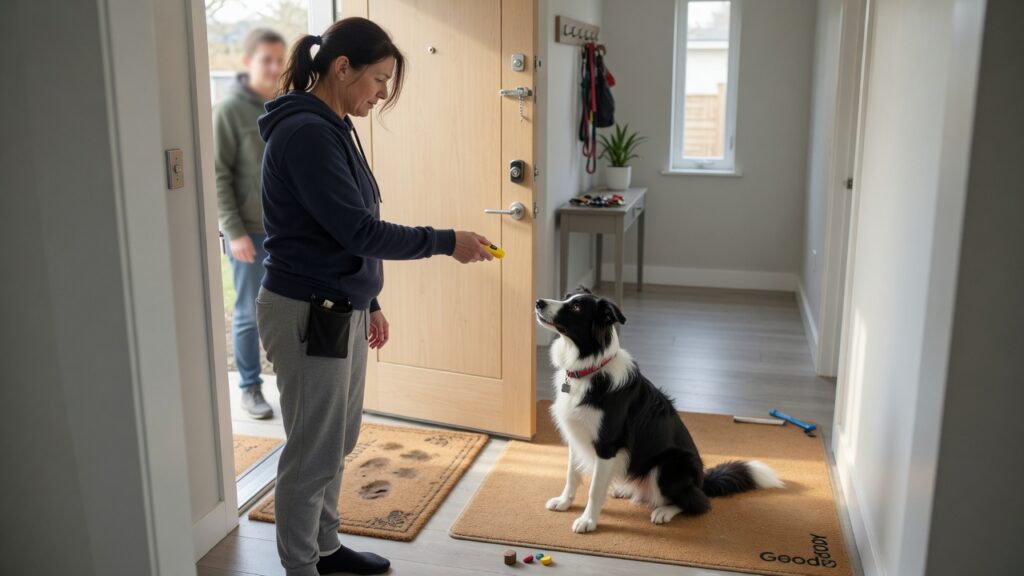
This is among the most common and most solvable forms of nuisance barking. Begin by desensitizing the doorbell sound itself — play a recording of a doorbell at low volume, click and treat for no reaction, gradually increase the volume over many sessions. Then, build a “go to your place” behavior on the mat.
Practice: ring bell → cue “place” → dog goes to mat → click and jackpot treat. Eventually, the sound of the doorbell becomes the dog’s own cue to go to their mat.
Fence and Territorial Barking
Practice with a confederate (a friend or neighbor the dog knows) walking along the fence line at maximum distance, clicking calm observations rather than barking reactions. Gradually decrease the distance. Use “watch me” or focus exercises to redirect attention from the fence to you when triggers appear.
Demand Barking and Attention-Seeking
This form requires a strict extinction protocol combined with the clicker. Completely ignore all barking — no eye contact, no verbal response, no moving away. The moment barking stops, even briefly, click and reward quiet behavior. This can initially produce an “extinction burst” — the barking gets worse before it gets better — which is a normal and expected part of the process. Consistency is non-negotiable.
Anxiety-Driven Barking
If your dog’s barking is rooted in anxiety — particularly related to life changes or stress events — the underlying emotional state must be addressed before or alongside behavior modification. Dogs that experience significant stress from displacement or change may exhibit heightened reactivity. You can explore related guidance on managing barking triggered by post-surgical stress and discomfort, which overlaps significantly with anxiety-driven vocalization protocols.
Counter-conditioning, calming protocols, and in some cases consultation with a veterinary behaviorist or the use of adjunct tools like anxiety wraps may be necessary before clicker training can be effective.
Building a Training Routine: Consistency and Progression
How Long Should Training Sessions Be?
Short, frequent sessions produce far better results than long, infrequent ones. Aim for 3–5 sessions of 5 minutes each per day, especially in the early stages. Dogs learn best when their brains are fresh and before frustration or fatigue sets in. End every session before the dog disengages — always on a success.
Reward Hierarchy: Choosing High-Value Treats
Not all treats are created equal. For barking reduction — which often involves high-arousal states — you need the most motivating rewards possible. Real meat (boiled chicken, turkey, roast beef), cheese, or commercial high-value training treats (Zukes Mini Naturals, Vital Essentials freeze-dried) are typically the most effective. Reserve these exclusively for barking training sessions to maintain their value through scarcity.
Tracking Progress and Adjusting Protocols
Keep a training log. Record the trigger, the protocol used, the threshold distance, the number of barking episodes versus quiet responses, and any changes in the dog’s body language. This data allows you to objectively measure progress and make systematic adjustments. If you see no improvement after 10–15 sessions, it is time to revisit your threshold management, treat value, or timing.
What Not to Do: Mistakes That Make Barking Worse
Punishment-Based Approaches and Why They Backfire
Bark collars (citronella, vibration, or shock), yelling, spraying water, or using physical corrections do not address the underlying motivation for barking — they suppress the symptom while increasing stress, fear, and in many cases, reactivity. Research consistently shows that punishment-based interventions increase cortisol levels, damage the human-dog relationship, and often result in displaced aggression or learned helplessness. According to the American Veterinary Society of Animal Behavior (AVSAB), punishment-based training is associated with significantly increased behavioral risks and is not recommended as a first-line intervention.
Inconsistent Responses From Family Members
One of the most common reasons clicker training for barking fails is household inconsistency. If one person reinforces silence while another inadvertently rewards barking with attention, the dog receives mixed signals, and the behavior is maintained. Every person in the household must follow the same protocol, use the same cues, and apply the same reinforcement rules.
Reinforcing Barking Accidentally
This happens more than most owners realize. Speaking to a barking dog (“it’s okay, calm down”), moving toward a barking dog to comfort them, or giving food or toys during a barking episode all reinforce the behavior. From the dog’s perspective, barking produced a desirable outcome — therefore, the behavior is strengthened. It’s also worth noting that if your dog has recently moved to a new home and is barking excessively, some of that vocalization may have a very different cause — you can learn more about why dogs bark after a move and how to manage it.
Frequently Asked Questions About Clicker Training for Barking
How long does it take to stop nuisance barking with a clicker? Results vary considerably based on the type of barking, the dog’s history, and training consistency. Many owners see measurable improvement within 2–4 weeks of consistent daily training. Deeply ingrained behaviors or anxiety-driven barking may take several months.
Can I use a clicker with a dog that is afraid of loud noises? Yes — with adjustments. Some dogs are sound-sensitive and find the standard clicker aversive. Use a softer i-Click device, muffle the click through a pocket, or use a tongue click instead. A verbal marker like “yes!” can also serve the same function.
Does clicker training work for all breeds? Clicker training is an effective method across all breeds, but the approach may need to be tailored. High-drive working breeds (Border Collies, Belgian Malinois) may require higher-intensity exercise before training sessions to reduce arousal. Hounds may need additional patience. The fundamentals of operant conditioning are universal.
Should I hire a professional trainer? For complex cases — particularly anxiety-driven barking, reactivity with aggression, or cases involving multiple dogs — working with a certified professional dog trainer (CPDT-KA) or a veterinary behaviorist is strongly recommended. Self-directed training is effective for most typical nuisance barking cases.
My dog stops barking the moment I reach for treats. Is that a problem? Initially, no — the dog is anticipating reward. But over time, you want the “quiet” cue, not treat motion, to be the trigger for calm behavior. Practice carrying treats all the time (in your pocket, on your body) so the treat bag movement loses its predictive value.