
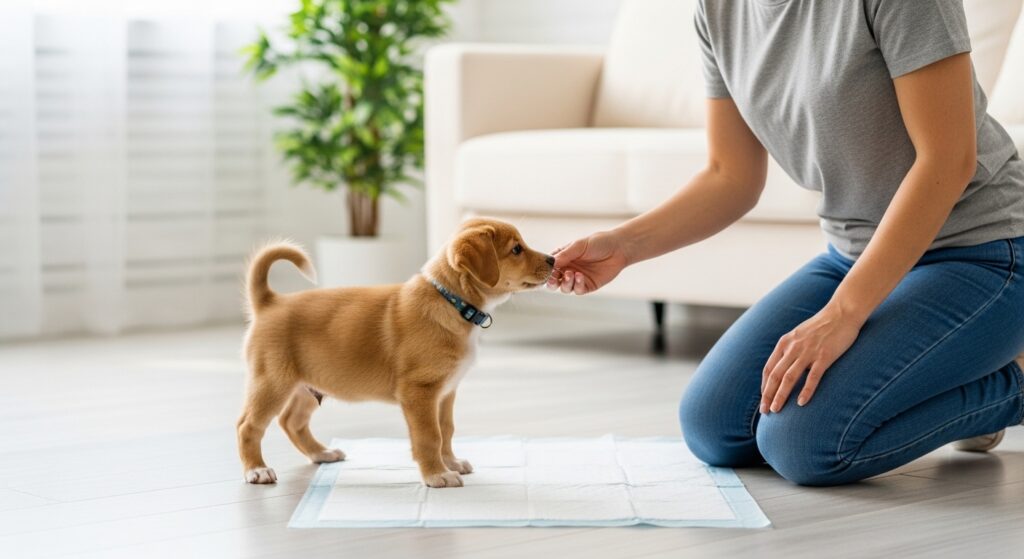

Summary: Potty training a puppy with puppy pads works best when you treat it as a complete house-training system, not a random backup option. The key is to choose one bathroom area, keep the pad in a fixed location, supervise closely, follow a predictable potty schedule, reward the exact moment your puppy uses the pad, and clean accidents thoroughly so scent does not pull your puppy back to the wrong spots. Puppy pads can be especially useful for apartment living, limited mobility, bad weather, and very young puppies that need frequent bathroom trips or have restricted outdoor access before full vaccination, but expert guidance also notes that indoor potty options can make the later transition to outdoor-only pottying take longer, so consistency and a clear end goal matter from day one.
This guide naturally covers related search intent terms such as puppy pad training, pee pad training, indoor potty training, housebreaking a puppy, puppy potty schedule, crate and potty training, puppy accidents in the house, potty cues, house training regression, and transitioning from puppy pads to outside.
Outline
- Potty Training a Puppy with Puppy Pads: The Complete Guide
- Understanding Puppy Pad Training
- Preparing Your Home for Success
- Step-by-Step Puppy Pad Training Plan
- Creating a Potty Schedule That Actually Works
- Supervision, Confinement, and Crate Training
- Handling Accidents the Right Way
- Transitioning from Puppy Pads to Outside
- Common Mistakes and Troubleshooting
- When to Call a Vet or Trainer
- Final Takeaways
- Understanding Puppy Pad Training
What puppy pad training is
Puppy pad training is indoor house training. Instead of teaching your puppy from day one that grass, soil, or an outdoor potty spot is the only acceptable bathroom surface, you teach them to use a designated indoor elimination area with an absorbent pad. This can be a temporary bridge while your puppy is young, a practical solution for apartment life, or a longer-term indoor potty routine for owners who need flexibility. Veterinary and training guidance consistently points to the same foundations: supervision, routine, and immediate reinforcement for going in the right place.
When puppy pads make sense
Puppy pads are especially helpful when you live in a high-rise apartment, have mobility limitations, work through harsh weather conditions, or need to reduce a very young puppy’s exposure to public outdoor potty areas before vaccinations are complete. They can also help in the earliest weeks because puppies simply need to go very often. AKC guidance notes that very young puppies have limited bladder control, and a common rule of thumb is that they can hold it for about their age in months plus one hour, which means frequent bathroom trips are normal, not “bad behavior.”
Pros, cons, and long-term goals
The biggest advantage of puppy pads is convenience. The biggest drawback is that they can blur the line between “inside is okay” and “only this exact indoor spot is okay,” which may slow the later transition to outdoor-only pottying. Humane World for Animals specifically notes that indoor potty options like pee pads can make outdoor housebreaking take longer. That does not mean pads are a bad idea. It means you should decide early whether your goal is permanent indoor pottying, a mixed system, or a gradual move to outside. The clearer your goal, the cleaner and faster your training usually becomes.
Preparing Your Home for Success
Choosing disposable vs. washable puppy pads
Disposable puppy pads are convenient, easy to replace, and ideal for owners who want the fastest cleanup. Washable pads are more eco-friendly and cost-effective over time. Either can work. The most important thing is consistency in surface texture and scent association. If you keep changing the type of potty surface, your puppy may struggle to build a clear toileting habit. A pad holder or tray can also help keep the pad flat so it does not bunch up, slide across the floor, or become a toy.
Picking the right potty pad location
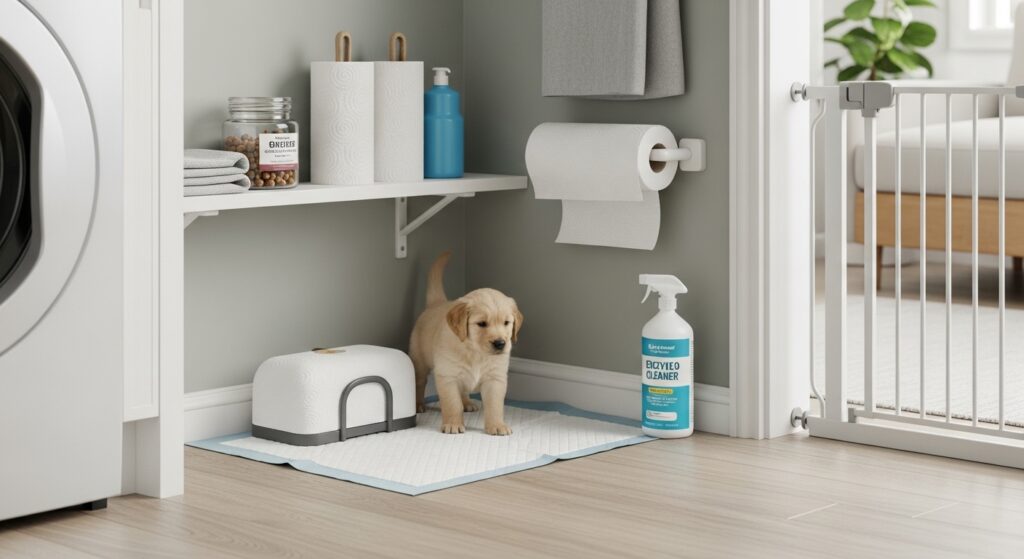
The best puppy pad location is quiet, easy to reach, and easy to clean. Good options include a bathroom corner, laundry room, kitchen nook, or a section of a playpen. Try not to move the pad once training begins unless you are intentionally transitioning outdoors. AKC guidance specifically warns that moving the pad while your puppy is still learning can create confusion and lead to more accidents. Keep the pad away from your puppy’s bed and food bowls, but not so far away that they cannot get there quickly when they feel the urge.
Setting up a puppy pad station
A smart potty station includes more than a pad. Keep high-value treats near the pad, along with poop bags, paper towels, and an enzymatic cleaner for accidents. VCA notes that good cleanup matters because leftover urine or fecal odor can act as a cue for your puppy to eliminate in the same wrong location again. If your puppy will spend time in a pen, set up a clear separation between the sleeping area and the potty zone so you do not accidentally teach them to soil right beside their bed.
Step-by-Step Puppy Pad Training Plan
Introducing the pad on day one
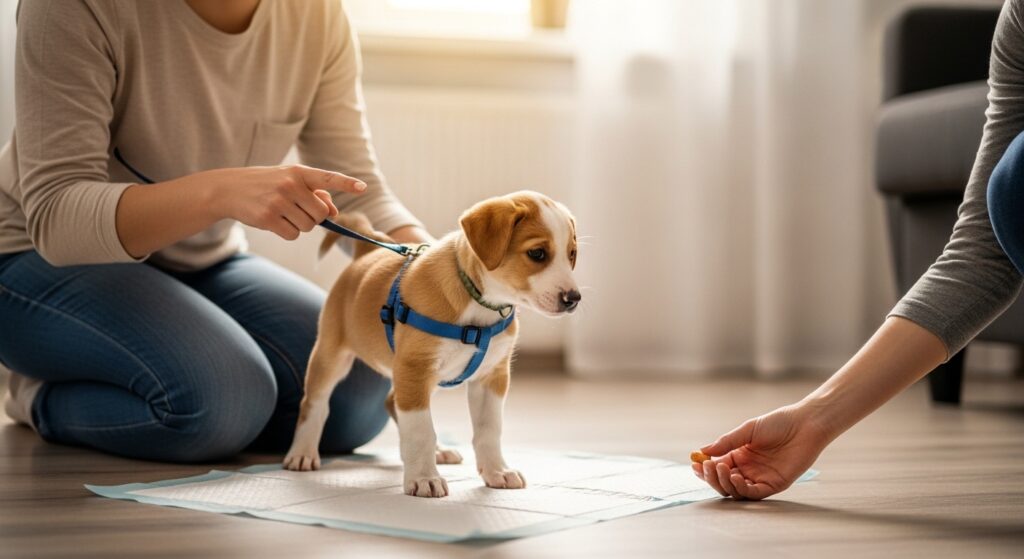
Start on day one. Each time your puppy wakes up, finishes a meal, drinks a lot of water, ends a play session, or comes out of the crate, take them straight to the pad. Do not wait to see if they “ask.” Early success comes from management, not mind-reading. Lead them calmly to the pad and stay there quietly. If your puppy is distractible, walk them to the pad on a leash and keep them there until they focus on the task. The goal is to build a pattern: urge happens, puppy goes to the pad, puppy eliminates, reward happens.
Using potty cues and positive reinforcement
Choose one potty cue such as “go potty,” “hurry up,” or “do your business.” Use it softly when your puppy is about to eliminate, not while they are zooming around the room. Once they finish, reward immediately with praise, a treat, or both. Humane World for Animals and AKC both emphasize immediate reinforcement, and Humane also notes that you should wait until the puppy is completely finished before rewarding, because some puppies stop mid-stream if they are interrupted by excitement. In learning terms, this is clean operant conditioning: the correct behavior is reinforced right away, so the puppy is more likely to repeat it.
What to do when your puppy doesn’t go
If your puppy reaches the pad and does nothing, do not assume they no longer need to go. Wait a few minutes. If they still do not eliminate, do not let them roam freely, and then have an accident 90 seconds later. AKC recommends putting the puppy back in the crate or a confined area for about 10 to 15 minutes, then trying again. This prevents “fake potty trips” from turning into indoor accidents and teaches your puppy that bathroom breaks come before free play.
Creating a Potty Schedule That Actually Works
Age-based potty frequency
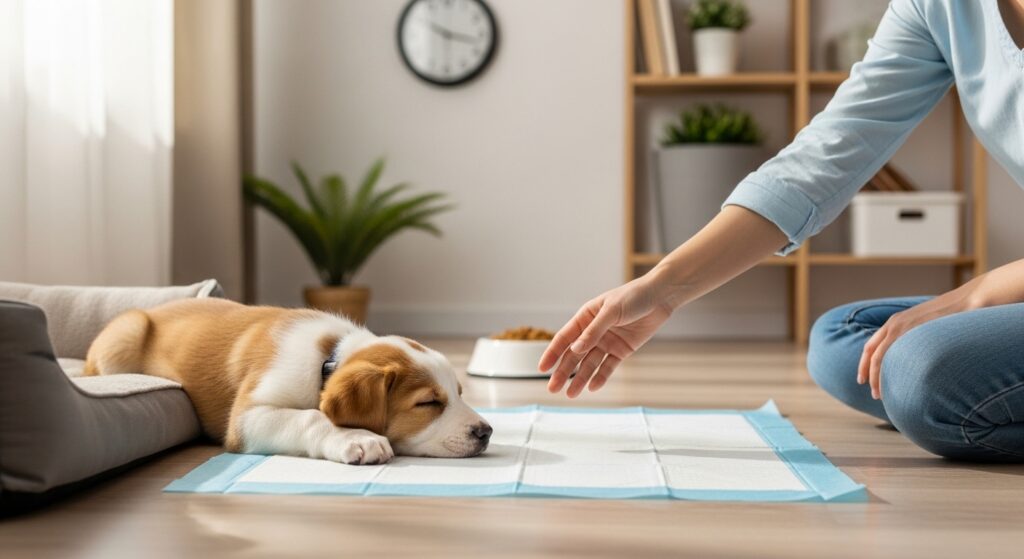
A potty schedule is the backbone of puppy pad training. A very young puppy may need a trip to the pad as often as every 15 to 30 minutes during active periods. VCA also notes that puppies may need breaks every half hour during high-energy play, every 1 to 2 hours when awake, immediately after naps, after meals or large drinks, and during the night when very young. The “age in months plus one hour” rule is useful as a rough upper limit, but it is not a target you should push to. If your puppy is actively playing, excited, or just woke up, their real window may be much shorter.
Best times to take your puppy to the pad
The most important potty moments are predictable: first thing in the morning, after every meal, after drinking, after every nap, after every play session, after chewing excitement, after leaving the crate, and right before bed. Feed meals on a schedule rather than free-feeding if you want more predictable bowel movements. Humane World for Animals and AKC both stress that routine makes house training easier because you can better predict when your puppy needs to eliminate. Predictability reduces accidents, reduces stress for the owner, and creates faster learning for the puppy.
Night-time potty training and nap-time breaks
Night training is where many owners get discouraged, but it is completely normal for very young puppies to need overnight outings or pad access. VCA notes that puppies may need overnight bathroom breaks until around 5 months of age. This is one reason confinement and a realistic evening routine matter so much. If your puppy wakes at night, keep the trip boring: straight to the pad, quiet praise if they go, then right back to sleep. No play session, no party, no mixed signals. And remember that full house training often takes months, not days. Humane World for Animals says 4 to 6 months is a typical range, though it can vary by size, age, and previous habits.
Supervision, Confinement, and Crate Training
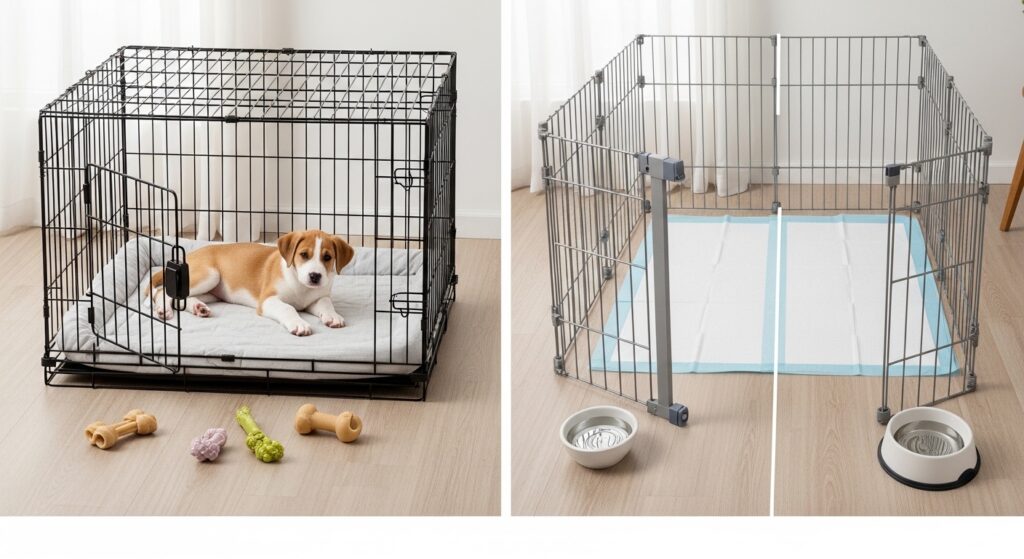
The three modes of successful house training
A puppy in training should generally be in one of three states: directly supervised, safely confined, or in a controlled potty area that includes a sleeping space and a designated toileting surface. VCA describes a very similar management model because accidents happen most often in the gap between “I thought he was fine” and “I only looked away for a minute.” Direct supervision means your puppy is in sight, close enough for you to notice sniffing, circling, sudden restlessness, or squatting. If you cannot supervise, management should take over immediately.
Using a crate without causing accidents
A properly introduced crate can support potty training because most puppies prefer not to soil their sleeping space. AKC recommends a crate that is large enough for your puppy to stand, turn around, and lie down, but not so large that one end becomes a bathroom. The crate should never be a punishment. It should be a calm, rewarding den. When your puppy comes out of the crate, go straight to the pad. If you want to strengthen the overnight side of this routine, pair your potty plan with this guide to crate training a puppy overnight.
Combining pads with a playpen or gated area
If you will be away longer than a short crate interval, a larger pen setup may work better than forcing too much crate time. VCA notes that puppies left alone for more than about 3 hours generally need a potty break or a larger area with a rest zone and an appropriate toileting substrate such as a piddle pad. Humane World for Animals similarly advises planning support if you are gone for more than 4 to 5 hours a day. In practical terms, that means a sitter, a neighbor, or a pen with a distinct sleep side and potty side. Creating a puppy too long and hoping for the best usually backfires.
Handling Accidents the Right Way
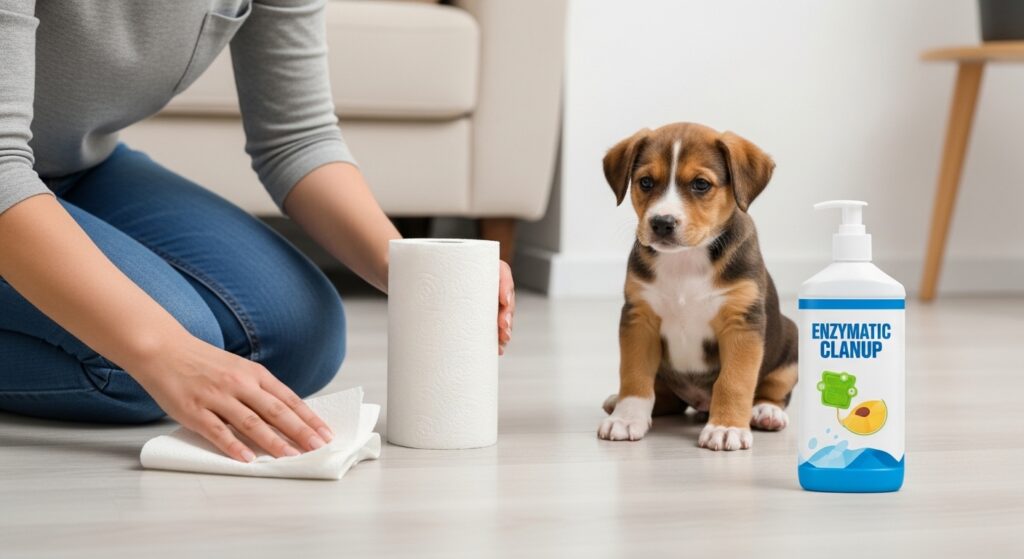
How to interrupt an accident calmly
When you catch your puppy in the act, interrupt gently and immediately guide them to the pad. AKC suggests a quiet interruption rather than a frightening reaction. VCA also advises distraction without scaring the puppy. If your puppy finishes on the pad, praise them. The lesson is not “toileting is dangerous.” The lesson is “this is the right place.” That distinction matters because puppies that feel punished often learn to eliminate behind furniture, in hallways, or anywhere the owner is not looking.
Cleaning smells so your puppy doesn’t repeat them
If you discover an old accident after the fact, do not lecture your puppy. They will not connect your anger to something they did minutes or hours ago. Clean the area thoroughly and quietly with an enzymatic cleaner so the scent does not invite repeat accidents. Humane World for Animals advises cleaning soiled areas thoroughly, and VCA specifically recommends a high-quality enzymatic cleaning product because remaining odor can cue future toileting in the same location. Some owners also place a soiled paper towel on the pad early in training so the puppy associates the correct area with bathroom scent.
Why punishment slows house training
Punishment feels emotionally satisfying in the moment, but it slows learning. Humane World for Animals warns that scolding or rubbing a puppy’s nose in an accident can make them fearful and delay progress. VCA is even more direct: punishing a puppy for a natural act can teach them that they should never toilet near a person. So skip shame, yelling, nose-rubbing, and physical correction. House training is not about dominance. It is about patterning, management, timing, and trust.
Transitioning from Puppy Pads to Outside
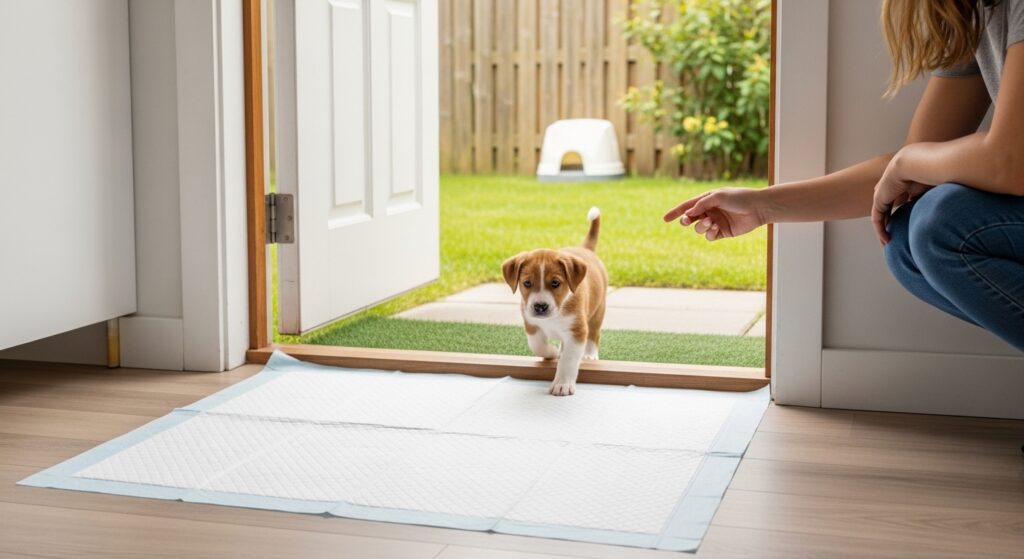
When to start the transition
Start the transition when your puppy is reliably using the pad, you have a manageable outdoor plan, and you can be consistent for at least a few weeks. Do not begin during a chaotic travel week, after a move, or while your schedule is unpredictable. Your puppy first needs a stable bathroom habit. Then you can shift the location of that habit.
Moving the pad toward the door
AKC’s recommended transition is gradual: move the pad a small distance at a time toward the door, then just outside the door, then toward the final toilet area outdoors. Use the same potty cue you taught indoors and continue rewarding immediately after success. If your puppy struggles, slow down. Sudden changes create confusion. Many puppies become attached to the familiar surface and location of the pad, so a step-by-step transition is usually smoother than removing the pad overnight and expecting instant outdoor success.
Replacing the pad with outdoor potty habits
Once the pad is outside, reduce its size gradually so your puppy begins using the ground itself. Reward heavily for grass, gravel, or whatever outdoor surface will become the long-term bathroom area. If your puppy does not go outside, bring them back in for brief supervision or confinement and try again shortly after. Do not let them fail repeatedly inside. The goal is to preserve the same behavioral chain you built indoors: arrive at potty area, hear cue, eliminate, get rewarded.
Common Mistakes and Troubleshooting
Too much freedom too soon
One of the biggest potty training mistakes is giving a puppy too much unsupervised freedom too early. A puppy that can wander the whole home will often choose a quiet corner, hallway, or rug long before they develop a habit of seeking out the pad. More freedom should be earned, not guessed. VCA notes that once a puppy has gone 8 to 12 weeks without mistakes, they may be ready for more gradual freedom. Until then, think in zones, not full-house access.
Dirty pads, late rewards, and moving the pad around
Other common mistakes are letting dirty pads sit too long, rewarding after the moment has passed, moving the pad location randomly, and feeding without any schedule. AKC emphasizes that rewards need to be immediate and that the pad location should stay stable while the puppy is learning. A dirty, shredded, or saturated pad can also make your puppy avoid the correct spot entirely. Clean setup plus fast reinforcement is what creates clarity.
Regression, stubborn puppies, and busy owner schedules
Regression usually has a reason. Sometimes it is a growth phase, a recent routine change, too much freedom, a missed schedule, or a transition that happened too quickly. Sometimes it is simply owner inconsistency. Puppies do not generalize well at first, so being good in the kitchen does not mean they are trained in the living room. If your workday is long, build a system that matches reality: sitter, neighbor help, a larger pen, or a clear indoor potty setup. A good plan beats wishful thinking every time. Humane guidance also notes that smaller dogs may need more frequent potty breaks than larger dogs.
When to Call a Vet or Trainer
Medical red flags
If your puppy is not making progress despite a consistent routine, suddenly starts having more accidents after doing well, strains to urinate, seems painful, urinates unusually often, drinks excessively, or soils unpredictably after being reliable, talk to a veterinarian. AKC notes that stalled progress can sometimes be linked to a urinary tract infection or another medical issue, and VCA similarly advises veterinary guidance if a previously trained dog begins house soiling. Training only works when health is not the hidden problem.
Behavior issues vs. training gaps
If health is fine but progress still feels stuck, a positive-reinforcement trainer can help identify whether the issue is timing, management, anxiety, overfreedom, or unclear reinforcement. This is especially helpful for rescue puppies, fearful puppies, or homes where schedules change often. Getting expert feedback early is usually faster and cheaper than spending months repeating the same mistakes.
When professional help speeds things up
Professional help is a smart move if your puppy hides to eliminate, seems fearful around you during potty time, cannot settle in confinement, or has repeated setbacks during the outdoor transition. Good help should make the plan simpler, not more complicated.
Final Takeaways
Signs your puppy is making progress
Progress does not mean perfection. It means fewer accidents, longer dry periods, clearer signals before elimination, faster trips to the pad after waking or eating, and a puppy that begins heading toward the pad without being carried there. That is learning. Stay patient, stay boring during accidents, stay excited during success, and keep the routine predictable. Potty training is less about one magical trick and more about stacking hundreds of small correct repetitions until the right habit becomes automatic.
Helpful resources and next steps
For extra reading and external reference points, compare your routine with the AKC’s puppy potty pad and paper training guide and Humane World for Animals’ housebreaking tips. Those pair well with your internal overnight routine resource on crate training, especially if you are building a full housebreaking system that covers naps, nighttime, and time away from home.