

Summary
Dog barking near the food bowl before meals is one of the most common yet misunderstood canine behaviors. Rooted in a combination of conditioned anticipation, demand communication, food-driven anxiety, and instinctual guarding responses, this behavior spans a wide spectrum — from harmless mealtime excitement to signs of food-related aggression or obsessive-compulsive tendencies. Understanding the triggers, reading body language cues accurately, and applying consistent positive reinforcement training are the most effective ways to manage or eliminate problematic food bowl barking. This guide Why Dogs Bark at Food Bowl Before Meals explores every dimension of this topic, from the neuroscience of hunger-driven vocalizations to breed-specific tendencies and step-by-step training protocols.
Table of Contents
- What Is Pre-Meal Barking in Dogs?
- The Science Behind Food-Related Vocalizations
- Why Dogs Bark at Their Food Bowl: Core Reasons
- Breed-Specific Tendencies in Food Bowl Barking
- How Diet and Nutrition Influence This Behavior
- Reading Your Dog’s Body Language at the Bowl
- Training Strategies to Reduce or Manage Food Bowl Barking
- When Food Bowl Barking Becomes a Problem
- What NOT to Do When Your Dog Barks at the Bowl
- Consulting a Professional: When to Seek Help
- Frequently Asked Questions (FAQs)
- References
What Is Pre-Meal Barking in Dogs?

Defining the Behavior
Pre-meal barking refers to vocalizations a dog produces in proximity to their food bowl, typically in the window between when they sense feeding time approaching and when food is actually delivered. This behavior may include continuous barking, whining, howling, or a mix of vocalizations often paired with circling, pawing at the bowl, jumping, or staring intensely at the owner or the food storage area.
How Common Is It?
Pre-meal barking is extremely prevalent across dog breeds, ages, and sizes. Studies in canine behavioral science suggest that food-anticipatory behaviors — including vocalizations — are among the top five most reported behavioral concerns by dog owners. It is most commonly observed in puppies and adolescent dogs, though adult dogs with inconsistent feeding schedules or reinforcement histories frequently exhibit this pattern as well.
The Science Behind Food-Related Vocalizations
Conditioned Responses and Classical Conditioning
Ivan Pavlov’s foundational work on conditioned responses applies directly here. When a dog repeatedly experiences a sequence — owner enters kitchen → bowl is retrieved → food is poured → eating occurs — their nervous system maps the early cues (the conditional stimuli) as reliable predictors of the reward. Over time, the dog begins reacting to the anticipation of the food, not just the food itself.
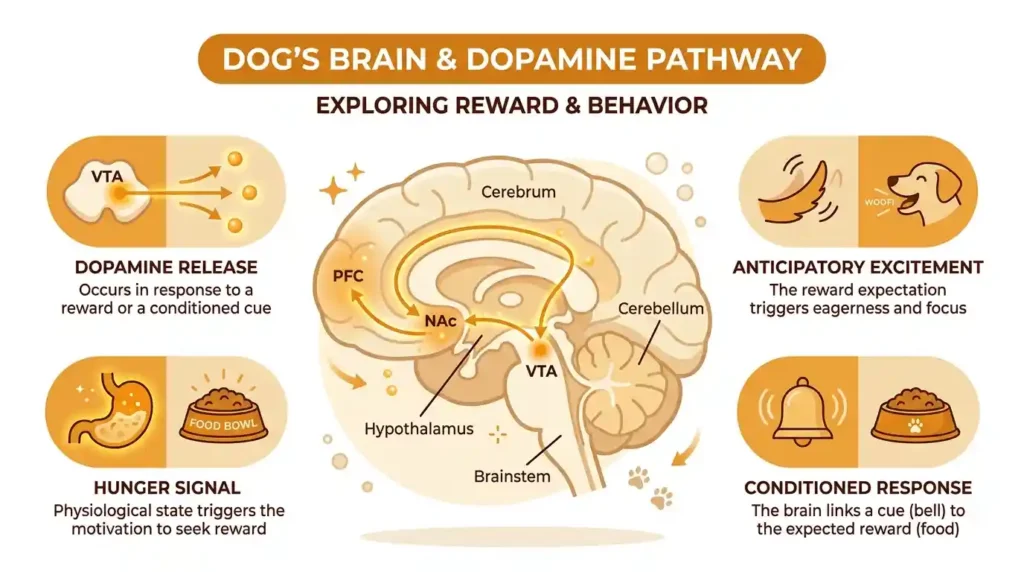
The barking is, in Pavlovian terms, a conditioned emotional response — an involuntary behavioral output triggered by the learned association between environmental cues and the incoming food reward.
The Role of Dopamine and Hunger Hormones
At a neurochemical level, the anticipation of a meal triggers a surge in dopamine — the neurotransmitter responsible for reward-seeking behavior. Research in comparative neuroscience confirms that dogs experience dopaminergic activation in anticipation of food in ways remarkably parallel to humans. This creates an emotional state of urgency and heightened arousal, which physically manifests as barking, pacing, and whining.
Additionally, the hunger hormone ghrelin rises as mealtime approaches. Elevated ghrelin levels create physical discomfort akin to mild anxiety, which some dogs vocalize. This is especially notable in dogs fed on rigid schedules, where the biological clock reinforces the behavioral loop.
Why Dogs Bark at Their Food Bowl: Core Reasons
Anticipatory Excitement
This is the most benign and common cause. The dog has simply learned that certain cues — the sound of kibble, the opening of the pantry, the owner moving toward the feeding area — signal an incoming reward. The excitement becomes overwhelming, and barking is the emotional overflow.
This type of barking is usually joyful: the dog’s tail wags, their body wiggles, they may spin in circles. It is communicative in nature and not a sign of aggression or distress.
Demand Barking and Attention-Seeking
Demand barking occurs when a dog has learned — through inadvertent owner reinforcement — that vocalizing produces results. If an owner consistently fills the bowl when the dog barks, the dog has been operantly conditioned: bark → food appears. This is a textbook positive reinforcement loop, and it will strengthen over time unless deliberately interrupted.
Anxiety and Insecurity Around Food
Dogs who have experienced food scarcity — particularly rescues, former strays, or dogs from multi-dog households with competition — may bark from a place of anxiety rather than excitement. The barking here functions as a stress vocalization: the dog is uncertain whether they will receive food, and the insecurity is expressed vocally.
Signs of anxiety-based barking differ from excitement barking: the dog may appear tense, low-eared, crouched, or show lip-licking and yawning (calming signals) even while barking.
Food-Guarding Instincts
Some dogs bark near the bowl as part of a resource guarding response — a deeply instinctual behavior rooted in survival genetics. The dog is communicating ownership over a high-value resource. This type of barking is directed at other animals, children, or anyone approaching the food zone and carries different body language markers: stiffening, hard stare, low growl preceding or interspersed with the bark.
Pain or Discomfort While Eating
Less commonly, a dog may vocalize near or during eating due to oral pain (dental disease, cracked teeth), gastrointestinal discomfort, or physical difficulty bending to the bowl (orthopedic issues). These vocalizations are usually yelps, whimpers, or involuntary cries rather than demand-style barking, and warrant immediate veterinary attention.
Breed-Specific Tendencies in Food Bowl Barking
High-Energy and Vocal Breeds
Certain breeds are neurologically wired for higher vocalization output. Beagles, Siberian Huskies, Miniature Schnauzers, Dachshunds, and Yorkshire Terriers are known for expressive vocal behavior across all contexts, including mealtimes. For these breeds, pre-meal barking often requires more consistent and patient training intervention.
Herding and Working Breeds
Border Collies, Australian Shepherds, and German Shepherds are highly food-motivated and have strong anticipatory behavior systems. Their pre-meal barking often reflects the same focused, task-oriented energy they apply to working scenarios. These breeds respond exceptionally well to structured feeding protocols that channel their energy productively.
How Diet and Nutrition Influence This Behavior
The relationship between what your dog eats and how they behave around food is more complex than many owners realize. Nutritional deficiencies, poor-quality ingredients, and irregular feeding schedules can all amplify food-related barking. Understanding How Diet and Nutrition Affect Dog Barking Behavior is a crucial part of addressing the root causes of mealtime vocalization rather than just the surface symptoms.
Hunger-Driven Barking
Dogs fed insufficient quantities for their size, age, and activity level will bark more intensely and persistently before meals. This is a biological signal of genuine need. Reviewing portion sizes with a veterinarian and ensuring meals align with the dog’s metabolic requirements is often the first corrective step.
Blood Sugar and Mood Swings in Dogs
Dogs fed high-glycemic, carbohydrate-heavy diets may experience blood sugar spikes and crashes between meals. These fluctuations create physical discomfort and behavioral irritability, intensifying pre-meal barking and anxiety. A balanced, high-protein diet with complex carbohydrates helps stabilize energy levels and reduce hunger-triggered behavioral outbursts.
Reading Your Dog’s Body Language at the Bowl
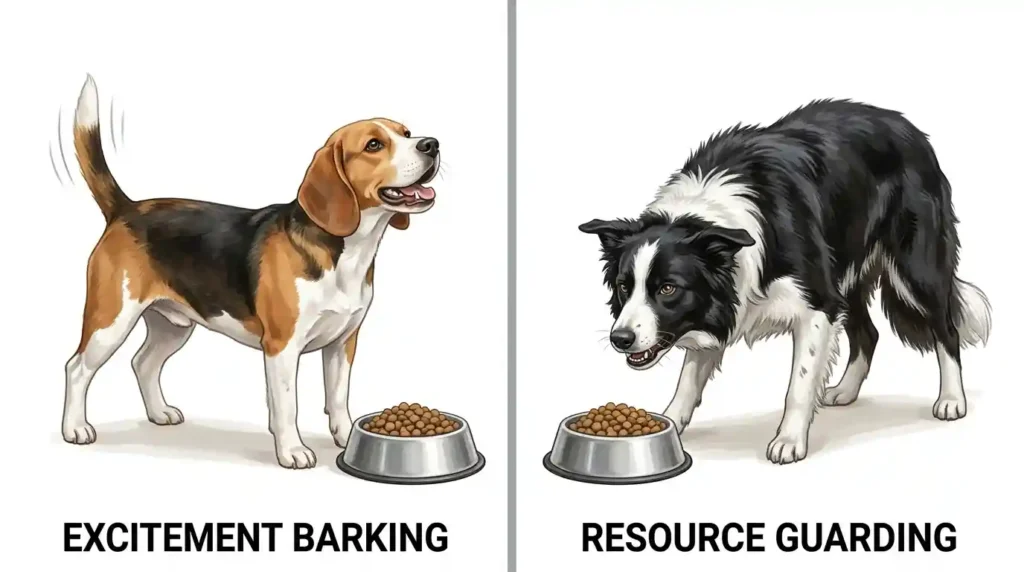
Excitement vs. Aggression Signals
Correctly interpreting your dog’s body language is essential for choosing the right intervention:
Excitement signals: loose, wiggly body, high wagging tail, jumping, spinning, eyes soft, ears relaxed or perked forward. Barking is high-pitched and rhythmic.
Aggression/guarding signals: stiff body posture, low or tucked tail, hard direct stare, raised hackles, ears pinned back or rigidly forward, growling beneath or between barks, snapping.
Stress and Anxiety Signals
Stress signals: lip-licking, yawning, whale eye (showing whites of eyes), crouching low, panting despite no exertion, avoiding eye contact while barking, pacing. These require a compassionate approach focused on building food security and positive association with the bowl.
It is also worth noting that some dogs exhibit vocalizations in sleep that mirror their waking behaviors. Understanding Dog Barking While Sleeping can provide additional insight into how deeply ingrained food-related anxieties may manifest even during rest cycles, especially in dogs with significant feeding insecurities.
Training Strategies to Reduce or Manage Food Bowl Barking

The “Sit and Wait” Protocol
This is the most widely recommended and effective structured approach:
- When preparing your dog’s meal, stop all movement the moment barking begins.
- Stand still. Do not make eye contact. Do not speak.
- The moment the dog is quiet — even for two seconds — resume movement.
- Ask for a “Sit.” Wait for compliance.
- Ask for a “Wait” or “Stay.” Place the bowl on the ground.
- Release with a calm “Okay” or “Free.”
Consistency is non-negotiable. Every person in the household must follow the same protocol. Mixed responses will slow progress significantly.
Positive Reinforcement Techniques
Never punish barking with yelling, bowl removal, or physical corrections. These approaches increase arousal and anxiety, worsening the behavior. Instead:
- Mark and reward silence: Use a clicker or the word “Yes” to mark the exact moment quiet behavior occurs, then immediately reward.
- Reward calm approach to the bowl: Shape a calm, non-vocal approach to the feeding area by rewarding incremental steps toward relaxed mealtime behavior.
- Jackpot rewards for exceptional calm: Occasionally, provide a high-value treat for particularly calm mealtime behavior to accelerate learning.
Desensitization and Counter-Conditioning
For anxious or resource-guarding dogs, desensitization involves gradually exposing the dog to feeding-related stimuli at low intensity (e.g., simply picking up the food bowl without filling it) and building positive associations before moving to full feeding scenarios. According to the American Kennel Club’s guidelines on resource guarding, systematic desensitization paired with counter-conditioning is the gold standard approach for food-related behavioral issues.
Structured Feeding Routines
Dogs thrive on predictability. Establishing consistent feeding times, locations, and rituals reduces anxiety-driven barking by making the food event feel safe and guaranteed rather than uncertain.
- Feed at the same times daily.
- Use the same feeding location.
- Avoid free-feeding (leaving food out all day), which can paradoxically increase food anxiety in some dogs.
- Create a calm pre-feeding ritual: a short training session, a calm sit, a brief pause before release.
When Food Bowl Barking Becomes a Problem
Escalation to Aggression
Pre-meal barking that escalates to growling, snapping, or biting when the bowl is approached is a behavioral emergency requiring immediate professional intervention. This is not a training issue that can be resolved with YouTube tutorials — it is a safety concern, particularly in homes with children or elderly individuals.
Obsessive or Compulsive Barking
In rare cases, food-related barking becomes compulsive — the dog barks even when food is unavailable, cannot be redirected, and shows no ability to self-regulate. This may indicate an underlying anxiety disorder or compulsive behavioral condition, both of which require veterinary behavioral consultation and potentially pharmacological support. The ASPCA’s resource on compulsive behaviors in dogs offers valuable guidance on identifying and addressing these patterns.
What NOT to Do When Your Dog Barks at the Bowl
- Do not feed the dog while it is barking. This directly reinforces the behavior.
- Do not yell or punish. Negative emotional responses increase arousal and anxiety.
- Do not ignore the behavior indefinitely if it is escalating or involves guarding signals.
- Do not inconsistently enforce rules. Feeding the dog “just this once” while they bark resets the training clock.
- Do not use aversive tools (shock collars, spray bottles) for food-related barking — these create negative food associations and can increase anxiety.
Consulting a Professional: When to Seek Help
Seek professional guidance from a certified professional dog trainer (CPDT-KA) or veterinary behaviorist (DACVB) when:
- Barking escalates to growling, snapping, or biting near the food bowl.
- The behavior has been present for months with no improvement despite consistent training.
- The dog appears genuinely distressed (not just excited) around food.
- Multiple dogs in the household are involved in food-related conflicts.
- The dog’s vocalization patterns change suddenly (potential medical cause).
Frequently Asked Questions (FAQs)
Q: Is it normal for dogs to bark before eating? Yes, mild anticipatory barking is normal. It becomes a concern when it is intense, persistent, aggressive, or linked to guarding behavior.
Q: How long does it take to train a dog to stop barking at the food bowl? With consistent daily practice, most dogs show significant improvement within 2–4 weeks. Dogs with deep-rooted demand barking histories may take 6–8 weeks.
Q: Should I feed my dog less to reduce barking? No — reducing food intake inappropriately will worsen hunger-driven barking. Consult your vet to confirm correct portion sizes.
Q: My dog only barks at the bowl when guests are over. Why? This is likely social excitement compounded with routine disruption. The dog’s arousal threshold is elevated by the social stimulation, making food anticipation harder to regulate.
Q: Can multiple dogs in one household make food bowl barking worse? Yes. Inter-dog competition elevates stress hormones around mealtimes, which amplifies vocalization. Separate feeding stations and simultaneous feeding can help significantly.
References
- American Kennel Club — Resource Guarding Training Guide: https://www.akc.org/expert-advice/training/resource-guarding/
- ASPCA — Compulsive Behaviors in Dogs: https://www.aspca.org/pet-care/dog-care/common-dog-behavior-issues/compulsive-behaviors