


Summary: Diet and nutrition play a surprisingly significant role in shaping a dog’s barking behavior. From blood sugar spikes caused by low-quality kibble to gut microbiome imbalances that affect mood-regulating neurotransmitters, what your dog eats directly influences how calm, reactive, or anxious they are. This in-depth guide How Diet Affects Dog Barking Behavior explores the gut-brain axis in dogs, identifies dietary triggers that worsen excessive barking, highlights key nutrients that support emotional balance, and offers practical strategies for feeding your dog in a way that promotes quieter, calmer behavior.
Table of Contents
Introduction — The Gut-Brain Connection in Dogs
Understanding Why Dogs Bark
- Types of Barking and Their Triggers
- Neurological and Behavioral Roots of Excessive Barking
How Nutrition Directly Influences Canine Behavior
- Blood Sugar Fluctuations and Hyperactivity-Linked Barking
- Protein, Amino Acids, and Neurotransmitter Production
- The Role of Tryptophan and Serotonin in Calm Behavior
Common Dietary Triggers That May Worsen Barking
- Artificial Additives, Preservatives, and Dyes
- Grain and Gluten Sensitivity in Dogs
- Food Allergies and Inflammation-Driven Irritability
Nutrients That Promote Calmer Behavior in Dogs
- Omega-3 Fatty Acids and Brain Health
- Magnesium, B Vitamins, and Nervous System Support
- Probiotics, Gut Microbiome, and Emotional Regulation
Feeding Schedule and Meal Timing Effects on Barking
- Hunger-Induced Barking and Irregular Feeding
- Overfeeding, Digestive Discomfort, and Restlessness
Hydration and Its Often-Overlooked Role
Special Dietary Considerations for Anxious or Reactive Dogs
- Calming Diets and Functional Dog Foods
- Natural Supplements Worth Considering
How to Transition Your Dog’s Diet Safely
When to Consult a Veterinary Nutritionist
Conclusion
Introduction — The Gut-Brain Connection in Dogs
Most dog owners think of barking as a purely behavioral or environmental problem — something to be solved through training, socialization, or management. While those factors absolutely matter, there is a growing body of veterinary and nutritional science pointing to something deeper: what your dog eats can significantly influence how much and how intensely they bark.

The gut-brain axis — the bidirectional communication network between the gastrointestinal system and the central nervous system — is just as relevant in dogs as it is in humans. The enteric nervous system lining the dog’s digestive tract produces and regulates neurotransmitters like serotonin, dopamine, and GABA. These chemical messengers govern mood, anxiety levels, stress responses, and impulse control. When a dog’s diet disrupts this system through poor ingredients, allergens, imbalanced macronutrients, or irregular feeding, behavioral symptoms — including excessive, reactive, or compulsive barking — can follow.
Understanding this connection empowers dog owners to look beyond the bark and examine the bowl.
Understanding Why Dogs Bark
Types of Barking and Their Triggers
Barking is a natural, multi-functional form of canine communication. Dogs bark to alert, to express excitement, to signal anxiety, to demand attention, or to respond to pain and discomfort. Broadly, barking falls into these categories:
- Alert or territorial barking — triggered by strangers, sounds, or perceived threats
- Anxiety or fear barking — driven by separation, phobias, or unfamiliar environments
- Demand barking — used to seek food, attention, or playtime
- Compulsive barking — repetitive, often without clear cause; linked to stress or neurological imbalance
- Pain-related barking — a response to physical discomfort, including digestive distress
Nutritional deficiencies and dietary imbalances most directly affect anxiety barking, compulsive barking, and demand barking — patterns driven by internal states rather than purely external stimuli.
You might also notice barking during sleep — a phenomenon with its own fascinating explanation. If your dog barks or whimpers while sleeping, learn more about what’s happening neurologically in our guide on Dog Barking While Sleeping.
Neurological and Behavioral Roots of Excessive Barking
Excessive barking is often rooted in heightened neurological arousal — a state where the dog’s nervous system is chronically over-stimulated or under-regulated. Key neurotransmitters involved include:
- Serotonin — the primary mood stabilizer; low levels correlate with anxiety and aggression
- Dopamine — regulates motivation and reward; imbalances can drive compulsive behaviors
- GABA (gamma-aminobutyric acid) — the brain’s main inhibitory neurotransmitter; deficiency leads to excitability
- Cortisol — the stress hormone; chronically elevated levels (often linked to poor diet) sustain a hypervigilant state
Diet directly affects the production, availability, and balance of all of these.
How Nutrition Directly Influences Canine Behavior
Blood Sugar Fluctuations and Hyperactivity-Linked Barking
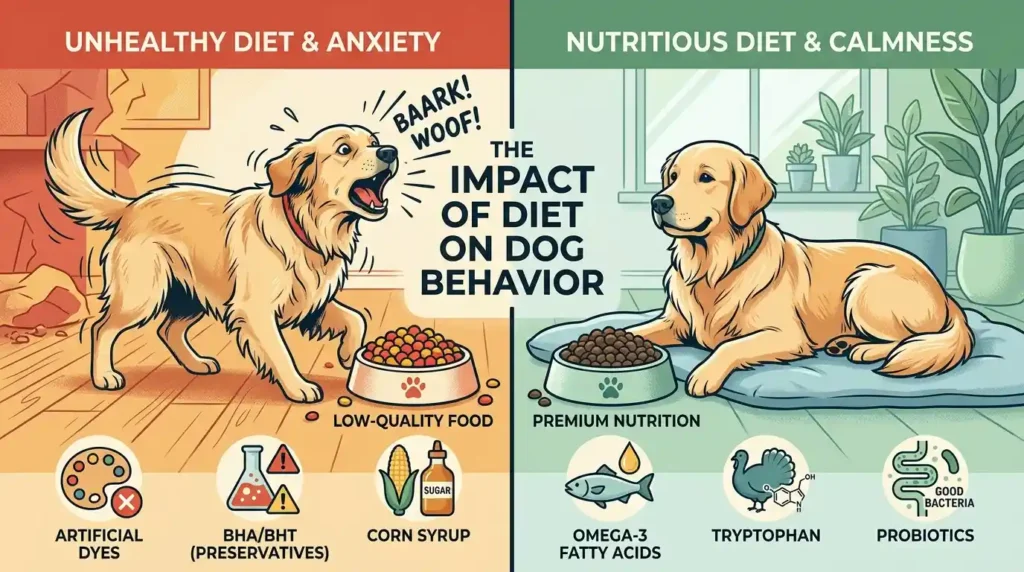
Just like children who experience mood and energy swings after consuming sugar, dogs fed high-glycemic diets — particularly low-quality kibble packed with corn syrup, refined starches, and simple carbohydrates — experience sharp rises and falls in blood glucose. These spikes trigger the release of adrenaline (epinephrine), which puts the dog into a state of heightened arousal. The result: restlessness, reactivity, and excessive barking.
Dogs fed diets with a lower glycemic index — those rich in complex carbohydrates, lean proteins, and healthy fats — tend to maintain more stable energy and mood throughout the day.
Protein, Amino Acids, and Neurotransmitter Production
Protein quality is one of the most important and underappreciated factors in canine behavioral health. Dietary proteins are broken down into amino acids, which serve as the building blocks for neurotransmitters. Specifically:
- Tryptophan → converts to serotonin (calming effect)
- Tyrosine and phenylalanine → precursors to dopamine and norepinephrine
- Glutamine → supports GABA synthesis
Diets low in bioavailable protein — common in products that use meat “meals” or plant-based protein fillers as primary sources — may leave dogs with insufficient amino acid pools to maintain healthy neurotransmitter levels. This contributes to chronic low-grade anxiety, which expresses itself behaviorally through barking, whining, pacing, and destructive behavior.
The Role of Tryptophan and Serotonin in Calm Behavior
Tryptophan deserves particular attention. As the dietary precursor to serotonin — the neurotransmitter most associated with emotional stability and calm — tryptophan availability in the diet directly impacts a dog’s baseline anxiety level. Research has shown that dogs supplemented with alpha-casozepine (a tryptophan-rich hydrolyzed milk protein) showed measurable reductions in anxiety-related behaviors.
Natural food sources rich in tryptophan for dogs include turkey, chicken, eggs, and fish. Diets that feature these ingredients prominently may support a calmer behavioral baseline compared to heavily processed alternatives.
Common Dietary Triggers That May Worsen Barking
Artificial Additives, Preservatives, and Dyes
Certain synthetic ingredients commonly found in low-quality commercial dog foods have been linked to hyperactivity and behavioral issues in dogs. These include:
- BHA, BHT, and ethoxyquin — chemical preservatives suspected to have neurological effects
- Artificial food dyes (Red 40, Yellow 5, Yellow 6) — associated with hyperactivity in sensitive animals
- Propylene glycol — a moisture-retaining additive that may affect gut health
- Sodium nitrate — used in meat preservation; linked to oxidative stress
While definitive canine studies are still emerging, the precautionary principle suggests choosing foods free of these additives, particularly for dogs that display reactive or excessive barking.
Grain and Gluten Sensitivity in Dogs
Some dogs — particularly certain breeds like Irish Setters — are genetically predisposed to gluten sensitivity or grain intolerance. In these animals, consuming wheat, barley, or rye-based products triggers an inflammatory response in the gut. Chronic inflammation affects the gut-brain axis, altering neurotransmitter production and increasing systemic stress responses.
Behavioral manifestations of food-based inflammation can include increased anxiety, irritability, and — yes — more frequent barking. Switching to grain-free or single-protein diets has anecdotally reduced reactivity in many sensitive dogs.
Food Allergies and Inflammation-Driven Irritability
Food allergies in dogs — most commonly to beef, dairy, chicken, wheat, and soy — produce chronic immune activation. This persistent inflammatory state elevates cortisol, disrupts the gut microbiome, and reduces the intestinal production of calming neurotransmitters. Dogs suffering from undiagnosed food allergies are often described as “constantly on edge” — reactive barkers who seem irritable without obvious cause.
Common signs that barking may be allergy-related include: itchy skin, recurrent ear infections, gastrointestinal upset, and behavioral changes after eating.
Nutrients That Promote Calmer Behavior in Dogs
Omega-3 Fatty Acids and Brain Health
Omega-3 fatty acids — particularly EPA (eicosapentaenoic acid) and DHA (docosahexaenoic acid) — are essential for brain structure, neuronal signaling, and the regulation of inflammatory pathways in the nervous system. Research published in veterinary behavioral journals has consistently shown that supplementation with fish-derived omega-3s reduces anxiety, aggression, and compulsive behaviors in dogs.
DHA, in particular, is critical for the development and maintenance of the myelin sheaths surrounding nerve fibers — the insulation that allows for efficient, regulated neural communication. A dog deficient in omega-3s may have a nervous system that is literally less efficient at regulating its own arousal. Sources include salmon oil, sardine oil, and krill oil. According to the American Kennel Club’s nutrition guidelines, omega-3 supplementation is among the most evidence-backed nutritional interventions for canine behavioral health.
Magnesium, B Vitamins, and Nervous System Support
Magnesium plays a central role in regulating the NMDA receptor — a key component of the stress response in the nervous system. Magnesium-deficient dogs may experience heightened nerve excitability, making them more prone to startle responses, anxiety, and reactive barking. Good dietary sources include pumpkin seeds, spinach, and certain legumes (used carefully in dogs).
B vitamins — particularly B1 (thiamine), B6 (pyridoxine), and B12 (cobalamin) — are essential cofactors in neurotransmitter synthesis. Thiamine deficiency is directly associated with neurological dysfunction in dogs. High-quality whole-food diets tend to be naturally richer in these micronutrients than heavily processed kibble.
Probiotics, Gut Microbiome, and Emotional Regulation
Perhaps the most cutting-edge area of canine nutritional science is the role of the gut microbiome in behavioral regulation. The community of bacteria, fungi, and other microorganisms living in your dog’s digestive tract produces a staggering array of neuroactive compounds — including the majority of the body’s serotonin.
When the microbiome is disrupted (dysbiosis) — through antibiotics, poor diet, stress, or illness — this serotonin production drops. Probiotic supplementation with strains like Lactobacillus acidophilus, Bifidobacterium longum, and Lactobacillus rhamnosus has shown promise in restoring microbial balance and reducing anxiety-related behaviors in dogs. As noted by VCA Animal Hospitals’ behavioral nutrition resource, dietary interventions targeting the gut-brain axis represent a frontier in companion animal behavioral medicine.
Feeding Schedule and Meal Timing Effects on Barking

Hunger-Induced Barking and Irregular Feeding
Dogs are creatures of routine. When meal times are irregular or inconsistent, dogs experience anticipatory anxiety — a low-grade stress state that keeps their nervous system activated. Demand barking (barking for food) is the most obvious manifestation, but the residual anxiety from unpredictable feeding can spill over into general reactivity throughout the day.
Feeding your dog at the same times each day — typically twice daily for adult dogs — creates a predictable hormonal and neurological rhythm that supports calmer behavior overall.
Overfeeding, Digestive Discomfort, and Restlessness
On the opposite end, overfeeding produces its own behavioral consequences. Dogs that consistently eat more than their metabolic needs experience digestive discomfort, bloating, and gut inflammation. This physical discomfort translates into restlessness, whining, and agitation. In some cases, dogs with GI distress will bark seemingly without cause — because the cause is internal and invisible to the owner.
Hydration and Its Often-Overlooked Role
Dehydration is a frequently overlooked contributor to canine behavioral problems. Even mild dehydration affects cognitive function and mood regulation in dogs. A dog that is consistently under-hydrated may be more irritable, more reactive, and more prone to vocalization.
Dogs fed dry kibble exclusively are at higher risk of chronic mild dehydration than those fed wet food or raw diets. Ensuring access to fresh, clean water at all times — and considering partial transition to moisture-rich food — can meaningfully support behavioral stability.
Special Dietary Considerations for Anxious or Reactive Dogs
Calming Diets and Functional Dog Foods
Several commercial diets have been formulated specifically to address anxiety and stress in dogs. These products typically feature:
- Elevated tryptophan levels
- Hydrolyzed milk proteins (alpha-casozepine)
- L-theanine (an amino acid from green tea with documented anxiolytic effects)
- Reduced simple carbohydrates
Royal Canin’s Calm diet and Hill’s Prescription Diet c/d are among the most clinically studied options in this category.
Natural Supplements Worth Considering
For dogs whose barking appears anxiety-driven, the following supplements have the most supporting evidence:
- L-theanine — promotes alpha brain wave activity and calm alertness
- Melatonin — particularly useful for noise phobia, barking, and sleep disturbances
- Valerian root — traditional herbal calming agent with mild evidence of efficacy
- CBD (cannabidiol) — increasingly studied for canine anxiety; consult your vet before use
- Alpha-casozepine (Zylkène) — well-researched; derived from cow’s milk protein
How to Transition Your Dog’s Diet Safely
Any dietary change should be made gradually over 7–14 days to prevent digestive upset. A typical transition schedule looks like this:
- Days 1–3: 75% old food, 25% new food
- Days 4–6: 50% old food, 50% new food
- Days 7–9: 25% old food, 75% new food
- Days 10–14: 100% new food
Monitor stool consistency, energy levels, and behavioral changes throughout the transition. If GI symptoms persist beyond 2–3 days at any stage, slow the transition further.
When to Consult a Veterinary Nutritionist
If your dog’s barking is persistent, severe, or accompanied by other concerning signs (aggression, self-directed behaviors, profound anxiety), a multi-pronged approach is warranted. Consult a board-certified veterinary behaviorist alongside a veterinary nutritionist — especially if you suspect food allergies, micronutrient deficiencies, or if your dog has an underlying health condition affecting diet.
It’s also important to rule out pain as a cause of barking. Dental disease, arthritis, ear infections, and GI disorders are common medical causes of increased vocalization. Some rescue dogs, due to their often unknown and potentially traumatic histories, display complex barking patterns that require both behavioral and nutritional attention. Understanding the nuances of reactive rescue dogs — such as those addressed in our piece on Why Does My Rescue Dog Bark at Men Specifically — can help you determine whether diet, trauma, or socialization is the dominant factor.
Conclusion
The relationship between diet, nutrition, and barking behavior in dogs is not a simple one — but it is a real and meaningful one. From the amino acid composition of your dog’s protein source to the health of their gut microbiome, from blood sugar stability to magnesium availability, nutritional science is revealing that the bowl is as important as the training leash. A dog fed a species-appropriate, nutrient-dense, allergen-free diet with consistent meal timing will almost always be calmer, less reactive, and less prone to excessive barking than one subsisting on low-quality, additive-laden food. Start with the basics: high-quality protein, omega-3s, probiotics, clean water, and a consistent schedule — and observe how your dog’s behavior shifts from the inside out.