


Summary
Dogs barking, whimpering, or twitching during sleep is a completely normal and scientifically well-documented behavior rooted in their REM (Rapid Eye Movement) sleep cycle, during which dreaming occurs. Just like humans, dogs process the day’s experiences through dreams, and their vocalizations — whether soft whimpers, muffled barks, or even full-throated woofs — are simply expressions of an active dream state. However, while occasional sleep vocalizations are healthy and harmless, certain patterns such as violent thrashing, prolonged episodes, or post-sleep confusion may indicate underlying neurological or medical conditions like REM Sleep Behavior Disorder or canine epilepsy, warranting a veterinary evaluation. This guide Dog Barking While Sleeping covers everything a dog owner needs to understand about sleep barking, from the science of canine sleep cycles to when it’s time to consult a professional.
Table of Contents
Understanding Sleep in Dogs
- Dog Sleep Cycles Explained
- REM Sleep and Its Role in Canine Behavior
Why Do Dogs Bark, Whimper, or Make Noises in Their Sleep?
- Dream Activity in Dogs
- The Neurological Basis of Sleep Vocalizations
- H3: LSI Concepts: Twitching, Paddling, and Whimpering Together
Is It Normal for Dogs to Bark While Sleeping?
- When It’s Completely Normal
- Breed-Specific Tendencies
- Age-Related Differences (Puppies vs. Senior Dogs)
What Are Dogs Dreaming About When They Bark?
- Scientific Evidence on Dog Dreams
- Common Dream Scenarios Dogs Likely Experience
Sleep Barking vs. Sleep Disorders in Dogs
- REM Sleep Behavior Disorder (RBD) in Dogs
- Canine Epilepsy and Nighttime Seizures
- How to Tell the Difference
When Should You Be Concerned About Your Dog Barking in Sleep?
- Warning Signs to Watch For
- Questions to Ask Your Veterinarian
Should You Wake a Barking, Dreaming Dog?
- The Old Saying and the Science Behind It
- Safe Ways to Gently Rouse a Dog
How to Support Better Sleep for Your Dog
- Creating a Comfortable Sleep Environment
- Routine, Exercise, and Mental Stimulation
- Diet and Sleep Quality
Related Barking Behaviors Pet Owners Often Confuse
Frequently Asked Questions
References
Understanding Sleep in Dogs

Sleep is one of the most essential biological functions for dogs, just as it is for humans. Dogs typically sleep between 12 and 14 hours per day, with puppies and senior dogs often sleeping even more. Understanding the architecture of canine sleep helps decode why dogs bark, whimper, paddle their legs, or twitch during rest.
Dog Sleep Cycles Explained
Dogs cycle through two primary sleep stages:
SWS (Slow Wave Sleep): This is the lighter phase of sleep. During SWS, a dog is relatively easy to wake, and the brain is in a lower activity state. Muscle tone is maintained, and bodily repair functions begin.
REM Sleep (Rapid Eye Movement): This is the deeper, more active phase where the brain becomes highly engaged — nearly as active as when the dog is awake. The eyes move beneath closed lids, breathing becomes irregular, and muscle activity increases. This is the stage associated with dreaming.
Dogs reach their first REM cycle relatively quickly — usually within 20 minutes of falling asleep — and cycle between SWS and REM multiple times throughout a sleep session. Smaller dogs tend to dream more frequently but for shorter periods, while larger dogs dream less often but for longer durations.
REM Sleep and Its Role in Canine Behavior
During REM sleep, the brain’s pons region — a structure in the brainstem — sends signals that typically paralyze voluntary muscles, preventing the body from physically acting out dreams. However, this mechanism is not always perfect. When it partially disengages, the result is the physical manifestations we observe: paw paddling, muffled barks, whimpering, growling, and tail wagging. These behaviors are direct expressions of whatever neural activity is occurring in the dreaming brain.
Why Do Dogs Bark, Whimper, or Make Noises in Their Sleep?
Dream Activity in Dogs
The primary reason dogs vocalize during sleep is dream activity. Dogs are known to dream about familiar, emotionally significant events: chasing a squirrel, playing fetch, interacting with their owners, or even reliving social encounters with other dogs. The barks and whimpers heard during sleep are the auditory output of these internal experiences.
The Neurological Basis of Sleep Vocalizations
Neurologically, sleep vocalizations arise from the motor cortex and limbic system — the parts of the brain governing movement and emotion. When a dog dreams of something exciting or threatening, these brain areas fire in patterns nearly identical to waking behavior. The vocalization that results is not a conscious act; it’s an involuntary neurological expression.
Matthew Wilson and Kenway Louie at MIT conducted landmark research showing that rats replay their daytime experiences during REM sleep, and subsequent studies have supported similar conclusions for dogs. The brain essentially rehearses and consolidates memories during this period — a process that directly produces sleep vocalizations.
Twitching, Paddling, and Whimpering Together
Sleep vocalizations rarely occur in isolation. Pet owners frequently observe a cluster of behaviors during their dog’s REM phase:
- Leg paddling or running motions — the dog appears to be chasing something
- Facial twitching or whisker movement
- Eyelid fluttering with visible rapid eye movement
- Whimpering, yelping, or soft barking
- Tail wagging or tucking
- Changes in breathing rhythm — short, shallow, or rapid breaths
This cluster of behaviors, described in veterinary literature as sleep myoclonus combined with somniloquy (sleep talking in animals), represents the complete picture of an active dream state. It is not a cause for alarm when these behaviors are brief, and the dog wakes easily and normally.
Is It Normal for Dogs to Bark While Sleeping?
When It’s Completely Normal
Yes — in the vast majority of cases, a dog barking while sleeping is entirely normal. It falls under the umbrella of parasomnia behaviors in animals: events that occur during sleep but are not classified as disorders unless they cause harm or reflect an underlying condition. If your dog barks occasionally during sleep, settles quickly, and wakes up acting like their usual self, there is nothing to be concerned about.
Breed-Specific Tendencies
Certain breeds are more prone to expressive sleep behaviors than others. Breeds with high prey drive, intense daily energy output, or strong emotional sensitivity tend to be the most vocal sleepers:
- Beagles and scent hounds — deeply driven by olfactory memory, they frequently vocalize during sleep
- German Shepherds and working breeds — their active, task-oriented days produce rich dream content
- Terriers — high-energy, highly reactive dogs that often carry their intensity into sleep
- Labrador and Golden Retrievers — social, emotionally engaged dogs that dream vividly of play and interaction
Brachycephalic breeds (flat-faced dogs like Bulldogs and Pugs) may also make more exaggerated sleep sounds due to their anatomy affecting airflow during sleep.
Age-Related Differences (Puppies vs. Senior Dogs)
Puppies tend to bark and twitch more during sleep because they spend a higher proportion of their sleep time in REM. Their brains are processing an enormous volume of new information — sights, smells, sounds, social cues — and the dream state is the primary mechanism for this consolidation. Expect a puppy to be a very active, vocal sleeper.
Senior dogs may experience more frequent or intense sleep vocalizations due to cognitive changes. Canine Cognitive Dysfunction (CCD) — the dog equivalent of dementia — can disrupt normal sleep architecture and increase nighttime vocalizations. If your older dog has recently become more vocal during sleep alongside other behavioral changes (disorientation, altered appetite, house soiling), a veterinary visit is warranted.
What Are Dogs Dreaming About When They Bark?
Scientific Evidence on Dog Dreams
While we cannot ask a dog what they dreamed about, neuroscience offers strong indirect evidence. Dr. Stanley Coren, a leading canine psychologist and author, has written extensively on animal dreaming, noting that the brain wave patterns of sleeping dogs closely mirror those of humans during the dreaming phase. The hippocampus — the memory center of the brain — shows particularly active patterns during canine REM sleep, strongly suggesting that dogs replay real experiences.
For a fascinating dive into the science of animal cognition and sleep, the American Kennel Club’s resource on dog sleep and dreams provides an accessible, research-backed overview of what happens in your dog’s brain during rest.
Common Dream Scenarios Dogs Likely Experience
Based on behavioral observation and neurological research, dogs are believed to dream about:
- Chasing and hunting — leg paddling and excited vocalizations
- Play with other dogs or humans — tail wagging and happy barking
- Past stressful or fearful encounters — whimpering or defensive barking
- Daily routines — fetching, walking familiar routes, meal anticipation
Dogs with rich daily lives — lots of walks, social interaction, training, and play — tend to have more expressive sleep behavior because they have more material for their dreaming brain to work with.
Sleep Barking vs. Sleep Disorders in Dogs
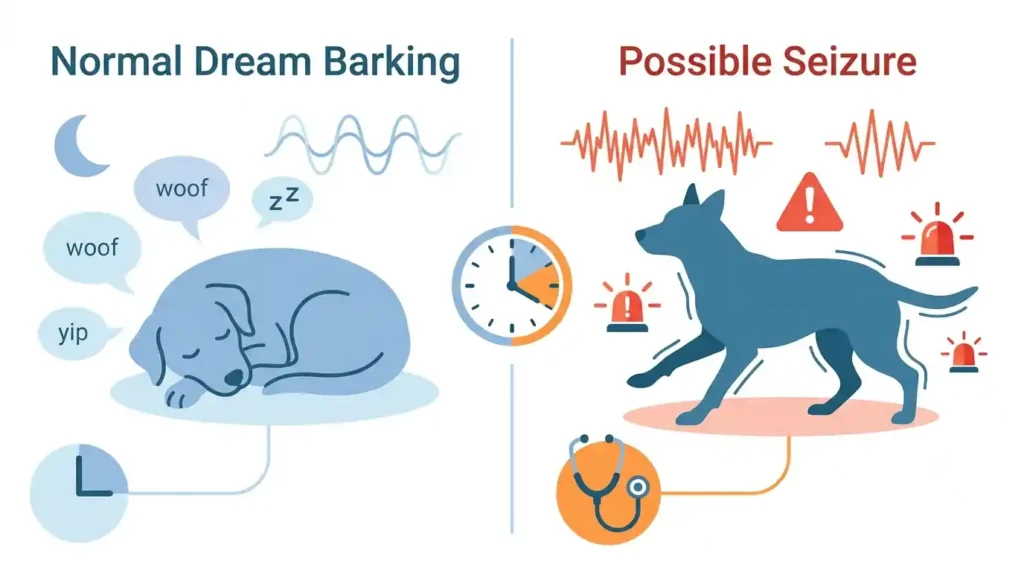
REM Sleep Behavior Disorder (RBD) in Dogs
In some cases, the brain’s mechanism for suppressing physical movement during REM sleep fails more significantly than normal. This condition, called REM Sleep Behavior Disorder (RBD), causes dogs to physically act out their dreams in ways that can be violent or dangerous. A dog with RBD may:
- Leap up suddenly during sleep
- Bite or snap at the air or nearby objects
- Run into walls or furniture
- Show aggression upon waking, directed at people or other pets
- Experience episodes that are difficult to interrupt
RBD is more commonly observed in older dogs and has been documented in veterinary neurology literature. It is distinct from normal sleep vocalizations because of the intensity, duration, and potential for self-injury or injury to others.
Canine Epilepsy and Nighttime Seizures
It is critical to distinguish between dream-related sleep vocalizations and nocturnal seizures. Epileptic episodes can occur during sleep and may superficially resemble intense dreaming. Key differences include:
| Feature | Normal Sleep Barking | Nocturnal Seizure |
| Duration | Seconds to 1-2 minutes | Often longer, may escalate |
| Response to touch/voice | Wakes fairly easily | Unresponsive or delayed |
| Post-episode behavior | Normal, relaxed | Confused, disoriented, exhausted |
| Muscle rigidity | Absent | Often present |
| Urination/defecation | Absent | May occur |
| Eye appearance | Closed or fluttering | Fixed, glazed, or rolled back |
How to Tell the Difference
The single most telling sign is post-episode behavior. After a normal dream, your dog wakes up, looks around, perhaps stretches, and returns to normal. After a seizure, a dog typically enters a postictal phase — a period of confusion, exhaustion, temporary blindness, or excessive thirst. If you observe postictal signs, contact your veterinarian immediately.
When Should You Be Concerned About Your Dog Barking in Sleep?
Warning Signs to Watch For
Consult a veterinarian if sleep vocalizations are accompanied by:
- Episodes lasting more than 2-3 minutes consistently
- Violent physical movements — biting, running, and crashing into objects
- Post-sleep confusion, disorientation, or aggression
- Loss of bladder or bowel control during episodes
- A sudden increase in sleep vocalization frequency in an older dog
- Signs of pain upon waking (whining, limping, reluctance to move)
- Daytime behavioral changes alongside sleep disturbances
Questions to Ask Your Veterinarian
When visiting your vet, be prepared to describe:
- How long do episodes last
- How frequently they occur
- What the dog looks like during and immediately after
- Any recent changes in diet, routine, medication, or environment
- Your dog’s age and breed
Video documentation of an episode is invaluable — most smartphone recordings made quietly from across the room can give your vet a clearer picture than any verbal description.
Should You Wake a Barking, Dreaming Dog?
The Old Saying and the Science Behind It
The phrase “let sleeping dogs lie” has both a literal and figurative truth. Dogs awakened suddenly from deep REM sleep can be disoriented, startled, or even snap reflexively — not out of aggression but from pure neurological confusion. This is not a character flaw; it is the brain transitioning rapidly from a deeply active dream state to wakefulness without adequate transition time.
This is especially relevant if you have a rescue dog with a trauma history. Understanding why your Does My Rescue Dog Bark at Men Specifically might react defensively when startled awake can help you respond with patience rather than alarm.
Safe Ways to Gently Rouse a Dog
If you must wake a dreaming dog — because of distress signals or safety concerns — do so gently:
- Call their name calmly and softly from a distance
- Avoid touching them suddenly, especially near the face or paws
- Use a familiar verbal cue in a calm, low tone
- Allow several seconds for full wakefulness before interaction
- Once awake, reassure them with calm praise
How to Support Better Sleep for Your Dog

Creating a Comfortable Sleep Environment
A high-quality sleep environment reduces sleep disruptions and supports healthy REM cycles:
- Provide a dedicated, comfortable dog bed placed away from foot traffic
- Keep the sleeping area at a comfortable, consistent temperature
- Minimize sudden loud noises during your dog’s primary sleep periods
- Use orthopedic beds for senior dogs to reduce physical discomfort
Routine, Exercise, and Mental Stimulation
Dogs who receive adequate physical exercise and mental enrichment during waking hours tend to sleep more soundly. A well-exercised dog has more positive dream content and spends more productive time in restorative sleep stages. Aim for:
- Daily walks are appropriate for the breed and age
- Interactive play sessions (fetch, tug, nose work)
- Training sessions that challenge the dog mentally
- Social interaction with familiar people and dogs
Interestingly, barking behaviors during the day — such as when your My Dog Bark When I Hug Someone Else — can reflect emotional states that may also influence dream content and sleep quality.
Diet and Sleep Quality
Nutrition plays a supporting role in sleep health. Avoid large meals immediately before bedtime. Ensure your dog has access to fresh water. Dogs on high-quality, balanced diets with appropriate omega-3 fatty acids (supporting brain and neurological health) tend to have more regulated sleep patterns. Some dogs benefit from a small, easily digestible evening snack that maintains blood sugar stability through the night.
Related Barking Behaviors Pet Owners Often Confuse
Pet owners sometimes confuse sleep barking with other behaviors:
- Barking at night while awake: Dogs that bark at real stimuli (sounds outside, other animals) while technically awake but groggy. This is a behavioral issue, not a sleep issue.
- Sleep apnea vocalizations: More common in brachycephalic breeds; snoring or gasping sounds that are respiratory, not dream-related.
- Anxiety-related nighttime vocalization: Dogs with separation anxiety may cry or bark when left alone at night — awake and distressed, not dreaming.
- Pain-related vocalization: Dogs in physical discomfort may whimper or cry during sleep when pressure is applied to sore areas. This warrants investigation.
For a comprehensive resource on dog behavior and vocalizations, the VCA Animal Hospitals’ guide to canine behavior offers expert-reviewed insights into interpreting what your dog is communicating.
Frequently Asked Questions
Q: Is it normal for dogs to bark in their sleep every night? Frequency varies by individual dog. Some dogs vocalize almost nightly; others rarely do. If the dog is healthy, wakes normally, and shows no distress, nightly sleep barking is not a concern.
Q: Can nightmares cause dogs to bark in their sleep? Yes. Dogs can experience negative dream content — reliving fearful encounters or stressful events — which may produce distressed vocalizations like whimpering or anxious barking.
Q: Do older dogs bark more in their sleep? They may, particularly if experiencing Canine Cognitive Dysfunction. Any notable increase in sleep vocalization in a senior dog should be discussed with a veterinarian.
Q: Should I comfort my dog after it barks in its sleep? Once fully awake, gentle reassurance is fine. Avoid rushing to comfort during the episode itself, as startling the dog can cause defensive reactions.
Q: Can stress during the day cause more sleep barking at night? Yes. Dogs processing stressful or highly stimulating daytime events may have more active and vocal dream states as the brain works through those experiences.
References
- American Kennel Club — Do Dogs Dream? https://www.akc.org/expert-advice/health/do-dogs-dream/
- VCA Animal Hospitals — Canine Behavior and Body Language https://vcahospitals.com/know-your-pet/how-to-read-your-dogs-body-language