
Summary
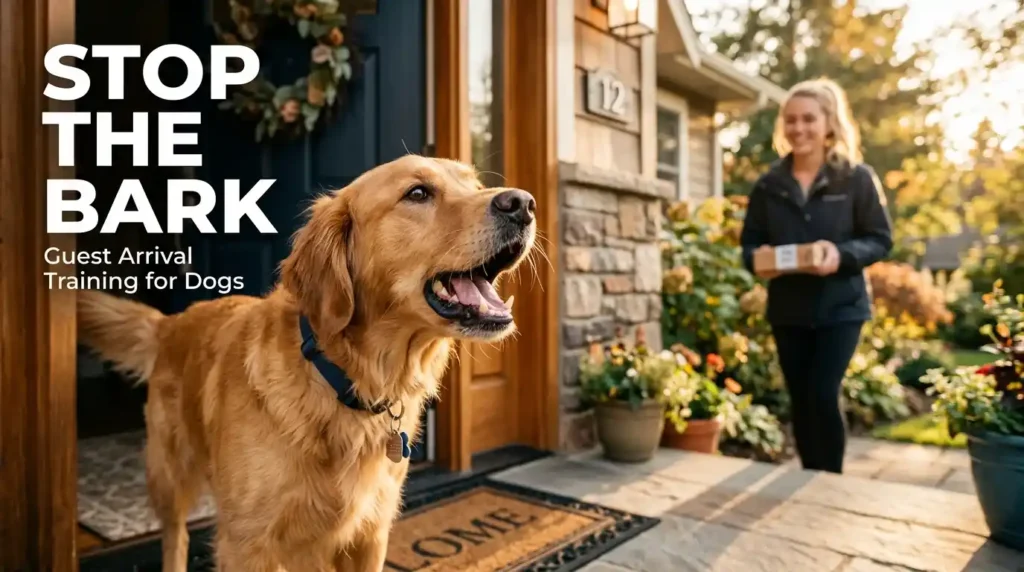
When a dog barks at guests and refuses to stop, it is almost always rooted in one of three behavioral drivers: territorial instinct, overexcitement, or fear-based anxiety. Understanding which driver is at play is the foundation of any effective training plan. This guide covers the complete picture — from canine psychology and body language reading, to step-by-step training protocols like desensitization, counter-conditioning, place training, and the “Quiet” command. It also addresses common owner mistakes, breed-specific tendencies, management strategies, and when professional help becomes necessary. Whether your dog goes into a barking frenzy the second the doorbell rings or continues barking long after guests are seated, this guide gives you the tools to create lasting calm.
Table of Contents
- Understanding Why Dogs Bark at Guests
- Reading Your Dog’s Body Language During Guest Arrivals
- The Psychology Behind Guest-Triggered Barking
- Training Methods to Stop Dog Barking When Guests Arrive
- Management Strategies While Training Is in Progress
- Socialization as a Long-Term Solution
- Common Mistakes Owners Make That Worsen the Barking
- Breed-Specific Tendencies and What to Expect
- When to Seek Professional Help
- FAQs About Dog Barking at Guests
Understanding Why Dogs Bark at Guests
Before you can stop the behavior, you must understand it. Dogs do not bark at guests out of spite or stubbornness. There is always a communicative, emotional, or instinctual reason behind it.
Territorial Barking vs. Excitement Barking
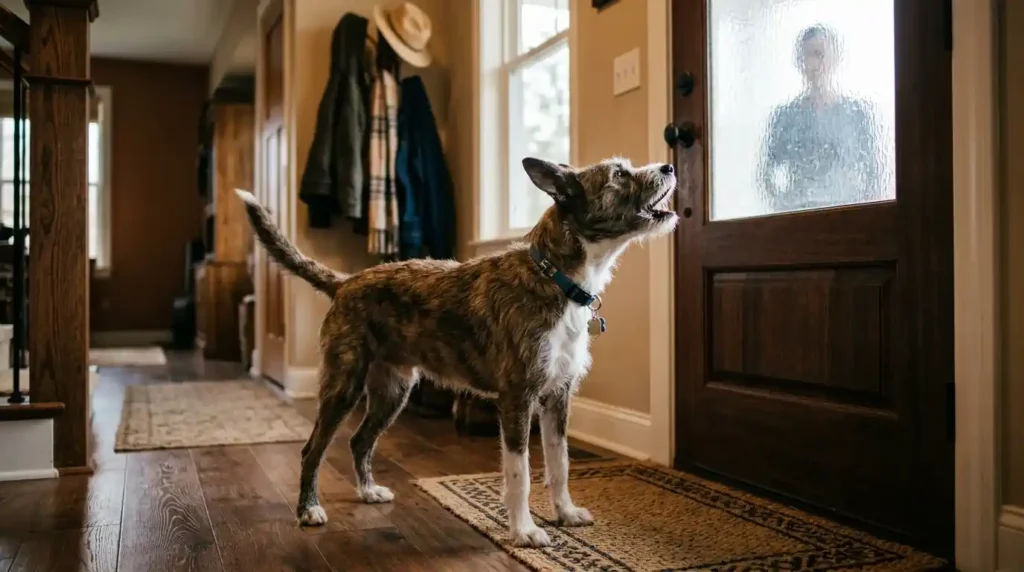
Territorial barking occurs when your dog perceives guests as a potential threat to its home, family, or resources. The dog is essentially performing its self-assigned security role. This type of barking is typically lower-pitched, sustained, and accompanied by stiff posture or raised hackles.
Excitement barking, on the other hand, happens when the dog simply cannot contain its joy. Some dogs love people so much that a guest’s arrival sends them into an uncontrollable frenzy. This barking is higher-pitched, yippy, and comes with spinning, jumping, and a wildly wagging tail.
Both types are problematic, but they require different solutions. Confusing the two leads to training failures.
Fear-Based Barking and Anxiety Triggers
Fear is one of the most underdiagnosed causes of guest-triggered barking. A dog that was not properly socialized during its critical developmental window (typically 3–14 weeks) may view strangers as genuinely threatening. The barking is a defense mechanism — a way of saying “stay back.” These dogs often retreat behind furniture, bark in bursts rather than continuously, and may lunge forward then retreat.
Learned Behavior and Reinforcement Cycles
Dogs are fast learners — including learning the wrong things. If a dog barks at a guest and the owner picks it up, pets it, or even yells (which the dog interprets as you joining in), the dog learns: barking works. This creates a reinforcement cycle that becomes harder to break with every repetition. Even guests saying “it’s okay, I don’t mind” can inadvertently reward the behavior.
Reading Your Dog’s Body Language During Guest Arrivals
Signs of Territorial Aggression
- Stiff, upright tail (even if wagging slightly)
- Raised hackles along the spine
- Deep, continuous bark
- Blocking your path to the door
- Hard eye contact with the guest
Signs of Overexcitement
- Loose, wiggly body posture
- High-pitched, rapid barking
- Jumping up repeatedly
- Inability to settle even after guests are calm
- Mouthing or nipping out of arousal
Signs of Fear or Stress
- Tucked tail with barking
- Yawning, lip licking, or whale eye (showing the white of the eyes)
- Barking in short bursts, then retreating
- Hiding behind the owner while barking
- Piloerection (raised fur) with crouching posture
The Psychology Behind Guest-Triggered Barking
How Dogs Perceive Strangers
Dogs rely heavily on scent and routine. A new person entering their home carries unfamiliar smells, moves in unpredictable ways, and disrupts the established sensory environment. Even friendly strangers represent a form of environmental disruption that dogs must process and evaluate.
The Role of the Doorbell and Knocking as Conditioned Stimuli
Through classical conditioning, the doorbell or knock on the door becomes a powerful trigger — a conditioned stimulus that reliably predicts “a stranger is about to enter.” The dog’s barking response often begins the moment it hears the doorbell, even before anyone is visible. This is why desensitization to the doorbell itself is often the first step in training.
Pack Mentality and Protective Instincts
Dogs are social animals with deeply embedded pack behaviors. Many dogs view the home as the pack’s den and feel compelled to alert the pack (you) to any approaching entity. This alerting behavior is natural and, in moderate amounts, acceptable. The problem arises when the dog cannot de-escalate after the threat is assessed and deemed non-threatening.
Training Methods to Stop Dog Barking When Guests Arrive
Desensitization and Counter-Conditioning
Desensitization involves gradually exposing your dog to the trigger (doorbell, knocking, guests) at a low enough intensity that it does not provoke a barking response. You then counter-condition by pairing that trigger with something the dog loves — high-value treats, praise, or play.
Step-by-step desensitization protocol:
- Record your doorbell or knock on your phone.
- Play it at low volume while feeding your dog treats.
- Gradually increase the volume over multiple sessions.
- Have a family member ring the actual doorbell while you reward calm behavior inside.
- Introduce a “guest” (a familiar person) at the door, rewarding calm behavior at each stage.
- Gradually introduce less familiar people.
This process may take days to weeks, but it rewires your dog’s emotional response from arousal/fear to calm anticipation of something good. According to the American Kennel Club’s guide on dog training, counter-conditioning is one of the most scientifically validated methods for modifying reactive behavior in dogs.
The “Quiet” Command Training Protocol
Teaching “quiet” requires first teaching your dog to bark on cue (“speak”), so you can then reward the cessation of barking.
- Trigger a bark (knock on a surface, ring a bell).
- Say “Speak” — reward the bark.
- Wait for a pause in barking and say “Quiet” — reward the silence immediately.
- Gradually increase the duration of silence required before the reward.
- Generalize to real-world triggers like the doorbell or guest arrivals.
Consistency is critical. The “quiet” command only works if every household member uses it the same way, every time.
Place Training — Teaching Your Dog Where to Go
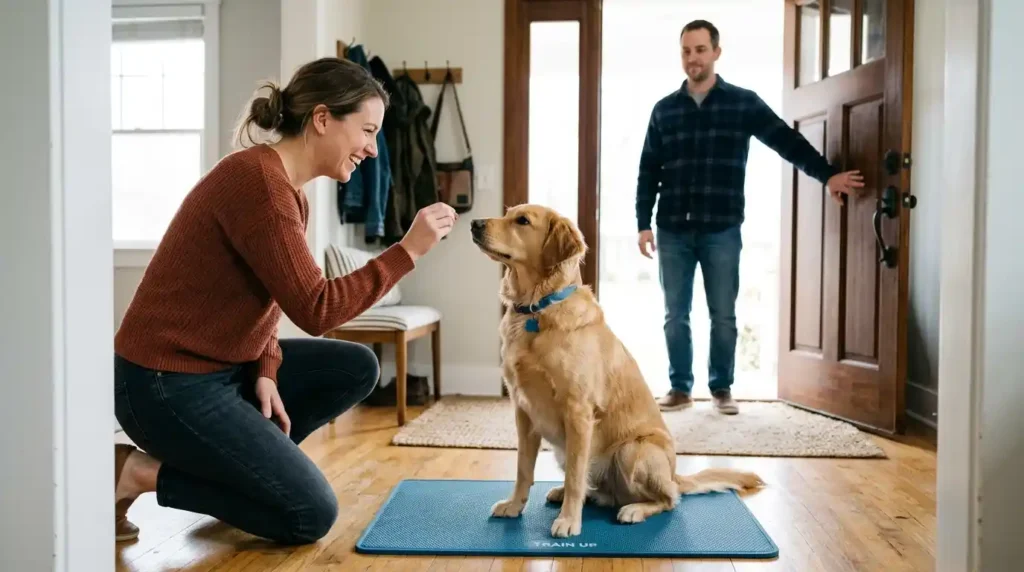
Place training teaches your dog to go to a designated spot (a mat, bed, or crate) and remain there when guests arrive. This is arguably the most practical tool for managing guest arrivals.
- Choose a spot that is visible but slightly removed from the entry area.
- Lure your dog to the mat with a treat and say “place” or “go to your spot.”
- Reward duration on the mat with high-value treats.
- Practice with the door opening, then with a familiar person entering.
- Build up to full guest scenarios over multiple sessions.
The dog learns: when the door opens, I go to my place, and good things happen. This redirects the behavior before it starts rather than trying to suppress it after it escalates.
Using a Clicker for Precision Training
A clicker allows you to mark the exact moment your dog makes the right choice — the instant it stops barking, looks at you instead of the guest, or settles on its mat. The precision of a clicker dramatically speeds up learning. You can learn how to use a Clicker to Reduce Nuisance Barking and combine this tool with the methods described above for maximum effect.
Management Strategies While Training Is in Progress
Training takes time. In the meantime, you need to manage the environment to prevent rehearsal of the unwanted behavior, because every time the dog barks successfully at a guest, the behavior is reinforced.
Using Baby Gates and Crates
Confining your dog to a room or behind a baby gate during guest arrivals removes the trigger while you work on training. It also prevents guests from inadvertently reinforcing the barking by interacting with an overstimulated dog.
Leash Management During Greetings
Keeping your dog on a leash during initial greetings gives you direct physical control. You can redirect attention, prevent jumping, and guide the dog to a calmer body position. A front-clip harness reduces pulling and gives better steering control.
Pre-Guest Arrival Routine
Exercise is one of the most underused tools in managing reactive dogs. A vigorous walk, game of fetch, or training session 30–60 minutes before guests arrive significantly lowers your dog’s arousal level. A tired dog is a calmer dog. Combine this with a long-lasting chew (bully stick, frozen Kong) given just as guests arrive to create a competing, calming behavior.
Socialization as a Long-Term Solution
Controlled Guest Introductions
Ask guests to ignore the dog completely upon arrival — no eye contact, no talking to the dog, no reaching out to pet. This removes the social pressure the dog feels. Once the dog settles, guests can offer a treat tossed gently on the floor (not hand-fed initially) to build a positive association at the dog’s pace.
Puppy Socialization Windows
Puppies have a critical socialization window between 3 and 14 weeks of age. Positive exposure to a wide variety of people, sounds, and environments during this period dramatically reduces fear-based and territorial reactions later in life. The ASPCA recommends structured puppy socialization programs as one of the most effective investments in long-term behavioral health.
Adult Dog Socialization Challenges
Adult dogs can still be socialized, but it requires more patience and a slower pace. The goal is not to overwhelm but to create enough positive experiences with strangers over time that guests become a non-event. Progress is measured in weeks and months, not days.
Common Mistakes Owners Make That Worsen the Barking
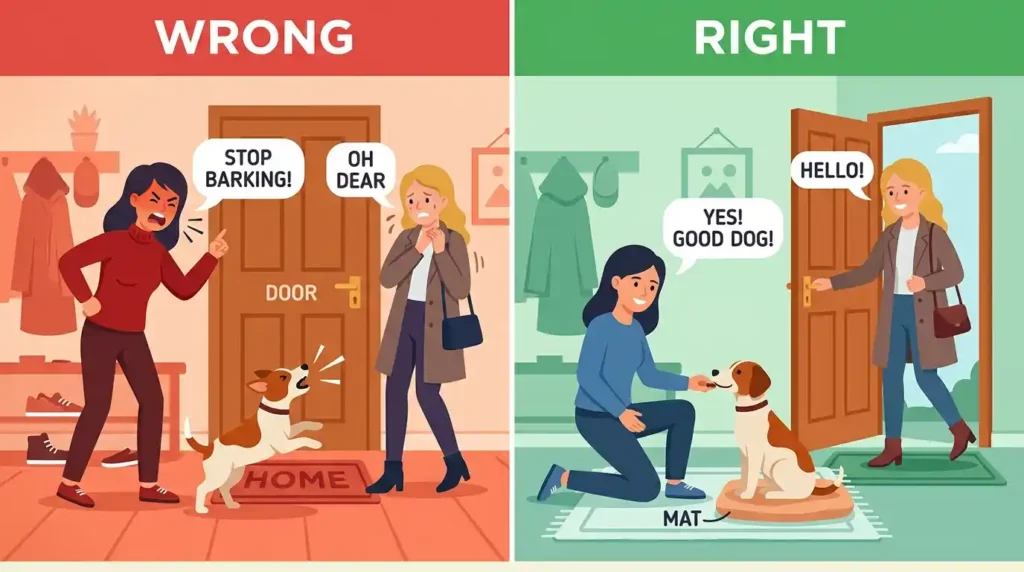
Yelling or Punishing the Dog
Raising your voice at a barking dog communicates that you are also alarmed, which can escalate territorial or fear-based barking. Punishment-based approaches (shock collars, spray bottles, physical corrections) may suppress the behavior temporarily but do not address the underlying emotional state and can cause significant psychological harm — particularly in fear-reactive dogs.
Accidentally Rewarding the Behavior
Petting a barking dog to “calm it down,” letting the dog outside when it barks at the door, or allowing guests to greet the dog while it is still barking all reward the barking behavior. The dog learns: if I bark long enough, I get what I want.
Inconsistency Across Household Members
If one family member enforces the “place” command and another lets the dog jump all over guests, training collapses. Every person in the household must follow the same protocol. Brief your guests as well — your training is only as strong as your least consistent participant.
Breed-Specific Tendencies and What to Expect
High-Alert Breeds
German Shepherds, Dobermans, Rottweilers, and other guardian breeds were selectively bred to alert and protect. Their territorial barking at guests is deeply hardwired and may require more intensive and longer training. That said, well-socialized, well-trained guardian breeds can be remarkably calm in the home.
Social Breeds That Bark Out of Excitement
Labrador Retrievers, Golden Retrievers, Beagles, and Boxers tend to bark at guests out of excitement rather than fear or territory. These dogs typically respond faster to training because the emotional underpinning is positive — the behavior just needs to be channeled.
Low-Reactivity Breeds
Basset Hounds, Greyhounds, and many toy breeds are less prone to sustained guest-triggered barking. However, no breed is immune — individual personality, history, and early experience matter just as much as genetics.
When to Seek Professional Help

Signs That Training Alone Won’t Work
- Barking escalates to growling, snapping, or biting
- The dog cannot recover emotionally for hours after guests leave
- Training sessions worsen the reactivity rather than improve it
- The dog shows barking in multiple high-stress contexts simultaneously
Working With a Certified Dog Behaviorist
A Certified Applied Animal Behaviorist (CAAB) or International Association of Animal Behavior Consultants (IAABC) certified professional can assess your specific dog, identify the exact emotional driver of the barking, and build a customized behavior modification plan. This is especially important if aggression is involved.
Veterinary Intervention and Anxiety Medication
Some dogs have clinical anxiety disorders that make behavior modification very difficult without pharmaceutical support. Medications like fluoxetine or trazodone (prescribed by a veterinarian) can lower baseline anxiety enough for training to take hold. Medication is a tool, not a cure — it works best when combined with consistent behavior modification.
FAQs About Dog Barking at Guests
Q: How long does it take to stop a dog from barking at guests? It depends on the severity and root cause, but most dogs show meaningful improvement within 4–8 weeks of consistent daily training. Fear-based reactivity typically takes longer than excitement-based barking.
Q: Is it normal for a dog to bark when someone comes to the door? Yes, some alerting is normal. The problem is sustained barking that the dog cannot self-regulate even after the “threat” has been assessed as non-threatening.
Q: Can this behavior be related to moving or new environments? Absolutely. Dogs that are already stressed by environmental change tend to be more reactive to guests. If your dog recently relocated and is showing heightened barking, read about Dog Barking After Moving to a New House for context-specific guidance.
Q: Should I use an anti-bark collar? Most certified behaviorists advise against aversive tools like shock or citronella collars, as they suppress behavior without addressing the root cause and can increase anxiety. Positive reinforcement-based methods produce more durable, humane results.
Q: What if my dog only barks at certain guests? This is a significant clue. Dogs often respond to specific physical characteristics — hats, beards, uniforms, height, or erratic movement. Identifying the specific trigger helps you create targeted desensitization exercises.