
Summary
Why does my puppy bark at older dogs is a common question for new puppy owners because barking can mean excitement, fear, confusion, frustration, or an attempt to communicate. Puppies are still learning dog body language, social rules, confidence, impulse control, and safe interaction habits. When they meet older dogs, they may bark because they want to play, feel unsure, are overstimulated, or do not yet understand calm greetings. The good news is that most puppy barking can improve with controlled socialization, positive reinforcement, distance management, and patient training.
Table of Content
- Why Does My Puppy Bark at Older Dogs?
- Why Does My Puppy Bark at Older Dogs During First Meetings?
- Common Reasons Puppies Bark at Senior or Adult Dogs
- How to Read Your Puppy’s Body Language
- Is Your Puppy Being Aggressive or Just Overexcited?
- How Older Dogs React to Puppy Barking
- How to Stop Puppy Barking at Older Dogs Safely
- Training Mistakes to Avoid
- When to Call a Trainer or Vet
- Conclusion
- FAQs
Why Does My Puppy Bark at Older Dogs?
Puppies bark at older dogs for many reasons, and the meaning depends on the puppy’s age, temperament, confidence level, socialization history, and the behavior of the older dog. In many cases, barking is not “bad behavior.” It is communication. Your puppy may be saying, “I want to play,” “I am nervous,” “You are too close,” “Look at me,” or “I do not know what to do.”
Older dogs can feel very different to a puppy. They may move more slowly, give stronger body language signals, correct rude puppy behavior, avoid rough play, or simply ignore the puppy. A young puppy may not understand these signals yet. Because puppies are still developing emotional control and social skills, barking often becomes their default response when they are excited, confused, or overwhelmed.
This is especially common during walks, dog park visits, puppy classes, vet clinic waiting rooms, family gatherings, or introductions to an older resident dog at home. The key is not to punish the barking but to understand what is causing it. Once you know the reason, you can guide your puppy toward calmer and safer behavior.
Why Does My Puppy Bark at Older Dogs During First Meetings?
First meetings can feel intense for puppies. A puppy may be excited to meet a new dog but also unsure about what the older dog’s body language means. Older dogs may not act like littermates or other playful puppies. They may sniff calmly, stand still, turn away, give a warning growl, or correct pushy behavior. To a puppy, these signals can be confusing.
A puppy might bark during first meetings because of:
- Uncertainty about the older dog’s intentions
- Lack of social experience with adult dogs
- Overexcitement and poor impulse control
- Frustration from being held back on leash
- Fear caused by the older dog’s size, posture, or deep bark
- A desire to start play
- Attention-seeking behavior
Puppies are like children learning social manners. They do not automatically know how to greet every dog politely. Some puppies rush forward, bark, jump, paw, lick faces, or nip. Older dogs may find this annoying. If the older dog turns away, stiffens, growls, or walks off, your puppy may bark even more because they do not understand the rejection.
This is why calm, controlled introductions matter. A helpful external resource is the UC Davis Veterinary Medicine guide on puppy socialization, which explains the importance of positive, controlled experiences during puppy development: Puppy Socialization by UC Davis Veterinary Medicine.
Common Reasons Puppies Bark at Senior or Adult Dogs
1. Your Puppy Wants to Play
One of the most common reasons a puppy barks at older dogs is simple excitement. Puppies often use barking as an invitation. They may bark, bounce, play bow, wag their tail, and run around the older dog. This type of barking usually sounds higher-pitched and comes with loose, wiggly body language.
However, older dogs do not always want to play. Senior dogs may have joint pain, lower energy, less patience, or a preference for calm interaction. Adult dogs may also dislike rough puppy play. If your puppy keeps barking after the older dog walks away, your puppy may need help learning boundaries.
2. Your Puppy Feels Nervous or Insecure
Not all barking is playful. Some puppies bark because they are worried. Older dogs can seem intimidating because of their size, deeper voice, direct eye contact, or confident posture. A nervous puppy may bark to create distance.
Fear-based barking may include:
- Tail tucked low
- Ears pinned back
- Hiding behind your legs
- Backing away while barking
- Lip licking or yawning
- Raised hackles
- Shaking or freezing
- Avoiding eye contact
If your puppy barks and retreats, do not force the greeting. Forced socialization can make fear worse. Instead, increase distance and reward calm observation.
3. Your Puppy Is Frustrated on Leash
Leash frustration is very common. Your puppy sees an older dog and wants to run over, sniff, or play. But the leash prevents access. This can create barking, pulling, whining, jumping, or spinning.
This is not always aggression. It is often frustration. The puppy wants something but cannot reach it. Over time, if every dog sighting becomes a pulling and barking event, the puppy may develop leash reactivity. That is why it is important to teach calm watching, loose-leash walking, and attention around other dogs early.
4. Your Puppy Has Not Learned Dog Manners Yet
Puppies need to learn canine communication. Adult dogs often teach boundaries, but not every older dog is suitable for this role. A calm, vaccinated, friendly adult dog can be a great teacher. But a fearful, reactive, painful, or intolerant older dog may not be safe for puppy socialization.
Your puppy may bark because they do not understand signals like:
- “Give me space”
- “Stop jumping on my face”
- “I do not want to play”
- “Calm down before approaching”
- “That behavior is too rough”
Good socialization is not about exposing your puppy to every dog. It is about creating positive, safe, controlled experiences.
5. Your Puppy Is Testing Boundaries
Puppies explore the world by experimenting. Barking may get a reaction from the older dog, from you, or from people nearby. If barking makes the older dog move, makes you pick the puppy up, or starts a play session, your puppy may repeat it.
This does not mean your puppy is being dominant. Dominance is often overused and misunderstood in dog training. Most puppy barking is better explained by emotion, learning history, arousal, fear, or lack of training.
6. Your Puppy Is Overstimulated
Puppies can become overwhelmed quickly. New smells, moving dogs, people talking, traffic noise, weather changes, and leash tension can all raise arousal. Once your puppy is overstimulated, barking becomes more likely.
Some dogs also react strongly to environmental changes. For example, many owners notice barking around storms, pressure changes, or unusual sounds. You can read more about sound and weather-related barking here: My Dog Bark Right Before It Rains.
7. Your Puppy Is Copying Other Dogs
Puppies learn by watching. If your puppy has seen other dogs bark during greetings, fence lines, or walks, they may copy that behavior. Barking can become a learned habit, especially if it is repeated often and creates excitement.
8. The Older Dog’s Behavior Is Triggering Barking
Sometimes the puppy is reacting to the older dog’s signals. An older dog may stare, growl, bark first, move stiffly, guard toys, guard food, or block space. Puppies may respond by barking because they feel challenged or confused.
Never assume the puppy is the only problem. Watch both dogs carefully.
How to Read Your Puppy’s Body Language
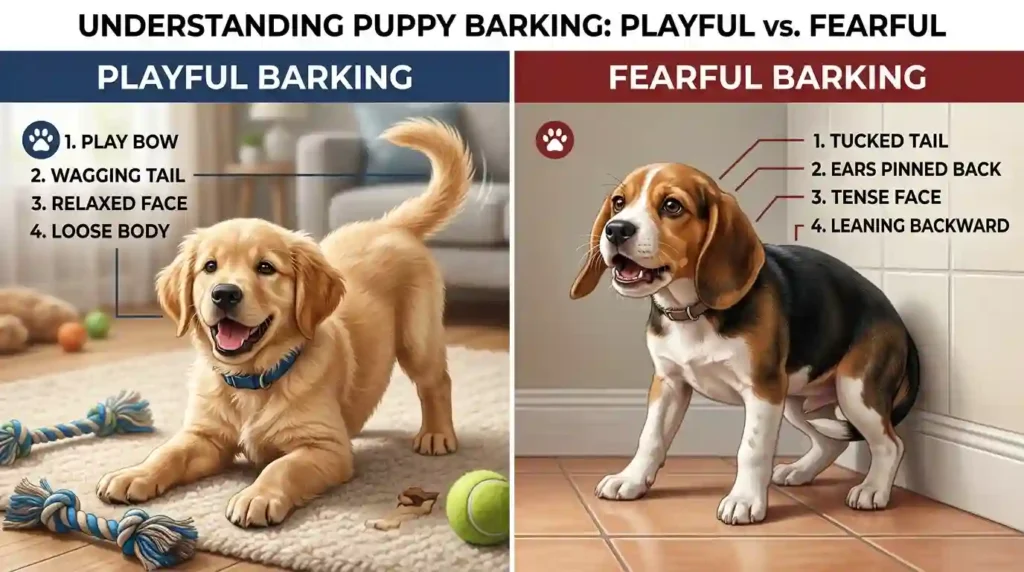
To understand why your puppy is barking, look at the whole body, not just the sound. A bark alone does not tell the full story. Body posture, movement, facial expression, and distance from the older dog are more important.
Signs of Playful Barking
Your puppy may be barking playfully if you see:
- Loose, wiggly body
- Play bow
- Bouncy movement
- Open mouth
- Soft eyes
- Tail wagging at mid height
- Taking turns during play
- Returning happily after short breaks
Playful barking usually comes with movement toward the dog, then away, then back again. The puppy may invite chase or wrestling.
Signs of Fearful Barking
Your puppy may be barking from fear if you see:
- Backing away
- Tail tucked
- Ears flat
- Whale eye
- Trembling
- Growling mixed with barking
- Hiding behind you
- Refusing treats
- Trying to escape
Fearful barking should be handled gently. Move away from the older dog and give your puppy space. Reward calm looking from a distance.
Signs of Frustrated Barking
Frustrated barking may include:
- Pulling hard on the leash
- Jumping forward
- Whining
- Spinning
- Ignoring treats
- Barking when prevented from greeting
- Calming down once the dog leaves
This is common in puppies who are friendly but lack impulse control. Training focus cues like “look at me,” “touch,” and “let’s go” can help.
Signs of Aggressive Intent
True aggression is less common in young puppies, but warning signs should not be ignored. These may include:
- Hard staring
- Stiff body
- Low growl
- Snapping
- Lunging with tension
- Freezing before barking
- Repeated attempts to bite
- Guarding food, toys, or people
If you see these signs often, consult a certified positive-reinforcement trainer or veterinary behavior professional.
Is Your Puppy Being Aggressive or Just Overexcited?
Many owners worry that barking means their puppy is aggressive. In most cases, a puppy barking at older dogs is not truly aggressive. It is usually excitement, uncertainty, frustration, or poor social skills.
A playful or overexcited puppy may sound intense, but their body is usually loose and animated. They may bark loudly because they want interaction. An aggressive or defensive puppy is more likely to show stiffness, avoidance, hard staring, growling, snapping, or panic.
The difference matters because the solution is different. Overexcited puppies need impulse control and calm greetings. Nervous puppies need confidence building and distance. Aggressive or defensive puppies need professional guidance and careful management.
Punishing barking can backfire. If your puppy is afraid and you correct them harshly, they may associate older dogs with punishment. This can make future reactivity worse. Instead, focus on changing the emotional response. Teach your puppy that older dogs predict good things: treats, praise, distance, and safety.
How Older Dogs React to Puppy Barking
Older dogs vary widely. Some are patient and gentle. Others are annoyed by puppies. Senior dogs may have pain, hearing loss, vision changes, arthritis, or lower tolerance for noise and rough play. An older dog that once enjoyed puppies may become less tolerant with age.
Normal Older Dog Corrections
Sometimes an older dog may growl, turn away, walk off, or give a quick bark. This can be a normal boundary-setting behavior. The older dog is saying, “Stop that,” or “Give me space.” A well-socialized puppy should learn from this and back off.
However, you should still supervise. Corrections should be brief and controlled, not repeated attacks or bullying.
When to Separate the Dogs
Separate the dogs if:
- The puppy keeps barking and will not calm down
- The older dog looks stressed or trapped
- Either dog freezes or stiffens
- There is snapping, chasing, or cornering
- Food, toys, beds, or bones are involved
- The older dog is elderly, painful, or fragile
- The puppy ignores warning signals
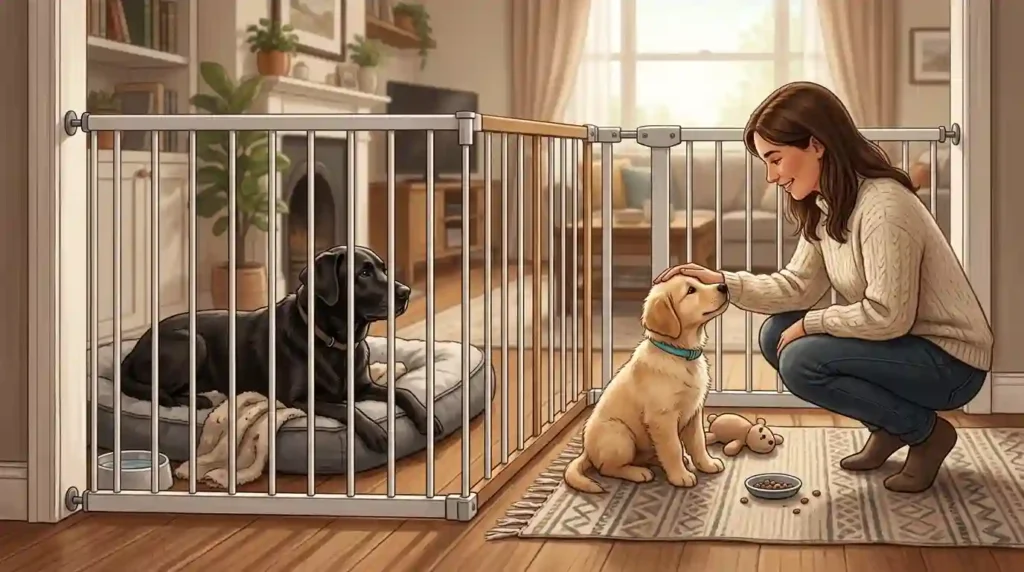
Use baby gates, crates, leashes, and separate rest areas to prevent conflict.
How to Stop Puppy Barking at Older Dogs Safely
1. Create Distance Before Barking Starts
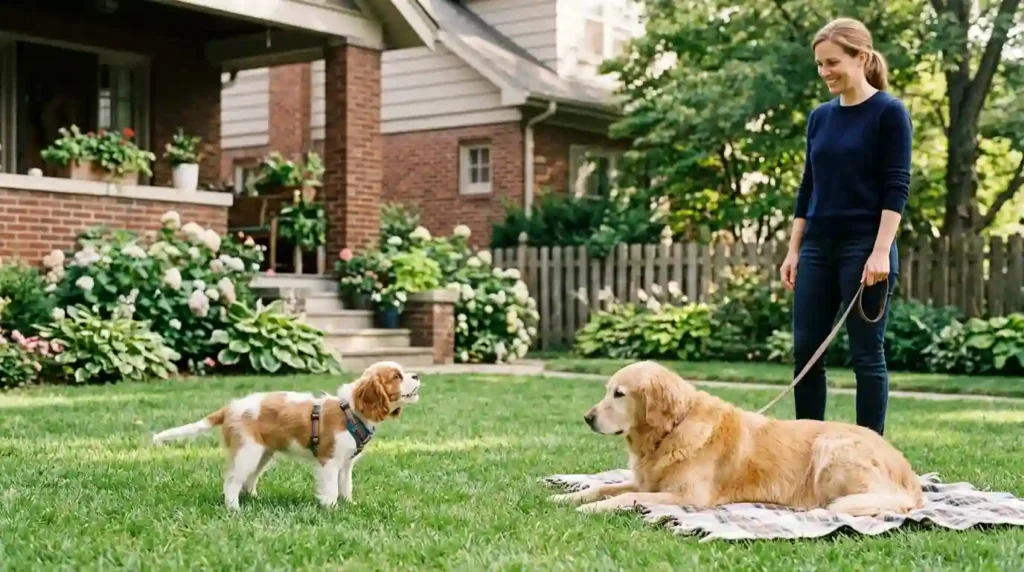
Distance is one of the most powerful tools. If your puppy barks when an older dog is 5 feet away, start training at 20 or 30 feet. At that distance, your puppy may be able to notice the dog without reacting.
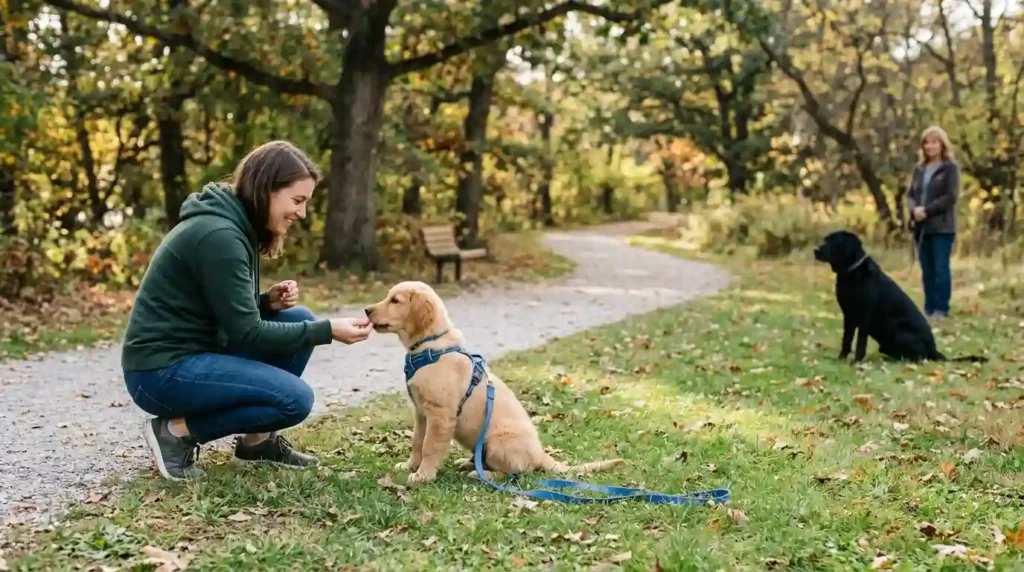
Reward your puppy for calm looking. Say “yes” or use a clicker, then give a treat. Over time, your puppy learns that seeing older dogs calmly is rewarding.
2. Use Positive Reinforcement
Reward the behavior you want. If your puppy looks at an older dog and stays quiet, reward immediately. If they look back at you, reward. If they sit, sniff the ground, or walk calmly, reward.
Good rewards include:
- Small soft treats
- Calm praise
- Gentle petting if your puppy enjoys it
- Moving farther away
- A favorite toy
Do not wait for barking to begin. Reward calm behavior before your puppy loses control.
3. Teach a “Look at Me” Cue
A focus cue helps redirect your puppy before barking escalates.
Practice at home first:
- Say your puppy’s name.
- When they look at you, mark with “yes.”
- Give a treat.
- Repeat until the puppy responds quickly.
- Practice in the yard, then on quiet walks.
- Use it around older dogs from a safe distance.
This teaches your puppy that checking in with you is more rewarding than barking.
4. Avoid Face-to-Face Leash Greetings
Many dogs feel tense during face-to-face leash greetings. Leashes restrict natural movement and can create frustration. Instead of letting dogs rush nose-to-nose, try parallel walking.
Walk both dogs in the same direction with space between them. Let them sniff the environment, relax, and gradually reduce distance if both are calm. This is often safer than direct greetings.
5. Keep Meetings Short
Puppy socialization should not be long and chaotic. Short, positive sessions are better than overwhelming interactions.
A good first meeting may last only a few minutes. End before your puppy becomes wild or the older dog becomes irritated. Successful socialization means your puppy leaves feeling safe and confident.
6. Give Your Puppy Enough Exercise and Rest
Tired puppies can become cranky and barky. Overstimulated puppies can also lose control. Balance activity with naps. A puppy that has had age-appropriate exercise, mental enrichment, and rest is more likely to stay calm.
7. Use Management at Home
If your puppy barks at an older resident dog, use management tools:
- Baby gates
- Playpens
- Crates
- Separate feeding areas
- Separate toys and chews
- Supervised short interactions
- Calm reward-based training
Do not let the puppy harass the older dog all day. Older dogs need rest and personal space.
8. Build Calm Around Dogs, Not Just Greetings
Many owners focus only on greetings, but your puppy also needs to learn how to ignore dogs. Practice sitting on a bench and watching dogs from a distance. Reward calm behavior. This teaches emotional control.
Your goal is not for your puppy to meet every dog. Your goal is for your puppy to stay calm whether they greet or not.
9. Be Careful With Bark-Control Tools
Some owners consider ultrasonic devices, collars, or noise-based tools for barking. These tools may interrupt barking, but they do not always fix the emotional cause. If your puppy is barking from fear, a startling device can increase anxiety.
Before using any bark-control tool, understand how it affects barking behavior. Here is a helpful related guide: How Ultrasonic Devices Affect Dog Barking.
Training Mistakes to Avoid
Punishing the Barking Harshly
Yelling, leash jerking, or scolding may stop barking for a moment, but it can create negative associations. Your puppy may learn that older dogs predict stress or punishment. This can increase reactivity over time.
Forcing Greetings
Do not drag your puppy toward an older dog. Do not hold your puppy still while another dog sniffs them if they are scared. Forced greetings can damage confidence.
Letting the Puppy Annoy Older Dogs
Some people believe older dogs should “teach the puppy.” A calm correction can be normal, but constant harassment is unfair and unsafe. Protect both dogs.
Going to Dog Parks Too Early
Dog parks can be overwhelming for puppies. Unknown dogs, rough play, disease risk, and poor supervision can create bad experiences. Choose controlled playdates with safe, vaccinated, puppy-friendly dogs instead.
Ignoring the Older Dog’s Stress
The older dog’s comfort matters too. Watch for lip licking, turning away, stiff body, growling, hiding, or leaving. Give the older dog escape options and quiet spaces.
When to Call a Trainer or Vet
Most puppy barking improves with training, but professional help is useful if the behavior is intense or worsening.
Call a certified dog trainer or veterinary behavior professional if:
- Your puppy lunges aggressively at older dogs
- Barking is getting worse each week
- Your puppy cannot calm down after seeing dogs
- Your puppy has bitten or tried to bite
- The older dog is becoming defensive
- There is fighting in a multi-dog home
- Your puppy shows extreme fear
- You feel unsafe managing introductions
Also talk to your vet if barking appears sudden, extreme, or connected to pain, illness, hearing issues, or neurological symptoms. Puppies can bark more when they are uncomfortable or unwell.
Conclusion
So, why does your puppy bark at older dogs? Most of the time, it is because your puppy is excited, nervous, frustrated, overstimulated, or still learning dog social skills. Older dogs communicate differently than puppies, and your young dog may not yet understand their signals.
The best solution is not punishment. It is patient training, positive reinforcement, careful socialization, and smart management. Give your puppy distance, reward calm behavior, avoid forced greetings, and choose safe older dogs for controlled introductions. At the same time, protect older dogs from rough puppy behavior and give them space to rest.
With consistency, your puppy can learn that older dogs are not something to bark at, fear, or chase. They can become a normal part of life. Calm exposure today can help your puppy grow into a confident, polite, and socially balanced adult dog.
FAQs
1. Why does my puppy bark at older dogs but not puppies?
Your puppy may bark at older dogs because adult dogs behave differently from puppies. Older dogs may be calmer, more serious, less playful, or more direct with body language. Puppies usually share similar energy, so your puppy may feel more comfortable with them.
2. Is it normal for a puppy to bark at an older dog?
Yes, it is common. Puppies bark to communicate excitement, fear, frustration, or confusion. However, frequent or intense barking should be managed early so it does not become a long-term habit.
3. Should I let the older dog correct my puppy?
A brief, appropriate correction from a calm older dog can be normal, but you should not rely on the older dog to train your puppy. Always supervise and separate them if either dog looks stressed, stiff, trapped, or unsafe.
4. How do I introduce my puppy to an older dog?
Start with distance, use leashes calmly, avoid face-to-face pressure, and try parallel walking. Reward calm behavior and keep the first meeting short. Do not force interaction if either dog is uncomfortable.
5. Why does my puppy bark at older dogs on walks?
This is often caused by leash frustration, excitement, fear, or lack of impulse control. Practice focus cues, increase distance, and reward your puppy for calmly looking at other dogs.
6. Can puppy barking turn into aggression?
It can become reactivity if not managed, especially if the puppy is repeatedly scared, frustrated, or punished around dogs. Early positive training helps prevent barking from becoming a stronger behavior problem.
7. Should I pick up my puppy when they bark at older dogs?
Only pick up your puppy if safety is a concern. Constantly picking them up may increase excitement or anxiety. In most cases, calmly move away, create distance, and reward quiet behavior.
8. What age do puppies stop barking at other dogs?
There is no exact age. Many puppies improve as they mature and receive training. Consistent socialization, calm exposure, and impulse-control exercises can reduce barking over weeks or months.
9. Can an older dog be scared of a barking puppy?
Yes. Some older dogs are sensitive to noisy, energetic puppies. Senior dogs may feel stressed, especially if they have pain, hearing changes, or low tolerance for rough play.
10. What is the fastest way to stop my puppy barking at older dogs?
The fastest safe method is to increase distance before barking starts, reward calm behavior, and avoid forced greetings. Long-term improvement comes from repeated positive experiences and consistent training.