
Summary
A dog barking when heating or AC turns on may be reacting to the sudden startup noise, moving air, vibration, or an unfamiliar smell coming from the vents. The behavior can also develop from fear, territorial alertness, or a negative association with the HVAC system. Fortunately, you can often reduce it by checking the equipment, creating distance from the trigger, and using gradual exposure with high-value rewards. This guide will help you identify the exact trigger, understand your dog’s body language, and follow a safe training plan without accidentally increasing their anxiety.
Table of Contents
- Why Dogs React to Heating and Air Conditioning
- Common HVAC Sounds That Trigger Barking
- Is the Barking Caused by Fear or Alertness?
- Signs of HVAC-Related Anxiety
- How to Stop Dog Barking When the Heating or AC Turns On
- HVAC Problems You Should Check
- Mistakes That Can Make the Barking Worse
- When to Contact a Veterinarian or Trainer
- How Long Does Behavior Modification Take?
- Frequently Asked Questions
Why Is My Dog Barking When the Heating or AC Turns On?
Your dog probably does not understand that the heating system or air conditioner is a harmless household appliance. From the dog’s perspective, something hidden inside the walls suddenly clicks, hums, rattles, and pushes air into the room.
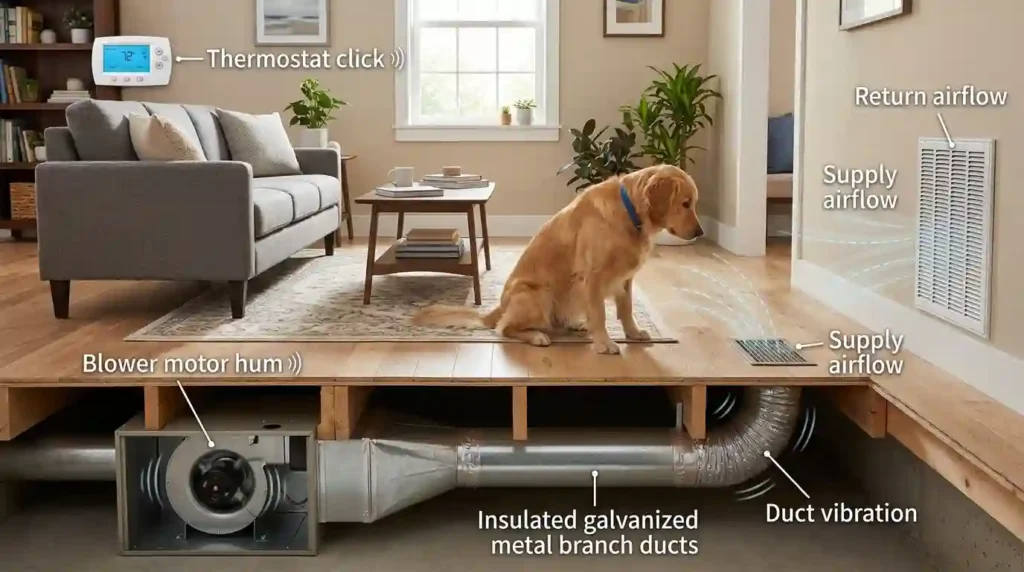
Dogs have sensitive hearing and can detect mechanical noises that people barely notice. A forced-air HVAC system may produce several sounds at once: the thermostat clicks, the furnace starts, the blower motor begins turning, the ductwork expands, and airflow passes through each supply vent and return register.
For a noise-sensitive dog, this sequence can feel unpredictable or threatening.
The most common reasons for barking include:
- Fear of the sudden or unfamiliar sound
- Alert barking in response to machinery inside the home
- Territorial barking at noises coming from the wall or floor
- Sensitivity to air movement near a favorite resting place
- Vibration traveling through the floor or ductwork
- A previous frightening experience involving the system
- A developing noise aversion or noise phobia
- A mechanical problem is making the HVAC unit unusually loud
Some dogs bark only during the first few seconds of startup. Others continue barking while the blower motor is running. Identifying exactly when the reaction begins will help you find the real trigger.
Common HVAC Sounds That Can Trigger Dog Barking
An HVAC system does not create just one sound. It produces a chain of noises, movements, temperature changes, and smells. Your dog may react to one part of that chain rather than the entire system.
Thermostat or Furnace Clicking Sound
A clicking sound often happens immediately before the furnace or air conditioner begins operating. Because the click predicts the louder startup noise, a dog may eventually react to the click alone.
This is an example of a conditioned emotional response. The dog learns:
Click → loud machine starts → possible danger
After that association forms, barking may begin before any air comes through the vent.
Blower Motor and Machinery Hum
The blower motor produces a low machinery hum that may travel through walls, floors, and furniture. Although it may seem quiet to you, your dog may hear additional frequencies or feel the vibration through their body.
A dog with noise sensitivity may stare at the vent, raise their ears, pace, bark, or leave the room as soon as the hum begins.
Rattling Ductwork or Loose Registers
Metal ductwork expands and contracts as its temperature changes. This can create popping, banging, or rattling noises.
A loose air vent or return register may also vibrate when airflow begins. Because the sound comes from inside the home, some dogs treat it like an intruder and respond with territorial barking.
Airflow From a Supply Vent
The sound may not be the only issue. A powerful stream of warm or cold air can disturb a dog sleeping close to a supply vent.
The moving air may touch their coat, carry unfamiliar odors, move curtains, or cause nearby objects to shift. A dog may bark at the vent because it appears to be the source of these changes.
Sounds Near the Return Register or Air Intake
A return register pulls air back into the HVAC system. It can produce a steady rushing sound, especially when the air filter is dirty or the return area is partly blocked.
Your dog may also notice light objects, hair, or dust moving toward the air intake. This movement can attract attention and contribute to barking.
Is the Barking Caused by Fear, Alertness, or Curiosity?
Barking alone does not reveal what a dog is feeling. You must look at the dog’s full body language, breathing pattern, location, and ability to recover.
Alert Barking
A dog showing alert barking may:
- Face the air vent directly
- Stand upright with ears forward
- Bark in short, sharp bursts
- Investigate the vent between barks
- Stop after checking the room
- Respond to a familiar cue or treat
This dog may believe the startup noise requires an investigation. Alert barking is not necessarily a serious anxiety problem, although it can become a learned habit if repeated every day.
Fear and Anxiety
A fearful dog may show:
- A lowered body position
- Ears held back
- A tucked tail
- Shivering or trembling
- Panting when the room is not hot
- Pacing or retreating
- Hiding behind furniture
- Clinginess
- Refusal of food
- Attempts to escape the room
These signs suggest that the HVAC noise is causing more than simple alertness. The dog may be experiencing a fight-flight-freeze response.
Curiosity or Playful Interest
Some dogs bark while moving toward the vent with relaxed muscles, a neutral tail, and playful movements. They may be interested in the air, moving curtains, or sounds inside the ductwork.
Even when the response appears playful, redirecting the dog to a favorite toy or resting area can prevent the barking from becoming a strong habit.
Understanding Noise Aversion and the Fear Response
Noise aversion exists on a range. One dog may dislike a startup noise but recover within seconds. Another may experience intense anxiety every time the furnace begins running.
During a fear response, the dog’s nervous system prepares for danger. Their breathing pattern may change, muscles may tighten, and attention may become fixed on the perceived threat. This state of hyperarousal makes it difficult for the dog to respond to a quiet command or eat a treat.
Every dog also has a fear threshold. Below that threshold, the dog notices the HVAC sound but can still learn. Above it, the dog is too frightened or excited to process training effectively.
Repeated exposure does not always lead to habituation. If each experience is overwhelming, sensitization can occur instead. This means the dog becomes increasingly reactive over time.
Trigger stacking can make the problem worse. For example, a dog may tolerate the heating system on an ordinary morning but react strongly after hearing construction, meeting unfamiliar visitors, and missing a walk. Several stressful events have pushed the dog closer to their fear threshold.
How to Stop Dog Barking When the Heating or AC Turns On
The most effective approach combines environmental management, HVAC inspection, systematic desensitization, and counterconditioning.
Step 1: Identify the Exact Trigger
Observe several HVAC cycles and record what happens immediately before the barking.
Ask:
- Does barking begin with the thermostat click?
- Does it start when the blower motor activates?
- Is one air vent louder than the others?
- Does the dog react to heating, cooling, or both?
- Does airflow touch the dog’s bed?
- Does the behavior occur in every room?
- Does the dog bark more at night?
- Can the dog accept food during the event?
You can make a short video for later review. Pay attention to subtle behavioral changes such as lip licking, scanning, freezing, retreating, or a sudden change in breathing.
Step 2: Rule Out an HVAC Problem
Listen carefully to the system without training your dog at the same time. Look for a blocked vent, loose register, dirty air filter, unusual vibration, or new rattling noise.
Do not place furniture, bedding, or heavy objects over an air intake or return register. Restricted airflow can make the system noisier and may reduce its efficiency.
If the noise is new, unusually loud, or accompanied by burning smells or weak airflow, arrange professional HVAC maintenance. An HVAC technician can inspect the blower motor, ductwork, registers, air filter, and mechanical connections.
Never open or repair electrical, gas, or internal HVAC components unless you are properly trained.
Step 3: Create a Comfortable Safe Space
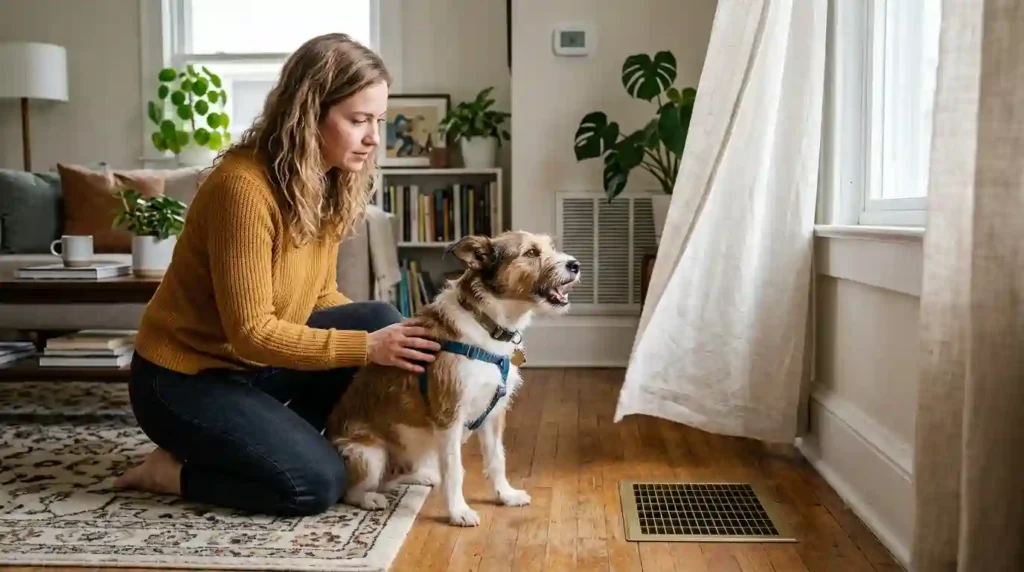
Move your dog’s bed away from the loudest supply vent, return register, furnace room, or vibrating section of floor. The safe space should allow the dog to retreat without becoming trapped.
You can reduce the contrast of the startup noise by using:
- White noise
- A fan
- Quiet radio
- Television at a comfortable volume
- Rugs or soft furnishings that reduce echoes
- A crate or covered bed, if the dog already enjoys using it
Sound masking should make the environment more comfortable, not create another loud or frightening stimulus.
Some owners use calming garments during stressful events. Our guide on whether Thunder Shirts Reduce Stress-Related Barking explains how pressure wraps may fit into a wider calming plan. A garment should never replace training, veterinary care, or necessary HVAC repairs.
Step 4: Teach Relaxation Away From the Trigger
Before working with the HVAC sound, teach a relaxation cue in a quiet room.
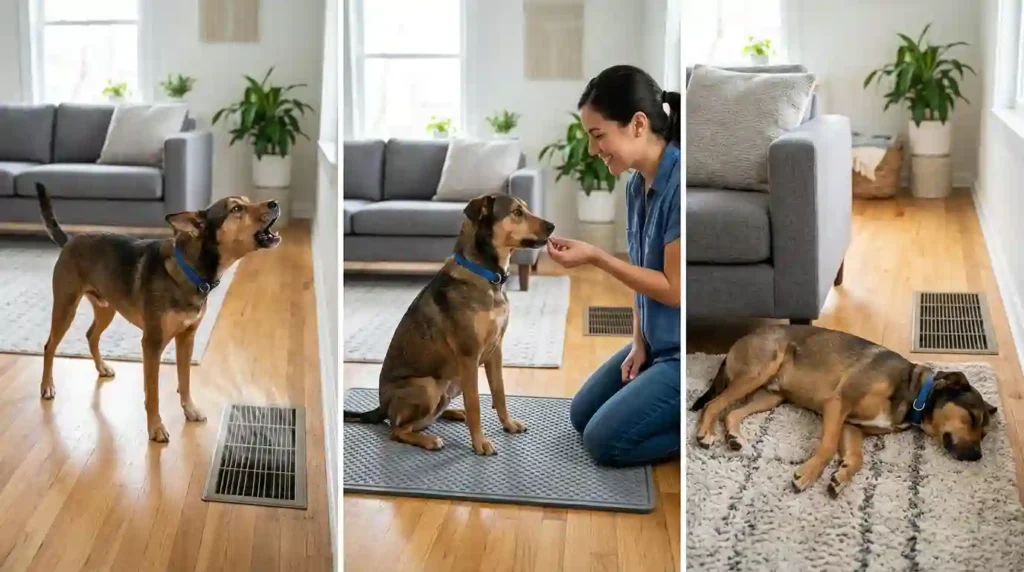
Ask your dog to settle on a mat or bed. When their body becomes loose, and their breathing slows, say a cue such as “relax” or “settle,” and provide a high-value treat.
Keep sessions short and easy. The goal is to build a strong connection between the relaxation cue, calm body language, and positive reinforcement.
A quiet command may help with simple alert barking, but it does not remove fear. If the dog is anxious, focus first on changing the emotional response instead of demanding silence.
Step 5: Begin Low-Intensity Exposure
Use controlled exposure at a level that does not trigger barking, hiding, or panic.
Possible starting points include:
- Standing farther from the noisy vent
- Closing a door between the dog and the HVAC unit
- Playing a sound recording at very low volume
- Practicing while white noise softens the real sound
- Beginning in a room where the system is less noticeable
As soon as the dog notices the low-intensity sound, offer a high-value treat or favorite toy. Stop the rewards when the sound ends.
This teaches a new association:
HVAC sound → good things appear
The dog should remain below their fear threshold throughout the exercise.
Step 6: Increase Exposure Gradually
Increase only one element at a time. You might raise the recording’s volume slightly, reduce the distance from the trigger, or open the door a little wider.
If the dog stiffens, stops eating, barks, retreats, or begins panting, the exposure is too intense. Reduce the sound, increase the distance, and return to an easier stage.
Effective gradual exposure may look slow, but it is safer and more productive than pushing the dog into panic.
The Merck Veterinary Manual’s guidance on behavior modification also emphasizes relaxation, gradual desensitization, and reducing the intensity when a dog becomes too excited or distressed.
Step 7: Reward Calm Behavior During Real HVAC Cycles
Once your dog succeeds with low-level practice, begin working with the actual heating system or air conditioner.
Prepare small treats before the system starts. When you hear the thermostat click, calmly deliver treats before barking begins. Continue at a comfortable pace while the blower starts, then stop when the initial trigger passes.
Over time, reward longer periods of relaxed behavior. You can also ask the dog to move to their mat, engage with a food toy, or perform a familiar, easy behavior.
Stimulus control develops when the dog learns that the startup noise is a signal to perform a calm alternative behavior rather than bark.

HVAC Problems That May Make Barking Worse
Training will be less successful if the system produces an avoidable mechanical disturbance.
Dirty Air Filter
A dirty air filter can restrict airflow and contribute to stronger suction sounds around the return register. Replace or clean the filter according to the manufacturer’s instructions.
Blocked Supply Vent or Return Register
A blocked vent may create whistling, rushing, or vibration. Keep vents unobstructed and avoid placing the dog’s bed directly against them.
Loose Air Vent Cover
A loose register can vibrate when the blower starts. If tightening an accessible cover does not solve the problem—or if you are unsure—contact an HVAC technician.
Ductwork Expansion
Metal ductwork can pop when heating causes it to expand. Occasional mild sounds may be normal, but repeated loud banging deserves professional inspection.
Blower Motor Problems
Grinding, squealing, scraping, or a newly developed machinery hum can indicate a motor or fan problem. Turn the system off and seek professional help if the noise seems severe or unsafe.
Mistakes That Can Increase HVAC-Related Barking
Punishing the Dog
Shouting, spraying water, startling the dog, or using painful equipment may temporarily interrupt barking, but it can make the HVAC sound feel even more dangerous.
The dog may learn:
Machine turns on → owner becomes frightening
This can increase anxiety and damage trust.
Using Flooding
Flooding means exposing the dog to the feared stimulus at full intensity and preventing escape until the reaction appears to stop.
A quiet dog is not always a relaxed dog. The animal may have frozen or shut down. Flooding can strengthen a noise phobia and should not be used as a do-it-yourself solution.
Moving Too Quickly
If your dog repeatedly barks during training, the exercise is too difficult. Return to a lower volume, greater distance from the trigger, or shorter session.
Rewarding Only After Intense Barking
Offering food only after a long barking episode can create an unclear pattern. Whenever possible, reward calm behavior as soon as the dog notices the trigger and before barking starts.
If barking has already begun, gently create distance, wait for a brief moment of calm, and then reinforce that calmer response.
Barking can also be physically and emotionally tiring. Read whether Dogs Get Tired of Barking to understand why exhaustion should never be treated as a training strategy.
When Should You Contact a Veterinarian?
Arrange a veterinary examination if the behavioral change is sudden, severe, or accompanied by other symptoms.
Seek professional advice when your dog:
- Develops a new noise fear without an obvious reason
- Shows intense hiding, shivering, or escape attempts
- Loses their appetite
- Cannot settle long after the HVAC stops
- Becomes aggressive when approached
- Reacts to many ordinary household sounds
- Shows confusion or other cognitive changes
- Has possible hearing loss
- Appears painful or physically unwell
An underlying medical condition can lower a dog’s ability to cope with stress. Pain, age-related cognitive changes, sensory changes, and some medical disorders may contribute to unusual behavioral reactions.
A veterinarian may perform a physical examination and recommend blood work when appropriate. Tests may help investigate issues such as pain, metabolic disease, or a thyroid disorder, but no single test should be assumed necessary for every barking case.
For serious anxiety, the veterinarian may discuss anxiety medication as part of a wider treatment plan. Medication should be selected and monitored by a qualified professional; never give a dog human medication unless specifically instructed by a veterinarian.
When to Work With a Dog Behavior Professional
A certified dog trainer experienced in fear-free methods can help with mild or moderate reactions. For severe noise phobia, panic, aggression, or complicated anxiety, ask your veterinarian for a referral to a veterinary behaviorist.
Professional guidance is especially valuable when:
- You cannot keep the dog below their fear threshold
- The dog refuses high-value treats during exposure
- The barking is spreading to other household appliances
- Avoidant behavior is becoming more severe
- Training attempts have increased the reaction
- The behavior affects sleep or daily family life
- There is a risk of injury or escape
A qualified professional can design a safe behavior modification plan based on your dog’s history, health, triggers, and home environment.
How Long Does It Take to Stop the Barking?
There is no universal timeframe. A dog showing mild alert barking may improve within several days or weeks. A dog with established noise aversion or a conditioned fear response may require weeks or months of careful practice.
Progress depends on:
- How intense the fear response is
- How long the behavior has been occurring
- How often does the HVAC system activate
- Whether mechanical noise can be reduced
- Whether the dog remains below their fear threshold
- The consistency of positive reinforcement
- The presence of other anxiety or health conditions
Track small improvements. Recovery may begin with fewer barks, faster relaxation, willingness to eat, less hiding, or the ability to remain farther from the safe space.
Habituation should happen through safe, manageable experiences—not forced endurance.
Conclusion
A dog reacting to the furnace or air conditioner is not being stubborn or deliberately difficult. The barking may come from alertness, sensitive hearing, vibration, moving air, or genuine fear of an unpredictable household sound.
Begin by identifying the exact trigger and checking for HVAC problems such as a loose register, blocked vent, dirty air filter, or abnormal blower motor noise. Then create a safe space and use systematic desensitization, counterconditioning, and positive reinforcement to change how your dog feels about the sound.
Keep every exposure below the dog’s fear threshold. Avoid punishment and flooding, and seek help from an HVAC technician, veterinarian, certified dog trainer, or veterinary behaviorist when the problem is beyond a simple training issue.
Frequently Asked Questions
Why does my dog bark when the furnace turns on?
The thermostat click, blower motor, duct vibration, or warm airflow may startle your dog. Barking can represent alertness, curiosity, or a fear response.
Why does my dog bark at the air vent?
The dog may hear sounds inside the ductwork or feel air moving across their coat. A rattling register or unfamiliar smell can also draw attention.
Can a dirty HVAC filter make my dog bark?
Possibly. A dirty air filter can restrict airflow and make the return register or blower sound louder, which may trigger a noise-sensitive dog.
Should I give my dog treats when the AC starts?
Yes, if your dog is calm enough to eat. Offer a high-value treat when the sound begins so the HVAC startup predicts something pleasant.
Am I rewarding my dog for being afraid?
No. Fear is an emotional response, not a deliberate bad behavior. Properly timed treats can help replace a negative association with a positive one.
Should I use a sound recording for training?
A recording can provide volume control for gradual exposure. However, it may not reproduce the vibration, airflow, or full sound of the real HVAC system.
Can white noise stop HVAC-related barking?
White noise may soften the contrast between silence and sudden startup noise. It works best as environmental support alongside gradual behavior modification.
Why has my older dog suddenly started barking at the heater?
Pain, hearing changes, anxiety, or cognitive changes may alter an older dog’s response to familiar sounds. A sudden behavioral change warrants a veterinary examination.
Should I turn off the HVAC whenever my dog barks?
Temporarily reducing exposure can prevent panic, but permanent avoidance does not teach a new response. Combine sensible management with controlled, gradual training.
When does HVAC barking require professional help?
Seek help when barking is accompanied by panic, hiding, appetite loss, aggression, escape attempts, or slow recovery. Sudden or severe changes should be discussed with a veterinarian.