


Summary: Thunder shirts reduce stress-related barking by applying gentle, evenly distributed pressure around a dog’s torso. For some dogs, this snug sensation may lower arousal during thunderstorms, fireworks, visitors, travel, separation, and other anxiety triggers. When the dog feels less overwhelmed, barking, whining, pacing, trembling, and escape behavior may decrease. However, a calming vest does not teach a new behavior or remove the cause of fear. It works best when introduced before a stressful event and combined with a safe environment, positive reinforcement, gradual desensitization, and professional guidance when anxiety is severe. Proper sizing also matters: the wrap should feel snug without restricting breathing, movement, or circulation. Owners should monitor the dog’s complete body language rather than judging success by silence alone.
Table of Contents
- What Stress-Related Barking Means
- How Thunder Shirts Reduce Stress-Related Barking
- What the Evidence Says About Pressure-Wrap Efficacy
- When a Thunder Shirt May Reduce Anxiety-Driven Barking
- How to Choose the Right Calming Vest
- How to Introduce a Thunder Shirt Step by Step
- How to Use the Vest During a Stressful Event
- What to Combine With a Thunder Shirt
- Common Thunder-Shirt Mistakes
- When a Calming Vest Is Not Enough
- Practical Thunder-Shirt Checklist
- Conclusion
- Frequently Asked Questions
A dog that erupts into barking during thunder, fireworks, visitors, car rides, or periods of being home alone is not necessarily being stubborn. Barking can be an outward expression of fear, stress, overexcitement, frustration, or an attempt to create distance from something the dog finds threatening.
A thunder shirt—also called an anxiety wrap, pressure wrap, calming vest, or thunder jacket—is designed to provide gentle pressure around the chest, back, and sides of the dog’s torso. The pressure may help some dogs settle enough to recover from an anxiety trigger instead of remaining in a cycle of barking and agitation.
A pressure wrap can be useful, but it is not a guaranteed cure for excessive barking or canine anxiety disorder. Understanding why your dog is barking, fitting the vest correctly, and combining it with behavior modification will give you the best chance of a meaningful result.
What Stress-Related Barking Means
Stress-related barking is a vocalization caused or intensified by emotional arousal. The barking may begin when a dog feels frightened, trapped, uncertain, overstimulated, or unable to reach safety.
It is different from barking that has been deliberately reinforced to obtain food, play, eye contact, or another reward. A dog that barks when you stop petting them may be seeking attention, while a dog that barks and trembles when thunder starts is more likely responding to fear.
When barking appears to be reward-seeking rather than anxiety-driven, use a training approach designed to Stop Attention-Seeking Barking instead of assuming that pressure clothing will solve the problem.
Common signs of stress-related barking
An anxious dog rarely communicates through barking alone. Look at the full pattern of behavior before deciding what the barking means.
Possible signs include:
- Trembling or shaking
- Panting when the dog is not hot
- Whining, howling, or repeated vocalization
- Pacing or restlessness
- Hiding behind furniture or seeking constant contact
- Trying to escape through doors, windows, fences, or crates
- Destructive behavior
- Drooling
- Dilated pupils
- Ears held back
- A low or tucked tail
- Repeated yawning
- Tongue flicking or lip licking
- Refusing treats
- Freezing or becoming unusually still
- Urinating or defecating indoors
- Becoming unable to respond to familiar cues
The intensity of these signs matters. Occasional barking followed by a quick recovery is different from prolonged panic, destructive escape behavior, or a dog that cannot settle for hours.
Common causes of anxiety-driven barking
Stress-related barking can develop around a single trigger or several overlapping triggers.
Noise anxiety and noise phobia: Thunder, fireworks, construction, alarms, household appliances, and other loud noises can produce barking, pacing, hiding, and escape attempts. A noise phobia is generally more intense than ordinary startle behavior and may worsen over time.
Thunderstorm phobia: A storm can involve more than thunder. Changes in wind, rain, atmospheric pressure, darkness, flashes of lightning, and static sensations may all become predictive signals for a sensitive dog.
Separation anxiety: A dog may bark, howl, pace, destroy objects, eliminate indoors, or attempt to escape when separated from a particular person. True separation anxiety is more than boredom and usually requires a structured treatment plan.
Visitors and unfamiliar people: Barking at visitors may be driven by fear, territorial behavior, uncertainty, excitement, or a combination of these emotions.
Other dogs: Dogs may bark because they are fearful, socially frustrated, overexcited, or uncomfortable with another dog’s proximity.
Travel and car rides: Motion, engine noise, confinement, nausea, unfamiliar surroundings, and anticipation can contribute to vocalization.
Vet visits and grooming: Physical handling, slippery surfaces, unfamiliar people, previous uncomfortable experiences, and unusual equipment may trigger stress.
Homecoming excitement: Some dogs become overwhelmed when a family member returns after an absence. For strategies specific to this pattern, see Dog Barking When You Come Home After a Long Day.
A thunder shirt is most likely to help when barking is connected to arousal or anxiety. It is less likely to change barking caused by pain, a need to eliminate, hunger, lack of exercise, learned attention-seeking, territorial rehearsal, or an unmet environmental need.
How Thunder Shirts Reduce Stress-Related Barking
A thunder shirt wraps around the dog’s chest and torso using adjustable fabric panels. When fitted correctly, it applies gentle, relatively constant pressure across a broad area rather than squeezing one narrow point.
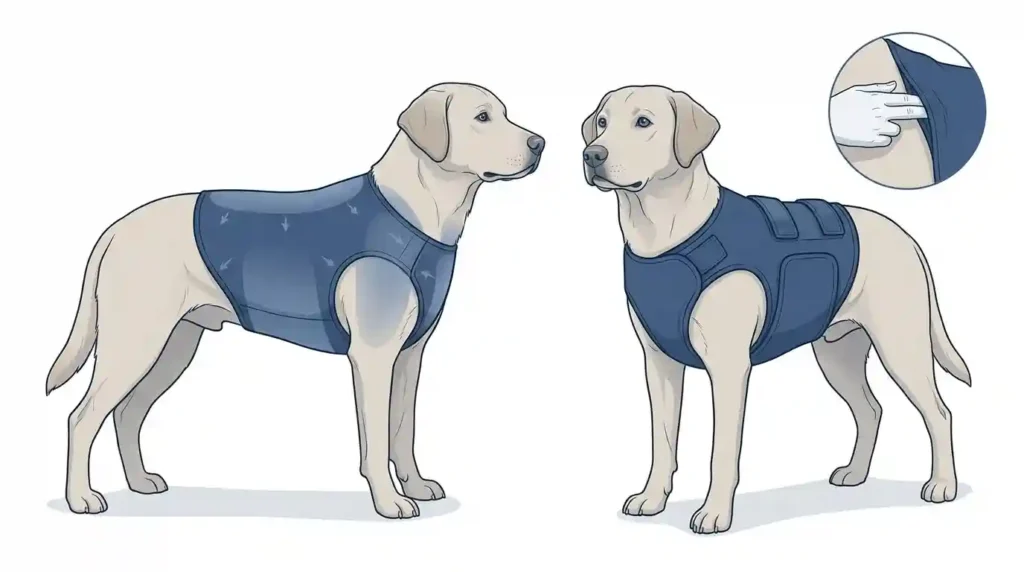
The sensation is often compared with swaddling or a steady, calming hug. Veterinary guidance describes a properly worn anxiety wrap as distributing pressure over the dog’s back and the sides of the chest. However, the precise biological mechanism responsible for any calming effect has not been conclusively established.
Pressure may lower overall arousal
Barking during a frightening event is part of a larger stress response. The dog may experience an elevated heart rate, muscle tension, heightened alertness, faster breathing, and an urgent desire to hide or escape.
If the pressure wrap makes the dog feel more physically secure, that sensation may reduce the intensity of the response. A dog that drops from extreme panic to moderate concern may be able to take food, respond to a familiar cue, lie down, or disengage from a window.
The vest does not physically prevent barking. Instead, its intended benefit is to reduce the emotional arousal that is contributing to the barking.
Consistent pressure may be less stimulating than repeated touching
Owners often try to calm an anxious dog by repeatedly patting, grabbing, or repositioning them. Some dogs appreciate slow, steady contact, but quick or unpredictable touching can add stimulation.
A pressure wrap provides continuous contact without requiring a person to keep touching the dog. This can be useful when the owner needs to close curtains, prepare a safe room, operate a white-noise machine, or manage other animals in the home.
The vest may become a learned cue for settling
A thunder shirt can also gain meaning through association. When it is repeatedly introduced with treats, calm activities, and predictable routines, the dog may begin to recognize it as a cue that a safe settling routine is about to begin.
That association can help, but the reverse is also possible. When the vest appears only before frightening storms, fireworks, or departures, the dog may learn that seeing it predicts trouble.
This is why acclimation during calm periods is so important. Veterinary guidance recommends putting an anxiety wrap on during pleasant situations so the dog does not associate it exclusively with unpleasant events.
Reduced barking does not always equal reduced fear
Silence alone is not enough to prove that a dog feels safe. A dog can become quieter because they are calming down, but they can also freeze or become behaviorally inhibited while remaining frightened.
Look for a group of positive behavioral changes:
- Breathing becomes slower
- The dog’s muscles soften
- The tail and ears return toward a neutral position
- Pacing decreases
- The dog voluntarily lies down
- The dog can sniff, drink, or eat
- The dog responds to a familiar cue
- The dog stops scanning the environment continuously
- Recovery after the trigger becomes faster
A dog that is silent but rigid, panting, wide-eyed, refusing food, and trying not to move may not be experiencing a genuine calming effect. VCA Animal Hospitals similarly warns that owners should not automatically interpret quiet or still behavior as evidence that the source of anxiety has been resolved.
What the Evidence Says About Pressure-Wrap Efficacy
Evidence for anxiety wraps is promising in some areas but limited overall. The fairest conclusion is that pressure wraps may help certain dogs, yet the response varies, and they should normally be treated as an additional tool rather than a complete treatment.
A study involving dogs diagnosed with separation anxiety or generalized anxiety disorder compared a correctly fitted ThunderShirt, a loosely fitted shirt, and no shirt. Dogs wearing the properly fitted wrap had a smaller increase in average heart rate than the control dogs. However, most measured behavioral outcomes—including barking—did not differ significantly among the groups. The researchers concluded that the wrap could be considered an adjunct to behavior modification and medication, while also calling for more research.
An earlier open-label study of a different pressure wrap reported lower owner-scored anxiety during thunderstorms after repeated uses. However, the sample was small, there was no control group, and owners knew that their dogs were receiving the treatment. Those limitations make it difficult to separate a true treatment effect from expectation, changing storm conditions, or changes in owner behavior.
A more recent systematic review of compression wraps for dogs found that the available studies contain important limitations, including small samples, owner-reported outcomes, inconsistent methods, and limited control conditions. The review does not support presenting pressure wraps as a guaranteed or universally effective anxiety treatment.
The practical takeaway is straightforward:
- A pressure wrap may provide noticeable relief for some dogs.
- Other dogs may show only a small improvement.
- Some dogs may show no meaningful change.
- The vest should not replace an appropriate behavioral or veterinary assessment.
- Results should be measured through the dog’s overall behavior, not barking alone.
Claims that a calming vest reliably releases oxytocin, reduces cortisol, stimulates specific calming hormones, or changes the nervous system in a predictable way should be treated cautiously. Deep-pressure therapy is often discussed as a possible explanation, but the exact mechanism and its consistency in dogs remain uncertain.
When a Thunder Shirt May Reduce Anxiety-Driven Barking
A pressure wrap is most useful when you can identify a repeatable anxiety trigger and put the vest on before the dog reaches full panic.
Thunderstorms
For storm-sensitive dogs, apply the shirt when forecasts or early environmental signs indicate that a storm is approaching. Waiting until the dog is barking, shaking, and trying to escape can make handling more difficult.
The wrap should be one part of a storm plan that may also include:
- Moving to an interior room
- Closing windows and curtains
- Playing white noise, a fan, or steady music
- Providing access to a preferred hiding place
- Offering a stuffed food toy when the dog can still eat
- Remaining calm and available
- Following a veterinarian’s medication instructions when applicable
For a general-purpose option, the ThunderShirt Classic Dog Anxiety Calming Vest is the most natural product to mention in a storm-management article. The manufacturer describes it as a lightweight, breathable, machine-washable wrap designed to apply gentle pressure around the dog’s neck and torso.
Fireworks and loud noises
Fireworks are difficult because the timing and volume can be unpredictable. Put the wrap on before nearby fireworks normally begin, then move the dog away from windows and outdoor noise.
Do not take a noise-sensitive dog to a fireworks display to “get them used to it.” Exposure at an overwhelming intensity can worsen fear rather than create desensitization.
The same principle applies to construction noise, alarms, vacuum cleaners, motorcycles, or other predictable sound triggers. The goal is to reduce the intensity of exposure while helping the dog practice calm behavior.
Visitors and unfamiliar people
A calming vest may lower general arousal when visitors enter, but it does not teach a dog how to interact safely with unfamiliar people.
Before opening the door:
- Put the vest on while the dog is still below their reaction threshold.
- Move the dog behind a gate or into a comfortable room.
- Give the dog distance from the entrance.
- Ask the visitor to ignore the dog initially.
- Reward quiet observation and voluntary disengagement.
- Do not force an introduction.
If barking includes lunging, snapping, growling, or bite risk, use physical management and consult a qualified behavior professional.
Car rides and travel
For travel-related barking, first determine whether the cause is anxiety, excitement, frustration, or motion sickness.
A pressure wrap may help with emotional arousal, but it will not treat nausea or physical discomfort. A dog that drools heavily, vomits, repeatedly swallows, or appears ill during car rides should be discussed with a veterinarian.
The ThunderShirt Sport Dog Calming Vest may suit owners who want a lightweight polyester model for travel or active use. The product listing describes adjustable pressure around the neck and torso, breathable fabric, and free movement while worn.
The dog must still travel in an appropriate restraint system. A calming vest is not a seat belt, crash-tested harness, or substitute for safe vehicle containment.
Warm weather and hot indoor environments
Dogs can become uncomfortable or overheat when wearing clothing in warm conditions. For a dog that benefits from pressure but needs greater airflow, the ThunderShirt Breeze Dog Anxiety Vest uses mesh fabric designed to provide additional ventilation.
A breathable vest does not eliminate heat risk. Monitor panting, gum color, energy level, coordination, and body temperature, and never leave a vested dog unattended in a hot vehicle or poorly ventilated room.
Separation-related barking
A thunder shirt may help some dogs settle when left alone, but true separation anxiety is a complex panic disorder. Simply dressing the dog and leaving for several hours is not a complete treatment plan.
Dogs with separation anxiety may need:
- Gradual practice with very short absences
- Changes to departure cues
- Video monitoring
- A structured behavior-modification program
- Environmental management
- Medication prescribed by a veterinarian
- Guidance from a veterinary behaviorist or experienced separation-anxiety professional
If the dog attempts to break through doors, windows, or crates, do not rely on the vest to prevent injury.
How to Choose the Right Calming Vest
The best calming vest is not automatically the tightest, most expensive, or most heavily advertised option. Fit, material, adjustability, and the individual dog’s comfort matter more than branding alone.
Choose a model that matches the situation
| Product option | Most suitable context | Main consideration |
| ThunderShirt Classic | General home use, storms, fireworks, visitors | Versatile starting option for most dogs |
| ThunderShirt Sport | Travel, active households, frequent use | Lightweight polyester construction |
| ThunderShirt Breeze | Warm climates or dogs that become hot easily | Mesh fabric provides greater airflow |
These links lead to standard Amazon product pages and can be replaced with your Amazon Associates links.
Measure the dog rather than guessing
Follow the specific manufacturer’s sizing chart because sizing categories vary among brands. A “medium” vest from one company may fit differently from a medium made by another.
Measure around the widest part of the dog’s chest, usually just behind the front legs. Depending on the brand, you may also need the dog’s weight, neck circumference, or back length.
Do not choose a smaller size merely to create more pressure. A wrap should provide gentle compression, not forceful constriction.
Check the fit around the entire torso
A properly fitted vest should:
- Sit flat against the body
- Feel snug but not rigid
- Allow normal breathing
- Allow a normal walking stride
- Avoid rubbing the armpits
- Stay clear of the throat
- Avoid pressing directly on an injury
- Allow the dog to sit, lie down, and turn comfortably
- Remain secure without twisting
You should be able to slide your fingers beneath key edges without struggling. Follow the manufacturer’s instructions rather than relying only on a general “two-finger rule,” since construction differs between products.
Consider coat, skin, and temperature
Breathable fabric is helpful, but dogs with dense coats, skin conditions, wounds, surgical sites, or heat sensitivity need closer monitoring.
Remove the wrap and check the skin after initial sessions. Look for:
- Redness
- Chafing
- Dampness
- Compressed or tangled fur
- Swelling
- Sensitivity when touched
- Repeated scratching or biting at the vest
Consult a veterinarian before placing pressure clothing over an injury, painful area, breathing problem, or recent surgical site.
How to Introduce a Thunder Shirt Step by Step
Do not make the dog’s first experience with the shirt happen during the loudest part of a thunderstorm. Build a positive association over several calm, low-pressure sessions.
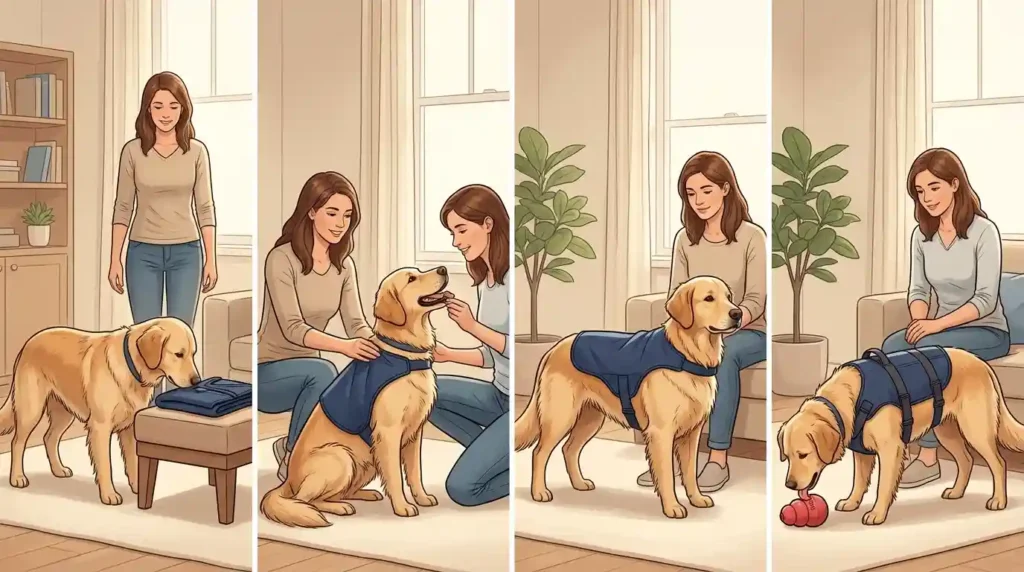
1. Let the dog investigate the vest
Place the folded vest on the floor several feet from the dog. Allow voluntary investigation.
When the dog looks at, approaches, or sniffs it, offer a small treat. Do not move the shirt toward a worried dog or hold the dog in place.
Why this matters: The vest begins as a neutral object rather than a signal that something unpleasant is about to happen.
Success looks like: The dog can remain relaxed near the vest and willingly approach it.
2. Pair handling with rewards
Lift the vest briefly, touch it to the dog’s shoulder, reward, and remove it. Repeat with the side of the torso and back.
Keep each repetition short. Stop if the dog backs away, stiffens, lowers their body, turns their head repeatedly, or refuses food.
Common mistake: Trying to complete the entire dressing process immediately because the dog tolerated one touch.
Better approach: Break the procedure into very small actions and progress only while the dog remains comfortable.
3. Drape the vest without fastening it
Rest the vest loosely over the dog’s back for one or two seconds, offer a reward, and remove it.
Gradually increase the duration. Let the dog move away between repetitions so participation remains voluntary.
Success looks like: The dog remains loose-bodied and continues taking food.
4. Fasten it loosely
Secure the vest without creating its full pressure. Reward the dog, allow a few steps of movement, and remove it.
Check that the closures do not catch fur or produce a sudden loud sound near a noise-sensitive dog.
5. Adjust to the intended snug fit
Once the dog is comfortable wearing it loosely, adjust the panels according to the manufacturer’s instructions.
Observe breathing, gait, posture, and behavior. The dog should be able to walk, sit, turn, lie down, drink, and accept treats normally.
6. Pair the fitted vest with calm activities
Use the thunder shirt during pleasant, low-arousal activities:
- Licking a food-filled toy
- Resting beside you
- Gentle scent games
- Receiving scattered treats
- Relaxing on a familiar bed
- Practicing simple, well-known cues
Avoid immediately introducing a loud recording or another major trigger.
7. Increase duration gradually
Begin with a few minutes and increase slowly if the dog stays comfortable.
Veterinary guidance notes that continuous wear may diminish usefulness and recommends applying the wrap before a stressful event and removing it afterward.
The aim is not to make the dog wear the vest all day by default. The aim is to create a predictable tool for specific situations.
8. Test it during a mild version of the trigger
Once the dog is comfortable with the shirt, try it during a low-intensity challenge.
For example, play a thunder recording at a barely noticeable volume while the dog eats treats or rests. Stop before the dog becomes distressed.
Success looks like: The dog notices the sound but can remain relaxed, eat, sniff, and recover immediately.
If it does not work: Reduce the sound, increase distance, shorten the session, or return to calm vest practice.
How to Use the Vest During a Stressful Event
A good thunder-shirt routine begins before the barking escalates.
1. Recognize the earliest warning signs
Learn what happens before your dog begins barking. Early signs may include scanning, ear movement, lip licking, following you, moving toward a hiding place, or becoming unable to settle.
These signs give you a valuable window for intervention.
2. Put the vest on before peak arousal
Apply the wrap while the dog is still able to cooperate. Do not wrestle a panicking dog into clothing, especially if fear could lead to defensive biting.
If the dog is already too distressed to be safely handled, focus on distance, containment, noise reduction, and any veterinarian-approved emergency plan.
3. Reduce exposure to the trigger
The vest should not be used as permission to keep the dog close to something frightening.
During storms or fireworks:
- Move away from exterior walls and windows
- Close curtains
- Use a fan or steady background sound
- Allow access to a safe hiding space
- Keep doors and gates secure
- Attach identification information before high-risk events
- Supervise outdoor bathroom breaks
During visitor-related barking:
- Use gates, doors, leashes, or separate rooms
- Increase distance
- Prevent crowding
- Ask visitors to avoid staring at or reaching for the dog
4. Offer calming activities without forcing them
A dog that can eat may benefit from licking, chewing, sniffing, or simple food-search games.
If the dog refuses food, do not push treats into their face. Refusal can indicate that the dog is already above their coping threshold.
5. Reinforce voluntary calm behavior
Reward behaviors such as:
- Looking away from the trigger
- Orienting toward you
- Taking a breath and softening the body
- Moving to a bed
- Sniffing the floor
- Sitting or lying down voluntarily
- Pausing between barks
Do not wait for perfect silence. Reward small signs of recovery.
6. Remove the vest after the event
When the trigger has passed and the dog is settled, remove the vest calmly. Check the skin and coat, particularly after longer use.
Record what happened so you can compare future events.
Useful notes include:
- When the vest was applied
- Trigger type and intensity
- Number or duration of barking episodes
- Other stress signals
- Ability to take food
- Time required to recover
- Fit or temperature concerns
- Whether the dog seemed better, unchanged, or worse
What to Combine With a Thunder Shirt
Pressure wraps generally make the most sense as one part of a wider anxiety-reduction plan.
Environmental management
Management reduces the dog’s exposure while training is still in progress.
Examples include:
- Blocking visual access to pedestrians or dogs
- Using privacy film on windows
- Closing curtains before storms
- Moving the dog away from the front door
- Creating a quiet interior resting area
- Using white noise
- Scheduling walks during quieter periods
- Preventing unsupervised rehearsal of barking
Management does not “cure” fear, but it can prevent repeated high-intensity reactions that make training harder.
Positive reinforcement
Reward behavior you want the dog to repeat. Depending on the trigger, this may include checking in with you, moving to a mat, remaining behind a gate, or disengaging from a sound.
Avoid punishing fear-driven barking with shouting, spray devices, physical corrections, or shock collars. Punishment may suppress warning behavior without making the dog feel safer and can create additional negative associations with the trigger.
Desensitization and counterconditioning
Desensitization means exposing the dog to a very mild version of a trigger that does not cause a full reaction. Counterconditioning means pairing that manageable exposure with something the dog values.
For a dog frightened by recorded thunder:
- Begin at a volume that produces little or no visible concern.
- Pair the sound with food or a calm activity.
- End the session while the dog is relaxed.
- Repeat at the same level until the response is consistently comfortable.
- Increase the volume only slightly.
- Reduce it immediately if stress signs appear.
Real storms include environmental changes that a recording cannot reproduce, so audio training may help without fully preparing every dog for actual thunder.
Predictable routines
Predictability can reduce uncertainty. Before a known trigger, follow the same calm sequence:
- Bathroom break
- Secure doors and windows
- Put on the fitted anxiety wrap
- Move to the safe area
- Start background sound
- Offer a calming activity
- Monitor body language
- Remove the wrap after recovery
Medication when medically appropriate
Some dogs need more support than a calming vest and training alone can provide. Veterinarians may prescribe medications such as fluoxetine or clomipramine for suitable cases, particularly when anxiety is severe or persistent.
Medication decisions depend on the dog’s diagnosis, medical history, other drugs, trigger pattern, and risk level. Do not give a dog human medication or use another pet’s prescription.
The VCA veterinary overview of anxiety vests notes that some dogs benefit from a combination of an anxiety wrap, behavior modification, and prescribed medication rather than any one option alone.
Common Thunder-Shirt Mistakes
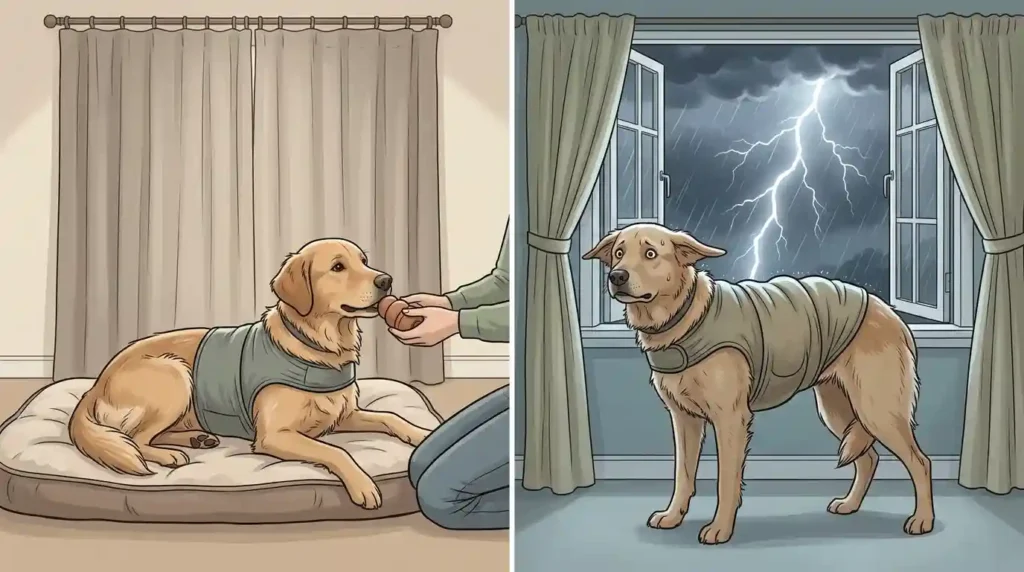
Mistake 1: Putting it on only when something frightening happens
When the shirt always appears immediately before thunder, fireworks, or a departure, it can become a warning signal.
Better alternative: Practice during calm, pleasant situations and reward the dog for wearing it comfortably.
Mistake 2: Making it excessively tight
More pressure does not necessarily create more calm. An overly tight vest can cause discomfort, restricted movement, rubbing, or breathing concerns.
Better alternative: Follow the sizing and fitting instructions, monitor movement and respiration, and adjust or remove the vest when the dog appears uncomfortable.
Mistake 3: Measuring success only by barking
A dog may stop barking while remaining tense, frozen, or frightened.
Better alternative: Track panting, pacing, posture, eating, movement, responsiveness, recovery time, and willingness to rest.
Mistake 4: Leaving it on continuously
Long, unsupervised wear can lead to heat, skin irritation, snagging, and loss of the vest’s usefulness as a specific calming cue.
Better alternative: Use it around predictable stressful events, supervise the dog, and remove it afterward.
Mistake 5: Waiting until the dog is panicking
A dog in full panic may resist handling, be unable to take food, or react defensively.
Better alternative: Identify the earliest signs of anxiety and apply the vest before the reaction reaches peak intensity.
Mistake 6: Using the vest instead of reducing exposure
Placing a thunder shirt on a dog and then moving closer to fireworks, visitors, traffic, or unfamiliar dogs can overwhelm the animal.
Better alternative: Combine the wrap with distance, barriers, sound reduction, and a safe retreat.
Mistake 7: Assuming all barking is anxiety
Territorial barking, attention-seeking, under-stimulation, pain, compulsive behavior, and frustration require different solutions.
Better alternative: Identify the trigger, timing, body language, and consequence of the barking before choosing a treatment.
Mistake 8: Expecting an immediate cure
Some dogs appear calmer during the first use, while others require acclimation or show no benefit.
Better alternative: Run a fair trial over several comparable events and record observable results.
Mistake 9: Ignoring the dog’s refusal
A dog that hides from the shirt, bites at it, freezes during application, or repeatedly tries to remove it is communicating discomfort.
Better alternative: Return to gradual conditioning or choose another method rather than forcing the garment.
When a Calming Vest Is Not Enough
Contact a veterinarian when barking or anxiety begins suddenly, especially in an adult or senior dog. Pain, sensory decline, cognitive changes, endocrine disease, neurological conditions, medication effects, and other medical problems can alter behavior.
Professional assistance is especially important when the dog:
- Injure themselves while trying to escape
- Breaks teeth, nails, doors, windows, or crates
- Cannot be safely left alone
- Stops eating during frequent anxiety episodes
- Remains distressed long after the trigger ends
- Shows aggression toward people or animals
- Has breathing difficulty
- Collapses or appears disoriented
- Develops worsening noise phobia
- Cannot tolerate the vest
- Shows no meaningful improvement despite careful use
- Experiences anxiety that disrupts daily life
A veterinarian can first assess physical health and discuss whether medication is appropriate. A veterinary behaviorist can evaluate complex anxiety disorders and create an integrated medical and behavioral plan. A qualified animal behaviorist or reward-based dog trainer may assist with desensitization, environmental management, and practical handling.
Before the appointment, prepare:
- Videos of the behavior when recording are safe
- A list of triggers
- The age at which the behavior began
- Frequency and duration of episodes
- Signs that appear before barking
- Recovery time
- Previous training methods
- Products and medications already tried
- Changes in health, routine, household, or environment
- A record of the dog’s response to the pressure wrap
The more specific your observations are, the easier it is for a professional to distinguish fear, separation distress, overexcitement, frustration, learned barking, and possible medical causes.
Practical Thunder-Shirt Checklist
Use this checklist before relying on a calming vest for stress-related barking.
Before the trigger
- Identify the likely cause of the barking.
- Rule out pain or a new medical problem.
- Measure the dog using the product’s sizing chart.
- Introduce the vest during calm periods.
- Confirm that the dog can walk, breathe, sit, and lie down normally.
- Prepare a secure, quiet resting space.
- Choose rewards that the dog can comfortably eat.
- Plan how to reduce exposure to the trigger.
- Put the vest on before anxiety peaks.
During the trigger
- Monitor breathing, posture, temperature, and movement.
- Reduce visual and sound exposure.
- Allow the dog to hide if the location is safe.
- Reinforce voluntary calm behavior.
- Avoid punishment.
- Do not force contact, food, or interaction.
- Watch for freezing as well as barking.
- Follow the veterinarian’s medication plan where applicable.
After the trigger
- Wait until the dog has begun to recover.
- Remove the vest calmly.
- Check the skin and coat.
- Record barking and other stress behaviors.
- Note how quickly the dog recovered.
- Adjust the fit or timing before the next event.
- Seek professional help when the dog remains highly distressed.
Conclusion
Thunder shirts may reduce stress-related barking when the barking is driven by fear, noise sensitivity, separation distress, travel anxiety, visitors, or another identifiable source of arousal. The gentle pressure can help some dogs settle, but the response is individual, and the current evidence does not support treating a pressure wrap as a guaranteed cure.
For the best chance of success, choose the correct size, introduce the vest during calm periods, put it on before anxiety peaks, and monitor the dog’s complete body language. Combine it with distance from the trigger, a safe resting area, positive reinforcement, and gradual desensitization.
Begin with a short, calm fitting session rather than waiting for the next major storm. If the dog remains distressed, becomes destructive, attempts to escape, or cannot function normally, consult a veterinarian or qualified behavior professional.
Frequently Asked Questions
Do thunder shirts stop dogs from barking?
Thunder shirts do not directly prevent a dog from barking. They may reduce barking when anxiety, fear, or overarousal is the underlying cause. By providing gentle pressure around the torso, the vest may help some dogs feel secure enough to settle or recover more quickly. It will not reliably solve barking caused by boredom, pain, attention-seeking, territorial rehearsal, lack of exercise, or a need to eliminate. Identify the cause of the barking and track the dog’s full behavior rather than treating silence as the only measure of success.
How quickly does a thunder shirt work?
Some dogs show a change during the first properly fitted session, while others need several positive acclimation sessions before the vest can be evaluated fairly. Put it on before the trigger reaches full intensity and observe barking, panting, pacing, posture, food acceptance, responsiveness, and recovery time. Do not expect the garment to reverse severe panic immediately. If repeated, correctly timed use produces no meaningful improvement—or makes the dog uncomfortable—stop relying on it and discuss other options with a veterinarian or behavior professional.
How tight should a thunder shirt be?
A thunder shirt should be snug enough to provide gentle, even pressure but not so tight that it restricts breathing, movement, circulation, or normal posture. The dog should be able to walk, sit, lie down, turn, drink, and take treats comfortably. Follow the manufacturer’s sizing and fitting instructions because vest designs vary. Check for rubbing around the armpits, pressure near the throat, skin redness, compressed fur, or repeated attempts to remove the garment. Never choose a smaller size simply to create stronger compression.
Can a dog wear a thunder shirt all day?
A dog generally should not wear a thunder shirt continuously without a specific reason and appropriate supervision. Extended use can contribute to heat, moisture, skin irritation, rubbing, snagging, or reduced usefulness as a calming cue. Veterinary guidance suggests using anxiety wraps before stressful events and removing them afterward rather than relying on constant wear. Follow the product instructions and consider the dog’s coat, skin, environment, temperature, activity, and medical history. Remove the vest immediately if breathing, movement, or comfort changes.
Can I leave my dog alone in a thunder shirt?
Leaving a dog unsupervised in any garment introduces potential risks, including snagging, chewing, overheating, or an unnoticed fit problem. Follow the manufacturer’s safety instructions and first confirm through supervised sessions that the dog remains comfortable and does not try to remove or destroy the vest. A thunder shirt also should not be treated as a complete solution for separation anxiety. Dogs that bark, howl, panic, destroy doors, or injure themselves when alone need a structured assessment and may require gradual absence training, environmental changes, video monitoring, and veterinary treatment.
Do ThunderShirts work for separation anxiety?
A thunder shirt may lower arousal for some dogs with separation-related distress, but it rarely addresses the disorder by itself. Separation anxiety can involve panic, vocalization, pacing, destruction, elimination, drooling, and escape behavior after a person leaves. Effective treatment often requires gradual practice with absences short enough to avoid panic, changes to departure cues, environmental management, and sometimes prescription medication. The shirt can be tested as one part of that program, but it should not be used to justify leaving a severely distressed dog alone for longer than they can tolerate.
Can ThunderShirts make anxiety worse?
Yes, a thunder shirt can increase distress when the dog dislikes clothing, has not been acclimated, finds the fit uncomfortable, becomes too warm, or has learned that the vest predicts a frightening event. Signs of a negative response include hiding from the shirt, freezing during application, refusing treats, biting at the fabric, scratching, stiff movement, increased panting, or trying to escape. Remove the garment and return to gradual positive conditioning. When the dog continues to resist it, choose another anxiety-management strategy rather than forcing repeated use.
Should I put the thunder shirt on after barking starts?
It is usually better to apply the vest when you notice the earliest signs of anxiety, before barking escalates into panic. A highly aroused dog may resist handling, refuse food, or react defensively when you try to dress them. For predictable triggers such as storms, fireworks, visitors, or travel, prepare the vest in advance and include it in a familiar settling routine. When the dog is already panicking, prioritize safety, distance, environmental management, and any veterinarian-approved treatment plan rather than forcing the vest onto them.
Can ThunderShirts help with fireworks and thunderstorms?
They may help some dogs with fireworks or thunderstorm anxiety, particularly when introduced positively and applied before the noise begins. The vest should be combined with a secure indoor location, closed windows and curtains, background sound, access to a safe hiding place, and calm supervision. Do not expose the dog to louder noise simply because it is wearing the vest. Dogs with severe noise phobia, destructive escape attempts, prolonged panic, or worsening reactions should be evaluated by a veterinarian or veterinary behaviorist.
Are ThunderShirts a replacement for anxiety medication?
No. A thunder shirt is a non-drug management tool, not an automatic replacement for medication. Dogs with mild, occasional anxiety may benefit from environmental changes, a pressure wrap, and behavior modification. Dogs with severe or frequent anxiety may need prescription treatment so they can remain below panic level and participate in training. A veterinarian must decide whether medication such as fluoxetine, clomipramine, or a situational medication is appropriate. Never stop prescribed medication or substitute a calming product without discussing the change with the prescribing veterinarian.