
Summary
Stopping excessive barking in apartment dogs begins with identifying why the dog is barking—not simply trying to silence it. Your dog may be reacting to hallway sounds, boredom, territorial instincts, anxiety, or too much unused energy. This guide explains how to reduce barking through environmental changes, positive reinforcement, exercise, mental enrichment, and gradual trigger training without fear or punishment.
Table of Contents
- Why Apartment Dogs Bark Excessively
- Identify Your Dog’s Barking Trigger
- How to Stop Excessive Barking in Apartment Dogs
- Reduce Hallway, Window, and Outdoor Triggers
- Teach the Quiet Cue and Replacement Behaviors
- Manage Barking When Your Dog Is Alone
- Build a Bark-Reducing Daily Routine
- Methods and Devices to Avoid
- When to Seek Professional Help
- Conclusion
- Frequently Asked Questions
Why Excessive Barking in Apartment Dogs Happens
Barking is a form of natural canine communication. Dogs bark to alert people, express excitement, request attention, release frustration, or respond to something they consider threatening.
The problem is not that an apartment dog barks occasionally. The problem begins when barking is frequent, prolonged, difficult to interrupt, or disruptive to neighboring residents.
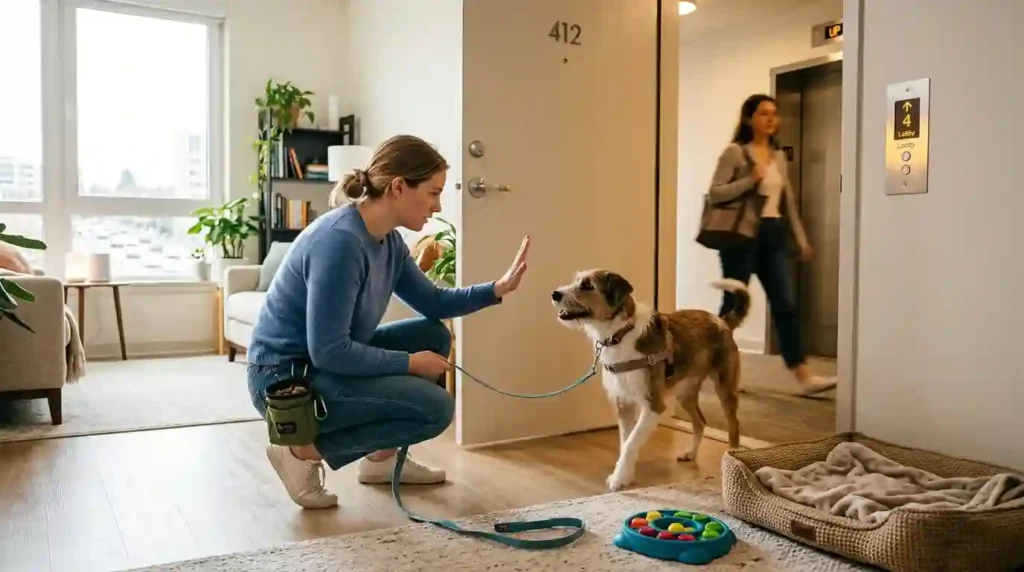
Apartment living can make barking worse because several unfamiliar sounds occur close to the dog’s home. Footsteps, an elevator opening, a visitor knocking, or a neighboring dog vocalizing may happen only a few feet from the front door.
Because the dog cannot investigate these sounds, its alertness can develop into repeated barking.
If you have wondered whether barking eventually exhausts a dog, read Dogs Get Tired of Barking. Waiting for a dog to tire itself out is generally unreliable because barking can become self-reinforcing.
Common Types of Apartment Barking
Identifying the barking type makes it easier to choose the correct solution.
Alert Barking
Alert barking occurs when a dog hears a door sound, hallway noise, elevator noise, footsteps, a siren, or another unexpected sound. The barking usually starts suddenly and may stop once the sound disappears.
Territorial Barking
Territorial barking is directed toward a visitor, passerby, delivery worker, or neighboring dog. It may be accompanied by guarding behavior, running toward the door, a stiff body, or intense window barking.
Attention-Seeking Barking
A dog may bark to request food, playtime, petting, access to another room, or a daily walk. If the owner responds immediately, the dog learns that barking produces attention.
Boredom Barking
Boredom barking often develops from under-stimulation, loneliness, or a lack of exercise. It may sound repetitive and can occur alongside destructive chewing, pacing, or attention-seeking behavior.
Anxiety-Related Barking
Anxiety barking can result from fear, stress, separation anxiety, isolation anxiety, or confinement anxiety. A distressed dog may also whine, scratch doors, pace, destroy household items, or show house soiling.
Frustration or Overstimulation
A dog may bark when it can see something but cannot reach it. This frustration is common when dogs watch people, vehicles, or animals through a window. Overstimulation from constant activity can be just as problematic as under-stimulation.
Identify the Root Cause and Barking Trigger
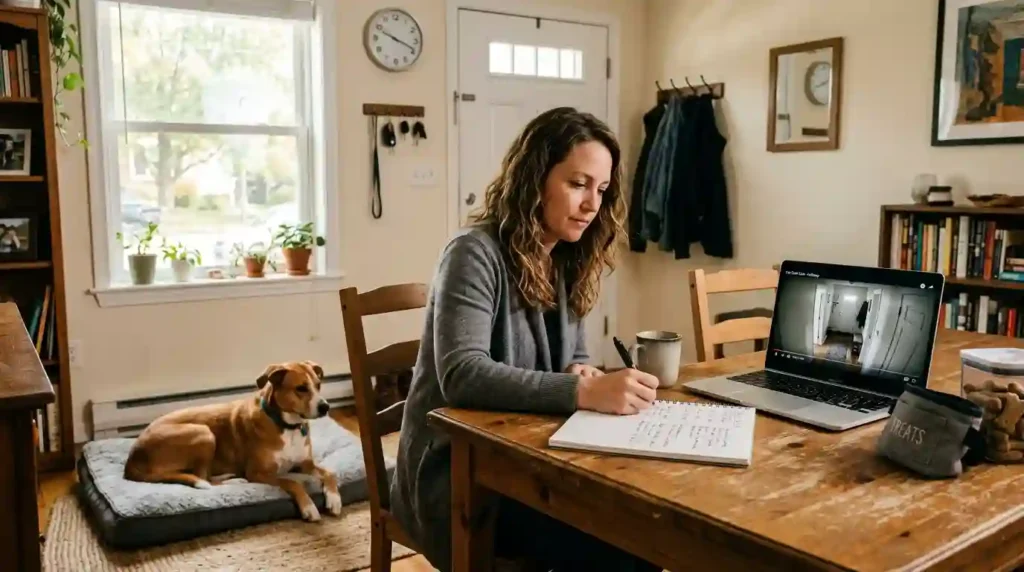
Effective training depends on root-cause identification. Before changing the behavior, record what happens immediately before, during, and after each barking episode.
For three to seven days, track:
- The time barking starts
- The barking trigger
- Where your dog is standing
- Whether anyone is home
- How long does the episode last
- Your dog’s body language
- How you respond
- What makes the barking stop
A simple log may reveal that barking happens whenever someone walks past the apartment, before the walking schedule begins, or during the first 20 minutes after you leave.
Use a Camera When You Leave
A pet camera or an old phone can help you determine what happens when your dog is alone. Look for differences between boredom and genuine distress.
A bored dog may bark occasionally before engaging with an interactive toy or going to sleep. A dog experiencing separation anxiety may begin pacing, whining, barking, scratching doors, or trying to escape shortly after its guardian leaves.
Destructive behavior alone does not confirm separation anxiety. Destructive chewing can also result from boredom, adolescence, or unused energy. A veterinarian or qualified behavior professional should assess serious or persistent symptoms.
Check for Household Triggers
Not every barking trigger is obvious. Heating systems, air conditioners, pipes, appliances, and fans can create noises inside walls or ceilings. If this applies to your home, see Dog Barking When the Heating or AC Turns On for targeted guidance.
Medical discomfort can also increase sensitivity and vocalization. A sudden change in barking—especially in an older dog—should be discussed with a veterinarian.
How to Stop Excessive Barking in Apartment Dogs
The most effective plan combines environmental management, trigger reduction, positive reinforcement, and appropriate daily activity. Training works better when your dog is not repeatedly pushed beyond its ability to remain calm.
1. Reduce Exposure Before Starting Training
Environmental management prevents your dog from exhibiting unwanted behavior throughout the day. Every successful barking episode can strengthen the habit, particularly when the dog believes its barking made a passerby disappear.
Useful changes include:
- Closing curtains or a window blind
- Installing frosted window film or privacy film
- Using furniture relocation to block access to windows
- Placing a pet gate between the dog and the front door
- Moving the dog bed away from noisy shared walls
- Creating a safe space in an interior room
- Using a fan, radio, television, or white noise for noise masking
Calming music may help some dogs settle, although it should not replace training, exercise, or anxiety treatment.
These changes do not “give in” to the behavior. They reduce stress and create conditions in which learning becomes possible.
2. Reward Calm Behavior
Owners often give their dog attention when it barks but overlook it when it is quiet. Reverse that pattern.
Throughout the day, notice moments when your dog hears something but remains quiet. Calmly deliver a dog treat or praise. Proper reward timing helps the dog connect silence with the reward.
You can also reward your dog for:
- Resting on its dog bed
- Looking at you after hearing a sound
- Moving away from the window
- Remaining relaxed near the front door
- Choosing an interactive toy instead of barking
- Settling while neighbors move through the hallway
The goal is not only to stop barking. It is to strengthen the calm behavior you want the dog to repeat.
3. Teach a Quiet Cue
A quiet cue should tell the dog what earns a reward. It should not be shouted as a threat.
Follow these steps:
- Allow a mild, controlled trigger at a low intensity.
- Let the dog bark once or twice.
- Say “quiet” once in a calm voice.
- Present a high-value treat near the dog’s nose.
- The moment barking stops, mark the silence with “yes” or a clicker.
- Give the treat after one or two quiet seconds.
- Gradually increase the required quiet time.
With clicker training, the click must happen during silence—not while the dog is barking. Training consistency and precise reward timing are more important than repeating the cue loudly.
Avoid showing food before every repetition once the behavior is understood. Otherwise, the treat can become a bribe instead of a reward.
4. Teach a Replacement Behavior
Dogs learn more effectively when they are shown what to do instead of only being interrupted.
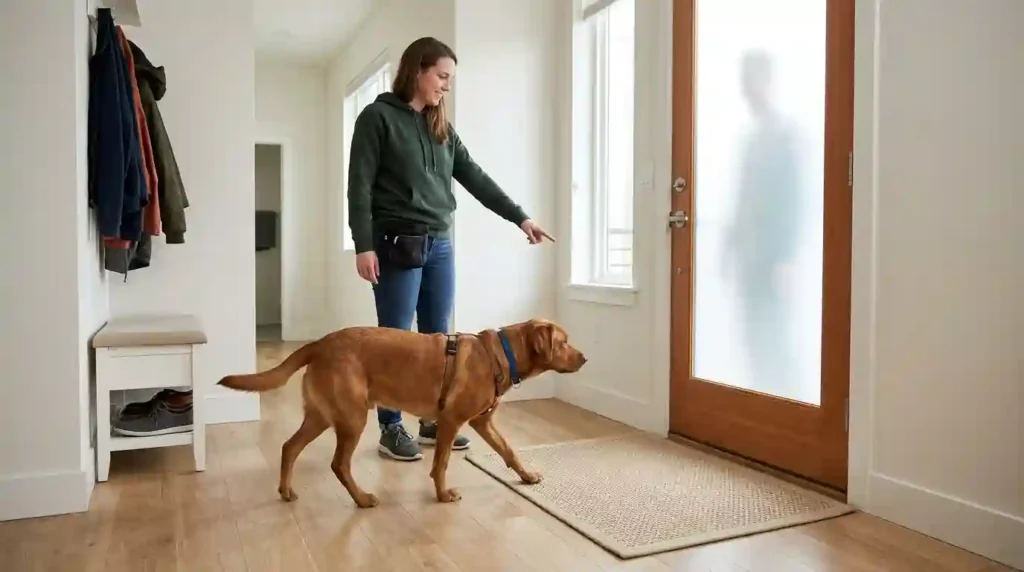
A useful replacement behavior for door barking is a place cue. Teach your dog to go to a mat or bed when it hears the doorbell, a knock, or activity in the hall.
Start without a real visitor:
- Point to the mat and say “place.”
- Reward the dog for stepping onto it.
- Reward sitting or lying down.
- Increase the time spent on the mat.
- Add a soft recorded knock.
- Progress to a real door sound.
- Practise with a familiar visitor.
This exercise develops impulse control and gives the dog a predictable task. Basic obedience training, including “come,” “stay,” “look,” and “leave it,” can further improve communication during exciting situations.
Reduce Hallway, Door, and Window Barking
External noise and visual stimulus are common causes of apartment barking. The solution is to lower the intensity of the trigger and gradually create a new emotional response.
Desensitization
Desensitization means exposing the dog to a barking trigger at a level that does not produce a full reaction.
For example, play a recording of hallway footsteps at very low volume. If the dog remains calm, provide a treat. Increase the volume slightly over several sessions.
If the dog begins barking, lunging, freezing, or refusing food, the trigger is too intense. Lower the volume or increase the distance.
Counterconditioning
Counterconditioning creates a positive association with something the dog previously found upsetting.
When elevator noise, a door sound, or footsteps begin, offer several small high-value treats. Stop the treats when the sound ends. Over time, the dog can learn that the noise predicts something pleasant rather than danger.
The American Society for the Prevention of Cruelty to Animals explains that counterconditioning can change a fearful or anxious response into a more pleasant, relaxed one. Severe cases may require a carefully managed desensitization plan with professional guidance. Read the ASPCA’s separation-anxiety guidance for more information.
Stop Window Barking
For window barking, begin with trigger reduction:
- Close curtains during busy periods.
- Apply frosted window film at the dog’s eye level.
- Move the sofa away from the window.
- Use a pet gate to limit access.
- Reward the dog for moving away when called.
- Provide a puzzle feeder in a quieter part of the apartment.
Do not repeatedly drag your dog away or shout from across the room. Call the dog toward you, reward disengagement, and direct it to an appropriate activity.

Manage Barking When Your Dog Is Alone
Barking in an empty apartment requires a different approach from alert barking when the owner is present.
Boredom and Loneliness
A dog left without meaningful activity may experience boredom, loneliness, frustration, and pent-up energy. Before leaving, provide suitable physical exercise and a chance to sniff and explore.
Offer a safe puzzle feeder, treat-dispensing game, or durable interactive toy reserved for alone time. A sniffing game around the apartment can also provide mental stimulation before departure.
Food enrichment works best for boredom and mild distress. A severely anxious dog may be too stressed to eat.
Separation, Isolation, and Confinement Anxiety
These conditions are related but not identical:
- Separation anxiety may focus on the absence of a particular person.
- Isolation anxiety occurs when the dog struggles to be completely alone but may relax with another safe person.
- Confinement anxiety appears when the dog is restricted in a crate, room, or playpen.
Crate training is not a universal solution. A dog that already feels trapped may panic more intensely in a crate. Signs such as heavy panting, drooling, escape attempts, persistent vocalization, or injuries require professional attention.
A dog bed, open playpen, gated room, or quiet safe space may be more comfortable, depending on the dog’s history and behavior.
Practise Short Absences
Begin with an absence your dog can comfortably tolerate—even if it lasts only a few seconds.
Pick up your keys, step outside, and return before anxiety begins. Gradually extend the duration. If the dog starts barking or panicking, shorten the next repetition.
Avoid testing how long the dog can endure distress. Repeated panic can make the association with being alone worse.
When work keeps you away longer than your dog can manage, consider a dog walker, trusted sitter, or day-care arrangement while training progresses.
Create a Routine That Reduces Barking
A predictable routine helps many dogs regulate excitement and stress. Your routine should include a consistent feeding schedule, walking schedule, rest periods, and appropriate social contact.
Provide Enough Physical Exercise
Physical exercise should match the dog’s age, breed, health, and fitness.
A daily walk should provide more than bathroom access. Whenever safe, allow time for sniffing. Sniffing provides valuable mental engagement and can be calming.
Useful activities include:
- Brisk neighborhood walks
- Playtime with tug or fetch
- Controlled stair-free indoor games
- Short training walks
- Safe play with compatible dogs
- Several brief activity sessions throughout the day
Exercise helps reduce pent-up energy, but exhausting a fearful dog will not cure a phobia or separation anxiety.
Add Mental Stimulation
Mental stimulation can be as valuable as physical activity. Rotate activities so the dog does not lose interest.
Try:
- A puzzle feeder
- A treat-dispensing game
- A hidden-food sniffing game
- Short obedience training sessions
- Simple scent discrimination
- An interactive toy
- Calm trick training
- Cardboard-box searches under supervision
Keep training sessions short and successful. Five focused minutes repeated several times can be more useful than one long and frustrating session.
Schedule Rest
Overstimulation can keep a dog reactive even after exercise. Dogs need quiet, uninterrupted sleep in a comfortable area.
If your apartment remains busy throughout the day, move the dog bed to an interior space and use noise masking. Teach family members not to disturb the dog while resting.

Avoid Punishment and Aversive Devices
Yelling may sound like joining the barking from the dog’s perspective. It can increase excitement, fear, stress, or attention-seeking behavior.
Physical punishment and aversive stimulation also fail to address the underlying cause. A frightened dog may temporarily suppress the sound while becoming more anxious about the trigger.
Be cautious with:
- Shock collars
- Citronella collars
- Ultrasonic anti-barking devices
- Physical corrections
- Shouting or intimidating gestures
- Startling the dog with loud objects
A shock collar may associate pain with a nearby visitor, child, passerby, or neighboring dog. This negative association can increase fear, phobia, or aggression.
Citronella collars and other anti-barking devices can also activate at the wrong moment or respond to another dog’s bark. Even when they interrupt vocalization, they do not teach calm behavior or resolve anxiety.
Reward-based methods are the safer foundation for long-term training. The American Veterinary Society of Animal Behavior’s humane training statement recommends reward-based training and advises against aversive methods for behavior modification.
When to Get Professional Help
Contact a veterinarian if the barking begins suddenly or is accompanied by pain, confusion, appetite changes, altered sleep, or unusual sensitivity. Medical conditions should be ruled out before assuming the issue is purely behavioral.
A professional dog trainer can help with obedience training, place training, impulse control, and controlled trigger practice. Choose someone who uses positive reinforcement and can clearly explain the training plan.
For serious fear, anxiety, phobia, aggression, or separation-related distress, consult a veterinary behaviorist or certified applied animal behaviorist. These professionals can evaluate the dog’s environment, emotional state, health, and learning history.
A veterinarian may sometimes recommend medication as part of a complete behavior plan. A synthetic pheromone product may provide limited calming support for some dogs, but it should not replace diagnosis, environmental management, or training.
Seek help promptly if your dog:
- Injures itself trying to escape
- Cannot settle when left alone
- Refuses food during absences
- Shows aggression toward people or animals
- Barks for long, uninterrupted periods
- Displays repeated house soiling, pacing, or destructive behavior
- Becomes more fearful despite careful training
Conclusion
Stopping excessive apartment barking requires more than correcting the sound. First, identify whether the dog is reacting to external noise, territorial pressure, boredom, anxiety, loneliness, or insufficient activity.
Reduce preventable triggers, reward calm behavior, teach a quiet cue and place cue, and introduce sounds gradually through desensitization and counterconditioning. Combine training with physical exercise, mental stimulation, adequate rest, and a predictable routine.
Most importantly, avoid punishment. A quiet dog is not necessarily a relaxed dog. The goal is to help your dog feel safe, make better choices, and live peacefully alongside your apartment neighbors.
Frequently Asked Questions
How much barking is too much in an apartment?
Barking is excessive when it is prolonged, happens repeatedly, is difficult to interrupt, or regularly disturbs neighboring residents.
How can I manage excessive barking in apartment dogs at night?
Block visual triggers, use white noise, provide an evening walk, schedule bathroom breaks, and investigate anxiety, discomfort, or hallway sounds.
What should I do about an apartment neighbor’s dog barking at night?
Document the dates and duration, speak politely with the owner, and contact property management if respectful communication does not resolve it.
What are the dog-barking apartment laws?
Rules vary by city, state, lease, and building. Check local noise ordinances, nuisance-animal regulations, and your apartment’s written pet policy.
How can I stop a neighbor’s dog barking in seconds?
There is no safe, reliable instant method. Avoid confronting or frightening the dog; notify the owner calmly and follow the building’s complaint process.
What if my neighbor’s dog won’t stop barking in an apartment complex?
Keep an accurate barking log, record only where legally permitted, contact management, and use local non-emergency animal or noise services when necessary.