

Summary
If you have wondered, “Why does my dog bark at the vacuum cleaner?” the answer usually involves fear, sensitive hearing, instinct, or overexcitement—not stubbornness. A vacuum combines loud noise, floor vibration, unfamiliar smells, and unpredictable movement in one intense experience. Your dog may interpret it as a perceived threat, moving prey, or an intruder that must be chased away. The good news is that gradual exposure, counterconditioning, and positive reinforcement can help most dogs feel safer. This guide explains what your dog’s behavior means, the signals you should watch for, and a practical training plan that does not rely on punishment.
Table of Contents
- Why Does My Dog Bark at the Vacuum Cleaner?
- What Your Dog Experiences When the Vacuum Starts
- Fear, Instinct, and Other Causes of Vacuum Barking
- What Different Reactions Mean
- How to Stop Your Dog Barking at the Vacuum Cleaner
- Mistakes That Can Make Vacuum Phobia Worse
- When to Seek Professional Help
- Preventing Vacuum Fear in Puppies
- Conclusion
- Frequently Asked Questions
Why Does My Dog Bark at the Vacuum Cleaner?
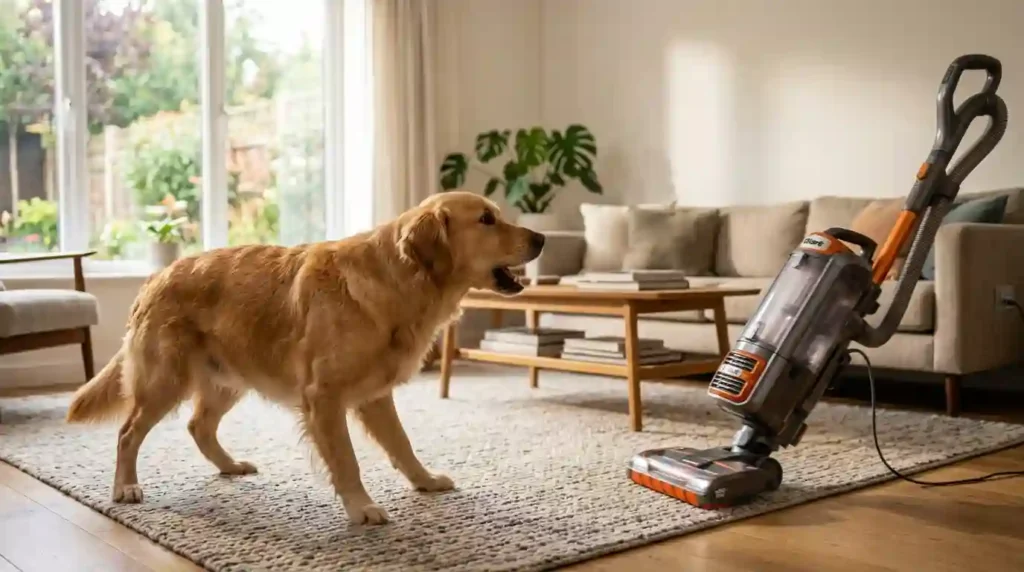
Your dog may bark at the vacuum cleaner because it looks, sounds, and moves like a threat. From a dog’s perspective, this strange machine suddenly enters the room, produces an intense vacuum noise, moves directly toward familiar resting areas, and changes direction without warning.
The barking may be a warning bark intended to make the machine retreat. It may also be an expression of fear, anxiety, excitement, frustration, prey drive, or protective instinct. In many cases, several of these motivations occur together.
Owners can easily misread the behavior as playfulness or defiance. However, a dog that is charging, growling, chasing, or nipping at the vacuum may be experiencing genuine distress. Understanding the emotion beneath the behavior is the first step toward changing it safely.
Your dog’s barking may appear to “work”
Think about what happens after your dog confronts the vacuum. The dog barks, lunges, or chases—and eventually the machine is turned off and placed in a cupboard.
Your dog may conclude that barking made the threat disappear. Each successful confrontation can reinforce the behavior, making the reaction faster and more intense during the next cleaning session.
This does not mean you should keep vacuuming until your dog becomes exhausted. Forced exposure can increase fear and create a stronger vacuum phobia. Instead, the machine should be introduced at an intensity your dog can tolerate without panicking.
What Your Dog Experiences When the Vacuum Starts
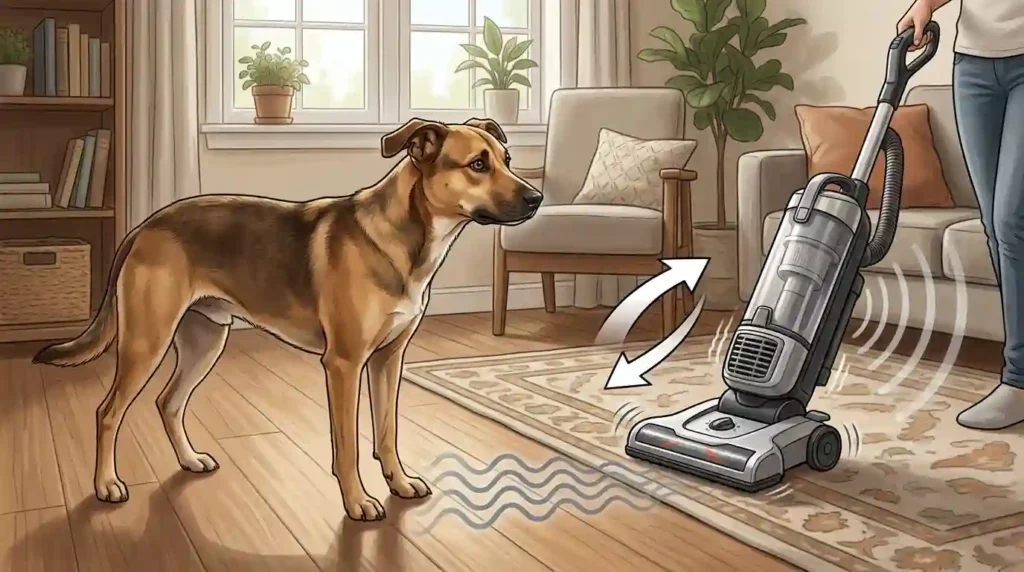
A vacuum cleaner is not merely “a loud object” to a dog. It creates several sensory triggers at the same time, which can lead to sensory overload.
Loud and high-frequency sound
Dogs generally have sensitive hearing and can detect frequencies beyond the normal human hearing range. A vacuum’s motor may produce high-frequency sound that people barely notice, but dogs find sharp or uncomfortable.
The vacuum noise can also change when the machine moves between carpet, wood, and tile. These sudden changes make the sound less predictable. A dog with existing noise sensitivity or noise phobia may react even when the vacuum is operating in another room.
Not every barking dog is experiencing physical pain from the sound. Nevertheless, the volume, pitch, and unpredictability can be stressful, especially for a dog with a nervous temperament.
Floor vibration
Vacuum motors and rotating brushes create floor vibration. Dogs feel this through their paws and body, particularly while lying down.
For a resting dog, the combination of vibration and noise may resemble an approaching threat. The dog may stiffen, stare, get up suddenly, and begin barking before the vacuum comes close.
Unpredictable movement
A vacuum moves forward, reverses, turns sharply, disappears behind furniture, and returns without following the smooth movement pattern of a person or animal. Its unpredictable movement may activate fear or an instinctive chase response.
The long cord, moving hose, spinning brush, and fast changes in direction can add to the confusion. A robot vacuum may be quieter, but its independent motion can still be unsettling because no person appears to control it.
A strange or novel stimulus
Dogs do not automatically understand household equipment. If a dog has never encountered a vacuum, it is a novel stimulus with no safe meaning attached to it.
A lack of early exposure during the puppy socialization period can make the machine more difficult to accept later. Adult dogs can still learn, but the introduction may need to be slower and more carefully managed.
Why Does My Dog Bark at the Vacuum Cleaner? Common Causes
The immediate trigger may be obvious, but the reason behind your dog’s reaction can vary. Watch what happens before, during, and after the barking to identify the most likely cause.
Fear and anxiety
Fear is one of the most common reasons for vacuum barking. The dog perceives the machine as unsafe and uses barking to create distance.
When the vacuum does not retreat, the dog’s anxiety and stress may increase. The body enters a fight-or-flight response. Some dogs choose flight by hiding or running away. Others choose a defensive response that may include a warning bark, growling, lunging, snapping, or biting.
Severe cases can look like fear aggression. The dog is not attacking because it wants to dominate the machine; it is trying to stop or escape something frightening.
Fear may be more likely when your dog:
- Keeps its body low or leans away
- Pins its ears back
- Tucks its tail
- Pants when the room is not warm
- Shakes, hides, or searches for an escape route
- Refuses treats
- Tries to increase its distance from the vacuum
- Barks only when the machine is switched on
A previous scary encounter
One negative exposure can create a lasting association. The vacuum may have bumped the dog, approached while the dog was trapped in a corner, or started unexpectedly beside a sleeping puppy.
Even if you did not witness a previous scary encounter, your dog may remember it. Rescue dogs may also have histories that their current owners do not know.
Once the machine predicts fear, each cleaning session can strengthen the association unless the pattern is changed.
Territorial or protective instinct
A dog may see the vacuum as an intruder entering its home or approaching valued people. Territorial instinct can produce barking, blocking, charging, and attempts to drive the machine out of the room.
Protective instinct may be involved when the dog positions itself between the vacuum and a family member. However, apparent “protection” can still be rooted in uncertainty or fear.
Prey drive
The fast, ground-level movement of a vacuum can activate prey drive. A dog may stalk it, stare intensely, chase it, or try to grab the brush head.
These dogs may appear excited rather than frightened, but grabbing a moving vacuum is unsafe. Teeth, gums, paws, or the tongue can be injured by rotating components.
Herding instinct
Some herding breeds are especially responsive to motion. They may circle the vacuum, cut off its path, bark repeatedly, or nip at its wheels.
This behavior can resemble the dog’s natural tendency to control movement. Even so, allowing nipping or chasing to continue can create a strong habit and increase arousal.
Overstimulation
Some dogs experience overstimulation when sound, movement, vibration, and human activity happen together. Their excitement rises until they lose the ability to respond to familiar cues.
This state may include barking, jumping, spinning, hyperfocus, or frantic chasing. It is not necessarily a carefully chosen behavior; the dog may be struggling to regulate intense arousal.
Individual temperament and genetics
Dogs vary in their sensitivity to sound and movement. A naturally cautious dog or one with a nervous temperament may need more time to accept household equipment.
Age and health can also matter. Senior dogs experiencing cognitive changes may become more reactive to familiar sounds. If an older dog has recently developed persistent vocalization or confusion, read Manage Barking in Dogs With Dementia and arrange a veterinary evaluation.
Understanding Your Dog’s Body Language
Barking alone does not reveal whether your dog is afraid, excited, or attempting to control the machine. Look at the complete body.
Common stress signals
Early stress signals may be easy to miss. They can include:
- Lip licking when no food is present
- Yawning despite not being tired
- Turning the head away
- Showing the whites of the eyes
- Suddenly sniffing the floor
- Ears held back
- A lowered or tucked tail
- Panting, pacing, or shaking
- Stiffening or freezing
- Refusing a normally valued food reward
These signals suggest that the stimulus intensity is too high. Stop or reduce the trigger rather than waiting for barking, lunging, or snapping.
Signs of high arousal or chase motivation
A dog driven by excitement, prey drive, or herding instinct may display:
- Upright or forward posture
- Staring and hyperfocus
- Rapid movement toward the machine
- Repeated chasing
- Attempts to nip the wheels or vacuum head
- Difficulty disengaging
- Fast, repetitive barking
Excited behavior is not automatically safe behavior. High arousal can quickly become frustration, and a dog attempting to attack the vacuum may be injured.
Avoid labeling the dog too quickly
A growl is valuable communication. It tells you the dog is uncomfortable and may escalate if pressure continues. Punishing a growl can suppress the warning without resolving the underlying fear.
Also, notice whether your dog reacts to other sudden household sounds. A dog that startles at coughing, appliances, or sneezing may have broader sound sensitivity. For a related example, see why a Dog Bark on Sneeze and how context changes the meaning of that reaction.

How to Stop Your Dog Barking at the Vacuum Cleaner
The safest approach combines management, systematic desensitization, and counterconditioning. The goal is not merely to stop the sound of barking. It is to change how your dog feels about the vacuum.
1. Prevent uncontrolled confrontations
Until training has progressed, place your dog in a separate room before cleaning. Provide a puzzle toy, stuffed food toy, or safe chew to make separation pleasant.
The room should function as a safe space, not a punishment area. It should be far enough from the vacuum that your dog can settle, and the dog should have water, comfortable bedding, and an escape route from the loudest area.
Use doors, baby gates, or another secure barrier. Supervision remains important, especially if the dog becomes destructive or attempts escape behavior.
2. Identify your dog’s trigger distance
Trigger distance is the closest distance at which your dog notices the vacuum but can remain calm and accept food. For one dog, that may be across a large room. For another, it may be behind a doorway or at the opposite end of the house.
Begin farther away than you think is necessary. Your dog should be able to look at the vacuum and then turn back toward you without barking, stiffening, or staring continuously.
If your dog refuses a high-value treat, you are probably too close or moving too quickly.
3. Introduce the vacuum while it is off
Place the switched-off vacuum at a comfortable distance in a controlled environment. Do not push it toward your dog.
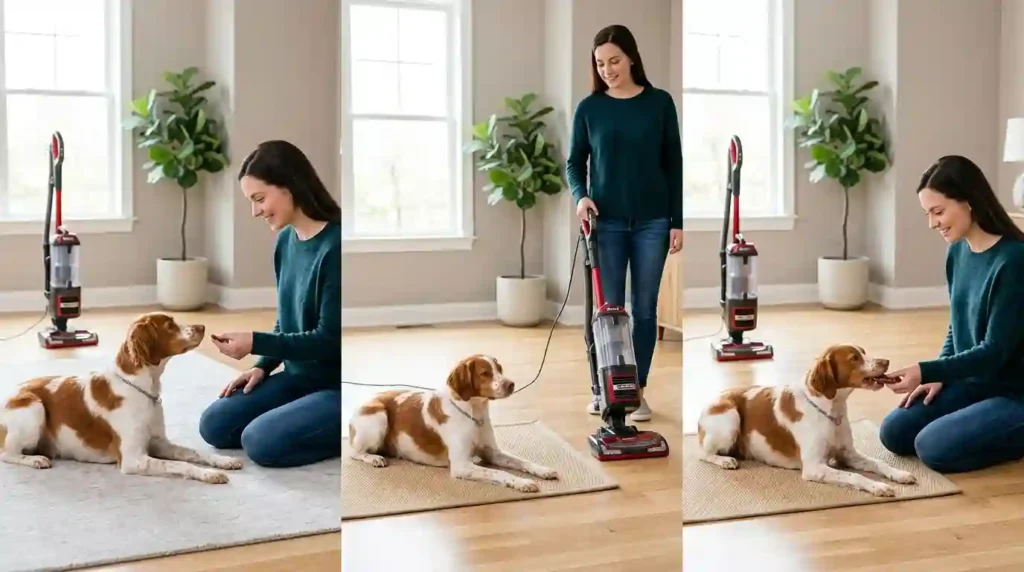
The moment your dog notices it, use a consistent reward marker such as “yes,” then deliver a high-value treat. You can also use praise or play if your dog finds those genuinely rewarding.
Repeat until the sight of the stationary machine predicts something pleasant. Keep each training session short—often one to five minutes is sufficient at the beginning.
4. Reward investigation without pressure
Allow your dog to approach only if it chooses to do so. Do not lure a worried dog all the way to the vacuum with food, because the dog may follow the treat beyond its comfort level and then panic.
Reward calm behavior such as looking at the machine, looking back at you, sniffing from a safe distance, settling on a mat, or walking past without reacting.
This builds a positive association while preserving the dog’s sense of control.
5. Introduce vacuum movement separately
When your dog is comfortable with the stationary machine, move it a few centimeters while it remains switched off. Mark and reward calm behavior.
Over several sessions, gradually increase the vacuum movement. Start with slow, predictable motion and avoid moving directly at the dog.
If barking or lunging begins, stop. Return to an easier step during the next session.
6. Introduce sound at a lower intensity
Movement and sound should initially be trained as separate components. Put the dog at a safe distance—possibly in another room—and switch the vacuum on for only one second.
Immediately give a high-value treat, then turn the vacuum off. The sequence should be clear: vacuum sound appears, excellent food appears; vacuum sound ends, the food stops.
If available, begin with a lower volume setting or use a quieter vacuum. A recording may help with sound practice, but recorded audio does not reproduce the floor vibration or full acoustic effect of the real machine.
7. Increase vacuum duration gradually
Once your dog can remain relaxed during a one-second sound, progress to two or three seconds. Increase vacuum duration in small increments while keeping distance, motion, and other difficulty factors easy.
Change only one variable at a time:
- Distance from the dog
- Sound level
- Duration
- Movement speed
- Movement direction
- Room size
- Floor surface
Increasing every variable at once may overwhelm the dog.
8. Combine sound and movement
Only combine sound with movement after your dog is comfortable with both separately. Begin at a generous distance and move the running vacuum slowly for one brief pass.
Reward calm behavior generously. A second person can deliver treats while another handles the vacuum, provided both people can work safely.
Over time, progress toward a realistic cleaning routine. Maintain a predictable routine so your dog knows where to settle and what reward is available when the vacuum appears.
9. Teach an alternative behavior
Teach your dog to go to a mat, bed, crate, or safe room on cue. Practice this behavior when the vacuum is absent before asking for it during training.
A reliable “go to your mat” response gives the dog something specific to do instead of barking, chasing, or nipping. Continue reinforcing the behavior with food rewards, praise, a puzzle toy, or a safe chew.
10. Proceed at your dog’s pace
Effective behavior modification may take days, weeks, or longer. Progress is not always linear. A bad experience, illness, environmental change, or overly difficult session may temporarily increase reactivity.
The key to systematic desensitization is keeping exposure below the dog’s fear threshold. Counterconditioning works by pairing that manageable exposure with something the dog values.
VCA Animal Hospitals provides a useful professional explanation of desensitization and counterconditioning for fearful pets, including how to separate the vacuum’s sight, sound, and movement during training.
Mistakes That Can Make Vacuum Phobia Worse
Punishment and scolding
Do not punish barking caused by fear or anxiety. Scolding may add another negative experience to an already frightening situation.
Punishment can also increase defensive behavior. The dog may stop barking temporarily while remaining intensely afraid, or it may escalate more quickly to growling, snapping, or biting the next time.
Teasing or chasing the dog
Never move the vacuum toward your dog for entertainment. Teasing can create negative exposure, damage trust, and turn mild concern into a serious vacuum phobia.
Children should not operate the vacuum around a reactive dog. Keep dog-and-vacuum interactions under responsible adult supervision.
Flooding the dog with prolonged exposure
Running the vacuum close to a frightened dog until the animal “gets used to it” is known as flooding. It can produce sensory overload and panic instead of learning.
A dog that becomes motionless may not be calm. Freezing, stiffening, staring, and shutting down can all be stress responses.
Rewarding only after explosive behavior
If treats appear only after a long barking episode, the timing may be unclear. Start at a level where the dog is still calm and reward before the reaction occurs.
Your reward marker should identify the exact behavior you want—such as calmly noticing the vacuum and returning attention to you.
Advancing too quickly
A dog that accepts a stationary vacuum is not necessarily ready for full-volume cleaning. Break the trigger into manageable pieces and increase stimulus intensity gradually.
Short training sessions are generally more productive than one long and stressful session.
When to Seek Professional Help
Consult a veterinarian if the reaction is sudden, severe, worsening, or accompanied by sensitivity to other sounds. Pain, changes in hearing, cognitive decline, and medical conditions can alter a dog’s tolerance for noise.
Professional support is particularly important when your dog:
- Has bitten or attempted to bite a person
- Redirects aggression toward people or other pets
- Attacks the vacuum and risks physical injury
- Cannot take food even at a considerable distance
- Panics, shakes, urinates, or attempts to escape
- Remains distressed long after the vacuum stops
- Shows a broad noise phobia
- Has not improved with careful, gradual exposure
A certified dog trainer experienced in fear-based behavior can help with mild or moderate cases. For intense fear, aggression, or complex anxiety, ask for an applied animal behaviorist or veterinary behaviorist.
A veterinarian or veterinary behaviorist may discuss anxiety medication when fear is too severe for learning to occur. Medication should never be given without veterinary direction. Pheromone products may help some dogs as part of a broader plan, but they should not replace appropriate management and training.
If there is a risk of biting, stop direct training until a qualified professional has designed a safety plan.
Does Buying a Quiet or Robot Vacuum Help?
A quiet vacuum can reduce stimulus intensity, but it may not solve the entire problem. Even a lower-volume appliance can create vibration and threatening movement.
A robot vacuum produces a different challenge. It may be quieter and follow a more consistent route, yet its independent movement can activate staring, chasing, or herding behavior. Introduce it with the same gradual exposure process used for a conventional vacuum.
Do not allow your dog to ride, paw at, block, or attack a robot vacuum. Supervise early sessions and provide access to a separate room.
Preventing Vacuum Fear Through Puppy Socialization
Thoughtful puppy socialization can reduce the risk of future fear. During the socialization period, introduce household sounds at a low, manageable intensity and pair them with food, play, and calm interaction.
Begin with the vacuum switched off. Reward the puppy for calmly noticing it. Add slight movement, greater movement, distant sound, and then closer sound over multiple short sessions.
Puppy socialization is not about exposing a puppy to the loudest possible version of every experience. It is about creating positive, safe encounters without overwhelming the animal.
Give the puppy room to move away, and never chase it with the machine. Even a confident puppy can develop noise sensitivity after one frightening encounter.
Conclusion
Dogs bark at vacuum cleaners because the machines combine loud sound, high-frequency noise, floor vibration, unusual appearance, and unpredictable movement. Depending on the dog, the reaction may be driven by fear, anxiety, territorial instinct, protective instinct, prey drive, herding instinct, or overstimulation.
Watch your dog’s body language to determine whether the behavior reflects distress or excited arousal. Manage the environment so the dog cannot rehearse chasing, attacking, or biting the vacuum, then introduce its sight, movement, sound, and duration in separate stages.
Systematic desensitization and counterconditioning are most effective when exposure remains below the dog’s threshold. Use a controlled environment, sufficient trigger distance, brief sessions, and valuable rewards to build a positive association. Avoid punishment, scolding, teasing, and forced exposure.
With patience and a predictable routine, many dogs can learn that the vacuum is simply another harmless part of home life. If your dog panics, becomes aggressive, or fails to improve, involve a veterinarian and a qualified behavior professional.
Frequently Asked Questions
How do I stop my dog from barking at the vacuum cleaner?
Keep your dog at a comfortable distance and pair brief, low-intensity vacuum exposure with high-value treats. Increase sound, movement, and duration gradually.
Why do dogs dislike vacuum cleaners?
Vacuums combine loud noise, high-frequency sound, vibration, strange smells, and unpredictable movement, which may feel threatening or overwhelming.
Why does my dog go crazy over the vacuum cleaner?
Your dog may be experiencing fear, overstimulation, prey drive, or herding arousal. Body language can help distinguish panic from excited chasing.
What do dogs think a vacuum cleaner is?
Dogs do not necessarily categorize it as a machine. They may perceive it as a noisy intruder, a moving threat, or a chaseable object.
Are vacuums too loud for dogs?
Some vacuums may be distressingly loud for noise-sensitive dogs, especially when combined with vibration and sudden pitch changes. Move the dog to a quieter room if needed.
How do you desensitize your dog to the vacuum?
Start with the vacuum switched off and far away, reward calm behavior, and slowly introduce movement, distant sound, and longer duration over separate sessions.
Why do dogs bark at sweepers?
Sweepers also move unpredictably across the floor and may trigger fear, prey drive, territorial behavior, or an instinct to control moving objects.