

Is Pedigree a good dog food? For many healthy adult dogs, Pedigree can be a reasonable budget-friendly option because its complete-and-balanced formulas are designed to meet established nutritional requirements. Manufactured by Mars Petcare, Pedigree offers affordable dry kibble, canned food, puppy formulas, and small-breed recipes that are widely available across the United States. However, affordable nutrition does not mean every recipe is ideal for every dog. Some Pedigree formulas rely heavily on corn, wheat, meat and bone meal, soybean meal, and other ingredients that may not appeal to owners looking for more clearly identified animal proteins or specialized diets. Certain recipes also contain artificial colors and preservatives such as BHA. Pedigree has experienced product recalls, including a July 2026 recall involving specific canned-food lots, making current safety information important. This review examines Pedigree’s ingredients, guaranteed analysis, protein content, nutritional adequacy, recall history, cost, and customer feedback to help you decide whether the brand suits your dog’s age, health, dietary needs, and budget.
Table of Contents
- Is Pedigree a Good Dog Food? Quick Verdict
- What Is Pedigree Dog Food?
- Pedigree Dog Food Formulas
- Pedigree Ingredients and Label Analysis
- Pedigree Nutrition Analysis
- Dry Pedigree vs. Canned Pedigree
- Benefits and Drawbacks of Pedigree
- How Much Pedigree Should You Feed Your Dog?
- Pedigree Dog Food Recalls and Safety History
- Pedigree Cost and Value
- What Dog Owners Say About Pedigree
- Frequently Asked Questions About Pedigree Dog Food
- Final Verdict: Should You Feed Your Dog Pedigree?
Is Pedigree a Good Dog Food? Quick Verdict
Pedigree is a reasonable affordable dog food for many healthy dogs, provided you choose a complete-and-balanced formula appropriate for your dog’s life stage.
The brand offers established pet-food manufacturing resources, accessible pricing, and multiple recipes for different feeding preferences.
However, the nutritional value of a food cannot be judged solely by its price, marketing claims, or the ingredients listed first.
Some Pedigree recipes contain substantial amounts of grains and plant-derived protein ingredients.
They may also include broadly named animal ingredients and added colors.
These factors do not automatically make the food nutritionally inadequate, but they may influence your choice.
Pedigree is best evaluated as a practical, budget-oriented brand rather than a specialized veterinary diet or premium limited-ingredient product.
Who Pedigree May Suit
Pedigree may be appropriate for:
- Healthy adult dogs without specific dietary restrictions.
- Owners seeking affordable complete-and-balanced nutrition.
- Dogs that tolerate grain-inclusive foods.
- Households needing widely available kibble.
- Small dogs that benefit from smaller kibble pieces.
- Dogs that prefer softer canned food.
- Owners who want to combine dry and wet feeding.
A dog eating Pedigree should maintain a healthy body condition, normal stools, suitable energy levels, and an appropriate appetite.
If these indicators remain good, there may be no compelling reason to change food simply because another brand has a more expensive ingredient list.
Who May Need a Different Food
Pedigree may not be the best choice for dogs with:
- Diagnosed food allergies requiring an elimination diet.
- Chronic digestive disease requiring specialized nutrition.
- Kidney or other diseases requiring therapeutic diets.
- Specific veterinary-prescribed nutrient restrictions.
- Complex growth requirements needing a carefully selected puppy formula.
- Poor tolerance of a particular Pedigree recipe.
Dogs with chronic itching, ear infections, recurrent diarrhea, or vomiting should not automatically be switched between commercial brands without investigating the cause.
Food intolerance is only one possible explanation.
Key Pros and Cons
| Pros | Cons |
| Generally affordable | Some recipes rely heavily on corn and other grains |
| Widely available in U.S. stores | Certain animal ingredients are broadly named |
| Complete-and-balanced options | Some formulas contain artificial colors |
| Dry and wet food varieties | BHA appears in selected recipes |
| Puppy and size-specific choices | Limited suitability for prescription-diet needs |
| Convenient feeding guides | Recall history requires attention |
| Manufacturing and formulation resources | Not every recipe suits every dog’s digestion |
Overall assessment: Pedigree can be a practical everyday food for many healthy dogs, but the exact formula matters more than the brand name alone.
What Is Pedigree Dog Food?
Pedigree is a widely recognized dog food brand owned by Mars, Incorporated, through its Mars Petcare business.
The brand offers dry kibble, canned meals, pouches, and treats.
Its main focus is accessible everyday canine nutrition.
Brand History and Manufacturer
Pedigree developed from a long history of commercial pet-food production and became one of the most recognizable mass-market dog food brands.
Today, Mars Petcare operates numerous pet-food brands and veterinary-related businesses worldwide.
Pedigree’s U.S. products are developed within this broader pet-nutrition organization.
The company states that its formulation teams include professionals with graduate-level qualifications in animal nutrition and food science.
It also describes veterinary involvement in nutritional compliance and product safety.
The brand is associated with the Pedigree Foundation, which supports dog adoption and animal welfare initiatives.
These activities are positive aspects of the company’s background, but they should not be confused with proof that every individual product is nutritionally ideal.
Where Pedigree Is Made
Pedigree’s U.S. product information identifies multiple dry formulas as manufactured in the United States using ingredients sourced domestically and internationally.
The company states that its complete-and-balanced wet and dry foods are produced at Pedigree Petcare manufacturing facilities.
However, country of manufacture and ingredient origin are not the same thing.
A formula manufactured in the United States may contain ingredients sourced from other countries.
Manufacturing information can also differ between markets.
Pedigree sold in the United Kingdom, India, or elsewhere may use different recipes from those available in the United States.
For an accurate comparison, always check the packaging sold in your country.
Product Range by Life Stage, Size, and Food Type
Pedigree’s U.S. range includes several types of products.
| Product Category | Examples | Intended Use |
| Adult dry food | Complete Nutrition recipes | Adult maintenance |
| Puppy dry food | Puppy Growth & Protection | Growing puppies |
| Small-dog dry food | Small Dog and Tender Bites recipes | Adult small dogs |
| Large-breed dry food | Large Breed recipes | Adult large dogs |
| Weight-management food | Healthy Weight recipes | Selected adult dogs |
| Canned wet food | Choice Cuts in Gravy | Adult feeding |
| Soft wet food | Chopped Ground Dinner | Adult feeding |
| Pouches | Choice Cuts in Gravy pouches | Meals or mixed feeding |
Availability and product names may change.
The nutritional adequacy statement on the package determines the intended life stage.
For broader nutrition information, browse our Dog Food resources.
Pedigree Dog Food Formulas
Pedigree should not be treated as one single recipe.
Different formulas vary in protein content, fat content, calorie density, ingredient composition, and intended life stage.
Dry Food and Kibble
Pedigree dry dog food is designed for convenience and economical feeding.
Popular U.S. products include Complete Nutrition recipes in roasted chicken or grilled steak flavors.
Some use smaller kibble pieces for small dogs.
Other formulas provide modified fat or calorie levels for weight management.
Dry kibble is easy to measure, store, and use in certain puzzle feeders.
However, it contains much less moisture than canned food.
Dogs eating dry kibble must have unrestricted access to fresh drinking water.
The brand’s standard adult recipes generally emphasize practical nutrition and affordability rather than unusually high animal-protein content.
Canned and Wet Food
Pedigree offers several wet-food textures.
Choice Cuts in Gravy contains soft pieces of food in a gravy-style sauce.
Chopped Ground Dinner has a softer, ground texture.
Wet recipes generally contain much more moisture than dry kibble.
This can be useful for dogs that prefer soft food or need additional dietary moisture.
However, wet food often costs more per calorie.
Owners should also confirm whether the particular recipe is complete and balanced or intended only for supplementary feeding.
Puppy, Adult, Senior, and Size-Specific Recipes
Puppies require nutrition formulated for growth.
Adult maintenance diets are not automatically appropriate for growing puppies.
Pedigree’s Puppy Growth & Protection dry food is formulated for puppies and includes DHA, a fatty acid associated with normal neurological and visual development.
Small-dog adult recipes offer appropriately sized kibble pieces.
Large-breed adult recipes are intended for bigger dogs, but they should not be confused with formulas specifically validated for the growth of large-breed puppies.
For senior dogs, evaluate the exact product and life-stage statement rather than assuming the word “senior” guarantees an appropriate nutrient profile.
Older dogs may benefit from individualized calorie, protein, and health assessments.
Notable Pedigree Recipes Compared
The following figures are examples from U.S. product labels reviewed in October 2026.
| Pedigree Formula | Protein Minimum | Fat Minimum | Moisture Maximum | Calories |
| Adult Complete Nutrition Grilled Steak & Vegetable dry | 21% | 10% | 12% | Approx. 325 kcal/cup |
| Small Dog Roasted Chicken, Rice & Vegetable dry | 21% | 11% | 12% | Approx. 332 kcal/cup |
| Puppy Growth & Protection dry | 27% | 11% | 12% | Approx. 292 kcal/cup |
| Large Breed Roasted Chicken, Rice & Vegetable dry | 22% | 10% | 12% | Approx. 321 kcal/cup |
| Choice Cuts in Gravy Beef canned | 8% | 3% | 82% | Approx. 332 kcal/13.2-oz can |
Important: These are label-based examples, not guaranteed values across every package or future formulation.
The lower as-fed protein percentage in wet food does not automatically mean it contains less protein relative to dry matter.
Moisture differences must be considered before comparing them.
How to Compare the Exact U.S. Formulas Fairly
To compare two Pedigree products accurately:
- Confirm both are intended for the same life stage.
- Read the complete ingredient lists.
- Compare protein, fat, moisture, and calories.
- Check the AAFCO nutritional adequacy statements.
- Assess whether your dog needs a specific nutrient profile.
- Calculate daily feeding cost rather than comparing package price alone.
For example, a puppy formula containing 27% minimum crude protein should not automatically be considered better than an adult formula containing 21%.
Growth and adult maintenance involve different nutritional needs.
The intended life stage matters more than which product displays the larger number.
Pedigree Ingredients and Label Analysis
Ingredient lists can reveal the main components of a recipe, but they do not directly measure nutrient quality, digestibility, or manufacturing standards.
A fair review should examine the entire formula.
Main Protein Sources
Pedigree dry recipes may contain ingredients such as:
- Meat and bone meal.
- Chicken by-product meal.
- Corn gluten meal or corn protein meal.
- Soybean meal.
- Chicken meal in selected products.
Animal-derived meals can provide concentrated protein and other nutrients.
For example, chicken by-product meal may include nutritious animal tissues beyond skeletal muscle.
The term “by-product” does not automatically mean the ingredient is unsafe or nutritionally worthless.
However, broadly named ingredients such as “meat and bone meal” identify the source less specifically than ingredients such as “chicken meal.”
Owners who need to avoid particular animal proteins may prefer formulas with more clearly identified sources.
Plant ingredients also contribute to the crude protein total.
Therefore, a guaranteed analysis showing 21% protein does not mean all that protein came from meat.
Corn, Grains, and Carbohydrate Content
Some Pedigree dry recipes list whole grain corn among their first ingredients.
Other grain ingredients may include wheat and rice.
Corn provides digestible carbohydrates when appropriately processed, along with some protein and other nutrients.
Wheat and rice can also contribute dietary energy.
The presence of grains does not automatically make dog food unhealthy.
Most healthy dogs can digest properly processed grains.
However, the proportions of grain and animal-derived ingredients may matter to owners comparing feeding philosophies.
Ingredient order is based on weight before processing.
Fresh ingredients contain substantial water, while rendered meals are more concentrated.
This means the position of an ingredient does not directly reveal its contribution to the finished food’s nutrient content.
Ingredient splitting can also make interpretation difficult.
For example, multiple related corn ingredients may appear under separate names rather than one combined entry.
A recipe’s overall nutritional profile is more informative than the first ingredient alone.
Fats and Named Versus Unnamed Animal Ingredients
Pedigree formulas may contain ingredients listed as animal fat.
Fat supplies concentrated dietary energy and essential fatty acids.
Linoleic acid, an omega-6 fatty acid, contributes to normal skin and coat function.
Some recipes identify animal fat as preserved with BHA and citric acid.
From a transparency perspective, a specifically named fat source can be easier to evaluate when a dog has a known dietary intolerance.
However, a broadly named animal fat is not inherently nutritionally inadequate.
The important questions include nutritional composition, quality control, digestibility, and whether the ingredients are suitable for the individual dog.
Vitamins, Minerals, and Added Amino Acids
Pedigree recipes include vitamin and mineral supplements intended to help meet nutritional requirements.
Depending on the formula, these may include:
- Vitamin A.
- Vitamin D.
- Vitamin E.
- B vitamins.
- Calcium.
- Phosphorus.
- Zinc.
- Copper.
- Selenium.
- Choline.
- DL-methionine.
- L-tryptophan.
Minerals support functions including skeletal maintenance, enzyme activity, and normal metabolism.
Vitamin E contributes antioxidant activity.
Zinc plays important roles in skin health and cellular function.
Some puppy formulas contain added DHA.
However, a long list of supplemented nutrients should not automatically be interpreted as superior nutrition.
The total balance, availability, and appropriateness of nutrients matter.
Preservatives, Colors, and Other Additives
Some U.S. Pedigree dry-food labels include BHA, BHT, and artificial colors such as Red 40, Yellow 5, Yellow 6, or Blue 2.
These ingredients can concern owners who prefer foods without synthetic colors or particular preservatives.
BHA and BHT are antioxidants used to help protect fats against oxidation.
Their permitted uses are regulated, and the presence of an approved preservative does not by itself demonstrate that a finished food is harmful.
At the same time, consumers may reasonably prefer recipes using different preservation systems.
Artificial colors generally provide visual appeal rather than essential canine nutrition.
Dogs do not need colorful kibble to obtain a balanced diet.
Other ingredients, such as beet pulp, may contribute fiber.
Natural flavors may help improve palatability.
The significance of any ingredient depends on its function, amount, and the complete formulation.
Ingredient Processing and Safety Considerations
Dry dog food is typically produced through industrial processing that involves grinding, mixing, cooking, and extrusion.
Extrusion can improve the digestibility of certain starches while creating shelf-stable kibble.
Wet foods are generally heat processed in sealed packaging.
Processing methods have advantages and limitations.
Heat can improve food safety by reducing microbial contamination, but manufacturing controls remain essential.
No processed food is automatically unsafe simply because it is processed.
Likewise, a fresh-looking ingredient list does not prove that a food is free from contamination.
Manufacturer quality assurance, appropriate storage, and effective recall procedures are important.
How to Read a Pedigree Nutrition Label
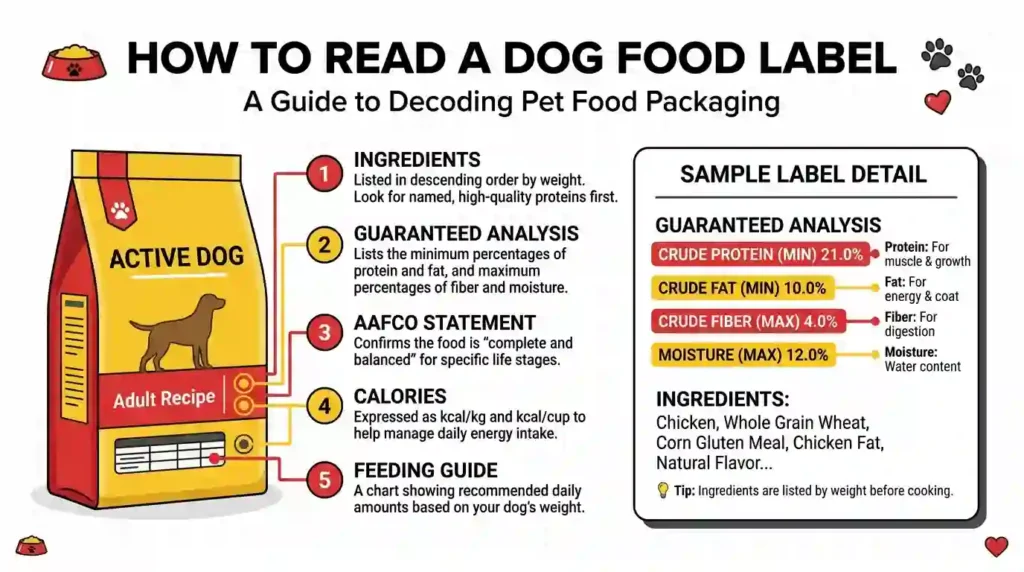
When examining a Pedigree package, focus on five sections.
Ingredient list: Shows ingredients in descending order by weight before processing.
Guaranteed analysis: Gives specified nutrient minimums and maximums.
Nutritional adequacy statement: Identifies the life stage for which the food is formulated or tested.
Calorie statement: Usually lists metabolizable energy in kcal/kg and sometimes kcal/cup or kcal/can.
Feeding directions: Provide a starting point for portion sizes.
A label is more useful when all these sections are considered together.
For a dog with a health condition, a veterinarian may also request nutrient data beyond the guaranteed analysis.
How to Interpret the AAFCO Nutritional Adequacy Statement
AAFCO stands for the Association of American Feed Control Officials.
AAFCO publishes model regulations and nutritional profiles used in U.S. pet-food labeling.
A complete-and-balanced food should identify the intended life stage.
Common categories include adult maintenance, growth, or all life stages.
Nutritional adequacy may be established through formulation to AAFCO nutrient profiles or appropriate feeding trials.
These are different substantiation methods.
AAFCO does not directly approve, certify, or endorse individual commercial dog foods.
A label carrying an AAFCO nutritional adequacy statement is not evidence that AAFCO independently tested every production batch.
Pedigree states that its complete-and-balanced formulas are designed to meet the nutritional requirements of their intended life stages.
Always check the exact package because not every product, topper, treat, or supplementary food is intended to serve as a complete diet.
Pedigree Nutrition Analysis
Nutritional quality involves more than identifying individual ingredients.
A dog’s diet must provide adequate energy, essential amino acids, fatty acids, vitamins, and minerals in appropriate proportions.
Protein, Fat, Fiber, and Moisture
Consider a U.S. Pedigree Adult Complete Nutrition Grilled Steak & Vegetable dry-food example.
Its published guaranteed analysis includes:
| Nutrient | Label Value | What It Tells You |
| Crude protein | 21% minimum | Minimum measured crude protein |
| Crude fat | 10% minimum | Minimum measured crude fat |
| Crude fiber | 4% maximum | Maximum specified crude fiber |
| Moisture | 12% maximum | Maximum water content |
| Calcium | 1% minimum | Minimum calcium |
| Phosphorus | 0.8% minimum | Minimum phosphorus |
| Linoleic acid | 1.5% minimum | Minimum listed omega-6 fatty acid |
These figures describe guaranteed label limits, not exact laboratory measurements of every batch.
Crude protein measures nitrogen-containing material and cannot distinguish animal protein from plant protein.
Crude fat describes a minimum fat content, but it does not show the complete fatty-acid profile.
Crude fiber is not the same as total dietary fiber.
Moisture varies substantially between dry and wet food.
A dog’s nutritional suitability also depends on calorie intake, body condition, digestibility, and individual health needs.
Complete and Balanced Nutrition
A food described as complete and balanced is intended to provide all essential nutrients for the stated life stage when fed as directed.
That is a meaningful requirement.
It indicates that the food is designed as a primary diet rather than an occasional treat.
However, complete and balanced does not necessarily mean optimal for every dog.
A healthy adult dog and a dog with chronic kidney disease may need very different diets.
Likewise, a rapidly growing large-breed puppy may need particular calcium and energy considerations.
For healthy adult dogs, a properly formulated adult-maintenance Pedigree recipe can be nutritionally adequate.
For dogs with diagnosed medical conditions, the feeding decision should be individualized.
AAFCO Standards and WSAVA Guidelines
AAFCO and WSAVA are often mentioned together in dog-food discussions, but they serve different roles.
AAFCO establishes nutrient profiles and model pet-food labeling frameworks.
WSAVA, the World Small Animal Veterinary Association, publishes guidance that helps veterinarians and owners evaluate pet-food manufacturers and nutritional information.
WSAVA does not issue an official list of approved dog-food brands.
Its nutrition guidance encourages owners to consider questions such as:
- Who formulates the food?
- What are their qualifications?
- Does the company employ appropriate nutritional expertise?
- How does the manufacturer assess product quality?
- Is nutritional information available?
- What research or feeding evidence supports the formulas?
- Can the company answer detailed nutritional questions?
Pedigree’s manufacturer reports access to animal nutrition specialists, food scientists, and veterinary expertise.
Those are relevant considerations.
However, consumers should still examine the specific product and discuss their dog’s nutritional needs with a veterinarian.
As-Fed Versus Dry-Matter Nutrient Values
Dry food and wet food cannot be compared fairly using only the percentages printed on the package.
Wet food contains substantially more water.
Suppose one dry food lists 21% crude protein with 12% maximum moisture.
A simplified dry-matter estimate using those label values would be:
21 ÷ 88 × 100 = approximately 23.9% protein on a dry-matter basis.
Now consider a canned food listing 8% crude protein with 82% maximum moisture.
The simplified calculation becomes:
8 ÷ 18 × 100 = approximately 44.4% protein on a dry-matter basis.
These are illustrative calculations using guaranteed minimum and maximum values, not precise laboratory-determined dry-matter percentages.
Actual moisture and protein concentrations may differ from the label limits.
The example demonstrates why 8% protein in wet food does not necessarily mean the food supplies less protein relative to its dry matter.
For accurate comparisons, request typical or average nutrient analyses from the manufacturer.
How to Assess a Formula for Your Dog
A practical assessment should answer several questions.
Is the recipe complete and balanced for your dog’s life stage?
Does it provide appropriate calories?
Does your dog digest it comfortably?
Is body weight stable and appropriate?
Are the skin and coat healthy?
Does your veterinarian identify any dietary concerns?
For dogs with food sensitivities, check all relevant ingredients.
For weight management, compare calorie density rather than relying only on package descriptions such as “healthy weight.”
For puppies, confirm growth adequacy.
If your dog is doing well, changing brands solely because of internet ingredient rankings may not provide any measurable health benefit.
Dry Pedigree vs. Canned Pedigree
Dry and wet Pedigree products can serve different practical needs.
Neither format is automatically healthier.
Differences in Moisture, Texture, and Palatability
Dry kibble generally contains around 10–12% moisture.
Pedigree wet-food examples may contain up to approximately 78–82% moisture.
This makes canned food a useful option when a dog prefers soft textures or benefits from additional dietary water.
Wet food may be more appealing to some picky eaters because of its aroma and texture.
Dry kibble is generally easier to use in puzzle toys and automatic feeders.
One important misconception is that ordinary dry kibble reliably cleans a dog’s teeth.
Although chewing kibble may provide some mechanical contact, standard kibble should not be treated as a substitute for toothbrushing or veterinary dental care.
Cost, Storage, and Feeding Convenience
Dry kibble generally offers the lowest cost per calorie.
It is also easier to store before opening and may be practical for large dogs.
Wet food is often more expensive per calorie and requires refrigeration after opening.
Pedigree advises storing opened dry food in its original bag in a cool, dry environment and generally using it within approximately two months.
For canned food, the manufacturer recommends refrigerating opened food promptly and using it within a short period; its current general guidance specifies a maximum of 48 hours.
Follow the instructions on your particular package if they are more restrictive.
A useful feeding accessory for bulk kibble storage is the Gamma2 Vittles Vault Airtight Pet Food Storage Container, available through Amazon.
It is a well-reviewed storage option with a screw-top lid, but it is best to keep the original food bag inside the container when practical.
That preserves the lot code, expiration information, and manufacturer packaging.
Using Wet Food as a Meal or Topper
Pedigree wet food can be served as a complete meal when its label states that it is complete and balanced for the dog’s life stage.
It may also be mixed with kibble.
However, adding wet food without reducing dry food increases the total calorie intake.
For example, adding half a can of food containing approximately 332 calories per full can contributes about 166 calories.
That can be a substantial addition for a small dog.
If using wet food only as a topper, measure its calories rather than estimating by spoonful.
A veterinarian can help determine how much kibble to replace.

Benefits and Drawbacks of Pedigree
Pedigree has several practical strengths, especially for budget-conscious households.
Its limitations become more important when dogs have specialized dietary needs.
Affordability and Availability
Pedigree’s strongest advantage is cost.
Large bags of dry food often cost substantially less than comparable amounts of premium kibble.
The brand is also sold in supermarkets, mass retailers, pet stores, and online marketplaces.
That availability can help owners maintain a consistent feeding routine.
For additional budget-friendly comparisons, our article Is Beneful a Good Dog Food examines another widely available brand.
Owners researching grain-inclusive alternatives can also explore Is Diamond Dog Food Good.
Recipe Variety and Palatability
Pedigree offers dry, wet, small-dog, puppy, and other formulas.
This allows owners to select different textures or kibble sizes.
Some dogs may prefer the aroma and softness of canned food.
Others may do well on standard dry kibble.
However, palatability varies between individuals.
A recipe that one dog enjoys may be rejected by another.
The brand’s variety is useful, but it does not guarantee that every dog will tolerate every formulation.
Ingredient Quality and Dietary Limitations
Some owners may prefer foods with more explicitly identified animal proteins or fewer synthetic colors.
Pedigree is not primarily marketed as a limited-ingredient or veterinary therapeutic diet.
That makes it less suitable for dogs requiring carefully restricted ingredients.
For a comparison focused on dietary sensitivities, see is natural balance dog food good.
Other conventional dry-food options worth comparing include Is Diamond Naturals a Good Dog Food and is black gold dog food good.
The appropriate choice depends on the individual recipe, not whether its marketing position is “premium” or “budget.”
How Much Pedigree Should You Feed Your Dog?
Correct portion control matters as much as the brand you choose.
Overfeeding a complete-and-balanced food can still result in unhealthy weight gain.
Using the Package Feeding Guide
Start with the feeding directions printed on your exact Pedigree product.
An example feeding guide for a standard adult dry recipe lists approximately:
| Adult Dog Weight | Example Daily Dry Food Amount |
| 5–10 lb | ½–¾ cup |
| 10–25 lb | ¾–1¾ cups |
| 25–50 lb | 1¾–3 cups |
| 50–75 lb | 3–4 cups |
| 75–100 lb | 4–4¾ cups |
These are broad starting ranges, not individualized medical feeding prescriptions.
Dogs with the same body weight may need different calorie amounts depending on age, activity, neuter status, metabolism, and body condition.
Adjusting Portions for Weight, Age, and Activity
Monitor your dog’s body condition rather than relying only on the scale.
A healthy dog should generally have a visible waist from above and an abdominal tuck from the side.
The ribs should be palpable without excessive fat covering.
Dogs that gain excess weight may need fewer calories.
Very active dogs may require more.
Growing puppies need feeding guidance specific to their developmental stage.
Senior dogs may need adjustments if their activity or body composition changes.
A digital food scale can be more accurate than measuring cups.
One useful Amazon-listed option is the Etekcity Digital Kitchen Scale, 11 lb/5 kg model, which has a large number of positive customer reviews.
Its tare function allows you to measure food in grams directly into a bowl.
This is especially helpful when managing calories for small dogs.
Accounting for Treats and Toppers
Treats and toppers add calories.
A common veterinary nutrition guideline is to keep treats and other non-complete foods within approximately 10% of daily calorie intake.
The remaining calories should come primarily from an appropriate complete-and-balanced diet.
If you add canned Pedigree to dry Pedigree, reduce the kibble portion accordingly.
If your dog eats too quickly, a slow-feeding bowl can help extend mealtime.
The Outward Hound Fun Feeder Slo Bowl, available on Amazon, is a well-reviewed option that uses raised ridges to slow access to food.
Choose a suitable size and maze pattern for your dog, and clean it thoroughly after meals.
Slow feeders are optional feeding tools; they do not treat digestive disorders or guarantee prevention of bloat.
Pedigree Dog Food Recalls and Safety History
Pedigree has experienced product recalls, including one announced in July 2026.
Recall history is relevant when evaluating a brand, but it should be interpreted accurately.
A recall affecting a specific lot does not automatically mean every product from the manufacturer is unsafe.
Likewise, a long interval without a recall does not guarantee that a food will never have a safety problem.
Recall History
Several notable U.S. Pedigree recalls include:
| Date | Affected Product | Recall Reason |
| August 2014 | Selected Adult Complete Nutrition dry-food bags | Possible metal fragments |
| May 2024 | Selected 44-lb Adult Complete Nutrition Grilled Steak & Vegetable dry-food bags | Potential loose metal pieces |
| July 2, 2026 | Two lots of High Protein Chopped Chicken & Duck Flavor canned wet food | Potential metal and plastic foreign material |
May 2024 recall: Mars Petcare voluntarily recalled 315 bags of Pedigree Adult Complete Nutrition Grilled Steak & Vegetable Flavor in the 44-pound size.
The affected products were distributed through Walmart stores in Arkansas, Louisiana, Oklahoma, and Texas.
The listed lot code was 410B2TXT02, with a best-by date of March 4, 2025.
July 2026 recall: Mars Petcare announced a voluntary recall involving two lots of Pedigree High Protein Chopped Chicken & Duck Flavor canned wet dog food in 13.2-ounce cans.
The affected lot codes were:
- 613C3KKCFC
- 613C1KKCFC
According to the company announcement, the affected products had been designated for destruction but were apparently diverted into U.S. distribution.
The concern involved possible sharp metal and plastic foreign material.
At the time of that announcement, the company reported no associated pet illness or injury.
The recall applied to those specific lots, not every Pedigree canned-food product.
Owners should consult the FDA’s July 2026 Pedigree recall announcement for the official product-identification details.
How to Verify a Recall by Product Name and Lot Code
If you are concerned about a recall, do not rely only on the brand name.
Check the following:
- Exact product name.
- Package size.
- Lot or production code.
- Best-by date.
- Manufacturer’s recall notice.
- Distribution details.
Lot codes may appear on the bottom of cans or on specific sections of dry-food packaging.
If a product matches a current recall, stop feeding it and follow the manufacturer’s or FDA’s instructions.
If your dog may have consumed food containing sharp foreign material, or develops vomiting, abdominal pain, choking, bloody stools, or other concerning symptoms, seek veterinary care promptly.
Preserve the packaging and product information for identification.
Pedigree Cost and Value
Cost is one of Pedigree’s main selling points.
However, value should be measured by how much it costs to feed an appropriate number of calories, not just the size of the bag.
Typical Cost by Food Type and Dog Size
Pedigree dry food generally occupies the budget segment of the U.S. dog-food market.
For example, an online Walmart listing checked in October 2026 showed a 44-pound Pedigree Complete Nutrition adult dry-food bag at approximately $26.
Prices vary by retailer, bag size, location, promotion, and formula.
Wet-food pricing also varies by can, pouch, and multipack.
Smaller packages usually cost more per pound than large dry-food bags.
When comparing foods, look at the unit price and calorie density.
Estimated Daily Feeding Cost by Dog Size
Consider a simple illustrative example using a 44-pound bag priced at $26.
That works out to approximately $0.59 per pound.
For a dry formula providing roughly 325 calories per cup, the approximate food cost is about $0.13 per cup.
| Dog Size | Example Cups per Day | Approximate Daily Food Cost |
| 10 lb | ½–¾ cup | 0.06–0.10 |
| 25 lb | 1¼–1¾ cups | 0.16–0.23 |
| 50 lb | 2½–3 cups | 0.32–0.39 |
| 75 lb | 3½–4 cups | 0.45–0.52 |
These figures are illustrative calculations, not fixed prices or veterinary portion recommendations.
They exclude taxes, delivery charges, treats, supplements, and wet-food additions.
They also assume the example formula’s calorie density and approximate cup weight.
A different Pedigree recipe or retail price will change the calculation.
How Pedigree Compares With Other Budget and Premium Brands
Pedigree generally competes on affordability and accessibility.
Other budget or mid-priced brands include Beneful, Diamond, Nature’s Recipe, Pure Balance, 4Health, and Rachael Ray Nutrish.
Higher-priced alternatives include some formulas from Purina Pro Plan, Iams, Royal Canin, and other specialized brands.
However, premium pricing does not automatically indicate superior nutrition.
A more expensive formula may provide particular features, different ingredient sourcing, or a specialized nutrient profile.
It may also cost more because of packaging, retail positioning, or marketing.
For additional comparisons, see Is Next Level dog food good.
If you want to explore a company with a strong veterinary nutrition focus, our review is hills a good dog food discusses another option.
Owners considering fresh food can also compare Is Freshpet Good for Dogs and is just food for dogs good.
These products differ significantly in format, cost, and formulation.
The most valuable food is one that meets your dog’s nutritional needs consistently and safely.
What Dog Owners Say About Pedigree
Owner feedback can provide useful practical observations about taste, convenience, and digestive tolerance.
However, customer reviews are not controlled nutritional studies.
Experiences vary between dogs, formulas, and individual households.
Common Feedback on Taste and Acceptance
Positive customer feedback often focuses on affordability, easy availability, and dogs willingly eating the food.
Some owners report that their dogs enjoy the flavor of Pedigree kibble.
Others prefer the wet-food textures because their dogs seem more interested in soft meals.
However, palatability is highly individual.
A dog that refuses one recipe may accept another.
A food that is popular with customers is not necessarily nutritionally better than another complete-and-balanced formula.
Taste is one part of the overall assessment.
Reports About Digestion and Overall Experience
Some owners report normal stools and stable weight while feeding Pedigree.
Others describe digestive upset, gas, loose stools, or changes in appetite.
Such reports do not establish that Pedigree is the cause.
Digestive symptoms can arise from rapid food changes, overfeeding, spoiled food, parasites, infections, medications, or other illnesses.
If a dog develops persistent diarrhea, repeated vomiting, significant lethargy, or loss of appetite, contact a veterinarian.
When evaluating any food, look for patterns over time rather than drawing conclusions from a single review.
Individual tolerance matters more than whether internet commenters describe a brand as premium, cheap, excellent, or terrible.
Frequently Asked Questions About Pedigree Dog Food
Is Pedigree Safe for Dogs?
Pedigree’s appropriately formulated complete-and-balanced foods can be suitable for healthy dogs, but owners should check current recalls and select the correct formula.
Is Pedigree Suitable for Puppies?
Pedigree offers puppy-specific formulas, but owners should verify the growth nutritional adequacy statement and ensure the recipe suits the puppy’s expected adult size.
Is Pedigree Recommended by Veterinarians?
Some veterinarians may consider Pedigree an acceptable budget option for healthy dogs, but recommendations depend on the exact formula and individual nutritional needs.
Can Dogs With Allergies or Sensitive Stomachs Eat Pedigree?
Some can, but dogs with diagnosed food allergies or chronic digestive problems may need a veterinarian-directed diet rather than routine commercial formulas.
How Should You Switch Your Dog to or From Pedigree?
Gradually replace the old food with the new food over approximately seven days or longer if needed, adjusting the transition under veterinary guidance for sensitive dogs.
Is Pedigree a Bad Dog Food?
Not inherently; it offers complete-and-balanced options, although some owners may prefer different ingredients, fewer additives, or more specialized formulations.
How Much Protein Is in Pedigree Dog Food?
The amount varies by recipe; examples include 21% minimum crude protein in certain adult dry formulas and 27% in a puppy dry formula.
Is Pedigree Dog Food Good for Small Dogs?
Pedigree offers small-dog recipes with smaller kibble pieces, but the chosen food must still match the dog’s age, calorie needs, and health.
Does Pedigree Contain Real Meat?
Some formulas contain animal-derived ingredients, including chicken, meat and bone meal, or chicken by-product meal; check the exact ingredient list.
Is Pedigree Better Than More Expensive Dog Food?
Not automatically; value depends on nutritional adequacy, the dog’s health and tolerance, manufacturing practices, and cost per appropriate daily portion.
Final Verdict: Should You Feed Your Dog Pedigree?
Pedigree can be a reasonable budget-friendly dog food for many healthy dogs, particularly when the chosen recipe is complete and balanced for the correct life stage. Its strengths include affordability, nationwide availability, formulation resources, and a wide range of dry and wet products.
However, some recipes use substantial grain and plant-protein ingredients, broadly identified animal materials, artificial colors, and certain preservatives. The brand’s recall history also makes product-level safety checks important.
Our recommendation is to judge Pedigree by the specific formula, your dog’s body condition, digestion, health requirements, and your veterinarian’s guidance, rather than price or ingredient marketing alone.
If your dog thrives on an appropriate Pedigree recipe, changing food may not be necessary. For more practical nutrition and feeding guidance, visit Dog Behavior and Training and explore our Dog Food Brand Reviews.