


Summary
If you have ever wondered, “Why does my dog bark when I sneeze?”, the answer usually involves surprise, concern, excitement, or a learned response. A human sneeze is a sudden, sharp sound accompanied by unusual facial and body movements. Your dog may interpret it as a perceived threat, a cry of pain, an invitation to play, or simply an event that deserves attention. By observing your dog’s body language and what happens immediately after the sneeze, you can identify the likely cause and teach a calmer reaction.
Table of Contents
- Why does my dog bark when I sneeze?
- What your dog may think a sneeze means
- Why does my dog bark at me when I sneeze?
- Why does my deaf dog bark when I sneeze?
- Why dogs bark when you cough or sneeze
- How to stop the barking
- The three-bark rule
- Barking between dogs in the same house
- When barking becomes unreasonable
- When to seek professional help
- Conclusion
- Frequently asked questions
Why Does My Dog Bark When I Sneeze?
Most dogs bark at a sneeze because it is sudden, unfamiliar, or emotionally significant. A sneeze does not sound like normal speech. It begins quickly, can be surprisingly loud, and may be accompanied by a sharp head movement, closed eyes, raised shoulders, or a hand moving toward the face.
To a dog, those combined signals may mean that something unusual has just happened.
Dogs also have sharp hearing and notice changes in sound that people often overlook. The volume, pitch, and explosive quality of a human sneeze can produce an immediate startle response. Barking is then your dog’s way of reacting to the interruption, investigating the sound, or communicating discomfort.
The bark alone does not reveal the full meaning. You need to consider your dog’s posture, facial expression, movement, and behavior after the sneeze.
The most common explanations
Your dog may bark after you sneeze because of:
- A startle response to the sudden noise
- Alarm barking triggered by an unexpected loud noise
- Fear, anxiety, or confusion
- Concern that you made a cry of pain or a cry for help
- A protective instinct or defensive response
- Excitement and playfulness
- An attempt at canine communication
- An attention-seeking habit
- A response learned from your previous reactions
In most cases, this behavior is harmless. It becomes a concern when the barking is intense, difficult to interrupt, associated with aggression, or part of a broader pattern of distress.
What Your Dog May Think a Human Sneeze Means
A dog does not necessarily understand that a sneeze is a routine respiratory reflex. Your pet interprets the event through its sound, movement, context, and previous experience.
“Something unexpected just happened”
For many dogs, barking is the canine equivalent of saying, “What was that?”
A loud sneeze can resemble a snort, cough, yelp, or even the sound of a tooth snap. Because it arrives without warning, it briefly activates the dog’s alert system. An otherwise relaxed dog may lift its head, bark once, look toward you, and then settle again.
This brief response usually indicates surprise rather than fear.
“My person may be hurt”
Dogs are emotionally sensitive to changes in human voices, movements, and expressions. A forceful sneeze may sound like a cry of pain. Your dog may rush toward you, bark, whine, paw at you, or inspect your face because it thinks you need help.
This reaction is often described as a protective instinct, although concern or social curiosity may be more accurate than deliberate protection. Your dog has noticed that you made an unusual sound and is checking what happened.
“There may be danger nearby”
Some dogs interpret any abrupt sound as a possible warning. The sneeze may trigger alarm barking, particularly in dogs that already react to doorbells, footsteps, objects falling, or noises outside.
A vigilant dog may not immediately recognize that the sound came from you. It might scan the room, run toward a doorway, or continue barking as though searching for a perceived threat.
“You want to play”
Sneezing has a social meaning in some canine interactions. Dogs may produce sneeze-like sounds during energetic play. These sounds can occur when dogs are excited and may help signal playful intentions.
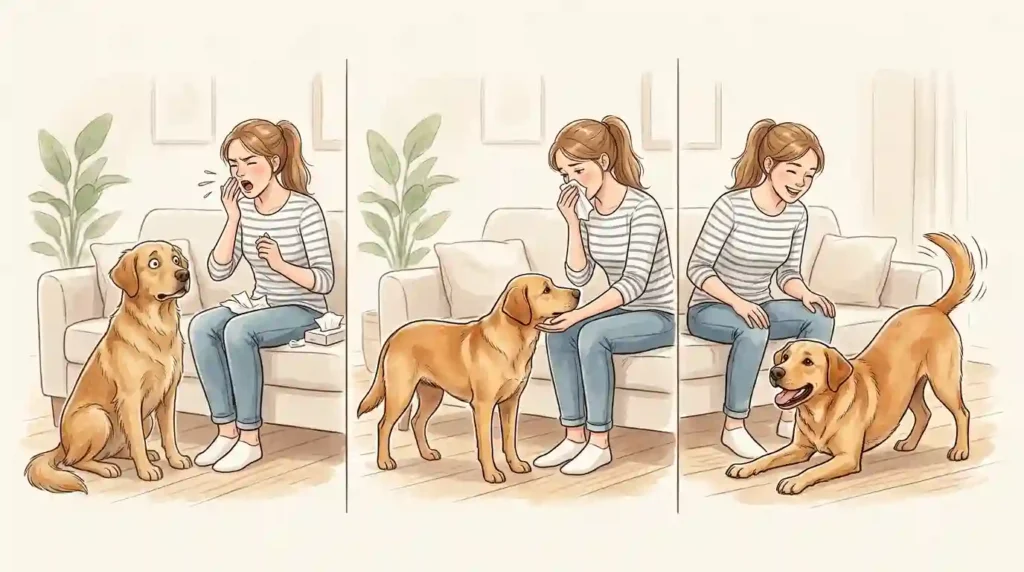
Your human sneeze is not identical to a dog’s play sneeze, but an excitable dog may still treat it as a social cue or invitation to play. If your dog barks with a loose body, wagging tail, play bow, or quick bouncing movements, playfulness is a likely explanation.
Why Does My Dog Bark at Me When I Sneeze?
When the barking is directed specifically at you, your dog is probably responding to your behavior rather than to an unidentified noise elsewhere in the room.
The dog may be asking for information, expressing concern, objecting to the sound, or expecting a familiar consequence. Look at what your dog does between barks.
A dog that approaches with relaxed muscles and a wagging tail is more likely to be curious or excited. A dog that backs away, lowers its body, pins its ears, licks its lips, or tucks its tail may be experiencing fear or anxiety. A dog that moves between you and another person could be displaying a defensive response.
Your reaction may reinforce the behavior
Owner reaction often determines whether a one-time bark becomes a learned response.
Suppose your dog barks after a sneeze and you immediately laugh, talk to it, make eye contact, throw a ball, offer a toy, or give it a treat. From the dog’s perspective, barking produced a valuable outcome. The next sneeze becomes an opportunity to request attention or play.
Even mild scolding can reinforce attention-seeking if the dog values interaction. The pattern may develop like this:
- You sneeze.
- Your dog barks.
- You react dramatically.
- The dog learns that barking after a sneeze gets attention.
This is not necessarily human behavior mimicry in a literal sense. It is more often associative learning. The dog recognizes a predictable sequence and participates in it.
Why some dogs appear offended by sneezing
Owners sometimes describe a dog as looking annoyed or offended. The dog may bark, leave the room, stare, or huff after every sneeze.
The reaction can look personal, but the dog is more likely sensitive to the sound or uncomfortable with the sudden movement. If your sneeze is particularly loud, the dog may be requesting distance rather than expressing human-like disapproval.
Do not deliberately sneeze close to the dog’s face to test the reaction. A close, forceful sneeze can be unpleasant and may create a stronger negative association.
Why Does My Deaf Dog Bark When I Sneeze?
A deaf dog may bark when you sneeze, even if it cannot hear the sound clearly. Deafness does not prevent a dog from detecting movement, vibration, airflow, visual changes, or the reactions of other animals.
Your sneeze causes more than sound. Your chest and shoulders contract, your head moves, your facial expression changes, and the floor or furniture may transmit a small vibration. A nearby deaf dog can notice these physical signals.
Other possible explanations include:
- The dog retains limited hearing at certain pitches or volumes.
- It sees your sudden body movement.
- It feels vibration through the floor, sofa, or bed.
- It notices another dog reacting.
- It has been learned that your sneezing movement predicts attention.
- The sneeze wakes or startles it through non-auditory cues.
If a dog previously had normal hearing, it may also retain an established learned response to the sight and context of a sneeze.
Avoid startling a deaf dog from close range. Use predictable visual cues, gentle floor vibrations, and calm hand signals when approaching or communicating. If hearing loss is new or has not been assessed, arrange a veterinary examination to rule out treatable ear problems and obtain appropriate guidance.
Why Does My Dog Bark When I Cough or Sneeze?
If your dog reacts to both coughing and sneezing, the common trigger is probably the abrupt change in your normal behavior.
A cough or sneeze may sound like distress, a snort, a growl-like burst, or a cry for help. Both sounds involve sudden body movement and an interruption in your regular breathing or speaking pattern. A sensitive dog may respond to either event with confusion or concern.
Pay attention to whether your dog also reacts when you:
- Hiccup
- Laugh loudly
- Clear your throat
- Clap
- Drop an object
- Raise your voice
- Pretend to cough
- Make quick arm movements
Reacting to several abrupt sounds suggests general noise sensitivity or heightened alertness rather than a specific problem with sneezing.
A new reaction to coughing may also arise because the dog has observed that coughing changes your behavior. For example, if you sit down, reach for medicine, receive help from another person, or stop an activity after coughing, the dog may recognize it as an important social event.
How to Stop Your Dog Barking When You Sneeze
You do not necessarily need to eliminate a single, brief bark. A one-off response is often normal canine communication. Training is more useful when the dog becomes distressed, barks repeatedly, rushes at people, wakes household members, or cannot settle afterward.
Step 1: Identify the emotion behind the bark
Before choosing a training method, observe the dog’s entire response.
Signs of a playful or excited reaction include:
- A loose, wiggly body
- A broad tail wag
- Play bows
- Bouncing movements
- Bringing you a ball or toy
- A relaxed, open mouth
Possible signs of fear or anxiety include:
- Ears held back
- Tail tucked or held low
- Crouching
- Moving away
- Trembling
- Panting when the room is not hot
- Repeated lip licking
- Refusing food
- Hiding or remaining hyper-alert
A fearful dog needs distance, predictability, and a gradual behavior plan. Treating fear as disobedience can intensify the problem.
Step 2: Keep your own reaction calm
After sneezing, return to a neutral posture and use calm reassurance if your dog looks concerned. Avoid excited laughter, repeated fake sneezes, shouting, or animated movements.
If the dog gives one bark and settles, continue what you were doing. A calmer reaction from you helps communicate that the event is unimportant.
Step 3: Reward the behavior you want
Prepare small, high-value treats and teach a simple alternative behavior such as “settle,” “place,” or looking at you quietly.
Practice the behavior when nobody is sneezing. Once the dog understands it, use the cue after a soft sneeze-like sound. Reward quiet attention or remaining on the mat. Over time, the dog learns that calm behavior is more rewarding than excessive barking.
Give the reward for the calm response, not during a barking outburst. Timing matters because dogs associate consequences with what they were doing immediately before the reward appeared.
Step 4: Use desensitization carefully
Desensitization means introducing the trigger at an intensity low enough that the dog notices it without becoming distressed.
Begin with a very soft recorded sneeze or a quiet imitation from a distance. Keep the volume below the level that produces barking, retreating, or tense body language. Repeat only a few times during a short session.
Gradually increase the realism or volume over multiple sessions. If the dog becomes tense, reduce the intensity. Progress should follow the dog’s comfort level rather than a fixed schedule.
Step 5: Add counterconditioning
Counterconditioning changes what the sneeze predicts. At a low, manageable intensity, make the sound and immediately provide something the dog values, such as a small treat or brief access to a favorite toy.
The sequence should be:
- Mild sneeze sound
- The dog remains comfortable
- A treat or an enjoyable activity appears
Eventually, the sound can become a predictor of something safe and pleasant. The American Veterinary Society of Animal Behavior advises using reward-based methods and reinforcing desirable responses for behavior concerns such as barking. Its position statement on humane dog training also advises against aversive training methods.
Do not use shouting, spray bottles, shock collars, or physical punishment. These methods may suppress the visible bark without resolving fear or confusion. They can also make the sneeze, the owner, or the surrounding situation feel more threatening.

What Is the Three-Bark Rule?
The “three-bark rule” is an informal household training approach, not a scientific rule or universal legal standard. It generally means allowing a dog to bark up to three times to alert the owner, then asking it to stop or perform a trained alternative behavior.
For example, an owner may acknowledge the alert with a calm phrase such as “Thank you,” then cue the dog to go to a mat. The idea is to recognize the dog’s communication without allowing the alert to develop into prolonged barking.
The method works only if the dog already understands the quiet or place cue. Repeating “quiet” while the dog continues barking does not teach the meaning of the word.
For sneeze-related barking, a rigid three-bark allowance may be unnecessary. Rewarding immediate calm or one brief alert followed by settling is usually clearer.
How to Stop Your Dog Barking at Other Dogs in the House
Barking after a sneeze can spread quickly in a home with several dogs. One dog reacts to the sound, another responds to the first dog, and the result becomes a chain of alarm barking.
Determine which dog initiates the response. Work with that dog individually at first, using low-intensity sounds and rewarding quiet behavior. Then practice with the other dogs present while maintaining enough space to prevent competition or conflict.
Useful strategies include:
- Teaching each dog an individual mat or resting place
- Rewarding quiet behavior before the group becomes excited
- Separating dogs briefly when arousal rises
- Avoiding competition over one treat, toy, or ball
- Practicing cues with each dog separately
- Providing adequate exercise and mental enrichment
- Blocking access to areas where dogs rehearse reactive behavior
For a more complete household plan, read Dog Barking in Multi-Dog Households.
If an older dog has begun barking at ordinary sounds, appearing confused, or vocalizing at unusual times, cognitive changes may be involved. This guide can help you Manage Barking in Dogs With Dementia.
What Is Classed as Unreasonable Dog Barking?
There is no single number of barks that is automatically unreasonable in every situation. The practical and legal meaning depends on local rules, duration, frequency, time of day, volume, and the effect on other people.
Barking is more likely to be considered unreasonable when it is:
- Frequent and prolonged
- Repeated late at night or early in the morning
- Loud enough to disrupt sleep or ordinary home life
- Allowed to continue without reasonable management
- Associated with an unattended or distressed dog
- Persistent despite documented complaints
A few barks after a sneeze would not ordinarily fit that description. However, if every cough, sneeze, or household noise causes several minutes of intense barking, the cumulative disturbance may become significant.
Keep a behavior log if you are trying to assess the problem. Record the trigger, time, duration, body language, and what stopped the barking. This information can reveal patterns and help a veterinarian or qualified behavior professional recommend an appropriate plan.
When to Seek Professional Help
Occasional barking after a sneeze is rarely a medical concern. Arrange a veterinary or behavioral assessment if:
- The reaction begins suddenly without an obvious explanation
- The dog appears panicked or remains distressed
- Barking is accompanied by lunging, snapping, or biting
- The dog reacts aggressively when someone coughs or sneezes
- Noise sensitivity is becoming more severe
- The dog shows confusion, sleep changes, or unusual nighttime vocalization
- A deaf dog has not received a hearing assessment
- Training produces no improvement or increases anxiety
Sudden behavioral changes can sometimes be associated with pain, sensory decline, neurological changes, or other health problems. A veterinarian can examine possible medical causes before the behavior is treated solely as a training issue.
A qualified reward-based trainer or veterinary behaviorist can then design a controlled desensitization and counterconditioning plan for severe fear, defensive behavior, or excessive barking.
Conclusion
Dogs bark when people sneeze for several possible reasons. The sound may trigger a startle response, resemble a cry of pain, activate alarm barking, create confusion, or encourage playful excitement. Some dogs also learn that barking after a sneeze earns attention, praise, a treat, a toy, or a game with a ball.
The best way to understand the behavior is to look beyond the bark. A relaxed, bouncing dog is communicating something different from a dog that crouches, retreats, or remains tense. Once you identify the emotion, you can respond with calm reassurance, reward quiet behavior, and use gradual desensitization or counterconditioning when needed.
For most dogs, the reaction is simply a brief piece of canine communication. Consistent, gentle handling can prevent it from developing into fear or excessive barking.
Frequently Asked Questions
Why do dogs react to humans sneezing?
A sneeze combines a sudden noise with abrupt body movement. Dogs may interpret it as a surprise, social cue, warning, or sign that their owner is in distress.
Why is my dog upset when I sneeze?
Your sneeze may frighten your dog or resemble a cry of pain. Watch for tucked posture, pinned ears, retreating, trembling, or other signs of anxiety.
How do dogs act when they sense you are sick?
Some dogs become more attentive, remain close, sniff more often, or behave protectively. These reactions reflect changes they notice in scent, routine, movement, and mood.
Why is my dog obsessed with my sneeze?
Your dog may find the sound exciting or may have learned that reacting earns attention. A predictable owner reaction can turn sneezing into a repeated social game.