
Summary
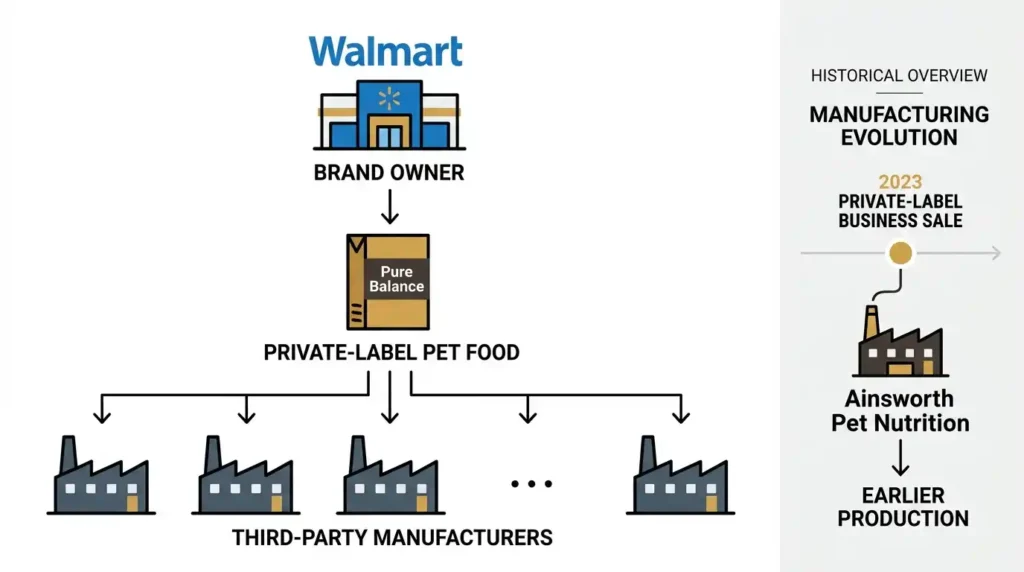
If you are asking who makes Pure Balance dog food, the clearest confirmed answer is that Walmart owns the brand and hires third-party pet food producers to manufacture its recipes. Ainsworth Pet Nutrition was historically identified as a manufacturer of Pure Balance dry food, but this relationship should not automatically be treated as current. The J.M. Smucker Company acquired Ainsworth in 2018, then sold its private-label pet food business and related manufacturing facilities to Post Holdings in 2023. Walmart currently describes Pure Balance as a private-label brand manufactured by third-party suppliers, without publicly naming one company responsible for every recipe.
Many Pure Balance products are marketed as being made in the United States, although ingredient origins and production arrangements may vary by formula. Pure Balance remains a Walmart-exclusive pet food line offering dry food, wet food, puppy recipes, senior formulas, grain-inclusive and grain-free choices, and the veterinarian-formulated Pure Balance PRO+ range. This guide separates verified ownership facts from outdated manufacturer claims while examining where the food is made, what it contains, and how owners can evaluate it safely.
Table of Contents
- Who makes Pure Balance dog food?
- Who owns the Pure Balance brand?
- Where is Pure Balance dog food made?
- Is Ainsworth Pet Nutrition still the manufacturer?
- What changed after the J.M. Smucker sale?
- How private-label pet food manufacturing works
- Pure Balance’s history and product launch
- Pure Balance food varieties
- Ingredients used in Pure Balance recipes
- Grain-inclusive versus grain-free formulas
- Pure Balance PRO+ and specialized nutrition
- AAFCO standards and nutritional adequacy
- Manufacturer transparency and quality control
- Pure Balance recall history
- Is Pure Balance a good dog food?
- Pure Balance compared with other brands
- Conclusion
- Frequently asked questions
Who Makes Pure Balance Dog Food?
Pure Balance is a Walmart private-label brand. Walmart owns and controls the brand, determines its market position, and sells its products through Walmart stores and Walmart.com. Walmart does not operate publicly as the direct pet food manufacturer behind every Pure Balance recipe.
Instead, the retailer uses outsourced manufacturing. One or more third-party pet food producers formulate, manufacture, package, or supply the food according to Walmart’s specifications and quality requirements.
Ainsworth Pet Nutrition has frequently been identified as the company that produced Pure Balance dry dog food. That attribution has a historical basis, but the ownership of Ainsworth’s private-label pet food operations changed in 2023. As a result, articles that simply state “Ainsworth makes Pure Balance and J.M. Smucker owns Ainsworth” are now incomplete or outdated.
The responsible manufacturer may also vary according to product format. Dry kibble, canned dog food, wet trays, rolls, treats, and specialized formulas do not necessarily come from the same facility or contract pet food manufacturer.
The most accurate current answer is:
- Walmart owns Pure Balance.
- Third-party pet food producers manufacture the products for Walmart.
- Ainsworth Pet Nutrition was historically associated with production.
- J.M. Smucker should not be described as the confirmed current manufacturer.
- Walmart does not publicly identify one manufacturer for every Pure Balance recipe.
- The product label is the best source for formula-specific manufacturing and contact information.
Who Makes Pure Balance Dog Food Now: Understanding the Ainsworth Claim
Ainsworth Pet Nutrition was a Pennsylvania-based pet food producer headquartered in Meadville, Pennsylvania. The company manufactured branded and private-label pet food and became widely associated with Pure Balance.
In 2018, the J.M. Smucker Company acquired Ainsworth Pet Nutrition. Smucker, headquartered in Orrville, Ohio, expanded its pet food operations through that acquisition.
This corporate history led many websites to publish a simple ownership chain:
Walmart owns Pure Balance, Ainsworth manufactures it, and J.M. Smucker owns Ainsworth.
That description did not account for later changes.
In April 2023, J.M. Smucker completed the sale of several pet food brands, its private-label pet food business, and relevant manufacturing assets to Post Holdings. The transaction included manufacturing facilities in Meadville, Pennsylvania, and Lawrence, Kansas, as well as a manufacturing and distribution facility in Bloomsburg, Pennsylvania. The change is confirmed in the J.M. Smucker divestiture announcement.
Because the transaction included Smucker’s private-label pet food operations, it is no longer reliable to identify J.M. Smucker as the current company behind Pure Balance based only on pre-2023 information.
Post Holdings acquired the relevant private-label business and facilities, but publicly available materials do not clearly confirm that Post currently manufactures every Pure Balance product. It may be involved in some production, but that should not be presented as a verified brand-wide fact without a current Walmart or manufacturer statement naming the exact relationship.
This is why manufacturer transparency matters. Corporate acquisitions can make an older but once-accurate answer misleading.
Who Owns Pure Balance Dog Food?
Walmart owns the Pure Balance brand. It is a Walmart-exclusive pet food line rather than an independently operated pet food company.
A private-label product is created for and controlled by a retailer but manufactured by an outside supplier. The retailer owns the brand name, product positioning, packaging, distribution arrangement, and customer relationship.
The external manufacturer may be responsible for some or all of the following:
- Product formulation
- Ingredient purchasing
- Raw-material testing
- Manufacturing
- Quality control
- Packaging
- Lot-code creation
- Distribution support
- Regulatory compliance
The arrangement allows Walmart to offer a premium-style product at a price that may be lower than comparable national brands. It also means the name of the factory owner may be less visible than it would be for a pet food company that owns both the brand and its manufacturing plants.
Pure Balance is sold mainly through Walmart stores and Walmart.com. Its limited retailer availability reflects its position as a Walmart private-label brand.
Where Is Pure Balance Dog Food Made?
Many Pure Balance dog foods are labeled as made in the United States. This includes several dry dog food recipes available to American shoppers.
However, “made in the USA” and “made entirely from domestic ingredients” do not mean the same thing. A dog food can undergo final manufacturing in the United States while containing globally sourced ingredients.
The origin may also vary among:
- Dry dog food
- Wet dog food
- Canned dog food
- Semi-raw dog food
- Treats
- Supplements
- Grain-free recipes
- Pure Balance PRO+ products
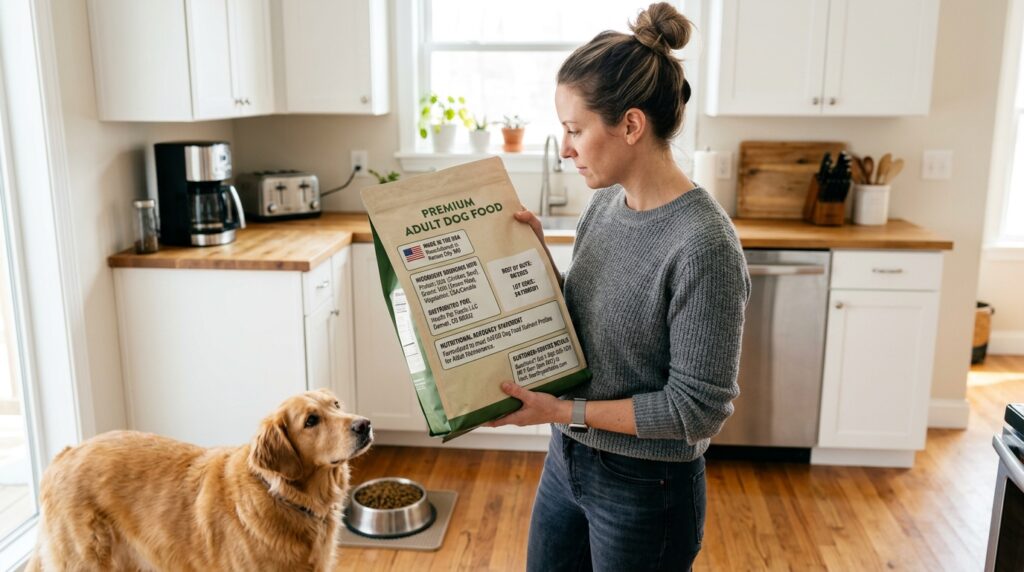
The most reliable way to determine where a particular product was made is to inspect its current pet food label. Look for the manufacturing statement, distributor information, lot code, and customer-service contact.
Do not assume that every formula comes from Meadville, Pennsylvania, simply because Ainsworth was once located there. Do not assume that Orrville, Ohio, is a current production location because it is associated with the J.M. Smucker Company. Headquarters, former ownership locations, distribution centers, and factories are different things.
What Does United States Manufacturing Mean?
United States manufacturing usually means the final product was processed and packaged in an American facility. The process may include grinding ingredients, combining the formula, extrusion for kibble, cooking, drying, coating, testing, and packaging.
It does not necessarily mean every ingredient originated in the United States.
A recipe may contain domestic ingredients alongside globally sourced ingredients such as vitamins, minerals, amino acids, oils, or other specialized nutrients. Large commercial dog food companies often use international supply chains to obtain materials that meet specific quality, price, and availability requirements.
Country of origin alone does not establish ingredient quality. Food safety also depends on:
- Supplier approval
- Ingredient specifications
- Transportation conditions
- Storage
- Hazard controls
- Contaminant testing
- Manufacturing sanitation
- Traceability
- Finished-product testing
- Corrective-action procedures
If ingredient sourcing is important to you, contact the company using the information printed on the package. Provide the full product name, package size, UPC, lot code, and best-by date.
How Private-Label Pet Food Manufacturing Works
Pure Balance is an example of private-label commercial dog food. Walmart owns the brand, but a co-packer or contract pet food manufacturer produces the physical product.
A contract manufacturer may make food for several different companies. Each customer can supply its own formula, ingredient specifications, packaging requirements, and quality standards.
This does not mean all foods made in the same plant are identical. Different brands may use different recipes, suppliers, nutritional targets, production schedules, and testing procedures.
Private-label manufacturing can offer several benefits:
- Lower development and infrastructure costs
- Faster product expansion
- Access to established manufacturing equipment
- Competitive retail pricing
- Large-scale production
- Exclusive formulas for one retailer
It can also make manufacturer evaluation more difficult. Consumers may not know which company operates the plant, whether manufacturers differ by format, or when a supplier relationship changes.
For this reason, the phrase “manufactured for Walmart” is more accurate than assigning every current Pure Balance product to Ainsworth, Smucker, Post Holdings, or another company without formula-specific proof.
When Was Pure Balance Launched?
Walmart launched Pure Balance in 2012 as its first ultra-premium dry dog food brand. The original product launch emphasized affordable premium pet food and recipes without added soy, wheat, corn, artificial colors, preservatives, or chicken by-products.
The historical launch details are available in Walmart’s official Pure Balance announcement.
The product line later expanded beyond its initial dry recipes. Pure Balance now includes wet food, grain-inclusive and grain-free formulas, puppy food, senior dog food, limited-ingredient options, specialized recipes, treats, and the Pure Balance PRO+ range.
Formulas can change over time. Claims made during the 2012 launch should not automatically be applied to every recipe sold today. Consumers should always use the ingredient disclosure on the current package.
What Types of Pure Balance Dog Food Are Available?
Pure Balance offers a broad range intended for different ages, sizes, and dietary preferences.
Dry Dog Food
Pure Balance dry dog food is conventional kibble. Dry recipes are convenient to measure, store, and serve. They generally provide more calories per ounce than wet food because they contain less moisture.
The dry range includes chicken, salmon, beef, and lamb recipes. Some formulas combine named meat meal with grains, while others use grain-free carbohydrate sources.
Wet and Canned Dog Food
Wet dog food contains more moisture and may be useful for dogs that prefer a softer texture. Pure Balance canned dog food and trays are available in several animal-protein combinations.
Check whether the food is labeled as a complete meal or for supplemental feeding. A topper or mixer may not provide complete and balanced nutrition when fed alone.
Puppy Food
Pure Balance puppy food is intended to support growth. Puppy formulas may include additional protein, fat, calcium, and DHA to support muscle growth, bone development, and cognitive development.
The nutritional adequacy statement should identify the formula as suitable for growth or all life stages. Large-breed puppies may require controlled mineral and calorie intake, so professional guidance is valuable.
If you are comparing refrigerated puppy diets with kibble, read Is Freshpet Good for Puppies.
Senior Dog Food
Senior formulas may focus on calorie control, mobility, digestive health, or senior wellness. However, “senior” is not one of AAFCO’s formally recognized life stages.
The actual nutritional profile matters more than the word “senior” on the front of the bag. A veterinarian can help determine whether an older dog needs fewer calories, more protein, joint support, or a prescription diet.
Grain-Inclusive Formulas
A grain-inclusive formula may contain whole grains such as brown rice or barley. Grains provide carbohydrates, fiber, vitamins, and other nutrients.
Dogs do not generally require grain-free food unless there is a valid individual reason for choosing it.
Grain-Free Formulas
Pure Balance also sells grain-free formulas that may use peas, dried peas, sweet potatoes, or other plant ingredients instead of corn, wheat, rice, or barley.
A grain allergy is less common than an allergy to an animal protein. Owners should avoid diagnosing a grain allergy without veterinary evaluation.
Limited-Ingredient and Fish-Based Formulas
A limited-ingredient formula may use fewer primary protein and carbohydrate sources. A fish-based formula commonly uses salmon and may appeal to owners seeking a different animal protein.
“Limited ingredient” is a marketing description, not a guarantee that a recipe is appropriate for every dog with a food sensitivity. Dogs undergoing a formal elimination diet may require a veterinary therapeutic food rather than an over-the-counter product.
Semi-Raw and Specialized Products
Certain Pure Balance products have been described as semi-raw or minimally processed. These should be evaluated according to their exact label, handling instructions, and nutritional adequacy.
Do not assume a food is safer, more digestible, or more nutritious simply because it uses words such as natural, raw, fresh, premium, or holistic.
What Is Pure Balance PRO+?
Pure Balance PRO+ is an extension of Walmart’s private-label pet food line. It was introduced as veterinarian-formulated pet food for particular life stages and nutritional concerns.
The range has included formulas associated with:
- Puppy development
- Adult maintenance
- Weight management
- Senior wellness
- Large-breed needs
- Small-breed needs
- Skin and coat support
- Digestive health
“Veterinarian formulated” does not mean the food is a prescription diet. Prescription diets are therapeutic products intended to help manage diagnosed medical conditions under veterinary supervision.
Pure Balance PRO+ may suit healthy dogs with particular lifestyle or maintenance needs, but dogs with kidney disease, diabetes, pancreatitis, urinary disease, severe allergies, or other medical problems may require specialized veterinary nutrition.
Ingredients Commonly Found in Pure Balance Dog Food
Ingredients vary by recipe, so the current label should always take priority over a general brand review.
Animal Protein
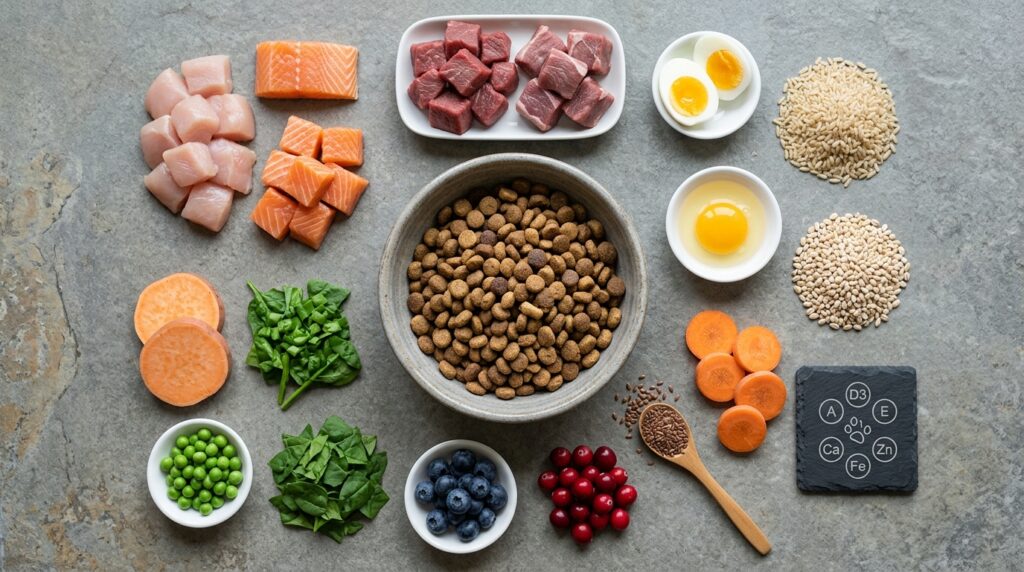
Many Pure Balance formulas feature real meat or fish, such as chicken, salmon, beef, lamb, or egg. Some dry foods also contain named meat meal, including chicken meal or lamb meal.
Named meat meal can be a concentrated source of animal protein because much of the water and fat has been removed during rendering.
A named source gives buyers more information than a vague term such as animal meal. Nevertheless, the final nutrient profile and digestibility matter more than any single ingredient.
Fats and Oils
Chicken fat may provide energy and fatty acids. Flaxseed or flaxseed oil can supply fat, fiber, and plant-based omega fatty acids.
Appropriate dietary fat supports energy level, skin health, and coat quality. Dogs with a history of pancreatitis or fat intolerance may require a specially controlled diet.
Fruits and Vegetables
Depending on the recipe, the ingredient list may include blueberries, cranberries, peas, sweet potatoes, spinach, carrots, or tomatoes.
These ingredients can provide fiber, carbohydrates, phytonutrients, vitamins, or minerals. Their presence does not by itself prove that a food is nutritionally superior; their quantity and role in the finished formula also matter.
Whole Grains and Carbohydrates
Grain-inclusive recipes may contain barley or brown rice. Grain-free recipes may rely more heavily on peas, potatoes, or other legumes and starches.
Carbohydrates supply energy and help maintain the physical structure of kibble. The appropriate amount depends on the overall formula and the individual dog.
Vitamins and Minerals
Pure Balance labels may list added vitamins and mineral compounds such as:
- Folic acid
- Biotin
- Ascorbic acid
- Vitamin D3
- Thiamine
- Niacin
- Zinc sulfate
- Ferrous sulfate
- Calcium iodate
- Copper sulfate
- Manganese sulfate
- Sodium selenite
These ingredients help the finished food meet defined nutritional targets. A long list of chemical-sounding names does not automatically indicate poor ingredient quality. Many are recognized forms of essential nutrients.
Ingredients Pure Balance Commonly Avoids
Pure Balance’s original launch highlighted formulas without added soy, wheat, corn, artificial colors, artificial preservatives, or chicken by-products.
Today, shoppers should verify these claims recipe by recipe. The Pure Balance range has grown substantially, and ingredient lists can change.
There is also an important distinction between an ingredient being excluded for marketing purposes and that ingredient being inherently unsafe.
Corn, wheat, and soy can supply useful nutrients and are not automatically harmful to dogs. Chicken by-products may include nutrient-rich organs and tissues. Artificial preservatives and flavors should be evaluated by their specific names and permitted uses rather than rejected solely because they sound technical.
Dogs with confirmed food sensitivity need an individualized plan. Randomly eliminating multiple ingredients can make it harder to identify the true trigger and may lead to an unnecessarily restricted diet.
Does Pure Balance Meet AAFCO Standards?
Many Pure Balance recipes include a nutritional adequacy statement indicating that they are formulated to meet AAFCO nutrient profiles for a stated life stage.
AAFCO is the Association of American Feed Control Officials. It develops model regulations, ingredient definitions, feeding protocols, and nutrient profiles used throughout the American pet food industry.
AAFCO does not personally test or approve every dog food. Therefore, saying “AAFCO approves Pure Balance” is inaccurate.
Instead, a package may state that the food is formulated to meet the nutritional levels established by the AAFCO Dog Food Nutrient Profiles for:
- Growth
- Adult maintenance
- All life stages
Some products may instead be intended for intermittent or supplemental feeding. These should not be used as a dog’s sole diet unless the label says otherwise.
The nutritional adequacy statement is one of the most important parts of the pet food label because it explains the food’s intended nutritional role.
How to Read a Pure Balance Pet Food Label
A front label is designed partly for marketing. The back and side panels provide more useful technical information.
Check the Exact Recipe Name
Pure Balance offers many similar products. Record the full name, protein flavor, life stage, package size, and food format.
Find the Ingredient List
Ingredients are generally listed in descending order by weight before processing. Remember that fresh meat contains substantial water, while named meat meal is more concentrated.
Review the Guaranteed Analysis
The guaranteed analysis normally shows minimum protein and fat and maximum fiber and moisture. Wet and dry foods should not be compared directly without adjusting for moisture.
Locate the Nutritional Adequacy Statement
Confirm that the food is suitable for your dog’s life stage. Puppy, adult, and all-life-stages foods are not interchangeable in every situation.
Examine the Feeding Guide
Feeding directions are starting estimates, not precise prescriptions. Monitor weight and body condition and adjust portions when necessary.
Save the Lot Code and Best-By Date
Keep the original package even if you transfer the food into an airtight container. The lot code and best-by date are necessary for a pet food recall or quality complaint.
Look for Manufacturer or Distributor Information
The label may say “manufactured for,” “distributed by,” or use other legally meaningful wording. “Distributed by Walmart” does not necessarily reveal which factory made the food.
Manufacturer Transparency and Quality Control
Manufacturer transparency involves more than naming the brand owner. Useful questions include:
- Who formulates the recipes?
- Does the company employ a qualified pet nutritionist?
- Does it consult board-certified veterinary nutrition professionals?
- Who owns or operates the factories?
- Are third-party co-packers used?
- How are suppliers approved?
- Are finished products tested?
- How are contaminants and nutrient levels checked?
- Can the company provide a typical nutrient analysis?
- Where are ingredients sourced?
- How are complaints investigated?
- Can a specific lot be traced to its manufacturing facility?
Private-label brands may provide less public information than manufacturers selling directly under their corporate name. That does not prove poor quality, but it may make independent manufacturer evaluation more difficult.
If Walmart or the responsible supplier cannot answer a question, acknowledge the uncertainty. Avoid replacing missing information with assumptions repeated by older websites.
Has Pure Balance Dog Food Been Recalled?
Major recall-tracking resources have reported no Pure Balance-branded pet food recall as of September 2026. However, recall databases change, and consumers should verify the latest information through the FDA before making a current safety claim.
A lack of recalls does not prove that a product has never experienced a complaint or quality issue. It means no qualifying Pure Balance recall was identified in the sources reviewed.
It is also important to separate the brand’s recall history from the history of a contract manufacturer. A manufacturer may produce many unrelated foods. A recall involving another brand does not automatically mean Pure Balance was affected.
Similarly, a manufacturer’s past voluntary recall may still be relevant when evaluating quality systems, but it should be described accurately and with product-specific context.
What to Do If Your Dog Becomes Sick
Stop feeding the product and preserve the packaging. Record the lot code, best-by date, UPC, purchase location, and feeding timeline.
Contact a veterinarian when symptoms are persistent, severe, or accompanied by lethargy, repeated vomiting, blood, pain, weakness, or dehydration. Report suspected product problems to Walmart and, when appropriate, the FDA.
Do not conclude that the food caused illness based on timing alone. Digestive symptoms can result from diet changes, infection, parasites, scavenging, stress, intolerance, or underlying disease.
Is Pure Balance a Good Dog Food?
Pure Balance may be a reasonable budget-friendly nutrition option for healthy dogs that tolerate its ingredients. The brand often combines identifiable animal protein with grains, vegetables, vitamins, and minerals while remaining less expensive than many premium national brands.
Its potential strengths include:
- Real meat or named meat meal in many formulas
- Grain-inclusive and grain-free choices
- Puppy, adult, and senior options
- Wet and dry formats
- Accessible pricing
- Broad availability at Walmart
- Recipes without certain artificial colors, flavors, or preservatives
- Specialized Pure Balance PRO+ formulas
Possible limitations include:
- Limited public manufacturer transparency
- Uncertainty about current co-packers
- Walmart-exclusive retailer availability
- Variation between formulas
- Legumes in certain grain-free products
- Less published feeding research than some veterinary-focused brands
- No guarantee that every recipe suits every dog
A veterinarian or qualified pet nutritionist can help when a dog has chronic illness, food sensitivity, unexplained weight changes, digestive problems, or special life-stage requirements.
Feeding can also affect routines, motivation, appetite, and training responses. The Dog psychology section provides related guidance on canine behavior and daily habits. For broader nutritional information and answers about what a Dog can Eat, explore the main food resource hub.
Pure Balance Compared With Other Dog Food Brands
Pure Balance is commonly compared with Purina Pro Plan and Blue Buffalo.
Purina Pro Plan is generally positioned around veterinary research, performance nutrition, and targeted formulas. Blue Buffalo emphasizes identifiable meat sources and ingredient-focused marketing. Pure Balance competes by offering premium-style recipes at a more accessible Walmart price.
These differences do not establish one universal winner. The better choice depends on:
- The exact formula
- Life-stage suitability
- Nutritional adequacy
- Ingredient tolerance
- Calorie requirements
- Health conditions
- Manufacturer information
- Budget
- Retail availability
- The dog’s response
For ownership and production comparisons, read the guides to Diamond Dog Food, Natural Balance Dog Food, and Pedigree dog food.
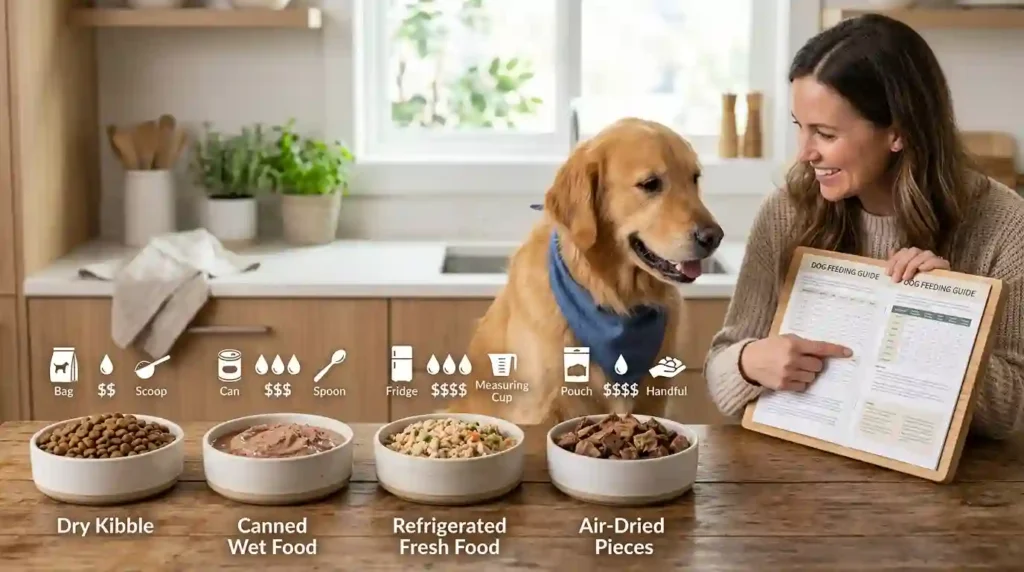
Pure Balance Versus Fresh Dog Food
Pure Balance mainly offers shelf-stable commercial dog food, while fresh dog food usually requires refrigeration and has a shorter usable life after opening.
Start with the guide to Freshpet Dog Food and the company profile explaining who makes Freshpet dog food.
Before changing formats, compare storage and feeding requirements. These resources explain How Long Does Freshpet Last, the likely Freshpet Dog Food Cost monthly, and how much Freshpet to feed dog.
Premium air-dried dog food is another alternative, but “premium” does not automatically mean nutritionally superior. Compare calories, adequacy, digestibility, manufacturer qualifications, and cost per day.
Conclusion
Walmart owns Pure Balance as a private-label, Walmart-exclusive pet food brand. It does not publicly manufacture the food itself. Third-party pet food producers make Pure Balance recipes according to Walmart’s requirements.
Ainsworth Pet Nutrition was historically associated with Pure Balance manufacturing, and the J.M. Smucker Company acquired Ainsworth in 2018. However, Smucker sold its private-label pet food business and related facilities to Post Holdings in 2023. This makes the often-repeated claim that “Smucker currently makes Pure Balance” outdated and unsupported.
So, where is Pure Balance dog food made? Many products are labeled as manufactured in the United States, but the exact facility, manufacturer, and ingredient origins may vary by recipe. Check the current package and contact Walmart with the product name, UPC, lot code, and best-by date when you need a formula-specific answer.
Pure Balance offers dry food, wet food, puppy and senior recipes, grain-inclusive and grain-free formulas, limited-ingredient choices, and Pure Balance PRO+ products. Many recipes feature real meat or named meat meal alongside carbohydrates, fats, vitamins, and minerals.
The brand may provide a useful balance between price and ingredient preferences for healthy dogs. However, its limited public manufacturer transparency is worth recognizing. Choose an exact recipe based on nutritional adequacy, life stage, ingredient tolerance, calorie needs, health status, and professional guidance—not on marketing terms alone.
Frequently Asked Questions
Who makes Pure Balance dog food?
Walmart owns Pure Balance and uses third-party manufacturers to produce it. Walmart does not currently name one company responsible for every recipe.
Does Ainsworth Pet Nutrition make Pure Balance?
Ainsworth was historically associated with Pure Balance production. Its former private-label pet food business changed ownership in 2023.
Does J.M. Smucker make Pure Balance dog food?
There is no solid current basis for that claim. Smucker sold its private-label pet food business and relevant facilities to Post Holdings in 2023.
Does Post Holdings make Pure Balance?
Post acquired Smucker’s private-label pet food business, but public sources do not clearly confirm that it makes every current Pure Balance formula.
Who owns Pure Balance dog food?
Walmart owns Pure Balance as a private-label pet food brand.
Where is Pure Balance dog food made?
Many Pure Balance products are labeled as made in the United States. Check the exact package because production may vary by recipe.
Is Pure Balance sold outside Walmart?
Pure Balance is a Walmart-exclusive brand sold primarily through Walmart stores and Walmart.com.
Is Pure Balance made with domestic ingredients?
Some ingredients may be domestic, while others may be globally sourced. Review the package or contact Walmart for recipe-specific sourcing details.
Is Pure Balance AAFCO approved?
AAFCO does not approve individual foods. Applicable Pure Balance recipes are labeled as formulated to meet AAFCO nutrient profiles.
Has Pure Balance dog food been recalled?
No Pure Balance-branded recall was identified in the major recall resources reviewed as of September 2026. Always check the current FDA database.
Is Pure Balance good for puppies?
Pure Balance offers puppy formulas. Choose one with a nutritional adequacy statement for growth and consult a veterinarian about large-breed puppies.
Does Pure Balance contain real meat?
Many formulas list chicken, salmon, beef, lamb, or a named meat meal. Ingredients vary, so inspect the current recipe label.
Is Pure Balance grain-free?
The brand sells both grain-free and grain-inclusive recipes. Choose according to your dog’s nutritional needs rather than marketing preference alone.
Is Pure Balance a prescription diet?
No. Pure Balance and Pure Balance PRO+ are over-the-counter foods, not veterinary prescription diets.
Is Pure Balance cheaper than Purina Pro Plan?
Pure Balance is generally positioned as a more affordable option. Actual cost depends on recipe, package size, feeding quantity, and current price.