
Summary
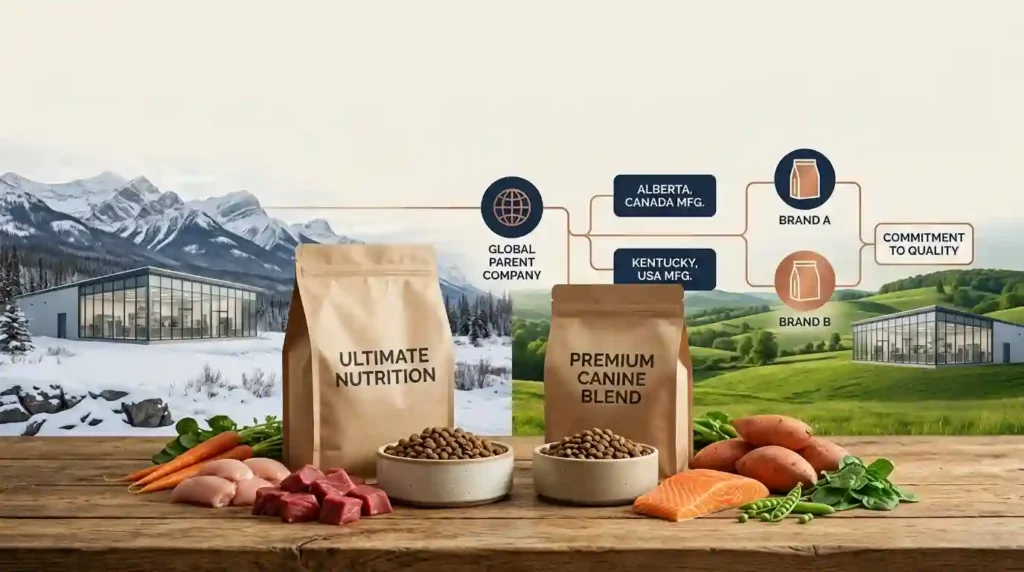
If you are wondering who owns Orijen dog food, the direct answer is Mars Incorporated. Mars completed its acquisition of Champion Petfoods—the company that develops and manufactures Orijen and Acana—on February 28, 2023. Champion Petfoods now operates within Mars Petcare as an independent business unit, so Mars is the ultimate parent company while Champion remains responsible for the brands’ recipe formulation, ingredient sourcing, quality assurance, and day-to-day production.
This distinction matters because a brand owner and a food manufacturer are not always the same entity. In this case, Mars provides the corporate ownership, resources, and wider pet food portfolio, while Champion Petfoods continues to make and manage Orijen and Acana products.
Table of Contents
- Who owns Orijen dog food?
- Who owns Acana dog food?
- Who owns Champion Petfoods?
- The Champion Petfoods ownership timeline
- Who makes Orijen and Acana dog food?
- Where are Orijen and Acana foods manufactured?
- How Orijen and Acana differ
- Why dog food ownership matters
- Did the Mars acquisition change the recipes?
- How to evaluate either brand
- Related dog food company guides
- Frequently asked questions
Who Owns Orijen Dog Food? The Direct Answer
Mars Incorporated ultimately owns Orijen dog food through its ownership of Champion Petfoods. Mars Petcare completed the acquisition of Champion Petfoods on February 28, 2023.
The most useful way to understand the relationship is:
- Mars Incorporated: Ultimate parent company
- Mars Petcare: Mars division focused on pet nutrition, veterinary care, and related services
- Mars Pet Nutrition: Operating structure under which Champion was placed
- Champion Petfoods: Manufacturer and day-to-day operator
- Orijen: Premium pet food brand owned and managed through Champion
- Acana: Orijen’s sister brand, also made and managed by Champion
The official Mars acquisition announcement states that Champion Petfoods would operate as an independent business unit within Mars Pet Nutrition.
That operating structure is important. Mars owns Champion, but consumers still see Champion Petfoods named as the company behind Orijen. Champion’s teams continue to handle core functions such as product development, manufacturing oversight, recipe formulation, supplier relationships, and product quality.
Is Orijen owned directly by the Mars family?
Mars Incorporated is a privately held, family-owned company controlled by the Mars family. It is not a publicly traded corporation whose shares can be purchased on a stock exchange.
Therefore, Orijen is indirectly under Mars family ownership, but several corporate layers sit between the family and the food in a customer’s bowl. Champion Petfoods remains the relevant manufacturer, while Mars Incorporated is the ultimate owner.
Is Orijen still a Champion Petfoods brand?
Yes. The acquisition did not eliminate Champion Petfoods or transfer the Orijen name to an unrelated manufacturer. Orijen remains one of Champion Petfoods’ two primary brands.
When shoppers ask who owns Orijen, the complete answer is: Mars Incorporated owns Champion Petfoods, and Champion Petfoods owns and makes Orijen.
Who Owns Acana Dog Food Today?
The answer to who owns Acana dog food is the same: Mars Incorporated owns Acana through Champion Petfoods.
Acana was created by Champion and remains closely connected to the company’s history. It is not a separate Mars-developed label and was not purchased in isolation. Mars acquired the entire Champion Petfoods business, bringing both Acana and Orijen into the Mars Petcare portfolio.
For anyone asking who owns Acana, the ownership chain is:
Mars Incorporated → Mars Petcare → Champion Petfoods → Acana
Champion continues to position Acana as a premium pet food brand, although its recipes and price points are generally designed to cover a broader market than Orijen.
Are Acana and Orijen owned by the same company?
Yes. Both brands have the same parent company and manufacturer.
This shared ownership explains why their packaging, ingredient language, nutritional philosophy, retail channels, and customer-support systems can appear similar. However, shared ownership does not mean the foods are identical. Each brand has its own recipes, animal ingredient percentages, product formats, nutrient profiles, and pricing structure.
Who Owns Champion Pet Foods?
For readers asking who owns Champion Pet Foods, Mars Incorporated is the current owner. The company name is formally styled as Champion Petfoods, although consumers frequently search for “Champion Pet Foods.”
Before the Mars acquisition, Champion was controlled by an investor group. Bedford Capital and the Healthcare of Ontario Pension Plan, commonly abbreviated as HOOPP, were prominent investors. HOOPP reported that it held a majority stake and invested alongside Bedford Capital and Kensington Capital.
This earlier ownership structure placed Champion within a private equity and institutional investment environment. Mars later agreed to acquire the business, subject to customary regulatory approval.
Once the transaction closed in 2023, Champion joined Mars Petcare. The previous investor group sold its interests, and Mars became Champion’s parent company.
What does “independent business unit” mean?
An independent business unit is owned by a larger corporation but retains a meaningful degree of operational responsibility.
For Champion Petfoods, that means Mars controls the company at the corporate level, but Champion can continue operating with its specialized brand, nutrition, manufacturing, and quality teams. It does not mean Champion is financially independent from Mars or that its ownership did not change.
This structure allows Mars Petcare to expand its premium pet food category while preserving the expertise and consumer recognition Champion developed around Orijen and Acana.
Champion Petfoods Ownership Timeline
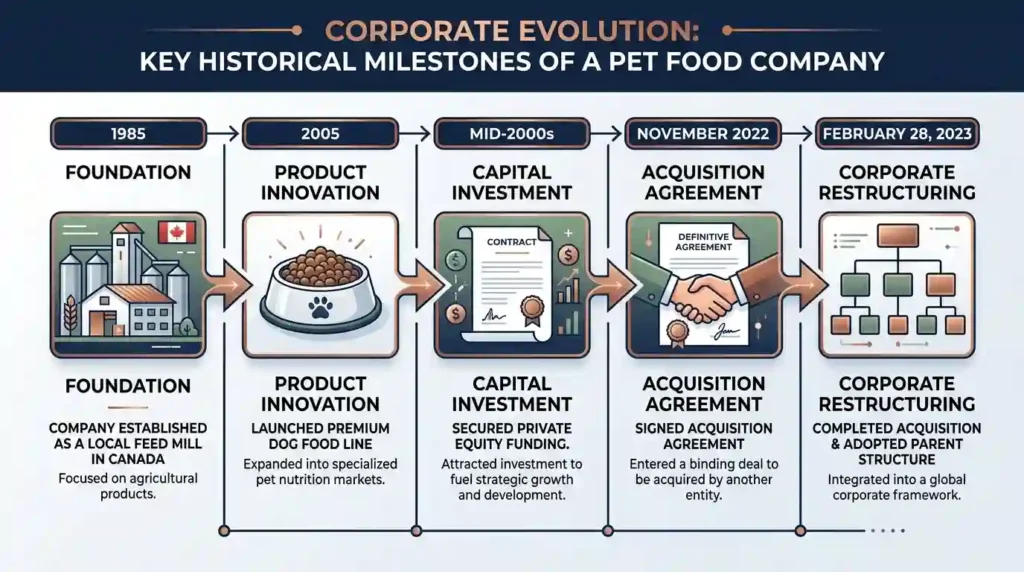
1985: Champion begins producing pet food
Champion Petfoods traces its roots to Alberta, Canada. Its early business focused on producing food for dogs and cats, with Acana becoming a central part of the company’s identity.
2005: Orijen enters the premium market
Champion introduced Orijen as a higher-tier brand emphasizing high animal protein, fresh meat, raw ingredients, and a nutritional concept inspired by a dog’s evolutionary diet.
The brand became known for nutrient-rich pet food, high-protein kibble, low carbohydrate content, and WholePrey ingredients such as meat, organs, cartilage, and bone.
Private investment period
Champion later received substantial investment from private equity and institutional partners. The ownership group included Bedford Capital, Healthcare of Ontario Pension Plan, and Kensington Capital.
This investment period helped Champion expand beyond a regional Canadian manufacturer. The company grew its production capacity, international distribution, pet specialty retail relationships, independent retail presence, and digital commerce channels.
November 2022: Mars announces the acquisition
Mars Petcare announced that it had entered into an agreement to acquire Champion Petfoods from the investor group. The proposed transaction still required the normal closing process and regulatory approval.
February 28, 2023: Ownership change is completed
The acquisition officially closed on February 28, 2023. Champion Petfoods became part of Mars Petcare and was positioned as an independent business unit within Mars Pet Nutrition.
Who Makes Acana Dog Food?
Champion Petfoods makes Acana dog food. Mars owns the manufacturer, but Mars is not normally the name consumers will see presented as the direct maker of an Acana recipe.
Champion remains responsible for developing Acana’s dry dog food, wet food, freeze-dried food, treats, and other products. Its internal teams establish product specifications, nutritional targets, ingredient standards, and quality standards.
The precise manufacturing arrangement can vary by recipe and format. Some products are made through in-house production at Champion facilities, while certain formats may involve carefully selected co-manufacturing partners.
For that reason, the package should always be treated as the most current source for a particular recipe’s manufacturing statement and country of origin.
Who Makes Orijen Dog Food?
Champion Petfoods makes Orijen dog food. It develops Orijen recipes and oversees the standards used for manufacturing, ingredient sourcing, quality assurance, and food safety.
Orijen is therefore not simply a Mars-branded formula produced interchangeably with every other food in the Mars pet food portfolio. It remains a distinct Champion brand with its own product positioning and nutritional approach.
Orijen’s range has included:
- High-protein kibble
- Dry dog food for different life stages
- Wet food
- Freeze-dried food and treats
- Fresh or raw animal ingredients
- WholePrey ingredients
- Grain-free and grain-inclusive recipes
- Formulas designed for puppies, adults, seniors, and different breed sizes
Consumers comparing feeding formats can explore the broader Dog Food resource section for additional brand and nutrition guides.
Where Are Orijen and Acana Dog Foods Made?
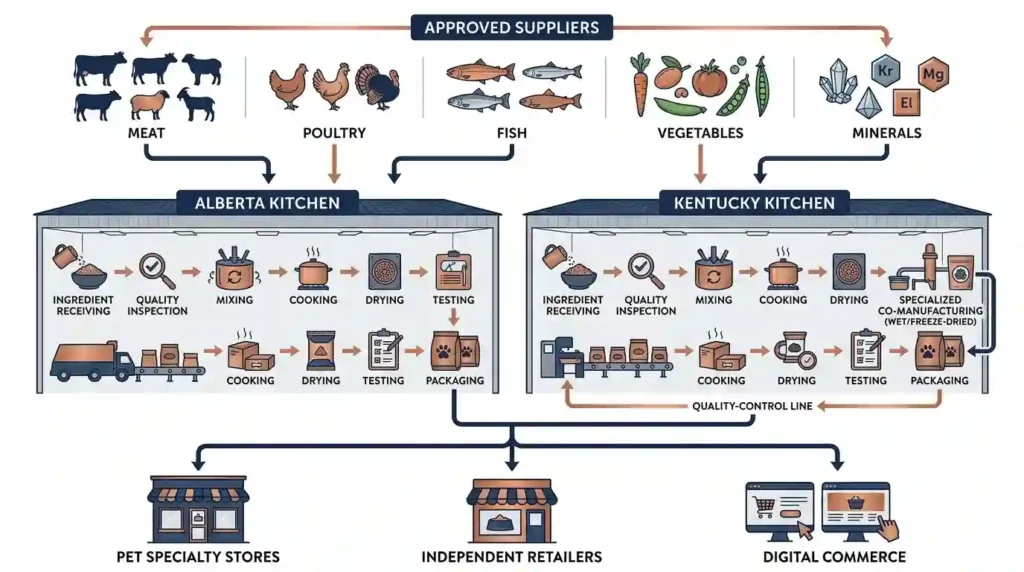
Manufacturing location depends on the product, market, and food format. Champion has operated major company-owned kitchens in Alberta, Canada, and Kentucky in the United States.
NorthStar Kitchen in Alberta, Canada
NorthStar Kitchen is Champion’s large production facility in Alberta. It supports the manufacturing of premium pet food using specialized systems designed for handling animal protein, dry ingredients, fresh meat, and raw ingredients at scale.
Its location reflects Champion’s Canadian history and its longstanding connections with regional sourcing networks.
DogStar Kitchen in Auburn, Kentucky
DogStar Kitchen supports United States production in Auburn, Kentucky. It has been an important manufacturing location for Orijen and Acana dry food sold in the U.S. market.
A U.S. manufacturing location does not mean every ingredient originates in the United States. Ingredient sourcing can involve multiple regions depending on availability, specifications, seasonality, food safety requirements, and the needs of a particular recipe.
Company-owned kitchens and co-manufacturing
Company-owned kitchens give Champion direct control over many manufacturing activities. These can include receiving ingredients, processing, cooking, batch tracking, testing, packaging, and releasing finished products.
However, not every product format is necessarily made in the same facility. Wet food and specialized formats may require different equipment. Champion has acknowledged using collaborators with appropriate manufacturing expertise for certain foods.
Co-manufacturing does not automatically indicate lower quality. What matters is whether the brand maintains control over:
- Recipe formulation
- Ingredient specifications
- Supplier approval
- Finished-product testing
- Food safety plans
- Traceability
- Corrective-action procedures
- Quality assurance
- Manufacturing oversight
How Orijen and Acana Differ
Orijen and Acana share a manufacturer, but Champion positions them differently.
Orijen
Orijen is generally the more animal-protein-focused and premium-priced line. Many recipes emphasize high proportions of animal ingredients, multiple meat or fish sources, WholePrey ingredients, and relatively low carbohydrate content compared with conventional kibble.
The brand’s biologically appropriate pet food philosophy is intended to reflect the type and variety of animal ingredients dogs and cats might naturally consume.
Acana
Acana also emphasizes animal protein and carefully selected ingredients, but it usually offers a wider variety of price points and recipe styles. Depending on the formula, Acana may contain a lower proportion or narrower variety of animal ingredients than a comparable Orijen recipe.
Acana’s broader range can make it accessible to owners who want premium or natural pet food without moving to Orijen’s highest price tier.
Which brand is better?
Neither brand is automatically best for every dog. A food’s suitability depends on factors such as:
- Life stage
- Body condition
- Activity level
- Calorie needs
- Digestive tolerance
- Allergies or food sensitivities
- Veterinary recommendations
- Budget
- Availability
- The nutritional adequacy statement on the package
An expensive food with a long ingredient list is not necessarily the correct food for an individual dog. Owners should evaluate the complete formula rather than relying only on ownership, marketing language, or the percentage of meat ingredients.
Why Who Owns Orijen Dog Food Matters to Buyers
Understanding ownership helps consumers evaluate accountability. A parent company can influence capital investment, research capacity, supplier networks, distribution, pricing, and long-term brand strategy.
Ownership alone, however, does not prove whether a food is suitable or unsuitable.
Recipe formulation and nutrition expertise
A manufacturer should be able to explain who formulates its foods, what qualifications those professionals hold, and how recipes are validated. Relevant professionals can include animal nutritionists, food scientists, veterinarians, quality specialists, and manufacturing experts.
Ingredient sourcing
Clear ingredient sourcing policies help owners understand how suppliers are selected and monitored. Regional sourcing can be valuable, but the word “regional” is not a complete quality guarantee.
The more important questions concern supplier approval, ingredient specifications, traceability, transportation, storage, contamination controls, and verification.
Pet food safety
U.S. pet food manufacturing is subject to applicable requirements under the FDA Food Safety Modernization Act. Modern food safety plans may incorporate hazard analysis, preventive controls, sanitation procedures, supply-chain verification, traceability, and recall readiness.
Certification programs such as Safe Quality Food can provide another layer of process verification. Nevertheless, no certificate replaces careful manufacturing control or ongoing finished-product testing.
Product quality after an acquisition
Large acquisitions often trigger consumer scrutiny. Owners may worry that a new parent company will reduce ingredient quality, alter recipes, consolidate factories, or prioritize profit.
These concerns are understandable, but they should be tested against current evidence. Compare labels, guaranteed analyses, calorie content, ingredient lists, package statements, and the dog’s response instead of assuming that every ownership change produces an immediate decline.
Observing appetite, stool quality, energy, coat condition, and other aspects of Dog Behavior can help owners identify changes that deserve closer attention.
Did Mars Change Orijen or Acana Recipes?
An acquisition does not freeze a brand’s formulas permanently. Pet food companies can update recipes because of nutritional research, ingredient availability, supplier changes, manufacturing improvements, regulatory requirements, or consumer demand.
Champion has said that it may occasionally make changes to its foods. That is different from proving that Mars ordered a broad reduction in product quality after the acquisition.
If you are concerned about recipe changes:
- Save a photograph of the current ingredient list and guaranteed analysis.
- Compare the old and new packaging carefully.
- Check calorie content per cup or can.
- Look for changes in the nutritional adequacy statement.
- Contact Champion Petfoods with the recipe name, lot code, and best-before date.
- Transition gradually if the formula has changed.
- Speak with a veterinarian if your dog develops persistent symptoms.
A small packaging revision does not necessarily signal a formula change. Conversely, a familiar bag design does not guarantee that every ingredient remains identical. The printed label and lot information provide better evidence than online rumors.
How to Evaluate Orijen or Acana for Your Dog
Start with nutritional adequacy
Check whether the recipe is complete and balanced for your dog’s life stage. Puppies—especially dogs expected to become large adults—have different nutritional requirements from adult dogs.
Compare calories, not only serving volume
Two foods can recommend similar-looking portions while providing different calories per cup. Use body condition, weight trends, activity, treats, and veterinary guidance when deciding how much to feed.
Transition gradually
A gradual transition can reduce digestive upset when moving to a nutrient-dense or high-protein food. Mix increasing amounts of the new recipe into the old food over several days, unless a veterinarian recommends another approach.
Monitor the individual dog
Watch for sustained vomiting, diarrhea, itching, appetite loss, unusual lethargy, or unwanted weight changes. These signs do not prove that a brand is defective, but they do justify reassessing the diet and seeking veterinary advice when necessary.
Check the package
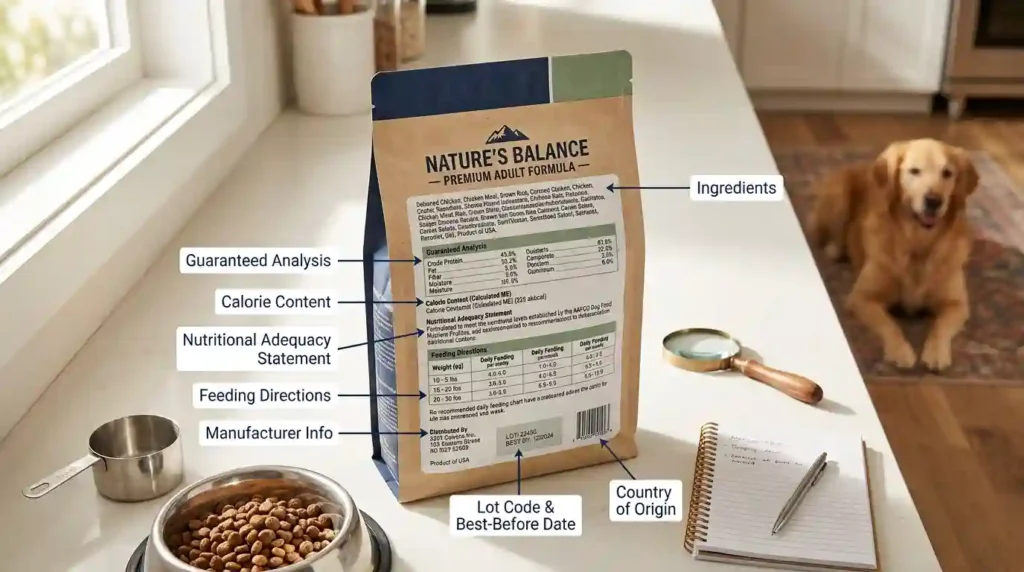
Manufacturing statements, recipes, and sourcing arrangements can change. Confirm the exact product name, country-of-origin information, lot code, ingredient list, guaranteed analysis, calorie content, and customer-service details printed on the current package.
Comparing Other Dog Food Companies and Formats
Ownership research is useful when comparing Orijen and Acana with other manufacturers. For example, readers can investigate Diamond Dog Food, Natural Balance Dog Food, Pedigree dog food, and Pure Balance Dog Food to see how brand ownership, private-label arrangements, and manufacturing relationships differ.
Owners considering refrigerated food can begin with the guide to Freshpet Dog Food and then learn who makes Freshpet dog food. Practical planning also includes understanding How Long Does Freshpet Last, estimating Freshpet Dog Food Cost monthly, calculating how much Freshpet to feed dog, and asking Is Freshpet Good for Puppies.
Conclusion
Mars Incorporated owns both Orijen and Acana because it owns their manufacturer, Champion Petfoods. The acquisition was completed on February 28, 2023, after Mars Petcare purchased Champion from an investor group associated with Bedford Capital, Healthcare of Ontario Pension Plan, and Kensington Capital.
Champion now operates as an independent business unit within Mars Pet Nutrition. It remains the company responsible for Orijen and Acana’s recipe formulation, ingredient standards, manufacturing oversight, quality assurance, and pet food safety systems.
For U.S. customers, Champion’s DogStar Kitchen in Auburn, Kentucky, has been an important source of domestic production, while NorthStar Kitchen in Alberta supports Canadian manufacturing. Certain food formats may also involve qualified co-manufacturing partners, so buyers should check the current package rather than assuming every recipe comes from the same facility.
The ownership change is worth knowing, but it should not be the only factor in a feeding decision. Evaluate the exact recipe, nutritional adequacy, calorie content, manufacturing information, quality controls, your dog’s individual needs, and advice from a veterinary professional.
Frequently Asked Questions
Who owns Orijen dog food?
Mars Incorporated owns Orijen through Champion Petfoods, which Mars Petcare acquired on February 28, 2023.
Who owns Acana dog food?
Mars Incorporated owns Acana through Champion Petfoods. Acana and Orijen are sister brands.
Who makes Orijen dog food?
Champion Petfoods formulates and manufactures Orijen while operating as an independent business unit within Mars Pet Nutrition.
Who makes Acana dog food?
Champion Petfoods makes Acana dog food and oversees its recipes, sourcing standards, quality assurance, and production.
Who owns Champion Petfoods?
Mars Incorporated owns Champion Petfoods through its Mars Petcare business.
Are Orijen and Acana the same company?
They are separate pet food brands made by the same company, Champion Petfoods.
When did Mars buy Champion Petfoods?
Mars completed its acquisition of Champion Petfoods on February 28, 2023.
Is Champion Petfoods still independent?
Champion is not independently owned, but it operates as an independent business unit within Mars Pet Nutrition.
Where is Orijen dog food made for the U.S. market?
Many U.S. dry products have been made at DogStar Kitchen in Auburn, Kentucky. Check the current package for the exact recipe.
Where is Acana dog food manufactured?
Production has included Champion facilities in Alberta, Canada, and Auburn, Kentucky, with arrangements varying by product and market.
Did Mars change Orijen’s formula?
Recipe updates can occur, but an acquisition alone does not prove a decline in quality. Compare current and previous labels for evidence.
Is Orijen more expensive than Acana?
Orijen is generally positioned at a higher price tier because many recipes emphasize greater animal ingredient content and variety.
Is Acana owned by Purina?
No. Acana is owned by Mars Incorporated through Champion Petfoods, not Nestlé Purina PetCare.
Does Mars manufacture Orijen directly?
Mars is the ultimate owner, while Champion Petfoods is the direct manufacturer and brand operator.
Are all Orijen products made in company-owned kitchens?
Not necessarily. Manufacturing can vary by product format, and certain items may involve specialized co-manufacturing partners.