

Summary
If you are wondering what is a good dog food for German Shepherds, start with a complete and balanced, age-appropriate diet made for large-breed dogs. The formula should provide a clearly named animal protein, controlled calories, appropriate calcium and phosphorus, digestible carbohydrates, and useful fats such as omega-3 fatty acids. The right food must also fit your dog’s age, activity level, body condition, digestion, and medical history. For most healthy German Shepherds, a reputable large-breed puppy, adult, or senior formula is a safer starting point than choosing food by marketing claims or the longest ingredient list.
Food quality is only half of the answer. German Shepherds can gain excess weight, eat too quickly, develop sensitive stomachs, and face joint or gastric dilatation-volvulus risks. That makes portion control, measured meals, gradual food transitions, and a consistent feeding schedule just as important as the recipe itself. This guide explains how to compare labels, choose among kibble, wet, fresh, and other formats, estimate portions from calorie density, and adjust the plan using your dog’s real-world condition.
Table of Contents
- What makes a food suitable for a German Shepherd?
- Nutrients that matter most
- Puppy, adult, and senior feeding
- Dog food formats compared
- Portion calculations and feeding schedules
- Sensitive stomachs, allergies, and picky eating
- Health risks and feeding mistakes
- Dog food labels and brand examples
- Transitioning to a new food
- Frequently asked questions
What Is a Good Dog Food for German Shepherds? The Short Answer
A German Shepherd is a large-breed dog with the frame of an athlete and, in many cases, the drive of a working dog. Even a companion Shepherd that spends most of the day at home usually has more muscle mass and exercise capacity than a small or sedentary breed. Good dog nutrition must support that lean body mass without supplying so many calories that the dog becomes heavy.
The best general starting point is a high-quality dog food that is:
- Complete and balanced for the correct life stage
- Appropriate for large-breed growth or maintenance
- Made by a company with qualified nutrition expertise and strong quality-control practices
- Built around a named protein source, such as chicken, beef, turkey, lamb, salmon, fish, duck, or eggs
- Calorie-controlled enough to maintain a lean body condition
- Digestible and consistent from bag to bag or batch to batch
- Supported by a clear nutritional adequacy statement
“Complete” means the diet supplies all required nutrients when fed as directed. “Balanced” means those nutrients are present in suitable proportions. Check the package for an AAFCO statement identifying the intended life stage. The official AAFCO guidance for selecting pet food explains the recognized categories, including growth, adult maintenance, gestation/lactation, and all life stages.
An all-life-stages formula can be suitable only when its nutritional profile is appropriate for the individual dog. For a puppy expected to weigh more than 70 pounds as an adult, the wording should indicate that the food is suitable for the growth of large-size dogs. This detail matters because rapid skeletal growth and excess calcium can increase the risk of developmental orthopedic disease.
The front of a bag may emphasize “premium,” “natural,” “ancestral,” or “breed-specific formula,” but those phrases do not prove nutritional quality. A German Shepherd picture on the package is less important than the AAFCO statement, calorie content, feeding directions, manufacturer expertise, and your dog’s response.
If you enjoy learning how behavior affects feeding routines, resource guarding, focus, and mealtime manners, the Dog Psychology hub offers useful context. Food choice and feeding behavior often work together, especially in fast eaters or anxious dogs.
The Nutrients German Shepherds Need Most
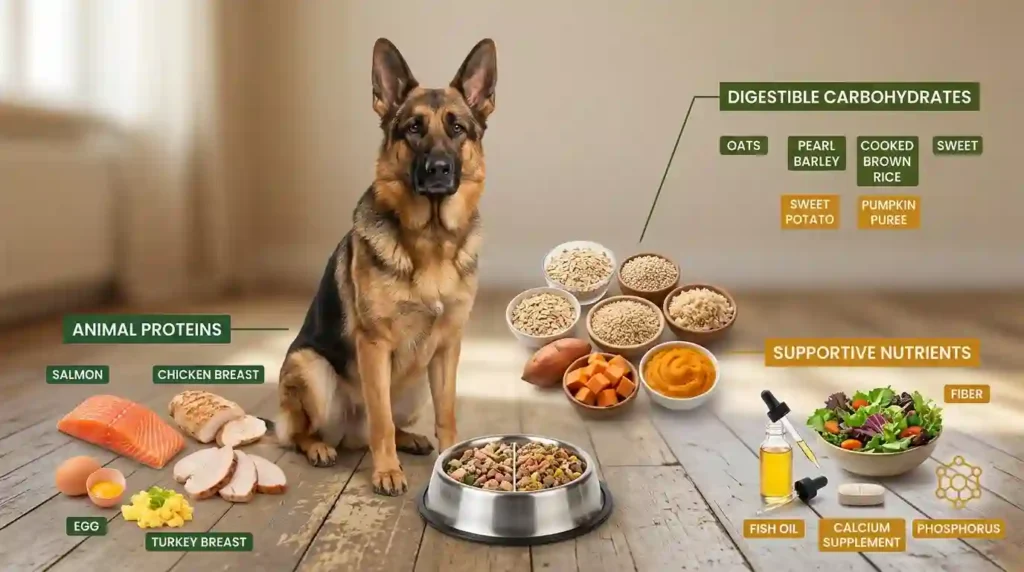
Animal protein and essential amino acids
Protein provides the essential amino acids used for muscle development, tissue repair, enzymes, hormones, and many immune functions. A German Shepherd diet should contain enough animal protein to preserve lean muscle mass, but “more” is not automatically better. Protein content must be considered alongside calorie density, fat content, digestibility, kidney or liver disease, and total portion size.
Look for a named protein source in the ingredient list. “Chicken,” “salmon,” “beef,” or “turkey meal” gives more information than a vague term such as “animal protein.” Meat meal is not automatically poor quality; because much of its water has been removed, a named meal can be a concentrated protein source. What matters is the named species, the manufacturer’s sourcing and quality controls, and the finished food’s complete nutritional profile.
Healthy puppies need protein for growth, while adults need it to maintain muscle. Senior dogs may need fewer calories as activity declines, but they still require adequate protein unless a veterinarian recommends a medical adjustment. Cutting both calories and protein too sharply can contribute to loss of lean tissue.
Healthy fat and fatty acids
Healthy fat provides concentrated energy and helps absorb fat-soluble vitamins. Essential fatty acids also support skin health, coat health, normal inflammation control, and nervous-system function. Omega-3 fatty acids—especially EPA and DHA from fish oil—are often included for skin and joint health. Omega-6 fatty acids are also necessary, but the overall balance matters more than chasing a single ingredient.
Chicken fat, fish oil, and other clearly identified fats can be useful ingredients. However, a very high-fat food may provide far more calories per cup than expected. That can be helpful for a hard-working, highly active Shepherd but inappropriate for a neutered indoor adult or senior with lower energy needs. Dogs with a history of pancreatitis may require a veterinarian-directed fat level.
Carbohydrates, whole grains, and fiber
German Shepherds can digest cooked carbohydrates. Oats, barley, brown rice, and other whole grains can provide energy and dietary fiber. Sweet potatoes and pumpkin may also contribute carbohydrates and fiber. The presence of corn, wheat, or soy does not by itself make a food unsafe, and grain-free diet labels do not automatically mean better quality.
Fiber supports stool quality and the gut microbiome. Soluble fiber can feed beneficial intestinal organisms, while insoluble fiber helps add stool bulk and support normal movement through the digestive tract. Too much fiber may reduce calorie density or nutrient absorption in some dogs, so the correct amount depends on the formula and the dog.
Probiotics contain beneficial microorganisms, while prebiotic fiber supplies compounds those organisms can use. These ingredients may support digestive health, but they are not a cure for chronic diarrhea, weight loss, persistent gas, or vomiting. Ongoing symptoms deserve veterinary investigation.
Calcium, phosphorus, vitamins, and minerals
Calcium and phosphorus are essential for bone development, but large-breed puppies need them in controlled amounts and in an appropriate calcium-to-phosphorus ratio. Adding calcium powder, bone meal, vitamin D, or a general mineral supplement to an already complete large-breed puppy food can unbalance the diet. Excessive supplementation is not harmless.
Vitamin E contributes antioxidant activity, while zinc and biotin support normal skin and coat functions. L-carnitine may be included in weight-management or cardiac-focused formulas. Antioxidants, vitamins, and minerals matter, but isolated ingredients should never distract from the adequacy of the whole recipe.
Glucosamine and chondroitin are common in large-breed and senior food. They may contribute to joint support, but the amount in ordinary food can vary. Neither ingredient can correct hip dysplasia or replace weight management, appropriate exercise, pain control, or veterinary treatment.
What Is a Good Dog Food for German Shepherds at Each Life Stage?
German Shepherd puppies
The safest default for a growing puppy is large-breed puppy food that is complete and balanced for growth, including the growth of large-size dogs. This type of formula is designed to support controlled growth rather than maximum growth. It should provide adequate protein for muscle development while controlling calories and mineral levels for bone development.
Puppies should stay lean enough that their ribs are easy to feel beneath a light covering of tissue. Overfeeding does not create a bigger or healthier adult; it can drive rapid growth and add unnecessary load to developing joints. Underfeeding is also harmful because it can limit energy, protein, and micronutrients during a demanding stage.
Products frequently considered in this category include Orijen Puppy Large and large-breed puppy recipes from established manufacturers. Any product name is only a starting point: confirm the current AAFCO statement, calorie density, intended adult size, and feeding instructions on the exact package you buy.
Most German Shepherd puppies transition to adult dog food after much of their skeletal growth is complete, often around 15 to 18 months. Some individuals mature earlier or later. Your veterinarian can judge timing from body size, growth rate, condition, and orthopedic history.
Adult German Shepherds
An adult food should maintain lean muscle, stable energy, healthy digestion, and an ideal weight. Moderately active adults often do well on a digestible large-breed formula with a named protein source, moderate healthy fat, and useful omega-3 fatty acids. Working and sport dogs may need more calorie-dense food and larger portions, while quiet household dogs may need much less than the upper feeding recommendation on the bag.
Breed-specific products such as Royal Canin German Shepherd Adult may appeal to owners who prefer kibble shape and nutrients designed around breed tendencies. Broader large-breed foods can also be appropriate. Purina Pro Plan Sensitive Skin & Stomach, Diamond Naturals Large Breed, Taste of the Wild, Canidae PURE, and some Blue Buffalo Wilderness recipes represent different approaches to proteins, grains, fat levels, and digestibility. These examples are not universal rankings or prescriptions. The best fit depends on the exact formula and the individual dog.
When deciding what to feed a German Shepherd dog, compare objective details rather than relying on a breed image or popularity. Review calories per cup, nutritional adequacy, feeding trials or formulation methods, quality controls, and the manufacturer’s ability to answer nutrition questions.
Senior German Shepherds
Senior dog food should reflect changes in activity, mobility, appetite, digestion, and health. Many older Shepherds need lower calorie intake to avoid obesity, but adequate protein remains important for preserving muscle. EPA, DHA, glucosamine, and chondroitin may support a broader mobility plan, especially when paired with a lean body condition and veterinarian-approved activity.
Arthritis, hip dysplasia, elbow dysplasia, dental disease, or chronic illness can change the ideal food texture and nutrient profile. A senior label alone does not make a product suitable. Some older dogs do well on standard adult maintenance food with adjusted portions; others benefit from a senior or therapeutic formula.
For additional breed-focused comparisons, explore Dogs Breeds Feeding. The same principles apply across breeds, but size, growth pattern, activity, and inherited health risks change how those principles are used. For example, this guide to the best dog food for labradors addresses another large, active breed with its own appetite and weight-management considerations.
Comparing Kibble, Wet, Fresh, Raw, and Home-Cooked Food
Kibble
Kibble is convenient, shelf-stable, easy to measure, and usually less expensive per calorie than other formats. A well-formulated kibble can provide complete and balanced nutrition. Its weaknesses are not inherent to the format; they depend on the recipe, calorie density, digestibility, manufacturing controls, and how accurately it is portioned.
Dry pieces also work well in slow-feeder bowls and food puzzles. However, kibble does not clean teeth reliably enough to replace dental care, and a calorie-dense recipe can lead to overfeeding when portions are estimated by eye.
Wet dog food
Wet dog food contains more moisture and may be easier to chew or more appealing to dogs with reduced appetite. It can support hydration and may be useful as a complete meal or a measured topper. Because a can or tray often contains fewer calories than an equal volume of kibble, owners must compare calories—not just cups or package size.
Fresh and lightly cooked food
Fresh dog food and lightly cooked food can be palatable and easy for some dogs to digest. Services such as The Farmer’s Dog offer pre-portioned meals, but the value of any fresh diet still depends on nutritional adequacy, calorie accuracy, storage, handling, and consistency. “Human-grade” language does not remove the need for a complete-and-balanced statement.
Freeze-dried dog food
Freeze-dried dog food offers shelf stability and may be used as a complete diet, topper, or treat. Some products are calorie-dense, so a small-looking portion may contain substantial energy. Confirm whether the product is complete and balanced or intended only for intermittent or supplemental feeding.
Raw and home-cooked diets
A raw diet requires careful attention to bacterial contamination, safe handling, bones, nutrient balance, and household risk. A home-cooked diet can be useful in specific medical or preference-driven situations, but meat, rice, and vegetables alone rarely provide complete and balanced nutrition over time. Recipes should be formulated for the individual dog by a board-certified veterinary nutritionist and followed exactly.
Novel protein diet, hydrolyzed protein diet, hypoallergenic diet, and veterinary therapeutic diet are not interchangeable labels. They have different purposes and levels of control. For suspected food allergy, a formal elimination diet under veterinary direction is more reliable than switching randomly among retail foods.
German Shepherd Portion Guide: Calories, Cups, and Meal Frequency
The feeding chart on a package is a starting estimate, not a command. Portions vary because two foods can contain very different calories per cup. Age, sex, neuter status, activity level, climate, body condition, treats, and health also affect daily calorie needs.
Estimate calories before measuring cups
A common veterinary starting calculation is resting energy requirement:
RER = 70 × body weight in kilograms^0.75
An adult maintenance estimate is then calculated by multiplying RER by an appropriate lifestyle factor. A range of about 1.4 to 1.8 times RER can provide a practical starting window for many neutered or moderately active adults, but individual needs may fall outside it. Puppies, intact adults, working dogs, seniors, and dogs needing weight loss use different factors.
| Adult weight | Approximate RER | Illustrative maintenance range |
|---|---|---|
| 50 lb | 730 kcal/day | 1,020–1,310 kcal/day |
| 60 lb | 835 kcal/day | 1,170–1,500 kcal/day |
| 70 lb | 940 kcal/day | 1,315–1,690 kcal/day |
| 80 lb | 1,035 kcal/day | 1,450–1,865 kcal/day |
| 90 lb | 1,135 kcal/day | 1,590–2,040 kcal/day |
These are estimates for discussion and monitoring, not prescriptions. A small, inactive 70-pound senior may need fewer calories than the table suggests, while a lean working dog training for several hours may require much more.
Convert calories into cups or packages
Find the calorie density on the label, usually written as kcal per cup, can, tray, or kilogram. Then use:
Daily quantity = target daily calories ÷ calories per unit
For example, if an adult needs 1,500 kcal per day and the kibble supplies 400 kcal per cup:
1,500 ÷ 400 = 3.75 cups per day
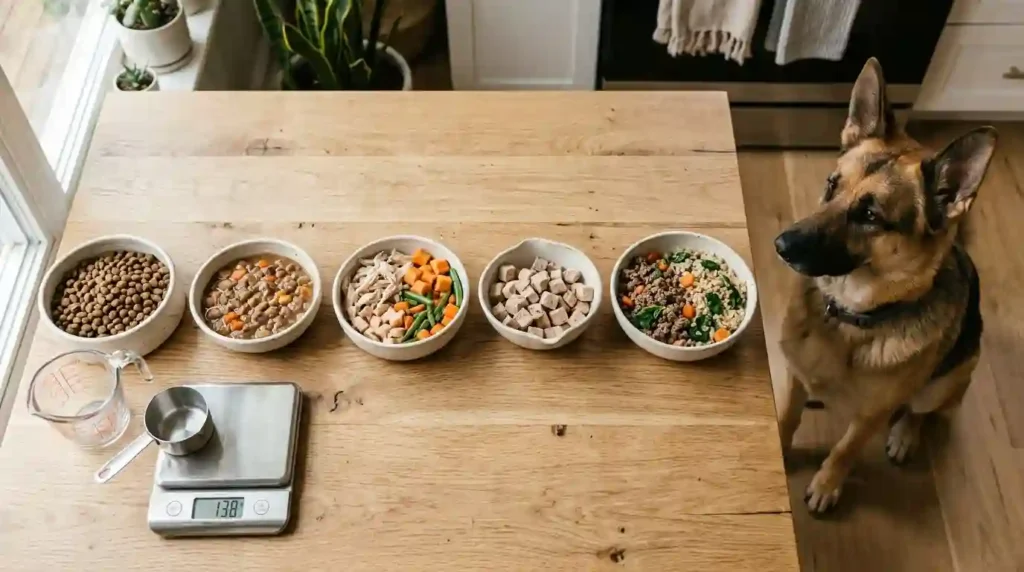
Split that amount into two or three measured meals. If treats provide 100 kcal, subtract those calories from the meal allowance rather than adding them on top. Use a level measuring cup or, for better repeatability, weigh the food on a kitchen scale.
Feeding frequency by age
| Life stage | Typical feeding frequency | Practical focus |
|---|---|---|
| Young puppy after weaning | 3–4 meals daily | Steady energy and small portions |
| Older puppy | 2–3 meals daily | Controlled growth and weekly monitoring |
| Adult | 2 meals daily; some do well with 3 | Measured intake and bloat-aware feeding |
| Senior | 2 or more smaller meals as needed | Appetite, digestion, medication, and calorie control |
Avoid free-feeding. Leaving food available all day makes intake difficult to measure and can encourage overeating. Smaller frequent meals can also reduce the size of any one meal, although no feeding routine eliminates gastric dilatation-volvulus risk.
Adjust using body condition, not appetite alone
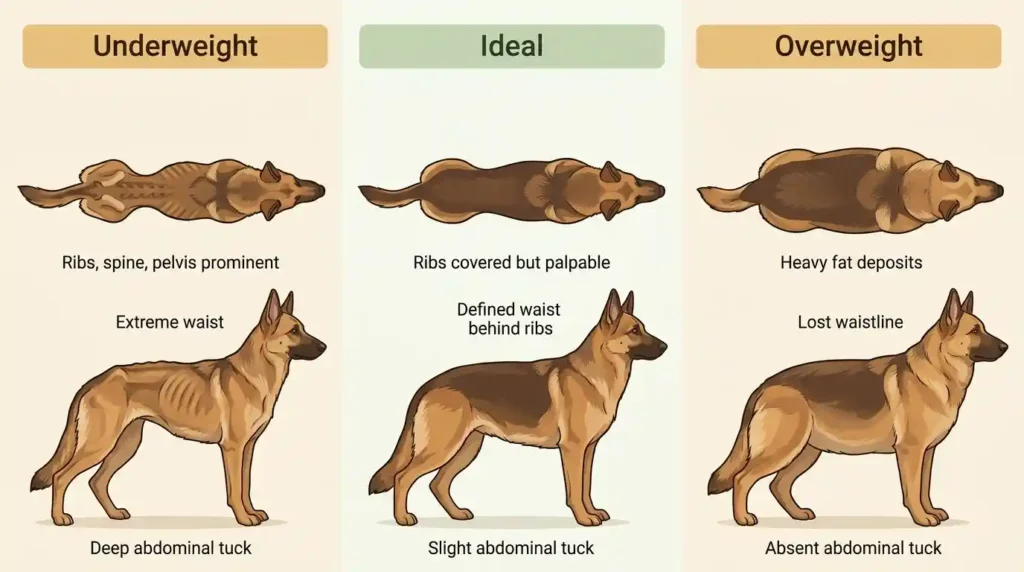
Check body condition every two to four weeks. At an ideal condition, you should be able to feel the ribs without pressing hard, see a waist from above, and notice an abdominal tuck from the side. A thickening waist, disappearing tuck, or ribs that are hard to feel suggests the current portion may be too large.
If weight and condition remain stable for two to three weeks, the portion is probably close. If the dog is gaining unwanted fat, reduce total daily calories modestly and reassess. If the dog is losing weight unexpectedly despite a good appetite, do not simply keep adding food; schedule a veterinary examination.
Feeding a German Shepherd With a Sensitive Stomach
German Shepherds have a reputation for sensitive digestion, but “sensitive stomach” is a description, not a diagnosis. Mild food sensitivity may cause soft stool, gas, itching, or inconsistent appetite. Chronic diarrhea, persistent vomiting, weight loss, ravenous appetite with poor condition, or unusually large stool volume can signal a medical problem.
Exocrine pancreatic insufficiency (EPI) is especially important to recognize in this breed. Affected dogs cannot produce enough digestive enzymes and may lose weight despite eating eagerly. EPI requires testing and veterinary treatment; changing from chicken to salmon is not an adequate substitute.
For mild, veterinarian-cleared digestive sensitivity, a consistent formula with a named protein source, moderate fat, and digestible carbohydrate may help. Some dogs respond well to salmon, lamb, or another protein they have not eaten often. A limited-ingredient diet can reduce variables, but retail “limited ingredient” foods may not have the manufacturing controls required for a true diagnostic elimination trial.
A food allergy involves an immune response, often to a protein. Chicken, beef, dairy, and other ingredients can be triggers, but guessing from an ingredient list is unreliable. A prescription hydrolyzed protein diet or carefully selected novel protein diet may be used for a controlled elimination period. Reintroducing ingredients under veterinary guidance helps identify whether food is truly responsible.
For broader ingredient and format comparisons, the Dogs Food category can help readers understand how formulas differ without treating every loose stool as an allergy.
Are German Shepherds Picky Eaters?
Some are, but many apparently picky dogs have learned that refusing kibble produces tastier alternatives. Frequent toppers, table scraps, and constant food switching can reinforce selective eating. This is where feeding routine and behavior matter as much as flavor.
First, rule out pain, dental disease, nausea, digestive illness, medication effects, and sudden appetite changes. A dog that normally loves food and abruptly refuses meals needs more attention than a healthy dog that has always been selective.
For a medically healthy picky eater:
- Offer measured meals at consistent times
- Leave the bowl down for a limited period, then remove it
- Keep treats modest and account for their calories
- Avoid changing flavors every time the dog hesitates
- Add warm water or a measured spoonful of compatible wet food if needed
- Store food properly so fats do not become stale
- Use a gradual transition when changing formulas
Palatability matters, but it should not outrank nutritional adequacy. Chicken fat, animal protein, food aroma, texture, and moisture can all affect acceptance. If appetite remains poor or weight declines, speak with a veterinarian.
Joint Health, Weight, and Other Breed-Specific Risks
Hip dysplasia, elbow dysplasia, and arthritis
German Shepherds are predisposed to hip dysplasia and elbow dysplasia. Nutrition cannot change inherited joint structure, but it can influence the load placed on joints. Controlled growth in puppyhood and a lean body condition throughout life are among the most practical nutrition-related protections.
Omega-3 fatty acids, EPA, DHA, glucosamine, and chondroitin may be components of a joint-supportive diet. They should complement—not replace—appropriate exercise, muscle maintenance, veterinary care, physical rehabilitation, and medication when needed. Excess weight can worsen mobility and arthritis discomfort even when the food contains attractive joint-support claims.
Gastric dilatation-volvulus
Gastric dilatation-volvulus, often shortened to GDV or called bloat, is a life-threatening emergency in which the stomach enlarges and may twist. German Shepherds are deep-chested dogs, which places them in a higher-risk group.
Feeding two or more smaller meals instead of one large daily meal is a reasonable bloat-aware habit. Discourage rapid eating with a slow-feeder bowl when appropriate, and avoid vigorous exercise immediately before or after meals. An elevated food bowl should not be used as a preventive measure unless a veterinarian recommends it for another reason. Ask your veterinarian about preventive gastropexy if your dog has substantial risk.
Unproductive retching, a swollen abdomen, restlessness, drooling, weakness, or collapse requires emergency veterinary care. Do not wait to see whether a food change helps.
Obesity and pancreatitis
Obesity develops when calorie intake repeatedly exceeds energy use. Measuring cups, treats, chews, toppers, and table scraps all contribute. Even a high-quality food can cause unhealthy weight gain when the portion is too large.
High-fat meals and table scraps can also trigger digestive upset and may contribute to pancreatitis in susceptible dogs. A dog with pancreatitis history needs an individualized plan rather than a generic high-protein or high-fat working-dog diet.
Degenerative myelopathy
Degenerative myelopathy is a progressive neurologic condition seen in German Shepherds. No ordinary food prevents or cures it. Adequate nutrition can support healthy body condition and muscle maintenance, but weakness, dragging feet, or declining coordination requires veterinary evaluation.
How to Read a Dog Food Label Without Falling for Marketing
Start with the AAFCO statement
The AAFCO statement tells you whether the food is complete and balanced and identifies the life stage. It may indicate that adequacy was established through feeding trials or that the product was formulated to meet AAFCO nutrient profiles. Both are recognized routes, although feeding trials provide additional information about the food as consumed.
Check calorie density and feeding directions
Calories per cup can vary dramatically. Compare kcal per cup or kilogram before assuming two scoops of a new food equal two scoops of the old one. Feeding directions are an initial range; your dog’s body condition score and weight trend determine the final portion.
Interpret the guaranteed analysis carefully
The guaranteed analysis lists minimum crude protein and crude fat and maximum crude fiber and moisture. These “as fed” values are difficult to compare across wet and dry foods because moisture differs. A dry matter basis removes water from the comparison, but it still does not measure protein quality, digestibility, or overall adequacy.
Read the ingredient list in context
Ingredients are listed by weight before cooking. A fresh meat may appear first partly because it contains water, while a named meal contains less moisture. The first ingredient matters, but evaluating only that line oversimplifies the recipe.
Artificial colors add no nutritional value for the dog. Artificial flavors, chemical preservatives, and ingredients such as BHA or BHT may be avoided by owners who prefer naturally preserved products. Still, “no artificial additives” is not proof that a food is nutritionally complete.
Terms such as filler ingredients are often used loosely. Corn, wheat, and soy can supply nutrients when properly processed and used in a balanced formula. A specific food allergy or intolerance is different from a general belief that all grains are harmful.
Be cautious with grain-free claims
A grain-free diet may replace oats or rice with peas, lentils, potatoes, or sweet potatoes, so it is not necessarily lower in carbohydrates. Grain-free food should be selected for a clear reason, not because the phrase sounds healthier. Discuss long-term use with your veterinarian, particularly when legumes or pulses dominate the ingredient list.
Evaluate the manufacturer
Useful questions include:
- Does the company employ a qualified veterinary nutritionist or animal nutritionist?
- Who formulates the food?
- Does the company conduct feeding trials or finished-product testing?
- Can it provide typical nutrient analysis beyond the guaranteed minimums?
- Where is the food manufactured?
- What quality-control and recall procedures are in place?
- Can customer service answer detailed nutrition questions?
WSAVA guidelines are often used as a framework for asking these questions. They are not a brand-approval list. A shiny label and influencer praise cannot replace transparent manufacturing and nutrition expertise.
Popular Food Examples: How to Compare Them Responsibly
Owners frequently ask what dog food is good for German Shepherds and expect one product name. In reality, each line contains multiple recipes, and formulations can change. Compare the exact recipe rather than treating an entire brand as one food.
- Royal Canin German Shepherd Adult: A breed-specific formula designed for adult Shepherds; compare its calories, protein, fiber, and kibble characteristics with broader large-breed options.
- Purina Pro Plan Sensitive Skin & Stomach: Often considered for digestive or skin concerns; verify the correct life stage and large-breed version.
- Orijen Puppy Large: A protein-rich puppy option; check calorie density and the AAFCO large-size growth wording before choosing it for a German Shepherd puppy.
- The Farmer’s Dog: A fresh, portioned format; confirm the recipe’s nutritional adequacy and adjust delivery portions to body condition.
- Blue Buffalo Wilderness: Available in several life-stage and grain configurations; assess the individual formula, not only the product-family name.
- Diamond Naturals Large Breed: A large-breed option with multiple recipes; compare calories and protein sources to the dog’s activity and tolerance.
- Taste of the Wild: Offers grain-free and grain-inclusive choices; review legumes, calorie density, and the exact adequacy statement.
- Canidae PURE: A limited-ingredient retail line; useful simplicity does not make it equivalent to a prescription elimination diet.
No food on this list is automatically best for every German Shepherd. Availability, price, stool quality, coat condition, appetite, weight stability, medical needs, and manufacturer practices all affect the decision. If a current food is nutritionally appropriate and your dog maintains excellent condition, comfortable digestion, and steady energy, changing brands may offer no meaningful benefit.
How to Transition Dog Food Safely
An abrupt diet change can cause gas, loose stool, vomiting, or refusal, even when the new food is high quality. Use a gradual food transition over seven to ten days unless your veterinarian gives different instructions.
| Days | Current food | New food |
|---|---|---|
| 1–2 | 75% | 25% |
| 3–4 | 50% | 50% |
| 5–6 | 25% | 75% |
| 7 onward | 0% | 100% |
Sensitive dogs may need a slower transition. Measure by calories when the foods have substantially different calorie densities; equal cup volumes may not provide equal energy. Keep treats and toppers simple during the transition so you can interpret any reaction.
Track appetite, stool consistency, gas, itching, ear irritation, energy, and weight. A short-lived mild stool change may settle, but chronic diarrhea, repeated vomiting, facial swelling, hives, weakness, or rapid deterioration requires veterinary guidance.
Common German Shepherd Feeding Mistakes
Choosing food by protein percentage alone
A high number on the guaranteed analysis does not prove that the food is digestible, appropriately balanced, or right for a low-activity dog. Evaluate the whole formula and the calories delivered by the actual portion.
Overfeeding a puppy to encourage growth
Maximum growth is not the goal. Large-breed puppy food, measured meals, and a lean condition support steadier skeletal development. Do not add calcium or vitamin D unless a veterinarian identifies a specific need.
Using treats without counting them
Training rewards, dental chews, table scraps, and stuffed toys can quietly add hundreds of calories. Keep treats to a modest share of the daily total and reduce meal calories accordingly.
Switching foods repeatedly
Frequent changes can disrupt digestion and make it difficult to identify a trigger. Unless symptoms are severe, allow a properly transitioned food enough time to assess stool, appetite, skin, coat, and weight.
Assuming expensive means superior
Price can reflect ingredients, packaging, shipping, marketing, or format. It does not guarantee feeding trials, qualified formulators, or better outcomes. Cost per day is more useful than cost per bag because calorie density changes how long a bag lasts.
Ignoring the individual dog
The bag feeds a statistical dog; you feed the animal in front of you. Weight monitoring, body condition, muscle condition, stool quality, appetite, and activity provide the feedback needed to refine portions.

Conclusion
When owners ask what should I feed my German Shepherd, the best answer is not a universal brand. Choose a complete and balanced food for the correct life stage, confirm that a puppy formula supports large-size growth, favor transparent manufacturing and qualified nutrition expertise, and match calories to the individual dog.
Good feeding also means measuring portions, limiting extra calories, maintaining a lean body condition, transitioning foods gradually, and splitting the daily amount into smaller meals. Watch the dog—not just the bowl—for evidence that the plan works: stable weight, firm stool, comfortable digestion, steady energy, a healthy coat, and strong lean muscle.
If your German Shepherd has chronic digestive signs, suspected food allergy, pancreatitis, poor growth, unexplained weight change, or mobility problems, involve a veterinarian. A board-certified veterinary nutritionist can help formulate a safe home-cooked diet or solve complex feeding needs. The goal is not to find the trendiest food; it is to build a reliable nutrition plan your dog can thrive on.
Frequently Asked Questions
What is good dog food for German Shepherds?
A complete and balanced large-breed formula with a named protein source, appropriate calories, digestible ingredients, and the correct life-stage AAFCO statement is a strong starting point.
What to feed a German Shepherd puppy?
Choose large-breed puppy food labeled for growth, including growth of large-size dogs. Avoid extra calcium and control portions to support steady development.
What to feed a German Shepherd adult?
Feed a complete adult-maintenance or suitable all-life-stages formula that matches the dog’s activity, digestion, body condition, and health history.
Are German Shepherds picky eaters?
Some are selective, but frequent toppers and food changes can reinforce the behavior. Rule out illness, then use consistent, measured mealtimes.
How many cups should a German Shepherd eat per day?
There is no universal cup amount. Divide the dog’s estimated daily calorie need by the food’s calories per cup, then adjust according to weight and body condition.
How often should I feed my German Shepherd?
Most adults do well with two measured meals daily. Puppies usually need two to four meals, depending on age and individual veterinary advice.
Is grain-free food better for German Shepherds?
Not automatically. Whole grains can provide useful nutrients and fiber; choose grain-free food only for a clear, veterinarian-supported reason.
Is raw food good for German Shepherds?
Raw food can carry pathogen and nutritional-balance risks. Discuss it with a veterinarian or board-certified veterinary nutritionist before feeding it long term.
What should I do if my German Shepherd has chronic diarrhea?
Arrange a veterinary examination rather than repeatedly switching food. Chronic diarrhea can reflect parasites, food-responsive disease, EPI, or another medical condition.
Can I add joint supplements to my German Shepherd’s food?
Ask your veterinarian first. Glucosamine, chondroitin, EPA, and DHA may help some dogs, but dose, product quality, calories, and medical history matter.
When should a German Shepherd switch from puppy to adult food?
Many switch around 15 to 18 months, but growth rate and body condition vary. Your veterinarian can recommend the right timing for your dog.
What is the best way to prevent bloat at mealtime?
Feed smaller measured meals, discourage rapid eating, and avoid vigorous exercise around meals. Ask your veterinarian about your dog’s individual GDV risk.