
Summary
Dog barking at other dogs on leash is usually a sign of fear, frustration, excitement, or emotional overload—not proof that your dog is “bad” or naturally aggressive. The leash restricts movement, removes normal canine choices, and can make an approaching dog feel more threatening or more difficult to greet. This guide explains how to recognize your dog’s motivation, prevent explosive reactions, and use distance management, desensitization, counterconditioning, and positive reinforcement to create calmer walks.
Table of Contents
- Why Dogs Bark at Other Dogs While Leashed
- Why a Dog Barks on Leash but Not Off Leash
- Signs of Leash Reactivity
- How to Stop Dog Barking at Other Dogs on Leash
- A Step-by-Step Behavior Modification Plan
- What to Do When Another Dog Appears Suddenly
- Equipment for Safer, Calmer Walks
- Common Training Mistakes
- Barking Through Fences, Windows, and Doors
- When to Seek Professional Help
- Conclusion
- Frequently Asked Questions
Why Dogs Bark at Other Dogs While Leashed
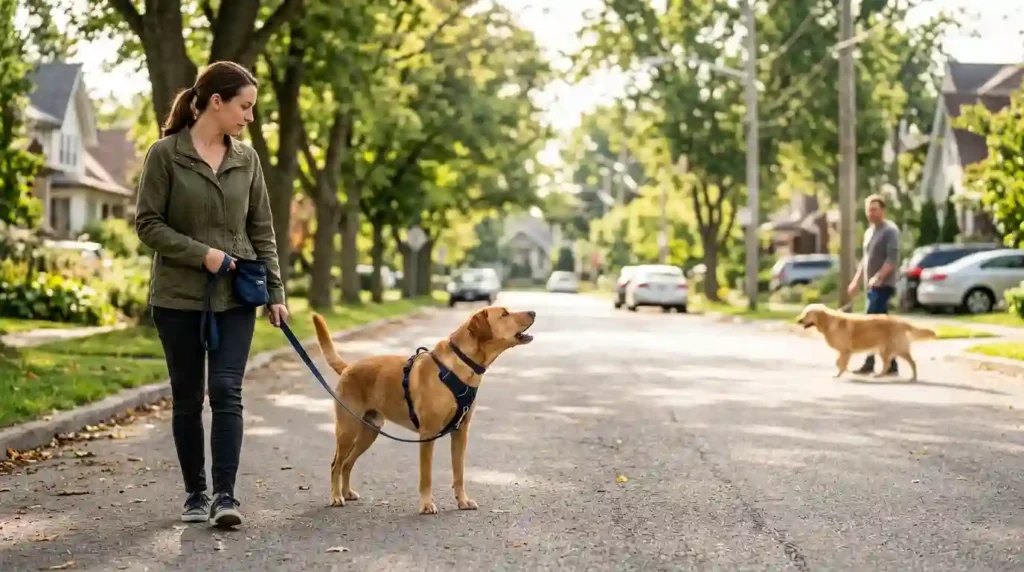
A dog that barks, lunges, or growls during a walk is often described as leash reactive. Leash reactivity is an intense response to a trigger while the dog is restrained. The trigger might be an unfamiliar dog, a particular breed or size of dog, direct eye contact, a narrow sidewalk, or an approaching dog moving quickly.
Although people sometimes call every explosive leash reaction “leash aggression,” not every reactive dog intends to fight. Barking can be a distance-increasing behavior, an attempt to reach another dog, or simply the result of overarousal.
Fear-based reactivity
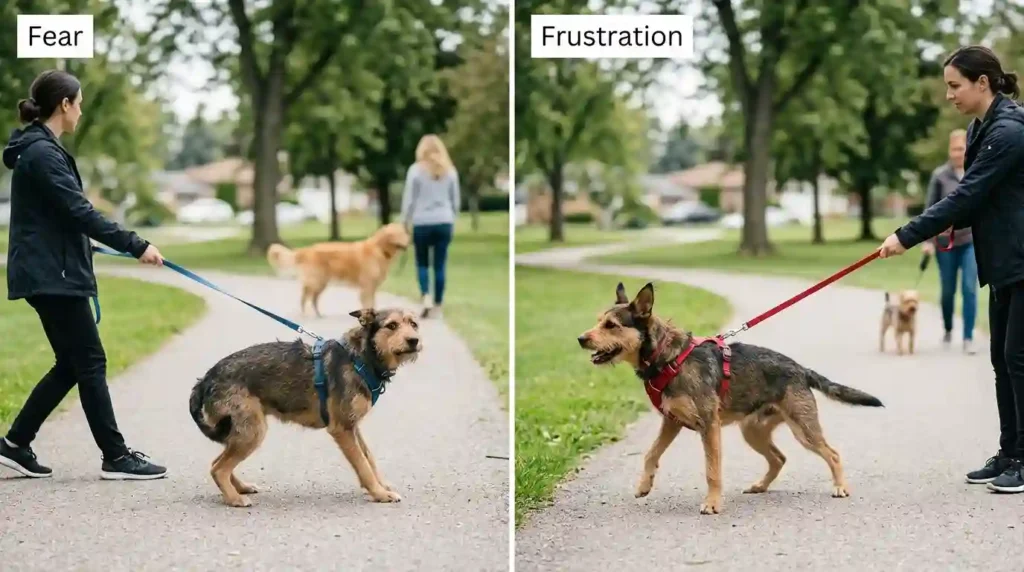
A fearful dog may bark to make another dog move away. Restricted movement and leash restraint prevent the dog from creating distance naturally, which can activate a fight-or-flight response. Because flight feels unavailable, the dog may choose a defensive display.
Fear-based reactivity can arise from:
- Lack of socialization during early development
- Negative experiences with other dogs
- A traumatic leash experience
- A previous dog attack
- Genetic predisposition toward caution or sensitivity
- Chronic anxiety or stress
- Pain, discomfort, or an undiagnosed medical condition
- Uncertainty about how to interact safely
A fearful dog may show a tucked tail, dilated pupils, raised hackles, avoidance, escape behavior, lip licking, or a stiff posture. Some dogs alternate between pulling forward and retreating. Barking, growling, snarling, or snapping may occur when the dog feels that quieter signals have not worked.
Frustration-based reactivity
Some dogs genuinely want to approach other dogs. These dogs are often called frustrated greeters. They may have developed a strong expectation that seeing another dog leads to play or an on-leash greeting. When the leash prevents access, excitement becomes leash frustration.
Frustration-based reactivity is more common in dogs with low impulse control or low frustration tolerance. Oversocialization can contribute when a puppy has been allowed to rush up to nearly every dog it sees. The dog learns that other dogs are always available for interaction and struggles when access is denied.
Signs can include:
- Whining or crying
- Pulling directly toward the other dog
- Spinning or bouncing
- High-pitched barking
- Intense staring
- Difficulty responding to familiar cues
- Rapid escalation when restrained
A frustrated dog may behave well during an off-leash interaction yet appear aggressive on a six-foot leash. That does not make the behavior harmless. High arousal can spill into redirected aggression, and a forceful greeting can frighten or provoke the other dog.
Overarousal and overstimulation
Not every reaction is driven entirely by fear or frustration. Some dogs become overstimulated by the combined pressure of traffic, people, smells, noises, and other dogs. Their emotional capacity gradually fills until one more stimulus causes an outburst.
This is sometimes called trigger stacking. A dog might calmly pass one dog early in the walk but react strongly to another after encountering construction noise, a skateboard, several strangers, and a tight hallway.
Genuine aggression and other motivations
Some displays may involve on-leash aggression, defensive aggression, territorial aggression, resource guarding, or a history of conflict with other dogs. A dog might also guard its handler, although behavior that looks like guarding is frequently rooted in fear or uncertainty.
A label alone does not explain the behavior. Two dogs may both bark and lunge, yet one is attempting to escape while the other is desperately trying to play. An effective behavior plan must address the emotion and function beneath the visible reaction.
Why a Dog Barks on Leash but Not Off Leash
When a dog barks on leash but not off leash, the key difference is usually choice.
During an appropriate off-leash interaction, a socially skilled dog can approach in an arc, pause, sniff the ground, turn sideways, retreat, or increase distance. A short leash removes many of these options. It can force dogs into a direct, face-to-face approach that may feel confrontational.
Leash tension also changes body language. When a handler pulls backward, the dog’s chest may move forward and its head may rise. The dog can appear stiffer or more threatening to the approaching dog. Tension may also tell an already worried dog that something is wrong.
This does not mean you should drop the leash or arrange uncontrolled off-leash meetings. A dog that is reactive while restrained can still present a safety risk. Instead, recognize that the behavior may be influenced by barrier frustration, restricted movement, and loss of control.
Why leash behavior can become a learned pattern
Reactive behavior often works from the dog’s perspective. The sequence may look like this:
- An unfamiliar dog appears.
- Your dog becomes worried or frustrated.
- Your dog barks and lunges.
- The other dog eventually moves away.
- Your dog experiences relief.
The dog may conclude that barking successfully creates distance. Repetition strengthens the pattern, especially when every walk pushes the dog beyond its emotional threshold.
Signs of Leash Reactivity
Leash reactivity is more than barking. Learning to read early body language gives you time to intervene before your dog loses the ability to think.
Early signs
Watch for:
- Closing the mouth suddenly
- Slowing down or freezing
- Turning the head away
- Fixating or intense staring
- Shifting weight forward
- Moving behind the handler
- Refusing treats
- Ears moving sharply forward or backward
- A tightly closed mouth or facial tension
- A lowered, tucked, or unusually high tail
- Raised hackles
- Faster breathing
Escalated signs
Once a dog moves beyond its threshold, you may see:
- Barking
- Lunging
- Growling
- Snarling
- Snapping
- Whining or crying
- Spinning
- Frantic pulling
- Inability to respond to cues
- Escape behavior
- Redirected biting at the leash, clothing, or handler
The threshold distance is the distance at which your dog can notice a trigger while remaining able to eat, move, and respond. The dog’s comfort zone can change from day to day. A tired or stressed dog may need considerably more space than usual.
How to Stop Dog Barking at Other Dogs on Leash
The most effective approach combines environmental management with behavior modification. Management prevents repeated explosions; training changes how the dog feels and responds.
There is no safe universal trick that will stop dog barking in seconds. You can interrupt an immediate episode by increasing distance or blocking the dog’s view, but meaningful improvement requires repeated practice below threshold.
1. Begin with distance management
Distance is not a training failure. It is one of the most useful training tools available.
When you see another dog:
- Cross the street early.
- Step behind a parked vehicle.
- Turn onto a side street.
- Use a hedge or solid fence as a line-of-sight barrier.
- Make an emergency U-turn.
- Walk at quieter times.
- Choose open spaces with multiple exit routes.
- Avoid narrow trails and crowded entrances temporarily.
Your first goal is not to make your dog pass every trigger. It is to keep the dog within a learning state.
2. Build a positive association
Counterconditioning changes the meaning of an approaching dog. Instead of predicting pressure, restraint, or conflict, the other dog begins to predict something pleasant.
At a comfortable distance:
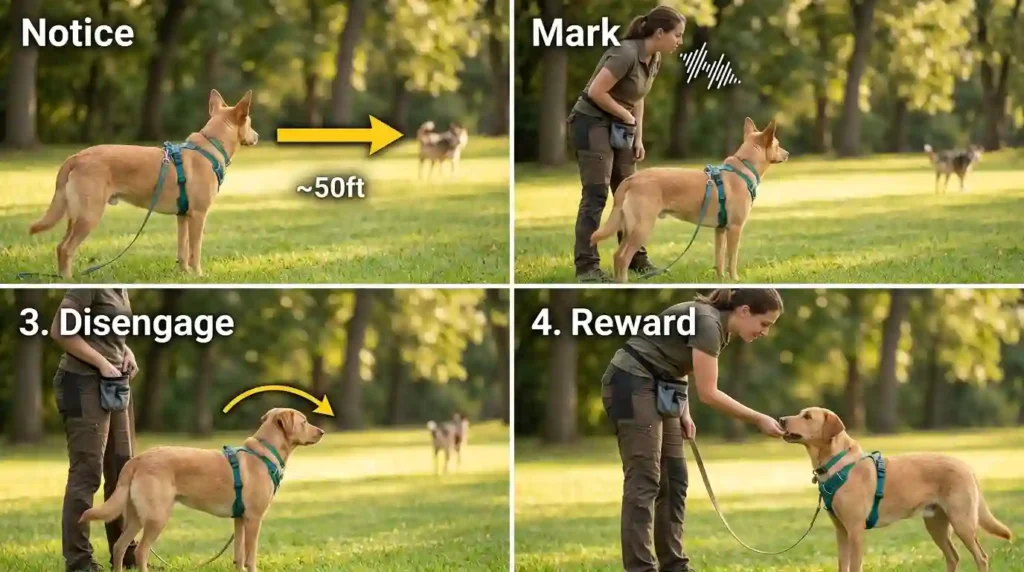
- Let your dog notice the other dog.
- Mark the moment with a click from a training clicker or a short word such as “yes.”
- Immediately provide a high-value treat.
- Continue feeding small treats while the other dog is visible.
- Stop when the dog disappears.
Use food your dog truly values, such as tiny pieces of chicken, cheese, or another veterinarian-approved treat. Carry it in an accessible treat pouch.
Over time, the sight of another dog should produce a positive association and voluntary attention toward you.
3. Use desensitization gradually
Desensitization means exposing your dog to a low-intensity version of the trigger and increasing difficulty slowly. For leash reactivity, intensity can be affected by:
- Distance
- The other dog’s size and energy
- Whether the dog is staring
- Speed and direction of movement
- Number of dogs present
- Available space
- Duration of exposure
Do not move closer simply because your dog completed one successful repetition. Look for loose muscles, normal breathing, easy eating, and the ability to disengage.
4. Play the engage-disengage game
The engage-disengage game teaches a dog to look at a trigger and then turn away.
Engage stage
Stand far enough away that your dog remains calm. When the dog looks at the other dog, mark the look and feed a treat. You are rewarding calm observation, not demanding that your dog ignore the environment.
Disengage stage
After enough repetitions, wait briefly when your dog sees the trigger. The instant your dog looks back at you, mark and reward. The dog learns that turning away is a valuable alternative behavior.
If your dog barks, lunges, freezes, or cannot eat, increase distance. The session became too difficult.
5. Teach practical alternative behaviors
A cue is most useful when it has been practiced away from triggers first. Helpful behaviors include:
- Looking at the handler
- Hand targeting
- Walking beside the handler for several steps
- Turning around promptly
- Finding scattered treats on the ground
- Moving behind the handler
- Relaxing on a portable mat
Differential reinforcement means reinforcing a desirable response that replaces the unwanted behavior. For example, you might reward loose-leash walking and voluntary check-ins instead of pulling and staring.
Redirection should occur before the explosion. Repeating “sit” while a dog is already barking and lunging is unlikely to work because the dog is over threshold.
A Step-by-Step Behavior Modification Plan
Week 1: Prevent rehearsal and develop foundation skills
For the first week, prioritize low-stress routes. Practice name response, hand targeting, treat scatters, and an emergency U-turn at home or in a quiet outdoor space.
Keep every short training session easy and rewarding. Three minutes of successful practice is more valuable than a 30-minute session that ends in overstimulation.
Record:
- Trigger type
- Approximate distance
- Your dog’s body language
- Whether your dog accepted food
- Recovery time
- Environmental factors
Patterns will help you identify the dog’s true comfort zone.
Weeks 2–3: Introduce controlled exposure
Work where other dogs can be seen at a predictable distance, such as across a large park. Reward calm observation and disengagement. Avoid stationary staring contests.
Begin at a distance where success is very likely. If your dog reacts at 40 feet, training might need to begin at 80 or 100 feet.
Weeks 4 and beyond: Reduce distance carefully
Only reduce distance when your dog repeatedly:
- Keeps a relatively loose body
- Accepts treats gently
- Responds to familiar cues
- Can look away from the stimulus
- Recovers quickly
- Shows no sustained barking or lunging
Change only one variable at a time. If you work closer, use a calm helper dog in a spacious environment. If the approaching dog is energetic, increase distance again.
Progress is rarely linear. Bad days do not erase learning.
What to Do When Another Dog Appears Suddenly
Surprise encounters happen even with careful planning. Your goal is to leave safely, not test your dog’s obedience.
Use an emergency U-turn
Teach a cheerful phrase such as “this way.” Practice turning 180 degrees and moving quickly with your dog before using it around triggers. Reward the turn generously.
When another dog appears:
- Avoid tightening the leash abruptly if possible.
- Say your U-turn cue once.
- Turn and move away.
- Feed while retreating if your dog can eat.
- Place a visual barrier between the dogs.
Cross the street or create an arc
A curved path is often less socially intense than a direct approach. Cross early rather than waiting until the dogs are nose-to-nose.
Use a treat scatter
If there is enough distance and no immediate physical danger, scatter several treats on the ground while the other dog passes. Sniffing can interrupt visual fixation and give your dog a simple task.
Do not use food to lure your dog into a closer encounter. Food should support distance and calm behavior—not conceal that the dog is uncomfortable.
Do not force a greeting
Tell approaching handlers clearly: “My dog needs space.” A leash sleeve saying “Needs Space” may help, but it does not replace active handling.
If an off-leash dog approaches, place your dog behind you, move away, and ask the other handler to call their dog. Do not put your hands between dogs.
Equipment for Safer, Calmer Walks
Equipment cannot resolve the underlying emotion, but appropriate gear can improve control and reduce safety risks.
Useful options
A well-fitted front-clip harness can reduce pulling leverage without tightening around the neck. A standard six-foot leash gives more flexibility than a very short leash while maintaining control.
Depending on the dog and handler, a professional may recommend:
- A double-ended or double leash system
- A front-clip or Y-shaped harness
- A properly conditioned head halter
- A leash sleeve requesting space
- A basket muzzle introduced through positive reinforcement
- A long line in a spacious, low-risk training area
A long line is not appropriate near roads, crowded paths, or unfamiliar dogs. Avoid retractable leashes for reactive-dog training because they make consistent distance and leash handling more difficult.
Why aversive tools can create additional problems
A shock collar, choke collar, prong collar, harsh leash correction, or other aversive tool may suppress visible behavior without resolving fear, anxiety, or frustration. If pain or punishment repeatedly occurs when another dog appears, the dog can form an even more negative association with other dogs.
The American Veterinary Society of Animal Behavior recommends reward-based training and advises against aversive methods in its position statement on humane dog training.
The objective is not merely to stop noise. It is to help the dog feel safer and make better choices.
Common Training Mistakes
Getting too close too soon
Repeatedly crossing the threshold does not necessarily teach a dog to “get used to” other dogs. Uncontrolled exposure can produce sensitization, making the response stronger.
Holding the leash tight throughout the walk
Constant leash tension can contribute to discomfort and prevent relaxed movement. Keep a safe grip while allowing a soft J-shaped leash whenever circumstances permit.
Punishing growling
A growl communicates discomfort. Punishing it may remove a warning without changing the underlying emotion. That can make future behavior less predictable.
Allowing every on-leash greeting
Many dogs do not benefit from greeting unfamiliar dogs while restrained. An on-leash greeting can create leash frustration, increase expectations, or trap a worried dog in an uncomfortable interaction.
Dog-to-dog greetings are optional. A successful walk does not require physical contact.
Assuming barking always means aggression
A dog that lunges at other dogs on leash may be fearful, excited, frustrated, or conflicted. Treating every case as a dominance problem can lead to inappropriate methods.
Using treats only after barking begins
If food always appears after a full reaction, your timing is too late. Deliver reinforcement when your dog calmly notices the trigger or chooses an appropriate alternative behavior.
Flooding the dog with social experiences
Socialization does not mean forcing interaction. For a reactive dog, quality, choice, and emotional safety matter more than the number of dogs encountered.
Barking Through Fences, Windows, and Doors
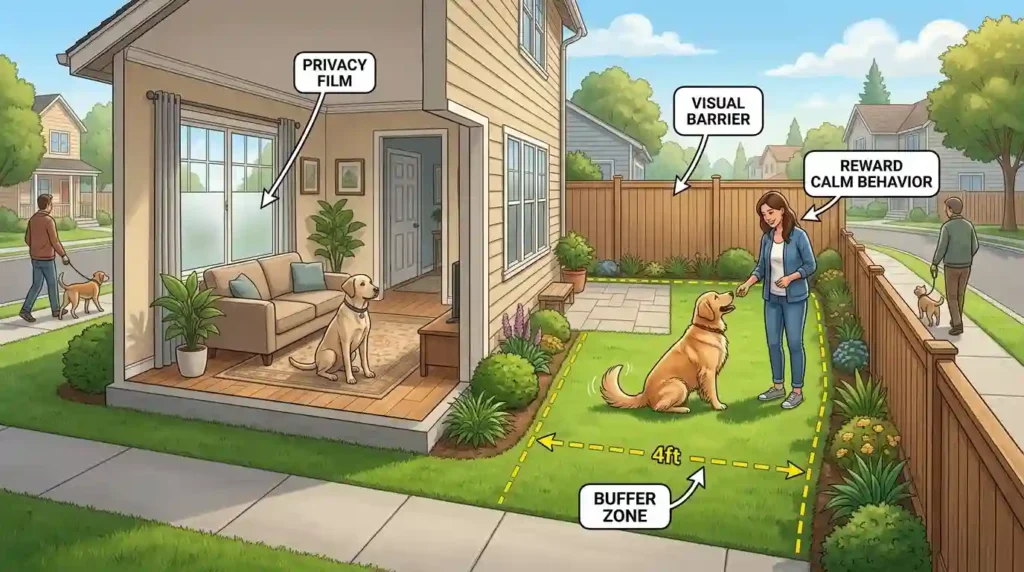
Barrier frustration is not limited to leashes. A dog may bark at other dogs through a fence because the barrier blocks approach or retreat. Dogs also bark at other dogs walking by the house because movement near the property can activate territorial aggression, fear, excitement, or a rehearsed alert-barking pattern.
How to stop a dog barking at other dogs through a fence
Use environmental management first:
- Install an opaque fence covering.
- Block gaps that allow intense staring.
- Supervise outdoor time.
- Bring the dog inside before busy walking periods.
- Create a buffer zone several feet away from the fence.
- Practice recall away from the fence.
- Reward calm behavior before barking begins.
Do not allow the dog to spend long periods charging the boundary. Every repetition can strengthen the pattern.
Managing window and household barking
Use privacy film, curtains, furniture placement, or a baby gate to reduce visual access. Provide enrichment away from windows and reinforce calm responses to outdoor movement.
Apartment dogs may react to footsteps, voices, elevators, and neighboring pets as well as visual triggers. For broader household strategies, read Stop Excessive Barking in Apartment Dogs.
Some dogs are especially sensitive to mechanical noises or changes in airflow. If household systems trigger barking, see Dog Barking When the Heating or AC Turns On.
When to Seek Professional Help
Consult a veterinarian when reactivity appears suddenly, worsens rapidly, or occurs alongside sensitivity to touch, mobility changes, sleep disruption, appetite changes, or other signs of pain. A medical condition can lower a dog’s tolerance and make behavior modification more difficult.
Professional support is especially important when:
- The dog has bitten or attempted to bite.
- Snapping occurs at close range.
- The handler cannot physically maintain control.
- Redirected aggression targets people or other household animals.
- Reactions are frequent or difficult to avoid.
- The dog remains highly stressed long after a trigger disappears.
- The behavior is becoming more intense.
- Children or vulnerable adults may be exposed.
- The dog has a known dog-attack history.
- The behavior presents a serious bite risk or other safety risk.
A certified professional dog trainer or qualified dog behavior consultant can help with foundation training and controlled setups. More complex cases may require a certified animal behaviorist or board-certified veterinary behaviorist. A veterinary behaviorist can evaluate both behavioral and medical factors and discuss medication when appropriate.
Ask any professional what methods and equipment they use. Look for someone who relies on positive reinforcement, understands threshold-based training, and creates an individualized behavior plan. Avoid guarantees that aggression will be “cured” in a fixed number of sessions.
Conclusion
A dog barking at other dogs during walks is communicating that the situation has become emotionally difficult. The cause may be fear-based reactivity, frustration-based reactivity, excitement, anxiety, territorial behavior, or a combination of factors.
Start by preventing repeated outbursts. Increase distance, cross the street, use line-of-sight barriers, and leave situations before your dog reaches threshold. Then use positive reinforcement, counterconditioning, desensitization, and differential reinforcement to change the dog’s emotional response and build useful alternative behaviors.
Do not measure success only by how closely your dog can pass another dog. A calm U-turn, a voluntary check-in, or a quick recovery is meaningful progress. With careful management, consistent practice, and qualified professional support when needed, many reactive dogs can learn to navigate walks with greater confidence and safety.
Frequently Asked Questions
How do I stop my dog from barking when it meets other dogs?
Create enough distance for your dog to notice the other dog without barking. Mark calm observation and provide a high-value treat. Gradually practice at safe distances while teaching alternative behaviors such as looking at you, hand targeting, or turning away. Avoid forced greetings and move farther away whenever your dog becomes tense or stops accepting food.
Should I let my dog meet other dogs on leash?
Not routinely. On-leash greetings restrict movement and can increase fear, leash frustration, and social pressure. If both dogs have loose body language and both handlers agree, a brief greeting may be appropriate, but many reactive dogs are more successful when they simply pass at a comfortable distance. Dog-to-dog interaction is not required on every walk.
How do I stop dog reactivity to other dogs?
Combine management with systematic behavior modification. Prevent close encounters, identify your dog’s threshold distance, build a positive association with other dogs, and reward disengagement. Work in short sessions and increase difficulty gradually. Seek professional guidance if reactions include snapping, biting, or redirected aggression.
How do I calm a dog when meeting other dogs?
Do not wait until the dogs are close. Increase distance, keep your own movement steady, avoid abrupt leash corrections, and use a practiced U-turn or treat scatter. If your dog cannot eat or respond, leave the area. Calm behavior is more likely when the dog feels safe and has space.
What is the best way to calm a reactive dog?
The best immediate strategy is usually to reduce the intensity of the trigger by adding distance or blocking the dog’s view. Long-term improvement comes from predictable routines, adequate rest, environmental management, positive reinforcement, and controlled counterconditioning. Some dogs also benefit from veterinary evaluation and medication.
How do I train my dog out of aggression toward other dogs?
Begin with a veterinary examination to rule out pain or illness, then obtain a qualified behavioral assessment. Avoid uncontrolled greetings and situations with bite risk. A professional can develop a safety and training plan using desensitization, counterconditioning, muzzle conditioning when appropriate, and reinforcement of alternative behavior.
Can reactivity be trained out of a dog?
Many dogs improve substantially, but outcomes vary. Some dogs eventually pass other dogs calmly at close range; others need lifelong distance management. Training can reduce the frequency, intensity, and recovery time of reactions even when sensitivity does not disappear completely.
What are common mistakes in socializing reactive dogs?
Common mistakes include forcing greetings, visiting crowded dog parks, moving closer too quickly, punishing barking or growling, allowing prolonged staring, and confusing exposure with socialization. Safe socialization should create positive experiences without overwhelming the dog.
What are signs of a negative dog interaction?
Warning signs include freezing, stiff posture, intense staring, a closed tense mouth, raised hackles, tucked tail, repeated avoidance, growling, snarling, snapping, pinning, relentless chasing, or one dog repeatedly trying to escape. Separate the dogs calmly before the interaction escalates.
How long does it take for a dog to stop being reactive?
There is no fixed timeline. Mild leash frustration may improve within weeks of consistent training, while severe fear or aggression may require months or longer. Progress depends on the dog’s history, health, genetics, trigger intensity, training consistency, and ability to avoid repeated over-threshold encounters.