


Summary
To stop attention-seeking barking, first make sure your dog is not communicating a genuine need such as pain, fear, hunger, bathroom urgency, insufficient exercise, or anxiety. Then prevent barking from earning attention, food, toys, play, or outdoor access; wait for a brief moment of silence; and immediately reward a calmer replacement behavior such as sitting, going to a mat, or bringing a toy quietly. Meet your dog’s needs proactively through scheduled exercise, mental enrichment, play, rest, and attention, while ensuring everyone in the household responds consistently. This teaches your dog that calm, polite communication works better than barking—without requiring you to ignore genuine communication or withdraw affection.
Table of Contents
- What attention-seeking barking means
- Why dogs bark for attention
- How to identify the function of barking
- How to stop attention-seeking barking step by step
- How to respond without ignoring your dog
- Common training mistakes
- Managing triggers and the home environment
- Teaching alternative ways to request attention
- When barking may indicate anxiety or illness
- How long does it take to stop attention-seeking barking?
- Image-generation prompts
- Conclusion
- Frequently asked questions
What Is Attention-Seeking Barking?
Attention-seeking barking is a vocal behavior a dog uses to obtain a response from a person. The desired reward might be eye contact, touching, petting, praise, food, playtime, a toy, access to the outdoors, or simple social interaction.
It is also commonly called attention barking or demand barking. A typical example is a dog standing in front of someone who is watching television and barking until that person speaks, looks over, throws a toy, or gets up.
The barking works because it changes human behavior.
Even negative attention can function as a reward. Saying “stop,” making eye contact, pushing the dog away, or scolding may give the dog exactly what it wanted: an immediate verbal response and interaction. From the dog’s perspective, barking caused the person to engage.
Barking itself is not inherently bad. It is part of normal canine communication and can be both innate behavior and functional behavior. Dogs bark to express excitement, warn others, request resources, respond to uncertainty, or communicate distress. The goal is therefore not to eliminate every sound. It is to reduce unwanted barking while preserving genuine communication.
Is It Really Demand Barking?
Before beginning training, identify the barking function. A training method intended for demand behavior may be ineffective—or harmful—if the dog is actually frightened, distressed, or in pain.
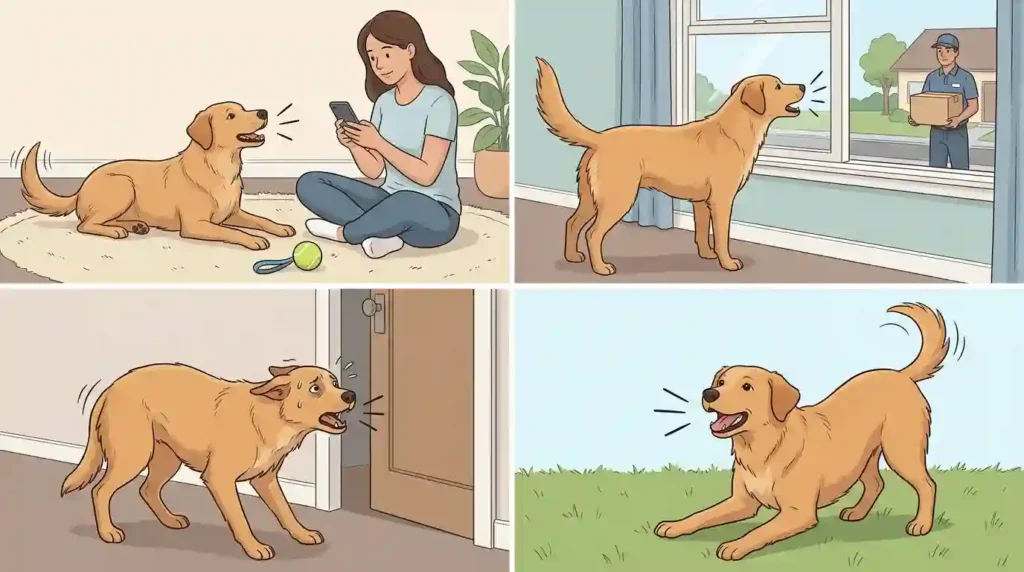
According to the ASPCA’s guide to barking, dogs bark for different reasons, and attention-seeking barking is only one category. The organization also recommends ruling out illness or injury before treating a persistent barking problem.
Signs of attention-seeking barking
Demand barking commonly has the following features:
- Your dog directs the barking toward a familiar person.
- The dog appears socially confident rather than frightened.
- Barking begins when attention, food, play, or access is unavailable.
- The behavior stops when the requested reward appears.
- Barking often occurs during predictable daily routines.
- The dog may combine barking with pawing, nosing, nudging, jumping, mouthing, or bringing a toy.
- The body remains relatively loose and relaxed.
- The dog watches closely to see whether the behavior is working.
This behavior often has a clear “If I do this, my person does that” quality.
Attention barking versus alert or territorial barking
Alert barking usually follows an environmental trigger, such as a noise outside, a delivery, an unfamiliar object, or movement near a window. Territorial barking is more specifically associated with someone or something entering or approaching an area the dog considers familiar.
A dog responding to aircraft, birds, or unfamiliar objects in the sky may need a different management plan. See this guide to Dog Barking at Drones or Flying Objects Overhead for that particular barking context.
Demand barking versus fear or distress barking
Fear barking and distress barking are emotional responses, not calculated demands for entertainment. Look for stress signals such as:
- Panting when it is not hot
- Pacing
- Drooling
- Trembling
- Repeated whining
- A tucked tail
- Flattened ears
- Attempts to hide or escape
- Destructive behavior near doors or windows
- Inability to settle
- Refusal of food
Separation anxiety may produce vocalization when the dog is alone or separated from an attachment figure. Ignoring this kind of barking does not treat its emotional cause.
Demand barking versus play or greeting barking
Play barking usually occurs during exciting social activity and may be accompanied by play bows, bouncing movements, or running. Greeting barking happens when a person or animal arrives.
For example, intense barking during a reunion can reflect excitement rather than a deliberate request. If this matches your situation, read Dog Barking When You Come Home After a Long Day for strategies tailored to arrival-related barking.
Why Dogs Learn to Bark for Attention
Demand barking is usually learned behavior shaped by its consequences. Dogs repeat actions that produce useful outcomes.
Operant conditioning and trial-and-error learning
Through operant conditioning, a dog learns that behavior affects what happens next. The dog may initially bark because of excitement, impatience, or frustration. If someone then offers food or attention, barking becomes reward-driven behavior.
The learning sequence is simple:
- The dog wants something.
- The dog barks.
- A person responds.
- The dog receives attention or another resource.
- Barking becomes more likely next time.
This is trial-and-error learning in everyday life. No one intentionally teaches the dog to bark, but the dog’s reinforcement history makes the behavior reliable.
Accidental reinforcement
Accidental reinforcement occurs whenever barking produces something valuable. Common examples include:
- Looking at the dog
- Saying the dog’s name
- Telling the dog to be quiet
- Petting the dog to calm it
- Throwing a toy
- Giving a chew
- Opening a door
- Preparing dinner immediately
- Letting the dog onto furniture
- Walking toward the dog
Scolding can also reinforce barking because negative attention is still human attention. If barking reliably produces interaction, the emotional tone of that interaction may matter less than its availability.
Intermittent reinforcement makes barking persistent
Demand barking becomes especially strong when it is rewarded inconsistently. Perhaps one family member ignores it, another offers a treat, and someone else gives in after five minutes.
This creates intermittent reinforcement. The dog learns that barking does not work every time—but might work if it continues long enough. A variable reinforcement schedule can make a behavior remarkably resistant to change.
It resembles a person repeatedly checking a device because a rewarding notification appears only occasionally. Uncertainty fuels persistence.
The barking habit loop
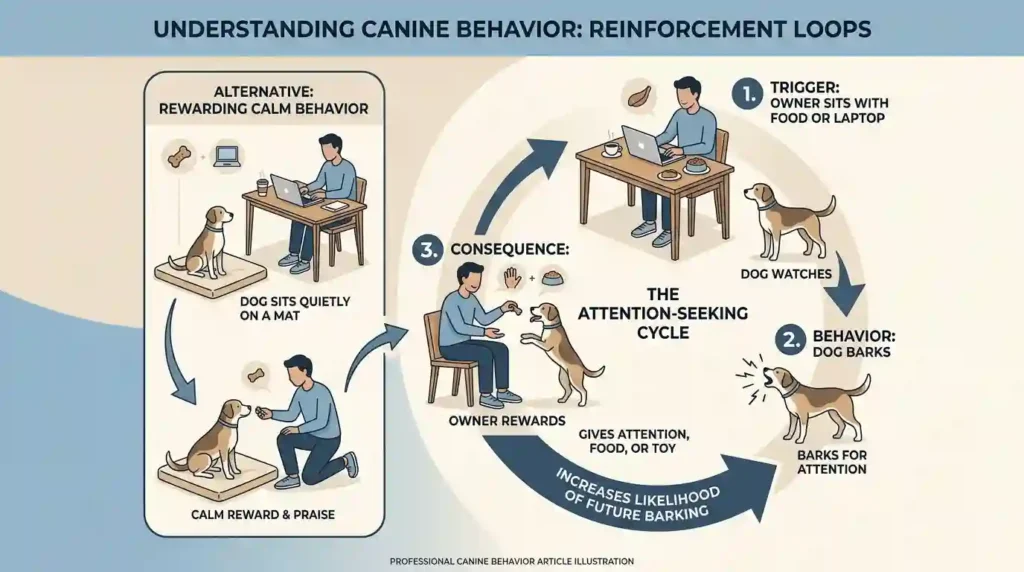
Over time, demand barking can develop into a habit loop:
- Antecedent: A person sits down to eat.
- Behavior: The dog barks.
- Consequence: The dog receives a piece of food.
The behavior can eventually become nearly automatic. Identifying these antecedents, consequences, and behavior patterns is essential for changing the loop.
Barking can become self-reinforcing
Some unwanted behavior is partly self-reinforcing. Barking can release excitement or frustration, make a person move, or temporarily relieve internal tension. This means removal of reinforcement alone may not solve every case. Dogs often need trigger prevention, better self-regulation skills, and an alternative behavior that produces a clear reward.
Meet Genuine Needs Before Starting a Training Session
A dog cannot make good choices when an important physical or emotional need has been neglected. Before treating barking as attention-seeking behavior, check for unmet needs.
Ask whether your dog may be experiencing:
- Hunger or thirst
- Bathroom urgency
- Insufficient sleep
- Pain or discomfort
- Boredom
- Loneliness
- Frustration
- Anxiety
- Uncertainty
- Excessive excitement
- Inadequate daily exercise
- Too little mental stimulation
- A sudden disruption to its structured routine
A dog that has been indoors for hours may be communicating a legitimate need to eliminate. A young working breed with no appropriate activity may be overwhelmed by stored energy. An older dog barking unexpectedly at night may have a medical or cognitive problem.
Preemptively meeting needs does not reinforce barking when it is done before the usual demand begins. Scheduled walks, meals, rest, play, training, and bathroom breaks reduce the motivation to demand resources.
How to Stop Attention-Seeking Barking Step by Step
The most effective plan combines prevention, careful removal of reinforcement, and positive reinforcement for a preferred response.
Step 1: Record the barking context
For three to seven days, use simple behavior tracking. Record:
- Time and location
- What happened immediately before barking
- Who was present
- Your dog’s body language
- What the dog appeared to want
- How each person responded
- How long will the barking continue
- What eventually stopped it
This information reveals attention-seeking triggers and environmental triggers. You might discover that barking occurs before dinner, during work calls, when you sit on the sofa, or when play suddenly ends.
Tracking also distinguishes demand behavior from fear, alerting, and genuine communication.
Step 2: Decide what barking must no longer produce
Choose the consequences your household will withhold when demand barking occurs. Depending on the case, these may include:
- Eye contact
- Conversation
- Petting
- Food
- Toys
- A game
- Door access
- Being lifted onto furniture
This is the removal of reinforcement. In technical terms, briefly withholding a desired outcome after barking may also be described as negative punishment: something the dog wants is temporarily unavailable. “Negative” means removing something, not harming or intimidating the dog.
The process should be neutral and brief. There is no need for anger.
Step 3: Prevent rehearsal whenever possible
Every repeated barking episode strengthens the behavior pattern. Use antecedent arrangement to make barking less likely.
For example:
- Give the dog a bathroom break before your meeting.
- Schedule play before the time it is usually demanded.
- Prepare a food puzzle before sitting down to eat.
- Ask for a settled behavior before opening your laptop.
- Place a comfortable bed near you.
- Keep tempting toys out of sight until scheduled play.
- Use a baby gate to prevent disruptive pacing around guests.
Prevention is not surrender. It creates conditions in which the dog can practice calm behavior successfully.
Step 4: Reinforce quiet before barking begins
Proactive reinforcement is one of the fastest ways to change the pattern. Notice your dog resting quietly, sitting politely, chewing an appropriate item, or watching you without vocalizing.
Mark that moment with a clicker or marker word such as “yes,” then provide a suitable reward. Depending on the dog, that might be:
- A small treat
- Gentle petting
- Calm praise
- Access to a toy
- A short game
- Permission to go outside
- Quiet social interaction
This technique is often called “capture quiet.” You are showing the dog that silence—not barking—is an effective way to access good things.
Do not wait until calm behavior feels extraordinary. Reward it frequently at first.
Step 5: Teach a replacement behavior
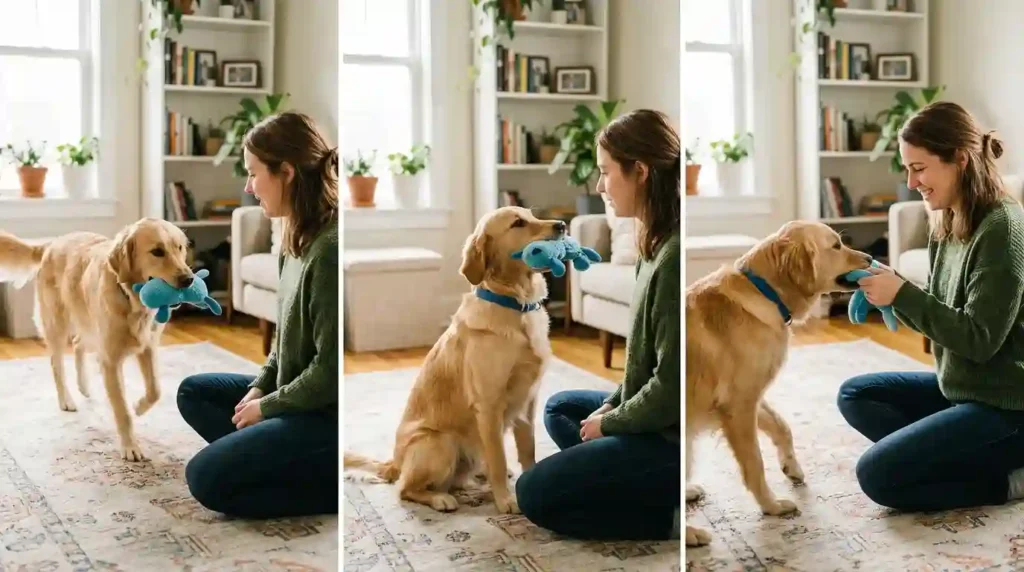
A replacement behavior should be easy, visible, and compatible with being quiet. Useful options include:
- A sit cue
- A place cue
- A settled behavior
- A touch cue
- An eye-contact cue
- Bringing a specific toy
- Resting the chin on your knee
- Sitting beside the door
- Ringing a bell for bathroom access
This becomes alternative communication—a polite requesting system the dog can use instead of barking.
For example, if your dog barks to start play, teach it to bring a toy and sit. When the dog performs that sequence quietly, begin the game. If barking starts, pause play briefly. Resume when the dog offers the preferred response again.
This is differential reinforcement: the alternative behavior earns rewards while barking does not.
Step 6: Reinforce the first moment of silence
If barking has already begun, wait for a genuine pause. At first, that pause may last only one second. Mark the silence, cue a known alternative behavior, and reward that behavior.
The sequence could be:
- The dog barks.
- You remain neutral.
- The dog pauses.
- You say “yes.”
- You cue “place.”
- The dog goes to its mat.
- You reward the dog on the mat.
Reward timing matters. The marker should identify silence or the requested alternative—not the bark immediately before it.
As the dog improves, build quiet duration gradually. Move from one second to two, then three, five, eight, and ten seconds. Avoid increasing the requirement too quickly.
Step 7: Build waiting tolerance
Dogs often demand bark because waiting is difficult. Teach patience in small, achievable increments.
Ask for a sit before:
- Setting down the food bowl
- Opening a door
- Clipping on the leash
- Throwing a ball
- Offering petting
- Releasing the dog from the car
Begin with a very short pause. Reward calm behavior quickly, then increase the delay gradually. This builds self-regulation and makes everyday rewards predictable.
Step 8: Keep the entire household consistent
Owner consistency is crucial. If barking works with one person, the dog has a reason to keep trying it with everyone.
Agree on:
- Which behaviors count as demand barking
- Which legitimate signals will receive a response
- Which replacement behavior should the dog use
- Which marker words and cues will everyone use
- What happens when barking begins
- When scheduled attention and play occur
Household consistency transforms random consequences into a clear learning system.
How to Stop Attention-Seeking Barking Without Ignoring Your Dog
Many people feel uncomfortable with the advice to “just ignore the dog.” That concern is reasonable. Ignoring all vocal behavior can prevent owners from noticing fear, pain, bathroom needs, or meaningful communication.
A better approach is to acknowledge needs without rewarding the demanding method.
Perform a calm needs check
When barking begins unexpectedly, assess the situation without immediately delivering the suspected reward.
Check:
- Has the dog had a recent bathroom opportunity?
- Is fresh water available?
- Is the environment too hot, cold, or noisy?
- Is the dog showing pain or stress signals?
- Did something frightening happen?
- Has the dog had appropriate movement and enrichment?
- Is this behavior sudden or unusual?
Keep your assessment low-key. Avoid excited talking, prolonged eye contact, or automatic petting.
Respond to the need, not the barking
If the dog genuinely needs to eliminate, calmly take it outside. Keep the trip functional rather than turning it into spontaneous playtime.
If the dog appears anxious, create distance from the trigger and help it settle. If the dog is in pain, seek veterinary care.
If all needs are met and the dog is simply requesting entertainment, wait for quiet and ask for the established alternative behavior. Then decide whether attention is appropriate.
Use preemptive attention
Preemptive attention means initiating healthy interaction before your dog demands it. This may include scheduled attention, short training games, sniffing activities, grooming, play, or relaxed contact.
This method protects the owner-dog relationship while teaching that calmness makes social interaction more available. Your dog does not have to create a crisis to connect with you.
Teach a Quiet Cue Correctly
A quiet cue can be helpful, but it is not magic. It must be taught rather than repeatedly shouted during excessive barking.
Capture silence
Begin in a low-distraction setting.
- Wait for your dog to be naturally quiet.
- Say “quiet” or another silent cue.
- Mark the calm moment.
- Deliver a treat.
- Repeat in short sessions.
Once the dog connects the word with silence, practice after mild, manageable vocalization.
Teach bark and quiet under stimulus control
Some trainers teach a bark cue first, then a quiet cue. This can make the distinction clearer:
- Use a predictable, low-intensity trigger.
- Say “speak.”
- Allow one bark.
- Mark and reward it.
- Present a treat near the dog’s nose.
- When the dog stops barking to sniff, say “quiet.”
- Mark the silence and reward.
With repetition, both behaviors come under stimulus control: the dog barks when asked and stops when cued.
This approach is not suitable for every dog. Avoid deliberately triggering a dog that is fearful, highly reactive, or easily overstimulated.
Avoid repeating the cue
If you say “quiet” ten times while the dog continues barking, the word loses meaning. Give the cue once when success is likely. If the dog cannot respond, reduce the trigger intensity, increase distance, or use environmental management.
Environmental and Behavior Management

Training is easier when the environment does not continually provoke barking.
Reduce visual triggers
For dogs that switch between demand barking and alert barking, consider:
- Closing blinds or curtains
- Applying removable window film
- Using furniture placement to block access
- Installing visual barriers around a yard
- Moving the dog’s resting area away from windows
- Using a baby gate to restrict entry to a triggering room
Reduce sound triggers
White noise, a fan, or quiet background audio may soften sounds from hallways, neighbors, or traffic. This can help dogs rest and reduce general arousal.
Create a quiet area
A quiet area should feel safe, comfortable, and voluntary. It may include a bed, water, appropriate chew toys, and soft background sound.
A crate can be useful only if the dog is already comfortable inside it. Never use confinement as punishment for barking. A dog that panics in a crate may experience greater distress.
Provide mental enrichment
Mental stimulation is often more effective than simply trying to exhaust a dog physically. Useful activities include:
- Interactive toys
- Food puzzles
- A stuffed Kong
- Safe chew toys
- Veterinarian-approved edible chews or bully sticks
- Treat-search games
- Scent work
- Slow sniffing activities
- Short clicker-training sessions
- Simple problem-solving games
Match enrichment to the dog’s age, health, chewing style, and dietary needs. Supervise items that could be swallowed or broken apart.
Balance exercise with rest
Daily exercise helps reduce boredom and frustration, but more is not always better. Constant high-intensity activity can create a dog that expects stimulation all day.
Combine walks and play with sniffing, training, chewing, and planned rest. Puppies, senior dogs, flat-faced breeds, and dogs with medical limitations require individualized exercise.
A Practical Daily Training Plan
A structured routine makes progress easier to measure.
Morning
Provide a bathroom break, an appropriate walk, breakfast through a food puzzle, and a few minutes of training. Reward calm behavior after the activity ends.
Midday
Offer a bathroom opportunity, sniffing time, or a short play session. Practice the place cue for several repetitions. Give the dog a safe enrichment item while you work.
Evening
Provide physical activity appropriate to the dog, followed by a calming transition. Practice polite requesting before dinner, toys, outdoor access, and petting.
Throughout the day
Capture quiet whenever you notice it. Initially, aim for frequent rewards when the dog settles independently. As calmness becomes reliable, reduce food rewards gradually while continuing to offer praise, access, play, and affection.
The purpose is not to carry treats forever. It is to establish a strong reinforcement history for the behavior you want.
What Is an Extinction Burst?
When barking has worked in the past but suddenly stops producing rewards, it may briefly become louder, longer, or more intense. This behavior escalation is known as an extinction burst.
The dog is effectively trying harder:
“Barking usually works. Perhaps I need to bark more.”
The dog may also shift to pawing, jumping, mouthing, nosing, shoe stealing, or counter surfing. These behaviors are alternative attempts to restore interaction.
An extinction burst does not mean the training plan is failing. However, it does create a difficult moment. If the owner gives in during the most intense barking, the dog may learn that persistence is especially effective.
Prevent this problem by meeting needs in advance, teaching a replacement response before removing rewards, and ensuring everyone follows the same plan.
Common Mistakes That Keep Demand Barking Alive
Scolding the dog
Scolding supplies attention and may increase anxiety or arousal. Some dogs interpret loud voices as participation in the noise. Others become uncertain about their owner without learning what to do instead.
Rewarding too soon after a bark
If you routinely give food the instant barking stops, the dog may learn a behavior chain: bark, pause, receive food.
Avoid this by asking for a meaningful alternative behavior and gradually increasing quiet duration. Reinforce calm periods that occur independently, not only pauses following barking.
Using treats as a bribe
Showing a high-value treat while the dog is barking may teach the dog to bark until food appears. Keep rewards out of sight and use a marker to identify the correct response.
Waiting until the dog fails
If you know your dog barks every evening at 7:00, begin enrichment, a bathroom break, or mat training at 6:50. Trigger prevention is more efficient than handling a full barking episode.
Providing too little enrichment
A dog with no suitable outlet may invent activities. Shoe stealing, destructive behavior, jumping, and excessive barking often increase when daily life offers insufficient engagement.
Expecting silence all day
Dogs are social animals, and barking is normal canine communication. The goal is reasonably quiet and appropriate signaling—not robotic silence.
Using aversive training
Shock collars, intimidation, physical corrections, and other aversive training methods may suppress sound without resolving anxiety, frustration, or environmental triggers. Suppression can also remove warning signals while leaving the underlying emotion intact.
Punishment-free training focuses on management, skill-building, reinforcement, and emotional safety.
How Long Does It Take to Stop Attention-Seeking Barking?
There is no universal timeline. Mild, recently learned attention barking may improve within several days of consistent training. A deeply established habit reinforced for years may require weeks or months.
Progress depends on:
- The dog’s reinforcement history
- How often barking has been rewarded
- Whether the behavior is purely attention-related
- The number and intensity of triggers
- The dog’s age and temperament
- Existing anxiety or frustration
- The quality of the replacement behavior
- Household consistency
- Training frequency
- The owner’s reward timing
- Whether physical and mental needs are being met
Measure progress by more than complete silence. Useful signs include fewer barking episodes, shorter duration, lower intensity, faster recovery, improved waiting tolerance, and more frequent use of polite requesting.
Patience matters. Behavior change is rarely perfectly linear.
When to Seek Veterinary or Professional Behavior Help
Schedule a veterinary examination if barking begins suddenly, intensifies without an obvious reason, occurs mostly at night, or accompanies changes in appetite, mobility, sleep, elimination, or temperament.
Possible medical causes include pain, sensory decline, neurological conditions, endocrine disorders, gastrointestinal discomfort, urinary urgency, or age-related cognitive changes.
Seek professional help when:
- Barking is accompanied by panic or destructive behavior.
- Your dog cannot settle when alone.
- Fear or territorial behavior is escalating.
- The dog growls, snaps, or bites.
- Barking seriously affects neighbors’ or household well-being.
- You cannot identify the barking function.
- Several weeks of consistent training produce no improvement.
- The behavior is too intense to manage safely.
Appropriate professionals include a veterinary behaviorist, a Certified Applied Animal Behaviorist, or a qualified Certified Professional Dog Trainer experienced in humane behavior modification. Ask any dog trainer to explain their methods before hiring them.
Conclusion
Learning how to stop attention-seeking barking begins with understanding why the bark occurs. Demand barking is usually a functional, learned behavior supported by a history of successful rewards. Eye contact, verbal responses, petting, food, toys, and even scolding can keep that behavior alive.
The solution is not to withdraw affection or ignore genuine communication. Meet your dog’s physical and emotional needs, manage predictable triggers, stop delivering rewards for demanding behavior, and make calm alternatives more worthwhile. Capture quiet, reinforce silence, teach a sit or place cue, build waiting tolerance, and provide scheduled attention before frustration develops.
With thoughtful behavior management, positive reinforcement, household consistency, and patience, your dog can learn that polite communication is the easiest path to attention. That change reduces unwanted barking while strengthening—not weakening—the owner-dog relationship.
Frequently Asked Questions
Why does my dog bark at me for attention?
Your dog probably barks because the behavior has produced a useful response before. Looking, talking, touching, feeding, playing, or opening a door can all reinforce barking. Your dog may also be bored, lonely, excited, frustrated, hungry, or in need of a bathroom break, so check genuine needs before treating it as demand behavior.
How do I stop my dog from demand barking?
Prevent predictable triggers, meet legitimate needs in advance, avoid rewarding the bark, and reinforce an alternative response such as sitting, going to a mat, or bringing a toy quietly. Reward calm behavior throughout the day rather than interacting only when barking occurs.
Should I ignore my dog when they bark for attention?
You should withhold the specific reward the dog is demanding, but you should not blindly ignore every bark. First, assess bathroom needs, pain, fear, anxiety, hunger, and environmental triggers. When needs are met, wait for a quiet moment and reinforce a polite alternative behavior.
How can I stop attention-seeking barking without ignoring my dog?
Use proactive interaction. Schedule walks, play, enrichment, rest, and affection before barking begins. When a demand occurs, calmly check for genuine needs and then prompt a quiet replacement behavior. This allows you to remain responsive without teaching the dog that barking controls your attention.
How do I teach my dog to be quiet on command?
Say “quiet” during a moment of silence, mark the behavior with a click or marker word, and reward it. Practice repeatedly in calm conditions. Later, introduce mild barking triggers and reward progressively longer pauses. Do not shout the cue repeatedly while the dog is over threshold.
How do I reward quiet behavior without reinforcing barking?
Reward calmness that happens before barking whenever possible. If barking has started, wait for a pause, ask for a sit or place cue, and reward that completed behavior. Gradually extend the required quiet duration so the dog does not learn a simple bark-pause-treat chain.
What can I teach my dog instead of barking for attention?
Teach sitting, going to a mat, resting the chin on your leg, bringing a toy, making gentle eye contact, performing a nose touch, or using a bathroom bell. Choose one response that is easy to recognize and reinforce it consistently.
Does rewarding a dog after they stop barking reinforce the barking?
It can if the reward consistently follows a very short pause after every bark. The dog may learn that barking starts the reward sequence. Reduce this risk by capturing independent quiet, asking for an alternative behavior, varying reward timing appropriately, and gradually building longer periods of calmness.
Why does my dog’s barking get worse when I stop responding?
This may be an extinction burst. When a previously successful behavior stops working, the dog may temporarily bark more intensely or try pawing, jumping, or stealing objects. Stay consistent, prevent unmet needs, and reinforce the desired alternative. If the behavior involves panic or aggression, consult a professional.
How long does it take to stop demand barking?
A new, mild habit may improve within days. A behavior with a long or inconsistent reinforcement history may take several weeks or months. Consistent responses, preventive management, frequent reinforcement of calmness, and an easy replacement behavior usually improve the timeline.
How can I tell the difference between demand barking and anxiety barking?
A demand-barking dog typically looks confident, focuses on a person or desired resource, and relaxes when it receives the reward. Anxiety barking is more likely to include panting, pacing, trembling, drooling, escape attempts, destructive behavior, or an inability to eat and settle. A professional assessment may be necessary when the signs overlap.
Can boredom cause attention-seeking barking?
Yes. Dogs may create social interaction when their routine lacks movement, sniffing, problem-solving, training, or appropriate chewing. Mental enrichment, food puzzles, interactive toys, sniffing activities, scheduled play, and adequate rest can reduce boredom-related barking.
How much exercise does a dog need to reduce attention barking?
Exercise requirements depend on age, breed, health, fitness, and temperament. Rather than relying on a fixed number, observe whether your dog can relax after an appropriate mixture of walking, sniffing, play, training, enrichment, and rest. Ask your veterinarian for guidance if your dog has health limitations.
When should I seek professional help for my dog’s barking?
Seek help if barking begins suddenly, includes fear or aggression, happens during separation, disrupts sleep, causes severe household conflict, or does not improve with consistent training. Start with a veterinarian to rule out medical causes, then consider a veterinary behaviorist, Certified Applied Animal Behaviorist, or qualified Certified Professional Dog Trainer.