
Summary
Dog barking during play is usually a normal expression of excitement, but the sound alone cannot tell you whether a dog is happy, frustrated, frightened, or becoming aggressive. The reliable clues are the dog’s complete body language, the context, the intensity of play, and whether both dogs voluntarily keep participating.
A playful dog typically has a loose, wiggly body, an open mouth, exaggerated movements, frequent play pauses, and role reversal. Frustration is more likely when access to another dog or toy is blocked. Potential aggression involves warning signs such as freezing, rigid posture, a direct stare, lip lifting, repeated snapping, or hard biting.
This guide will help you understand dog barking, identify its underlying motivation, interrupt unsafe play, reduce excessive vocalization through positive reinforcement, and recognize when professional support is necessary.
Table of Contents
- What Dog Barking During Play Really Means
- Why Dogs Bark or Growl During Play
- Dog Barking During Play: Excitement vs. Frustration vs. Aggression
- How to Read a Barking Dog’s Body Language
- When Play Barking Becomes Too Intense
- How to Stop Dog Barking During Play
- Stopping Barking Around Other Dogs
- Common Training Mistakes
- When to Seek Professional Help
- Conclusion
- FAQs
What Dog Barking During Play Really Means
Barking is part of normal canine communication. Dogs do not bark only when they are angry, just as people do not raise their voices only during arguments. A dog may bark to begin a game, express excitement, request attention, release frustration, create distance, or warn another dog that an interaction has become uncomfortable.
That is why interpreting play barking requires more than listening to pitch or volume. You must consider:
- What happened immediately before the barking
- Whether the dog can freely approach or move away
- The dog’s facial expression and body posture
- Whether the other dog appears comfortable
- Whether the dogs take turns chasing or wrestling
- How quickly does the dog settle after a pause
- Whether barking is accompanied by stiffness, snapping, or hard contact
A dog that barks loudly during play is not automatically aggressive. Some dogs are naturally vocal roughhousers. Herding breeds, terriers, working dogs, and other high-drive breeds may bark frequently while chasing, wrestling, or anticipating a thrown toy. Individual personality and learning history matter as much as breed.
However, “normal” does not necessarily mean desirable in every situation. Repeated, piercing barking may disturb neighbors, overwhelm another dog, or signal that emotional arousal is climbing beyond a safe level. The goal is not always to eliminate every playful vocalization. It is to help the dog remain responsive, respect social boundaries, and return to a calmer state when asked.
Why Dogs Bark or Growl During Play
Play initiation
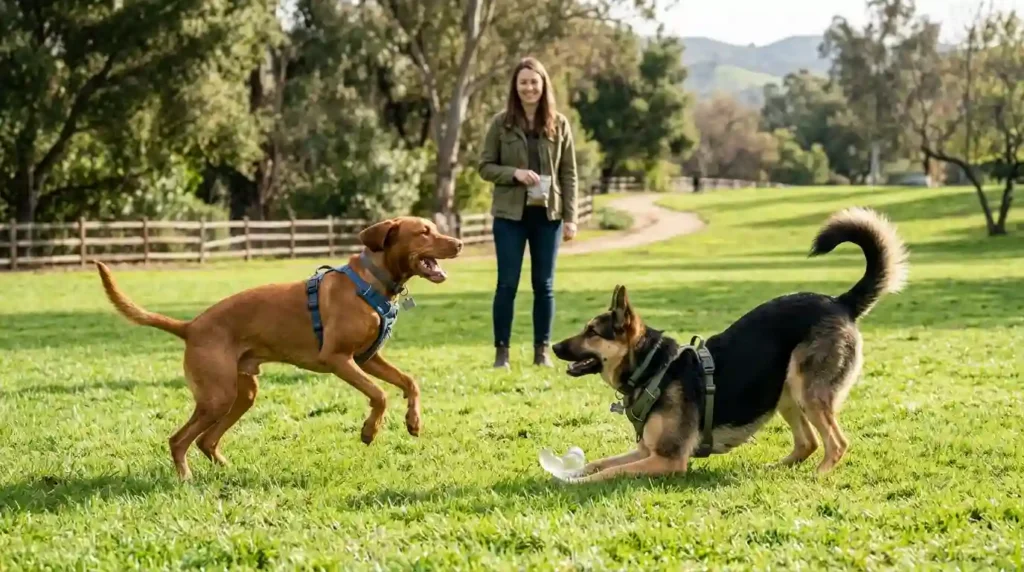
A short bark can be a play signal. A dog may lower into a play bow, bounce backward, bark once or twice, and wait for the other dog to respond. This is essentially an invitation: “Chase me,” “Wrestle with me,” or “Come get the toy.”
Healthy play initiation usually includes exaggerated movement. The dog may hop sideways, slap the ground with its front feet, turn its head, or deliberately run more slowly so the other dog can catch up. These movements reduce ambiguity and communicate friendly intent.
Excitement barking
Excitement barking occurs when anticipation or activity raises a dog’s emotional arousal. Common triggers include:
- Seeing a familiar canine friend
- Beginning a game of fetch
- Watching another dog run
- Hearing a favorite toy squeak
- Waiting for a leash to be unclipped
- Chasing during a puppy playdate
- Joining family members who are moving energetically
An excited dog often produces repeated, sharp barks. A high-pitched bark while playing can be completely normal when paired with relaxed body language. Look for a wiggly body, soft eyes, an open mouth, curved movement, and voluntary pauses.
Excitement can still develop into overarousal. A dog that begins happily may become too stimulated to control its body. Barking becomes faster, play biting becomes harder, and the dog stops responding to familiar cues. At that point, the dog needs a calming break—not punishment.
Demand barking
Demand barking is a behavior that has been learned to produce a desired result. The dog may bark at another dog to make it run, bark at a person to make them throw a ball, or bark when play pauses.
This attention-seeking barking is often reinforced accidentally. If a dog barks and the owner immediately throws the toy, the dog learns that barking activates the game. If another dog moves whenever barking begins, barking may also become an effective way to control that dog’s behavior.
Demand barking at other dogs can feel pushy even when it is not aggressive. A socially skilled dog may tolerate a few barks, while a less confident dog may try to leave. The barking dog must learn that quiet behavior—not harassment—restarts the fun.
Frustration barking
Frustration barking arises when a dog wants something but cannot reach it or make it happen. Blocked access and movement restriction are common causes. A dog may bark when:
- Held on a leash near playing dogs
- Standing behind a fence or gate
- Prevented from chasing
- Waiting for a toy that another dog possesses
- Restrained while another dog approaches
- Unable to control the direction of play
Barrier frustration can produce barking, lunging, whining, spinning, or pulling. These behaviors sometimes resemble aggression, especially during leash reactivity. Yet the dog may behave socially when allowed to meet under suitable conditions.
That distinction does not make lunging harmless. A frustrated dog in a state of high arousal can tip into redirected aggression, mouthing the handler or snapping at a nearby dog. Management and frustration-tolerance training are therefore essential.
The ASPCA’s authoritative guide to barking behavior similarly identifies excitement or frustration when dogs are excited but prevented from reaching something they want. It recommends teaching impulse control before access to rewarding activities.
Play growling
Why do dogs bark or growl during play? Growling can add intensity and drama to play fighting. Many dogs make theatrical sounds while tugging, wrestling, chasing, or play biting. A deep play growl may sound alarming even though the dog’s body remains loose and bouncy.
Evaluate the whole interaction. Play growling is more likely to be harmless when:
- Both dogs repeatedly return to the game
- Their bodies remain loose rather than rigid
- They pause without immediately re-engaging forcefully
- Chasing and wrestling roles reverse
- The stronger dog uses self-handicapping
- Mouthing remains inhibited
- Either dog can disengage without being pursued relentlessly
A growl is also a warning signal when a dog needs space. Never assume every growl is playful. If it occurs with freezing, guarding, stiffness, avoidance, or a direct stare, interrupt the interaction calmly.
Dog Barking During Play: Excitement vs. Frustration vs. Aggression
The most important question is not “What does this bark sound like?” but “What is motivating this dog right now?”
| Possible motivation | Common context | Body-language clues | What to do |
| Playful excitement | Chasing, wrestling, and greeting a friend | Loose posture, play bow, soft eyes, open mouth, role reversal | Monitor and reward voluntary pauses |
| Demand barking | Dog wants a ball thrown or wants another dog to move | Facing the person or dog, repeated barking, expectant posture | Wait for quiet, cue a replacement behavior, then restart |
| Frustration | Leash, fence, gate, withheld toy, blocked access | Pulling, pacing, lunging, rapid barking, difficulty disengaging | Increase distance, reduce stimulation, train impulse control |
| Fear or anxiety | Unfamiliar dog approaches or play becomes overwhelming | Weight shifted back, pinned ears, avoidance, tucked or stiff tail | Create distance and end the interaction |
| Defensive aggression | Dog feels threatened or trapped | Freezing, rigid posture, lip lifting, snapping, hard stare | Separate safely and seek behavioral guidance |
| Overarousal | Play has continued too long or become too intense | Frantic behavior, harder nipping, body slamming, poor cue response | Use a play interruption and calming break |
Signs of healthy playful excitement
Friendly play can look rough. Dogs may wrestle, chase, jump, mouth, growl, or briefly pin one another. These actions remain playful when the interaction has flexibility and consent.
Look for:
- A loose body posture
- A wiggly body rather than a rigid one
- Soft, blinking eyes
- An open, relaxed mouth
- A play bow
- Curved approaches instead of direct charges
- Bouncy, exaggerated movement
- A gentle tail wag or a broad, loose wag
- Role reversal during chasing or wrestling
- Self-handicapping by the larger or stronger dog
- Frequent play pauses
- Both dogs chose to resume
Self-handicapping occurs when a stronger dog deliberately reduces its advantage. It may lie down for a puppy, roll over, slow its running speed, or allow the other dog to “win.” Role reversal means that one dog is not always the chaser, wrestler, or dog on top. These patterns help preserve social balance.
Signs of frustration or overstimulation
A frustrated dog is often focused on gaining access. An overstimulated dog may already be interacting but has lost the ability to regulate its behavior.
Watch for:
- Rapid, repetitive barking without pauses
- A high, quick tail wag combined with bodily tension
- Repeated jumping or body slamming
- Ignoring another dog’s attempts to move away
- Frantic chasing with no role reversal
- Escalating mouthing or nipping
- Grabbing clothing or the leash
- Inability to respond to a name or a familiar cue
- Panting unrelated to heat or exertion
- Repetitive fetch that makes the dog more agitated
- Immediate explosive re-engagement after separation
A high, quick tail wag does not always mean friendliness. Tail movement must be interpreted with the dog’s posture, facial expression, and weight distribution. A rapidly moving stiff tail can indicate tension, while a sweeping wag connected to loose movement is more reassuring.
Signs that aggression may be developing
Aggression is behavior intended to increase distance, stop a perceived threat, or control an interaction through threatening or harmful action. Fear, pain, resource conflict, poor social compatibility, or accumulated stress may contribute.
Potential warning signs include:
- Sudden stiffness or rigid posture
- Freezing
- A closed, tense mouth
- Prolonged direct staring
- Slow stalking outside a balanced chase
- Lip lifting or snarling
- Pinned ears with visible tension
- Raised hackles
- A high, stiff tail
- Repeated snapping
- Forceful lunging
- Hard biting
- A dog attempting to escape while being pursued
- One-sided pinning or body slamming
- No play pauses or role reversal
Raised hackles indicate arousal, not aggression by themselves. Likewise, barking, growling, or showing teeth during play cannot be interpreted in isolation. The concerning picture is a cluster of signals, an unwilling participant, and escalating intensity.
A true dog fight often looks and feels different from noisy play. Movement becomes efficient rather than exaggerated, bites may be forceful, and one or both dogs may be difficult to interrupt. Do not reach between fighting dogs or grab near their collars, because redirected bites can cause severe injury.
How to Read a Barking Dog’s Body Language
Observe the entire dog
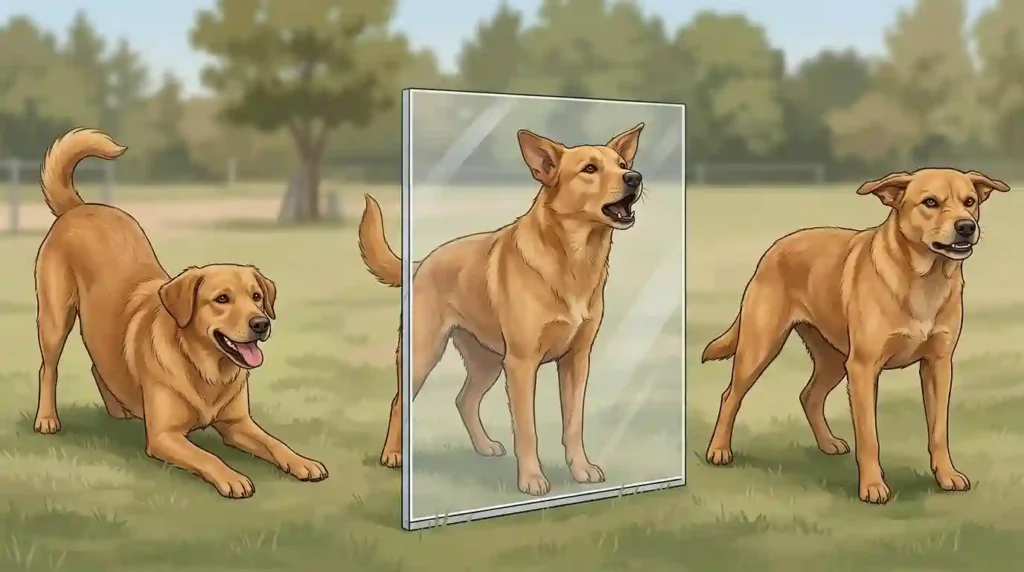
Bark pitch is useful but unreliable by itself. A high-pitched bark may accompany excitement, distress, or frustration. A low bark may occur during playful roughhousing or as a serious warning.
Read from nose to tail:
- Are the facial muscles soft or tense?
- Is the mouth open and relaxed or tightly closed?
- Are the eyes soft or fixed?
- Is movement curved and bouncy or straight and rigid?
- Is the dog leaning in willingly or trying to retreat?
- Is the tail loose, tucked, or stiff?
- Can the dog pause and disengage?
A “dog barks loudly” complaint describes volume, not emotion. Large dogs can produce powerful, playful barks, while a small, frightened dog may use sharp, high-pitched vocalizations. Intensity matters mainly when considered alongside posture and behavior.
Watch the other dog
The barking dog is only half the interaction. The play partner’s response reveals whether social boundaries are being respected.
Comfortable dogs willingly approach after pauses, use loose movements, and remain engaged. An uncomfortable dog may turn its head away, lick its lips, lower its body, hide behind a person, repeatedly shake off, or attempt to leave.
If one dog disengages and the other repeatedly blocks, chases, mounts, or barks in its face, the interaction is no longer balanced. Even if no bite has occurred, supervised play should stop.
Use a consent test
A simple consent test can help evaluate rough play:
- Calmly hold back the more intense dog for two or three seconds.
- Do not drag, frighten, or physically punish either dog.
- Observe the other dog’s choice.
- If the released dog approaches with loose body language, play may continue.
- If it leaves, hides, avoids eye contact, or stays near a person, end the session.
The test is not a guarantee of safety, but it provides useful information about voluntary participation.
Notice changes from normal behavior
If your dog is barking at other dogs all of a sudden, do not assume it is a new training problem. Sudden behavioral changes can be associated with discomfort, pain, sensory changes, illness, a frightening experience, or a shift in the environment.
For example, a dog with joint pain may bark or snap when another dog collides with it. A dog experiencing ear pain may react when its head or neck is touched. Arrange a veterinary examination when behavior changes abruptly, especially if you also notice sensitivity, reduced activity, appetite changes, limping, sleep disruption, or unusual irritability.
Context changes can also affect barking. Dogs may vocalize before elimination, in response to gestures, or when detecting outdoor stimuli that people cannot easily identify. Related behavior guides, such as Dog Barks Before Pooping, Dog Bark When I Point at Something, and Dog Barking at Nothing can help owners examine triggers instead of treating every bark as the same behavior.
When Play Barking Becomes Too Intense
Crossing the arousal threshold
Every dog has an arousal threshold beyond which thoughtful responses become difficult. Below that threshold, a dog can notice a trigger, eat a treat, respond to its name, and choose a replacement behavior. Above it, the dog may exhibit frantic behavior and become unable to process familiar cues.
Overarousal is more likely with:
- Long or chaotic play sessions
- Crowded dog parks
- Several dogs chasing one dog
- Repetitive fetch without breaks
- High environmental stimulation
- Lack of sleep or downtime
- Incompatible play styles
- Leash restraint near free-running dogs
- Competition over toys, food, or attention
- A history of fear, anxiety, or reactivity
Puppies and adolescent dogs frequently need human help regulating play. They may appear tireless while actually becoming overstimulated. Hyperactivity after extended play can signal a need for sleep rather than more exercise.
Stress and defensive behavior
Stress signals may appear before overt aggression. A dog might yawn, turn away, lick its lips, shake off, sniff the ground, or seek proximity to its owner. These subtle behaviors are requests for relief.
If those requests fail, the dog may progress through a fight-flight-freeze response. It may flee, freeze, bark, snarl, snap, or bite. Defensive aggression is often the final stage of an interaction that the dog has been trying to escape.
Respecting early warning signals reduces the chance of escalation. Punishing growling is especially risky because it may suppress the warning without resolving fear or discomfort.
Play-related aggression
Play-related aggression is not a precise diagnosis that owners should make on their own. The phrase may describe genuine aggression that appears during play, excessively forceful behavior, poor bite inhibition, guarding of toys, or redirected aggression caused by overarousal.
End play immediately and seek qualified help if you observe:
- Bites that puncture or bruise
- Repeated attacks after the other dog retreats
- Guarding that escalates around toys or people
- Inability to interrupt without risking a bite
- Sudden, unpredictable behavioral changes
- A substantial size mismatch combined with unsafe behavior
- Persistent fear or avoidance in either dog
How to Stop Dog Barking During Play
Can you train a dog to bark less during play? Yes. The most effective approach combines environmental management, carefully timed interruptions, reinforcement of quiet behavior, and practice with impulse control.
There is no ethical method guaranteed to stop dog barking “in seconds.” You may interrupt an episode quickly by creating distance or scattering treats, but lasting behavior modification requires repetition and attention to the barking’s cause.
Step 1: Identify the underlying motivation
Keep a brief record for several sessions:
- What triggered the first bark?
- Was access blocked?
- Who initiated play?
- How long had the dogs been active?
- Did barking make a person throw a toy?
- Did another dog appear frightened or annoyed?
- Could your dog respond to a cue?
- How long did recovery take?
Video can reveal patterns that are difficult to see in the moment. Record only when it is safe and do not stage a risky interaction.
If barking consistently makes the ball move, demand barking is likely. If barking appears behind a gate, consider barrier frustration. If it occurs after ten minutes of wrestling and is followed by frantic nipping, overarousal may be driving it.
Step 2: Manage the environment
Environmental management prevents repeated rehearsal while training develops.
Helpful changes include:
- Choose quieter areas rather than crowded dog parks
- Arrange a puppy playdate with one compatible dog
- Remove toys if they create conflict
- Use shorter supervised play sessions
- Avoid on-leash greetings when the leash creates tension
- Increase trigger distance before barking begins
- Provide physical space for easy disengagement
- Schedule downtime between stimulating activities
- End play while both dogs are still successful
Compatible play style matters. A gentle dog may dislike body slamming, while a robust wrestler may find cautious interaction frustrating. Socialization does not mean forcing a dog to tolerate every dog. It means developing safe, flexible responses to the environment.
Step 3: Reinforce quiet behavior
Do not wait for a full barking episode. Capture tiny moments of quiet during play.
- Allow a brief, appropriate interaction.
- Call your dog away before the barking intensity rises.
- Mark the moment the dog turns toward you with “yes” or a clicker.
- Reward with a high-value treat.
- Ask for a simple behavior, such as a hand target or sit.
- Release the dog back to play if both dogs remain comfortable.
Returning to play is a powerful reward. The dog learns that responding calmly does not always end the fun.
Initially, mark one second of quiet. Gradually build to two, three, and five seconds. Avoid repeating “quiet” while the dog is actively barking and unable to respond. A quiet cue becomes meaningful only after the dog understands which behavior earns reinforcement.
Step 4: Teach a replacement behavior
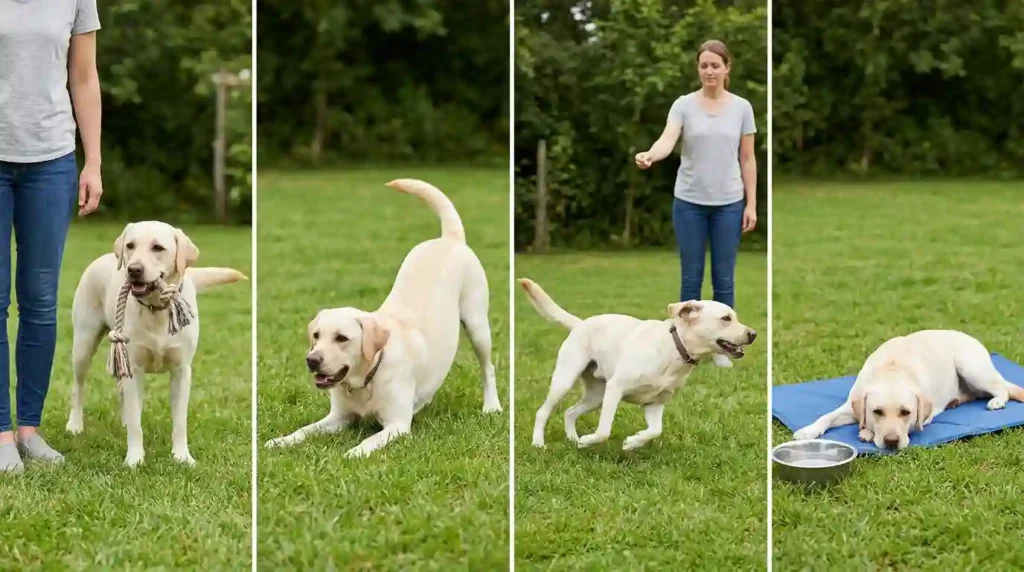
A replacement behavior gives the dog something specific to do instead of barking. Useful options include:
- Make eye contact with the handler
- Touch the handler’s palm
- Sit before the toy is thrown
- Retrieve a toy instead of barking in another dog’s face
- Go to a mat for a brief reset
- Sniff for scattered treats
- Walk beside the handler away from the trigger
Practice away from exciting play first. A dog cannot learn a new attention game in the middle of overstimulation.
Step 5: Use structured play interruptions
A play interruption should be predictable and positive, not a punishment.
Call the dogs apart every 30 to 90 seconds, depending on their arousal. Reward them for checking in, allow a short pause, and decide whether to resume. Frequent breaks help preserve bite inhibition and prevent emotional arousal from accumulating.
During a calming break:
- Create physical distance
- Offer water
- Scatter treats in the grass
- Use a quiet sniffing activity
- Allow the dog to rest on a mat
- Resume only when its body becomes loose and responsive
If the dog immediately returns to frantic barking, end the session. A longer recovery period is needed.
Step 6: Build impulse control and frustration tolerance
Obedience training is most useful when it teaches functional self-control rather than demanding robotic compliance.
Practice:
- Waiting briefly before going through a door
- Sitting before the leash is attached
- Pausing before chasing a toy
- Remaining on a mat while a toy moves at low intensity
- Looking at another dog and then returning attention to the handler
- Taking turns during toy games
- Releasing an object voluntarily
Keep practice easy enough for success. Increase only one factor at a time: duration, distance, distraction, or movement.
Step 7: Provide balanced enrichment
Exercise helps, but simply exhausting a highly aroused dog can create a fitter dog that still lacks emotional regulation. Combine physical activity with mental stimulation and relaxation practice.
Useful options include:
- Sniff walks
- Food searches
- A puzzle toy
- A treat-dispensing toy
- Short positive-reinforcement sessions
- Chewing and licking activities
- Age-appropriate free movement
- Scheduled naps and quiet periods
For dogs energized by repetitive fetch, alternate a few throws with sniffing, training, or rest. Stop before chasing becomes compulsive or frantic.
How to Stop Your Dog Barking When Playing With Other Dogs
Start below the dog’s threshold
If your dog barks as soon as it sees another dog, direct play may be too difficult. Begin at a trigger distance where your dog can notice the other dog without lunging or barking.
Use Look at That training:
- Let your dog notice the other dog from a safe distance.
- Mark the glance with “yes” or a clicker.
- Give a high-value treat.
- Allow another brief glance.
- Gradually reinforce, turning attention back to you.
This is a form of counterconditioning when the sight of another dog predicts something positive. It also creates a practical attention game.
If the dog cannot eat, orient to you, or move away, increase distance. Continuing at close range while the dog is over threshold does not teach calm behavior.
Use a “Find It” game
“Find It” is a simple distraction game that encourages sniffing and disengagement.
Say “Find it,” then scatter several small treats on clean ground away from the other dog. Practice at home before using it around triggers. During play, use it as an early interruption—not as a last-second attempt to break up a fight.
Avoid throwing food between unfamiliar dogs or near dogs that may guard food. Separate them first.
Reinforce polite approaches
Do not allow a barking, pulling dog to drag you toward another dog. Advancing can reinforce the outburst.
Instead:
- Stop or move farther away.
- Wait for relaxed leash pressure and a moment of quiet.
- Mark and reward.
- Move slightly closer only while calm behavior continues.
- Retreat if barking or lunging returns.
Not every dog needs to greet. For dogs with leash reactivity, calm parallel walking at a comfortable distance may be a safer goal than face-to-face interaction.
Prevent demand barking during play
If your dog barks to make another dog play:
- Interrupt before the barking becomes repetitive
- Call your dog to you
- Reward quiet attention
- Give the other dog space
- Resume only if the other dog voluntarily re-engages
If your dog barks at you to throw a ball, hold the toy still and wait silently. Mark a brief pause, request a simple behavior, and then throw. Over time, increase the quiet interval.
Consistency matters. If barking sometimes causes the toy to move, the behavior may become more persistent.
Common Training Mistakes
Yelling over the barking
Yelling may increase environmental stimulation and sound like participation. It also provides attention, which can reinforce attention-seeking barking. Use distance, a trained cue, or a calm interruption instead.
Waiting until the play has escalated
Intervening only after snarling, lunging, or hard nipping makes success less likely. Watch for early changes in barking intensity and responsiveness. End or pause play before the dog crosses its arousal threshold.
Using punishment or aversive stimulation
Shock collars, citronella collars, leash corrections, shouting, and physical intimidation may suppress vocalization without addressing fear, frustration, or discomfort. A dog can become quieter while feeling worse.
Punishment near other dogs can also create a damaging association: another dog appears, and pain or fear follows. This may increase anxiety, defensive behavior, or reactivity. Reward-based behavior modification is safer and provides the dog with an understandable alternative.
Forcing socialization
Repeated exposure is not automatically productive socialization. A dog overwhelmed in a busy dog park may become more fearful or reactive. Select controlled environments, appropriate trigger distance, and compatible partners.
Treating every bark as aggression
This can lead owners to interrupt healthy communication or punish normal play growling. Assess context, body language, reciprocity, and recovery rather than relying on sound alone.
Conversely, do not dismiss every bark as play. If an interaction includes stiffness, fear, escape attempts, or hard bites, stop it.
Expecting an instant cure
Searches for “how to stop dog barking in seconds” reflect understandable frustration, but behavior rarely has a safe universal off switch. Rapid interruption and long-term learning are different goals.
A “Find It” cue may stop barking momentarily. Sustainable improvement comes from identifying triggers, preventing rehearsal, building impulse control, and reinforcing quiet choices.
One similarly phrased search—“player barks like a dog during game”—usually concerns a person or viral sporting moment, not canine behavior. It has no meaningful relationship to diagnosing a dog’s play vocalization.
When to Seek Professional Help
Consult a qualified professional if:
- A bite punctures skin
- Barking is accompanied by repeated snapping or lunging
- Your dog cannot disengage from another dog
- Play regularly becomes one-sided
- Fear, anxiety, or defensive aggression is suspected
- The behavior began suddenly
- A child or vulnerable person may be at risk
- The dog redirects onto the leash, handler, or nearby animal
- Management and reward-based training are not producing improvement
Begin with a veterinarian when pain or illness is involved. Depending on severity, appropriate behavioral support may come from a skilled positive-reinforcement professional dog trainer, certified behavior consultant, certified applied animal behaviorist, or veterinary behaviorist.
A veterinary behaviorist is especially appropriate when aggression is serious, anxiety is severe, or medication may be part of a comprehensive treatment plan.
Bring videos only if they can be obtained safely. Do not provoke barking, aggression, or a dog fight for documentation.
Conclusion
Dog barking during play usually reflects excitement, play initiation, or a request to keep the game moving. It can also reveal frustration, fear, excessive arousal, or developing aggression. The bark itself is only one piece of information.
Healthy play has loose movement, voluntary participation, role reversal, self-handicapping, and frequent pauses. Frustrated or overstimulated dogs become repetitive, intense, and difficult to interrupt. Potential aggression is more concerning when barking occurs with freezing, rigid posture, hard staring, lip lifting, snapping, or hard biting.
To reduce barking, identify its underlying motivation, arrange compatible supervised play, interrupt early, reward quiet behavior, and teach practical replacement behaviors. Short sessions, calming breaks, mental stimulation, and relaxation practice help dogs enjoy play without losing control.
Most importantly, protect communication rather than merely suppressing noise. A dog that can pause, respond, and move away is not simply quieter—it is safer, more comfortable, and better prepared for successful social play.
FAQs
Why does my dog bark during play?
Your dog may be expressing excitement, initiating play, demanding interaction, or releasing frustration. Body language and context reveal the most likely motivation.
How to tell if a dog is aggressive or excited?
Excited dogs generally remain loose, bouncy, and responsive. Potentially aggressive dogs are more likely to freeze, become rigid, stare directly, lift their lips, or bite hard.
Is my dog aggressive or just playful?
Look for play bows, role reversal, self-handicapping, and voluntary pauses. One-sided pursuit, escape attempts, stiffness, and escalating bites suggest the interaction is unsafe.
Why is my dog barking when excited?
High emotional arousal can trigger vocalization, particularly during greetings, chasing, or anticipation. Reinforce calm pauses and keep stimulating activities short.
Is it normal for a dog to growl when excitement barking?
Yes, play growling can be normal when bodies remain loose and both dogs willingly participate. Growling with stiffness, guarding, or avoidance requires intervention.
How to stop dog barking in play?
Interrupt before overarousal, reward brief silence, teach a quiet cue and replacement behavior, and restart play only when the dog is calm.
How to calm an excitable barking dog?
Increase distance, use a “Find It” game, offer a sniffing or chewing activity, and provide a quiet break. Resume play only after relaxed behavior returns.
How to fix excitement aggression in dogs?
First obtain a professional assessment because excitement, frustration, and aggression require different plans. Management and reward-based behavior modification are usually central.
What are two signs of potential aggression in a dog?
Freezing with a rigid posture and prolonged direct staring are two important warning signs, especially when followed by lip lifting, snapping, or biting.