

Summary
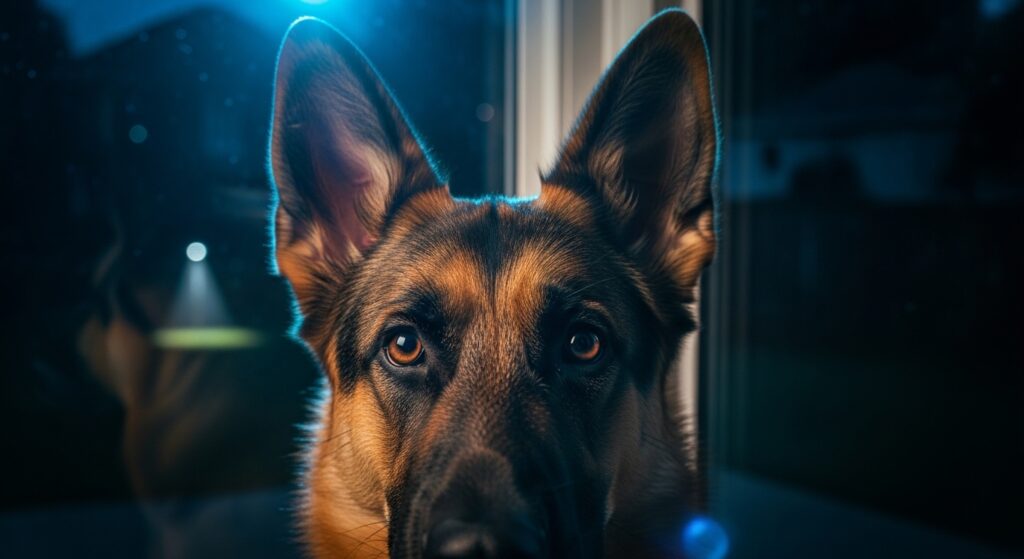
Dogs barking at nothing outside at night is one of the most common and puzzling complaints among pet owners, but the truth is your dog is almost never reacting to “nothing.” Dogs possess extraordinary sensory abilities — hearing frequencies up to 65,000 Hz, detecting scents 10,000 to 100,000 times better than humans, and seeing movement in near-darkness — meaning they routinely perceive wildlife, distant sounds, airborne odors, and environmental stimuli that are completely invisible to us. Beyond sensory triggers, nighttime barking can also stem from territorial instincts, anxiety, age-related cognitive decline, pain, learned behavior, or breed disposition. This guide explores every dimension of this behavior, from the neuroscience of canine perception to actionable, vet-approved strategies for reducing excessive nocturnal barking, helping you and your dog finally get a peaceful night’s sleep.
OUTLINE
- Understanding Canine Sensory Perception: What “Nothing” Really Means
- Common Reasons Dogs Bark at Night Outside
- Medical and Psychological Causes of Nighttime Barking
- Breed-Specific Barking Tendencies at Night
- The Role of Routine, Environment, and Conditioning
- How to Stop Your Dog from Barking at Nothing Outside at Night
- When to See a Veterinarian
- Frequently Asked Questions (FAQs)
Why Is My Dog Barking at Nothing Outside at Night? The Complete Guide
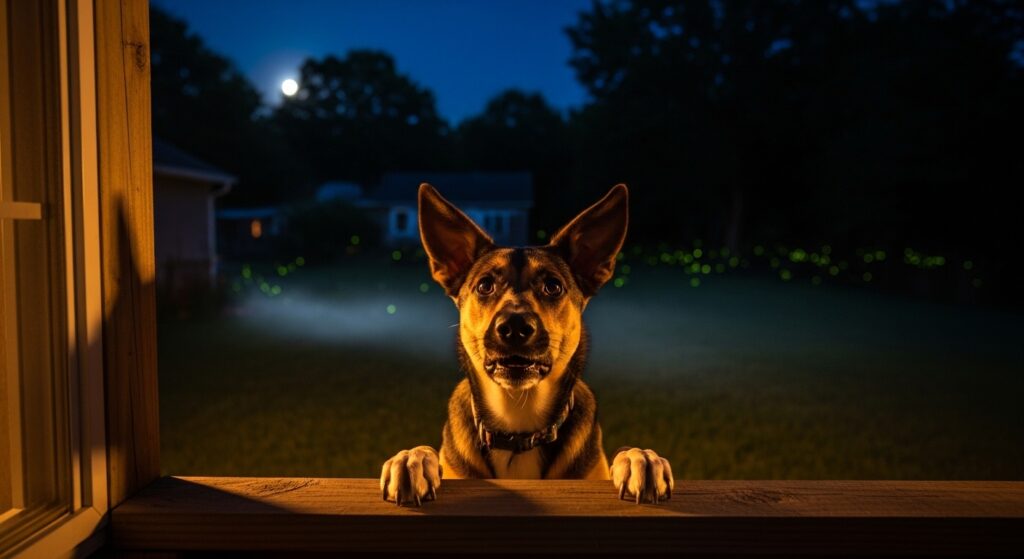
If you’ve ever watched your dog stare intensely into a dark yard, barking furiously at what appears to be empty air, you’re far from alone. This behavior confuses and frustrates millions of dog owners every year, and it often raises an unsettling question: Is my dog seeing something supernatural? The answer is almost certainly more grounded — and more fascinating — than that.
Dogs are extraordinary sensory machines. What looks like “nothing” to a human standing at the same window is, from your dog’s perspective, a richly layered sensory environment filled with scent trails, ultrasonic frequencies, and subtle movements. Understanding why your dog barks outside at night requires understanding the biology, psychology, and behavioral science behind the behavior.
Understanding Canine Sensory Perception: What “Nothing” Really Means
The single most important concept to grasp is this: when your dog barks at apparently empty space, they are not malfunctioning or being dramatic. Their senses are simply operating on a plane that human biology cannot access.
The Olfactory System — A Dog’s Superpower
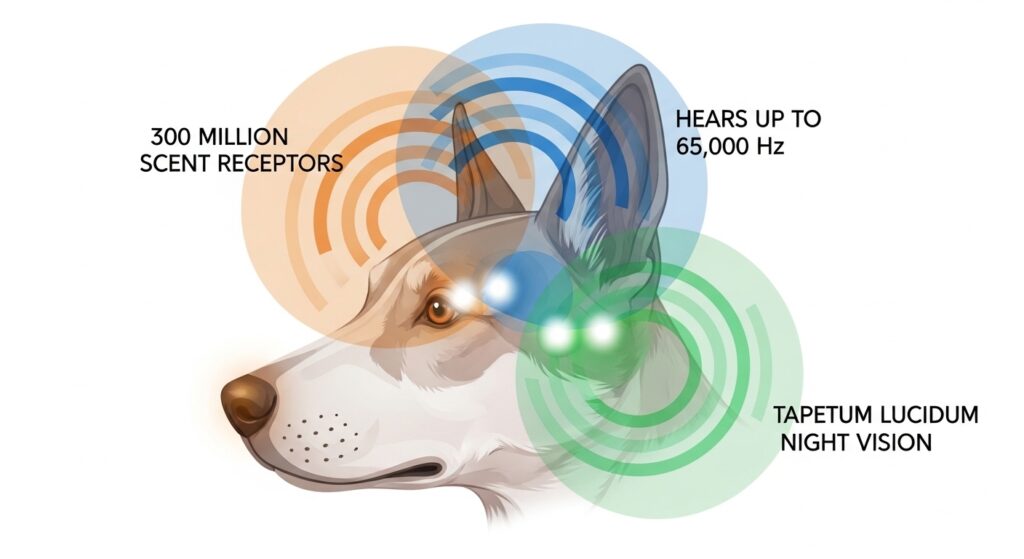
A dog’s nose contains approximately 300 million olfactory receptors compared to a human’s 6 million. The part of a dog’s brain dedicated to analyzing smells is proportionally 40 times larger than the equivalent in humans. This means your dog can detect a scent molecule that passed through your yard hours earlier — a raccoon that crossed the lawn at dusk, a fox that marked a fence post, a neighbor’s cat that slept near your porch. At night, with reduced wind and cooler, denser air, scent molecules settle closer to the ground and linger longer, actually making nighttime a peak olfactory experience for dogs.
When your dog is barking at “nothing” outside, there is very likely a scent trail present that is communicating a story your nose will never read.
Auditory Range Beyond Human Limits
The human hearing range spans roughly 20 Hz to 20,000 Hz. Dogs can hear frequencies between 40 Hz and 65,000 Hz, meaning they detect sounds in the ultrasonic range that are entirely inaudible to us. Bats echolocating overhead, rodents communicating in the walls of your fence, insects vibrating at high frequencies, even distant traffic or construction creating low-frequency rumbles — all of these can trigger a dog’s auditory attention at night when ambient noise is lower, and these sounds carry farther.
Dogs also have 18 or more muscles in each ear, allowing them to rotate, tilt, and raise each ear independently to precisely triangulate the source of a sound. Your dog barking at a corner of the yard may be pointing its ears at a sound source over half a mile away.
Visual Sensitivity in Low-Light Conditions
While dogs don’t see in complete darkness, they have several visual advantages over humans in low-light conditions. They possess a tapetum lucidum — a reflective layer behind the retina that bounces light back through the photoreceptors for a second pass, dramatically improving night vision. Dogs also have a higher rod-to-cone ratio in their retinas, making them more sensitive to motion and dim light, though less sensitive to color detail.
This means your dog can detect the flicker of a moth, the dart of a mouse across the lawn, or the sway of a branch caused by a perching animal — all in conditions you would describe as pitch black.
Common Reasons Dogs Bark at Night Outside
Wildlife, Pests, and Nocturnal Animals
This is the single most frequent explanation for dogs barking at nothing outside at night. Raccoons, opossums, skunks, deer, foxes, coyotes, squirrels, rabbits, rats, and mice are all primarily or partially nocturnal. Even if you never see them, they are moving through suburban and rural environments constantly after dark.
Your dog doesn’t need to see the animal. The scent, sound, or even the vibrations of footsteps on soil can trigger an alert response. Many dogs have a hardwired prey drive that activates the moment they detect small animals, leading to intense, sustained barking.
Seasonal patterns matter here, too. During spring, young animals disperse from nesting areas, increasing wildlife traffic through residential neighborhoods. During autumn, animals are hyperactive foraging before winter. If your dog’s nighttime barking spikes during these seasons, wildlife is almost certainly the culprit.
Environmental and Atmospheric Triggers
Changes in atmospheric pressure before storms, the sound of distant thunder (below or above the human range), lightning flickering at the horizon, the creak of trees expanding and contracting in cold air, a neighbor’s wind chimes, or even the hum of a newly installed piece of electrical equipment — all of these qualify as environmental sound triggers. Dogs experiencing noise sensitivity or sound phobia may react to these with sustained alarm barking.
Interestingly, seismic sensitivity has also been documented in dogs. There is compelling anecdotal evidence — and some scientific investigation — suggesting dogs can detect minor geological tremors or pre-seismic electrical changes in the ground before human instruments register them.
Other Dogs Barking in the Distance
Dogs communicate vocally across vast distances. When one dog in a neighborhood begins barking, it frequently sets off a chain reaction. Your dog may be responding to a dog barking three streets away — a sound you can’t hear at all. This is a form of conspecific communication, and your dog may perceive it as a warning, a challenge, or simply social information that demands acknowledgment.
Territorial and Alarm Barking
Dogs are, fundamentally, territorial animals. The yard, the perimeter of the property, and even the airspace above it can be perceived as territory worth defending. When your dog detects any intrusion — sensory or physical — into that territory after dark, alarm barking is a natural, instinctive response. This behavior is especially pronounced in guardian breeds like German Shepherds, Rottweilers, Dobermans, and livestock protection dogs.
Alarm barking at night can also be triggered by unfamiliar people walking past the fence line, delivery vehicles parking nearby, or even neighbors sitting on their porches. The darkness amplifies the dog’s uncertainty about the nature of the “intruder,” which can intensify the response.
Medical and Psychological Causes of Nighttime Barking

When behavioral and environmental explanations don’t fit — particularly in dogs that have only recently developed nighttime barking — medical causes must be considered seriously.
Canine Cognitive Dysfunction (CCD) — Doggy Dementia
Canine Cognitive Dysfunction is a neurodegenerative condition analogous to Alzheimer’s disease in humans. It is estimated to affect over 50% of dogs over the age of 11, and its hallmark symptoms include nighttime restlessness, disorientation, aimless wandering, altered sleep-wake cycles, and vocalizing — including barking — seemingly at nothing. Dogs with CCD may bark at walls, corners, or empty spaces because they are experiencing confusion, spatial disorientation, or sensory hallucinations related to neural degeneration.
If your senior dog has recently begun barking at night at nothing in particular, especially if accompanied by house-soiling, staring at walls, getting “stuck” in corners, or changes in personality, a veterinary evaluation for CCD is essential. According to the American Kennel Club’s guide on canine cognitive dysfunction, early intervention with medication, dietary supplements, and environmental enrichment can meaningfully slow the progression of the condition.
Anxiety Disorders and Fear Responses
Separation anxiety, generalized anxiety disorder, noise phobia, and situational fear are all well-documented in dogs and can manifest as nighttime barking. The reduced stimulation and quieter environment of nighttime can actually amplify anxiety in some dogs, as there are fewer distractions to mask anxious thoughts and sensory hyper-vigilance increases.
Dogs with anxiety-driven nighttime barking often display accompanying signs: panting, pacing, drooling, destructive behavior, or seeking close contact with their owner. This behavioral pattern is meaningfully different from the sharp, directional alarm bark of a dog responding to wildlife.
If your dog tends to follow you everywhere suddenly and also barks at night, it’s quite possible these behaviors are both expressions of underlying anxiety or insecurity that deserve behavioral and possibly veterinary attention.
Pain, Discomfort, and Underlying Health Conditions
Dogs in pain rarely communicate it directly. A dog suffering from arthritis, gastrointestinal distress, urinary tract infection, dental pain, or neurological discomfort may bark at night because pain worsens when they rest, when they stand from lying positions, or because the quiet of nighttime removes distractions from their suffering. Hypothyroidism, Cushing’s disease, and other hormonal disorders can also disrupt sleep and trigger nocturnal vocalization.
Any abrupt change in nighttime behavior — especially in a previously quiet adult dog — warrants a veterinary check-up. Pain is frequently underestimated in dogs because of their stoic nature.
Breed-Specific Barking Tendencies at Night
Not all dogs are equal in their inclination to vocalize. Understanding your breed’s history helps contextualize nighttime barking:
Hounds — Beagles, Basset Hounds, Coonhounds, Bloodhounds — were bred for centuries to track and vocalize when they found a scent or trail. Expecting these dogs to be silent when they detect a nocturnal animal scent is working against thousands of years of selective breeding. Terriers were bred to locate and alert to small animals; their vermin-detection instincts are deeply embedded. Guardian breeds were developed to patrol and alert — nighttime is when they feel most “on duty.” Nordic breeds like Huskies and Malamutes have a strong vocal communication tradition and may bark or howl at distant sounds that no other breed would notice.
This doesn’t mean excessive barking is inevitable or acceptable, but it does mean your training and management strategies need to be calibrated to your dog’s genetic baseline.
The Role of Routine, Environment, and Conditioning
Learned Barking Behavior
Dogs are exceptionally fast learners, and they learn what works. If your dog barked at something outside on a Tuesday night and you immediately came to the door, looked outside, talked to them, or brought them inside, your dog learned that nighttime barking produces attention and action. This is positive reinforcement of barking, even if unintentional. Over time, the barking can become habitual and self-reinforcing, occurring even when no genuine stimulus is present.
Changes in the Home Environment
A new baby, a new pet, a recently moved household, a change in the owner’s schedule, renovation work, or even rearranged furniture can generate enough anxiety to trigger new barking behaviors. Dogs are creatures of extraordinary routine sensitivity, and disruptions to their predictable world can express themselves as nighttime vocalization.
How to Stop Your Dog from Barking at Nothing Outside at Night

Training Techniques That Work
The “Quiet” command, when properly trained, is one of the most effective tools for managing barking. The key is to never reward barking with attention — instead, wait for a brief pause, then mark and reward the silence. For detailed, science-based guidance on bark training, the Humane Society of the United States offers excellent, force-free protocols grounded in positive reinforcement methodology.
The “Go to Place” or “Settle” command trains your dog to move to a specific mat or bed on cue, redirecting them from the window or door and into a calm default behavior. Combined with the Quiet command, this creates a powerful interruption sequence for nighttime barking episodes.
Environmental Management and Modifications
Blocking visual access to the yard — using frosted window film, closing curtains, or physically preventing access to the barking spot — can significantly reduce stimulus-driven barking. White noise machines or calming music played near the dog’s sleeping area can mask ambient sounds that trigger the behavior. Limiting outdoor access after a certain hour also prevents the barking from being rehearsed and reinforced by the experience of being outside.
Ensuring adequate physical and mental exercise during the day is critically important. A dog that has burned physical energy and engaged their mind is a dog that sleeps more deeply and reacts less intensely to mild nocturnal stimuli.
Desensitization and Counter-Conditioning
For dogs with sound phobia or anxiety-driven barking, a systematic desensitization program — playing recordings of triggering sounds at very low volume while pairing them with high-value treats, and gradually increasing the volume over many sessions — can reduce the emotional reactivity that drives nighttime barking. This is best done with the guidance of a certified applied animal behaviorist (CAAB) or a veterinary behaviorist.
Anti-anxiety tools such as Adaptil diffusers (synthetic dog-appeasing pheromone), calming wraps, and melatonin supplementation (always under veterinary guidance) can support the training process in anxious dogs.
When to See a Veterinarian
Schedule a veterinary appointment if your dog’s nighttime barking is sudden and unexplained in a previously quiet dog, if they are a senior dog and the barking is accompanied by confusion or disorientation, if they show signs of pain or physical discomfort, if the barking is accompanied by other behavioral changes, or if behavioral modification strategies have been properly implemented for 4–6 weeks without improvement. A vet can rule out medical causes, assess for CCD, and if needed, refer you to a veterinary behaviorist or prescribe appropriate medication to support the behavior modification program.
Frequently Asked Questions
Why does my dog bark at nothing at night but not during the day? Nighttime offers lower ambient noise, less visual clutter, and denser scent conditions — all of which make your dog’s extraordinary senses more effective, not less. Combine this with reduced household activity (meaning fewer distractions), and nighttime is actually peak alerting time for most dogs.
Is my dog seeing a ghost? Dogs do not see ghosts. They detect real-world sensory stimuli that are simply outside human perceptual range. The behavior that looks supernatural is, in reality, an extraordinary biological sensory system doing exactly what it evolved to do.
Can anxiety medication help my dog stop barking at night? In cases where anxiety is the primary driver, veterinary-prescribed medications such as fluoxetine, clomipramine, trazodone, or alprazolam can significantly reduce the emotional intensity that fuels barking. These are most effective when paired with behavior modification, not used as a standalone solution.
At what age might cognitive dysfunction cause nighttime barking? CCD can begin as early as age 9 in some breeds, but is most common in dogs 11 years and older. Giant breeds tend to show cognitive aging signs earlier than small breeds.
How long will it take to train my dog to stop barking at night? Consistent behavior modification programs typically show meaningful progress within 4–8 weeks, though results vary significantly based on the dog’s age, history, anxiety level, breed, and the consistency of the training implementation.