

Summary
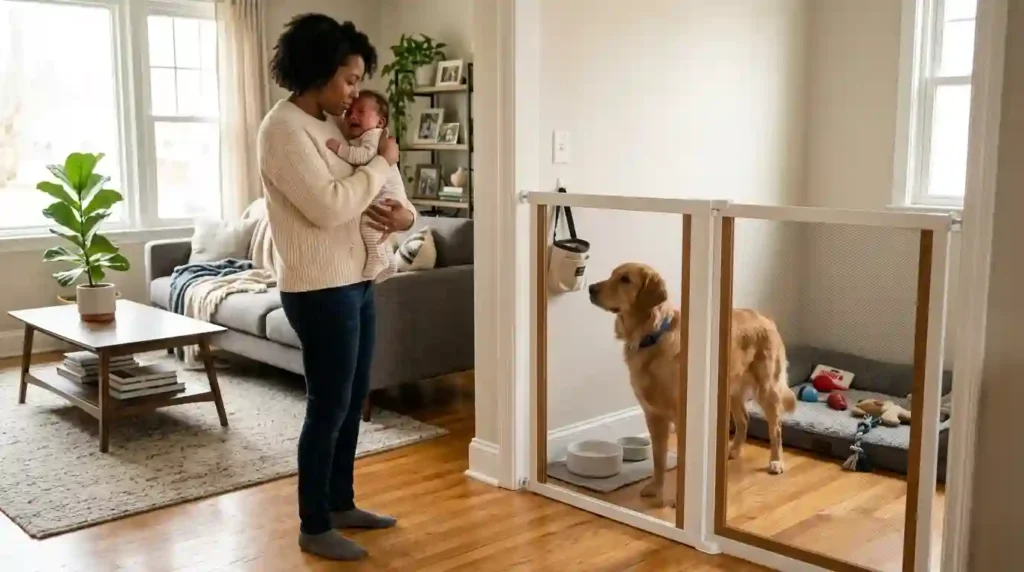
Dog barking at baby crying is usually a response to an unfamiliar sound, heightened excitement, anxiety, concern, or a sudden change in the household routine. Although barking does not automatically mean aggression, parents should take it seriously, observe the dog’s body language, and manage every interaction carefully. Creating distance, rewarding calm behavior, teaching a settle cue, and gradually helping the dog form positive associations with crying can reduce the reaction. Dogs showing growling, lunging, snapping, intense fixation, or severe anxiety should be separated from the baby and evaluated by a qualified professional.
Table of Contents
- Why Dog Barking at Baby Crying Happens
- Dog Barking at Baby Crying: Immediate Management Steps
- Understanding Your Dog’s Body Language
- A Step-by-Step Training Plan
- How to Set Up a Safer Home
- Daily Habits That Reduce Barking
- Common Mistakes to Avoid
- When to Seek Professional Help
- Conclusion
- Frequently Asked Questions
Why Dog Barking at Baby Crying Happens
A baby’s cry can be intense, unpredictable, and unfamiliar to a dog. Even a well-socialized dog may not immediately understand what the sound means or how to respond to it.
Barking is a form of canine communication. Before trying to stop it, consider what the dog may be communicating. The same behavior can result from alertness, excitement, stress, frustration, curiosity, or a desire to approach the baby.
The Crying Is New and Unfamiliar
Dogs often respond to changes in their environment. A newborn introduces new sounds, scents, equipment, visitors, schedules, and household rules.
The baby’s crying may initially function like an alarm. Your dog hears an unusual sound and barks to alert you. This is especially common in dogs that already bark at doorbells, outside noises, unfamiliar visitors, or sudden movement.
Some dogs stop reacting once the sound becomes familiar. Others continue because the barking is repeatedly reinforced or because the crying remains emotionally difficult for them.
Your Dog Is Excited or Overstimulated
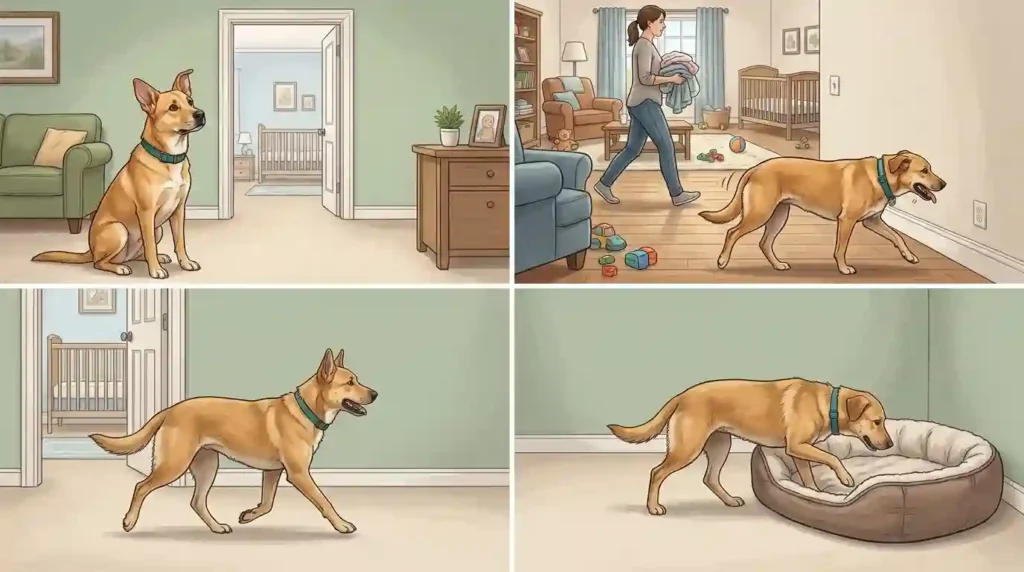
Crying can raise the energy level throughout the home. Parents may move quickly, speak urgently, turn on lights, pick up the baby, or walk from room to room. The dog can become caught up in this activity.
An overstimulated dog may bark, pace, jump, grab toys, follow the parent, or run between rooms. This does not necessarily indicate hostility toward the baby. It does mean the dog’s arousal level is too high for close interaction.
The Dog Is Anxious or Sensitive to Sound
Some dogs are more sensitive to high-pitched, sudden, or repetitive sounds. A noise-sensitive dog may bark because the crying makes it uncomfortable or anxious.
Other signs of sound-related stress can include:
- Panting when the room is not warm
- Pacing or circling
- Trembling
- Hiding
- Lip licking
- Yawning outside normal resting periods
- Refusing food
- Trying to leave the room
- Staying unusually close to a caregiver
A dog that cannot settle after the crying stops may need a more structured behavior plan.
The Dog Wants to Investigate the Baby
A socially curious dog may bark because it wants to approach, sniff, or see what is happening. Barriers such as baby gates can sometimes add frustration, especially when the dog has not been taught how to relax behind them.
Curiosity should not be mistaken for permission to approach freely. A dog can be curious and still become overwhelmed at close range.
The Dog Is Responding to Your Emotions
Dogs pay close attention to human movement, voice, posture, and routine. When a baby cries, a caregiver may become tense, tired, frustrated, or hurried. The dog may respond to the overall emotional change rather than to the crying alone.
Try to keep your own movements controlled when possible. A calm, practiced response can help the dog understand that crying is a normal household event rather than an emergency.
Barking Has Been Reinforced
Dogs repeat behaviors that produce useful outcomes. Barking may have previously caused someone to speak to the dog, make eye contact, offer food, open a gate, or allow access to the family.
Even negative attention can reinforce attention-seeking behavior. Shouting the dog’s name every time the baby cries may unintentionally teach the dog that barking begins an interaction.
The Dog Is Experiencing Trigger Stacking
Trigger stacking occurs when several mildly stressful events happen within a short period and collectively push the dog beyond its normal coping threshold.
For example, your dog may have:
- Slept poorly
- Missed its regular walk
- Encountered visitors
- Heard construction outside
- Been prevented from entering familiar rooms
- Received less attention than usual
- Then heard prolonged crying
The crying may appear to be the only cause, but it may actually be the final trigger in a stressful day.
Dog Barking at Baby Crying: Immediate Management Steps
Training is important, but immediate management comes first. Your initial goal is not to test the dog or force it to accept the sound. Your goal is to prevent unsafe contact and lower the dog’s arousal.
Create Physical Distance
Move the dog farther away from the baby using a baby gate, closed door, exercise pen, or separate room. Distance often makes it easier for a dog to think, respond to cues, and accept food.
Choose a barrier that the dog cannot jump over, push aside, or open. Barriers should create genuine separation rather than the appearance of separation.
Do not tether the dog near the baby. A restrained dog that cannot move away may feel trapped and become more distressed.
Care for the Baby Without Involving the Dog
Attend to the baby while allowing the dog to remain in its designated area. Do not invite the dog closer to “see that everything is okay” during intense barking.
If another adult is present, that person can calmly guide the dog away, offer an enrichment activity, or reward quiet behavior. When only one caregiver is available, a prepared safe zone becomes particularly valuable.
Lower the Overall Stimulation
Reduce unnecessary noise and movement. Close curtains if the dog is also reacting to outdoor activity. Turn down the television, limit visitors, and avoid shouting over the barking.
A fan, white-noise machine, or quiet instrumental audio may soften the contrast between silence and sudden crying. It should not be loud enough to distress the baby or dog.
Reward Pauses in Barking
Wait for a brief pause, even if it lasts only one second. Calmly mark the silence with a word such as “yes” and place a treat on the dog’s bed or behind the barrier.
Over time, gradually reward longer periods of quiet behavior. The dog should learn that calmness, rather than barking, produces attention and rewards.
Avoid holding food in front of a barking dog while repeatedly saying “quiet.” This can create a pattern in which the dog barks first and then waits for payment.
Avoid Punishment
Do not yell, spray the dog with water, shake a can, use a shock collar, or physically correct it. Punishment can increase anxiety and may cause the dog to associate the baby’s crying with frightening consequences.
The dog might temporarily stop barking while becoming more uncomfortable internally. A quiet dog is not always a relaxed dog.
Your goal is emotional regulation, not simple suppression of sound.
Understanding Your Dog’s Body Language
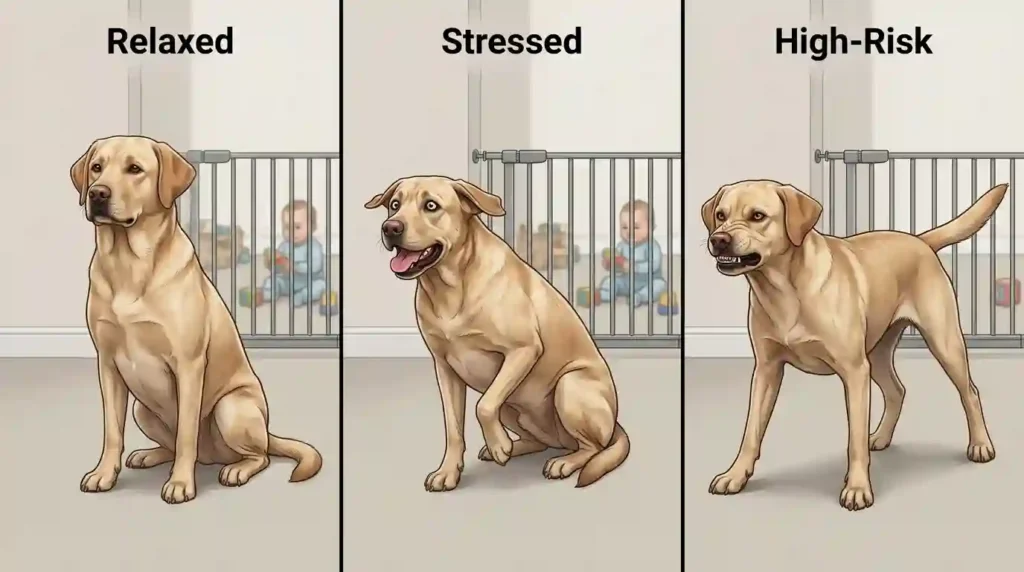
Body language provides more useful information than barking alone. Look at the entire dog, including its eyes, mouth, ears, tail, posture, movement, and ability to disengage.
Signs the Dog Is Relatively Relaxed
A dog that is coping well may display:
- A loose, curved body
- Soft facial muscles
- A gently open mouth
- Neutral ears
- Normal breathing
- A relaxed tail
- The ability to look away
- Interest in treats
- Willingness to lie down
- A normal response to familiar cues
A relaxed dog may still bark briefly, but it can recover and return to normal behavior.
Signs of Growing Stress
Create more distance when you notice:
- Repeated lip licking
- Frequent yawning
- Pacing
- Sudden scratching
- Shaking off when not wet
- Ears held back
- A lowered body
- A tucked tail
- Rapid panting
- Refusal of favorite treats
- Repeated attempts to leave
- Persistent whining
- Inability to settle
These signals suggest that the dog is struggling. Continuing the exposure may make the reaction stronger.
Warning Signs That Require Immediate Separation
End the interaction and secure the dog in another area if you observe:
- A rigid or frozen posture
- Hard staring
- Intense fixation on the baby
- A tightly closed mouth
- Raised lips
- Growling
- Snapping
- Lunging
- Charging a barrier
- Repeated attempts to reach the baby
- Guarding a parent, doorway, crib, or baby equipment
Do not punish growling. A growl is an important warning that the dog is uncomfortable. Quietly increase distance and seek professional guidance.
A Step-by-Step Training Plan
The following process uses desensitization, counterconditioning, positive reinforcement, and environmental management. Progress at the dog’s pace rather than according to a fixed timetable.
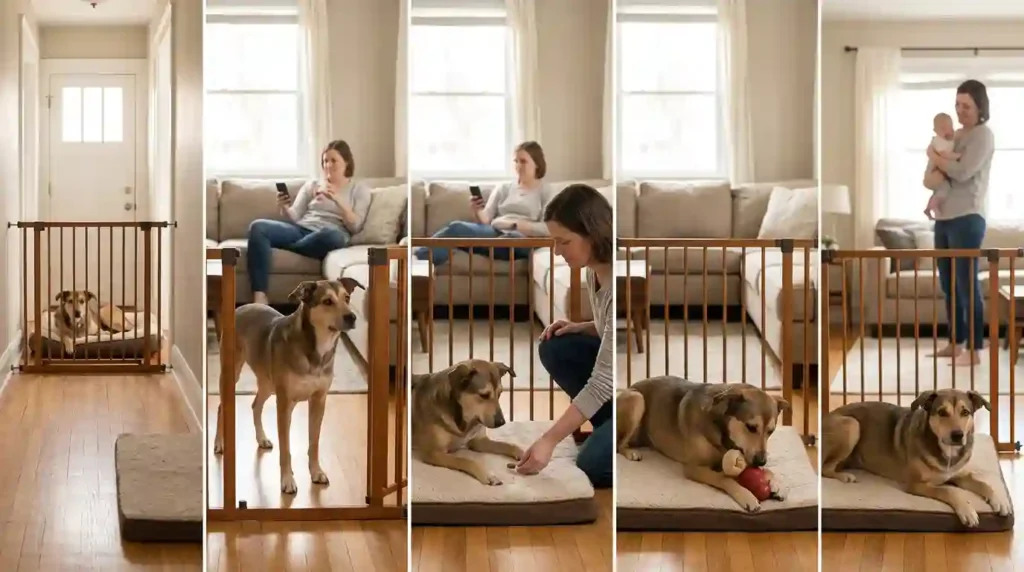
Step 1: Prepare a Safe Training Area
Choose a location where the dog can hear the baby without being close enough to become highly aroused. Set up:
- A comfortable mat or dog bed
- A secure gate or closed door
- Small, high-value treats
- A stuffed food toy
- Fresh water
- A familiar chew
- A white-noise machine, when appropriate
The dog should be able to retreat farther from the sound. A safe area should never become a place where the dog is cornered.
Step 2: Teach a Mat or Settle Cue
Practice when the baby is calm or asleep.
Place a treat on the mat. When the dog steps onto it, mark and reward the behavior. Continue rewarding the dog for standing, sitting, and eventually lying down on the mat.
Add a cue such as “mat,” “bed,” or “settle” only after the dog begins moving to the location predictably.
Keep sessions brief. Several two-minute sessions are often more productive than one long session.
Step 3: Introduce Recorded Baby Sounds at Low Volume
Use a recording only if it does not upset the baby or disturb the household. Begin at a volume low enough that the dog notices but remains relaxed.
As the sound plays, offer small treats or begin a calm enrichment activity. Stop the treats when the sound stops. This pattern teaches the dog that crying predicts something positive.
If the dog barks, freezes, refuses food, or leaves, the recording is too loud, or the dog is too close. Reduce the intensity at the next session.
Do not increase the volume until the dog remains loose and comfortable at the current level.
Step 4: Pair Real Crying With Calm Rewards
Once the dog can respond calmly to low-level recordings, use the same process during real crying.
When the baby begins to cry:
- Guide the dog to its mat or safe zone.
- Increase distance if needed.
- Offer a series of small treats for remaining calm.
- Use a stuffed food toy when the crying may continue.
- Stop food delivery when the crying ends.
- Allow the dog to rest afterward.
This is counterconditioning. The emotional goal is to change the meaning of the sound from “something alarming is happening” to “this predicts calm, safe activities.”
Step 5: Teach a Quiet Cue Separately
A quiet cue is most effective when the dog already understands what behavior earns a reward.
Practice with a mild, controllable barking trigger that is not connected to the baby. After one or two barks, present a treat near the dog’s nose. When the dog pauses to sniff, say “quiet,” mark the silence, and reward.
With repetition, begin saying the cue before presenting the treat. Gradually increase the duration of silence required.
Do not rely on a quiet cue when the dog is panicked or showing aggressive behavior. At that point, distance and safety are more important than obedience.
Step 6: Build Duration Gradually
At first, reward several short moments of calmness. Later, provide rewards less frequently and introduce longer-lasting activities such as licking mats, food puzzles, or safe chews.
A useful progression might look like this:
- One second of silence
- Three seconds of silence
- Five seconds on the mat
- Ten seconds of relaxed behavior
- Thirty seconds with a chew
- Several minutes settled behind a barrier
Progress will not always be linear. Sleep disruption, visitors, teething, schedule changes, or illness may temporarily increase barking.
Step 7: Practice With Every Caregiver
All adults in the home should follow the same basic plan. Use the same cue, the same safe area, and the same rules about access to the baby.
Inconsistency can make the dog’s behavior less predictable. For example, one person should not allow the dog to rush toward the baby while another person punishes the same behavior.
How to Set Up a Safer Home
Training is easier when the physical environment supports good decisions.
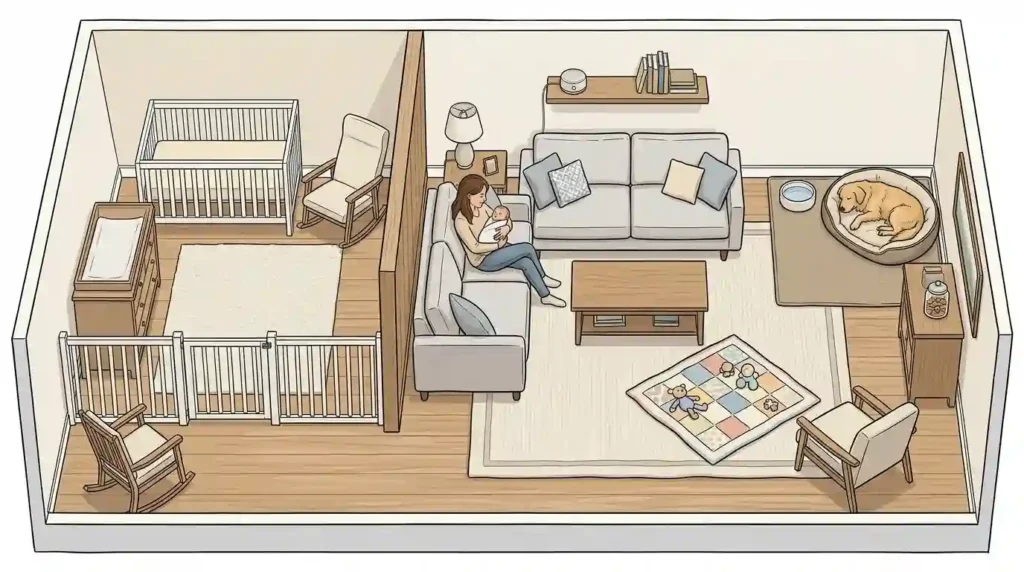
Create Dog-Free and Baby-Free Zones
The nursery, feeding area, changing station, and floor-play area may need to remain inaccessible to the dog. The dog should also have a private resting area where children will not disturb it.
A dog’s safe zone might include a crate, separate room, gated corner, or quiet bed. A crate should be introduced positively and should not be used as punishment.
Use Two Layers of Protection
When possible, use more than one safety measure. For example:
- A closed nursery door plus a hallway gate
- A playpen plus adult supervision
- A gated dog area plus a leash held by an adult
- Separate rooms during feeding or floor play
This reduces the chance that one open door, dropped leash, or moved barrier will create direct access.
Separate Dogs During High-Risk Activities
Keep the dog away when:
- The baby is on the floor
- A caregiver is feeding the baby
- The dog is eating
- The dog has a chew, bone, or valued toy
- Visitors are creating excitement
- The baby is crying intensely
- The dog is overtired or unwell
- The caregiver cannot actively supervise
Supervision means an alert adult is close enough to intervene. Being in the same home or checking a monitor is not active supervision.
The CDC’s guidance on dogs and children advises that young children should not interact with dogs without supervision, including familiar family dogs.
Plan for Future Development
A newborn is relatively stationary, but this changes quickly. Reassess your setup before the baby begins rolling, crawling, reaching, grabbing, or walking.
A dog that is comfortable with a crying newborn may react differently to a crawling child approaching its bed or food bowl. Continue using barriers and controlled exposure as the child develops.
Daily Habits That Reduce Barking
Behavior training works better when the dog’s daily physical and emotional needs are being met.
Maintain Predictable Routines
Try to keep meals, walks, toilet breaks, rest periods, and bedtime reasonably consistent. Complete predictability is impossible with a baby, but familiar anchors can help the dog adjust.
A simple routine might include a morning walk, breakfast in a puzzle feeder, a midday toilet break, a short training session, evening enrichment, and an uninterrupted sleeping period.
Provide Appropriate Exercise
Exercise can reduce restlessness, but exhausting the dog is not the goal. The type and amount should suit the dog’s age, health, breed traits, and normal activity level.
Sniffing walks, controlled play, food searches, and reward-based training often provide useful mental stimulation without increasing frantic behavior.
Protect the Dog’s Sleep
Dogs need regular, undisturbed rest. A tired dog may have a lower tolerance for noise and household activity.
Place the dog’s bed away from the nursery, television, main walkway, and frequently opened doors. Do not allow visitors or older children to disturb a resting dog.
Use Enrichment Before Difficult Periods
If the baby tends to cry during feeding, bathing, or bedtime, prepare the dog in advance. Offer a food puzzle or chew in its safe zone before the activity begins.
Proactive management is usually more effective than trying to redirect a dog that is already barking intensely.
Consider Broader Sound Triggers
Some dogs react not only to crying but also to laughter, shouting, sneezing, singing, or sudden movement. If your dog becomes vocal when people make strong sounds, the guide My Dog Bark When I Laugh Loudly explains how loud human vocalizations can become behavioral triggers.
A dog’s history can also shape its responses to particular voices, appearances, or household members. For dogs with uncertain backgrounds or selective reactions to people, see My Rescue Dog Bark at Men, specifically for a closer look at fear, socialization, and learned associations.
Common Mistakes to Avoid
Forcing the Dog to Stay Close
Repeatedly bringing the dog near a crying baby does not guarantee that it will “get used to it.” Exposure that is too intense can sensitize the dog, making its reaction stronger.
Effective desensitization begins below the dog’s stress threshold.
Allowing Face-to-Face Contact
Do not place the baby’s face near the dog’s face for photographs, greetings, or sniffing. Infants move unpredictably and cannot recognize or respond to warning signals.
Physical closeness is not necessary for a positive relationship.
Correcting the Bark Without Addressing the Cause
A verbal correction may interrupt barking briefly, but it does not resolve fear, frustration, or overstimulation. Identify the emotional and environmental causes before choosing a training strategy.
Rewarding Only After Intense Barking
If treats appear only after a long barking episode, the dog may learn a chain: hear crying, bark repeatedly, pause, receive food.
Prevent this by rewarding calm behavior early, preferably before barking begins or during the first quiet moment.
Progressing Too Quickly
One successful session does not mean the dog is ready for closer exposure or louder crying. Look for consistent relaxation across several sessions and different situations.
Assuming a Wagging Tail Means Safety
Tail movement reflects arousal and emotional activity, not friendliness by itself. A stiff, rapidly moving tail can appear alongside tension or fixation.
Evaluate the dog’s whole body rather than one signal.
Punishing Warning Signals
Growling, retreating, freezing, and avoidance provide information. Punishing these signals can make the dog less likely to communicate discomfort clearly.
Respond by increasing the distance and adjusting the environment.
When to Seek Professional Help
Some cases can be managed through structured home training. Others require professional assessment.
Contact your veterinarian when the barking begins suddenly, particularly if the dog also shows pain, confusion, sleep changes, appetite changes, reduced mobility, or unusual sensitivity to touch or sound. Medical discomfort can affect behavior and stress tolerance.
Seek help from a qualified reward-based trainer, certified behavior consultant, or veterinary behaviorist when:
- Barking is becoming more frequent or intense
- The dog cannot settle after the crying ends
- The dog refuses food around the baby
- The dog guards a parent or a room
- The dog shows severe noise sensitivity
- The dog has a bite history
- The dog growls, snaps, lunges, or freezes
- The dog repeatedly tries to cross barriers
- Family members feel unsafe
- Training has not produced improvement
A veterinary behaviorist may be appropriate when anxiety is severe, aggression is present, or medication may be part of a broader treatment plan.
Until the dog has been assessed, maintain complete physical separation from the baby. Management is not a failure. It is a responsible way to prevent the dog from rehearsing unsafe behavior.
Conclusion
A dog barking when a baby cries is communicating that something about the sound or situation has captured its attention or exceeded its current coping ability. The response may be caused by alertness, curiosity, excitement, anxiety, frustration, noise sensitivity, or accumulated stress.
Begin with safety. Separate the dog from the baby, reduce stimulation, observe body language, and reward calm behavior. Teach a reliable mat cue, introduce crying sounds gradually, and pair those sounds with positive experiences at a comfortable distance.
Do not force proximity or punish barking and growling. These approaches can increase stress and create a negative association with the baby. Consistent management, gradual training, adequate rest, enrichment, and professional guidance when necessary can help the household become calmer and more predictable.
The goal is not simply to produce a silent dog. The goal is to help the dog feel safe enough to remain relaxed while protecting the baby through thoughtful supervision and secure physical boundaries.
Frequently Asked Questions
Is It Normal for a Dog to Bark When a Baby Cries?
Yes, an initial barking response can occur because the sound is new, intense, or emotionally stimulating. Some dogs alert the household, while others become excited or anxious. Although the reaction can be understandable, it should still be managed carefully.
Does Barking Mean My Dog Wants to Hurt the Baby?
Not necessarily. Barking alone can reflect many emotional states, including curiosity, alertness, frustration, or fear. Look at the dog’s complete body language.
Rigid posture, hard staring, freezing, growling, lunging, and repeated attempts to reach the baby require immediate separation and professional help.
Should I Let My Dog Sniff the Baby When the Baby Is Crying?
No. Crying is already a highly stimulating situation. Allowing the dog to approach can increase pressure on both the dog and caregiver.
Keep the dog at a safe distance. Any introduction should occur under controlled conditions when the baby is calm and the dog is relaxed.
Should I Give My Dog Treats While the Baby Cries?
Yes, treats can be used to build a positive association, provided the dog remains below its stress threshold. Offer food for calm behavior, looking away from the baby, responding to a cue, or settling on a mat.
If the dog is too distressed to eat, increase the distance and reduce the intensity.
How Long Will It Take for My Dog to Stop Barking?
There is no universal timeline. Some dogs adjust within days, while dogs with anxiety, sound sensitivity, limited socialization, or a history of reinforcement may need weeks or months.
Progress should be measured by reduced intensity, quicker recovery, softer body language, and an improved ability to settle, not only by the absence of barking.
Can I Use a Bark Collar to Stop the Reaction?
Punishment-based bark collars are not recommended for this situation. They may suppress vocalization without changing the fear, stress, or excitement causing it. They can also create a negative association between the baby’s crying and an unpleasant consequence.
Use distance, positive reinforcement, desensitization, counterconditioning, and professional support instead.
What Should I Do if My Dog Growls at the Baby?
Immediately and calmly separate the dog from the baby. Do not scold or punish the growl. Prevent further access and contact a qualified behavior professional.
A growl is a serious sign of discomfort. Until the situation has been professionally evaluated, use secure barriers and keep the dog and baby completely separated.
Can White Noise Help My Dog Ignore the Crying?
White noise may reduce the contrast and intensity of household sounds, particularly when the dog is resting in another room. It should be used as a management tool rather than the only solution.
Continue training the dog to relax around low-intensity crying sounds while maintaining safe separation.
Will My Dog Naturally Get Used to the Baby?
Some dogs adapt as the baby’s sounds and routines become familiar, but passive exposure does not guarantee improvement. Repeated stressful experiences can make a reaction stronger.
A planned approach using gradual exposure, positive associations, predictable routines, and physical barriers is safer than waiting for the behavior to resolve by itself.