

Summary
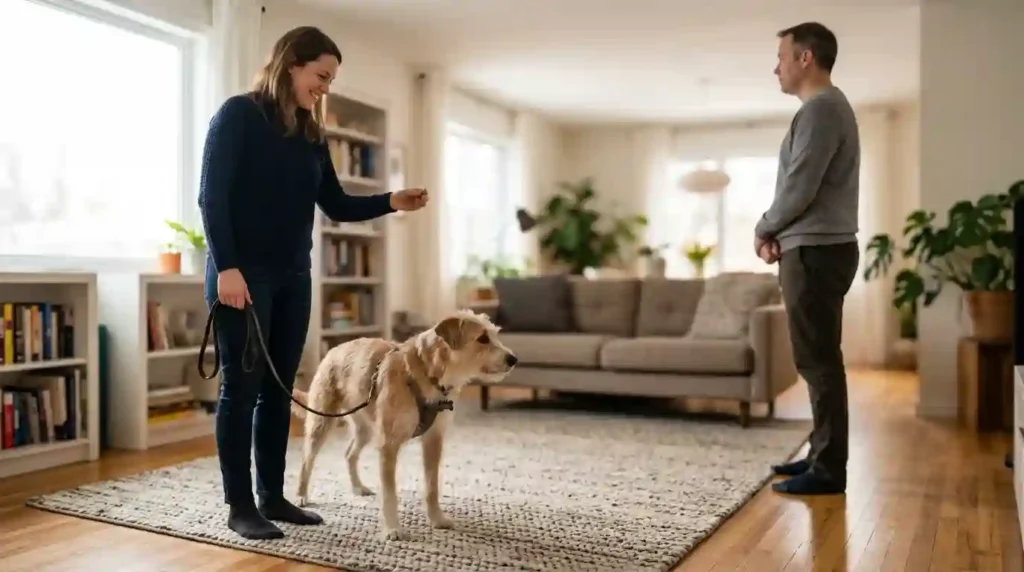
If my rescue dog bark at men specifically is the concern bringing you here, the behavior is usually rooted in fear, unfamiliarity, learned associations, or a lack of positive early experiences with different types of people. Men may appear more intimidating to some dogs because of their height, deeper voices, facial hair, clothing, posture, scent, or direct movements. A rescue dog may also associate certain masculine characteristics with a frightening event from the past, even when the current person poses no threat.
The barking should not automatically be interpreted as aggression or proof of previous abuse. Dogs bark to create distance, communicate discomfort, alert their owners, or cope with uncertainty. By identifying your dog’s triggers, keeping the dog below its fear threshold, using gradual desensitization, and creating positive associations with men, you can help your rescue dog feel safer. Progress should be measured by improved emotional comfort rather than complete silence.
Table of Contents
- Why Does My Rescue Dog Bark at Men Specifically?
- Does Barking at Men Mean My Rescue Dog Was Abused?
- Common Characteristics That May Trigger Barking
- Understanding Your Dog’s Body Language
- How Can I Stop My Rescue Dog Bark at Men Specifically?
- What Men Should Do Around a Fearful Rescue Dog
- Common Training Mistakes to Avoid
- When to Contact a Professional
- Conclusion
- Frequently Asked Questions
Why Does My Rescue Dog Bark at Men Specifically?
A rescue dog that reacts strongly to men is not being stubborn, judgmental, or deliberately difficult. Barking is communication. In many cases, the dog is saying, “I am uncomfortable,” “Please stay away,” or “I do not understand whether this person is safe.”
Dogs categorize people by noticeable features. They do not necessarily think of “men” as a social category in the same way humans do. Instead, your dog may be reacting to a combination of height, voice, movement, smell, clothing, and body shape.
Men May Look More Intimidating
On average, men may appear taller or broader than the people your rescue dog is comfortable around. A tall person standing directly over a dog can feel threatening, particularly when the dog is already anxious.
Men may also walk with a heavier step, use larger gestures, or occupy more physical space. None of these characteristics is inherently dangerous, but a nervous dog can interpret them as signs of pressure.
Even a friendly action, such as leaning over the dog to offer a hand, may increase fear. From the dog’s perspective, a large, unfamiliar person has entered its space and is reaching toward its face.
Deeper Voices Can Be Startling
A deep or loud voice may cause a stronger reaction than a soft, higher-pitched voice. This does not mean every dog dislikes deep voices. However, a rescue dog that has not experienced a wide range of voices may find them unfamiliar.
Sudden laughter, shouting, coughing, or enthusiastic conversation can also trigger barking. Some dogs respond to the sound itself, while others respond to the movement and energy accompanying it.
Dogs that react to vocal changes may display similar behavior in other situations. For example, a dog may bark when a person laughs unexpectedly. You can read more about this related behavior in My Dog Bark When I Laugh Loudly.
Facial Hair, Hats, and Clothing Can Change a Person’s Appearance
Beards, mustaches, baseball caps, hooded jackets, helmets, sunglasses, uniforms, and bulky coats can make it more difficult for a dog to read a person’s face and body.
A dog that is comfortable with a clean-shaven man may react differently when the same person grows a beard or wears a hat. This indicates that the dog may be responding to visual features rather than gender alone.
Uniforms can be especially confusing because they alter a person’s outline. Delivery workers, maintenance staff, construction workers, and people carrying tools or bags may therefore produce a stronger reaction.
Scent May Influence the Reaction
Dogs gather an enormous amount of information through scent. Cologne, tobacco smoke, workplace odors, other animals, hormonal differences, and grooming products can all affect how a person smells.
Your dog may associate a particular scent with uncertainty or a previous negative experience. In some situations, the dog is reacting to the smell rather than the person’s appearance.
Limited Socialization Can Create Fear of Unfamiliar People
Socialization is the process through which a young dog learns that different people, animals, environments, surfaces, sounds, and experiences are safe.
A dog that had limited exposure to men during puppyhood may consider male visitors unusual. This can happen in dogs raised primarily by women, dogs kept in isolated environments, stray dogs, and dogs from overcrowded facilities.
Limited socialization does not mean the dog cannot improve. It simply means the dog may need slower, more structured introductions.
Does Barking at Men Mean My Rescue Dog Was Abused?
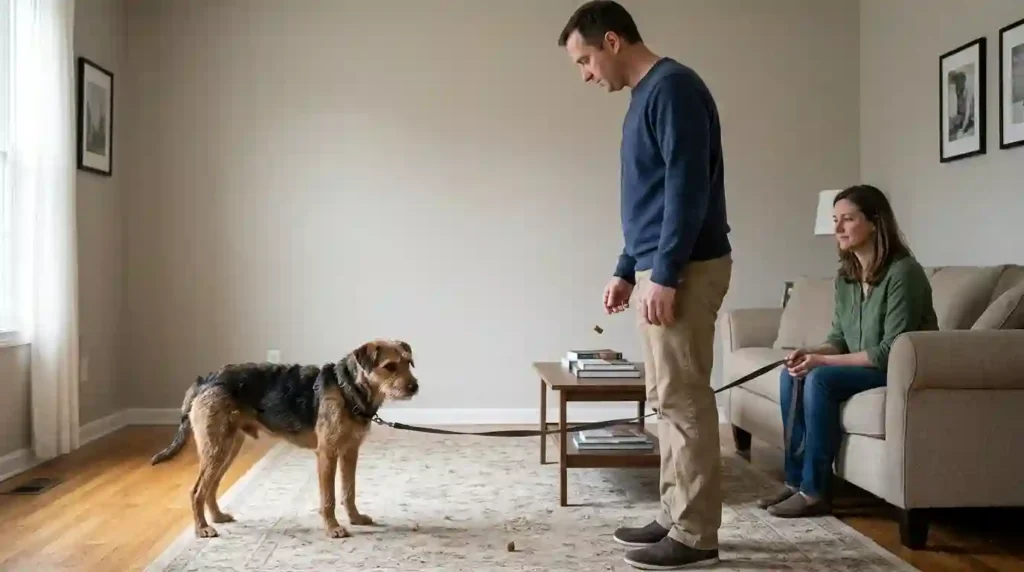
Not necessarily. It is understandable to suspect abuse when a rescue dog shows fear around a specific type of person, but behavior alone cannot confirm what happened in the dog’s past.
A dog may bark at men because of:
- Poor early socialization
- A single frightening encounter
- General anxiety
- Sensitivity to size or movement
- Territorial behavior
- Frustration caused by a leash or barrier
- Learned barking that successfully makes people move away
- Pain or physical discomfort
- Genetic temperament
- Stress from entering a new home
Previous mistreatment is possible, but it is only one explanation. Rescue histories are often incomplete, and constructing a dramatic story about the dog’s past may distract from what the dog needs now.
The more useful question is not, “What exactly happened?” It is, “What is my dog communicating, and how can I make this situation feel safer?”
Why Barking Can Become a Learned Strategy
Suppose a man approaches your dog. Your dog barks, and the man steps back. From the dog’s perspective, barking worked. It created distance from something frightening.
This pattern can strengthen over time:
- A man appears.
- The dog feels unsafe.
- The dog barks.
- The man stops, moves away, or leaves.
- The dog experiences relief.
The relief reinforces the behavior. This does not mean the dog is manipulating anyone. The dog has simply learned that barking is an effective safety strategy.
Punishing the barking may suppress the warning temporarily, but it does not change the fear underneath it. In some cases, suppressing warning signals can make behavior less predictable because the dog may stop barking while remaining deeply uncomfortable.
Common Characteristics That May Trigger Barking
Your dog may not react equally to every man. Identifying specific patterns will help you create a more effective behavior plan.
Height and Body Shape
A dog may be comfortable around shorter men but bark at tall or broad-shouldered men. Observe whether the intensity of the reaction changes according to the person’s size.
Direct Eye Contact
Prolonged staring can feel confrontational to a nervous dog. Many people look directly at a dog because they are trying to be friendly, but a fearful dog may interpret direct attention as social pressure.
Fast or Unpredictable Movement
Reaching, bending, running, waving, carrying large objects, or walking directly toward the dog may trigger defensive barking.
Children can produce similar reactions because their movements are fast and unpredictable, even though they do not resemble adult men.
Entering the Home
Some rescue dogs remain calm when they see men outdoors, but bark when a man enters the house. This suggests a territorial, proximity-related, or visitor-specific component.
The dog may feel trapped indoors because it has fewer options for moving away. Doorbells, knocking, and the excitement surrounding a visitor’s arrival can also increase arousal before the dog sees the person.
Approaching While the Dog Is Restrained
A leash, crate, window, fence, or baby gate may intensify barking because the dog cannot create distance naturally. This is sometimes described as barrier frustration or leash reactivity, although fear may still be the main emotion.
Loud Media and Recorded Sounds
Some dogs generalize their reactions to voices or barking heard through televisions, phones, and computers. A dog that responds to unfamiliar sounds may also react when canine vocalizations play through a speaker. The article Dog Barking at the Sound of Other Dogs on YouTube explains why recorded sounds can trigger alert barking, confusion, or social responses.
Keeping a trigger diary can reveal patterns that are easy to miss in the moment. Record the location, distance, person’s appearance, dog’s body language, intensity of barking, and how long recovery took.
Understanding Your Dog’s Body Language
Barking should be evaluated alongside the rest of the dog’s body. A bark can signal fear, alarm, excitement, frustration, territorial behavior, or social interest.
Signs of Fear or Anxiety
A fearful dog may show:
- Ears pulled back
- Tail lowered or tucked
- Body leaning away
- Crouched posture
- Lip licking
- Yawning outside a sleepy context
- Wide eyes or visible eye whites
- Trembling
- Panting when the environment is not hot
- Avoiding eye contact
- Hiding behind the owner
- Refusing treats
- Attempting to escape
Growling, lunging, snapping, and showing teeth can also occur when a fearful dog believes its earlier signals have not created enough distance.
Signs of Alert or Territorial Barking
A dog displaying alert behavior may stand tall, orient toward the person, hold its tail higher, move forward, and produce sharp, repeated barks.
However, alertness and fear can occur together. A dog may move forward while still feeling conflicted and unsafe.
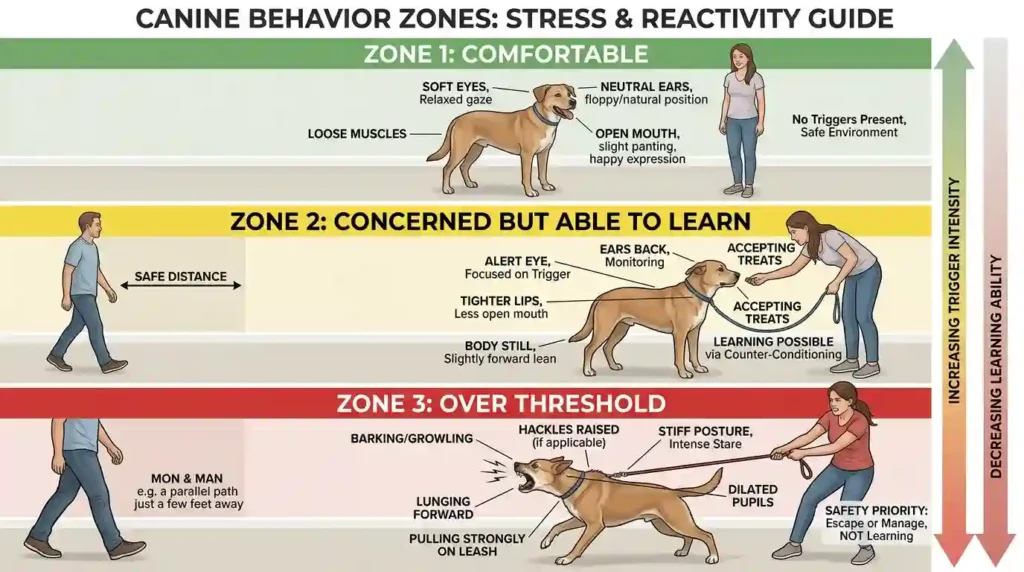
What Is a Dog’s Fear Threshold?
The fear threshold is the point at which a dog becomes too distressed to learn effectively. Below threshold, the dog notices the trigger but can still eat, respond to familiar cues, sniff the ground, and disengage.
Above threshold, the dog may bark continuously, lunge, freeze, panic, or refuse food.
Training should begin at a distance or intensity where the dog remains below threshold. If your dog is already barking uncontrollably, the man is probably too close, moving too quickly, or interacting too directly.
How Can I Stop My Rescue Dog Bark at Men Specifically?
The goal is not to force your dog to tolerate men. The goal is to change the dog’s emotional response from fear or alarm to safety and predictability.
This process usually involves management, desensitization, counterconditioning, and reward-based training.
Begin With Management
Management prevents your dog from repeatedly practicing intense barking. It also protects visitors and gives the dog room to recover.
Useful management strategies include:
- Increasing distance from men during walks
- Crossing the street before the dog reacts
- Using curtains or window film to reduce visual triggers
- Placing the dog behind a baby gate before opening the door
- Giving the dog access to a quiet room during gatherings
- Asking visitors to ignore the dog
- Using a secure harness and standard leash
- Avoiding crowded environments during early training
Management is not a failure. It creates the conditions needed for learning.
Use Desensitization
Desensitization means introducing the trigger at a low enough intensity that the dog remains calm.
For example, your dog may notice a man standing 50 feet away without barking. That distance is your starting point. Over several sessions, the distance can gradually decrease, but only while the dog remains relaxed.
Progress should be slow. Moving too close too quickly is called flooding. Flooding can increase fear because the dog is forced to endure an overwhelming situation without an effective escape option.
Pair Men With Something Positive
Counterconditioning changes the dog’s emotional association with the trigger.
The basic exercise is simple:
- A man appears at a safe distance.
- You immediately give your dog high-value treats.
- The man remains neutral and does not approach.
- When the man disappears, the treats stop.
- The process is repeated during short sessions.
Over time, the appearance of a man predicts something pleasant. Instead of thinking, “A frightening person is approaching,” the dog begins to anticipate food and safety.
The American Veterinary Society of Animal Behavior provides a useful explanation of desensitization and counterconditioning for fearful dogs, including the importance of working at an intensity the dog can handle.
Choose Truly High-Value Rewards
Regular kibble may not be valuable enough when your dog is worried. Consider small pieces of cooked chicken, cheese, turkey, or another veterinarian-approved food your dog loves.
Treats should be small so the dog can receive many repetitions without consuming a full meal.
If the dog refuses a normally desirable treat, increase the distance from the trigger. Refusing food often indicates that the dog is too stressed to participate comfortably.
Teach an Alternative Behavior
Once your dog can remain below threshold, teach a simple behavior that provides structure.
Useful options include:
- Looking at you
- Touching your hand with its nose
- Turning away from the trigger
- Walking with you in the opposite direction
- Moving to a mat
- Finding treats scattered on the ground
- Standing behind you
A cheerful “find it” cue can be particularly useful. Say “find it” and scatter several treats on the ground. Sniffing can help redirect attention and move the dog away from a person without physical force.
Keep Training Sessions Brief
A five-minute successful session is more valuable than a 30-minute session that ends with the dog overwhelmed.
Stop while your dog is still comfortable. Give the dog time to decompress through sleep, sniffing walks, chewing, and calm activities.
Dogs can experience trigger stacking, which occurs when several stressful events accumulate. A visitor, loud vehicle, unfamiliar dog, and grooming appointment on the same day may produce a stronger reaction than any single event alone.
Let the Dog Control the Distance
Choice is particularly important for fearful rescue dogs. Do not hold the dog in place while a man approaches. Do not corner the dog or require it to accept petting.
Allow the dog to move away. Knowing that escape is possible can reduce the perceived need to bark or lunge.
What Men Should Do Around a Fearful Rescue Dog
The behavior of the person matters as much as the behavior of the dog.
Ignore the Dog at First
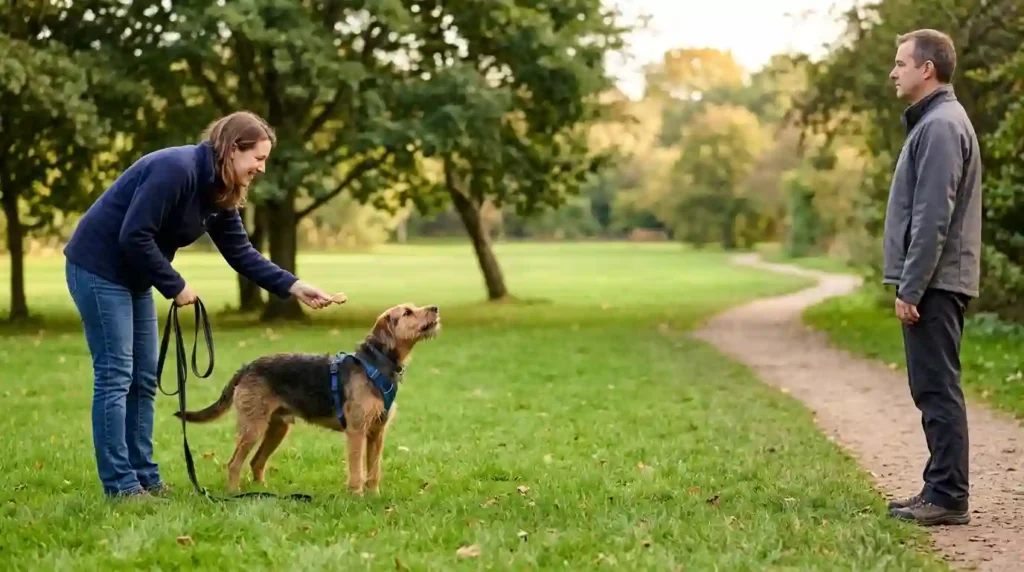
The safest introduction often involves no introduction at all. The man should avoid approaching, staring, calling the dog, reaching toward it, or attempting to pet it.
Ignoring the dog removes social pressure and allows observation from a safe distance.
Turn Sideways
A side-facing posture is usually less intimidating than a direct, frontal approach. The person should keep movements slow and predictable.
Sitting in a chair can reduce a person’s apparent size, but only when the chair does not trap the dog in a narrow space.
Toss Treats Away From the Body
A man can gently toss treats past the dog rather than encouraging the dog to come closer. This allows the dog to collect food and retreat.
Luring a fearful dog toward a person with food can create conflict. The dog may approach because it wants the treat, then panic after realizing how close it has come.
Treats should create a positive association, not pressure the dog into physical proximity.
Avoid Reaching Over the Head
Many dogs dislike hands moving directly over their heads, especially when the person is unfamiliar. If the dog eventually initiates contact, brief petting on the chest or side may be less threatening.
Contact should stop after a few seconds. If the dog moves closer, petting can continue. If the dog turns away, stiffens, licks its lips, or leaves, the interaction should end.
Common Training Mistakes to Avoid
Punishing the Barking
Yelling, leash corrections, shock collars, spray collars, and physical punishment may make the presence of men even more negative.
The dog may begin to associate men with both fear and punishment. Punishment can also suppress communication without resolving the underlying emotion.
Forcing Social Interaction
Do not ask men to surround the dog, hold out their hands, corner the dog, or repeatedly attempt to pet it. Forced interaction may confirm the dog’s belief that men do not respect its warnings.
Moving Too Quickly
A dog that accepts treats from a man at 20 feet is not necessarily ready for petting. Emotional progress often occurs in small stages.
The appropriate sequence may be seeing a man, staying relaxed near a man, walking parallel to a man, approaching voluntarily, sniffing, and only then considering touch.
Training Only During Real-Life Emergencies
Training is difficult when an unexpected visitor is already at the door. Arrange controlled practice sessions with a calm male volunteer who can follow instructions.
The volunteer should not be emotionally invested in winning the dog over. Quiet neutrality is usually more helpful than enthusiastic friendliness.
Expecting Progress to Be Linear
Your dog may perform well one day and struggle the next. Sleep, pain, environmental changes, previous triggers, weather, location, and the person’s appearance can all affect behavior.
Evaluate progress across several weeks rather than judging a single encounter.
When to Contact a Professional
Professional support is recommended when:
- The dog has bitten or attempted to bite
- Barking progresses to lunging or snapping
- The dog cannot recover after the trigger leaves
- The behavior occurs at very large distances
- The dog redirects aggression toward the owner or another animal
- Visitors cannot enter the home safely
- The behavior is becoming more frequent or intense
- The dog shows severe anxiety in several situations
- You feel unable to manage the dog safely
Look for a qualified reward-based trainer, Certified Applied Animal Behaviorist, veterinary behaviorist, or experienced behavior consultant. Professionals should use gradual exposure, positive reinforcement, and practical safety management.
A veterinarian should also evaluate sudden behavioral changes. Pain, impaired vision, hearing changes, neurological conditions, and other health problems may lower a dog’s tolerance for unfamiliar people.
Medication may be appropriate for some dogs with severe anxiety, but it should be discussed with a veterinarian. Medication does not replace behavior modification. It may help reduce anxiety enough for learning to occur.
How Long Will It Take for My Rescue Dog to Trust Men?
There is no universal timeline. Some dogs improve within several weeks, while others require months of careful work.
Progress depends on:
- The severity of the fear
- How often does the dog encounter triggers
- The dog’s ability to maintain distance
- The consistency of training
- The skill of the people involved
- The dog’s physical health
- The stability of the home environment
- Whether barking has been practiced for a long time
Signs of improvement may include taking treats sooner, recovering faster, barking fewer times, choosing to look away, displaying softer body language, or remaining in the room at a greater distance.
Your dog does not need to become socially enthusiastic about every man. Calm neutrality is a realistic and valuable goal.
Conclusion
When a rescue dog barks at men, the behavior is usually an attempt to manage discomfort rather than an expression of hatred or disobedience. The dog may be reacting to height, voice, facial hair, movement, scent, clothing, direct attention, or limited socialization.
You may never know exactly what happened before your dog entered your home, and you do not need a complete history to help. Observe the dog in front of you. Identify the characteristics and situations that trigger barking, create a safe distance, and prevent overwhelming encounters.
Use management to reduce stressful repetitions. Pair the sight of men with valuable rewards, allow your dog to control proximity, and ask male visitors to remain calm and neutral. Avoid punishment, forced greetings, and rushed exposure.
The most meaningful sign of progress is not that your dog becomes silent. It is that your dog feels less threatened, recovers more quickly, and gains confidence in your ability to keep interactions safe.
Frequently Asked Questions
Why does my rescue dog bark at men but not women?
Your dog may have had more positive experiences with women or may find certain male characteristics unfamiliar. Height, deep voices, facial hair, posture, scent, and heavier movement can all influence the response. The behavior does not prove that a man previously abused the dog.
Should I let men give my dog treats?
Yes, but the method matters. At first, the man should toss treats away from himself rather than asking the dog to approach his hand. This creates a positive association while preserving the dog’s ability to retreat.
Should a man stare at my dog to show confidence?
No. Direct eye contact can feel threatening to a fearful dog. The man should turn slightly sideways, avoid staring, move slowly, and allow the dog to observe without pressure.
Why does my dog bark more when men enter the house?
The dog may feel territorial or trapped because indoor spaces provide fewer escape options. Knocking, doorbells, sudden entry, and visitor excitement can also raise arousal. Place the dog behind a barrier or in a quiet room before opening the door.
Can I punish my rescue dog for barking at men?
Punishment is unlikely to resolve the fear causing the barking. It may make the dog associate men with additional discomfort and can suppress warning signals. Use distance, management, desensitization, counterconditioning, and reward-based training instead.
Will socializing my dog with many men solve the problem?
Not when exposure is uncontrolled. Repeatedly placing a fearful dog near men can increase fear if the dog becomes overwhelmed. Social exposure must occur gradually, at a safe distance, and with the dog below its fear threshold.
Why does my dog bark at some men but not others?
Your dog may react to specific characteristics such as beards, hats, deep voices, uniforms, direct movement, body size, or scent. Keep notes about each encounter to identify consistent patterns.
What should I do when my dog barks at a man during a walk?
Create distance without scolding the dog. Cross the street, turn around, move behind a visual barrier, or scatter treats on the ground. Once the dog can observe the person calmly, reward quiet attention and disengagement.
Can a rescue dog completely overcome its fear of men?
Many dogs improve significantly, although outcomes vary. Some become comfortable interacting with men, while others achieve calm neutrality without seeking contact. Both outcomes can represent meaningful success.
When is barking at men considered dangerous?
Seek professional help when barking includes lunging, snapping, biting, redirected aggression, prolonged inability to recover, or behavior that cannot be managed safely. Use physical distance and secure barriers while arranging professional support.