

Summary
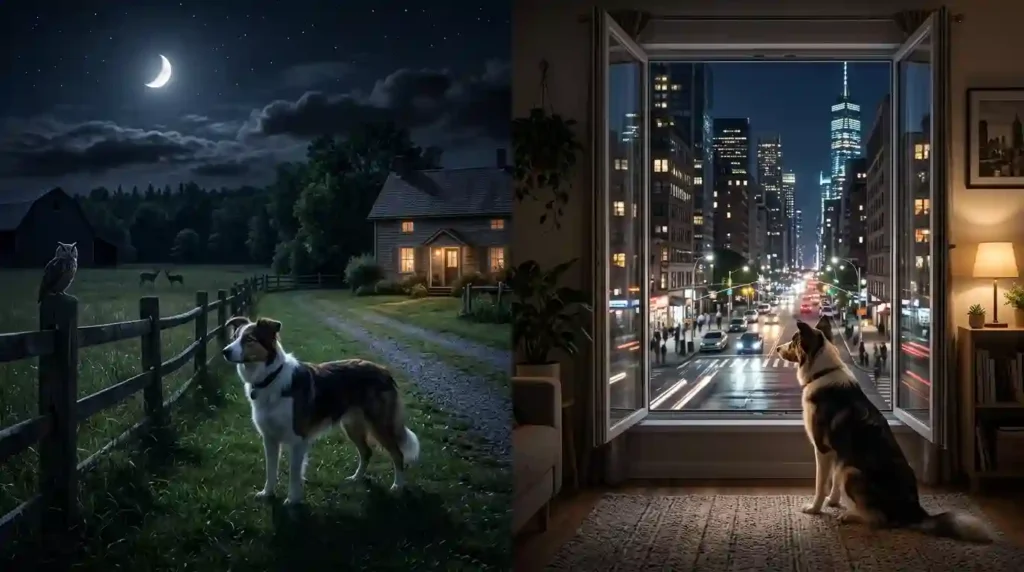
Dog barking at night in rural vs. urban areas can happen for very different reasons, even when the sound feels the same to tired owners and frustrated neighbors. In rural areas, dogs often bark at wildlife, livestock, distant movement, predators, wide-open property lines, and unfamiliar sounds carried across quiet land. In urban areas, nighttime barking is more commonly triggered by traffic, neighbors, apartment noises, sirens, delivery workers, other dogs, elevators, hallway footsteps, and limited outdoor space.
Understanding the environment is the first step to solving nighttime barking. A dog on a farm may be doing alert work, guarding territory, or responding to coyotes, deer, raccoons, or livestock movement. A dog in an apartment may be reacting to thin walls, boredom, separation anxiety, street noise, or repeated human activity outside the door.
The goal is not to silence a dog completely. Barking is a normal form of canine communication. The ASPCA explains that dogs bark for many reasons, including territorial behavior, alarm barking, attention-seeking, greeting, frustration, and social barking. The real goal is to identify the trigger, reduce unnecessary stimulation, improve nighttime comfort, and train a calmer response.
Table of Content
- Why Dogs Bark at Night
- Dog Barking at Night in Rural vs. Urban Areas: Key Differences
- Dog Barking at Night in Rural vs. Urban Areas: Common Triggers
- Rural Nighttime Barking: Causes and Solutions
- Urban Nighttime Barking: Causes and Solutions
- How Noise Travels Differently in Rural and Urban Areas
- How to Stop Night Barking Humanely
- When Barking Becomes a Health or Behavior Concern
- Conclusion
- FAQs
Why Dogs Bark at Night
Dogs bark at night because they are responding to something. Sometimes the trigger is obvious, like a passing car, a stray cat, a neighbor walking home, or another dog barking nearby. Other times, the reason is harder to identify because dogs can hear, smell, and detect movement far better than humans.
Nighttime barking may come from:
- Territorial instincts
- Alarm barking
- Wildlife or outdoor movement
- Loneliness or separation anxiety
- Boredom and excess energy
- Hunger, thirst, or bathroom needs
- Pain, discomfort, or aging-related confusion
- Noise sensitivity
- Lack of routine
- Poor sleep environment
- Reinforced barking behavior
A key point is that rural and urban dogs often bark for different environmental reasons. The same dog may behave calmly in a quiet house but bark constantly in an apartment building. Another dog may sleep peacefully in the city but become highly alert on a farm because of unfamiliar animal scents, wide-open space, and nighttime wildlife activity.
Barking Is Communication, Not “Bad Behavior”
Barking is one of the main ways dogs communicate. A bark can mean “someone is near the house,” “I am scared,” “I am bored,” “I want attention,” “I heard another dog,” or “something feels wrong.” The ASPCA notes that barking can serve different functions, and reducing it successfully depends on understanding the dog’s motivation first.
That is why punishment alone rarely solves the problem. Yelling, shock collars, or harsh corrections can increase anxiety and make barking worse, especially at night when the dog is already alert or uncertain.
Nighttime Makes Triggers Stronger
At night, the world changes for dogs. Human activity decreases, background noise drops in some areas, shadows become more noticeable, and small sounds become more important. A dog may hear a gate move, a fox crossing a field, footsteps in a hallway, or a delivery truck blocks away.
For some dogs, darkness itself increases alert behavior. For others, nighttime is when boredom or loneliness becomes strongest because the family is asleep and the dog has fewer outlets.
Dog Barking at Night in Rural vs. Urban Areas: Key Differences
Dog barking at night in rural vs. urban areas differs mainly because the environment is different. Rural dogs are often exposed to natural sounds, wildlife, livestock, large yards, open fields, and fewer human-made barriers. Urban dogs are surrounded by people, traffic, buildings, shared walls, elevators, sirens, delivery services, and other pets living close together.
Rural Areas: More Space, More Natural Triggers
In rural areas, a dog may bark at:
- Coyotes, foxes, raccoons, deer, skunks, or stray animals
- Livestock movement
- Farm equipment
- Distant vehicles on gravel roads
- Wind through trees or barns
- Other dogs barking across fields
- People approaching long driveways
- Unfamiliar scents carried by wind
- Night birds or rustling brush
A rural dog may also have a stronger guarding role. Some dogs are expected to alert owners to predators, trespassers, or livestock disturbance. This can make the line between useful barking and excessive barking harder to define.
Urban Areas: Less Space, More Human Noise
In urban areas, dogs are often exposed to constant human activity. Even at night, there may be:
- Cars and motorcycles
- Sirens and emergency vehicles
- Apartment hallway noise
- Elevators and stairwells
- Neighbors talking
- Trash collection
- Food delivery drivers
- Other dogs barking through walls
- Construction or street cleaning
- People walking near windows or doors
Urban dogs may bark more because they are close to triggers but unable to investigate them. A dog in a high-rise apartment can hear footsteps outside the door but cannot see who is there. That uncertainty can create repeated alarm barking.
Dog Barking at Night in Rural vs. Urban Areas: Common Triggers
Although rural and urban environments are different, many barking triggers overlap. The difference is usually the source, frequency, and intensity of the trigger.
Territorial Barking
Territorial barking happens when a dog believes someone or something is approaching its space. In rural homes, the territory may include the yard, driveway, barn, pasture, or property edge. In urban homes, the territory may be the apartment door, balcony, window, hallway, or fenced patio.
The ASPCA describes territorial barking as barking in response to people, dogs, or animals within or approaching a dog’s territory. This is why a rural dog may bark at a deer near the fence, while an urban dog may bark at someone walking past the apartment door.
Alarm Barking
Alarm barking is not always territorial. A dog may bark at any sudden sound or movement, even if it is not close to the home. This is common in both rural and urban settings.
In rural areas, alarm barking may be triggered by coyotes howling, branches scraping a window, or animals moving near a shed. In urban areas, it may be triggered by car doors, loud music, people shouting, or scooters passing outside.
Social Barking
Dogs often bark when they hear other dogs. This is called socially facilitated barking. In rural communities, one barking dog can start a chain reaction across nearby properties. In cities, one dog barking in an apartment building can trigger several others.
This type of barking can be difficult because your dog may not be the original cause. Your dog is reacting to a sound pattern that feels socially important.
Boredom and Frustration
A dog that sleeps all day, receives little mental stimulation, or lacks evening exercise may become restless at night. This can happen anywhere, but the pattern looks different depending on the environment.
A rural dog may pace along a fence line and bark into the dark. An urban dog may bark from a crate, balcony, or window because it has unused energy and no outlet.
Separation Anxiety
Some dogs bark at night because they feel isolated. This is especially common when a dog sleeps outside, in a separate room, or away from the owner. The barking may sound repetitive, panicked, or distressed.
Separation-related barking is not solved by simply telling the dog to be quiet. The dog needs emotional security, gradual independence training, and a predictable sleep routine.
Rural Nighttime Barking: Causes and Solutions
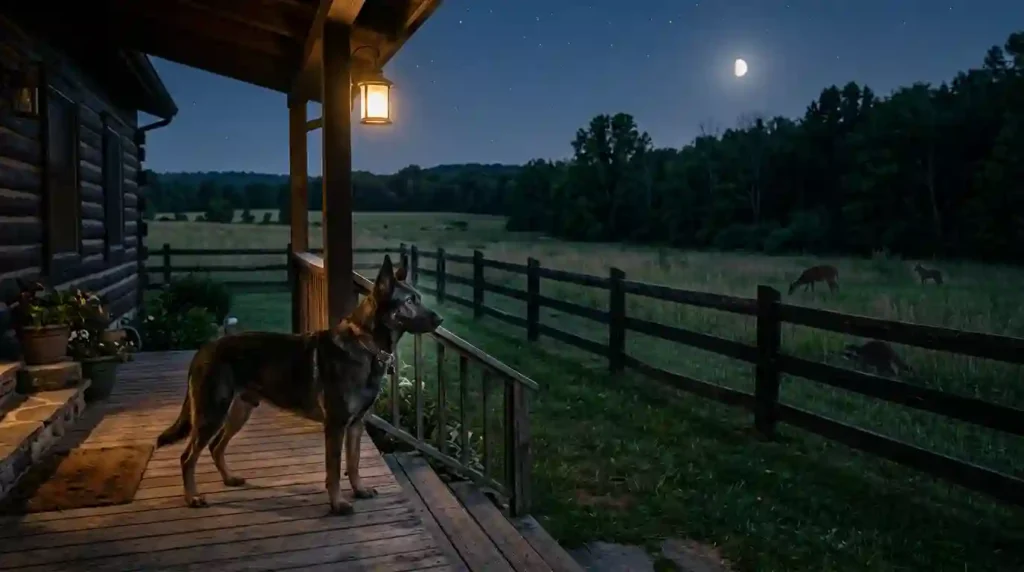
Rural living gives dogs more space, but it also exposes them to more unpredictable nighttime activity. A dog may feel responsible for watching over a large property, livestock, equipment, and family members.
Wildlife and Predator Activity
One of the biggest causes of rural nighttime barking is wildlife. Dogs may bark at coyotes, foxes, raccoons, opossums, deer, stray cats, snakes, or other animals near the property. Even when humans cannot see anything, dogs may hear or smell movement.
Solution: Reduce Outdoor Access at Peak Barking Times
Bring your dog indoors during the most active wildlife hours, especially late evening and early morning. If the dog must be outside, create a secure, smaller nighttime area away from property edges, livestock pens, and wooded boundaries.
Use motion lights carefully. They can help owners see what is happening, but they may also make some dogs more reactive if every movement becomes visible.
Livestock and Farm Sounds
Rural dogs often bark at livestock movement, especially if animals shift, vocalize, or become startled at night. Guardian breeds may bark as part of their job, while companion dogs may bark because they are confused or excited by the movement.
Solution: Separate Companion Dogs From Working Zones
If your dog is not a trained livestock guardian, avoid giving it overnight access to barns, pens, or pastures. A companion dog that barks at livestock all night may stress the animals and reinforce its own alert behavior.
Long Driveways and Property Boundaries
Rural dogs often monitor long driveways and open property lines. A distant vehicle, person, or animal may trigger barking long before the owner notices anything.
Solution: Create a Smaller “Night Territory”
Instead of allowing the dog to patrol the entire property, create a quiet nighttime sleeping space. This may be a mudroom, indoor crate, enclosed porch, insulated kennel, or bedroom corner. The smaller the perceived territory, the less the dog feels responsible for guarding.
Echo and Distance
Rural nights can be extremely quiet. Because there is less traffic and background sound, a single bark may travel far. Owners may assume barking is not disturbing anyone because neighbors are far away, but sound can carry across fields, valleys, and open land.
Solution: Do a Night Sound Check
Stand outside at different distances while another person stays with the dog. Listen from the road, property edge, or near the neighbor-facing side of the home. This helps you understand how loud the barking really is.
Urban Nighttime Barking: Causes and Solutions
Urban dogs live close to people, buildings, and constant movement. They may bark more frequently because triggers are close, sudden, and repetitive.
Apartment Hallways and Shared Walls
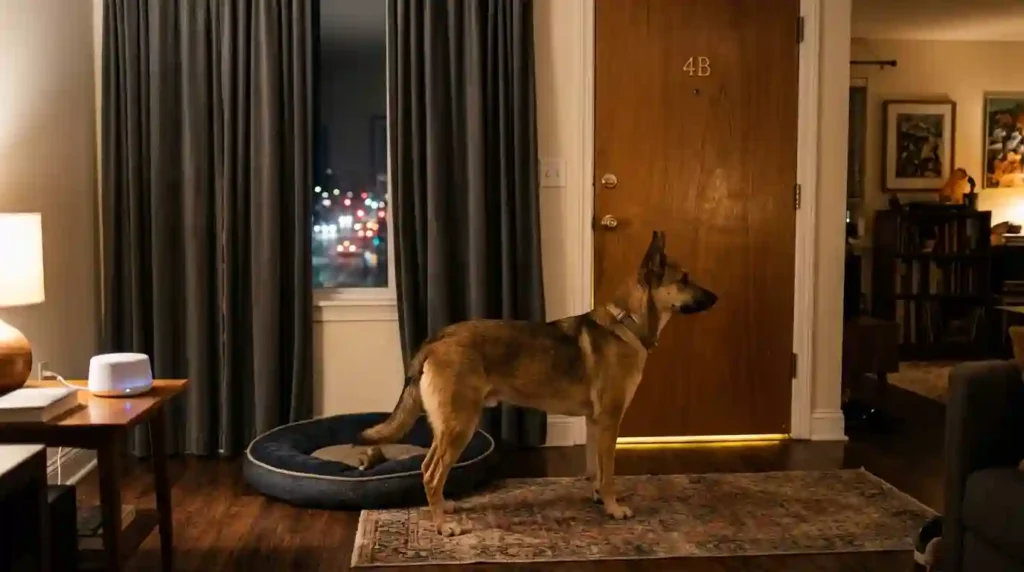
Dogs in apartments often bark at hallway footsteps, elevator doors, neighbors talking, or keys turning in locks. From the dog’s perspective, these sounds happen right outside the den.
Solution: Move the Sleeping Area
Place the dog’s bed or crate away from the front door, shared walls, windows, and balconies. A bedroom corner, interior hallway, or quiet room can reduce nighttime alert barking.
White noise, fans, calming music, or sound machines may also help mask hallway noise.
Street Noise and Traffic
Urban dogs may react to motorcycles, buses, sirens, garbage trucks, car alarms, and late-night pedestrians. Dogs near ground-floor windows may bark at every person passing by.
Solution: Block Visual Triggers
Close curtains, use privacy film, move furniture away from windows, and prevent balcony access at night. Many dogs bark less when they cannot visually scan the street.
Neighbor Dogs
In dense housing, one barking dog can trigger several others. Your dog may bark because it hears another dog through a wall, window, courtyard, or alley.
Solution: Teach a Quiet Cue and Reward Calm
When your dog hears another dog, calmly say a cue such as “quiet” or “thank you,” then reward the moment your dog pauses. The goal is to teach your dog that one alert is enough and silence earns reinforcement.
Lack of Outdoor Exercise
Urban dogs may not get enough sniffing, walking, and decompression time. A quick bathroom break is not the same as a satisfying walk. Without enough physical and mental activity, a dog may become restless at night.
Solution: Add an Evening Decompression Walk
A slow sniff walk before bedtime can reduce barking. Let the dog explore calmly instead of rushing. Sniffing lowers arousal and gives the brain work to do.
For dogs that bark at household sounds, including small triggers like electronics, remote clicks, or TV noises, you may also find this guide helpful: Stop a Dog From Barking at the TV Remote Click.
How Noise Travels Differently in Rural and Urban Areas
Noise behaves differently depending on buildings, land, weather, and background sound.
Rural Sound Travel
In rural areas, sound can travel long distances because there are fewer buildings, walls, and traffic sounds to absorb it. A barking dog may be heard across fields, especially on still nights. Valleys, hills, and open water can also affect how sound carries.
Cold air and calm weather may make barking seem sharper or farther-reaching. This is why a dog that sounds “not too loud” near the house may still disturb a neighbor far away.
Urban Sound Travel
In cities, sound often bounces off buildings, walls, courtyards, and narrow streets. This can make barking echo or feel amplified. In apartments, barking may travel through floors, ceilings, vents, windows, and shared walls.
Urban barking may not travel as far as rural barking, but it often affects people more directly because neighbors are closer.
Why Perception Matters
A rural neighbor may tolerate occasional alert barking because wildlife and farm noises are expected. An urban neighbor may be less tolerant because barking happens close to bedrooms, shared walls, or small children.
However, excessive barking can become a problem in either environment. The best approach is to reduce avoidable barking before it becomes a conflict.
How to Stop Night Barking Humanely
Stopping night barking starts with identifying the pattern. Do not guess. Track the barking for several nights.
Step 1: Keep a Barking Log
Write down:
- Time barking starts
- Duration
- Location of the dog
- Possible trigger
- Weather conditions
- Nearby sounds
- Whether the dog had exercise
- Whether the dog needed food, water, or bathroom access
- How you responded
After a week, patterns usually become clear. Maybe the dog barks at 2 a.m. when wildlife passes through. Maybe the barking begins when a neighbor comes home from work. Maybe it happens only when the dog sleeps alone.
Step 2: Improve the Sleep Environment
A calm sleep space can reduce barking dramatically. The ideal nighttime area should be:
- Comfortable
- Quiet
- Temperature-controlled
- Away from windows
- Away from property boundaries
- Away from shared walls
- Safe and familiar
- Paired with positive routines
Use a bed, crate, or mat your dog already likes. Add water access if needed. For older dogs, provide orthopedic bedding and easy access to potty breaks.
Step 3: Use White Noise or Sound Masking
White noise can help urban dogs ignore hallway sounds, and rural dogs ignore distant animal noises. A fan, air purifier, white noise machine, or soft background audio can reduce sudden sound contrast.
Avoid loud music or TV because it may overstimulate some dogs. The sound should be steady and calming.
Step 4: Add Evening Exercise and Mental Enrichment
A tired but not overstimulated dog sleeps better. Try:
- A slow sniff walk
- Food puzzle toys
- Basic obedience practice
- Gentle play
- Scent games
- Chew toys
- Lick mats
- Calm settling exercises
Avoid intense fetch or rough play right before bed if it makes your dog more alert.
Step 5: Teach “Quiet” the Right Way
Do not scream “quiet” while the dog is barking. That can sound like you are joining the barking. Instead:
- Wait for a tiny pause.
- Say “quiet” calmly.
- Reward the silence.
- Repeat consistently.
- Gradually increase the length of silence before rewarding.
The dog learns that calm behavior works better than barking.
Step 6: Reward One Alert, Then Redirect
Some owners want their dogs to alert them once. That is reasonable. The problem is repeated barking. You can teach a pattern like:
- The dog barks once or twice.
- The owner calmly says, “Thank you.”
- The dog comes away from the trigger.
- The dog gets rewarded for returning to bed or the mat.
This works especially well for territorial barking.
Step 7: Avoid Reinforcing Barking
Dogs repeat behaviors that work. If barking gets attention, outdoor access, food, play, or owner interaction, it may increase.
This does not mean ignoring distress. It means responding wisely. If your dog barks because it needs to potty, take it out calmly and silently, then return to bed. Do not turn it into playtime.
Step 8: Manage the Trigger
Training is important, but management works faster. Examples include:
- Bring rural dogs inside at night
- Close curtains
- Use privacy film
- Move crates away from doors
- Install secure fencing
- Block access to balconies
- Keep dogs away from livestock areas overnight
- Use white noise
- Create a smaller sleep zone
- Keep bedtime predictable
Management reduces rehearsal. The less your dog practices barking, the easier training becomes.
When Barking Becomes a Health or Behavior Concern
Sometimes, night barking is not just environmental. It can signal a medical or emotional problem.
Pain or Discomfort
A dog may bark at night because it cannot get comfortable. Arthritis, dental pain, digestive issues, skin irritation, injury, or urinary problems can disrupt sleep.
If nighttime barking begins suddenly, schedule a veterinary check.
Cognitive Decline in Older Dogs
Senior dogs may bark at night because of confusion, anxiety, vision loss, hearing changes, or canine cognitive dysfunction. They may wake up disoriented and vocalize.
Helpful changes may include night lights, consistent routines, orthopedic bedding, easier potty access, and veterinary guidance.
Anxiety and Fear
Dogs with anxiety may bark, whine, pace, pant, or scratch at doors. Rural dogs may fear wildlife sounds. Urban dogs may fear hallway noise, neighbors, or sirens.
An anxious dog needs gradual desensitization, confidence-building, and sometimes help from a certified trainer or veterinary behaviorist.
Compulsive Barking
Compulsive barking is repetitive and difficult to interrupt. The ASPCA describes compulsive barking as barking that may happen repeatedly for long periods, sometimes along with repetitive movement such as pacing or running along a fence.
If the barking seems compulsive, professional help is recommended.
Conclusion
Dog barking at night is not the same in every environment. Rural dogs and urban dogs experience different sounds, smells, movements, and pressures. A rural dog may bark because wildlife crosses the property, livestock moves in the barn, or a vehicle enters a long driveway. An urban dog may bark because of hallway noise, sirens, neighbors, traffic, or other dogs nearby.
The key to solving the problem is understanding the trigger before choosing a solution. Rural owners often need to manage outdoor access, wildlife exposure, property boundaries, and nighttime guarding behavior. Urban owners often need to reduce window access, hallway noise, shared-wall triggers, and boredom from limited exercise.
In both settings, humane training works best. Give your dog a quiet sleep space, reduce triggers, build a predictable bedtime routine, reward calm behavior, and avoid punishing fear or alarm. If barking is sudden, intense, compulsive, or linked to anxiety or pain, consult a veterinarian or qualified behavior professional.
Night barking can be frustrating, but it is also information. When you listen carefully to what your dog is responding to, you can create a calmer home, better sleep, and a more peaceful relationship with neighbors.
FAQs
1. Why does my dog bark more at night in the countryside?
Dogs in rural areas often bark at wildlife, livestock, distant vehicles, unfamiliar scents, and movement along property lines. Because rural nights are quieter, these sounds may stand out more clearly to your dog.
2. Why does my dog bark more at night in the city?
Urban dogs often bark at hallway footsteps, neighbors, elevators, sirens, traffic, delivery workers, and other dogs. Close living spaces make these triggers more frequent and harder for dogs to ignore.
3. Is rural dog barking more acceptable than urban dog barking?
It depends on the situation. Occasional alert barking may be expected in rural areas, especially where dogs help guard property or livestock. However, constant nighttime barking can disturb neighbors in both rural and urban communities.
4. Should I let my dog bark at wildlife at night?
A few alert barks may be normal, but repeated barking can become a habit. Bring your dog indoors, limit access to property edges, and create a quiet nighttime area if wildlife triggers barking often.
5. Can white noise help stop dog barking at night?
Yes, white noise can help some dogs by masking sudden sounds. It is especially useful in apartments, townhomes, and neighborhoods where dogs hear people, traffic, or other dogs nearby.
6. Should my dog sleep inside to reduce barking?
For many dogs, yes. Sleeping indoors can reduce exposure to wildlife, weather, street noise, and territorial triggers. It also helps anxious dogs feel more secure.
7. Why does my dog bark when other dogs bark at night?
This is often social barking. Dogs may respond to other dogs because barking is contagious in a social context. Teaching a quiet cue and using sound masking can help.
8. Is punishment effective for nighttime barking?
Punishment may stop barking temporarily, but it often fails to address the cause. If the dog is afraid, anxious, territorial, or overstimulated, punishment can make the emotional problem worse.
9. When should I worry about night barking?
Worry if the barking starts suddenly, continues for long periods, sounds distressed, happens with pacing or confusion, or appears linked to pain, aging, anxiety, or compulsive behavior. In these cases, contact a veterinarian or behavior professional.
10. What is the fastest humane way to reduce night barking?
The fastest approach is management plus training. Move your dog to a quieter sleeping area, block visual triggers, use white noise, provide evening exercise, and reward calm behavior. Then work on the specific trigger over time.