
Summary
Dog barking at people jogging past the house is usually caused by territorial instincts, barrier frustration, fear, excitement, or a learned habit. When a jogger runs by, your dog may see fast movement near their home territory and react with alarm barking, lunging, pacing, or window barking. The good news is that this behavior can be reduced with proper management, positive reinforcement, desensitization, counterconditioning, exercise, and calm alternative behaviors.
This guide explains why dogs bark at joggers, what the barking means, what not to do, and how to train your dog to stay calm when runners, cyclists, walkers, delivery drivers, or strangers pass your home.
Table of Content
- Why Dog Barking at People Jogging Past the House Happens
- Common Triggers Behind Jogger Barking
- How to Read Your Dog’s Body Language
- How to Stop Dog Barking at People Jogging Past the House
- Training Exercises That Work
- Mistakes That Can Make Barking Worse
- When to Get Professional Help
- Conclusion
- FAQs
Why Dog Barking at People Jogging Past the House Happens
Dogs do not bark at joggers for one single reason. Barking is a form of canine communication, and the meaning depends on the dog’s emotions, environment, breed tendencies, past experiences, and training history.
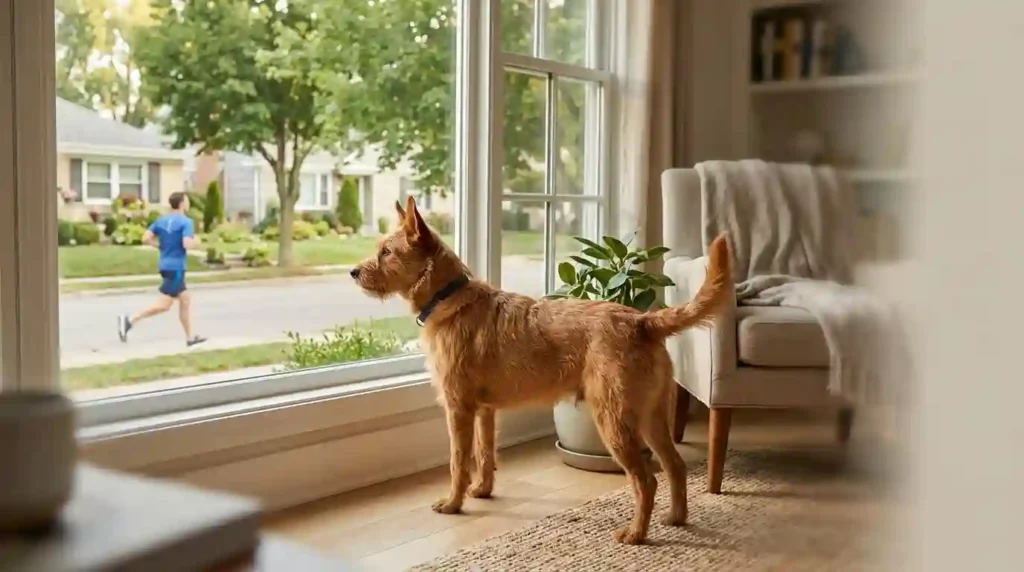
When a jogger passes your house, several things happen at once. The person is moving quickly, approaching and leaving your dog’s territory, often appearing suddenly in front of a window, fence, porch, or yard. To a dog, this can feel exciting, suspicious, threatening, or frustrating.
Some dogs bark because they want to chase. Others bark because they feel protective. Some bark because they are scared of sudden movement. Many dogs bark because the behavior has become rewarding over time.
Imagine this from your dog’s point of view: a jogger appears, your dog barks loudly, and the jogger keeps moving away. Your dog may believe, “My barking worked. I made that person leave.” This is called self-reinforcing behavior. Even though the jogger was always going to continue running, your dog may connect their barking with the jogger’s disappearance.
That is why dog barking at people jogging past the house can become stronger over time if it is not managed early.
Territorial Barking
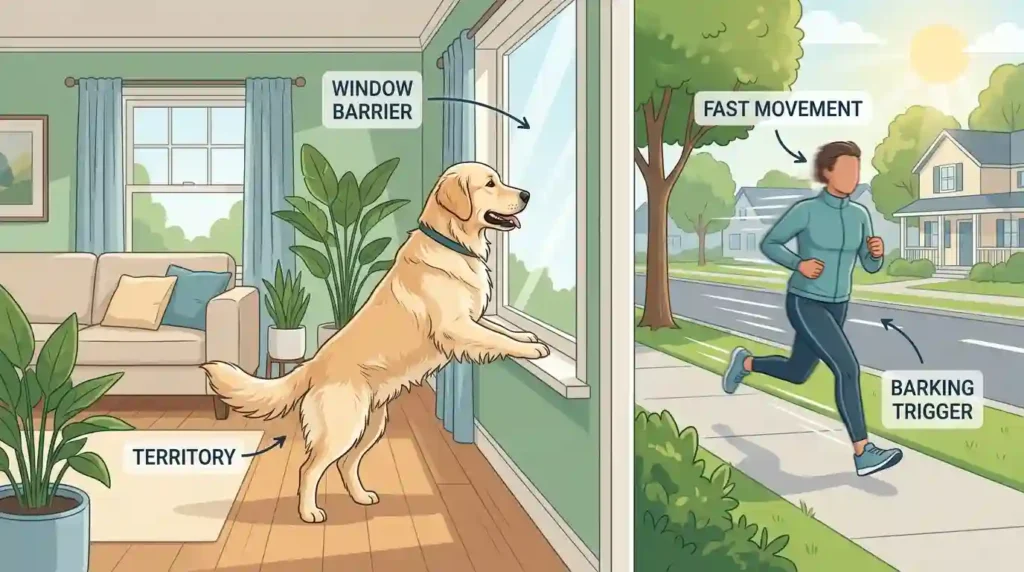
Territorial barking happens when a dog feels the need to protect the home, yard, family, or property line. Dogs often see the house, driveway, front window, porch, garden, and fence as part of their territory.
Joggers can trigger territorial barking because they move close to the home and pass quickly. Your dog may bark to say, “Stay away from my space.”
Common signs of territorial barking include:
- Barking from windows, doors, fences, gates, or balconies
- Stiff posture
- Raised tail or hackles
- Repeated barking every time someone passes
- Running from window to window
- Ignoring your voice when highly aroused
Territorial barking is common in many breeds, especially watchdog breeds, herding dogs, terriers, guarding breeds, and highly alert companion dogs.
Barrier Frustration
Barrier frustration happens when a dog can see something exciting or concerning but cannot reach it. A window, fence, leash, gate, crate, or screen door can create frustration.
Your dog may not necessarily want to hurt the jogger. They may want to chase, sniff, greet, investigate, or make the person go away. But because the barrier prevents action, the frustration comes out as barking, whining, jumping, scratching, spinning, or lunging.
This is why dogs that bark behind windows or fences may seem much calmer when there is no barrier.
Fear or Startle Response
Some dogs bark at joggers because fast-moving people make them nervous. A runner’s speed, swinging arms, bright clothing, hats, sunglasses, or sudden appearance can startle sensitive dogs.
Fear-based barking may sound sharp, frantic, or high-pitched. The dog may back away, tuck the tail, lower the body, bark and retreat, or hide after barking.
Fear barking should never be punished. Punishment can make the dog feel even more unsafe around joggers and may increase reactivity.
Prey Drive and Chase Instinct
Fast movement naturally attracts many dogs. Joggers, cyclists, skateboarders, scooters, children running, and cars can all activate a dog’s chase instinct.
This is especially common in herding breeds, sighthounds, terriers, sporting dogs, and high-energy mixed breeds. The dog may bark because the movement excites them and triggers a chase pattern.
The goal is not to remove the dog’s instincts. The goal is to teach impulse control and calm replacement behaviors.
Common Triggers Behind Jogger Barking
Not every dog reacts to every jogger. Some dogs only bark when the person is very close to the house. Others bark at runners, cyclists, walkers, children, delivery workers, mail carriers, or anyone wearing unusual clothing.
Understanding your dog’s exact trigger helps you build a better training plan.
Fast Movement
Dogs notice motion quickly. A person walking slowly may not bother your dog, but a jogger moving fast may activate alarm, excitement, or chase behavior.
Repetition
If the same jogging route passes your home daily, your dog may rehearse the barking behavior again and again. Repetition builds habit. The more your dog practices barking at joggers, the more automatic the behavior becomes.
Windows and Fences
Windows and fences often intensify barking because they allow the dog to see the trigger but prevent direct interaction. This can increase arousal, frustration, and defensive behavior.
Blocking the view during training is often one of the fastest ways to reduce barking.
Lack of Mental Stimulation
A bored dog may become extra reactive to outdoor activity. If the most exciting part of the day is someone running past the house, barking can become entertainment.
Dogs need physical exercise, sniffing opportunities, play, problem-solving, chewing, training, and rest. A mentally fulfilled dog is usually less likely to explode at every passing jogger.
Previous Reinforcement
If your dog has barked at joggers for months or years, the habit may be deeply ingrained. That does not mean it cannot improve. It simply means you need consistency, patience, and a structured training plan.
How to Read Your Dog’s Body Language
Before you can solve dog barking at people jogging past the house, you need to understand what your dog is feeling. The same bark can have different meanings depending on body language.
Signs of Excitement
An excited dog may show:
- Loose, wiggly body
- Wagging tail
- Bouncy movement
- Play bows
- Barking mixed with whining
- Running back and forth
This dog may want to chase or greet the jogger.
Signs of Fear
A fearful dog may show:
- Tucked tail
- Ears pinned back
- Crouched posture
- Lip licking
- Yawning
- Trembling
- Barking while backing away
- Hiding after the jogger passes
This dog needs confidence-building, distance, and calm counterconditioning.
Signs of Territorial Alert
A territorial dog may show:
- Forward body posture
- Hard staring
- Deep barking
- Raised hackles
- Stiff tail
- Pacing along the window or fence
- Difficulty disengaging
This dog needs management, redirection, and training that teaches “quiet observation” instead of guarding.
Signs of Overarousal
An overaroused dog may be unable to listen, take treats, respond to cues, or settle. This dog is over threshold.
When your dog is over threshold, learning becomes difficult. The best move is to increase distance, block the view, reduce intensity, and restart training at an easier level.
How to Stop Dog Barking at People Jogging Past the House
Stopping this behavior requires two things: preventing rehearsal and teaching a better response. If your dog keeps practicing barking every day, training will be much harder.
The most effective approach combines management, positive reinforcement, desensitization, counterconditioning, and calm routines.
For a helpful external resource on barking causes and training approaches, you can also review the ASPCA guide to barking.
Step 1: Block the View Temporarily
This is not a failure. It is smart management.
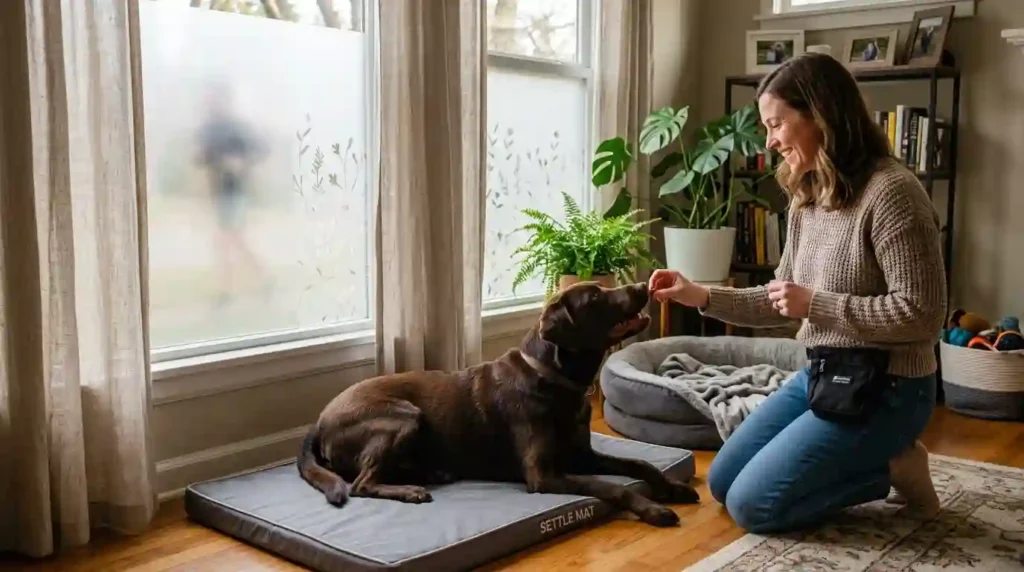
Use curtains, blinds, frosted window film, baby gates, furniture placement, or access restrictions to stop your dog from staring out the front window all day.
If your dog barks from the yard, bring them inside during busy jogging times or supervise outdoor time. If your dog barks from a balcony or porch, limit access until training improves.
Blocking the view lowers stress and stops the barking habit from getting stronger.
Step 2: Create a Calm Zone
Set up a quiet area away from the front window or fence. This can include:
- A dog bed
- Crate or playpen
- Chew toy
- Lick mat
- Stuffed food puzzle
- Calming music
- White noise
- Water bowl
Teach your dog that this area is a safe, rewarding place to relax when the outside world gets busy.
Step 3: Reward Calm Watching
When your dog notices a jogger but does not bark, reward immediately. Use small, high-value treats like chicken, cheese, turkey, or soft training treats.
The timing matters. Reward before the barking starts.
Your goal is to teach: “Seeing a jogger means look at my human and get rewarded.”
Step 4: Use Counterconditioning
Counterconditioning changes your dog’s emotional response to joggers.
Instead of jogger = threat or chase target, you want jogger = good things happen.
Start at a distance or intensity your dog can handle. For example, you may practice from a side window where joggers are farther away, or during quieter times of day.
Every time a jogger appears, give treats. When the jogger disappears, the treats stop. Over time, your dog learns that joggers predict positive outcomes.
Step 5: Teach an Alternative Behavior
You cannot simply tell your dog, “Don’t bark,” without giving them something else to do.
Teach one of these replacement behaviors:
- Go to your mat
- Look at me
- Come away from the window
- Sit quietly
- Find it
- Touch my hand
- Get your toy
A clear alternative behavior gives your dog a job.
For example, when a jogger appears, say “mat,” reward your dog for going to their bed, and give a chew or treat scatter.
Step 6: Practice Short Training Sessions
Do not wait until your dog is barking intensely. Practice in short, controlled sessions.
A good session might last only 3 to 5 minutes. End while your dog is still successful.
Several short sessions per week are better than one long, frustrating session.
Training Exercises That Work
Training should be simple, repeatable, and positive. Below are practical exercises to help reduce barking at joggers.
The “Look at That” Game
This exercise teaches your dog to notice joggers calmly.
Here is how it works:
- Let your dog see the jogger from a manageable distance.
- The moment your dog notices the jogger, say “yes” or use a clicker.
- Give a treat.
- Repeat each time your dog looks calmly.
- If your dog barks, increase the distance or block the view and try again later.
This teaches your dog that looking calmly is rewarding.
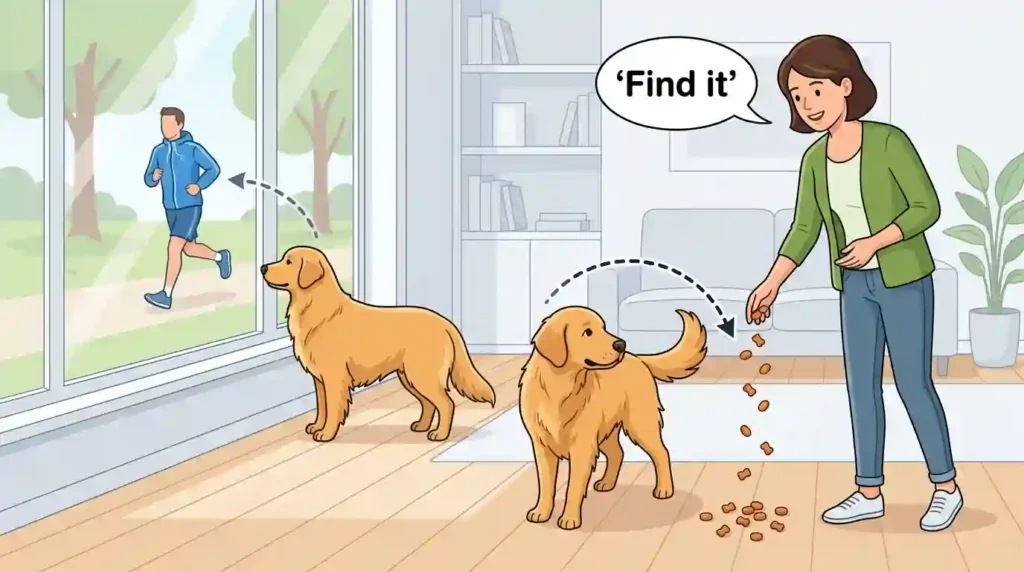
The “Find It” Treat Scatter
When a jogger passes, say “find it” and scatter treats on the floor away from the window.
Sniffing lowers arousal and redirects your dog’s focus. This works especially well for dogs that are food-motivated or easily overstimulated.
The “Go to Mat” Cue
Teach your dog to go to a bed or mat on cue.
Start when no joggers are present. Say “mat,” guide your dog to the mat, and reward. Once your dog understands, use the cue when outdoor triggers appear.
Over time, the mat becomes a calm station.
The Recall Away From the Window
Practice calling your dog away from the window before they bark.
Say your dog’s name, use a cheerful voice, and reward heavily when they turn away from the trigger.
Never call your dog in an angry tone. You want to come away from the window to feel rewarded, not punished.
Sound Masking
If your dog reacts to footsteps, voices, or running sounds before seeing the jogger, try white noise, a fan, calming music, or background household noise.
Sound masking is especially helpful for dogs in apartments, townhouses, or homes close to sidewalks.
Mistakes That Can Make Barking Worse
Many owners accidentally increase barking without realizing it. Avoid these common mistakes.
Yelling at Your Dog
Yelling often sounds like barking to your dog. Your dog may think you are joining in. It can also increase stress and excitement.
Instead, stay calm, reduce access to the trigger, and reward quiet behavior.
Waiting Until the Dog Is Exploding
If your dog is already barking, lunging, and ignoring you, training will be harder. Try to intervene earlier, when your dog first notices the jogger.
Letting the Dog Practice All Day
A dog that spends hours watching the street may become more reactive. Window watching can seem harmless, but for some dogs it creates constant alertness.
Use window film, curtains, and calm zones to prevent rehearsal.
Punishing Fear-Based Barking
If your dog is barking because they are afraid, punishment can confirm that joggers are bad news. This can make the fear stronger.
Use distance, rewards, and gradual exposure instead.
Inconsistent Rules
If barking is allowed sometimes and punished other times, your dog becomes confused. Everyone in the home should follow the same plan.
Lifestyle Changes That Help Reduce Barking
Training works better when your dog’s daily needs are met.
Increase Physical Exercise
A tired dog is not automatically a well-behaved dog, but appropriate exercise can reduce pent-up energy.
Good options include:
- Sniff walks
- Fetch
- Tug games
- Hiking
- Flirt pole play
- Swimming
- Structured leash walks
Choose activities that match your dog’s age, breed, health, and fitness level.
Add Mental Enrichment
Mental enrichment can be just as important as physical exercise.
Try:
- Puzzle feeders
- Frozen Kongs
- Lick mats
- Scent games
- Training sessions
- Hide-and-seek
- Chew toys
- Food-dispensing toys
If your dog often reacts after grooming or bathing, you may also find related behavior tips in Dog Barking After a Bath.
Improve Social Confidence
Some dogs bark because they are unsure about strangers. Controlled exposure, calm observation, and positive reinforcement can help build confidence.
Do not force your dog to meet joggers. Instead, reward calm behavior from a comfortable distance.
For dogs that bark in stressful environments, such as clinics, the same emotional regulation principles apply. You can read more in How to Calm a Dog That Barks at the Vet.
Prioritize Rest
Overtired dogs can be more reactive. Adult dogs often need many hours of rest each day, and puppies need even more.
Create quiet nap times away from windows, doorbells, and outdoor activity.
What If Your Dog Barks From the Yard?
Yard barking can be harder because the dog may feel even more territorial outside.
If your dog barks at joggers from the yard:
- Do not leave them outside unsupervised.
- Bring them inside during busy running times.
- Use privacy fencing or visual barriers.
- Practice recall away from the fence.
- Reward calm behavior before barking begins.
- Avoid letting your dog charge the fence line.
Fence running can become intense and habitual. The sooner you interrupt the pattern, the easier it is to change.
What If Your Dog Barks From the Window?
Window barking is one of the most common forms of barking at joggers.
Try this plan:
- Block access to the main window temporarily.
- Practice calm viewing for short sessions.
- Reward your dog for noticing joggers quietly.
- Call your dog away before barking starts.
- Use a mat, treat scatter, or chew as a replacement behavior.
- Slowly increase exposure as your dog improves.
The key is not to give your dog unlimited access to the trigger before they are ready.
What If Your Dog Barks at Joggers on Walks Too?
If your dog also barks at joggers during walks, the behavior may be part of a broader reactivity issue.
On walks:
- Create more distance from joggers.
- Avoid narrow sidewalks when possible.
- Reward your dog for looking calmly.
- Turn and move away before your dog explodes.
- Use high-value treats.
- Practice “look at me” and “let’s go.”
- Do not tighten the leash suddenly unless needed for safety.
Leash tension can increase frustration. Stay calm and keep your movements smooth.
When to Get Professional Help
Some barking can be managed at home. But professional help is recommended if your dog:
- Lunges aggressively at windows or fences
- Has bitten or tried to bite someone
- Cannot calm down after the jogger leaves
- Barks for long periods every day
- Shows severe fear or panic
- Redirects aggression toward people or pets inside the home
- Is getting worse despite training
Look for a certified professional dog trainer, veterinary behaviorist, or force-free behavior consultant. Choose someone who uses positive reinforcement and avoids fear-based punishment.
A professional can create a behavior modification plan based on your dog’s triggers, threshold, environment, and emotional state.
How Long Does It Take to Stop This Barking?
The timeline depends on your dog’s age, temperament, history, environment, and how often they have practiced barking.
Some dogs improve in a few weeks with consistent management. Others need several months, especially if the behavior is intense or long-established.
Progress may look like:
- Barking less often
- Barking for a shorter time
- Responding faster when called away
- Watching joggers calmly
- Choosing the mat instead of the window
- Taking treats around triggers
- Recovering faster after excitement
Do not expect perfection overnight. The goal is steady improvement.
Conclusion
Dog barking at people jogging past the house is usually not random or stubborn behavior. Your dog may be reacting because of territorial instincts, barrier frustration, fear, prey drive, boredom, or repeated reinforcement.
The best solution is to manage the environment, block constant access to triggers, reward calm behavior, and teach your dog what to do instead. Avoid yelling, punishment, and letting your dog rehearse the behavior all day.
With patience, consistency, and positive reinforcement, your dog can learn that joggers passing the house are not a threat, not a chase game, and not a reason to panic. A calmer dog means a quieter home, happier neighbors, and a more relaxed life for both you and your pet.
FAQs
Why does my dog bark at people jogging past the house?
Your dog may bark because joggers move quickly near their territory. This can trigger territorial barking, fear, excitement, chase instinct, or barrier frustration from being behind a window or fence.
Is my dog being aggressive when barking at joggers?
Not always. Barking can mean fear, excitement, frustration, alertness, or protectiveness. Look at your dog’s full body language to understand whether the barking is aggressive, anxious, playful, or territorial.
Should I punish my dog for barking at runners?
No. Punishment can increase stress, fear, and reactivity. It is better to block the trigger, reward calm behavior, and teach an alternative response, like going to a mat or looking at you.
How do I stop my dog barking at joggers from the window?
Temporarily block the window view, reward your dog for calm watching, call them away before barking starts, and teach a replacement behavior such as “go to mat” or “find it.”
Why does my dog bark more at runners than walkers?
Runners move faster, which can trigger chase instincts, alarm, or excitement. Fast movement is more stimulating than slow walking, especially for herding breeds, terriers, and high-energy dogs.
Can window film help stop barking?
Yes. Frosted window film, curtains, or blinds can reduce visual triggers and prevent your dog from practicing the barking habit all day.
Will my dog grow out of barking at joggers?
Some puppies may become calmer with maturity and training, but many dogs do not simply grow out of rehearsed barking. Without management, the behavior can become stronger.
What is the best command to stop barking?
Useful cues include “quiet,” “look at me,” “leave it,” “come,” “find it,” and “go to mat.” However, commands work best when trained before your dog is overexcited.
Can exercise reduce barking at joggers?
Yes, appropriate exercise and mental enrichment can reduce excess energy and boredom. However, exercise alone usually will not solve territorial or fear-based barking without training.
When should I contact a dog trainer?
Contact a professional if your dog lunges aggressively, cannot calm down, has a bite history, redirects aggression, or continues getting worse despite consistent training.