
Summary
Dog barking at reflections is usually caused by confusion, curiosity, fear, excitement, or the belief that the mirror image is another dog. Puppies may bark, growl, whine, paw at the glass, or invite the “other dog” to play because they do not understand what they are seeing. Adult dogs may react to nighttime reflections in windows, moving patches of light, or sudden images on televisions and other reflective surfaces.
Although occasional barking is often harmless, repeated exposure can turn the response into a practiced habit. This guide explains how to identify your dog’s motivation, reduce immediate triggers, and use gradual exposure, desensitization, counterconditioning, and positive reinforcement to encourage calm behavior.
Table of Contents
- Dog Barking at Reflections: Why It Happens
- Do Dogs Recognize Their Own Reflection?
- Mirrors, Windows, Light Reflections, and Other Triggers
- What Your Dog’s Body Language Means
- How to Stop Dog Barking at Reflections
- Common Training Mistakes
- How Long Does Training Take?
- When to Contact a Professional
- Preventing the Behavior From Returning
- The Aesop Fable and Reflection-Related Searches
- Conclusion
- Frequently Asked Questions
Dog Barking at Reflections: Why It Happens
When a dog sees a reflection, the image moves at exactly the same time as the dog. It looks like a dog, but it does not smell, sound, or behave like a normal social partner. That mismatch can be fascinating, confusing, or threatening.
Some dogs investigate once and lose interest. Others bark every time they encounter a mirror, window, glass door, polished appliance, television screen, or moving light reflection. Understanding the motivation behind the behavior is the first step toward changing it.
The ASPCA’s guidance on barking emphasizes that barking serves different functions and that the cause must be identified before a barking problem can be treated effectively. This is particularly important with reflections because two dogs can display similar barking while experiencing very different emotions.
Your Dog May Think the Reflection Is Another Dog
The most common explanation is simple: the dog interprets the mirror image as another dog. The image has a canine shape, makes direct movements, and appears to maintain eye contact. To an uncertain dog, those visual social cues may resemble a challenge.
The reflection also fails to respond normally. It does not turn away, soften its posture, approach from an angle, or provide the scent information dogs expect during an interaction. Instead, it copies every movement and continues facing the dog.
A dog that sees the image as an unfamiliar dog may display:
- Alert barking
- Growling or snarling
- Staring
- A rigid posture
- Raised hackles
- Showing teeth
- Lunging toward the glass
- Scratching or pawing at the surface
- Repeatedly checking behind the mirror
- Sniffing the mirror or its edges
These actions do not automatically mean the dog has territorial aggression. They can also reflect surprise, uncertainty, fear, or frustration.
Dogs Depend Heavily on Their Sense of Smell
People naturally rely on visual information, but dogs experience much of their world through scent. When a dog meets another dog, smell provides information that a flat visual image cannot.
A reflection has the appearance and movement of a dog but lacks the expected scent. This lack of scent can create confusion. Some dogs sniff the mirror, investigate behind it, and quickly decide that the image is irrelevant. Others remain unsettled because the visual stimulus is still present even though their nose cannot confirm what it is.
Fear and Defensive Behavior
A nervous dog may believe that the reflection represents a perceived threat. Barking can be an attempt to create distance: “Stay away from me.”
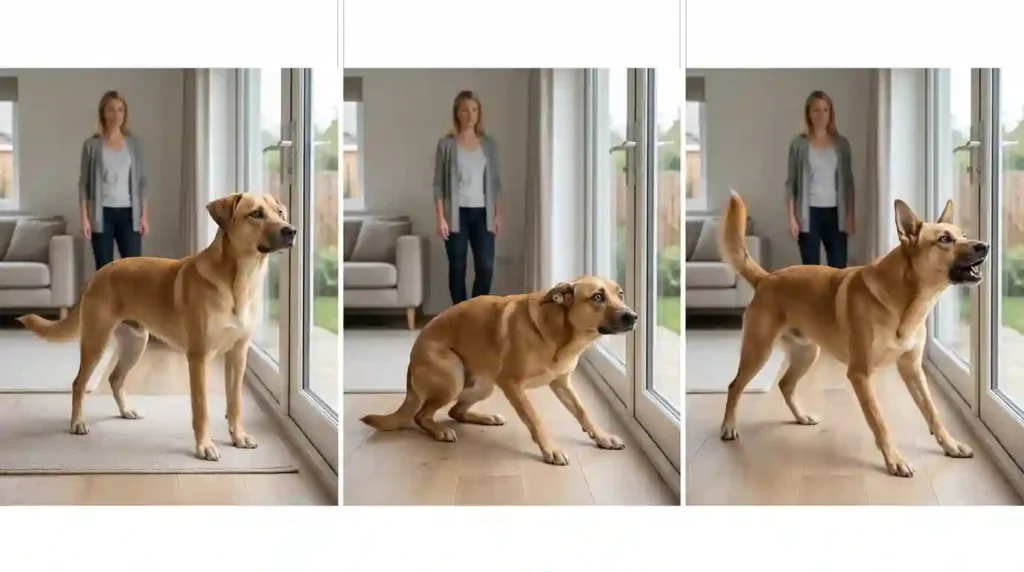
Fear-based behavior may include leaning backward, lowering the body, tucking the tail, avoiding direct approach, whimpering, retreating, or hiding behind the owner. The dog might rush forward and then jump backward. This approach-and-retreat pattern is often caused by emotional conflict rather than confidence.
If the reflection appears unexpectedly—especially in a dark window—the dog may enter a brief fight-or-flight response. Sudden surprise increases arousal, making it harder for the dog to respond to familiar cues.
Curiosity, Play, and Excitement
Not every dog barking at its own reflection is distressed. A puppy may believe the mirror image is a possible playmate. Playful signs include:
- A loose, wiggly body
- Play bowing
- Bouncing from side to side
- A relaxed, open mouth
- Soft eyes
- Playful whining
- Running back and forth
- Pawing without a stiff posture
A dog that barks at the reflection and then brings a toy may be inviting the image to play. Excitement can still become overarousal, however, especially if the dog repeats the interaction for long periods.
Territorial and Alert Barking
A reflection in a window or glass door can look like a dog standing just outside the home. This can activate alert barking or territorial behavior.
The barking may become self-reinforcing. The dog barks, moves away from the window, and the reflected “intruder” also appears to move away. From the dog’s perspective, barking worked. Each repetition strengthens the habit.
This pattern can overlap with broader window reactivity. If your dog also reacts to pedestrians, delivery workers, animals, or vehicles, explore the wider Dog Barking topic rather than treating the reflection as an isolated problem.
Boredom and Understimulation
Some dogs discover that chasing reflections is exciting. When physical exercise and mental stimulation are limited, barking at a reflection may become an entertaining activity.
Boredom alone does not explain every case, but it can make an existing behavior more persistent. A dog with no better outlet may spend long periods staring at windows, tracking light across walls, or waiting for the mirror image to move.
Do Dogs Recognize Their Own Reflection?
Dogs generally do not demonstrate visual self-recognition in the same way humans do. In the traditional mirror self-recognition test, an animal is expected to use the mirror to investigate a mark placed on its body. Dogs usually do not respond in a way that clearly shows they understand the image is of themselves.
That does not mean dogs lack all self-awareness. Animal cognition is complex, and a vision-based test may not fully measure the experience of an animal that relies strongly on smell. Dogs may distinguish their own odor from unfamiliar odors even if they do not identify their mirror image visually.
For practical training purposes, owners do not need to teach a dog, “That image is you.” The goal is simpler: teach the dog that the reflection is safe, unimportant, and not a reason to bark.
Why Puppies React More Often
A puppy is still learning which sights, sounds, and surfaces matter. The first encounter with a mirror can produce curiosity, play, fear, or surprise.
Many puppies naturally stop reacting through habituation. After repeated neutral exposure, the reflection loses its novelty. The puppy learns that it has no scent, does not cross the glass, and does not lead to a meaningful interaction.
However, owners should not assume every puppy will simply grow out of it. If the behavior is intense or repeatedly practiced, it can become a strong learned response.
Why the Behavior Can Return
A dog that previously ignored mirrors may suddenly bark at one again. This can be an example of spontaneous recovery—the return of an old response after a period without exposure.
The setting may also be different. A familiar bathroom mirror in daylight is not visually identical to a dark patio door, a shiny oven, or a hotel mirror. Fatigue, stress, pain, household changes, or trigger stacking can also lower the dog’s ability to cope.
Mirrors, Windows, Light Reflections, and Other Triggers
The phrase “my dog barks at his reflection” can describe several different situations. Identifying the precise barking trigger will help you choose an effective response.
Dog Barking at a Reflection in a Mirror
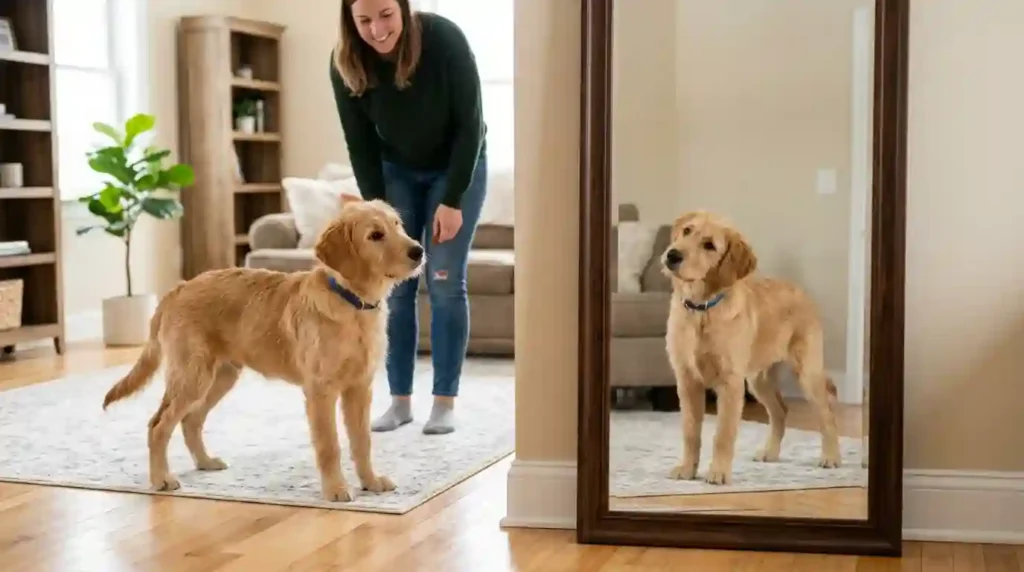
A mirror produces a clear, dog-shaped image. Dogs may bark because they mistake the image for another dog, become frustrated by its synchronized movements, or feel uncomfortable with apparent eye contact.
Some dogs walk around the mirror or look behind it. Others sniff the glass and lose interest. A playful puppy may bow, bounce, or paw at the mirror.
If the reaction is mild, a calm investigation may be enough. If the dog is growling, lunging, or unable to disengage, increase the distance and begin a structured training plan.
Dog Barking at a Reflection in a Window
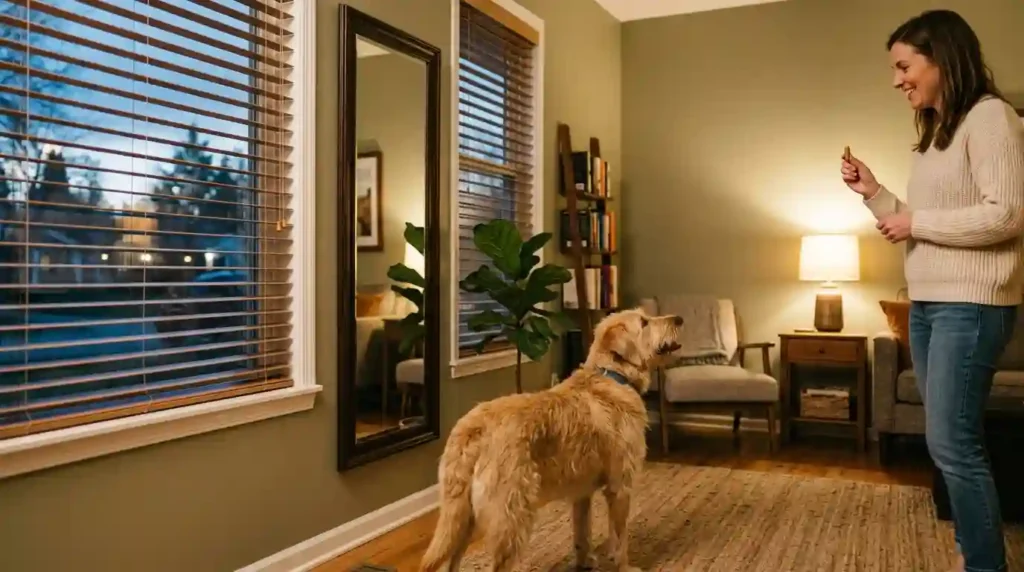
A window becomes more reflective when the room is brighter than the outdoors. That is why dog barking at a reflection in a window often happens after sunset.
A nighttime reflection can appear suddenly when someone moves inside the room. A dog resting on a couch may see the motion from the corner of its eye, wake abruptly, and begin alert barking. The reflection may also overlap with faint outdoor movement, making the image harder to interpret.
Closing blinds or shutters is a useful management step. Exterior lighting can sometimes make it easier to see outside, but it should be positioned carefully and should not create additional moving shadows.
Dog Barking at a Glass Door
Sliding glass doors combine reflections with a clear view of the yard. A dog may react to its own image, an animal outside, or both at once.
Watch where the dog is looking. A dog focused on its own outline may track the mirrored movement. A dog focused beyond the glass may be responding to a real sound, person, or animal. Smudges, indoor lights, and changing outdoor brightness can make the cause difficult to identify.
Temporary window film on the lower portion of a glass door can create a blocked view while leaving the upper section clear for people.
Dog Barking at Light Reflections
Light reflections are different from mirror images. Sunlight bouncing from a phone, watch, vehicle, or glass object can create a bright spot that moves across the wall or ceiling.
A dog with a strong prey drive may chase the moving light as if it were a small animal. The inability to catch it can create frustration and increasingly frantic behavior. A dog that barks at light reflections may also stare, pounce, scratch the wall, scan the ceiling, or wait for the light to return.
Never encourage this behavior with a laser pointer. Repeated laser-pointer play can increase fixation because the dog can chase but never physically capture the target. For a dog barking at shadows and reflections, remove controllable light sources and provide games with a clear ending, such as finding food, retrieving a toy, or catching an appropriate flirt-pole lure under supervision.
Dog Barking at Reflections on the Ceiling
A moving spot on the ceiling often comes from a phone screen, watch face, glass decoration, television, passing vehicle, or opening door. Identify the source before beginning training.
Close reflective objects, change the angle of the blinds, move hanging decorations, or adjust indoor lighting. If the dog continues scanning blank walls or ceilings after the light has disappeared, seek professional advice rather than repeatedly creating the reflection for training.
Dog Barking at a Reflection on the TV
A dark television screen may function like a mirror. When the television is on, animals or rapid movement on screen may create a separate visual trigger.
If your dog reacts when a person rises, and their movement appears on the screen, the pattern may resemble cases in which a Dog barks when someone stands up. Test the situations separately: observe the dog when the screen is off, when the television is playing calm content, and when people move around the room.
Do not repeatedly test the trigger until the dog erupts. One or two calm observations are enough to identify the likely cause.
What Your Dog’s Body Language Means
Barking volume alone does not reveal how a dog feels. Look at the entire body before choosing a training method.
Signs of Curiosity or Play
A curious or playful dog may have a loose body, relaxed face, gently wagging tail, soft eyes, and springy movements. The dog might sniff, play bow, paw once or twice, or look back at the owner.
This dog may need only calm redirection and reinforcement for disengaging from the reflection.
Signs of Fear or Anxiety
A fearful dog may crouch, tuck its tail, pin its ears back, lick its lips, pant, pace, tremble, retreat, or whimper. It may bark while trying to move away.
Do not force this dog closer to the mirror. Flooding—prolonged exposure at an intensity the dog cannot handle—can increase anxiety and avoidance.
Signs of Defensive or Territorial Behavior
A defensive dog may become still, lean forward, stare, growl, show teeth, or lunge. Territorial barking is more likely when the reflection appears in a window, door, or boundary area.
Create distance immediately. Do not place your hands near the dog’s collar or face during a highly aroused episode unless safety requires it and you can do so without risking a bite. Use a familiar recall or toss treats away from the reflective surface to create movement in a safer direction.
Signs of Compulsive or Obsessive Behavior
Occasional curiosity is different from obsessive behavior. Warning signs include:
- Staring at reflective surfaces for long periods
- Searching for reflections that are no longer present
- Chasing shadows repeatedly
- Ignoring food, play, or familiar cues
- Scratching walls or glass
- Becoming difficult to interrupt
- Returning to the trigger immediately after redirection
- Losing sleep or struggling to settle
- Performing repetitive movements alongside compulsive barking
These signs deserve professional attention. The behavior may be associated with anxiety, chronic stress, or a compulsive pattern requiring an individualized behavior modification plan.
How to Stop Dog Barking at Reflections
The safest training plan combines environmental management with desensitization and counterconditioning. Management prevents repeated barking, while training changes how the dog feels and behaves around the reflection.
Step 1: Identify the Exact Trigger
Record when and where the behavior occurs. Note:
- The reflective surface involved
- Time of day
- Indoor and outdoor lighting
- Distance from the surface
- Whether the dog was awake or startled from sleep
- The dog’s first body-language change
- Other sounds, people, or animals present
- How long recovery take
- Whether food or a cue could interrupt the response
A dog barking at its own reflection in a bedroom mirror may need a different plan from a dog chasing moving light on the ceiling.
Step 2: Prevent Rehearsal
Every intense repetition can strengthen the behavior. Use environmental management while training is underway.
Practical options include:
- Closing blinds or shutters before dark
- Applying removable frosted window film to the lower panes
- Covering a mirror temporarily
- Repositioning furniture away from windows
- Using a baby gate to restrict access
- Closing the room when supervision is unavailable
- Moving reflective decorations
- Changing the angle of indoor lights
- Turning off or covering a dark television screen
- Providing a quiet space away from busy windows
Management is not a failure. It lowers stress and gives the nervous system time to recover. A blocked view can be especially helpful for dogs that spend hours practicing window barking.
Step 3: Meet Physical and Mental Needs
A fulfilled dog is better prepared to learn. Provide appropriate physical exercise based on the dog’s age, breed, health, and fitness.
Mental stimulation can include:
- A relaxed enrichment walk with time to sniff
- A scent game using hidden treats
- A food puzzle toy
- A stuffed chew toy
- A lick mat
- Short reward-based training sessions
- Structured play with a toy that the dog can catch
- Calm chewing and foraging activities
Exercise will not cure fear, but suitable activity can reduce boredom, understimulation, and excess arousal.
Step 4: Establish Foundation Cues Away From the Trigger
Before working near a mirror or window, teach the dog simple behaviors in a quiet room.
Useful skills include:
- Responding to their name
- An attention cue, such as “look”
- A reliable recall
- A hand target
- A leave-it cue
- Going to a mat
- A quiet cue
- Turning away to find scattered treats
Practice until the dog responds easily. Recall training should begin without the reflection present. Asking for a new behavior during an emotional outburst is usually too difficult.
A clicker can be used for precise marking, but clicker training is optional. A consistent word such as “yes” can serve the same function.
Step 5: Find the Dog’s Safe Distance
Set up a controlled exposure in which the dog can notice the reflective surface without barking, freezing, lunging, or refusing food. This is the starting distance.
For one dog, the safe distance may be six feet. Another may need to begin across the room with most of the mirror covered. The correct distance is determined by body language, not by a fixed measurement.
Keep the dog free to move away. Do not hold the dog close to the mirror or block the exit.
Step 6: Pair the Reflection With Something Positive
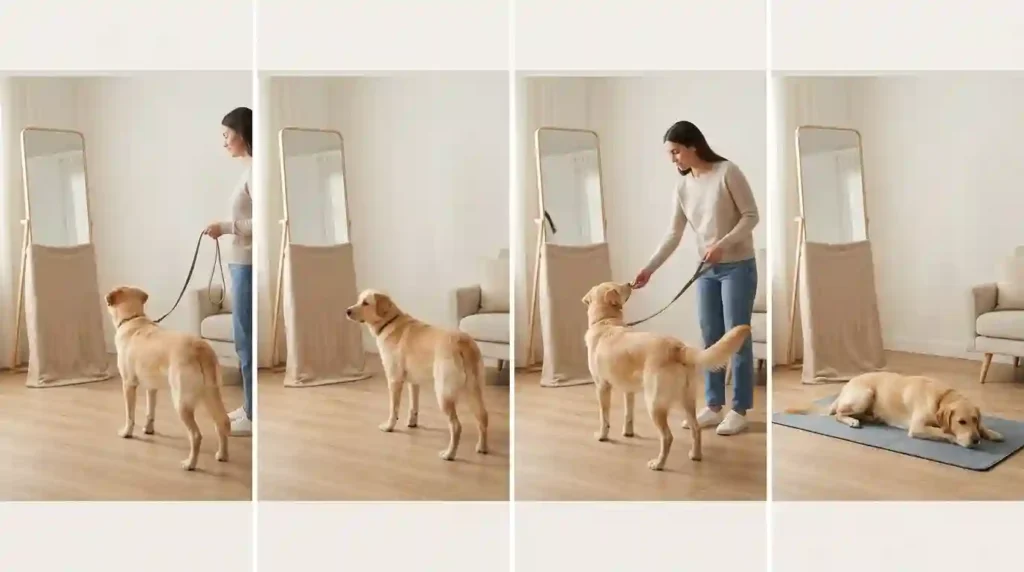
Allow the dog to notice the reflection briefly. The moment the dog looks at it while remaining calm, mark the behavior with “yes” or a click and offer a high-value treat.
The basic sequence is:
- The dog notices the reflection.
- You mark before barking begins.
- The dog turns toward you.
- You deliver the treat away from the reflective surface.
- The reflection is covered, or the dog moves away for a short break.
This combines desensitization—exposure at a manageable intensity—with counterconditioning, which changes the reflection’s emotional meaning.
Instead of predicting conflict or confusion, the reflection begins to predict food, praise, and movement toward the owner.
Step 7: Keep Sessions Short
Begin with three to five successful repetitions. A training session may last less than two minutes.
Stop while the dog is calm. Long sessions can cause trigger stacking, in which several small stressors accumulate until the dog crosses its threshold.
Signs that the session is too difficult include:
- Faster treat-taking
- Hard staring
- A closed, tense mouth
- Ears suddenly moving forward or backward
- Weight shifting toward the reflection
- Refusal of food
- Whining or growling
- Inability to turn away
- Barking or lunging
If these signs appear, increase distance, cover more of the surface, reduce exposure time, or end the session.
Step 8: Increase Difficulty Gradually
Change only one factor at a time. You might:
- Uncover a slightly larger part of the mirror
- Allow a one-second longer look
- Move a small distance closer
- Practice in slightly dimmer light
- Add gentle human movement in the room
- Transfer the skill from a mirror to a window
Do not increase distance, duration, movement, and brightness during the same session.
Gradual exposure works because the dog remains capable of learning. If the dog begins barking excessively at the reflection, the exercise has advanced too quickly.
Step 9: Teach an Alternative Behavior
A dog needs something specific to do instead of barking.
Good alternatives include:
- Turn toward the owner
- Touch the owner’s hand
- Come away from the window
- Go to a mat
- Find scattered treats
- Carry a toy
- Settle with a chew
- Sit behind a visual barrier
Reward the alternative behavior generously. Over time, the dog may see the reflection and automatically check in with you.
Step 10: Generalize the Skill
Dogs do not always transfer learning from one setting to another. Calm behavior near a hallway mirror does not guarantee calm behavior near a dark patio door.
Practice separately with:
- A bathroom mirror
- A full-length mirror
- A window during daylight
- A window near dusk
- A sliding glass door
- A dark television screen
- A shiny appliance
Return to an easier distance whenever the surface or lighting changes.
If another dog lives in the home, train individually at first. Barking can spread through social facilitation, with one dog reacting because the other has started. More guidance is available in Dog Barking in Multi-Dog Households.
Common Mistakes When Trying to Stop the Barking
Yelling at the Dog
Yelling may increase excitement or confirm that something alarming is happening. The dog may interpret the owner’s raised voice as participation in the alert.
Punishment can suppress visible behavior without changing fear or territorial motivation. In some cases, the dog may stop barking but remain tense, making its discomfort harder to recognize.
Speak calmly and focus on creating distance.
Waiting Until the Dog Is Fully Aroused
A quiet cue is unlikely to work when a dog is lunging, growling, and locked onto the reflection. Training should begin before the reaction reaches that level.
Watch for the earliest change: closed mouth, fixed stare, ears lifting, body stiffening, or weight shifting forward. Redirect at that moment.
Treating Without a Clear Training Sequence
Food does not automatically reward barking, but timing and placement matter. Repeatedly holding a treat in front of a dog while it continues barking may fail to teach the desired response.
Mark a specific behavior, such as calmly looking, turning away, making eye contact, or moving to a mat. Deliver the reward away from the reflection so the dog practices disengagement.
Forcing the Dog to Inspect the Mirror
Lifting a puppy toward a mirror or holding a fearful dog beside a window can increase anxiety. The dog should always have enough distance to observe without panicking.
Confidence grows through voluntary, successful interactions—not forced confrontation.
Allowing Unlimited Practice Between Sessions
Five minutes of training cannot offset hours of barking at a window. Use blinds, window film, gates, and supervision to prevent rehearsal when you are not actively training.
Moving Too Quickly
A common mistake is assuming one calm session means the problem is solved. Increasing exposure too quickly can cause a setback.
Progress is rarely perfectly linear. If barking returns, make the exercise easier rather than viewing it as disobedience.
Using a Laser Pointer
Never use a laser pointer to test or exhaust a dog that chases reflections. The moving light has no physical endpoint, which can increase frustration and fixation.
Use toys that the dog can catch or food-search games that end with a real reward.
Ignoring Pain or Medical Changes
A sudden behavior change can sometimes accompany pain, impaired vision, cognitive changes, or increased sensitivity. If an adult or senior dog unexpectedly begins barking at familiar reflections, schedule a veterinary examination.
How Long Does It Take to Stop Dog Barking at Reflections?
There is no universal timetable. A curious puppy may habituate after several calm encounters. A fearful dog with a long history of barking may require weeks or months of consistent work.
Progress depends on:
- How long the behavior has been practiced
- The dog’s age and temperament
- The intensity of the response
- The number of reflective surfaces in the home
- The owner’s consistency
- Whether the trigger can be managed between sessions
- The presence of general anxiety or reactivity
- Whether multiple dogs join the barking
- The quality and pace of gradual exposure
Measure improvement in small ways. Success may initially mean that the dog recovers in 20 seconds instead of two minutes. Later, the dog may take food, respond to recall, or bark once and disengage.
The goal is not necessarily to eliminate every bark. A realistic goal is for the dog to notice a reflection, remain emotionally safe, and return attention to another activity.
When to Contact a Professional
Consult a veterinarian if the behavior begins suddenly, particularly in an adult or senior dog. A medical examination can help rule out pain, vision changes, neurological concerns, or other health factors.
Contact a qualified professional dog trainer who uses reward-based training if:
- You cannot find a distance at which the dog remains calm
- The barking is becoming more frequent
- The dog repeatedly lunges at the glass
- The dog cannot disengage from the reflection
- Training attempts increase fear
- Multiple household triggers are involved
- The behavior is affecting sleep or daily life
A veterinary behaviorist is especially appropriate when the behavior appears compulsive, creates a risk of injury, or occurs alongside severe anxiety, aggression, or other repetitive behaviors.
In some cases, a veterinarian or veterinary behaviorist may discuss anxiety medication as one part of a wider treatment plan. Medication should not be started, stopped, or changed without veterinary guidance.
Pheromone sprays may help some dogs settle, but results vary, and they should not replace training or professional assessment.
Seek help promptly if the dog:
- Bites or redirects aggression toward a person or animal
- Crashes into windows or mirrors
- Damages teeth, nails, or paws
- Cannot eat or sleep normally
- Tracks nonexistent lights for extended periods
- Shows rapidly worsening fear or agitation
Safety comes before training. Use barriers and prevent access while arranging professional support.
Preventing the Behavior From Returning
Continue rewarding calm behavior even after obvious barking has decreased. Occasionally, reinforce the dog for looking at a reflective surface and choosing to disengage.
Maintain predictable routines and provide suitable exercise, rest, sniffing, chewing, and problem-solving opportunities. Background noise may reduce sudden sounds near windows, but it will not remove a visual reflection. Combine it with blinds or window film when needed.
Check seasonal changes in lighting. A window that is clear during summer evenings may become mirror-like earlier in winter. Moving lamps, decorations, and furniture can also create new reflections.
If the response returns, resume training at an easier level. Spontaneous recovery does not mean the original plan failed. It means the dog needs another reminder that the image is safe and irrelevant.
The Aesop Fable and Reflection-Related Searches
Some searches about a dog, a bone, and a reflection refer to Aesop’s fable “The Dog and Its Reflection.” In the story, a dog carrying food sees its reflection in water, mistakes it for another dog with a better prize, and loses what it already has.
This literary query is separate from real canine behavior. A real dog barking at a mirror or window is responding to sensory information, emotion, and learning—not acting out the moral of the fable.
Conclusion
A dog barking at its own reflection is usually trying to understand an unusual visual experience. The image looks and moves like another dog, but it has no scent and provides none of the normal social feedback dogs expect.
For many puppies, the behavior fades through habituation. Other dogs need help because fear, alert barking, territorial behavior, frustration, or repeated practice has made the response stronger.
Start by identifying the exact trigger and reading the dog’s body language. Prevent uncontrolled rehearsal with blinds, shutters, window film, gates, or temporary covers. Then use short sessions of desensitization and counterconditioning at a distance where the dog can remain calm.
Reward looking without barking, turning away, responding to an attention cue, and settling elsewhere. Avoid yelling, forced exposure, and laser-pointer play. If the behavior is intense, compulsive, sudden, or dangerous, seek help from a veterinarian, reward-based professional dog trainer, or veterinary behaviorist.
With patient management and consistent training, most dogs can learn that the mysterious dog in the mirror or window is not a threat—and not worth barking at.
Frequently Asked Questions
Is it normal for dogs to bark at their reflection?
Yes. Puppies and some adult dogs may mistake a reflection for another dog or react with curiosity, fear, surprise, or excitement.
How to get a dog to stop barking at a reflection?
Block uncontrolled access, begin at a calm distance, and reward the dog for noticing the reflection without barking and turning back to you.
What does it mean when a dog barks at something I can’t see?
Dogs can detect faint sounds, scents, motion, shadows, and reflections that people miss. Persistent or unusual barking should be assessed for environmental and medical causes.
Why does my dog bark at light reflections?
Moving light can activate curiosity or prey-driven chasing. Remove the light source and redirect the dog to a game with a physical target and a clear ending.
How do I stop my dog barking at reflections in windows at night?
Close blinds before dark, use lower-pane window film, and reward calm behavior at a distance before the dog becomes fixated on the nighttime reflection.
Should I let my puppy investigate a mirror?
Calm, voluntary investigation is generally acceptable. Create more distance or cover the mirror if the puppy shows fear, a rigid posture, growling, or lunging.
Can barking at reflections become compulsive?
Yes. Repeated staring, shadow chasing, wall scratching, or searching for absent reflections can indicate a compulsive pattern that needs professional assessment.