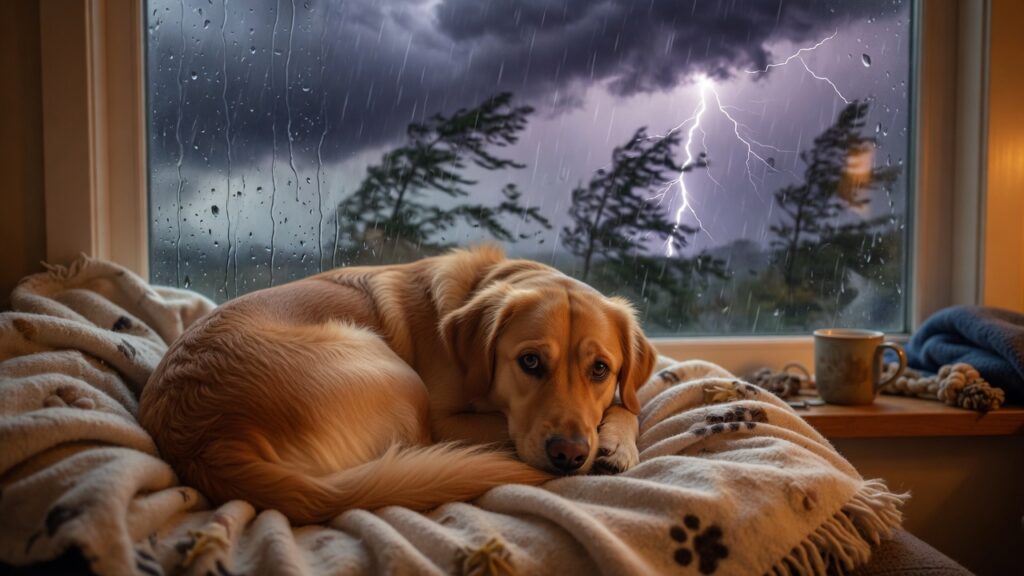

Summary: Dogs scared of wind or storms suffer from a genuine anxiety condition known as storm phobia or astraphobia — a complex fear response triggered by barometric pressure changes, static electricity, thunder, lightning, and howling winds. This guide covers everything pet owners need to know, from recognizing the behavioral signs of wind and storm anxiety in dogs, understanding the underlying neurological and sensory causes, to proven desensitization techniques, calming tools, veterinary treatments, and long-term management strategies that can dramatically improve your dog’s quality of life during stormy weather.
Table of Content
- Why Is My Dog Scared of Wind and Storms? The Complete Guide
- Understanding Storm Phobia and Wind Anxiety in Dogs
- Why Dogs Are Scared of Wind and Storms: The Science Behind It
- Signs and Symptoms of Storm Anxiety in Dogs
- What Triggers Fear of Wind in Dogs?
- Breeds Most Prone to Storm and Wind Anxiety
- How to Calm a Dog During a Storm: Immediate Relief Strategies
- Long-Term Treatment: Desensitization and Counter-Conditioning
- Veterinary Treatments for Storm Phobia
- Creating a Storm Safety Plan for Your Dog
- Frequently Asked Questions About Dogs Scared of Wind and Storms
Understanding Storm Phobia and Wind Anxiety in Dogs
What Is Canine Storm Phobia (Astraphobia)?
Canine storm phobia — sometimes called astraphobia or thunderstorm anxiety — is a persistent, intense fear response that dogs experience during or in anticipation of storms, high winds, and related weather events. Unlike a simple startle reflex, storm phobia in dogs is a deeply conditioned fear state that activates the sympathetic nervous system, flooding the animal’s body with cortisol and adrenaline. This “fight or flight” cascade is entirely real, measurable, and in many cases debilitating.
It is important to understand that a dog scared of wind is not being dramatic, stubborn, or attention-seeking. The fear is genuine. Behavioral science classifies storm phobia as a noise-induced anxiety disorder, and it sits alongside firework phobia and separation anxiety as one of the most prevalent stress-related conditions seen in domestic dogs today.
Astraphobia is distinct from generalized anxiety disorder in dogs, though the two often co-occur. A dog with storm phobia may be perfectly calm during everyday life but completely dysregulated the moment barometric pressure begins to drop or a gust of wind rattles the windows.
How common is wind and Thunder Fear in Dogs?
Studies in veterinary behavioral medicine suggest that between 25% and 49% of dogs show some degree of fear or anxiety related to storms, thunder, or wind noise. Research published in peer-reviewed journals like Applied Animal Behaviour Science has found that noise-sensitivity — including storm and wind fear — is one of the most under-reported welfare concerns in companion animals, as many owners normalize the behavior or mistake it for personality quirks.
The condition tends to worsen with age. A dog who showed mild nervousness at two years old may develop full-blown storm phobia by the time they reach middle age (5–8 years). This progressive worsening is linked to repeated, unaddressed fear exposures that reinforce the neurological fear pathway over time.
Why Dogs Are Scared of Wind and Storms: The Science Behind It
What Dogs Actually Sense During a Storm
Dogs do not simply hear thunder the way humans do. Their sensory world during a storm is far more complex and overwhelming. A dog approaching a thunderstorm is receiving a multi-channel bombardment of stimuli that begins well before the storm is visible or audible to their owners.
Dogs possess approximately 300 million olfactory receptors (compared to a human’s 6 million), meaning they can smell the ionic changes in the air as a storm approaches — the scent of ozone, the chemical shift in humidity, the electromagnetic charge of the atmosphere. They begin processing the storm as a threat long before it arrives.
Their hearing range — 40 Hz to 65,000 Hz compared to the human range of 20 Hz to 20,000 Hz — means dogs detect low-frequency infrasound rumbles from distant thunder that are entirely inaudible to humans. By the time you hear the first thunder crack, your dog may have been processing storm-related sounds for 20 to 40 minutes.
The Role of Static Electricity and Barometric Pressure
One of the most fascinating and often overlooked aspects of canine storm phobia involves static electricity. Research from veterinary behaviorists, including work highlighted by the American Kennel Club Canine Health Foundation, suggests that dogs with long or double coats are particularly prone to static electricity buildup during storms. The electrical charge from lightning and storm fronts accumulates in their fur, causing uncomfortable tingling sensations — essentially small, repeated, unpredictable shocks — that the dog cannot understand or escape.
This explains why many dogs desperately seek out grounded surfaces during storms: they head to bathtubs, basements, or ceramic tile flooring. These surfaces help discharge the static electricity from their bodies and provide genuine physical relief. It also explains why anti-static jackets and grounding pads can be so effective for some dogs.
Barometric pressure is another critical entity in this story. Dogs have demonstrated sensitivity to barometric pressure drops — the atmospheric change that precedes a storm. This pressure shift affects the fluid in their sinuses and inner ears, potentially causing mild discomfort or an unease they associate with the storm event. Over repeated exposures, the drop in barometric pressure becomes a conditioned stimulus — a reliable predictor of the discomfort to follow — and triggers anticipatory anxiety.
Noise Sensitivity and Sound Frequencies
Wind howling through eaves, rain hammering on rooftops, the crack of thunder — each of these produces sound frequencies that hit a dog’s auditory system with significantly more impact than human hearing would suggest. Thunder in particular produces intense infrasonic energy that dogs feel as much as hear — a physical vibration in their chest and skull. For a noise-sensitive dog, this sensory overload can trigger a panic response indistinguishable from a genuine life-threatening event.
Wind noise is particularly challenging because of its unpredictability. A howling, gusting wind is intermittent and inconsistent — it rises and falls without warning. From a behavioral neuroscience perspective, unpredictable, uncontrollable aversive stimuli produce far greater stress than predictable ones. This is why wind-phobic dogs often struggle more than those who fear steady rain sounds.
Signs and Symptoms of Storm Anxiety in Dogs
Mild to Moderate Signs
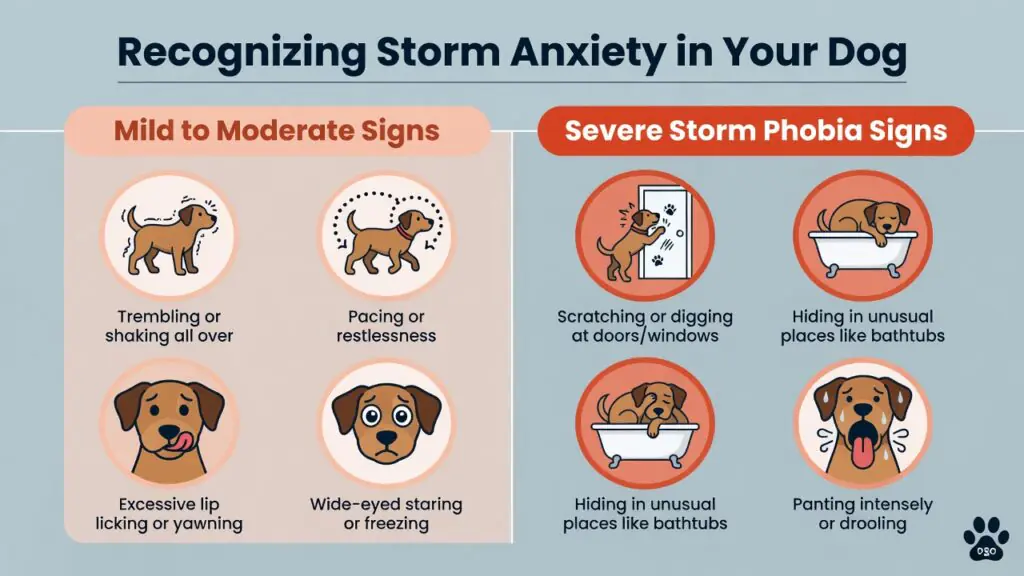
Recognizing storm anxiety early is crucial for effective intervention. Mild to moderate signs often include:
- Restlessness and pacing — the dog cannot settle and moves constantly from room to room
- Yawning and lip licking — calming signals indicating internal stress
- Seeking proximity to owners — sudden clinginess or “velcro dog” behavior
- Trembling or shivering — even when the temperature is warm
- Refusing to go outside — avoidance behavior tied to storm sounds or smells
- Dilated pupils and ears pinned back — physiological arousal indicators
- Loss of appetite — stress hormones suppress hunger
- Increased vocalization — whining, whimpering, or soft barking
These signs may appear 30 to 90 minutes before a storm arrives, as the dog responds to barometric changes and infrasonic cues long before the storm is perceptible to humans.
Severe Storm Phobia Symptoms
When storm anxiety escalates to clinical phobia, the behavioral and physical signs become more extreme and can cause genuine harm:
- Destructive behavior — chewing door frames, clawing at walls, breaking through windows in escape attempts
- Eliminating indoors — complete loss of housetraining during high arousal
- Self-injury — dogs have been known to injure paws, mouths, and noses trying to escape
- Severe panting and hypersalivation — signs of acute sympathetic nervous system activation
- Hiding in inaccessible places — behind appliances, in closets, inside walls
- Inconsolable distress — owner reassurance has no effect on the dog’s arousal state
- Aggression — a small number of dogs redirect their panic into biting when touched during storms
When Fear Becomes a Phobia
A phobia is distinguished from fear by its intensity, duration, and disproportionality. Fear is adaptive — it keeps an animal alive. Phobia is maladaptive — it impairs normal functioning and causes suffering beyond what the stimulus warrants. If your dog’s storm response meets three or more of these criteria, you are dealing with a phobia that warrants professional intervention:
- The fear response is disproportionate to any actual danger
- The dog cannot be easily distracted or redirected during the event
- The fear is persistent across multiple storm events without fading
- The response is worsening over time, not improving
- Normal life activities (eating, sleeping, playing) are disrupted on storm-related days
What Triggers Fear of Wind in Dogs?
Wind Sounds and Howling Noises
Wind-specific fear is somewhat distinct from general thunderstorm anxiety. Many dogs who cope reasonably well with thunder are particularly reactive to wind sounds — the howling, whistling, and moaning that wind produces as it moves through trees, buildings, and gaps in architecture. This is likely due to several factors:
Wind sounds in the frequency range of 500 Hz to 4,000 Hz overlap significantly with the vocalizations of distressed or threatening animals. Evolutionarily, a howl in the wind may register at a subconscious neurological level as a potential predator or threat signal. The dog’s brain pattern-matches the sound to danger, even in the absence of any actual threat.
Additionally, wind creates vibration. Windows rattle, walls flex, roofs creak. These physical vibrations are sensed through the dog’s paw pads and body, adding a tactile dimension to an already overwhelming auditory and olfactory experience.
Sudden Environmental Changes
Dogs are creatures of predictability. Their sense of safety is deeply tied to environmental consistency. Storms and high winds violate nearly every aspect of their normal sensory landscape simultaneously — the air smells different, sounds different, feels different, and the visual environment changes as trees sway and lights flicker. This multi-sensory disruption, combined with the unpredictability of when the next thunderclap or wind gust will strike, creates a perfect storm (literally) of anxiety triggers.
Just as dogs can display reactive behaviors in other unpredictable sensory situations — like barking at animals on TV when unexpected sounds and images appear — the sudden, uncontrollable nature of storm stimuli is a primary driver of storm-related panic.
Past Trauma and Learned Fear
Not all storm phobia is innate. Some dogs develop a fear of wind and storms following a traumatic event — being outside during a severe storm, being struck by debris, experiencing a flood, or simply being in a frightening situation that happened to coincide with a storm. Classical conditioning — the same mechanism that Pavlov famously demonstrated — can create a lasting fear association with minimal exposures. A single traumatic storm event in puppyhood can be sufficient to establish a phobia that persists for the dog’s entire life if not treated.
Learned fear can also be acquired socially. Dogs are highly attuned to the emotional states of both other dogs and their human family members. If another dog in the household panics during storms, a previously calm dog may learn fear through observation — a process called social learning or emotional contagion. Similarly, if an owner becomes anxious or overly protective during storms, this can inadvertently reinforce the dog’s fear by signaling that storms are, indeed, something to be afraid of.
Breeds Most Prone to Storm and Wind Anxiety
Herding Breeds
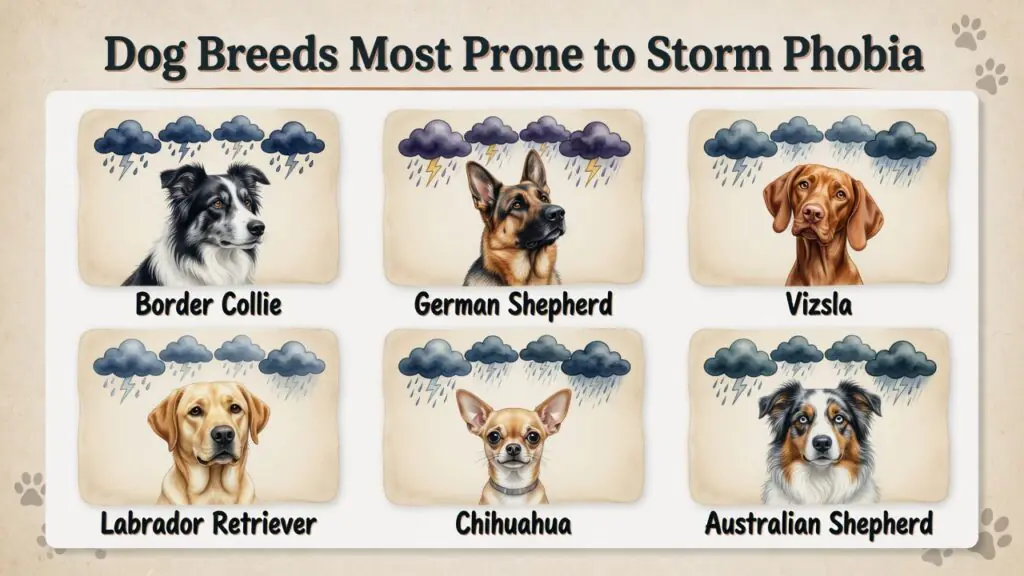
Border Collies, Australian Shepherds, German Shepherds, Shelties, and Belgian Malinois consistently appear at the top of storm-anxiety prevalence lists in behavioral research. These breeds have been selectively bred for heightened environmental awareness and reactivity — traits that are extraordinarily useful for herding work, but which translate into amplified storm sensitivity in a domestic context. Their nervous systems are essentially calibrated to detect and respond to the smallest environmental changes.
Working and Sporting Breeds
Labrador Retrievers, Golden Retrievers, and Vizslas show relatively high rates of noise sensitivity and storm phobia, despite their reputation as easy-going breeds. Vizslas, in particular, are clinically recognized as among the most noise-sensitive breeds. Sporting breeds bred to work closely with hunters in unpredictable outdoor conditions tend to have finely tuned environmental awareness that can predispose them to weather anxiety.
Small and Toy Breeds
Chihuahuas, Dachshunds, Yorkshire Terriers, and Maltese are over-represented in storm-phobia case studies. This may relate to a combination of genetic temperament, smaller body mass (meaning vibrations from thunder are proportionally more impactful), and the tendency for small-breed owners to inadvertently reinforce anxiety through excessive soothing. That said, it is worth noting that comforting a fearful dog is not wrong — the outdated notion that reassurance “rewards fear” is not supported by current behavioral science.
How to Calm a Dog During a Storm: Immediate Relief Strategies
Creating a Safe Space or Den
The single most evidence-backed immediate intervention for storm-phobic dogs is providing a consistent, accessible safe space. This is not about confinement — the dog should choose to use it. A suitable den space for storm anxiety has the following characteristics:
- Interior room or lowest floor — away from windows, with minimal exterior wall exposure
- Grounded surfaces — bathtubs, basement floors, ceramic tiles (for static discharge)
- Familiar, scented bedding — the dog’s own blanket and toys
- Consistent location — the same space every time, so the dog knows where to go
- Never force access — allow the dog to enter and exit freely
Many dogs self-select bathrooms during storms for the reasons discussed above — grounding and static relief. Rather than redirecting them away from these choices, facilitate them by ensuring bathroom doors are always open during storm events.
Pressure Wraps and Anxiety Vests
Pressure wraps such as the Thundershirt (and generic equivalents) work on the principle of deep pressure stimulation — the same mechanism behind weighted blankets for humans with anxiety disorders. Continuous gentle pressure activates the parasympathetic nervous system, counteracting the sympathetic activation of the fear response.
Clinical studies on pressure wraps for storm phobia show variable results — approximately 70% of dogs show some improvement, with roughly 30% showing a significant reduction in anxiety scores. Pressure wraps work best when introduced before a storm begins, at the first signs of anticipatory anxiety, rather than once the dog is already in a full panic response.
White Noise and Sound Masking
Reducing the acoustic impact of wind and thunder through sound masking is a practical and accessible strategy. White noise machines, box fans, or purpose-designed pet calming soundtracks (using frequencies in the range of 50–1,500 Hz) can help dampen the jarring impact of intermittent storm sounds. The goal is to replace an unpredictable aversive sound environment with a predictable, consistent auditory background.
Music therapy for dogs has been studied by researcher Dr. Deborah Wells and others, with findings suggesting that classical music and certain reggae/soft rock compositions reduce stress indicators in kennel dogs. Several streaming platforms now offer dog-specific sound channels curated for this purpose.
Calming Supplements and Natural Remedies
A number of over-the-counter calming supplements have supporting evidence for use in noise-anxiety contexts:
- L-Theanine — an amino acid from green tea that promotes alpha brain wave activity (calm alertness); found in products like Solliquin
- Melatonin — has shown preliminary effectiveness for storm anxiety; the generally cited dose is 1–3 mg for small dogs, 3–6 mg for larger dogs, but always verify with your vet
- Adaptil (DAP — Dog Appeasing Pheromone) — synthetic version of the pheromone nursing mothers produce; available as diffusers, collars, and sprays
- Zylkene (alpha-casozepine) — a casein-derived peptide that acts on GABA receptors similarly to benzodiazepines, without the sedating side effects
- CBD products — increasingly popular but with limited formal veterinary research; use only veterinary-formulated products from reputable brands
Long-Term Treatment: Desensitization and Counter-Conditioning
Sound Desensitization Therapy
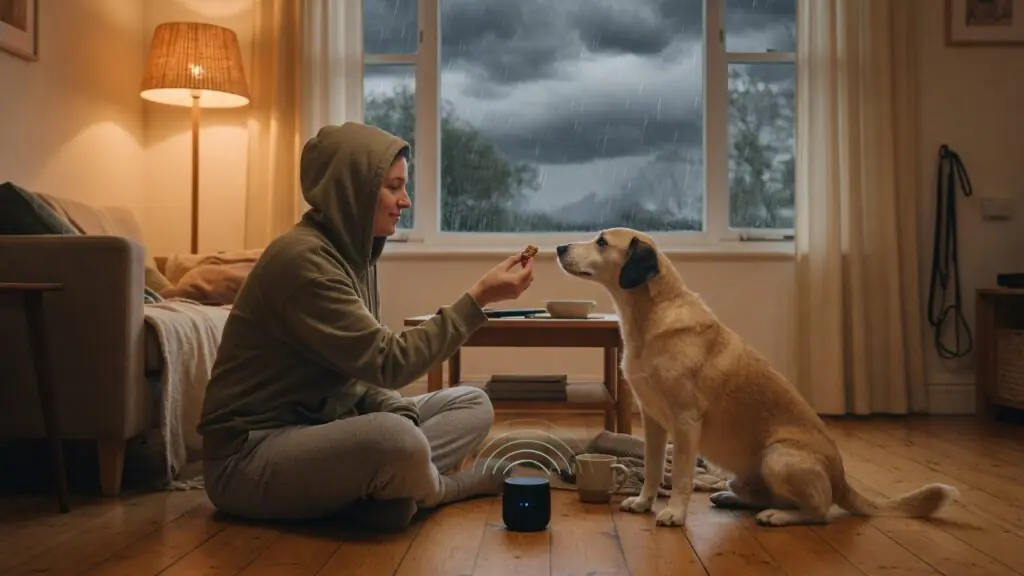
Sound desensitization — also called systematic habituation — involves gradually exposing the dog to recorded storm and wind sounds at sub-threshold volumes, building tolerance over weeks or months. This is one of the most evidence-supported long-term treatments for noise phobias in dogs, though it requires patience and consistency.
Key principles for effective sound desensitization:
- Start below threshold — the sound must be so quiet that the dog shows no fear response at all
- Pair with positive experiences — play, treats, and calm interaction during exposure
- Incremental volume increases only — never advance to a louder level until the dog is fully relaxed at the current level
- Maintain realistic recordings — use multi-track recordings that include infrasound, wind noise, and rain, not just thunder
- Daily sessions of 5–15 minutes — consistency matters more than duration
Commercial sound therapy programs designed specifically for dogs, such as those developed by veterinary behaviorists, are more effective than general thunder recordings because they include the full acoustic spectrum that dogs actually respond to.
Counter-Conditioning Techniques
Counter-conditioning changes the dog’s emotional response to storm stimuli by pairing those stimuli with something the dog loves. The goal is not to teach the dog to ignore storms, but to change what storms mean to the dog — from “something terrible is happening” to “high-value treats and good things are coming.”
Practically, this might involve:
- Beginning a special play session the moment you notice the barometer dropping
- Producing the dog’s absolute favorite treat only during storm events
- Engaging in a high-energy training session (which also burns anxious energy) during mild storm conditions
Counter-conditioning must be applied early — ideally during mild weather events or during the early anticipatory phase — not once the dog is already in a full stress response. A dog that is flooded with fear cannot learn; the cortisol response actually impairs the hippocampal memory formation needed for classical conditioning to work.
Systematic Desensitization Step-by-Step
Combining systematic desensitization and counter-conditioning (DS/CC) produces better outcomes than either technique alone. Here is a practical step-by-step protocol:
Step 1 — Baseline Assessment: Identify the exact sounds, stimuli, and sequence that trigger your dog’s storm fear. Rate their current fear on a scale of 1–10 during mild, moderate, and severe storms.
Step 2 — Acquire Multi-Track Recordings: Source high-quality recordings that include infrasound components, wind howling, rain on windows, and thunder. Pure thunder-only recordings are insufficient.
Step 3 — Establish a Positive Anchor: Before beginning desensitization, create a positive emotional anchor — a specific word, touch, or treat routine that reliably produces a happy, relaxed state. This will be used during sessions.
Step 4 — Begin Exposure at Level 1: Play recordings at barely audible volume. Immediately engage the positive anchor (treats, play, praise). Keep sessions to 10 minutes. End on a positive note.
Step 5 — Progress Slowly: Move to the next volume level only after three to five consecutive sessions showing zero fear response at the current level.
Step 6 — Generalize to Real Conditions: Once the dog tolerates recordings at moderate volume, begin working during actual mild weather events — a gentle rain, a breezy day. Real storms provide stimuli no recording can fully replicate.
Veterinary Treatments for Storm Phobia
Anti-Anxiety Medications
For dogs with moderate to severe storm phobia, behavioral modification alone is often insufficient. Veterinary pharmacotherapy — the use of medication to manage anxiety — is a legitimate, evidence-based part of comprehensive treatment. The most commonly used options fall into two categories:
Daily maintenance medications (used year-round or seasonally):
- Fluoxetine (Prozac) — SSRI; FDA-approved for separation anxiety in dogs under the brand name Reconcile; widely used off-label for noise phobia
- Clomipramine (Clomicalm) — Tricyclic antidepressant; FDA-approved for separation anxiety; commonly used for storm phobia
- Sertraline — an SSRI frequently prescribed by veterinary behaviorists for generalized anxiety with storm phobia comorbidity
These medications do not sedate the dog — they modulate baseline anxiety levels so that behavioral modification can be more effective.
Situational Medications (As-Needed)
For dogs whose storm anxiety is severe but infrequent, or as a bridge while behavioral modification is implemented:
- Sileo (dexmedetomidine oromucosal gel) — FDA-approved specifically for canine noise aversion; a partial alpha-2 agonist applied to the gums; works in 30–60 minutes
- Trazodone — serotonin antagonist/reuptake inhibitor; widely prescribed for situational anxiety; generally safe with few side effects
- Alprazolam (Xanax) — benzodiazepine; fast-acting; effective for acute panic states but carries dependency risk with frequent use
- Gabapentin — primarily an anticonvulsant; increasingly used for anxiety and pain; particularly useful for older dogs with concurrent joint pain (which worsens with barometric changes)
According to guidelines from the American Veterinary Society of Animal Behavior, medication should not be viewed as a last resort — early pharmacological intervention combined with behavior modification produces significantly better long-term outcomes than behavioral therapy alone.
Working with a Veterinary Behaviorist
For severe, treatment-resistant storm phobia, consultation with a board-certified veterinary behaviorist (Diplomate ACVB) or a certified applied animal behaviorist (CAAB) is strongly recommended. These specialists can conduct a comprehensive behavioral assessment, design individualized DS/CC protocols, supervise medication combinations, and provide owner coaching that is not available through general practice consultations.
Creating a Storm Safety Plan for Your Dog
Pre-Storm Preparation Checklist
Preparation is the foundation of effective storm management. Having a plan in place before a storm arrives — rather than scrambling reactively — dramatically reduces both your dog’s distress and your own anxiety:
- Monitor weather forecasts — identify approaching storm systems 24–48 hours in advance; begin calming supplements if used
- Exercise the dog beforehand — a well-exercised dog has a lower baseline arousal and more resilience to stress triggers
- Prepare the safe space — set up the den, add fresh bedding, and ensure the bathroom door is accessible
- Charge white noise devices — ensure power backup is available
- Have medications ready — situational medications must be given before the dog reaches peak anxiety; pre-dosing by 60–90 minutes is typically recommended
- Clear the calendar — when possible, be home with your dog during severe storm periods during active treatment phases
What NOT to Do During a Storm
Several well-intentioned behaviors can inadvertently worsen storm phobia:
- Do not force the dog out of hiding — forcing a fearful dog out of their safe space increases stress and erodes trust
- Do not punish fearful behavior — punishment during a fear state is neurologically damaging and ethically wrong; it also does not reduce fear
- Do not expose the dog to storms “to toughen them up” — flooding (forced, uncontrolled exposure) without systematic support causes trauma
- Do not use excessive, anxious reassurance — calm, matter-of-fact comfort is beneficial; panicky, over-solicitous behavior signals that there is indeed something to fear
- Do not ignore it — storm phobia does not resolve on its own; untreated, it worsens
Building Long-Term Confidence
Just as dogs can develop reactive behaviors in other contexts — such as barking reactively at other dogs on walks due to anxiety and poor early socialization — storm phobia benefits enormously from building general confidence and resilience across all areas of life. A dog with strong foundational confidence, a secure attachment to their owner, rich environmental enrichment, and a well-regulated autonomic nervous system will always handle storm stress better than an anxious, under-stimulated dog.
Practical confidence-building practices include:
- Regular, varied exercise that exposes the dog to different environments, sounds, and surfaces
- Positive-reinforcement training that gives the dog a sense of agency and competence
- Nose work and scent games (which activate the parasympathetic system and are deeply self-rewarding)
- Social enrichment with other calm, well-adjusted dogs
- Consistent routine and predictability in daily life
Frequently Asked Questions About Dogs Scared of Wind and Storms
Q: My dog was never afraid of storms before. Why has he suddenly become scared? Age-related sensitization is the most common cause of new-onset storm phobia in adult dogs. As dogs age, their nervous systems become less resilient to repeated stress exposures, and conditions like arthritis can cause barometric-pressure-related pain that becomes associated with storms. Have your vet rule out pain-related components.
Q: Should I comfort my dog during a storm, or will it make the fear worse? You should absolutely comfort your dog. The myth that reassurance reinforces fear is not supported by behavioral science. You cannot reinforce a fear response — fear is an emotional state, not an operant behavior. Calm, confident reassurance reduces cortisol and helps the dog co-regulate.
Q: Does a dog thunder jacket actually work? For many dogs, yes. Studies show that approximately 70% of owners report improvement with pressure wraps, though results vary. Effectiveness is highest when the wrap is introduced calmly before anxiety peaks. It is not a cure but a useful management tool.
Q: Can puppies develop storm phobia? Yes, though the most critical window for prevention is the socialization period (3–14 weeks). Positive, gradual exposure to storm sounds during this period can significantly reduce the likelihood of later phobia development.
Q: Is it safe to give my dog Benadryl for storm anxiety? Diphenhydramine (Benadryl) is sometimes used off-label for mild situational anxiety. It is generally considered safe in healthy dogs (roughly 1 mg/kg), but its efficacy for storm phobia specifically is minimal. For significant storm anxiety, purpose-designed options like Sileo, trazodone, or Adaptil are far more effective. Always consult your vet before administering any medication.
Q: My dog destroys the house during storms. What do I do? Destructive behavior during storms indicates a severe phobia requiring veterinary intervention. Do not attempt behavioral modification alone — this level of distress needs pharmaceutical support alongside a behavior plan. Ensure physical safety by confining the dog in a truly escape-proof but comfortable room, and see your vet promptly.
Q: How long does it take to treat storm phobia? With consistent DS/CC protocols, most dogs show meaningful improvement within 3–6 months. Complete resolution of phobia is less common but achievable. Many dogs require ongoing management (safe space access, calming tools, possibly seasonal medication) rather than a complete “cure,” and that is a valid outcome. The goal is a dog who is comfortable and functional during storms — not a dog who is indifferent to them.
References and Further Reading
For evidence-based guidance on canine anxiety disorders, the American Veterinary Society of Animal Behavior’s position statements on humane training provide invaluable clinical context on fear, anxiety, and stress in companion animals.
For in-depth research on noise sensitivity, sound therapy, and behavioral treatment protocols in dogs, the peer-reviewed resources available through the American College of Veterinary Behaviorists offer comprehensive clinical literature for both pet owners and veterinary professionals.