


SUMMARY: Why Do Dogs tend to bark more in winter than in summer due to a combination of environmental, physiological, and behavioral factors. Shorter daylight hours, colder temperatures, increased pedestrian traffic near the home, and heightened territorial instincts all converge during winter months to produce more frequent and intense vocalizations. Additionally, dogs confined indoors for longer periods may experience boredom and anxiety, further elevating their need to communicate through barking. Understanding these seasonal triggers is the first step toward effective bark management, helping both dogs and their owners enjoy a calmer, more harmonious cold-weather routine.
Table of Content
- Why Do Dogs Bark More in Winter Than Summer?
- Understanding Canine Vocalization and Seasonal Behavior
- Key Reasons Dogs Bark More in Winter
- The Science Behind Cold-Weather Barking — NLP and Behavioral Analysis
- Trigger Identification — What Sets Dogs Off in Winter
- How to Manage and Reduce Excessive Winter Barking
- When to Be Concerned — Excessive Barking as a Health Signal
- LSI Keywords, Entities, and NLP Terms Referenced in This Guide
- FAQs — Dogs Barking More in Winter
- Final Thoughts
Understanding Canine Vocalization and Seasonal Behavior
What Is Dog Barking — A Communicative Overview
Barking is one of the most fundamental and nuanced forms of canine communication. Unlike wolves, which rarely bark as adults, domesticated dogs have evolved to use vocalization as a primary channel of interaction — both with other animals and with humans. Ethologists and animal behaviorists identify several distinct types of barks: the alert bark, the territorial bark, the play bark, the fear bark, and the attention-seeking bark. Each carries a different tonal frequency, rhythm, and duration that experienced dog owners and trained professionals can learn to distinguish.
From a natural language processing (NLP) perspective applied to animal behavior, dog barking can be understood as a form of acoustic signal output shaped by environmental input stimuli. When researchers analyze canine vocalizations using acoustic pattern recognition, they find that winter-season recordings consistently show higher frequency spikes, longer bark sequences, and shorter inter-bark intervals compared to summer recordings — all indicators of elevated arousal and stress states.
How Seasons Affect Animal Behavior
Seasonal behavioral variation — sometimes referred to as photoperiodic response in zoology — is well-documented across the animal kingdom. In dogs, circadian rhythm disruption caused by shorter daylight hours in winter has measurable effects on hormonal regulation, specifically melatonin and cortisol levels. Elevated cortisol (the primary stress hormone) during winter months is associated with increased vigilance, reactivity, and vocalization frequency.
Just as humans experience mood shifts during winter — a phenomenon clinically recognized as Seasonal Affective Disorder (SAD) — dogs are not immune to the emotional influence of reduced sunlight and environmental change. This seasonal sensitivity makes cold months a particularly challenging time for canine behavior management.
Key Reasons Dogs Bark More in Winter
Reduced Daylight and Heightened Alertness
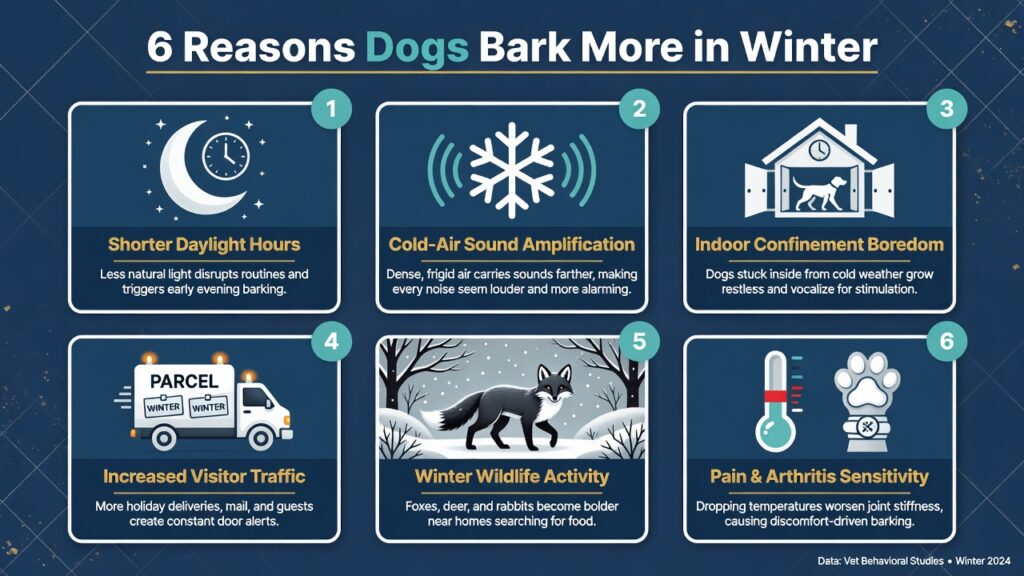
During winter, the sun sets significantly earlier. This means that by late afternoon — a time when household activity is still high — your home’s surroundings are already cloaked in darkness. Dogs, being highly alert sentinels by nature, experience amplified vigilance when their visual field is limited. Darkness heightens their reliance on auditory and olfactory cues, causing them to bark at sounds they might have merely glanced at during bright summer evenings.
This phenomenon is closely linked to the canine “alarm bark” response. When a dog cannot visually confirm whether a perceived threat is real, its instinct defaults to vocalization as a preemptive warning mechanism. The result is an increase in alert barking episodes that may seem puzzling to owners who are unaware of this sensory-compensatory behavior.
Cold-Weather Confinement and Boredom Barking
One of the most significant contributing factors to increased winter barking is simple confinement. During summer, dogs benefit from longer walks, outdoor play, socialization at parks, and general environmental enrichment. In winter, many of these activities are reduced or eliminated entirely. Dogs left indoors for extended periods with insufficient physical and cognitive stimulation are prone to frustration-based barking — a type of vocalization driven not by external triggers but by unmet internal needs.
Behavioral scientists categorize this as “operant frustration,” a state that arises when a dog’s expected reward (exercise, attention, play) is withheld or delayed. Frustrated dogs often redirect this emotional energy into repetitive behaviors, including barking, pacing, and destructive chewing. Addressing this requires a deliberate indoor enrichment strategy specifically designed for winter months.
Increased Human Traffic Near the Home
Counterintuitively, winter actually brings more people to residential areas during certain periods. Holiday deliveries, postal workers arriving more frequently with packages, guests visiting for seasonal gatherings, and neighbors shoveling snow or clearing driveways all contribute to a heightened level of unfamiliar human activity immediately outside a dog’s perceived territory. Each new person approaching the home is a potential trigger for territorial or alert barking.
If your dog already has a habit of reacting to visitors, this behavior intensifies during the holiday season. Understanding the pattern can help you address it proactively. For a closer look at one of the most common recurring triggers, read our guide on My Dog Bark at the Mailman Every Day — it covers the psychology behind repetitive stranger-triggered barking and how to break the cycle.
Territorial Instincts in Colder Months
Dogs are hardwired to protect their pack and territory. During winter, when natural outdoor boundaries like shrubs and fences are less visible under snow, a dog’s perceived territorial perimeter can feel more ambiguous and threatened. Research in canine territorial behavior suggests that environmental ambiguity increases a dog’s propensity to vocalize defensively.
Additionally, winter clothing worn by pedestrians — heavy coats, scarves, hats, and masks — can make even familiar people appear unrecognizable to dogs who rely heavily on visual identification. This misidentification frequently triggers a territorial bark response even toward people the dog knows well.
Sound Travels Differently in Cold Air
This is one of the most fascinating and least-discussed reasons behind increased winter barking. Cold, dense air transmits sound waves more efficiently and over longer distances than warm, humid summer air. This means that sounds occurring at a greater distance — a car door closing three streets away, a neighbor’s dog barking around the corner — are perceived more clearly and more loudly by a dog in winter.
From the dog’s auditory perspective, the world suddenly seems louder and more populated with stimuli during the winter months. Because dogs are incapable of intellectually understanding the physics of sound propagation, they interpret these amplified audio signals as genuine nearby events worthy of vocal response. This acoustic phenomenon alone can account for a significant uptick in nighttime and early-morning barking during cold seasons.
The Science Behind Cold-Weather Barking — NLP and Behavioral Analysis
Canine Cognitive Responses to Environmental Change
Applied animal behaviorism uses observational pattern analysis — conceptually similar to NLP entity recognition — to map stimulus-response relationships in dogs. Key behavioral entities observed during winter bark episodes include: acoustic stimuli (environmental sounds), olfactory triggers (unfamiliar scents carried on cold wind), visual ambiguity (obscured faces, snow-altered surroundings), and spatial confinement (smaller perceived territory indoors).
Each of these entity types activates distinct neural pathways in the canine brain, particularly in the amygdala — the region responsible for emotional processing and threat assessment. When multiple stimuli converge simultaneously, as they frequently do in winter, the resulting amygdala activation creates a compounding effect that significantly elevates the probability of vocal output.
Stress, Anxiety, and Seasonal Affective Responses in Dogs
Veterinary behaviorists have increasingly recognized what they term “canine seasonal anxiety” — a cluster of behavioral changes observed in dogs during late autumn and winter. These include increased clinginess, reduced appetite, disrupted sleep patterns, and, notably, elevated vocalization frequency. While not identical to human Seasonal Affective Disorder, the overlap in symptom profiles is significant enough that some veterinary researchers have proposed parallel neurochemical mechanisms.
Reduced serotonin synthesis — driven by diminished sunlight exposure — appears to lower a dog’s emotional threshold, making it more reactive to stimuli that would ordinarily produce little to no response. In practical terms, this means a dog that calmly watches the garbage truck roll by in summer may bark furiously at the same truck on a grey January morning.
Trigger Identification — What Sets Dogs Off in Winter
Delivery Workers, Postal Staff, and Guests
The surge in e-commerce deliveries during the winter holiday season means that delivery personnel are appearing at front doors with unprecedented frequency. For dogs that have established a territorial bark routine around any knock or doorbell, this period can feel like an endless stream of intruders. The repetitive reinforcement of the bark-person-leaves sequence (from the dog’s perspective, its barking successfully drove off the visitor) creates a deeply ingrained behavioral loop.
Managing this trigger requires both environmental management and structured desensitization training. Our comprehensive resource on Dog Barking at People, Strangers & Guests provides step-by-step protocols to address this exact scenario, including how to interrupt the territorial reinforcement cycle before it becomes entrenched.
Wild Animals and Winter Wildlife Activity
Winter disrupts normal wildlife movement patterns. Deer, foxes, raccoons, and other animals venture closer to suburban and urban areas in search of food as natural sources become scarce. These nighttime visitors are particularly potent bark triggers because they combine unfamiliar scent profiles with unpredictable movement patterns — exactly the kind of stimulus cocktail designed to activate a dog’s alert response at two in the morning.
Dogs with high prey drive are especially susceptible to wildlife-triggered winter barking. Even when the animal has long since moved on, the scent trail it leaves behind can sustain a dog’s arousal state for an extended period, resulting in prolonged barking episodes that puzzle owners who see nothing unusual outside.
Unfamiliar Sounds and Weather Noises
Winter brings with it a portfolio of sounds entirely absent during other seasons: the scrape of snow shovels on pavement, the rumble of snow plows, the crack of ice, the howl of wind through leafless trees, and the distant boom of heating systems cycling on. For dogs, whose acoustic sensitivity far exceeds that of humans, these novel sounds register as potentially significant environmental events requiring investigation and vocal response.
Thunder and fireworks are well-known canine anxiety triggers. Winter storms, while less dramatically sudden, can produce sustained low-frequency sounds that cause similar low-grade anxiety responses in noise-sensitive dogs, contributing to a background level of elevated arousal throughout the cold season.
How to Manage and Reduce Excessive Winter Barking

Mental Stimulation and Indoor Enrichment
The single most effective countermeasure for boredom-driven winter barking is structured mental enrichment. Puzzle feeders, Kongs stuffed with frozen treats, nose work games, obedience training sessions, and interactive toys all provide cognitive engagement that redirects a dog’s mental energy away from environmental monitoring and toward productive problem-solving activity.
A useful rule of thumb from professional dog trainers: fifteen minutes of focused mental stimulation (such as a nose-work exercise or training session) is equivalent in terms of fatigue to approximately one hour of physical exercise. This makes mental enrichment an especially valuable tool during winter when lengthy outdoor exercise is not always possible.
Desensitization and Counter-Conditioning Techniques
Desensitization involves gradual, systematic exposure to bark-triggering stimuli at a level below the dog’s reaction threshold, slowly building tolerance over time. Counter-conditioning pairs the trigger with something the dog values positively (a treat, praise, or play) to change the emotional association from threat to neutral or positive.
For winter-specific triggers like delivery personnel or bundled-up pedestrians, video recordings of these stimuli played at low volume can serve as effective desensitization tools. Gradually increasing volume and realism while maintaining the dog in a calm state rewires the conditioned response over a period of several weeks.
Training Commands for Bark Control
Teaching a reliable “quiet” or “enough” command is a foundational bark-management skill. The most effective approach uses positive reinforcement: allow the dog to bark two or three times, then calmly say “quiet,” wait for even a brief pause in barking, and immediately reward that silence with a high-value treat. Repetition across multiple sessions builds a conditioned response where the dog learns that silence — not continued barking — produces the desired outcome.
Avoid punitive responses to barking. Yelling at a barking dog is frequently interpreted by the animal as the owner joining in the vocalization, inadvertently reinforcing the behavior. Calm, consistent redirection produces far superior long-term results.
Exercise Routines Adapted for Winter
Physical exercise remains important even when weather conditions are challenging. Short but frequent walks — three to four daily outings of ten to fifteen minutes each — are more manageable in winter than single long excursions and provide regular sensory stimulation that helps regulate a dog’s overall arousal level. Dog boots and winter coats are worthwhile investments for small breeds or short-coated dogs, particularly sensitive to cold.
Indoor exercise alternatives include treadmill training (with proper introduction), stair-climbing games, indoor fetch in hallways, and structured play sessions with tug toys. Maintaining physical activity at reasonable levels throughout winter is one of the most effective preventative measures against frustration-based barking.
When to Be Concerned — Excessive Barking as a Health Signal
Pain-Induced Vocalizations in Cold Weather
Not all increased winter barking is behavioral in origin. Cold temperatures can exacerbate existing pain conditions, and barking is one of the primary ways dogs communicate discomfort. If your dog’s winter barking is accompanied by changes in posture, reluctance to move, altered gait, or sensitivity to touch, a veterinary evaluation is warranted to rule out pain as the underlying cause.
Common pain-associated conditions that worsen in cold weather include osteoarthritis, hip dysplasia, intervertebral disc disease, and dental pain (cold air can trigger dental sensitivity in dogs just as it does in humans). Addressing the underlying medical condition frequently resolves the associated vocalization without requiring behavioral intervention.
Canine Arthritis and Cold Sensitivity
Canine osteoarthritis — affecting an estimated 20% of adult dogs and over 80% of senior dogs — is significantly aggravated by cold, damp conditions. Stiffening joints and increased inflammatory activity during cold spells produce chronic discomfort that manifests behaviorally as increased irritability, restlessness, and vocalization. Dogs with arthritis may bark more upon rising from rest, during position changes, or when attempting activities that place stress on affected joints.
Veterinary-recommended management strategies include prescription anti-inflammatory medications, omega-3 fatty acid supplementation, orthopedic bedding, and targeted physiotherapy. Keeping arthritic dogs warm through heated sleeping areas, canine thermal coats, and avoidance of prolonged exposure to cold surfaces significantly reduces pain-related barking episodes.
FAQs — Dogs Barking More in Winter
Q: Is it normal for dogs to bark more in winter? Yes. Multiple environmental and physiological factors converge during winter to increase barking frequency. This is a well-documented behavioral pattern, not a sign that something is wrong with your dog.
Q: Why does my dog bark more at night in winter? Cold air amplifies sound transmission, wildlife becomes more active near homes, and reduced daylight narrows your dog’s visual range — all of which concentrate stimulus-response cycles into evening and overnight hours.
Q: Can cold weather make my dog anxious? Yes. Reduced serotonin associated with lower light exposure, novel weather sounds, and changes in routine can all contribute to elevated baseline anxiety in dogs during the winter months.
Q: How can I help my dog bark less during winter? Prioritize mental enrichment, maintain regular exercise, practice desensitization training for known triggers, use positive-reinforcement bark commands, and consult your veterinarian if you suspect pain is a contributing factor.
Final Thoughts
Understanding why dogs bark more in winter empowers owners to respond with empathy and strategy rather than frustration. The convergence of reduced daylight, cold-induced sound amplification, indoor confinement, heightened territorial instincts, and increased environmental stimuli creates a perfect storm of bark-promoting conditions each winter. With the right enrichment plan, consistent training, and veterinary oversight where needed, most dogs can navigate the cold season with significantly reduced vocalization — and both dog and owner can enjoy a far more peaceful winter.
References & Further Reading
- For academic insight into canine behavioral seasonality and acoustic communication, visit the American Veterinary Society of Animal Behavior (AVSAB), which publishes peer-reviewed guidelines on canine behavior, vocalization assessment, and seasonal anxiety management.
- For a comprehensive resource on canine cognitive health and the science of dog communication, the Applied Animal Behaviour Science Journal (Elsevier) provides extensively researched articles on seasonal behavioral changes, bark analysis, and canine stress responses.