


Summary: Dog barking when left alone is one of the most common and frustrating behavioral challenges pet owners face. This comprehensive guide How to Stop Dog Barking When Left Alone explores the root causes of separation anxiety in dogs, explains the science behind stress-triggered vocalization, and delivers proven, step-by-step strategies — from desensitization training and environmental enrichment to calming aids and professional interventions — so you can help your dog feel safe, secure, and quiet when home alone.
Table of Contents
- Understanding Why Dogs Bark When Left Alone
- The Science Behind Separation Anxiety in Dogs
- How to Diagnose the Root Cause of Your Dog’s Barking
- Step-by-Step Training Techniques to Stop Barking When Alone
- Environmental Modifications to Reduce Anxiety Barking
- Calming Aids and Products That Actually Work
- Obedience Training Foundations That Prevent Barking
- Lifestyle and Routine Changes for a Calmer Dog
- When to Seek Professional Help
- Common Mistakes Dog Owners Make
- Frequently Asked Questions
Understanding Why Dogs Bark When Left Alone
The Psychology of Canine Separation Anxiety
Dogs are deeply social animals. Evolutionarily, they descend from pack animals for whom separation meant danger. When a modern domestic dog is left alone, especially one that has developed a strong attachment bond with its owner, the brain can trigger a genuine fear response — not simply a behavioral nuisance. This is what behavioral scientists call separation-related behavior (SRB), and it sits at the core of most barking-when-alone problems.
Separation anxiety in dogs is a clinical condition characterized by extreme distress when a dog is separated from its attachment figure (usually a person). The barking you hear — or your neighbors complain about — is your dog’s vocalization of panic. Understanding this distinction is critical: punishing the barking treats a symptom, not the cause, and can make anxiety significantly worse.
Types of Barking: Anxiety vs. Boredom vs. Territorial
Not all alone-time barking stems from the same source. Identifying the correct type determines the right treatment approach:
Anxiety Barking: Begins within 30–60 minutes of owner departure. Often paired with whining, howling, panting, pacing, and destructive behavior. The dog may not settle even with distractions present.
Boredom Barking: Typically starts later in the alone period (after 2–3 hours). The dog is physically and mentally understimulated. This type responds well to enrichment strategies.
Territorial or Alert Barking: Triggered by stimuli outside the home — passing people, other dogs, or cars. The dog may bark in short, sharp bursts directed at windows or doors.
Learned Barking: Some dogs have learned that barking brings their owner home or produces a reaction. Reinforcement (even negative attention) has trained the behavior.
Key Signs Your Dog Has Separation Anxiety
Before designing a treatment plan, confirm that separation anxiety is the underlying issue. Common behavioral indicators include:
- Vocalization (barking, howling, whining) within minutes of the owner leaving
- Destructive behavior concentrated near exit points (doors, windows)
- House soiling despite being fully house-trained
- Excessive drooling, panting, or yawning (stress signals)
- Desperate greeting behaviors upon the owner’s return
- Refusal to eat when left alone
- Shadow-following (“velcro dog” behavior) before departure
The Science Behind Separation Anxiety in Dogs
Stress Hormones and Canine Behavior
When a dog experiences separation distress, the hypothalamic-pituitary-adrenal (HPA) axis activates, flooding the bloodstream with cortisol and adrenaline. These neurochemical changes are the same stress responses observed in human anxiety disorders. Elevated cortisol suppresses the prefrontal cortex’s regulatory capacity, meaning the dog literally cannot self-soothe or make rational behavioral choices. This is why scolding an anxious dog is biologically counterproductive — the dog is operating under a fear hijack, not deliberate misbehavior.
Research published in behavioral neuroscience journals confirms that dogs with chronic separation anxiety show measurable differences in HPA axis reactivity, dopamine regulation, and oxytocin receptor sensitivity — all neurochemical pathways implicated in attachment and social bonding.
Breed Predisposition and Genetic Factors
Some breeds are statistically more prone to separation-related barking than others due to selective breeding for human attachment and cooperation. High-risk breeds include Labrador Retrievers, German Shepherds, Border Collies, Cocker Spaniels, Vizslas, and Bichon Frises. Herding and sporting breeds, bred to work closely alongside humans, often have the deepest attachment bonds and the highest vulnerability to separation distress. Single-dog households and dogs adopted from rescue environments (with histories of abandonment or rehoming) also show elevated rates of separation anxiety.
How to Diagnose the Root Cause of Your Dog’s Barking
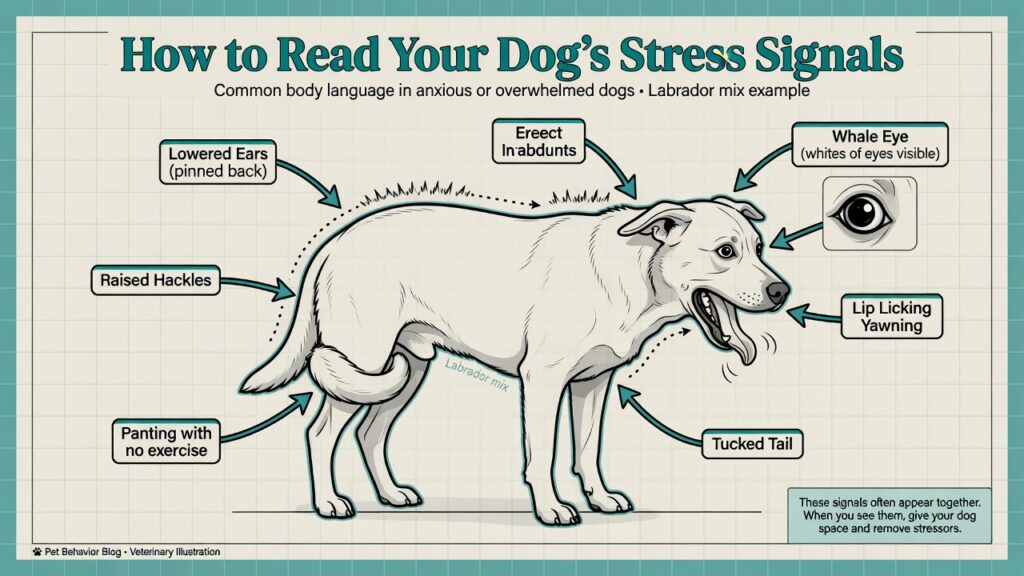
Using a Camera to Monitor Behavior
Before implementing any behavioral intervention, you need objective data. Set up a pet camera, smartphone, or baby monitor and record your dog for at least 60–90 minutes after departure across multiple days. Pay attention to:
- Latency to onset: How quickly does barking begin after you leave?
- Intensity progression: Does barking escalate, plateau, or self-resolve?
- Trigger identification: Is barking preceded by external stimuli (sounds, sights) or purely internal distress?
- Body language: Are stress signals (lip licking, yawning, low posture) present before vocalization?
This video evidence also becomes invaluable when consulting a veterinary behaviorist or certified dog trainer.
Behavioral Patterns to Watch For
True separation anxiety pattern: Immediate frantic behavior, persistent barking/howling, inability to settle, cessation only when the owner returns.
Boredom/frustration pattern: Quiet for the first 1–2 hours, barking increasing mid-day, receptive to food toys and enrichment.
Confinement anxiety pattern: Dog is calm when free-roaming but distressed when crated. Separate from true separation anxiety.
Barrier frustration: Barking directed at a closed door or fence. Ease when the barrier is removed, regardless of owner proximity.
Step-by-Step Training Techniques to Stop Barking When Alone
Desensitization and Counter-Conditioning
This is the gold-standard behavioral intervention for separation anxiety, backed by the American Veterinary Society of Animal Behavior (AVSAB). The principle is simple: gradually expose your dog to increasing durations of alone time at sub-threshold levels (before anxiety is triggered), while pairing departures with highly positive experiences.
How to implement:
- Identify your dog’s “threshold” — the duration at which anxiety first activates. For severely anxious dogs, this may be as short as 5 seconds.
- Start departures at 50% of that threshold (e.g., 2–3 seconds if the threshold is 5 seconds).
- Return calmly before any stress signals appear.
- Gradually, over days and weeks, increase the duration in small increments.
- Never progress to a longer duration if the dog shows any stress at the current level.
Progress is non-linear. Setbacks are normal. Patience is mandatory.
Departure Cue Neutralization
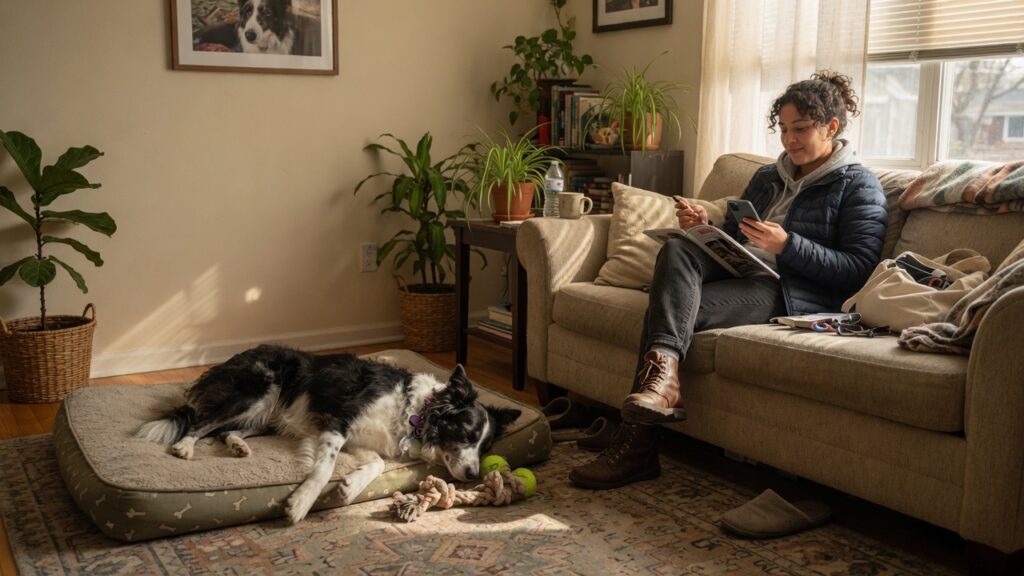
Dogs are expert pattern recognizers. They learn the pre-departure sequence — putting on shoes, picking up keys, putting on a jacket — and begin experiencing anxiety before they even leave. This anticipatory anxiety is neurologically identical to the real event.
Neutralization protocol:
- Practice putting on your shoes and sitting back down (no departure). Repeat 15–20 times daily.
- Pick up your keys, jingle them, put them down. Repeat.
- Put on your coat, watch TV for 20 minutes, then take it off.
- Eventually combine cues without leaving, then leave for just 10 seconds.
Over 2–4 weeks, these cues lose their predictive power and cease triggering the anxiety response.
Graduated from Alone-Time Training
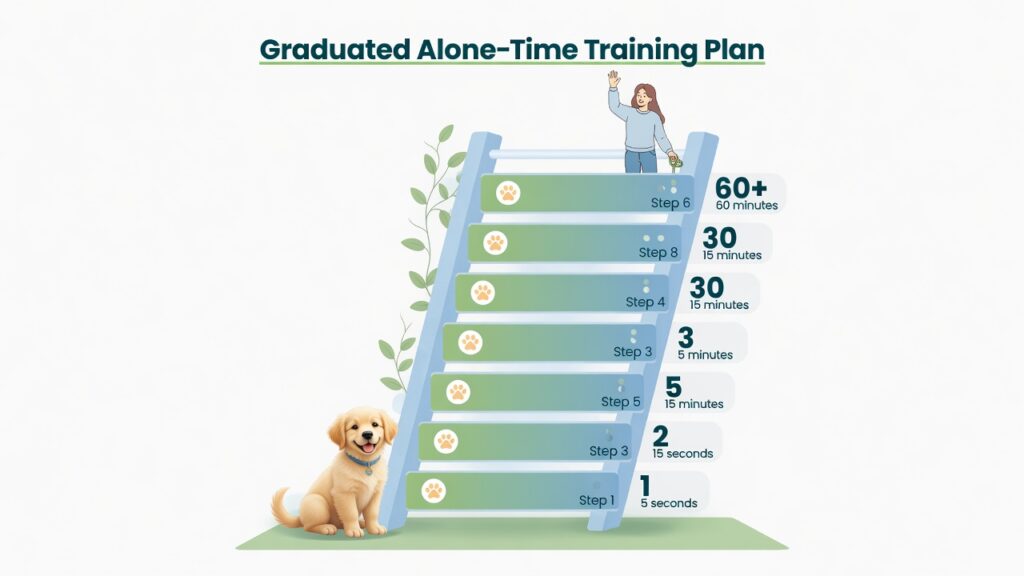
Also called “systematic desensitization,” this structured protocol should be conducted daily:
Week 1: Departures of 5–30 seconds, 10–15 sessions daily.
Week 2: Departures of 1–5 minutes, 5–8 sessions daily.
Week 3: Departures of 5–20 minutes, 3–5 sessions daily.
Week 4+: Extend toward target duration (work, full day).
Crucially, during active training, avoid all departures longer than your dog’s current tolerance level. If you must leave for work, arrange a dog sitter, doggy daycare, or a trusted neighbor during training periods.
Environmental Modifications to Reduce Anxiety Barking
Creating a Safe Space and Den Environment
Many dogs benefit from having a designated “safe zone” — a quiet, semi-enclosed space where they feel protected. This taps into the canine instinct for denning behavior. A properly conditioned crate can serve this purpose, but only if introduced positively — never used as punishment.
Den setup tips:
- Choose a location away from windows (reduces external triggers).
- Add worn clothing with your scent (activates oxytocin/comfort response).
- Use a covered crate or place furniture to create a semi-enclosed feel.
- Feed all meals in this space to build positive associations.
For dogs that associate crates with confinement stress, an exercise pen or gated bedroom may work better.
Sound Masking and White Noise
External sounds — street noise, other dogs, delivery trucks — are common barking triggers. Sound masking neutralizes these stimuli:
- White noise machines or fans create a consistent audio backdrop that buffers sudden sounds.
- Through a Dog’s Ear (bioacoustic music) is clinically tested music specifically designed to reduce canine cortisol levels.
- Radio or TV (calm talk radio or classical music) can reduce the contrast between “owner home” and “owner absent” acoustic environments.
Avoid music with heavy bass, erratic rhythms, or commercial breaks with sudden volume changes.
Mental Stimulation and Physical Exercise
A mentally exhausted dog is a quiet dog. Cognitive load reduces anxiety behaviors across virtually all behavioral studies on canine welfare.
Pre-departure enrichment stack:
- 30–60 minute vigorous exercise (not just a walk — running, fetch, or swimming) 1–2 hours before departure.
- Puzzle feeders loaded with the dog’s entire breakfast — this extends the feeding duration and occupies the brain.
- Frozen Kongs stuffed with kibble, peanut butter, banana, or plain yogurt and frozen overnight. Reserve exclusively for alone time to build positive departure associations.
- Snuffle mats and lick mats that trigger calming licking behaviors (licking releases serotonin).
- Scatter feeding — hide kibble around a room to activate natural foraging instincts.
For ongoing mental enrichment between departures, consider nose work training, which engages the dog’s olfactory system and produces measurable reductions in stress hormones.
Calming Aids and Products That Actually Work
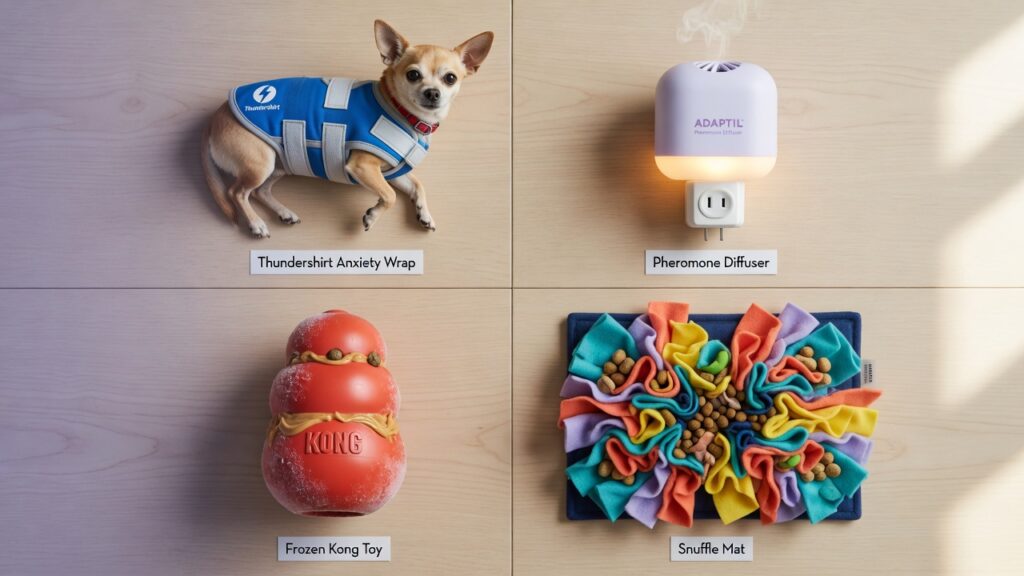
Pheromone Diffusers and Sprays
Adaptil (DAP — Dog-Appeasing Pheromone) is a synthetic version of the natural calming pheromone produced by lactating mother dogs. Available as a plug-in diffuser, collar, or spray, it has moderate evidence of efficacy in reducing anxiety behaviors, particularly when used alongside behavioral training. Multiple peer-reviewed studies have demonstrated statistically significant reductions in separation-related vocalizations in dogs using DAP diffusers.
Use consistently for at least 30 days before evaluating effectiveness.
Anxiety Wraps and Pressure Vests
The Thundershirt and similar compression garments work on the principle of deep pressure stimulation — the same mechanism behind weighted blankets for humans. Consistent, gentle pressure activates the parasympathetic nervous system and reduces arousal. In a controlled trial, over 80% of owners reported improved anxiety behaviors in their dogs using pressure wraps.
Put the wrap on 15–20 minutes before departure, not at the moment of leaving (prevents it from becoming a departure cue itself).
Calming Supplements and Nutraceuticals
For mild to moderate anxiety, evidence-supported supplements include:
- L-Theanine (Suntheanine) — an amino acid from green tea that promotes alpha brainwave activity and calm alertness without sedation.
- Alpha-casozepine (Zylkene) — a peptide derived from milk protein with benzodiazepine-like receptor activity. Multiple studies support its use for situational and chronic anxiety.
- Melatonin — regulates circadian rhythm and has mild anxiolytic properties; useful when anxiety disrupts sleep cycles.
- Ashwagandha and valerian root — herbal options with emerging evidence in canine anxiety research.
Always consult your veterinarian before introducing any supplement, particularly in dogs with existing health conditions or those on medications.
Obedience Training Foundations That Prevent Barking
Teaching the “Quiet” Command
The “quiet” command is taught through the interruption of a barking episode — it cannot be taught during a true panic state, so ensure you use it during mild barking scenarios (territorial barking at the window, for example).
Training protocol:
- Allow 3–4 barks.
- Say “quiet” once, calmly and clearly.
- Present a high-value treat near the dog’s nose.
- The moment barking stops to sniff/eat the treat, mark with “yes” and reward.
- Gradually extend the quiet duration before rewarding.
- Practice 3–5 times daily in low-arousal contexts.
Never use “quiet” during a full anxiety episode — this is not a training opportunity, it’s a welfare crisis requiring management.
Building Independence with “Place” Training
“Place” training teaches a dog to remain calmly on a designated mat or bed while remaining calm and stationary — even when the owner moves around or out of sight. This builds independence confidence, which directly reduces over-attachment anxiety.
Implementation steps:
- Teach “place” (go to mat) and reward for duration, incrementally.
- Walk out of sight for 1 second, return, and reward if the dog remains.
- Build to 1 minute, 5 minutes, and eventually longer.
- Practice “place” across different rooms and distances.
This is one of the most powerful independence-building exercises in behavioral modification. For an additional resource on evening-specific barking management techniques, visit our Guide to Stop Dog Barking at Night.
Lifestyle and Routine Changes for a Calmer Dog
The Power of a Predictable Schedule
Anxiety thrives in unpredictability. Dogs are creatures of routine, and consistent daily schedules are neurologically stabilizing. Feed, exercise, and leave at the same times each day. Predictability reduces the anticipatory stress that amplifies separation anxiety.
If your schedule varies significantly, simulate a consistent routine regardless — even on days off, follow the same morning pattern (but with a very short departure) to prevent the weekend-Monday anxiety spike many dogs experience.
Pre-Departure Exercise Routines
Exercise is one of the most powerful natural anxiolytics available to dogs. Aerobic exercise activates the release of endorphins and serotonin, reduces cortisol, and promotes behavioral calm for 4–6 hours post-exercise. A dog that has run, swum, or played vigorously is physiologically calmer when alone.
Target intensity: Your dog should be breathing hard, not just walking. A 15-minute leisurely stroll is insufficient for most working or sporting breeds.
Timing: Exercise 1–2 hours before departure, not immediately before, to allow heart rate and cortisol to normalize.
When to Seek Professional Help
Working with a Certified Applied Animal Behaviorist
If your dog’s separation anxiety is severe (immediate panic, self-injury, inability to settle within minutes), DIY training approaches may be insufficient or even harmful if implemented incorrectly. A Certified Applied Animal Behaviorist (CAAB) or a Veterinary Behaviorist (DACVB) is the appropriate specialist.
According to the American Veterinary Society of Animal Behavior, punishment-based interventions for separation anxiety are contraindicated and may worsen the condition. Evidence-based behavioral modification, often combined with medication, produces the best outcomes.
Look for professionals certified by:
- International Association of Animal Behavior Consultants (IAABC)
- Certification Council for Professional Dog Trainers (CCPDT)
- American College of Veterinary Behaviorists (ACVB)
Veterinary Behavioral Medication
For moderate to severe separation anxiety, behavioral medication in combination with behavior modification produces significantly better outcomes than either approach alone. Your veterinarian may discuss:
- Fluoxetine (Reconcile/Prozac): FDA-approved for canine separation anxiety. Reduces overall anxiety reactivity, enabling behavior modification to be effective.
- Clomipramine (Clomicalm): A tricyclic antidepressant also FDA-approved for separation anxiety.
- Trazodone, gabapentin, or alprazolam: Short-term situational medications used as needed.
Medication is not a failure — it’s a tool that lowers the dog’s physiological baseline enough for training to take hold. For further evidence-based reading, the ASPCA’s guide on separation anxiety is an excellent clinical resource.
Common Mistakes Dog Owners Make
1. Punishing the barking: Punishment increases stress and erodes trust, worsening the underlying anxiety. Never scold, yell, or use aversive devices (shock collars, citronella sprays) for anxiety-based barking.
2. Making departures dramatic: Elaborate goodbye rituals elevate arousal before you leave. Keep departures completely calm and matter-of-fact. A simple “see you later” and out the door.
3. Returning when the dog barks: If you return because the dog is barking, you have just reinforced the barking behavior. Only return when there is a moment of quiet.
4. Moving too fast in training: Skipping steps in desensitization training is the number-one cause of training failure. Progress must be incremental and driven by the dog’s behavior, not your timeline.
5. Expecting overnight results: Separation anxiety that has been present for months may take weeks to months of consistent training to meaningfully improve. Set realistic expectations and track progress incrementally.
6. Using confinement as a first resort: For confinement-anxious dogs, locking them in a crate before they’re conditioned to it creates a compounding crisis. Introduce confinement separately and positively.
Frequently Asked Questions
Q: How long does it take to stop a dog from barking when left alone? A: Mild cases with consistent training often improve in 2–4 weeks. Moderate to severe separation anxiety can take 3–6 months of structured behavioral modification. Some dogs require ongoing management.
Q: Do anti-bark collars work for separation anxiety? A: No. Aversive devices do not address the underlying cause (anxiety) and can cause significant psychological harm. They are contraindicated for anxiety-based barking by every major veterinary behavioral organization.
Q: Can I train an adult dog out of separation anxiety? A: Absolutely. Adult dogs can and do recover from separation anxiety with appropriate intervention. Neuroplasticity persists throughout a dog’s life. Age is not a barrier to behavioral change.
Q: Should I get a second dog to keep my dog company? A: This is a commonly suggested but unreliable solution. True separation anxiety is a human attachment disorder — many dogs remain distressed even with a companion present. A second dog should never be the primary treatment for separation anxiety.
Q: Is separation anxiety caused by spoiling my dog? A: No. Separation anxiety is not caused by affection or “spoiling.” It is a clinical anxiety disorder influenced by genetics, early socialization, trauma history, and the dog’s individual neurological makeup.