

Summary: Excessive dog barking at people, strangers, and guests is one of the most common behavioral challenges dog owners face, and it stems from a complex mix of fear, territorial instincts, lack of socialization, and learned behaviors. This comprehensive guide walks you through every aspect of understanding and correcting this behavior — from identifying the root cause and reading your dog’s body language, to applying proven training techniques like desensitization, counter-conditioning, and positive reinforcement. Whether your dog barks defensively at the mailman, lunges at strangers on walks, or goes berserk when guests arrive at the door, you will find actionable, science-backed strategies here to help you reclaim peace, build your dog’s confidence, and create a calmer, more sociable companion.
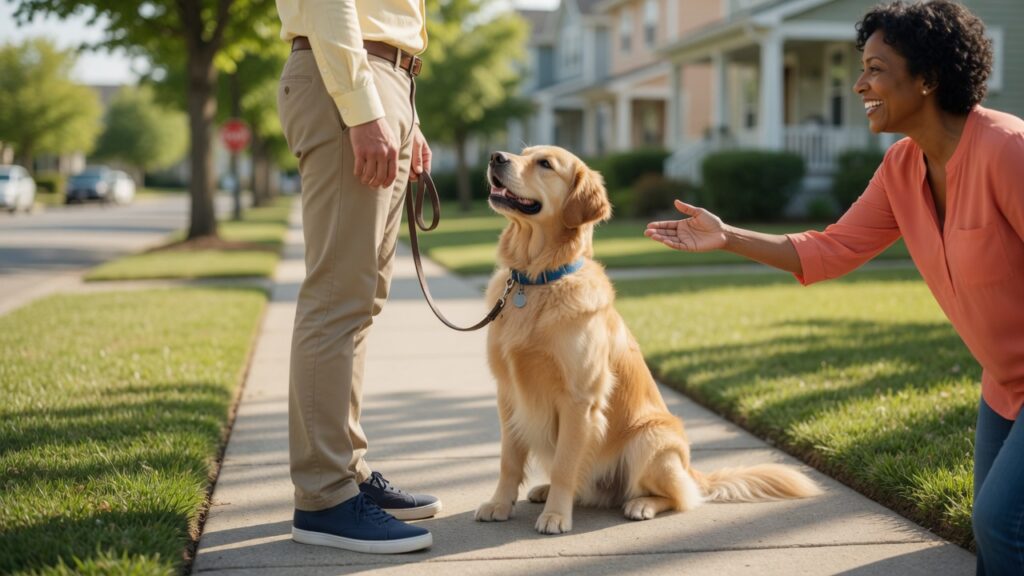
Table of Content
- How to Stop Dog Barking at People, Strangers & Guests: The Complete Guide
- Why Does My Dog Bark at People and Strangers?
- Understanding Your Dog’s Body Language When Barking
- How to Stop Dog Barking at Strangers on Walks
- How to Stop Dog Barking at Guests and Visitors at the Door
- How to Stop Dog Barking at People Through the Fence or Window
- Positive Reinforcement Techniques That Actually Work
- Common Mistakes Dog Owners Make When Correcting Barking
- When to Seek Professional Help
- Socialization: The Long-Term Solution
- Tools and Aids That Can Help
- Frequently Asked Questions
Why Does My Dog Bark at People and Strangers?
Before you can effectively address barking, you need to understand what is driving it. Dogs communicate through vocalization, and barking at people or strangers is almost always a symptom of an underlying emotional or psychological state — not simply “bad behavior.” Identifying the root cause is the single most important step in solving the problem.
Territorial Barking
Territorial barking occurs when a dog perceives a person approaching its defined space — the home, yard, car, or even the owner — as a threat. This is an instinctual behavior rooted in the dog’s drive to protect its pack and resources. Territorial barkers typically bark loudly as someone approaches and may calm down once the “intruder” has entered and been accepted, or they may escalate if the stranger continues to feel threatening.
The reinforcing trap of territorial barking is well documented: the dog barks, the mailman or delivery person walks away, and the dog’s brain records this as a win. Over time, the behavior becomes deeply ingrained because it appears to “work” from the dog’s perspective.
Fear-Based Barking and Anxiety
Fear is one of the most common drivers of barking at strangers. Dogs that were poorly socialized as puppies, experienced trauma, or have a naturally anxious temperament may bark as a distance-increasing behavior — essentially telling the stranger to “stay back.” This is often misread as aggression, but it is the dog’s way of saying it feels unsafe and wants more space.
Fear-based barkers often show physical signs of stress: tucked tail, flattened ears, lowered body posture, lip licking, and whale eye (showing the whites of the eyes). Understanding this distinction is critical because the wrong training approach can make a fearful dog significantly worse.
Alert Barking
Alert barking is your dog acting as a watchdog — notifying you that something or someone new has entered the environment. A few sharp barks to say “hey, there’s someone here” is natural and even useful. The problem arises when the dog cannot stop once acknowledged, or when any sight or sound of a person triggers a prolonged barking episode.
Alert barkers respond well to acknowledgment and redirection. Many owners find that simply saying “thank you, I’ve got it” in a calm voice and then redirecting the dog is enough to interrupt the behavior cycle.
Frustration and Excitement Barking
Some dogs bark at people not out of fear or territorial aggression, but out of excitement and frustration — they desperately want to greet the person and are frustrated by not being able to do so. This is common in social, friendly breeds like Labrador Retrievers, Golden Retrievers, and Beagles. These dogs may whine, spin, or jump alongside the barking.
The irony of excitement barking is that the dog’s intense behavior often frightens the very people it wants to greet, creating a negative feedback loop.
Lack of Socialization
Dogs that were not adequately exposed to a wide variety of people during their critical developmental window (roughly 3 to 14 weeks of age) often grow up viewing strangers as unpredictable and threatening. This insufficient socialization is one of the leading causes of fear-based and reactive barking in adult dogs. The good news is that while the early window is the easiest time to socialize, adult dogs can still make significant progress with patient, systematic exposure.
Understanding Your Dog’s Body Language When Barking
Reading your dog’s body language accurately will help you tailor your training approach and avoid inadvertently escalating the situation.
Signs of Fear vs. Aggression
| Body Signal | Fear-Based Barking | Confidence/Territorial Barking |
| Tail position | Tucked or low | High, stiff, flagging |
| Body posture | Crouched, leaning back | Erect, leaning forward |
| Ear position | Flattened back | Forward, erect |
| Hackles | May be raised | Typically raised |
| Eye contact | Avoidant or wide | Direct, hard stare |
A dog that is barking while moving toward a person with a stiff, upright posture presents a different challenge than a dog barking while trying to retreat. Never assume the barking is “just noise” — it is communication, and reading it correctly will save you from applying the wrong fix.
Reading Stress Signals
Calming signals and stress indicators often precede barking episodes. Yawning, excessive sniffing, sudden scratching, lip licking, and turning away are all signs your dog is feeling uncomfortable. Learning to intervene at this stage — before the barking escalates — is one of the most powerful skills you can develop as a dog owner. Catching these early signals gives you the opportunity to redirect and reward calm behavior before the threshold is crossed.
How to Stop Dog Barking at Strangers on Walks
Reactive barking on leash is one of the most stressful situations for dog owners and one of the most common complaints among those with anxious or territorial dogs. The leash itself can contribute to the problem, as it prevents the dog from using its natural coping strategy of simply moving away, creating what trainers call “leash reactivity.”
The Threshold Concept
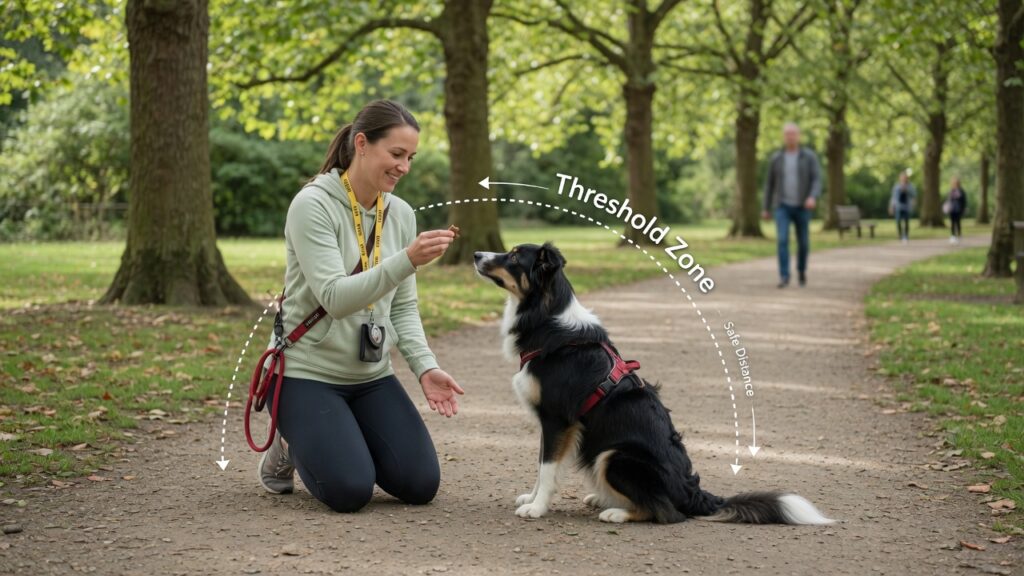
The threshold is the distance at which your dog notices a trigger (a person) but has not yet gone “over the top” into full reactive barking. Below threshold, your dog can think, take treats, and respond to cues. Above threshold, the thinking brain essentially shuts down and the emotional brain takes over. All effective leash reactivity training starts with keeping your dog below its threshold.
In practical terms, this means increasing the distance between your dog and the stranger until your dog can notice the person without reacting. For some dogs, this might be 20 feet. For others, it might be a full city block. Start wherever your dog can remain calm, then gradually decrease the distance over many training sessions.
Desensitization and Counter-Conditioning
Desensitization involves systematic, gradual exposure to the trigger (people) at a level that does not provoke a full reaction, so the dog gradually becomes less sensitive to it. Counter-conditioning works alongside this by pairing the sight of a person with something your dog loves — usually a high-value treat — so that the emotional response changes from fear or arousal to anticipation of something good.
The protocol looks like this:
- Find your dog’s threshold distance from a stranger.
- The moment your dog sees the person, begin delivering small, high-value treats continuously.
- When the person moves out of sight, stop the treats.
- Repeat dozens to hundreds of times across multiple sessions.
Over time, your dog learns that “person appearing = great things happen,” which fundamentally reshapes the emotional association.
The “Look at That” (LAT) Technique
Developed by Leslie McDevitt in her book Control Unleashed, the “Look at That” technique teaches your dog to calmly orient toward a trigger and then look back at you for a reward. Rather than demanding that the dog ignore people (an unrealistic expectation for a reactive dog), LAT acknowledges the trigger and teaches the dog to check in with you about it.
To practice LAT, wait for your dog to glance at a person in the distance, then immediately mark the behavior with a “yes” or a clicker and reward with a treat. The dog learns that noticing a stranger earns a reward, and the act of looking back at you becomes automatic. This technique works remarkably well for alert and fear-reactive barkers.
Leash Pressure and Redirection
When your dog begins to fixate on a stranger (staring, tensing, beginning to vocalize), gently use leash pressure to redirect attention back to you. A simple “let’s go” paired with a turn in the opposite direction can interrupt the fixation before it escalates to full barking. This is not punishment — it is simply redirecting your dog’s attention to something more productive.
Avoid yanking the leash or using harsh corrections, as this can increase anxiety and worsen reactive behavior over time, particularly in fear-based barkers.
Pro Tip: Carrying a “treat scatter” in your pocket is a powerful tool. If your dog suddenly encounters a stranger too close for comfort, tossing a handful of small treats on the ground engages the dog’s nose and naturally lowers arousal — sniffing is a calming, focused activity that competes directly with barking.
How to Stop Dog Barking at Guests and Visitors at the Door
The front door is a unique flashpoint for barking because it concentrates so many triggers at once: the doorbell or knock (a conditioned stimulus), the approach of a stranger, and the entry of that person into the dog’s primary territory. Most dogs have rehearsed door barking hundreds of times, which means the behavior is deeply conditioned.
Training a “Go to Your Place” Command
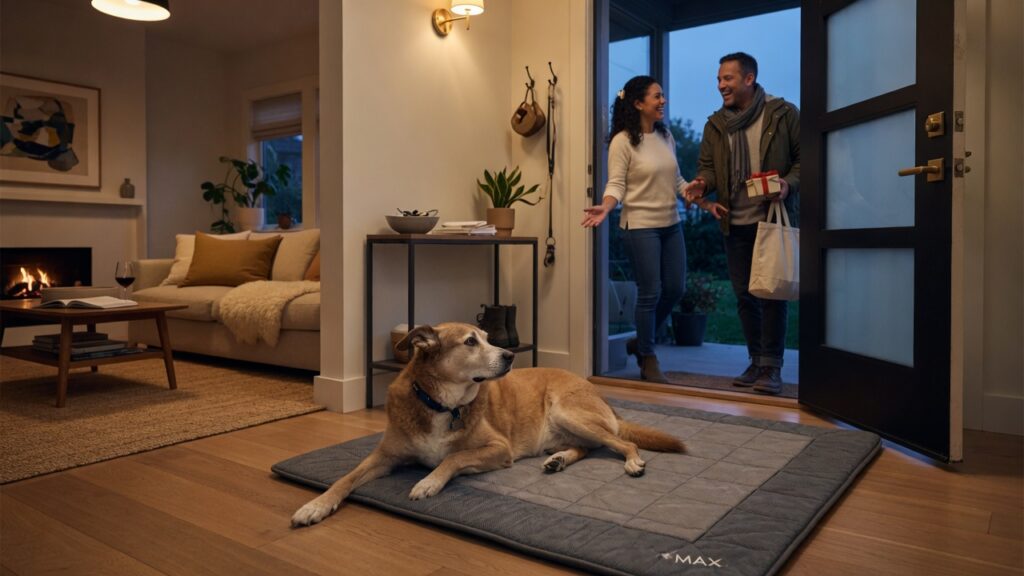
One of the most effective tools for managing door behavior is teaching your dog a reliable “place” or “mat” command — a cue that sends the dog to a designated spot (a bed or mat) and asks it to remain there until released. This gives your dog a clear, incompatible behavior to perform when the doorbell rings: it cannot simultaneously rush the door and lie calmly on its mat.
Training the place command:
- Use a distinctive mat or bed in a location a few feet from the door.
- Lure your dog onto the mat, reward generously, and build duration in calm sessions.
- Gradually introduce distractions, including knocking sounds played from a speaker at low volume.
- Practice with real guests: ask them to wait outside while you send your dog to the place, reward heavily on the mat, and only then open the door.
Consistency across all household members is essential. If one person allows the dog to rush the door, the training is undermined.
Door Manners: Teaching an Incompatible Behavior
Rather than simply telling your dog “no” when it barks at the door, give it something specific to do instead. Dogs that have a job are less anxious and less likely to fill the vacuum with undesirable behavior. Options include:
- Fetching a toy: Train your dog to grab a toy when the doorbell rings. Many dogs cannot bark effectively with a toy in their mouth.
- Sitting at the door: A solid “sit-stay” near (but not at) the door before it opens.
- Retreating to a crate or room: For dogs that are too overwhelmed to remain calm in the entry, temporarily managing them in another room during arrivals is a humane and effective short-term solution.
Managing Arrivals with a Calm Routine
How you and your guests behave during arrivals has a profound impact on your dog’s arousal level. Excited greetings, high-pitched voices, and immediate eye contact can ramp up a dog’s energy and trigger barking. Ask guests to:
- Enter calmly and ignore the dog initially.
- Avoid direct eye contact until the dog has settled.
- Turn sideways and let the dog approach on its own terms.
- Offer a treat if the dog approaches without barking.
This approach, sometimes called “no touch, no talk, no eye contact” during initial arrivals, dramatically reduces the intensity of door-related barking for many dogs.
How to Stop Dog Barking at People Through the Fence or Window
Fence and window barking often becomes a self-reinforcing habit. The stranger walks by, the dog barks, the stranger leaves, and the dog’s brain logs this as a success. Given that passers-by naturally keep moving regardless of the dog, this cycle repeats dozens of times a day without any training intervention, essentially practicing the dog to bark more intensely each time.
Managing the Environment
Management — reducing your dog’s access to the trigger — is the fastest and most reliable way to stop practice of the behavior while you work on training. Practical management strategies include:
- Window film or frosted glass: Block your dog’s view of street-level activity from windows.
- Baby gates: Restrict access to rooms with large windows overlooking busy streets.
- Privacy slats or solid fencing: Prevent your dog from seeing through fence gaps.
- Supervising yard time: Do not leave reactive dogs unsupervised in the yard.
Management is not a substitute for training, but it is an essential tool for stopping the reinforcement cycle while training takes effect.
Training “Quiet” and “Enough” Commands
The “quiet” command is best taught after — not during — a barking episode. When your dog barks a few times and then naturally pauses (as most dogs do to take a breath), immediately mark and reward the silence. Over many repetitions, you can add the cue word “quiet” just as the dog is about to stop naturally, and eventually the cue alone begins to suppress the barking.
Never reward your dog with attention, food, or anything else while it is barking. Wait for even a one-second pause, then reward. The duration of quiet you require before rewarding can be extended gradually.
Positive Reinforcement Techniques That Actually Work
Modern behavioral science is unequivocal: positive reinforcement is the most effective and most humane approach to modifying barking behavior. Punishment-based methods — spraying water, shaking cans, shock collars — may suppress the behavior in the short term but do not address the underlying emotional state, and in fear-based or anxious dogs, they can cause significant psychological harm.
According to the American Kennel Club’s guide on dog behavior, positive reinforcement combined with management and consistency is the gold standard for reducing nuisance barking.
Rewarding Calm Behavior Around Strangers
Many owners focus entirely on correcting the barking itself and forget to heavily reward the absence of barking. When your dog sees a stranger and does not react, that is an opportunity to throw a party. Immediate, generous praise and high-value treats in this moment tell your dog’s brain in the clearest possible terms: calm behavior around people = great things happen.
Using High-Value Treats Strategically

Not all treats are created equal. For highly aroused dogs, ordinary kibble or basic training treats may not be motivating enough to compete with the arousal of seeing a stranger. Reserve your dog’s absolute favorites — small pieces of chicken, cheese, freeze-dried liver, or hot dog — exclusively for stranger-exposure training sessions. This maintains their novelty and motivational value.
Clicker Training for Barking Reduction
A clicker allows you to mark the exact moment of desired behavior with pinpoint precision — the millisecond your dog makes eye contact with you instead of the stranger, or the first second of silence after barking. This precision accelerates learning significantly. If you are not familiar with clicker training, a “marker word” such as “yes!” performs the same function and requires no equipment.
Common Mistakes Dog Owners Make When Correcting Barking
Understanding what not to do is just as important as knowing the right techniques. The following mistakes are extremely common and can significantly slow progress or make the problem worse:
1. Yelling at the barking dog. From your dog’s perspective, you are barking along with it. This validates the behavior and increases arousal rather than suppressing it.
2. Consoling a fearful barker. “It’s okay, it’s okay,” delivered in a soothing voice while a dog is barking, communicates to the dog that the behavior is acceptable and even warranted. Stay calm and neutral, not reassuring.
3. Inadvertently rewarding barking with attention. Even negative attention — scolding, pushing the dog away, engaging with it — is still attention, and for attention-seeking dogs, it reinforces barking.
4. Expecting overnight results. Changing deeply ingrained behavior takes weeks to months of consistent work. Inconsistency — even occasional — dramatically extends the training timeline.
5. Training only in controlled settings. Behavior must be generalized across many environments, people, and contexts. Practice in different locations, with different strangers, and in varying contexts.
6. Skipping management. Allowing the dog to continue practicing the barking behavior while you “work on training” undermines every training session.
When to Seek Professional Help
Not all barking problems can be resolved with self-directed training, and knowing when to call in professional support is a mark of responsible dog ownership.
Working with a Certified Dog Trainer or Behaviorist
If your dog’s barking is intense, accompanied by lunging or snapping, or has not improved after several weeks of consistent training, consult a certified professional. Look for credentials such as:
- CPDT-KA (Certified Professional Dog Trainer – Knowledge Assessed)
- CDBC (Certified Dog Behavior Consultant)
- DACVB (Diplomate of the American College of Veterinary Behaviorists) — for severe cases
Avoid trainers who rely heavily on punishment, dominance theory, or aversive tools, as these approaches are not supported by modern behavioral science and can damage the human-dog relationship.
The Association of Professional Dog Trainers (APDT) provides a searchable database of qualified trainers who use humane, science-based methods.
Medication and Veterinary Support
For dogs with severe anxiety or fear, behavioral medication prescribed by a veterinarian can be a game-changer. Medications such as fluoxetine (Prozac) or clomipramine do not sedate the dog — they reduce the anxiety baseline, making the dog more capable of learning from training. Medication is most effective when used as a bridge alongside behavioral modification, not as a standalone solution.
If your dog’s barking is severe, sudden in onset, or accompanied by other behavioral changes, a full veterinary workup is warranted to rule out underlying medical causes, including pain, cognitive dysfunction (in senior dogs), or thyroid imbalances.
Socialization: The Long-Term Solution
Comprehensive, positive socialization is the single most powerful preventive measure against fear-based and reactive barking. It does not just suppress the symptom — it addresses the root cause by building genuine confidence and positive associations with the wider world.
Puppy Socialization Windows
The critical socialization period for puppies runs from approximately 3 to 14 weeks of age. During this window, the brain is uniquely receptive to new experiences, and exposure to a wide variety of people — different genders, ages, appearances, clothing, hats, glasses, uniforms — lays the neurological foundation for a confident, friendly adult dog.
Aim to expose your puppy to at least 100 different people in the first 12 weeks of ownership, always pairing each new person with positive experiences (play, treats, gentle handling). The quality of the exposure matters as much as the quantity — forced or frightening encounters during this window can cause lasting sensitivity.
Socializing Adult Dogs
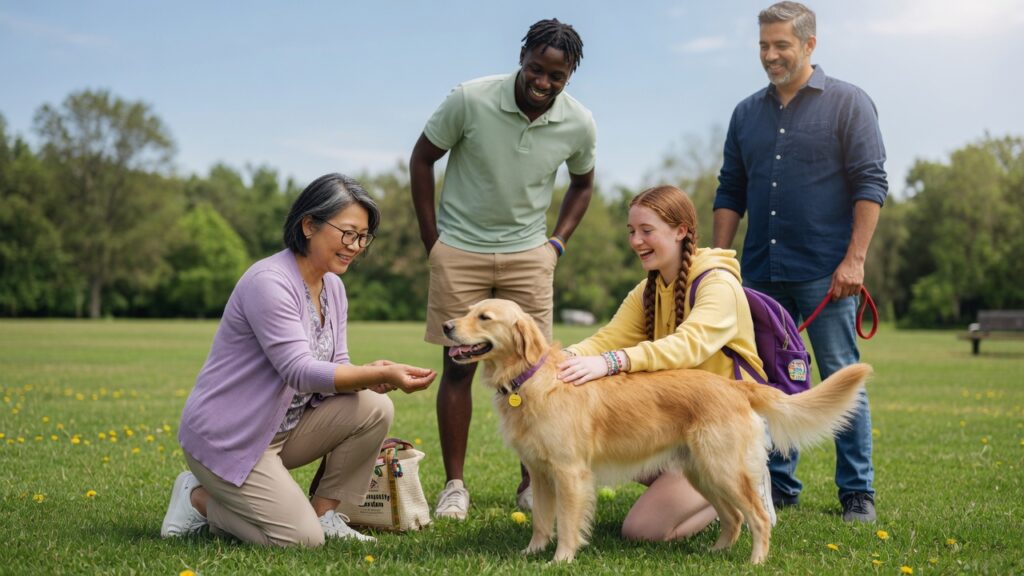
Adult dogs can absolutely make meaningful progress, though it requires more patience and systematic work than puppy socialization. Go-slow, positive exposure works. The key principles are:
- Never force interactions — let the dog set the pace.
- Keep exposures brief and positive initially, gradually building duration.
- Work below threshold at all times.
- Celebrate every small improvement generously.
Some adult dogs with severe fear histories may never become completely comfortable with strangers, but they can make significant quality-of-life improvements with patient, consistent work. If your dog struggles when left alone in addition to its social reactivity, learning how to stop dog barking when left alone is an important companion step in addressing the full picture of your dog’s anxiety.
Tools and Aids That Can Help
While no tool replaces training, several aids can support your work:
Pheromone diffusers and sprays (e.g., Adaptil): Synthetic dog-appeasing pheromones that mimic the calming pheromones produced by mother dogs. Shown in clinical studies to reduce anxiety-related behaviors in some dogs.
Anxiety wraps (e.g., ThunderShirt): A snugly fitting garment that applies gentle, constant pressure to the dog’s torso, similar to swaddling. Helpful for some anxious dogs during high-stimulus events.
Head halters (e.g., Gentle Leader): Give handlers greater control over a reactive dog on leash by controlling the direction of the head, which reduces pulling and can interrupt fixation on triggers.
Calming supplements: Products containing L-theanine, melatonin, or valerian are used by some owners to take the edge off anxiety in milder cases. Always consult your vet before adding supplements.
White noise machines: Can reduce alert barking triggered by sounds outside by masking ambient noise.
Avoid bark collars — particularly shock collars — for fear-reactive or anxious dogs. These devices associate the presence of people with pain or discomfort, which can worsen reactivity and cause significant psychological harm.
Frequently Asked Questions
Q: Will my dog eventually stop barking at strangers on its own? A: For most dogs, the behavior will not self-resolve and tends to intensify without intervention as the habit becomes more deeply ingrained. Active training is needed.
Q: How long does it take to stop a dog from barking at people? A: It depends on the severity of the behavior, the dog’s history, and the consistency of training. Many owners see meaningful improvement within 4–8 weeks of consistent work. Severe cases may take 6 months or more.
Q: My dog only barks at men. Is this a breed thing? A: This is most commonly a socialization gap — the dog was not adequately exposed to men during its developmental period or had a negative experience with a man. It is not breed-specific and responds well to targeted counter-conditioning with men.
Q: Should I use a bark collar? A: Most certified behaviorists and veterinary behaviorists recommend against aversive bark collars, particularly for fear-based or anxious dogs. The suppression of barking without addressing the underlying emotion can increase the dog’s stress and occasionally escalate behavior to biting without warning.
Q: Can I train an older dog not to bark at people? A: Yes. While older dogs may take longer than puppies, they are absolutely capable of learning new associations and behaviors. Patience, consistency, and a positive approach are the keys.