
Summary: Dogs bark at the mailman every day because of a deeply ingrained behavioral loop rooted in territorial instinct, negative reinforcement, and routine conditioning. Each day, the letter carrier approaches the home, the dog barks, and the mailman leaves — reinforcing the dog’s belief that barking successfully drove away the “intruder.” This guide explores every layer of that cycle, from canine psychology and sensory triggers to breed-specific tendencies and proven training methods, so you can finally break the pattern and restore calm to your daily routine.
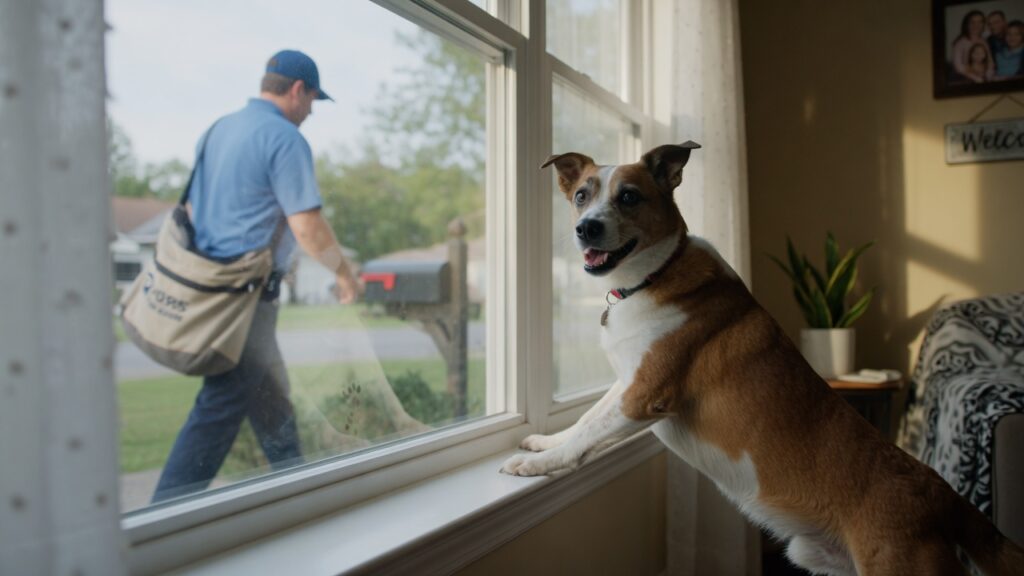
Table of Content
- Why Does My Dog Bark at the Mailman Every Day? (The Complete Guide)
- The Psychology Behind Why Dogs Bark at Letter Carriers
- What Your Dog Sees, Hears, and Smells When the Mailman Arrives
- Is This Normal Dog Behavior or a Problem?
- Which Dog Breeds Are Most Likely to Bark at the Mailman?
- How the Daily Reinforcement Cycle Makes the Problem Worse
- How to Stop Your Dog from Barking at the Mailman
- Training Tips That Actually Work (Step-by-Step)
- Should You Involve the Mailman in Training?
- Common Mistakes Dog Owners Make
- When to Seek Professional Help
- Frequently Asked Questions About Dogs Barking at Mailmen
The Psychology Behind Why Dogs Bark at Letter Carriers
The Territorial Instinct Explained
At its core, your dog’s barking at the mailman is not random — it is a deeply wired survival mechanism. Dogs are, by evolutionary design, territorial animals. Their ancestors used vocalizations to warn the pack of approaching threats and to signal ownership of a space. Your home is your dog’s den, and its front boundaries — the yard, the porch, the door — are considered the perimeter that must be defended.
When a stranger enters that perimeter, even briefly, your dog’s nervous system responds. The hypothalamus-pituitary-adrenal (HPA) axis activates, stress hormones including cortisol and adrenaline flood the system, and your dog enters a state of heightened arousal. Barking is the primary vocalization response in this state — it is alarm signaling, boundary assertion, and pack warning all rolled into one.
The technical term for this is territorial aggression precursor behavior, and even dogs with no history of actual aggression can display it intensely. It is important to understand that from your dog’s perspective, this is not misbehavior. It is a job being done effectively.
The Accidental Reinforcement Loop
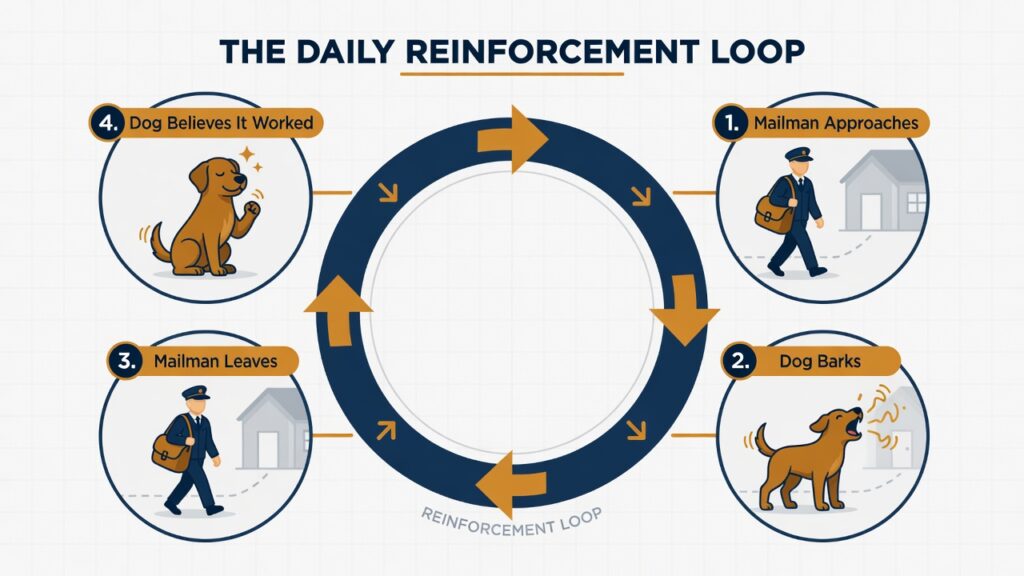
This is the critical piece that most dog owners miss. Every single day, the following sequence plays out:
- The mailman approaches.
- Your dog barks loudly and persistently.
- The mailman finishes the delivery and leaves.
- Your dog’s barking stops.
From your dog’s neurological perspective, the barking caused the mailman to leave. The threat was neutralized. The behavior worked. This is a textbook example of negative reinforcement in behavioral psychology — an unpleasant stimulus (the stranger) is removed following a behavior (barking), which strengthens that behavior over time.
This loop repeats daily, sometimes multiple times if parcels arrive at different hours. Each repetition deepens the neural pathway, making the barking faster, louder, and harder to interrupt. The dog is not being stubborn — it is being a very successful learner.
Routine and Predictability as a Trigger
Dogs are extraordinarily attuned to routine. Many owners report that their dog begins to show signs of arousal — pacing, whining, positioning near the door — even before the letter carrier arrives. This is anticipatory behavior driven by conditioned cues: the sound of a mail truck in the distance, the specific time of day, even the smell of certain seasons when mail delivery changes in frequency.
This predictability makes the response harder to break because the trigger chain begins well before the actual arrival. By the time the mailman is at the door, your dog may already be at peak arousal, making redirection difficult.
What Your Dog Sees, Hears, and Smells When the Mailman Arrives
Visual Triggers — Uniform, Body Language, and Movement
Dogs do not perceive the world the way humans do. Their visual processing is tuned to detect movement patterns, silhouettes, and approaching trajectories. A person walking directly toward the front of the house, carrying items, wearing a uniform that creates an unusual shape (bag, jacket, hat), and moving with purpose is visually alarming from a canine perspective.
Uniforms are particularly triggering because dogs learn to associate specific visual patterns with events. A mailman’s uniform — consistent across multiple encounters — becomes a visual symbol of “intruder incoming.” This is sometimes called stimulus generalization, where the dog’s response extends to anyone wearing similar clothing or carrying a bag in the same purposeful manner.
Auditory Triggers — Footsteps, Mail Slot, Vehicle Sounds
Sound is another powerful trigger layer. Dogs hear frequencies humans cannot, and they can identify individual footstep patterns, vehicle engine sounds, and gate latches. The sound of a mail van idling, the creak of the gate, the clatter of the mail slot, or the thud of a parcel on the porch are all distinct acoustic cues that precede the arrival.
Over time, each of these sounds becomes a conditioned stimulus — capable of triggering the barking response on its own, even without the visual confirmation of the mailman. This is why some dogs start barking the moment they hear the van turn onto the street.
Olfactory Triggers — Why Scent Matters More Than You Think
Dogs possess an olfactory system approximately 10,000 to 100,000 times more sensitive than that of humans. The mail itself carries a rich scent profile — other homes, other dogs, the letter carrier’s personal scent, vehicle exhaust, and the ink and paper of the mail itself.
When the mailman pushes envelopes through the door or drops a package on the mat, they are introducing a complex scent from a stranger directly into the dog’s territory. This olfactory intrusion can maintain or even escalate the arousal response even after the visual and auditory triggers are gone. According to research from the American Kennel Club on canine sensory behavior, a dog’s nose is its primary tool for interpreting the world, making scent-based triggers among the most powerful reinforcers of territorial behavior.
Is This Normal Dog Behavior or a Problem?
When Barking at the Mailman Is Just Natural
A dog that gives a few alert barks when the mailman arrives and then settles quickly is displaying completely normal, healthy canine behavior. This brief alarm response is appropriate — it means your dog is aware of its environment and communicating that something has changed. For many households, this level of barking is acceptable and even desirable as a mild deterrent.
When It Becomes Excessive or Aggressive Barking
The behavior crosses into problematic territory when the barking is prolonged (lasting more than a few minutes), escalating (getting louder or more frantic over time), physically aggressive (lunging at windows, scratching at doors), or causing distress to the dog itself (panting, inability to settle even after the mailman leaves).
Excessive barking also becomes a quality-of-life issue for the entire household and, potentially, a legal issue if noise complaints are filed. If your dog is barking for extended periods daily, it is no longer simple alert behavior — it has become a compulsive routine driven by the reinforcement cycle described earlier.
Signs Your Dog’s Reaction Has Crossed a Line
Watch for these behavioral indicators that the mailman response has become a serious issue: inability to respond to commands during or after the episode, redirected aggression toward family members, destruction of property near entry points, or extended post-arousal periods where the dog remains hypervigilant and unable to relax. These are signs that professional guidance may be needed.
Which Dog Breeds Are Most Likely to Bark at the Mailman?
Herding and Guardian Breeds
German Shepherds, Belgian Malinois, Collies, and Australian Shepherds were bred specifically to protect territory and alert handlers to approaching animals or people. Their barking threshold is naturally lower, and their territorial response is sharper. These dogs are doing exactly what generations of selective breeding designed them to do. That does not make the behavior acceptable indoors — it simply means training must be more consistent and structured for these breeds.
Terriers and Hounds
Jack Russell Terriers, Beagles, Dachshunds, and Miniature Schnauzers are notorious for their vocal responses to environmental stimuli. Terriers were bred to be tenacious and alert, while hounds were bred to vocalize as a working signal. Both categories have strong instinctive drives to bark, and the mailman scenario is a perfect storm of visual, auditory, and olfactory triggers that these breeds are primed to respond to.
Why Even Small Dogs React Intensely
It is a common misconception that small dogs bark more due to anxiety or insecurity. In reality, small dogs are simply applying the same territorial instinct as larger dogs, but in a smaller body with less capacity for physical deterrence. Their barking is compensatory — louder and more persistent because it is their only real line of defense. Additionally, small dogs are often inadvertently reinforced more because owners are less likely to take their behavior seriously and intervene early.
How the Daily Reinforcement Cycle Makes the Problem Worse
Operant Conditioning and the “Victory” Pattern
Every successful “expulsion” of the mailman is a behavioral win for your dog. In operant conditioning terms, the removal of an aversive stimulus (the approaching stranger) following a behavior (barking) reinforces that behavior on a fixed-interval schedule — one of the most powerful reinforcement patterns in behavioral science. Fixed-interval schedules produce highly consistent, predictable behavior because the reward is guaranteed to come at a regular time.
How Repetition Deepens the Response
The more times this cycle repeats without interruption, the more deeply the neural pathway is carved. Neuroscience uses the phrase “neurons that fire together, wire together” — the synaptic connections between the sensory trigger, the emotional arousal, and the barking response become stronger and faster with each repetition. After months or years of daily reinforcement, this response can feel nearly automatic.
The Role of Owner Reaction in the Cycle
Many owners unknowingly accelerate the problem. Yelling at the dog to stop is interpreted as the owner joining in the alarm — matching the dog’s energy and confirming that the situation is indeed threatening. Picking the dog up and soothing it can reinforce the anxiety. Even simply giving the dog attention during the episode — negative or positive — adds fuel to the fire.
How to Stop Your Dog from Barking at the Mailman
Desensitization and Counter-Conditioning
Desensitization involves gradually exposing your dog to the triggers associated with the mailman at a low enough intensity that no barking response is triggered, then incrementally increasing the intensity over multiple sessions. Counter-conditioning pairs those triggers with something highly positive — typically high-value treats or play — so that the emotional association shifts from threat to reward.
For the mailman scenario, begin with recordings of mail truck sounds played at very low volume while the dog eats or plays. Over days, increase the volume slightly. Simultaneously, begin asking the dog to perform an incompatible behavior (like lying on a mat) when any mail-related cue is present.
Teaching the “Quiet” Command
Train the “quiet” command separately from the mailman scenario. Allow the dog to bark two or three times in response to a known trigger, then calmly say “quiet” and present a treat directly at the dog’s nose. The dog must stop barking to sniff the treat. Mark the moment of silence with a clicker or a verbal marker (“yes!”) and reward. Repeat this consistently in low-stakes situations before attempting it during a real mail delivery.
Creating a Positive Association with the Letter Carrier
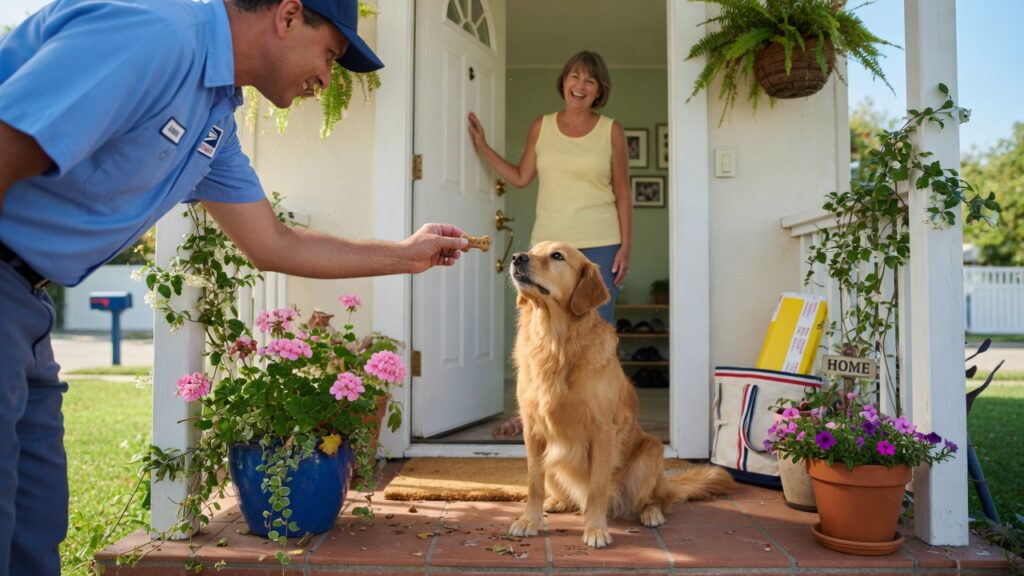
If possible, work directly with your letter carrier. Ask them to drop a few high-value treats through the mail slot or leave them on the porch mat before delivering the mail. Over time, the dog begins to associate the arrival of the mailman with the arrival of something wonderful. This technique — sometimes called the “mailman is a treat dispenser” approach — is one of the most effective long-term solutions available.
For more techniques on managing your dog’s reactions to people approaching your home, read our complete guide on Dog Barking at People, Strangers & Guests which covers a wide range of visitor-related barking scenarios.
Management Strategies While Training Is Ongoing
Training takes time, and management is necessary in the interim. Restrict your dog’s access to windows and doors during mail delivery hours. Use frosted window film on lower panes to reduce visual access to the street. Play white noise or calming music during the delivery window. Consider a baby gate to keep the dog away from the entry area.
These are not permanent solutions, but they break the daily reinforcement cycle while your training gains traction.
Using Enrichment and Exercise to Reduce Alert Barking
A dog that receives adequate physical exercise and mental stimulation has a lower baseline arousal level, which means its threshold for reacting to triggers is higher. A 30-minute vigorous walk in the morning — timed before the mail typically arrives — can measurably reduce the intensity of the barking response later in the day. Mental enrichment such as puzzle feeders, scent work, and training sessions also tire the brain and reduce hypervigilance.
Training Tips That Actually Work (Step-by-Step)
Week 1 — Identify and Interrupt
Track the exact time mail is typically delivered for three to five days. Position yourself near your dog with high-value treats before that time. The moment your dog begins to show pre-barking signs (stiffening, staring toward the door, moving toward the window), interrupt calmly with a word like “look” or “here,” redirect eye contact to you, and reward immediately. Do not wait for the bark to happen — interrupt the arousal state early.
Week 2 — Introduce the “Place” or “Go to Your Spot” Command
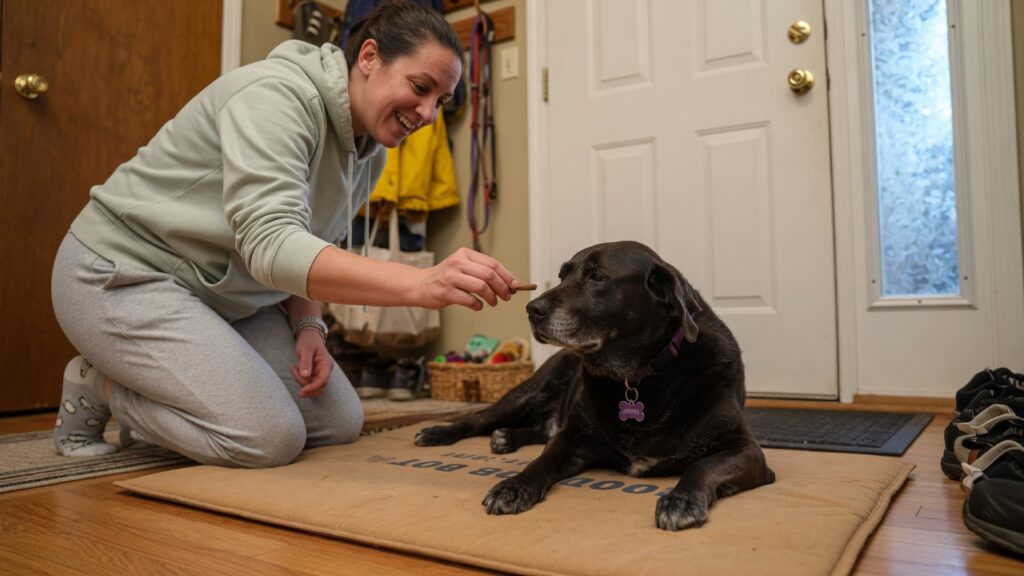
Teach your dog to go to a designated spot (a mat, a bed) on cue. Practice this command dozens of times throughout the day with no mail-related triggers present. By the end of the week, your dog should be able to go to the spot reliably on a single cue. Begin asking for the behavior before the anticipated mail delivery time, rewarding the dog heavily for staying on the spot during the delivery window.
Week 3 — Controlled Exposure and Reward
Now that the “place” command is solid and you are interrupting arousal early, begin pairing the mail delivery itself with a reward ritual. As the mailman approaches, say “place,” reward the dog on the mat, and maintain a stream of small treats through the entire delivery window. End the treat stream and release the dog only after the mailman has gone and the dog is calm.
Long-Term Maintenance
Once the behavior is under control, continue to occasionally reward calm responses during mail delivery to maintain the new association. Intermittent reinforcement — rewarding some calm responses but not all — is actually more durable than continuous reinforcement once the behavior is established.
Should You Involve the Mailman in Training?
How to Ask Your Letter Carrier for Help
Most letter carriers are willing to help if approached politely. A simple note left in the mailbox explaining that you are training your dog and asking if they would be willing to participate for a few weeks is usually well received. The United States Postal Service actually has internal guidelines encouraging carriers to support community dog safety efforts.
The Treat-at-the-Door Technique
Provide a small container of dog-safe treats at your mailbox or door with a note asking the carrier to leave a treat with the mail. Over time — typically two to four weeks of consistent treat delivery — most dogs shift their emotional response from alarm to anticipation. The mail becomes the best part of the day rather than a threat. According to Victoria Stilwell’s research on positive reinforcement in dogs, pairing previously threatening stimuli with high-value rewards is among the most effective and humane methods for reshaping territorial behavior.
Common Mistakes Dog Owners Make
Yelling at the Dog to Stop
Raising your voice matches the dog’s arousal and is often interpreted as you barking alongside them. It increases excitement rather than reducing it and can lead to redirected nipping or jumping in highly aroused dogs. Always respond to barking with a calm, low voice or no voice at all — let your body language and a treat do the communicating.
Letting It Play Out Without Intervention
Some owners assume the dog will eventually figure out that the mailman is not a threat. Without active training, this never happens. The reinforcement cycle guarantees that the behavior only deepens with time. Letting it play out daily without intervention is the same as training the dog to bark more.
Inconsistent Training Schedules
The most common reason dog training fails is inconsistency. If you interrupt the behavior three days a week and let it go unreinforced on the other four, you are teaching your dog an unpredictable rule — which makes the behavior more persistent, not less. Every household member must follow the same protocol, every day, without exception.
When to Seek Professional Help
Signs You Need a Certified Dog Trainer
If your dog’s barking at the mailman has escalated to lunging, snapping, or attempts to break through windows or doors, or if weeks of consistent home training have produced no measurable improvement, it is time to engage a Certified Professional Dog Trainer (CPDT-KA) or a Certified Applied Animal Behaviorist (CAAB). These professionals can conduct an in-home behavioral assessment and design a customized desensitization protocol.
Veterinary Behavioral Intervention
In some cases — particularly where the barking is accompanied by other anxiety-related behaviors such as destructive behavior, separation anxiety, or compulsive behaviors — a veterinary behaviorist may recommend short-term pharmacological support alongside behavioral training. Anti-anxiety medications such as fluoxetine or trazodone do not “fix” the behavior, but they lower the baseline arousal level enough to make behavioral training more effective.
Frequently Asked Questions About Dogs Barking at Mailmen
Q: Will my dog ever stop barking at the mailman on its own? No. Without deliberate intervention and training, the reinforcement cycle guarantees the behavior will continue and likely worsen with age and repetition.
Q: How long does it take to stop a dog from barking at the mailman? Most dogs show meaningful improvement within four to eight weeks of consistent, structured training. Dogs with deeply ingrained habits or high-arousal temperaments may take three to six months.
Q: Is my dog being aggressive or just protective? Most mailman-directed barking is territorial and protective, not predatory or offensive aggression. The distinction matters for training approach. A professional assessment is the safest way to determine which type you are dealing with if there are physical escalation signs.
Q: Can I use a bark collar to stop mailman barking? Bark collars — including citronella, ultrasonic, and static models — can interrupt the behavior in the short term but do not address the underlying emotional response. Most animal behavior experts advise against them as primary solutions because they do not replace the behavior with anything more appropriate and can increase anxiety in already-anxious dogs.
Q: My dog is fine with strangers elsewhere but loses it with the mailman — why? This is entirely consistent with territorial behavior. Dogs distinguish clearly between their home territory and neutral ground. A dog that greets strangers warmly in a park may guard its home aggressively against the same type of person. The location activates the territorial response, not the person.