
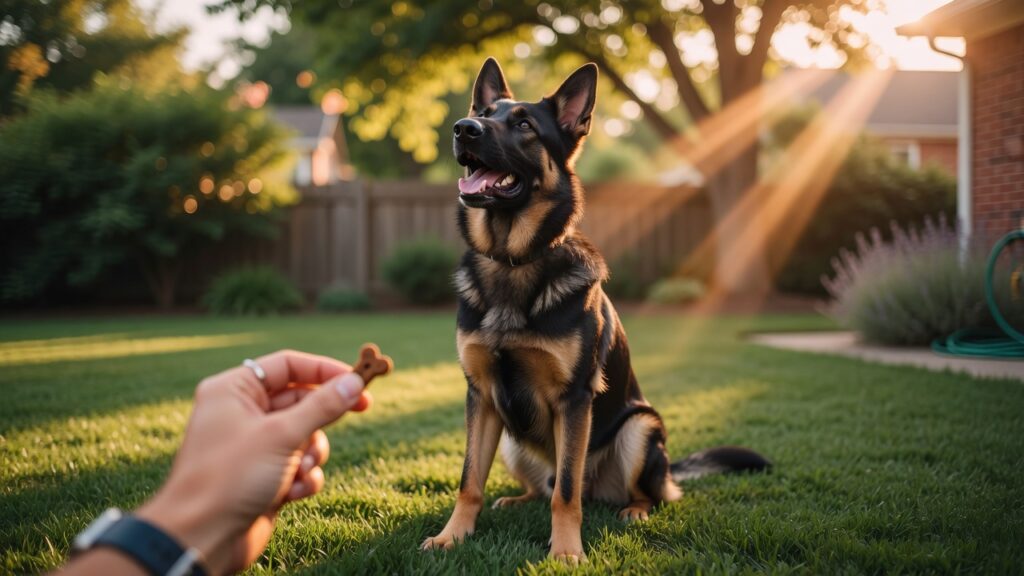

Summary: Training a dog to bark on command — commonly taught using cues like “speak” or “bark” — is one of the most rewarding yet nuanced behavioral exercises in dog obedience training. This guide, How to Train a Dog to Bark on Command, walks you through every essential stage: understanding canine vocalization, setting up your training environment, using positive reinforcement and marker training, troubleshooting over-barking or reluctance, and building on the “speak” command to teach its equally vital counterpart, “quiet.” Whether you have a new puppy, a rescue with unknown history, or a stubborn adult dog, the science-backed methods here will help you communicate clearly and build a lasting bond.
Table of Content
- Understanding Why Dogs Bark — The Behavioral Science Behind Vocalization
- Why Teach a Dog to Bark on Command?
- Setting Up for Success — Before You Begin Training
- Step-by-Step: How to Train a Dog to Bark on Command
- Teaching the “Quiet” Command Alongside “Speak”
- Common Challenges and How to Troubleshoot Them
- Advanced Applications of the Speak Command
- Positive Reinforcement vs. Aversive Methods — What the Research Says
- FAQs About Teaching Dogs to Bark on Command
Understanding Why Dogs Bark — The Behavioral Science Behind Vocalization
Before diving into training techniques, it is essential to understand why dogs bark. Barking is a primary form of canine communication — a complex, context-dependent vocalization shaped by emotion, environment, breed instinct, and learned behavior. In behavioral science, barking falls under the broader category of acoustic signaling, and its function varies widely depending on the stimulus.
Types of Dog Barks and What They Communicate
Dogs produce distinctly different barks depending on the situation. Research in animal cognition and ethology has identified several core barking categories:
- Alert barking: A rapid succession of mid-pitch barks signaling perceived threats or unusual stimuli in the environment.
- Demand barking: Persistent, often high-pitched vocalization used to solicit attention, food, or play from the owner.
- Excitement barking: High-pitched, erratic barks triggered by anticipation — common during walks, greetings, or playtime.
- Fear or stress barking: Often lower, more strained, and paired with body language cues like a tucked tail or flattened ears.
- Territorial barking: Sustained, assertive barks directed at strangers or animals near perceived territory.
Understanding these types matters deeply for command training. When teaching a dog to bark on cue, you are essentially asking the dog to produce a voluntary, controlled version of a behavior that is often reactive and emotion-driven. The goal is to transfer barking from an involuntary emotional response into a trained, cognitively mediated behavior — a process known in behavioral psychology as operant conditioning.
The Role of Breed and Genetics in Barking Behavior
Not all dogs are equally vocal. Breed selection for specific working roles has influenced barking tendencies significantly.
- Herding breeds (Border Collie, Australian Shepherd): vocal and reactive, tend to learn “speak” quickly.
- Scenthounds (Beagles, Basset Hounds): bred to vocalize during tracking; naturally expressive.
- Terriers: alert and prone to barking; may over-generalize the bark cue without careful training.
- Nordic breeds (Siberian Husky, Alaskan Malamute): howlers more than barkers; may respond to vocalization cues differently.
- Brachycephalic breeds (Bulldogs, Pugs): bark less frequently due to airway anatomy.
Knowing your dog’s breed tendencies helps set realistic expectations and adjust training intensity accordingly.
Why Teach a Dog to Bark on Command?
Many dog owners assume that teaching a dog to bark is counterproductive, especially if they are already dealing with excessive barking. In fact, the opposite is true. Teaching a dog to bark on cue gives the owner behavioral control over the action — and that control is the foundation for teaching the equally important “quiet” command.
Benefits for Safety and Security
A dog trained to bark on command can serve as a genuine deterrent. Many personal safety trainers and canine security consultants recommend the “speak” command as part of a home protection routine. A single verbal cue that produces a confident, clear bark can be enough to deter intruders or alert neighbors in emergency situations.
Additionally, if you ever notice unusual changes in your dog’s vocal behavior — for example, if your My Senior Dog Suddenly Barking More — having a trained baseline makes it much easier to identify what is abnormal and seek veterinary guidance promptly.
Mental Stimulation and Canine Enrichment
Cognitive enrichment is one of the most underutilized tools in dog ownership. Teaching new commands — especially ones that involve fine-grained impulse control — keeps a dog mentally sharp, reduces boredom-driven behavioral problems, and deepens the human-animal bond. The speak/quiet command pair is particularly effective because it requires the dog to perform an action and stop it on cue, demanding flexible cognitive control.
Setting Up for Success — Before You Begin Training
Tools and Supplies You Will Need
Effective bark-on-command training relies on a small but carefully chosen toolkit:
- High-value treats: Small, soft, highly palatable rewards — chicken, cheese, or commercial training treats. Avoid dry kibble during initial shaping sessions; the value of the reward must match the difficulty of the behavior.
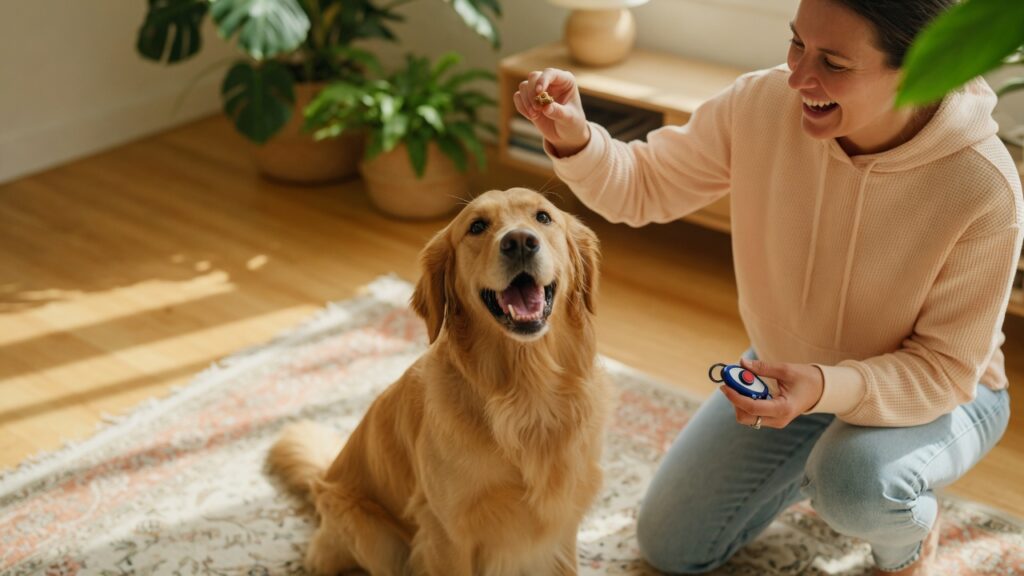
- A clicker or marker word: A clicker provides a precise, consistent marker signal that bridges the gap between the desired behavior and the reward. If you prefer a verbal marker, a crisp “yes!” works well.
- A quiet training space: Especially during early stages, low-distraction environments allow the dog to focus on your cues rather than external stimuli.
- Treat pouch: Keeps your hands free and rewards immediately accessible.
- Patience and a timer: Sessions should be short — 3 to 5 minutes maximum for most dogs, two to three times per day.
Choosing the Right Training Environment
Begin all new command training in a low-distraction, familiar environment — typically indoors. As fluency develops, you will progressively move training into more challenging settings. This process is called stimulus generalization in behavioral science, and it is critical for ensuring the dog responds to the cue regardless of where they are.
Avoid training immediately after meals (dogs are less food-motivated when full) or when the dog is overly tired or aroused. The optimal training window is when the dog is alert, calm, and slightly hungry.
Timing, Repetition, and Session Length
In operant conditioning, timing is everything. The marker signal — whether a click or a word — must occur within half a second of the desired behavior. Any delay weakens the association between the behavior and the reward. Practice marking with a clicker before introducing it to your dog so you are comfortable with your own timing.
Aim for 10 to 15 repetitions per session. End every session on a positive note — even if you need to ask the dog to perform an easier, already-mastered behavior to close out with success.
Step-by-Step: How to Train a Dog to Bark on Command
Step 1 — Capture the Bark Naturally
The most effective way to begin is through behavioral capturing — waiting for the dog to offer the behavior naturally and then marking and rewarding it immediately.
Here is how to apply it:
- Have your treats and clicker ready.
- Identify a situation that reliably triggers your dog to bark — a knock on the door, someone ringing the doorbell, or another dog walking by outside.
- The moment your dog barks, immediately click (or say “yes!”) and deliver a treat.
- Repeat this process consistently. After 5 to 10 successful captures, your dog will begin to understand that barking produces a reward.
Do not say the verbal cue yet. At this stage, you are simply building an association between the act of barking and a positive outcome.
Step 2 — Introduce the Verbal Cue (“Speak” or “Bark”)
Once the dog is reliably barking in anticipation of a treat in a specific triggering context, it is time to add the verbal cue. The most commonly used cues are “speak,” “bark,” “talk,” or “voice.”
- Just before presenting the trigger stimulus (or just before the dog is about to bark), say your chosen cue clearly and calmly — once.
- When the bark happens, click/mark and reward.
- Over 10 to 15 repetitions, the dog begins to associate the verbal cue with the act of barking.
- Test the cue by saying it without the trigger stimulus. If the dog barks, mark and heavily reward this — it is a significant milestone.
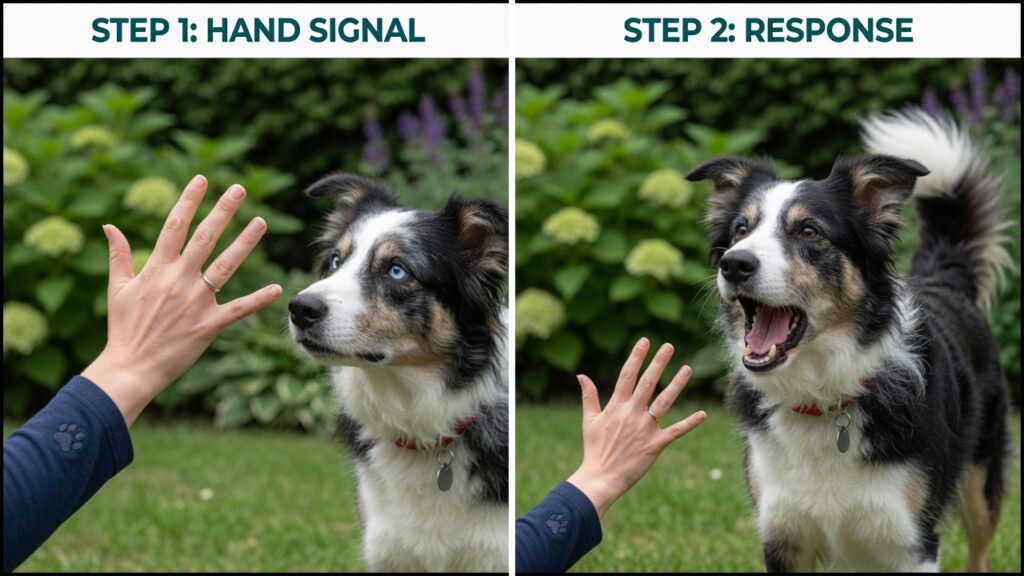
Step 3 — Add a Hand Signal
Pairing a hand signal with the verbal cue creates a dual-channel communication system — valuable in noisy environments or for dogs who are hearing-impaired. A common hand signal for “speak” is an open-and-close motion of the fingers and thumb (like a puppet mouth talking).
- Say the verbal cue while simultaneously presenting the hand signal.
- Click and reward the bark.
- Over time, test the hand signal alone. Many dogs quickly generalize to respond to either cue independently.
Step 4 — Generalize Across Environments
Take your training to new locations: the backyard, a quiet park, a friend’s home. Each new environment will initially reduce the dog’s responsiveness — this is called latent inhibition and is completely normal. Reward generously in new settings to rebuild the association quickly.
Also practice with mild distractions present, gradually increasing difficulty. This is known as proofing the behavior — a key concept in professional dog training.
Teaching the “Quiet” Command Alongside “Speak”
Why “Quiet” Is Just as Important as “Speak”
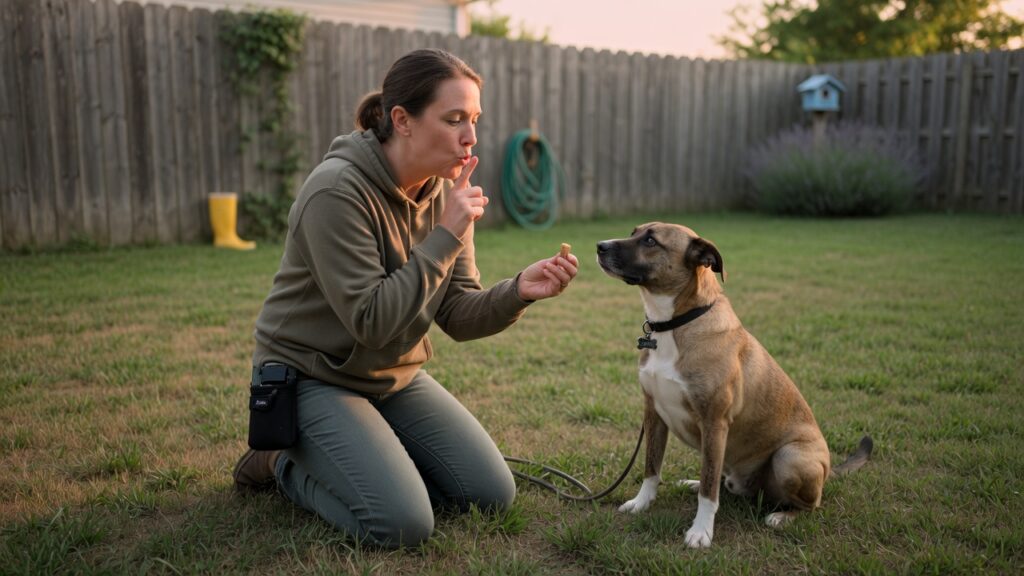
A dog that barks on command but cannot stop on command is not fully trained — it is just selectively aroused. The “quiet” command is the essential companion behavior that completes the communication loop and gives you genuine control over your dog’s vocal behavior.
This is also the primary tool for addressing nuisance barking. Dogs that react to environmental triggers — like Dog Barking at Birds in the Yard — benefit enormously from a solid “quiet” cue because it gives the owner a reliable interrupt signal that the dog has already been conditioned to respond to.
Step-by-Step “Quiet” Training Method
- Cue the bark using your “speak” command.
- Allow 1 to 3 barks.
- Say “quiet” calmly and clearly — once.
- Hold a treat near the dog’s nose. The act of sniffing will interrupt the barking.
- The moment silence occurs — even for one second — click and reward.
- Gradually extend the duration of silence required before rewarding.
- Practice the speak/quiet sequence in alternation: “speak” → bark → “quiet” → silence → reward.
With consistent repetition, most dogs learn the quiet cue within one to two weeks of daily practice.
Common Challenges and How to Troubleshoot Them
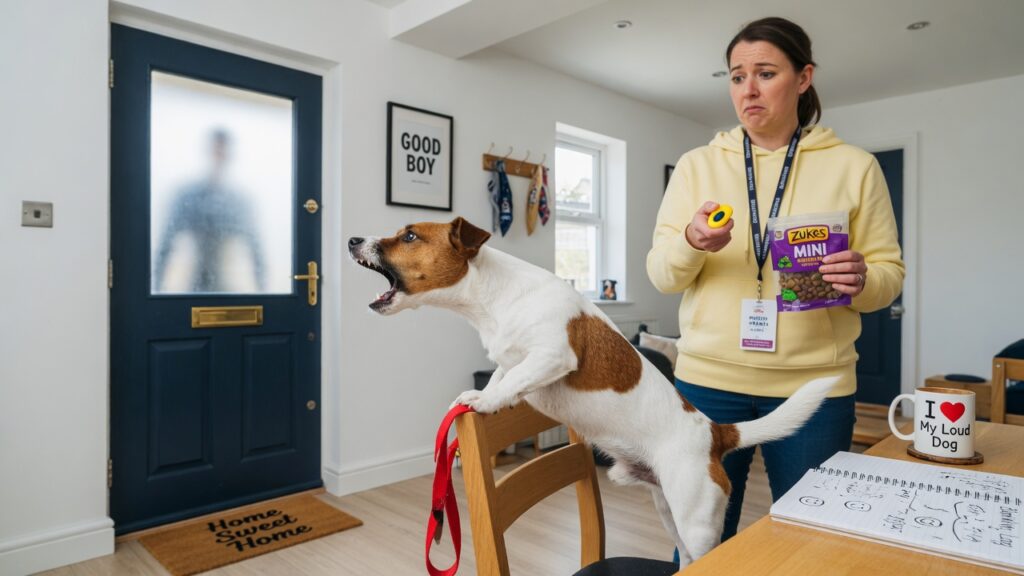
My Dog Won’t Bark on Cue
Some dogs — particularly those from calmer breeds or those who have been inadvertently punished for barking in the past — may be hesitant to vocalize in a training context. Strategies include:
- Use a more exciting stimulus: A favorite toy, a tug game, or another dog may elicit spontaneous barking.
- Try shaping through whining or growling first: Click for any vocalization and gradually shape toward a full bark.
- Train at the door: Ring the doorbell or knock — most dogs will bark reflexively.
- Use play arousal: Get the dog excited through rough play, then capture the excited bark.
My Dog Barks Uncontrollably
If your dog barks excessively during training — or cannot stop even after the quiet cue — take a step back. This often signals that the dog is over-threshold — too aroused or anxious to process training input. Lower the intensity of the trigger, shorten the session, and return to basics with high-value reinforcement for calm behavior. According to the American Kennel Club’s guide on dog training, managing your dog’s arousal level during training sessions is critical for effective learning.
My Dog Barks at Everything Outdoors
Environmental reactivity requires a separate behavioral modification protocol — typically counter-conditioning and desensitization (CC&DS) — rather than simple obedience training. If outdoor stimuli are reliably triggering uncontrolled barking, consult a certified professional dog trainer (CPDT-KA) or a veterinary behaviorist for a tailored behavior modification plan.
Advanced Applications of the Speak Command
Using “Speak” in Trick Training and Dog Sports
The speak command is a foundational element of trick training sequences and is commonly incorporated into:
- Dog sports: Rally obedience and freestyle routines often include vocalization tricks.
- Trick title programs: Organizations like Do More With Your Dog offer titling programs where “speak” is a recognized trick behavior.
- Canine theater and performance: Dogs trained in stage or film work routinely use the speak cue for scripted vocalization.
Building Alert Barking for Personal Safety
With advanced proofing, some owners choose to train their dog to bark specifically at strangers approaching the home while remaining silent in all other contexts. This requires:
- Teaching “speak” to a rock-solid fluency level.
- Associating the cue specifically with the presence of unfamiliar people near the threshold.
- Using differential reinforcement — rewarding the bark in target contexts, ignoring or redirecting in non-target contexts.
This is a nuanced application best developed with the guidance of a professional trainer, as it involves managing the dog’s territorial instincts carefully to prevent aggression or anxiety.
Positive Reinforcement vs. Aversive Methods — What the Research Says
The scientific consensus in veterinary behavioral medicine is clear: positive reinforcement-based training produces better learning outcomes, stronger human-animal bonds, and fewer behavioral side effects than punishment-based or aversive methods.
Aversive tools — including shock collars, spray collars, or citronella-based bark deterrents — may suppress barking in the short term but do not teach the dog what to do instead. They also carry significant risks of increasing anxiety, fear-based aggression, and learned helplessness, particularly in sensitive dogs.
The Association of Professional Dog Trainers (APDT) strongly advocates for reward-based training as the gold standard for all behavioral objectives, including vocalization training. Any training plan for bark-on-command should be built entirely on positive reinforcement — marking and rewarding desired behavior, redirecting unwanted behavior, and ignoring non-rewarded responses.
FAQs About Teaching Dogs to Bark on Command
Q: How long does it take to train a dog to bark on command? Most dogs with consistent daily training sessions (5 minutes, twice daily) show a reliable response to the “speak” cue within 1 to 3 weeks. Complex generalization and the paired “quiet” cue may take 4 to 6 weeks total.
Q: Can I teach an older dog to bark on command? Absolutely. Adult and senior dogs are fully capable of learning new commands. The process may take slightly longer due to established behavioral habits, but the methodology is identical.
Q: Will teaching my dog to bark make them bark more overall? No — when done correctly, it does the opposite. Teaching “speak” on cue gives the dog a structured outlet and makes it possible to teach “quiet” as a paired command, resulting in more control over barking, not less.
Q: What is the best cue word for “bark on command”? The most widely used cue words are “speak,” “bark,” “talk,” and “voice.” Choose one that you will not use casually in conversation — dogs learn the phonetic pattern, so a word you say frequently in other contexts can become confusing.
Q: My dog only barks when I’m not watching — how do I capture that? Use a remote camera or video monitoring device to identify triggers, then recreate those conditions intentionally during a structured training session. Alternatively, work with a trainer to develop a shaping plan using successive approximations toward a full bark.
With the right approach — patience, consistency, high-value reinforcement, and an understanding of canine behavioral science — teaching your dog to bark on command becomes not just achievable, but genuinely enjoyable for both of you.