


Summary: Dogs barking at cats on the street is a deeply rooted behavioral response shaped by genetics, breed instincts, prey drive, territorial tendencies, and socialization history. Understanding why your dog reacts this way — and knowing which breeds are most prone to this behavior — is the first step toward managing it effectively. This guide Dog Barking at Cats on Street covers the science behind the bark, breed-specific tendencies, training strategies, and real-world management tips to help you and your dog navigate cat encounters calmly and confidently.
Table of Contents
- Why Dogs Bark at Cats: The Behavioral Science
- Breed-Specific Behavior: Which Dogs Bark Most at Cats?
- The Role of Socialization and Early Exposure
- Body Language: Reading Your Dog’s Signals Before the Bark
- Training Strategies to Reduce Barking at Cats
- Management Tools and Practical On-Walk Tips
- When to Seek Professional Help
Why Dogs Bark at Cats: The Behavioral Science

To understand why your dog erupts into a frenzy of barking the moment a cat crosses the street, you need to look beyond the behavior itself and into the evolutionary programming that drives it. Dogs are descendants of wolves, and while thousands of years of domestication have softened many instincts, they haven’t erased them. The interaction between dogs and cats on the street activates a complex cocktail of neurological and behavioral responses.
Prey Drive and the Predatory Sequence
Prey drive is one of the most influential NLP (natural learning pattern) triggers in a dog’s behavioral vocabulary. It refers to the inherited motivation to chase, catch, and sometimes kill moving objects — particularly small, fast animals like cats, squirrels, and birds. The predatory sequence in dogs is: orient → eye → stalk → chase → grab-bite → kill-bite → dissect → consume. Most domestic dogs have had parts of this sequence selectively amplified or suppressed through breeding.
When a cat bolts across the street, its sudden movement activates the orient and chase phases of a dog’s predatory motor pattern. The barking that accompanies this isn’t always aggression — sometimes it’s excitement vocalization, a signal of arousal rather than hostility. Dogs with high prey drive often bark while pulling forward, unable to suppress the urge to engage.
Territorial and Reactive Barking
Some dogs bark at cats not because they want to chase them, but because they perceive the cat as an intruder in their patrol zone. This is especially common when walking the same routes repeatedly — dogs begin to develop a mental map of “their” territory. A cat on that street becomes a perceived threat to that space.
This form of barking is driven by autonomic nervous system activation — the dog’s fight-or-flight response kicks in, and barking is the vocalization of that stress. It’s worth noting that cats often respond to dogs with direct eye contact or a crouching body posture, which dogs read as a challenge signal, escalating the reaction further.
Frustration Barking and Leash Reactivity
Leash reactivity is a distinct but related phenomenon. When a dog is on a leash and spots a cat, it cannot act on its impulse — either to investigate, chase, or flee. This physical constraint generates frustration, which is expressed through barking, lunging, whining, and spinning. The leash literally transforms what might be mild curiosity into an explosive reaction.
This pattern is often misread by owners as aggression, but behaviorists classify it more accurately as barrier frustration — a form of conflict behavior arising from the inability to resolve a perceived stimulus. Understanding this distinction matters greatly for treatment approaches.
Breed-Specific Behavior: Which Dogs Bark Most at Cats?
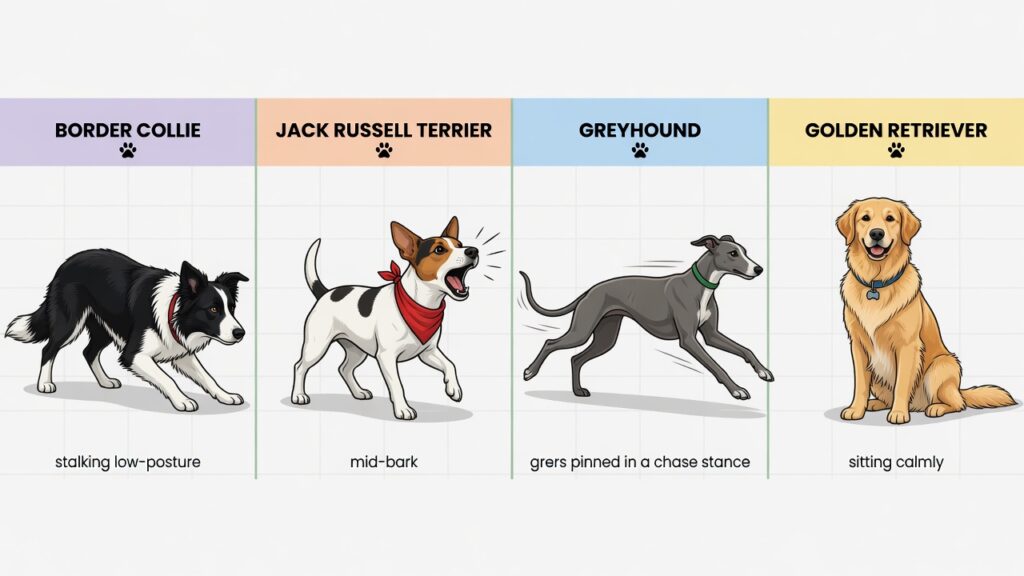
Not all dogs are equal in their tendency to bark at cats. Selective breeding has hardwired certain behavioral tendencies into specific breeds over centuries. Understanding where your dog falls on the spectrum helps set realistic expectations.
Herding Breeds
Herding dogs — including Border Collies, Australian Shepherds, Corgis, Shetland Sheepdogs (Shelties), and Belgian Malinois — were bred to stalk, chase, and control moving animals. Cats, with their quick dashes and erratic movements, trigger the herding sequence almost automatically.
These breeds tend to exhibit sustained eye contact, low stalking posture, and intense vocalization when they spot a cat. The “eye” behavior — where a Border Collie freezes and stares — is a precursor to the chase, and barking often follows when the dog can’t complete the sequence.
Shelties in particular are renowned for being vocal dogs, with a high-pitched bark that activates at the slightest visual stimulus. If your Sheltie barks at every cat in the neighborhood, you’re witnessing centuries of selective breeding doing exactly what it was designed to do.
Terrier Breeds
Terriers — including Jack Russell Terriers, Airedale Terriers, Scottish Terriers, Fox Terriers, and Bull Terriers — were bred to hunt vermin, including rodents and small animals. Their prey drive is intensely focused and explosive, and their bark is loud, persistent, and hard to interrupt.
Unlike herding dogs that stalk methodically, terriers react with immediate, high-intensity responses. They’re often described as “feisty” — and that feistiness means that a cat across the street can send a Jack Russell into a vocal meltdown within seconds. Terrier breeds also tend to have high arousal thresholds — once triggered, they are very hard to redirect.
Sight Hounds and Scent Hounds
Greyhounds, Whippets, Salukis, and other sight hounds were bred to detect and chase prey visually at great speeds. A cat moving at the edge of a field or across the street is essentially everything their neurology was engineered to respond to. However, sight hounds don’t always bark — many are silent chasers, lunging and pulling without making a sound.
Beagles, Bloodhounds, and Basset Hounds operate more through scent. They may not react as visually, but if a cat has walked the same path recently, a scent hound may track and bark along the trail.
Low-Reactivity Breeds
Not all breeds are high-reactors. Golden Retrievers, Labrador Retrievers, Cavalier King Charles Spaniels, and Basset Hounds tend to have lower prey drives and are generally more socially tolerant of cats, especially with proper socialization. That said, individual personality and history always play a significant role — any dog can develop cat-reactivity without proper exposure.
The Role of Socialization and Early Exposure
Breed instinct sets the stage, but socialization shapes the performance. A Border Collie raised alongside cats from puppyhood will respond very differently to a street cat than one who has never encountered a feline.
Critical Developmental Periods
The critical socialization window in puppies is approximately 3 to 14 weeks of age. During this period, the brain is highly plastic and actively forming neural associations with stimuli. Positive, calm exposure to cats during this window teaches the dog’s limbic system that cats are neutral or positive stimuli, not threats or prey.
Puppies who never encounter cats during this window don’t necessarily become reactive adults — but the default response to novel cat encounters will be closer to arousal and reactivity, because the brain has no established baseline of calm association with that stimulus.
Under-Socialized Dogs vs. Well-Socialized Dogs
An under-socialized dog sees a street cat and experiences it as a novel, unpredictable, high-stimulation event — triggering alert barking, prey drive, or fear-based reactivity. A well-socialized dog processes the same cat through a filter of prior experience, reducing the novelty and therefore the arousal.
This is why rescue dogs and dogs adopted at older ages frequently show more cat-reactivity — their early socialization history is unknown or lacking. It doesn’t make them bad dogs; it simply means they need more graduated counter-conditioning to build new neural pathways.
For more on controlling barking behavior in structured training, see how owners successfully train a Dog to Bark on Command — understanding when and why dogs vocalize gives you better tools to manage and redirect it.
Body Language: Reading Your Dog’s Signals Before the Bark
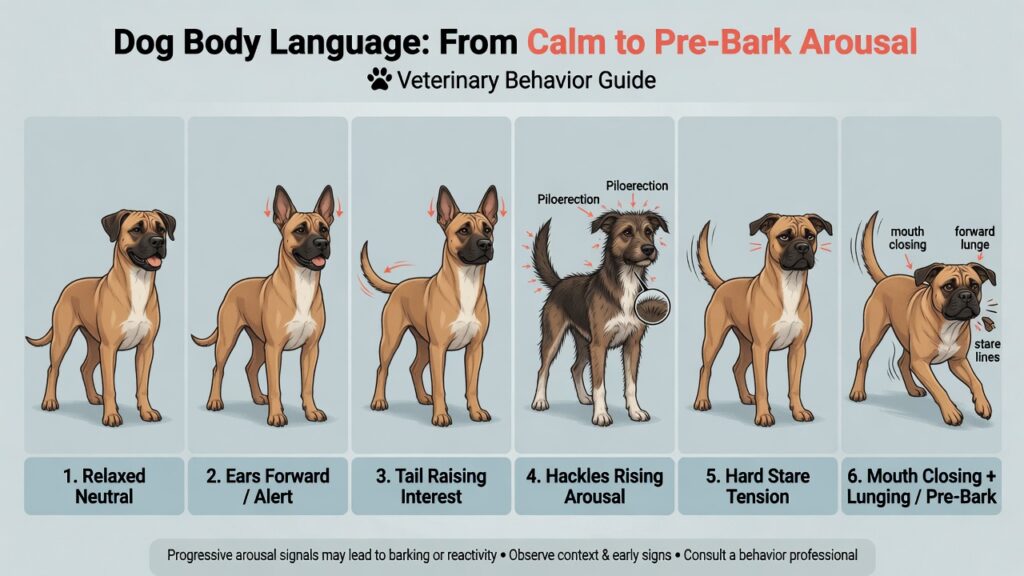
Most dogs don’t go from zero to barking in an instant. There’s a pre-bark escalation window — a sequence of stress and arousal signals that, if caught early, can be interrupted before vocalization begins.
Pre-Bark Stress Signals
Watch for these calming signals and stress indicators before the bark:
- Hard stare — fixed, unblinking gaze at the cat
- Forward weight shift — body weight moving onto front paws
- Tail raising — tail going high and stiff (not wagging loosely)
- Ears forward — fully erect and directed at the stimulus
- Piloerection (hackles) — fur along the spine and shoulders rising
- Tightened lips and closed mouth — replacing the relaxed, open-mouth panting
- Leash tension — subtle pulling that begins before vocalization
These signals are your intervention window. Redirect before the bark begins, and you avoid the full arousal loop from completing.
What the Cat’s Body Language Triggers
Interestingly, the cat’s posture significantly influences how reactive a dog becomes. Cats that:
- Run away → trigger chase and arousal barking
- Stand still and stare back → trigger threat-assessment barking (territorial response)
- Arch and hiss → can trigger either a fear-based bark or predatory escalation, depending on the dog
- Walk calmly and ignore the dog → are least likely to trigger a strong reaction
According to research on interspecies communication, dogs that have extensive cat exposure learn to read feline body language more accurately — an important reason why multi-pet households often produce calmer, less reactive dogs. You can explore how similar stimulus-based reactivity works in Dog Barking at Birds in the Yard — the same arousal patterns often apply across different outdoor stimuli.
Training Strategies to Reduce Barking at Cats
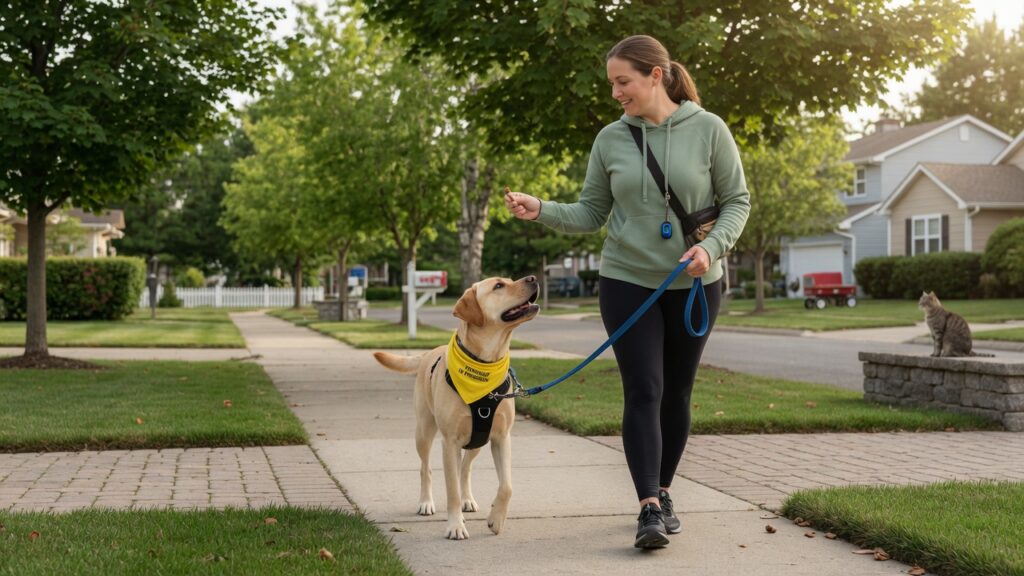
Reducing cat-directed barking requires systematic behavioral modification, not punishment. Punishing a barking dog increases stress, which increases reactivity over time. The goal is to change the dog’s emotional association with cats from arousal or threat to calm neutrality.
Counter-Conditioning and Desensitization
Counter-conditioning changes what a stimulus means to the dog. The process: every time your dog sees a cat without barking, deliver a high-value reward (real meat, cheese, or whatever your dog finds most reinforcing). Over time, “cat appearing” becomes a cue that predicts a food reward, and the emotional valence of the cat shifts from negative/exciting to positive/calm.
Desensitization pairs with this: start exposing your dog to cats at sub-threshold distances — far enough that the dog notices but doesn’t react. Gradually decrease the distance over days and weeks as the dog remains calm. This is the same graduated exposure principle used in treating human anxiety disorders, and it works through the same neurological habituation mechanism.
According to the American Kennel Club’s guidance on reactive dog training, consistent positive reinforcement at sub-threshold exposure levels is among the most evidence-supported approaches for managing dog-to-cat reactivity. (Source: AKC Canine Health Foundation)
Impulse Control and “Leave It”
Impulse control exercises build the dog’s capacity to pause before acting on a stimulus. The “Leave It” command is foundational — it teaches the dog that disengaging from an exciting object produces a reward. Practice first with low-value items (a sock, a toy), then progress to higher-value distractions, and eventually to real-world stimuli like cats.
“Watch Me” or “Look at Me” is another critical tool — it re-orients the dog’s attention from the cat to you. Combined with a calm verbal cue and high-value food, this becomes a powerful pattern interrupt that can short-circuit the bark before it happens.
Threshold Management on Walks
Every dog has a reaction threshold — the point at which exposure to a stimulus triggers an uncontrollable response. Effective training keeps the dog under threshold during learning and only gradually moves closer to it.
Practical strategies include:
- Crossing the street when a cat appears, before the dog reacts
- Changing direction the moment your dog’s body language escalates
- Using wide arcs around cats rather than straight-line approaches
- Timing walks during lower-traffic hours when fewer cats are outdoors
The goal of threshold management isn’t avoidance forever — it’s protecting the training environment so that counter-conditioning can work. You cannot counter-condition a dog that is already over threshold; the arousal loop must be broken first.
Management Tools and Practical On-Walk Tips
Training takes time. In the meantime, smart management tools reduce both the risk of incidents and the practice of the unwanted behavior (because every time a dog rehearses barking at a cat, that neural pathway becomes stronger).
Equipment: Harnesses, Head Collars, and Long Lines
- Front-clip harnesses (like the Ruffwear Front Range or PetSafe Easy Walk) redirect forward pulling by turning the dog to the side, reducing lunge force without causing pain.
- Head collars (like the Gentle Leader) provide steering control at the head, similar to a horse halter. They are not muzzles and don’t prevent barking, but they give the handler much better directional control during reactive episodes.
- Long lines (15–30 feet) give the dog more freedom while maintaining handler safety — useful during structured desensitization exercises in open spaces.
Avoid aversive tools like choke chains, prong collars, or shock collars for cat reactivity. These tools may suppress the behavior in the short term, but increase overall anxiety and can create negative associations — your dog may learn to associate the pain with the presence of cats, increasing the risk.
Routine Changes and Environmental Modification
Sometimes the simplest interventions produce the most immediate relief:
- Walking at different times — early morning or late evening reduces cat encounters
- Change your regular routes — novel environments reduce established territorial patterns
- Practice “look at that” games indoors near windows — let your dog observe cats through glass and reward calm behavior, gradually building the association between cat-sighting and reward in a controlled environment
According to research cited by the Association of Professional Dog Trainers (APDT), environmental management and controlled exposure are equally important pillars alongside active training in behavior modification programs. (Source: APDT)
When to Seek Professional Help
While most dogs can make significant progress with consistent home training, some cases warrant professional intervention:
- Escalation to aggression — if barking is accompanied by snapping, biting the leash, or redirected aggression toward the owner
- Panic and self-injury — if the dog’s arousal is so high that they injure themselves on the leash or harness
- No improvement after 8–12 weeks of consistent counter-conditioning
- Multiple triggers — if the dog reacts to cats, other dogs, cyclists, joggers, and children simultaneously, a broader reactivity program is needed
Look for a Certified Professional Dog Trainer (CPDT-KA) or a Veterinary Behaviorist (DACVB) if symptoms are severe. In some cases, short-term anti-anxiety medication (like fluoxetine or trazodone, prescribed by a vet) can reduce baseline anxiety enough for training to become effective.
Key Takeaways
- Dog barking at cats is driven by prey drive, territorial instinct, frustration, and arousal — not simple disobedience
- Breed matters: Terriers, herding breeds, and sight hounds are most prone; retrievers and companion breeds are generally calmer
- Socialization during the critical window (3–14 weeks) significantly shapes adult reactivity
- The most effective interventions are counter-conditioning, desensitization, and impulse control training — all reward-based
- Management tools like front-clip harnesses and route changes reduce rehearsal of the behavior while training progresses
- If reactivity is severe, professional help from a certified behaviorist is always worth pursuing
References: