

Summary
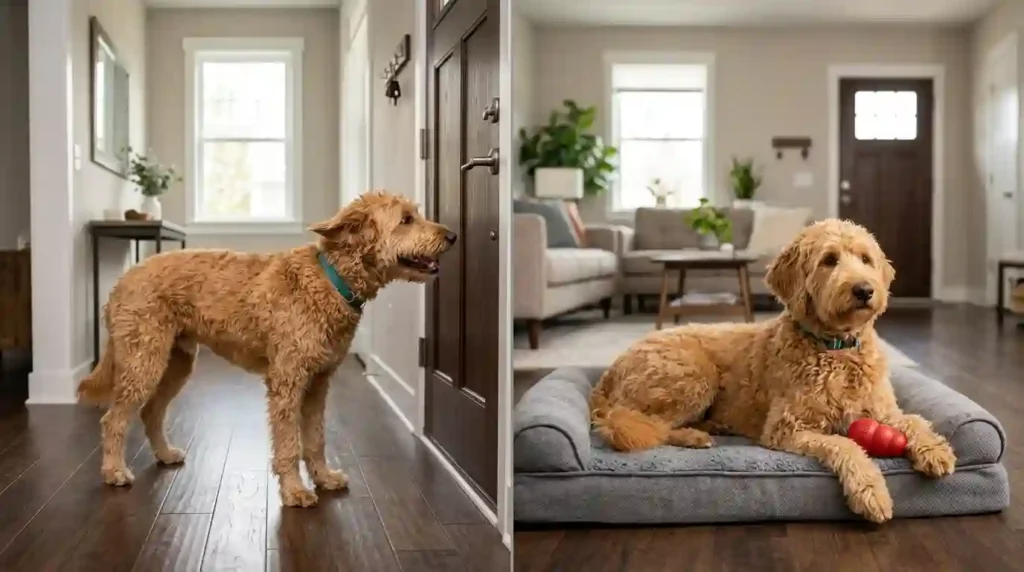
Separation anxiety barking is driven by genuine fear or panic, while normal protest barking usually reflects brief frustration, attention seeking, or resistance to a change in routine. Because both can begin when an owner leaves, they are easy to confuse. The most reliable way to tell them apart is to examine the dog’s entire behavior: how quickly the barking begins, whether the dog settles, what the body language shows, and whether symptoms such as pacing, salivation, destruction, escape attempts, or house soiling occur. This guide explains those differences and offers practical, humane steps for helping your dog.
Table of Contents
- What Is Separation Anxiety Barking?
- Separation Anxiety Barking vs. Protest Barking
- Signs That Barking Is Caused by Emotional Distress
- Why Dogs Protest When Left Alone
- How to Observe Your Dog’s Behavior
- Curing Dog Separation Anxiety Quickly: Is It Possible?
- Home Remedies and Environmental Support
- Training for Separation-Related Behavior
- Separation Anxiety When One Person Leaves
- Separation Anxiety at Night
- Medication and Professional Support
- What Not to Do
- Conclusion
- FAQs
What Is Separation Anxiety Barking?
Separation anxiety barking is excessive vocalization caused by distress when a dog is separated from a particular person or left alone. It is not simply a dog objecting to an inconvenience. The dog may experience fear, escalating stress, or panic during the owner’s absence.
Some dogs react as soon as their guardian walks through the door. Others show pre-departure anxiety when they notice familiar departure cues, such as shoes being put on, keys being picked up, or a work bag being moved. Barking may begin before the owner has even left.
Separation anxiety is one form of separation-related behavior. Other conditions within this broader category include isolation distress, in which a dog becomes distressed whenever no person is present, and confinement distress, in which panic is linked primarily to being enclosed.
These distinctions matter. A dog with isolation distress may remain comfortable if a dog sitter is present. A dog attached to one particular guardian may panic even when other family members remain at home. A dog with crate frustration may bark in a crate but settle comfortably when allowed to remain loose in a safe room.
Separation anxiety is an emotional response
A dog experiencing separation anxiety is not trying to punish an owner for leaving. Chewing, scratching, urination, defecation, and persistent barking are expressions of emotional distress, not calculated acts of revenge.
The behavior can be difficult for people to understand because the physical evidence is discovered later. A torn door frame may look deliberate, but damage concentrated around doors, windows, or other exit points often indicates an attempt to follow the absent person or escape from confinement.
Separation Anxiety Barking vs. Protest Barking
The central difference is the dog’s emotional state.
Normal protest barking is typically caused by temporary discomfort, frustration, boredom, or an attempt to regain access to a person or desired activity. Separation anxiety barking is associated with an inability to cope with being alone.
| Feature | Separation anxiety barking | Normal protest barking |
| Primary emotion | Fear, panic, or severe stress | Frustration, boredom, or attention seeking |
| Barking pattern | Persistent or continuous barking, often with whining or howling | Usually intermittent barking with pauses |
| Ability to settle | The dog struggles or fails to settle | Dog often settles after several minutes |
| Food response | May refuse even valuable food | Usually willing to eat or use toys |
| Body language | Pacing, panting, trembling, salivation | Alert posture, watching the door, occasional vocalization |
| Destructive behavior | Often directed at exit points or confinement barriers | More likely general chewing caused by boredom |
| House soiling | Can occur despite established housetraining | Uncommon unless the dog was left too long |
| Response to training | Requires gradual work below the distress threshold | Often improves through routine and reinforcement |
| Risk of self-injury | Possible in moderate or severe cases | Unusual |
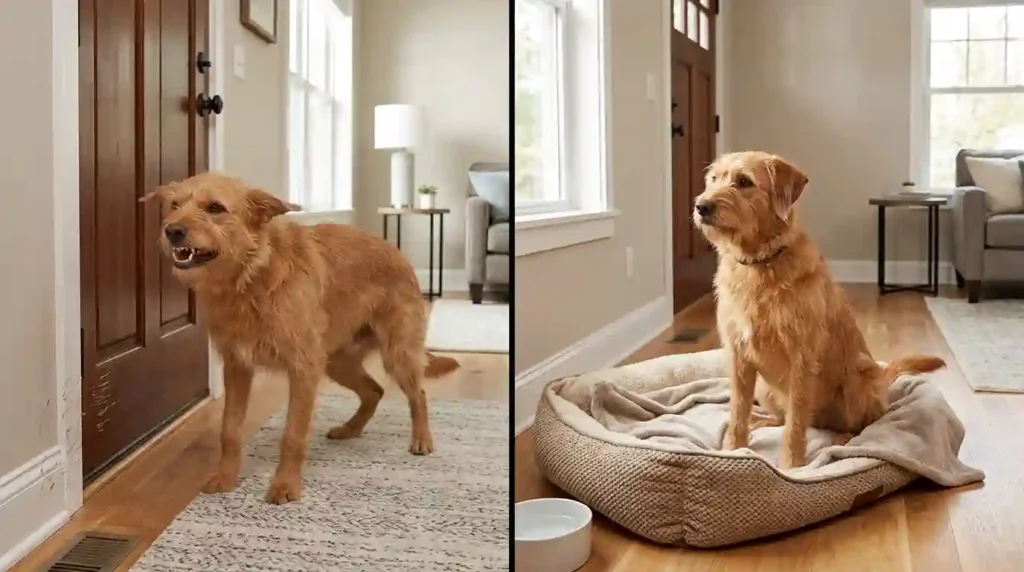
A protesting dog may bark when the door closes, pause to listen, bark again, and eventually lie down. An anxious dog may become increasingly agitated. The vocalization may shift from barking to whining or howling while the dog paces, pants, scratches the door, or tries to escape.
Protest barking is often goal-directed
Protest barking can function as demand barking or attention-seeking vocalization. The dog has learned that making noise sometimes causes a person to return, open a gate, release the dog from a crate, or provide attention.
That does not mean the dog feels nothing. Frustration is a real emotional experience. The distinction is that a protesting dog generally retains the ability to self-soothe and display settling behavior once the expected reward does not appear.
Dogs may also bark because of environmental triggers unrelated to separation. An unfamiliar noise, a person near the window, or a perceived threat can produce alert barking or territorial barking. If the dog responds to the same sights and sounds while the owner is present, the barking may not be caused by owner’s absence.
Breed tendencies can also influence vocal behavior. Herding dogs, for example, may be especially responsive to movement and changes in their environment. For more breed-specific context, read Dog Barking Behavior in Herding Breeds.
Signs That Barking Is Caused by Emotional Distress
Barking alone cannot confirm separation anxiety. Look for a cluster of symptoms that consistently appear during departures or owner absence.
Common separation anxiety symptoms
Possible signs include:
- Persistent barking, whining, or howling
- Pacing in repeated paths
- Panting when the room is not hot
- Trembling or an unusually tense posture
- Excessive salivation or drooling
- Destructive behavior near doors and windows
- Chewing, digging, or scratching at barriers
- Escape attempts from crates or rooms
- Urination or defecation despite reliable housetraining
- Coprophagia after stress-related defecation
- Refusal to eat when alone
- Attempts to follow the owner from room to room
- Excessive greeting behavior after even short separations
- Self-injury involving teeth, nails, paws, or the face
A dog does not need to show every symptom. Some dogs display excessive vocalization without destruction, while others attempt to escape silently.
Medical conditions can also cause house soiling, restlessness, vocalization, appetite changes, or nighttime distress. A veterinarian should rule out pain, urinary disease, gastrointestinal problems, cognitive decline, and other health issues before the behavior is treated as purely psychological.
Timing offers important evidence
True separation distress often starts within minutes of departure, although timing varies. The dog may react during the pre-departure routine or immediately after losing visual contact with the guardian.
Normal protest barking is more likely to fade as the dog realizes that barking will not bring the person back. A dog that vocalizes briefly and then sleeps for most of the absence is less likely to be experiencing sustained panic.
How to Observe Separation Anxiety Barking
A remote camera or video recording is one of the most useful diagnostic tools available to an owner. It shows what happens rather than what you assume happened based on the condition of the room.
Record at least 30 to 60 minutes, including the departure routine. If the dog is usually left longer, check recordings from different periods. Note:
- When the first sign of stress appears.
- Whether departure cues trigger anxiety.
- How long does barking continues?
- Whether barking is continuous or intermittent.
- Whether the dog eats, drinks, explores, or rests.
- Which environmental trigger precedes each reaction?
- Whether the dog approaches an exit point.
- Whether arousal rises, falls, or remains constant.
Behavioral observation also helps separate owner-related distress from reactions to hallway sounds, delivery drivers, outdoor animals, appliances, or nearby construction. A dog that responds intensely to household equipment may have a separate noise-related issue. The guide on why a Dog Bark at the Vacuum Cleaner explains how fear, movement, and sound can trigger that response.
Share the video with a veterinarian, qualified professional dog trainer, or veterinary behaviorist. A recording can reveal subtle body language that is easy to miss.

Why Separation-Related Behavior Develops
There is rarely one universal cause. Risk may be influenced by genetic predisposition, early experience, learning history, environment, health, and the strength or structure of a dog’s social attachments.
Common contributing events include:
- An abrupt schedule change
- A change of residence
- A change of guardian
- Loss of a family member or animal companion
- A traumatic experience while alone
- A long period of constant companionship, followed by regular absences
- Inadequate preparation for alone time
- Lack of exercise or mental stimulation
- A frightening environmental event
- Pain, illness, or age-related cognitive changes
A sudden onset deserves particular attention. If a dog previously stayed alone comfortably but begins panicking without an obvious household change, arrange a veterinary examination.
Dog separation anxiety when one person leaves
Some dogs become distressed only when a specific attachment figure leaves. They may ignore the presence of another family member because the departure of that one person is the relevant trigger.
Video can help confirm this pattern. Compare the dog’s behavior when different people leave. Treatment should include carefully planned absences involving the attachment figure, while another trusted person helps the dog remain below its distress threshold.
Curing Dog Separation Anxiety Quickly: What Is Realistic?
There is no dependable overnight cure for separation anxiety. Claims of instantly curing the condition usually overlook the dog’s emotional state or suppress visible behavior without reducing fear.
Improvement may begin quickly when triggers are managed well, but lasting behavior modification generally requires gradual, repeated practice. The goal is to teach the dog that alone time is safe without repeatedly exposing it to overwhelming panic.
Progress is rarely perfectly linear. A dog may handle ten minutes comfortably one day and struggle with five minutes after an unfamiliar noise, schedule disruption, or stressful event. Training should follow the dog’s observable response rather than a fixed calendar.
Work below the distress threshold
The distress threshold is the point at which the dog begins to show meaningful anxiety. Training departures should end before that point whenever possible.
For one dog, the starting exercise might involve touching the doorknob. Another may tolerate stepping outside for 20 seconds. The correct starting point is the duration or departure cue that the individual dog can experience while remaining calm.
Training for Separation Anxiety Barking
Moderate or severe separation anxiety is generally addressed through systematic desensitization, often combined with counterconditioning and environmental management.
The ASPCA’s separation anxiety guidance explains that mild cases may respond to counterconditioning, while more serious cases require carefully graduated separations that do not trigger anxiety.
Gradual desensitization
Gradual desensitization means exposing the dog to a very low-intensity version of the trigger and increasing it only while the dog remains comfortable.
A basic progression may look like this:
- Put on shoes without leaving.
- Pick up keys, then sit down.
- Walk to the door and return.
- Open and close the door.
- Step outside for one or two seconds.
- Repeat short separations at varied, manageable durations.
- Increase absence time gradually.
Avoid increasing duration after every successful repetition. Mixing shorter and slightly longer departures can prevent the exercise from becoming an obvious countdown to a difficult absence.
Counterconditioning
Counterconditioning changes the dog’s emotional association with being alone. A special food toy, stuffed Kong, or treat-dispensing toy can make a mild departure predict something pleasant.
However, refusal to eat is itself useful information. A dog experiencing intense fear may ignore its favorite food. Do not assume the dog is being stubborn, and do not rely on food toys as the only treatment for severe panic.
Alone-time training while you are home
Independence can also be developed without leaving the property. Encourage the dog to rest on a comfortable bed while you move around the room. Gradually step behind an interior door and return before anxiety begins.
Use positive reinforcement to reward calm, independent behavior. The goal is not emotional detachment. It is confidence and self-soothing in ordinary, safe situations.

Home Remedies for Separation Anxiety in Dogs
The phrase “home remedies” should refer to supportive management, not unverified substances or replacements for veterinary care.
Helpful options may include:
- A predictable routine for meals, walks, rest, and departures
- Appropriate physical exercise before alone time
- Scent games and environmental enrichment
- Puzzle feeders and interactive toys
- Long-lasting chew toys selected for safety
- A stuffed Kong or other food toy
- Background sound to soften unfamiliar noise
- Curtains or window film to reduce visual triggers
- A comfortable, safe space
- A dog walker for necessary absences
- Carefully selected dog daycare, if the dog enjoys group care
Physical exercise can reduce restlessness and boredom, but it does not cure panic. A tired dog can still be an anxious dog. Mental stimulation should also be appropriate to the individual, rather than so exciting that it increases arousal before departure.
Ask a veterinarian before using calming supplements. Products vary in quality, evidence, ingredients, and potential interactions with medication.
Crate training requires special care
A crate can become a secure resting place when introduced through positive, voluntary crate training. It is not automatically a treatment for separation anxiety.
For a dog with confinement distress or crate frustration, closing the crate may intensify escape attempts and increase the risk of self-injury. Compare camera footage from a crate with footage from a larger dog-proofed room. Use the environment in which the dog is safest and most relaxed.
Separation Anxiety at Night
Nighttime barking does not automatically mean separation anxiety. A puppy may need to eliminate, an adult dog may hear unfamiliar sounds, and an older dog may be affected by pain or cognitive changes.
Separation-related distress is more likely if barking begins specifically when the dog loses access to a person. Watch for pacing, panting, pawing at doors, inability to lie down, and repeated attempts to reach the sleeping owner.
For puppies, place the sleeping area at a manageable distance and increase separation gradually. For an adult or senior dog with new nighttime anxiety, seek veterinary advice before starting a behavioral program.
Separation Anxiety Dog Medication
Anti-anxiety medication may be appropriate when emotional distress is too intense for learning to occur. Medication does not sedate every dog, erase personality, or replace training when prescribed and monitored properly. Its purpose may be to reduce panic enough for behavior modification to succeed.
A veterinarian must decide whether medication is suitable. The decision may depend on symptom severity, physical health, other medications, and whether unavoidable absences continue to push the dog over its threshold.
Some dogs receive daily medication, while others may need additional short-acting support for predictable departures. Never give human medication or change a prescribed dose without veterinary guidance.
When professional help is needed
Seek help promptly if the dog:
- Injures itself during escape attempts
- Breaks teeth or nails against barriers
- Cannot tolerate even very short separations
- Refuses food and water during absences
- Shows severe salivation, elimination, or destruction
- Experiences symptoms after a sudden behavioral change
- Is not improving with carefully managed training
A veterinary behaviorist can assess medical and behavioral factors together. A qualified reward-based trainer or behaviorist can help implement gradual departures and interpret video, but medication decisions belong to a veterinarian.
What Not to Do With Dog Separation Anxiety
Do not use punishment
Punishment after returning home cannot teach a dog what to do during a past event. The behavior has already occurred, and the dog may associate the owner’s return with anger or danger.
Scolding, physical correction, and aversive tools can increase fear. An anti-bark collar may suppress vocalization without treating the panic beneath it. It can also make distress harder to detect.
Do not use the cry-it-out method
Repeatedly leaving a panicked dog until it stops does not reliably teach calm independence. A dog may stop vocalizing because of exhaustion while remaining distressed. In other cases, repeated exposure can sensitize the dog and make future departures harder.
Do not make the crate the default solution
Confinement can worsen the problem when the dog is afraid of barriers or attempts to reach an exit. Choose a safe setup based on observed behavior, not on the assumption that all dogs feel secure in crates.
Do not rush departure training
Jumping from one minute to an hour can undo progress. Gradual departures should remain short enough to preserve calm behavior. If the dog begins panting, pacing, trembling, or ignoring food, reduce the difficulty.
Do not reinforce demand barking accidentally
Demand barking and panic require different responses. If a comfortable dog barks for access or attention, wait for a brief quiet moment before providing the desired interaction. Reinforce quiet settling rather than the vocal demand.
This approach is not appropriate for a dog in genuine panic. Fear-based separation behavior requires emotional support, management, and gradual training rather than simple ignoring.
Conclusion
The difference between separation anxiety barking and normal protest barking is not the volume of the noise. It is the emotional and behavioral pattern surrounding it.
A protesting dog is frustrated but generally able to pause, eat, investigate the environment, and settle. A dog with separation anxiety may show persistent vocalization, escalating arousal, pacing, panting, salivation, escape attempts, destruction at exit points, house soiling, or refusal to eat.
Use a remote camera to observe the full sequence. Rule out environmental and medical causes, then match the response to the problem. Mild frustration may improve through enrichment, predictable routines, and reinforcement of settling behavior. Panic-based separation distress calls for gradual desensitization, careful management, and sometimes veterinary medication.
There may not be a genuine instant cure, but a patient plan built around the dog’s distress threshold can produce meaningful and lasting improvement.
FAQs
Does separation anxiety cause excessive barking?
Yes. It can cause persistent barking, whining, or howling, usually alongside other signs of distress during an owner’s absence.
What are the 4 types of barking?
Four common functional categories are alert barking, attention or demand barking, fear-based barking, and separation-related barking. Dogs can display more than one type.
Do all puppies have separation anxiety?
No. Brief protest is common while puppies learn independence, but panic, prolonged vocalization, and escape attempts are not universal puppy behavior.
Can a dog outgrow separation anxiety?
Dogs do not reliably outgrow it without support. Early alone-time training and appropriate treatment improve the likelihood of recovery.
Is it cruel to leave a dog with separation anxiety?
Leaving a dog in repeated, severe panic can compromise welfare. Use management and gradual training to keep unavoidable absences within tolerable limits.
At what age do puppies get separation anxiety?
Separation-related distress can appear after adoption or during puppyhood. There is no single age at which every affected puppy develops it.
What not to do with dog separation anxiety?
Avoid punishment, forced cry-it-out exposure, anti-bark collars, abrupt long absences, and unsafe confinement. These responses can intensify fear.
Does ignoring your dog help with separation anxiety?
Ignoring may reduce ordinary demand barking, but it does not treat panic. Separation anxiety requires gradual exposure and changes to the dog’s emotional response.
How can I calm a puppy with separation anxiety?
Begin with very short, comfortable separations, provide a safe resting space, reinforce calm behavior, and consult a veterinarian if distress is intense.