
Summary
When your dog barks every time you hug another person, it is almost never random. This behavior stems from a complex mix of canine psychology, including jealousy-like emotional responses, attention-seeking habits, protective instincts, misread body language, and sometimes anxiety. Dogs are deeply social animals wired to monitor their attachment figures, and a hug — which involves physical closeness, altered posture, and emotional energy — can trigger alarm, excitement, or demand barking depending on the individual dog. This guide Why Does My Dog Bark When I Hug Someone explores every angle of this behavior, from the neuroscience of dog emotions to practical, research-backed training strategies that will help you correct it and build a calmer, more confident dog.
Table of Contents
- Understanding Your Dog’s Emotional World
- The Psychology Behind Jealousy: Barking in Dogs
- Why Hugging Triggers Your Dog’s Barking
- Attention-Seeking Behavior and Demand Barking
- Protective Instincts and Territorial Responses
- Anxiety and Stress-Related Barking
- Breed-Specific Tendencies
- How to Stop Your Dog from Barking When You Hug Someone
- When to Seek Professional Help
- Frequently Asked Questions
Understanding Your Dog’s Emotional World
How Dogs Process Human Emotions

Dogs have co-evolved with humans for over 15,000 years, developing one of the most sophisticated cross-species social bonds in the animal kingdom. Modern neuroscience confirms what most dog owners already suspect: dogs feel emotions. Research using MRI imaging, notably from Dr. Gregory Berns at Emory University, has shown that the caudate nucleus — a brain region associated with positive emotions and reward anticipation — activates in dogs in response to human social cues, including familiar faces, scents, and voices.
Dogs are also highly attuned to oxytocin, the bonding hormone. Studies show that when dogs and their owners make eye contact, oxytocin levels rise in both species — a phenomenon not observed in wolves, suggesting domestication specifically shaped this emotional attunement. This means your dog is not just watching you; they are emotionally processing your interactions in real time.
The Role of Social Bonding in Canine Behavior
Dogs operate within a framework of social hierarchy and attachment. They form primary attachment bonds — often called “secure base effects” — with their main caregiver, similar to what human infants do with their mothers. When that caregiver redirects emotional and physical attention toward another individual, the dog registers this as a meaningful social event. It is not whimsy. It is wiring.
This attachment framework is the foundation for understanding why something as simple as a hug can produce barking, whining, nudging, or even jumping behavior in dogs.
The Psychology Behind Jealousy: Barking in Dogs
Do Dogs Actually Feel Jealous?
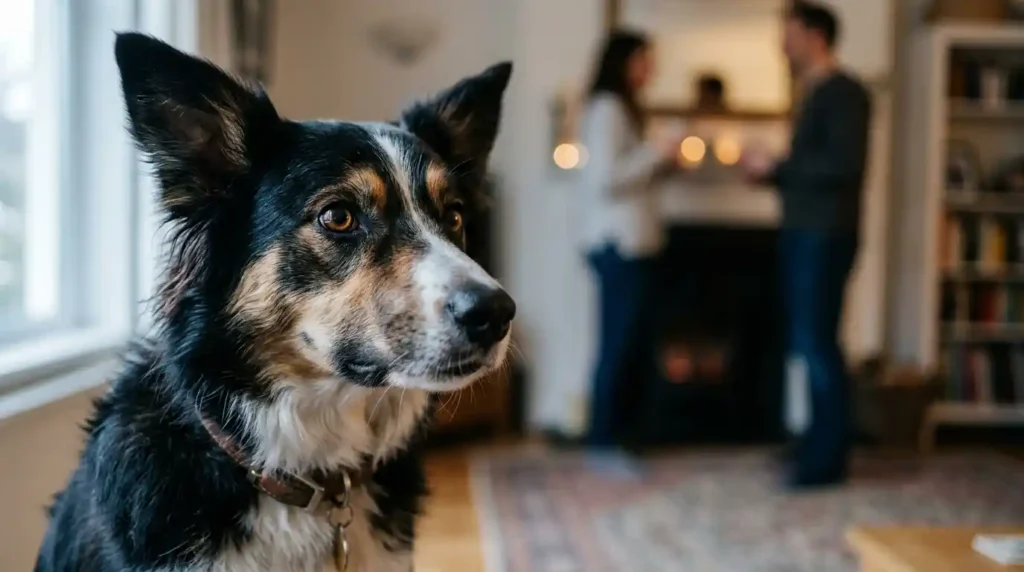
For years, scientists debated whether jealousy was an exclusively human emotion. A landmark 2014 study published in PLOS ONE by Dr. Christine Harris and Caroline Prouvost found that dogs exhibited jealous behaviors — snapping, pushing, and attention-seeking — when their owners interacted with a realistic stuffed dog. The dogs largely ignored owners interacting with non-social objects, confirming that the response was socially motivated, not general frustration.
This is what behavioral scientists call a “primordial jealousy response” — a basic, evolutionarily older form of jealousy rooted in resource competition. For your dog, you are the resource. Your attention, affection, and presence are among the most valuable things in their world.
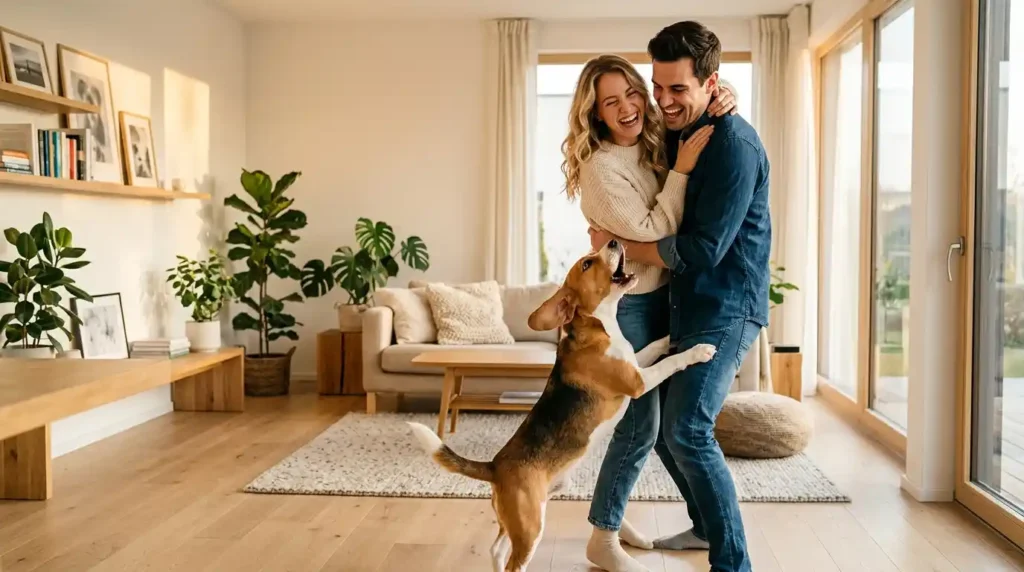
Signs Your Dog Is Barking Out of Jealousy
Jealousy-driven barking during hugs is typically accompanied by other behaviors that form a recognizable behavioral cluster:
- Pawing or nudging at you or the person you are hugging
- Jumping up to interrupt physical contact
- Whining or yipping alongside barking
- Placing themselves physically between you and the other person
- Making prolonged eye contact with you while barking
These are all attention-diversion behaviors. The dog is not necessarily aggressive — they are lobbying for inclusion.
Jealousy vs. Excitement: Telling the Difference
Not all hug-triggered barking is jealousy. Some dogs bark out of pure social excitement. If a guest arrives, the energy in the room elevates, and your dog feeds off this arousal; they may bark simply because stimulation thresholds have been crossed. Excitement barking tends to be higher-pitched, accompanied by a loose, wiggly body posture and a wagging tail. Jealousy or demand barking is often more focused and directed specifically at you, with the dog orienting their body toward you rather than toward the room in general.
Why Hugging Triggers Your Dog’s Barking
Dogs Don’t Naturally Understand Hugging
This is a critical and often overlooked point. Hugging is a human behavior with no direct equivalent in canine body language. Dogs do not hug. When one dog places their limbs over another, it is typically a dominance gesture or a precursor to play mounting — not affection. From a purely canine communicative standpoint, a hug can look like restraint, confrontation, or a dominance display.
Your dog has learned, over time, what hugs mean to you. But their first instinct is often to interpret the scene through a canine lens, which can trigger confusion, protectiveness, or an alert response.
Reading Body Language: What Your Dog Sees During a Hug
When you hug someone, your dog observes a multi-signal event:
- Two bodies pressed together — which can resemble conflict or play-fighting
- Faces close together — which in dog language can signal tension or challenge
- One or both people are making sounds, which your dog tries to interpret emotionally
- You, their primary attachment figure, are physically occupied and not responsive to them
This combination of signals — especially the final one — is enough to trigger a vocal response in sensitive, bonded, or under-socialized dogs.
Physical Closeness and Perceived Threats
Some dogs, particularly those with protective or guarding tendencies, perceive another person’s close physical contact with their owner as a potential threat. Even if the dog knows and likes the person being hugged, the act itself may momentarily read as an intrusion into the owner’s personal space. The bark in this case functions as a warning or an attempt to interrupt what the dog’s instinct flags as risky proximity.
Attention-Seeking Behavior and Demand Barking
Reinforcement History and Learned Behavior
One of the most common — and most overlooked — explanations is learned behavior through reinforcement history. If your dog barked during a hug in the past and you responded by breaking the hug, looking at the dog, saying “shh,” or giving them attention of any kind, you rewarded the bark. Dogs are extraordinarily efficient learners when it comes to operant conditioning. They quickly map out: “Barking during a hug = owner pays attention to me.” The behavior gets filed away and repeated.
This is demand barking — vocalizing to compel a specific human response. It is not dominance. It is your dog that has learned a very effective tool.
Resource Guarding and Human Attachment
Dogs can resource guard humans the same way they guard food, toys, or sleeping spots. This is called social resource guarding. Your dog views you as their primary resource and may bark to signal to others — including family members — that your attention and proximity are claimed territory. This behavior is more common in dogs that have been the sole pet for a long time, dogs that sleep in their owner’s bed, and dogs that have not been adequately socialized with other people or animals.
Protective Instincts and Territorial Responses
Pack Mentality and Guarding the Alpha
Dogs retain vestigial pack instincts from their wolf ancestry. Within the home, they assign social roles. If your dog sees you as the pack leader — or if they have assumed that role themselves — they may bark during a hug as a protective behavior: keeping watch while you are in a vulnerable, eyes-closed, arms-occupied position.
This interpretation is especially common in dogs that also bark when strangers approach their owners on walks, stand between their owner and a visitor, or follow their owner from room to room.
Overprotective Dogs: When It Becomes a Problem
Mild protectiveness is normal. When it escalates to persistent barking, growling, or even nipping during physical affection between their owner and another person, it crosses into problematic territory. Overprotective behavior can strain household relationships, create tension with guests, and — if left unchecked — escalate into aggression. Dogs that display Dog Barking Triggers in High-Rise Buildings and other environment-specific alert behaviors often share the same underlying anxiety profile as dogs that bark protectively during hugs.
Anxiety and Stress-Related Barking
Separation Anxiety vs. Situational Anxiety
Some dogs bark during hugs, not out of jealousy or protectiveness, but out of anxiety. Dogs with separation anxiety are hypervigilant about their owner’s attention and whereabouts. Any shift in your focus — even briefly during a hug — can spike their stress. This anxiety-driven barking is often more frantic, higher-pitched, and accompanied by physical stress signals: panting, pacing, yawning, or lip licking.
Situational anxiety, on the other hand, may be specific to certain people. If your dog only barks when you hug a particular person, assess whether your dog is genuinely anxious around that individual — perhaps due to a past negative association, an unfamiliar scent, or body language cues the dog has learned to distrust.
Dog Barking as a Sign of Pain or Illness
It is worth noting that sudden changes in barking behavior — including new or intensified barking during physical interactions — can sometimes have a medical component. Pain, cognitive dysfunction in older dogs, and hormonal imbalances can all lower a dog’s threshold for vocalization and reactivity. If your dog’s barking during hugs is a new development and accompanied by other behavioral or physical changes, a veterinary evaluation is warranted. For a deeper understanding of health-related vocalization, read this guide on Dog Barking as a Sign of Pain or Illness.
Breed-Specific Tendencies
High-Alert Breeds and Their Vocal Tendencies
Certain breeds are genetically predisposed to vocal reactivity. These include:
- German Shepherds — bred for protection and highly attuned to social changes
- Beagles and Hounds — instinctively vocal communicators
- Chihuahuas — known for intense bonding and anxiety-driven barking
- Miniature Schnauzers — alert barkers by breeding standard
- Dachshunds — bred to use their voice underground; highly reactive
These breeds may bark during hugs simply because their alert threshold is lower and their impulse to vocalize is stronger. This does not mean training is ineffective — it means expectations should be calibrated, and consistency is especially important.
Herding Breeds and Controlling Social Behavior
Herding breeds — Border Collies, Australian Shepherds, Shelties — present a particularly interesting case. These dogs are wired to manage the movement and grouping of animals. When two people come together in a hug, a herding dog may bark as a reflexive attempt to “manage” the social grouping. They may also nip at the heels or circle the people involved. This is not aggression — it is misdirected occupational instinct. Understanding this distinction is important for choosing the right corrective approach.
How to Stop Your Dog from Barking When You Hug Someone
Desensitization and Counter-Conditioning
Desensitization involves gradually exposing your dog to the trigger — hugging — at low intensity until they no longer react. Counter-conditioning pairs the trigger with something positive so the dog builds a new emotional association.
Step-by-step approach:
- Start by briefly touching another person’s arm while your dog is in the room. Reward calm behavior immediately.
- Progress to a brief side-hug, again rewarding silence and stillness.
- Gradually extend the duration and intensity of the hug over multiple sessions.
- Always reward before the bark begins — you are shaping an anticipatory calm, not punishing a reaction.
This process may take days to weeks, depending on the dog’s reactivity level. According to the American Kennel Club, counter-conditioning works best when introduced gradually and paired with high-value rewards like small pieces of chicken or cheese, which override the emotional response more effectively than praise alone.
Teaching the “Place” or “Settle” Command
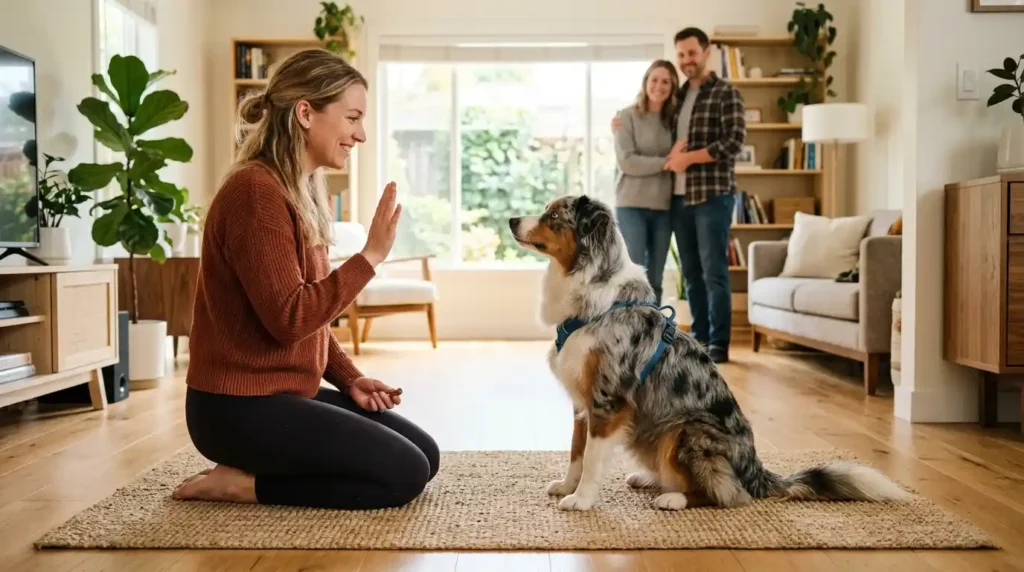
The “place” command — instructing your dog to go to a designated mat or bed and remain there — is one of the most powerful tools for managing hug-triggered barking. It gives your dog a clear behavioral alternative and removes them from the situation without punishment.
How to teach it:
- Use a specific mat and the word “place” consistently
- Lure your dog onto the mat, reward with a treat
- Build duration by rewarding for staying, using a stay cue
- Practice with progressively more exciting distractions in the room
- Once established, cue “place” before initiating a hug
With repetition, your dog learns that a hug predicts “go to your mat,” which reduces arousal because they know exactly what to do.
Rewarding Calm Behavior
One of the most common training mistakes is only reacting when the dog barks. Dogs learn enormously from what happens during quiet moments. When your dog is calm while you are affectionate with someone else, mark the behavior with a quiet “yes” and a calm reward. Over time, this builds a behavioral default of calm during social interactions.
Avoid the trap of over-excitement during rewards — this elevates arousal and can actually make barking more likely. Use calm verbal praise and low-key treats for these moments.
When to Seek Professional Help
Working with a Certified Dog Behaviorist
If your dog’s barking during hugs is intense, escalating, or accompanied by growling, snapping, or resource-guarding behavior toward people, it is time to consult a certified professional. Look for a Certified Applied Animal Behaviorist (CAAB) or a trainer with credentials from the International Association of Animal Behavior Consultants (IAABC). Avoid dominance-based trainers who use punishment — this can worsen anxiety-driven behavior significantly.
For more in-depth guidance on canine behavior modification, the resources available through the Association of Professional Dog Trainers are an excellent starting point for finding qualified professionals.
Veterinary Evaluation for Anxiety-Based Barking
For dogs displaying anxiety-driven barking, a veterinarian — ideally one with behavioral training — may recommend a combination of behavioral therapy and medication. SSRIs such as fluoxetine and anxiolytics like clonidine are increasingly used in veterinary behavioral medicine for dogs with generalized anxiety. Medication does not replace training; it lowers the anxiety baseline enough that training can take hold more effectively.
For a comprehensive scientific overview of canine social behavior and emotional processing, the research published by the Cambridge Centre for Animal Research and Ethics offers peer-reviewed insight into how and why dogs form the social bonds that drive these behaviors.
Frequently Asked Questions
Q: Is it normal for a dog to bark when you hug? Yes, it is extremely common and driven by jealousy, attention-seeking, protectiveness, or misread body language — all normal canine motivators.
Q: Does my dog think hugging is fighting? Potentially, yes. Dogs do not hug naturally, and the posture of a hug can be read as conflict or dominance behavior to a dog interpreting the scene through canine body language.
Q: Should I ignore my dog when they bark during a hug? Ignoring is often the right instinct — especially for demand barking — but simply ignoring without also teaching an alternative behavior is rarely sufficient. Combine ignoring with counter-conditioning and the “place” command.
Q: Will this behavior go away on its own? Rarely. Without intentional behavioral intervention, attention-seeking behaviors typically intensify because dogs continue to experiment with what works.
Q: My dog only barks when I hug one specific person. Why? Your dog may have a negative association with that individual — a past scare, an unfamiliar scent, or body language cues they find unsettling. Gradual socialization between the dog and that specific person is recommended.