

Summary
Dog barking in multi-dog households can quickly become overwhelming because one dog’s reaction often triggers the entire group. This is known as contagious barking or social facilitation. The solution is not simply telling every dog to be quiet. Owners must identify the first barking trigger, understand each dog’s emotional response, prevent rehearsal, and teach calm behavior individually before expecting success as a group.
This guide explains why dogs bark together, how pack dynamics affect vocalization, and how to use environmental management, positive reinforcement, desensitization, and individual training to create a quieter home.
Table of Contents
- Why Barking Spreads Between Dogs
- Common Causes of Group Barking
- How to Identify the Dog That Starts the Barking
- How to Stop Dog Barking in Multi-Dog Households
- Individual and Group Training Strategies
- Teaching a Reliable Quiet Cue
- Managing Common Household Triggers
- Barking, Conflict, and Aggression
- Mistakes That Make Group Barking Worse
- What Is the Three-Bark Rule?
- When to Seek Professional Help
- Frequently Asked Questions
Why Dog Barking in Multi-Dog Households Spreads Quickly
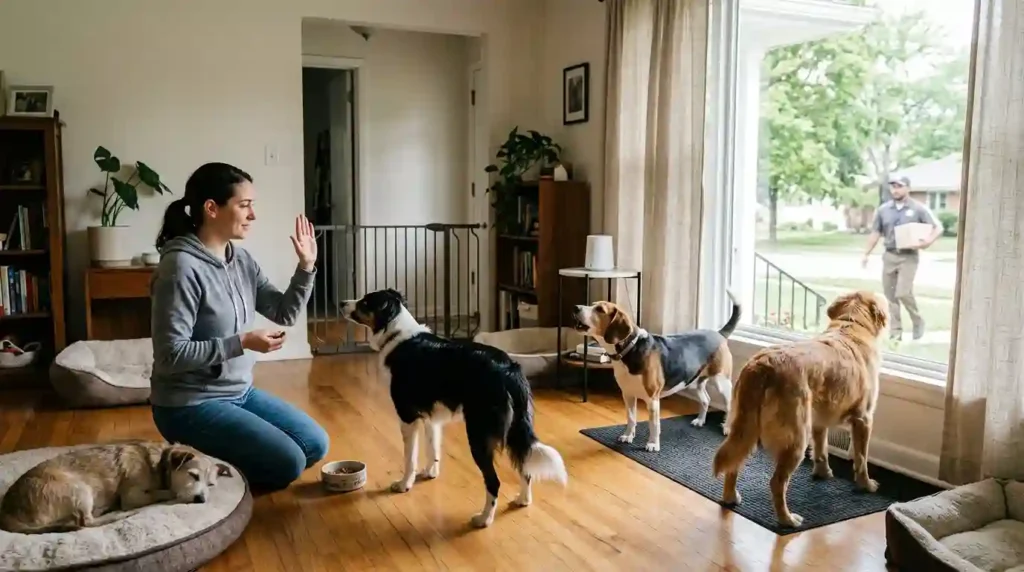
A single dog barking at the window is manageable. Three or four dogs barking, running, and pushing past one another can turn a minor event into complete chaos.
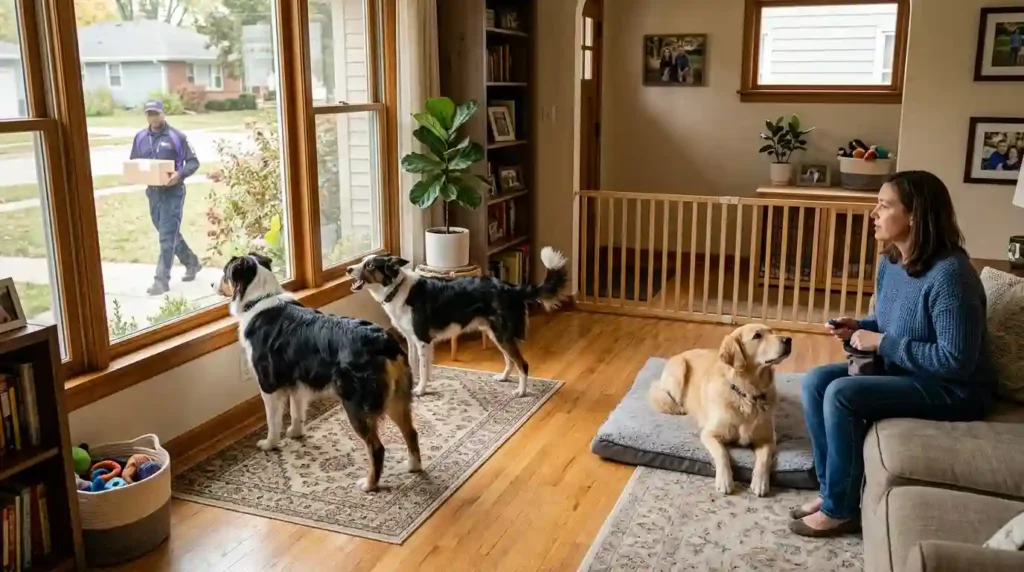
Dogs are social animals. They pay close attention to the behavior and emotional state of the other dogs around them. If one dog suddenly runs toward the door and begins alarm barking, the others may join before they even know what caused the reaction.
This is commonly called contagious barking. In behavioral terms, it is a form of social facilitation—one dog’s behavior makes the same behavior more likely in another dog.
The first dog may have heard a delivery driver. The second might bark because the first dog is excited. A third may join because running and barking have become part of an established group routine.
Over time, this creates a behavior chain:
- An outside stimulus appears.
- One dog notices it.
- That dog barks or runs toward it.
- The other dogs follow.
- The group rushes the window, door, or fence.
- The stimulus eventually disappears.
- The dogs believe their behavior made it leave.
Every repetition strengthens the pattern. The dogs are effectively practicing group barking, even when the owner never intentionally rewards it.
Barking Is a Form of Canine Communication
Barking is normal canine communication, not automatically a sign of disobedience. Dogs use vocalization to express excitement, uncertainty, frustration, fear, anxiety, and many other emotions.
The goal should not be to eliminate every bark. Instead, owners should teach dogs when barking is unnecessary and what they should do instead.
A dog that gives one or two alert barks and then responds to a recall cue is very different from dogs that bark continuously for 20 minutes. The second situation may qualify as excessive barking or nuisance barking and requires a structured plan.
Common Causes of Barking in Multi-Dog Homes
Group barking can have several causes. Different dogs in the same home may even be barking for different reasons during the same incident.
Territorial and Alarm Barking
Territorial behavior is one of the most common causes of household barking. Dogs may react when visitors, passersby, delivery workers, other dogs, or moving vehicles approach what they consider their territory.
Alarm barking can occur even when the dog is not strongly territorial. A surprising sound, doorbell, closing car door, or animal in the yard may be enough to cause a reaction.
The first dog raises the alarm, and the rest join in.
Excitement and Play Barking
Excitement barking often occurs before:
- Walks
- Car rides
- Meals
- Outdoor play
- Visitors entering
- A favorite person arriving home
Play barking may happen while dogs chase, wrestle, or compete for a toy. This is not always a problem, but owners should watch the dogs’ body language.
Loose movements, curved bodies, play bows, and frequent pauses generally indicate healthy play. Stiff posture, hard staring, raised lips, persistent mounting, growling, or one dog repeatedly trying to escape may indicate rising tension.
Attention-Seeking and Demand Barking
Dogs quickly learn which behaviors produce results. A dog may use demand barking to request food, play, access to the yard, or human attention.
If barking causes the owner to serve dinner, open a door, throw a toy, or speak to the dog, barking has been reinforced. Other dogs may observe this and adopt the same strategy.
Even negative attention can become barking reinforcement. Shouting a dog’s name still gives the dog a response.
Fear, Anxiety, and Frustration
Fearful barking often sounds sharp or defensive and may be accompanied by:
- Retreating
- Hiding
- Trembling
- Pacing
- Tucked tail
- Flattened ears
- Raised hackles
- Refusing food
An anxious dog may have a low barking threshold, meaning it reacts to soft sounds or movements that calmer dogs can ignore. When several dogs share the environment, the anxious dog’s reaction can increase everyone’s arousal.
Frustration may develop when dogs can see something but cannot approach it. Fence running and barking at neighboring dogs are common examples. Leash reactivity can involve a similar emotional pattern. For a focused explanation, read this guide to Dog Barking at Other Dogs on Leash.
Separation Anxiety and Dog Dependency
Separation anxiety can cause persistent barking, howling, pacing, destruction, or escape attempts when a dog is left alone. Some dogs are comfortable when another dog is present, but become distressed during controlled separation.
This may indicate dog dependency rather than simple boredom. A dependent dog has not learned to feel secure without its companion.
Distress vocalization should not be punished. The dog is not being stubborn; it is struggling emotionally. According to the ASPCA, separation-related barking is often persistent and occurs when the dog is separated from its guardian. Its guidance on separation anxiety can help owners recognize other warning signs.
Wildlife, Vehicles, and Outdoor Noise
Birds, squirrels, cats, motorcycles, trucks, and nearby construction can all cause group barking. Fast, loud vehicles can be especially difficult for noise-sensitive dogs. If motorcycles are a regular trigger, see why dogs Dog Bark at Motorcycles and how gradual training can reduce the reaction.
Dogs left outside unsupervised often develop fence running and repetitive barking because nobody interrupts the behavior early. Supervised yard time makes it easier to redirect dogs before they cross their reaction threshold.
Resource Guarding and Competition
Resource guarding can involve food, toys, beds, doors, people, or resting spaces. One dog may bark or growl to make another move away.
Competitive feeding routines can also increase arousal. Dogs may bark while meals are being prepared because they fear another dog will receive food first.
Feed the dogs in separate areas if there is tension. A gated room, crate, or closed door can provide physical safety and reduce competition. Do not force dogs to eat close together in an attempt to make them “get used to it.”
How to Identify Which Dog Starts the Barking
Before trying to stop group barking, determine what happens immediately before it begins.
Keep a Barking Record
For at least one week, record:
- Time of the incident
- Location of each dog
- First dog to react
- Likely barking trigger
- Duration of the barking
- Each dog’s body language
- What ended the episode
- How the owner responded
A home camera can reveal patterns that are difficult to notice during a noisy incident. You may discover that one dog consistently notices passersby first or that barking begins only when dogs are left in a particular room.
Look Beyond the Loudest Dog
The loudest dog is not always the instigator. A quiet dog may freeze, stare through a window, and become tense several seconds before another dog starts barking.
Watch for subtle signals such as:
- Closed mouth
- Forward weight shift
- Fixed stare
- Ears suddenly raised
- Tail becoming stiff
- Fast scanning of the environment
- Moving toward a window or fence
Interrupting at this early stage is more effective than waiting until every dog is overexcited.
Evaluate Every Dog Separately
Individual temperament matters. One dog may bark from fear, another from excitement, and a third from learned behavior.
Also consider age, hearing, vision, physical health, pain, sleep quality, previous fearful experiences, and the dog’s ability to recover after stress. A sudden increase in vocalization can be related to discomfort, sensory changes, or cognitive decline and should be discussed with a veterinarian.
How to Stop Dog Barking in Multi-Dog Households
The most effective approach combines management, individual training, and carefully controlled group practice.
Step 1: Prevent Repeated Barking Rehearsals
Every uncontrolled barking episode makes the behavior easier to repeat. Environmental management prevents dogs from practicing the unwanted response while training is underway.
Useful changes include:
- Closing curtains or blinds
- Applying frosted film to low windows
- Installing a solid visual barrier near a fence
- Moving furniture away from lookout points
- Using a fan or white-noise machine for noise masking
- Keeping dogs away from the front entry during deliveries
- Providing supervised yard time
- Bringing dogs inside during busy neighborhood periods
Management is not a failure or substitute for training. It lowers arousal so dogs remain capable of learning.
Step 2: Find Each Dog’s Barking Threshold
A barking threshold is the point at which a dog becomes too aroused to respond calmly. Below threshold, the dog notices a trigger but can still eat, think, and follow a familiar cue.
Above threshold, the dog may bark, lunge, ignore food, or fixate on the trigger.
Use distance management to keep each dog below the threshold. If a dog barks when another dog passes 15 feet from the window, begin gradual exposure from farther away or behind a visual barrier.
Trigger avoidance may be necessary during the first stage of training. Avoidance does not need to be permanent; it prevents setbacks while foundational skills are developed.
Step 3: Train Every Dog Individually
Individual training is essential in a multi-dog household. A dog cannot learn effectively while watching another dog bark and run around.
Use one-on-one training to teach:
- Name response
- Recall cue
- Quiet cue
- Mat or place cue
- Eye contact
- Hand target
- “Find it” treat search
- Calm behavior around mild distractions
Place the other dogs in safe spaces with puzzle toys or enrichment activities. Crate training can be useful if the dogs already view their crates positively. A crate must never be used as punishment.
Short training sessions of three to five minutes are often more effective than long sessions. End while the dog is still interested and successful.
Step 4: Reward Quiet Behavior Before Barking Begins
Many owners only interact with their dogs when something goes wrong. Instead, notice and reward the behavior you want.
If a dog sees a passerby and remains quiet, immediately use a marker signal such as “Yes” or a clicker, then deliver a high-value treat.
Reward timing matters. If the treat arrives after the dog begins barking, the association may be unclear. Mark the moment the dog notices the trigger but chooses not to react.
You can also reward dogs for:
- Resting calmly
- Looking away from a window
- Responding to their names
- Coming away from the fence
- Remaining on a mat
- Waiting quietly while meals are prepared
Calm praise should match the desired emotional state. Loud, excited praise may raise arousal again.
Step 5: Use a Positive Interrupt
A positive interrupt is a cheerful sound or cue that causes dogs to turn away from a trigger and check in with the owner.
You may use:
- A special word
- A kissy sound
- A whistle cue
- “This way!”
- “Find it!”
Teach the sound before using it during barking. Make the sound in a quiet room, then immediately reward the dog for looking toward you. Repeat until the dog responds automatically.
A positive interrupt should not frighten the dogs. Its purpose is to redirect attention, not suppress behavior through fear.
Step 6: Add Dogs Back Gradually
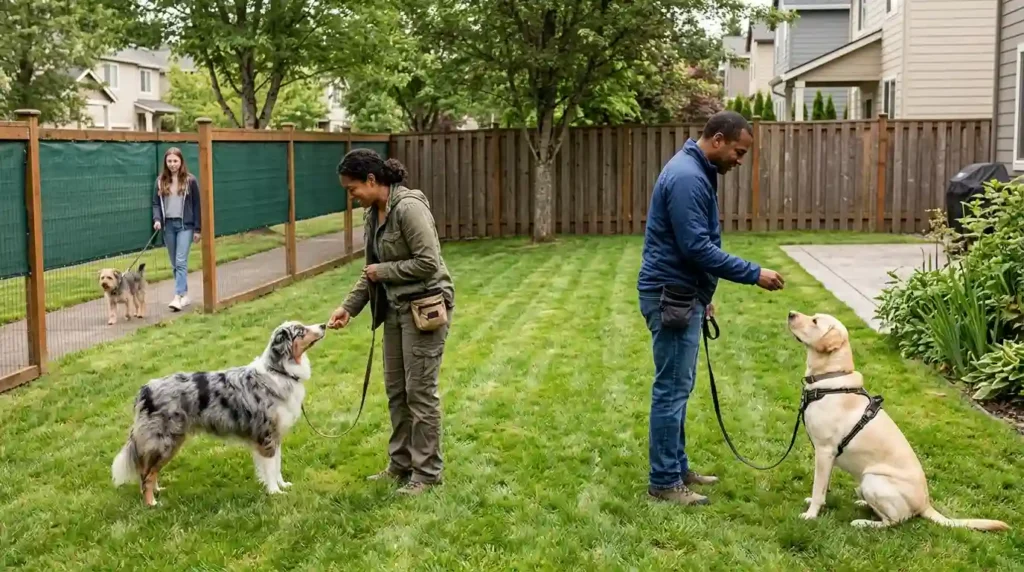
Once each dog can respond alone, practice with the two calmest dogs together. Use separate handlers if possible.
Begin with an easy version of the trigger and maintain enough distance to prevent barking. Reward both dogs for noticing the stimulus and returning their attention to their handlers.
Add the next dog only after the pair can remain calm consistently. If barking returns, reduce the difficulty. Increase distance, lower the trigger’s intensity, or return to individual work.
This gradual process is a combination of desensitization and counterconditioning:
- Desensitization introduces the trigger at a level the dog can handle.
- Counterconditioning changes the conditioned emotional response by pairing the trigger with something positive.
Teaching a Reliable Quiet Cue
A quiet cue works best when it is taught as a skill rather than shouted during a crisis.
Begin With One Dog
Choose a mild barking trigger, such as a soft knock. Allow one or two barks, then place a high-value treat near the dog’s nose.
The moment the dog stops barking to sniff:
- Say “Quiet” in a calm verbal cue.
- Mark the silence with “Yes” or a click.
- Give the treat.
- Continue rewarding several seconds of quiet behavior.
Gradually increase the length of silence from one second to three, five, and ten seconds.
Do not repeat “quiet” continuously. Say it once, then help the dog succeed by increasing the distance or reducing the trigger.
Consider Teaching a Speak Cue
Teaching a speak cue can help some dogs understand the difference between vocalization and silence. Ask for a bark, mark it, and then transition to the quiet cue.
This method is not ideal for every dog. Avoid deliberately encouraging barking in dogs that become overexcited easily or struggle to settle afterward.
Add an Alternate Behavior
Silence alone does not tell the dog what to do. An alternate behavior gives the dog a clear task.
After saying “Quiet,” ask the dog to:
- Go to a mat
- Touch your hand
- Sit behind a gate
- Find treats scattered on the floor
- Retrieve a toy
- Follow a recall cue away from the window
This uses operant conditioning: calm, useful behaviors produce rewards, while barking no longer produces access to the trigger or the desired human response.
Managing Common Barking Triggers
The Doorbell and Visitors
The doorbell can cause intense alarm barking because it predicts someone entering the home.
Practice when no real visitor is expected:
- Keep the volume low or use a recorded doorbell.
- Sound it once.
- Immediately scatter treats away from the door.
- Cue each dog to go to a designated mat or gated room.
- Reward quiet waiting.
- Increase the volume gradually over several sessions.
During real visits, use controlled separation. Secure the dogs before opening the door. Once the visitor is settled, introduce calm dogs individually if it is safe.
Passersby and Other Dogs
Block uncontrolled window access and reward dogs for calmly noticing movement outside. If possible, practice with a helper walking past at a comfortable distance.
Do not wait for explosive barking before offering food. The ideal sequence is:
Dog sees trigger → owner marks calm response → dog receives reward.
This helps create a new emotional and behavioral pattern.
Feeding-Time Barking
Prepare meals out of sight if food preparation itself starts the barking. Ask each dog to wait in a separate feeding location.
Set the bowl down only during a brief moment of quiet. If barking begins, pause without scolding. Resume when the dog settles.
Keep the feeding routine predictable. Dogs often become less frantic when they understand exactly where to wait and what behavior makes dinner appear.
Yard and Fence Barking
Use yard rotation when specific dogs increase one another’s reactions. One dog can have outdoor time while the others enjoy indoor enrichment.
A solid fence or visual barrier can reduce reactions to wildlife and neighboring dogs. Recall dogs before they begin fence running, then reward them generously for returning.
Do not leave dogs outdoors to “bark it out.” Repetitive fence behavior may increase frustration and can contribute to redirected aggression.
Barking When Home Alone
Record the dogs after leaving to determine whether the behavior is brief alert barking, boredom, dog dependency, or separation anxiety.
Provide appropriate exercise and mental stimulation before departures, but do not assume that exhaustion will cure emotional distress. Puzzle toys and food enrichment can help with mild boredom, while true separation anxiety usually requires a customized behavior modification program.
Exercise, Enrichment, and Confidence Building
Dogs with unmet physical and mental needs often react more strongly to everyday events. However, exercise alone does not teach quiet behavior.
Create a balanced routine that includes:
- Sniffing walks
- Age-appropriate physical exercise
- Food puzzles
- Scent games
- Chewing opportunities
- Individual attention
- Short training sessions
- Calm rest periods
- Confidence-building activities
One-on-one walks are especially valuable. They reduce group arousal and allow each dog to explore without depending on the others.
Confidence-building can help fearful dogs make better choices. Simple activities such as stepping onto different surfaces, searching for hidden treats, or learning easy tricks give the dog safe opportunities to solve problems.
Avoid highly stimulating exercise immediately before known triggers if it makes the dogs more excitable. Some dogs need a quiet decompression period after active play.

Barking, Conflict, and Redirected Aggression
Group arousal can become dangerous. Dogs crowded around a window, gate, or door may accidentally bump or block one another. A highly aroused dog may redirect its frustration toward the nearest dog.
Warning signs include:
- Stiff body posture
- Hard staring
- Deep growling
- Repeated lunging
- Snapping
- Pinning another dog
- Blocking access to doors or people
- Biting during or immediately after barking
Do not place your hands between fighting dogs or grab their collars during a conflict. Bites can be redirected toward people.
Use gates, doors, leashes, and dog rotation to prevent dangerous gatherings around known triggers. Seek professional help after any fight, bite, or repeated threat. Safety management should begin immediately rather than waiting to see whether the dogs resolve the problem themselves.
A head halter may help with physical control in some training plans, but it must be introduced gradually and used correctly. It does not change the dog’s underlying emotion and should not be used to jerk or force the head.
Common Mistakes That Make Barking Worse
Shouting Over the Dogs
Yelling may sound like additional barking to excited dogs. It also adds tension and rarely teaches an alternate behavior.
Use a trained cue, guide dogs away, and reward recovery.
Punishing Fear or Anxiety
Punishment may temporarily stop vocalization without changing the fear beneath it. The dog can become quieter while feeling more threatened, increasing the risk of sudden snapping or biting.
Avoid hitting, leash corrections, intimidation, or devices designed to cause pain or fear. Bark deterrent devices may also affect every dog nearby, including dogs that were quiet. A sound-based deterrent can potentially contribute to fear or hearing-related distress, especially in sensitive animals.
Reward-based training is the safer foundation. The ASPCA also recommends identifying the function of barking and using methods suited to its cause in its authoritative guide to common barking behavior.
Training the Whole Group Too Soon
Dogs that cannot respond individually will rarely succeed in an excited group. Build strong skills one dog at a time before combining them.
Rewarding Barking Accidentally
Opening the yard door while dogs bark, throwing a toy to stop demand barking, or serving food during vocal protests may reinforce the behavior chain.
Wait for a realistic moment of quiet, mark it, and then provide the desired outcome.
Ignoring Physical or Mental Health
Pain, hearing loss, cognitive changes, gastrointestinal discomfort, and other health conditions can alter barking behavior. Anxiety also affects mental health and deserves proper care.
Arrange a veterinary examination if barking begins suddenly, worsens without an obvious cause, occurs mostly at night, or is accompanied by physical or behavioral changes.
What Is the Three-Bark Rule?
The “three-bark rule” is an informal household training guideline, not a scientific or legal standard. It generally allows a dog to give up to three alert barks before the owner asks for quiet behavior or redirects the dog.
The idea is practical: dogs are permitted to communicate that something has changed, but they are not allowed to continue barking indefinitely.
In a multi-dog household, three barks from every dog can still become extremely loud. A more useful version is:
- Acknowledge the first dog’s alert.
- Give a calm, quiet, or recall cue.
- Move all dogs away from the trigger.
- Reward them for settling.
The rule only works if the dogs already understand the requested behavior. Repeating “quiet” after three barks will not help dogs that have never been taught what the word means.
What Is Classed as Unreasonable Dog Barking?
There is no universal duration that makes barking unreasonable everywhere. Local nuisance laws, housing agreements, and neighborhood standards differ.
In practical terms, barking may be considered unreasonable when it is:
- Frequent and prolonged
- Repeated early in the morning or late at night
- Easily heard inside neighboring properties
- Preventing others from sleeping or enjoying their homes
- Continuing after the owner has been informed
- Associated with dogs left outside without supervision
Keep a record of barking times and duration if neighbors express concern. Home recordings can also help establish what occurs when nobody is present.
Do not wait for a formal complaint. Early management protects neighborhood relationships and prevents the dogs from strengthening the habit.
When to Contact a Professional
Consult a veterinarian first when barking changes suddenly or may involve pain, illness, hearing problems, cognitive changes, or medication effects.
A certified dog trainer or qualified behavior consultant can help with routine excessive barking, household management, and cue training. Choose someone who uses positive reinforcement and can explain the purpose of each method clearly.
Seek a veterinary behaviorist or experienced clinical behavior professional when barking involves:
- Severe fear or anxiety
- Separation anxiety
- Resource guarding
- Redirected aggression
- Fighting between household dogs
- Lunging, snapping, or biting
- Inability to settle
- Self-injury
- Rapid behavioral deterioration
Professional support is especially important when the dogs cannot safely share space. Medication, synthetic pheromone products, or other supportive measures may sometimes be included in a veterinarian-led plan, but they should support training and management rather than replace them.
Conclusion
Dog barking in a multi-dog household is rarely caused by one “bad” dog. It usually develops through social facilitation, shared excitement, environmental triggers, individual emotional needs, and repeated reinforcement.
Start by identifying the first trigger and evaluating each dog separately. Prevent uncontrolled rehearsal with visual barriers, noise masking, supervised yard time, gated rooms, and controlled separation. Then use individual training, positive reinforcement, counterconditioning, and gradual exposure to teach every dog a calmer response.
Progress may be gradual because every dog affects the group. Consistent management and well-timed rewards can turn a chaotic barking routine into a manageable alert followed by quiet behavior.
Frequently Asked Questions
What is the three-bark rule?
It allows a dog a few alert barks before the owner calmly redirects it and rewards quiet behavior. It is a training guideline, not an official law.
How do I stop my dog barking at other dogs in the house?
Separate the dogs, identify the trigger, and train them individually below their reaction threshold. Seek professional help if barking includes guarding, lunging, or aggression.
What is classed as unreasonable dog barking?
Barking may be unreasonable when it is frequent, prolonged, disruptive, or occurs repeatedly during sleeping hours. The exact legal definition depends on local regulations.
Why does one barking dog make all my dogs bark?
Dogs copy one another through social facilitation. One dog’s alarm, excitement, or movement raises the entire group’s arousal.
Should I let my dogs bark it out?
No. Repeated barking rehearses and strengthens the behavior. Calmly interrupt it, manage the trigger, and teach an alternate response.
How long does it take to reduce group barking?
Mild cases may improve within several weeks. Long-standing fear, anxiety, fence barking, or aggression may require months of consistent management and training.
Should I train all my dogs together?
Begin individually. Combine two calm dogs only after each dog can reliably follow cues around mild distractions.
Do anti-bark collars work in homes with several dogs?
They may punish the wrong dog and can increase fear or tension. Trigger management and reward-based behavior modification are safer, more informative approaches.
Can exercise stop excessive barking?
Exercise can reduce unused energy, but it will not resolve fear, territorial behavior, or learned barking by itself. Combine it with enrichment and training.
When should I call a dog behavior professional?
Get help when barking involves panic, resource guarding, fights, snapping, biting, or severe separation distress—or when consistent training is not improving the problem.