
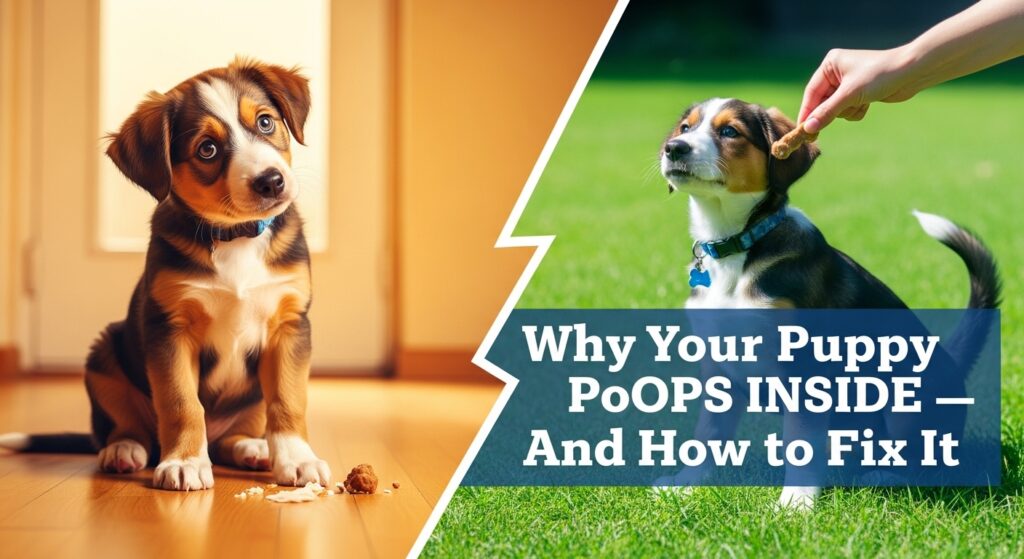

Summary: If your puppy refuses to poop outside but consistently goes indoors, you’re dealing with one of the most common and frustrating house-training challenges new dog owners face. This behavior stems from a mix of environmental conditioning, fear, incomplete reinforcement, and a puppy’s natural instinct to eliminate in familiar, safe spaces. The good news is that with consistent schedules, positive reinforcement, scent-based cues, and a few targeted behavioral interventions, you can fully reverse this pattern. This guide covers every angle — from root causes and step-by-step retraining techniques to common mistakes and breed-specific considerations — so you can successfully transition your puppy to reliable outdoor elimination.
Outline
- Why Your Puppy Poops Inside but Not Outside
- Understanding Puppy Elimination Behavior (The Science)
- Step-by-Step Fix: Retraining Your Puppy to Poop Outside
- How to Stop Your Puppy From Pooping Inside
- Common Mistakes That Make This Problem Worse
- Special Scenarios and Troubleshooting
- When to See a Vet
- Long-Term House Training Success Tips
- Frequently Asked Questions
Why Your Puppy Poops Inside but Not Outside
This is arguably the most searched variation of puppy house-training problems, and it makes sense — it feels backwards. Your puppy can clearly hold it long enough to come inside, yet they won’t go in the yard. Understanding the “why” is the first step toward any lasting fix.
Environmental Conditioning and Surface Preference
Puppies are powerfully conditioned by their early experiences. If your dog spent its first weeks in a breeder’s facility, a shelter run, or a pet store pen with puppy pads or newspaper, they have already imprinted on an indoor surface as the correct place to eliminate. This is called substrate preference in animal behavior science — the learned association between a specific texture or surface and the act of elimination.
Carpet, tile, hardwood floors, and absorbent pads feel familiar and “correct” to a puppy who has always gone there. Grass, gravel, concrete, or soil can feel strange, unsteady, or even alarming under their paws. This isn’t stubbornness — it’s deeply ingrained conditioned learning.
Fear, Anxiety, and Outdoor Overstimulation
The outdoors is full of novel stimuli: wind, traffic noise, birds, unfamiliar smells, and other animals. For a puppy still in their critical socialization window (roughly 3–14 weeks), this sensory overload can be enough to suppress the urge to defecate entirely. The puppy holds it because their sympathetic nervous system (fight-or-flight) is activated. The moment they return to the safe, calm indoors, their parasympathetic system kicks back in — and out comes the poop.
This phenomenon is particularly common in:
- Anxious or shy breeds (Chihuahuas, Shih Tzus, Maltese)
- Rescue puppies with unknown early histories
- Puppies who were under-socialized before 12 weeks
Inconsistent Reinforcement History
Another key LSI-related factor is incomplete positive reinforcement. If your puppy has occasionally pooped outside but was never consistently rewarded at the exact right moment, they haven’t made the association between outdoor elimination and good things happening. Meanwhile, indoors, going on the floor still results in a full belly and a warm nap — there’s no negative consequence from the puppy’s perspective.
Medical Reasons to Rule Out First
Before diving into behavioral retraining, rule out physical causes. Conditions like intestinal parasites (worms), Giardia, colitis, or food sensitivities can cause urgency that makes it impossible for a puppy to hold their bowels long enough to get outside. If your puppy also has loose stools, blood in stool, straining, or unusual frequency, visit your vet before starting any training protocol.
Understanding Puppy Elimination Behavior (The Science)
How Puppies Learn Where to Go
Puppies learn elimination locations through a combination of operant conditioning (consequences shaping behavior) and classical conditioning (association between stimuli and biological responses). The location where they’ve successfully gone before produces a conditioned cue — they return there because it “feels right” neurologically.
The Role of Scent Memory in Elimination
Dogs have an olfactory system roughly 10,000–100,000 times more powerful than humans. When a puppy smells their own previous elimination scent, it triggers an instinctive urge to eliminate again in the same spot. This is why accidents in the same indoor location keep recurring — and why using scent strategically outdoors can accelerate training dramatically.
Substrate Preference in Young Dogs
Research in applied animal behavior confirms that substrate preference develops early and can be remarkably resistant to change without deliberate counter-conditioning. A puppy who prefers soft surfaces (carpet, pads) may avoid grass for weeks without consistent positive reinforcement. This is also why picky eating behaviors in dogs — like refusing kibble but eating treats — follow a similar behavioral logic: comfort and prior conditioning shape what feels “right” to your dog.
Step-by-Step Fix: Retraining Your Puppy to Poop Outside
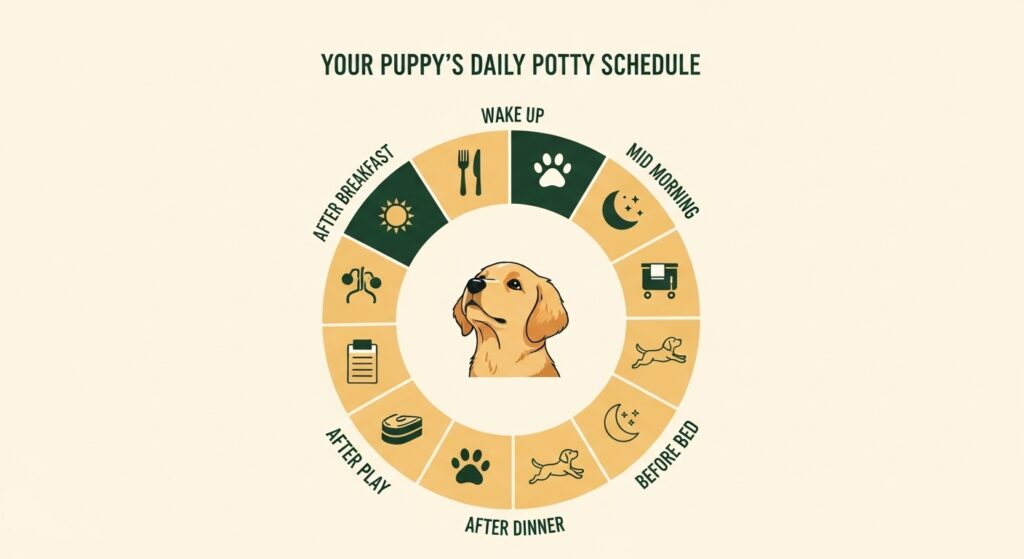
Step 1 — Establish a Strict Bathroom Schedule
Predictability is your greatest tool. Puppies typically need to eliminate:
- Within 15–30 minutes after eating
- Immediately after waking up (morning and naps)
- After play sessions
- Before bed
Create a fixed schedule and take your puppy out at every single one of these windows, every day, without exception. Consistency builds biological rhythm — over days and weeks, your puppy’s bowels will begin to naturally sync with the outdoor schedule.
How often? Young puppies (8–12 weeks) may need 8–10 outdoor trips per day. By 4–6 months, most puppies can manage 4–6 trips.
Step 2 — Choose a Designated Outdoor Elimination Spot
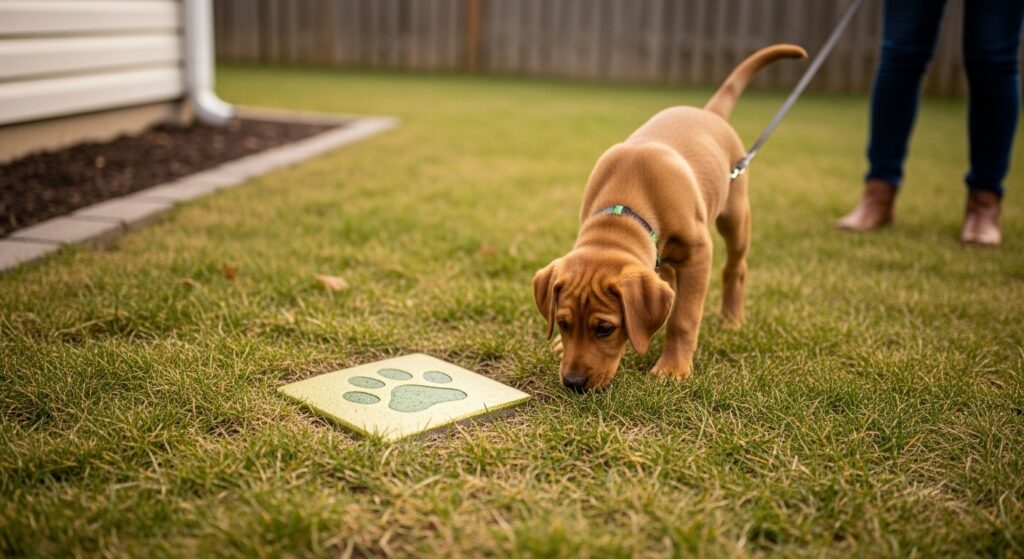
Pick one specific area in your yard or outdoor space and always take your puppy there first. The same spot accumulates scent over time, and that scent becomes a powerful environmental trigger. Don’t let the puppy wander freely — walk them directly to the spot on a leash.
If you don’t have a yard, carry a small amount of used puppy pad material or a soil-filled tray to a consistent spot outdoors to seed the scent.
Step 3 — Use Scent Cues and Command Words
Introduce a consistent verbal cue the moment your puppy begins to sniff and circle — behaviors that signal imminent elimination. Commands like “go potty,” “do your business,” or “hurry up” become conditioned cues over time through repetition.
You can also use a scent-based primer: bring a piece of paper towel or cotton ball that has absorbed your puppy’s indoor stool scent and place it in the outdoor spot. The familiar smell often triggers the elimination response outdoors.
Step 4 — The Leash-Control Method
Do not allow free outdoor play until after your puppy has eliminated. Keep them on a 4–6 foot leash at the designated spot. Stand still. Ignore the puppy (don’t talk, make eye contact, or interact). Give them 10–15 minutes.
This removes the distraction variable. If you’ve been letting your puppy run around and play outside, they’re focused on exploration — not elimination. The leash-controlled, boring outdoor experience signals “this is potty time, not play time.”
Step 5 — Reward Timing Is Everything
This is where most owners go wrong. The reward must come within 2–3 seconds of the puppy finishing their poop — not after you’ve walked back inside. Keep high-value treats (small pieces of chicken, freeze-dried liver, or their favorite reward) in your pocket every single time you go out.
The moment they finish, immediately say “yes!” (or click if you use a clicker), then deliver the treat. Follow up with enthusiastic praise. Make it a celebration. This precise timing creates the critical associative link between outdoor defecation and rewards.
Step 6 — Manage Indoor Access and Supervision
Until your puppy is reliably going outside, limit their indoor freedom. Use baby gates, exercise pens, and tethering techniques to keep them in view at all times. A puppy you can’t see is a puppy who will find an unsupervised corner to use as a bathroom.
When you can’t directly supervise, use a properly sized crate. Puppies naturally avoid soiling their sleeping space — crate training leverages this instinct to build bladder and bowel control.
How to Stop Your Puppy From Pooping Inside
Interrupt, Don’t Punish
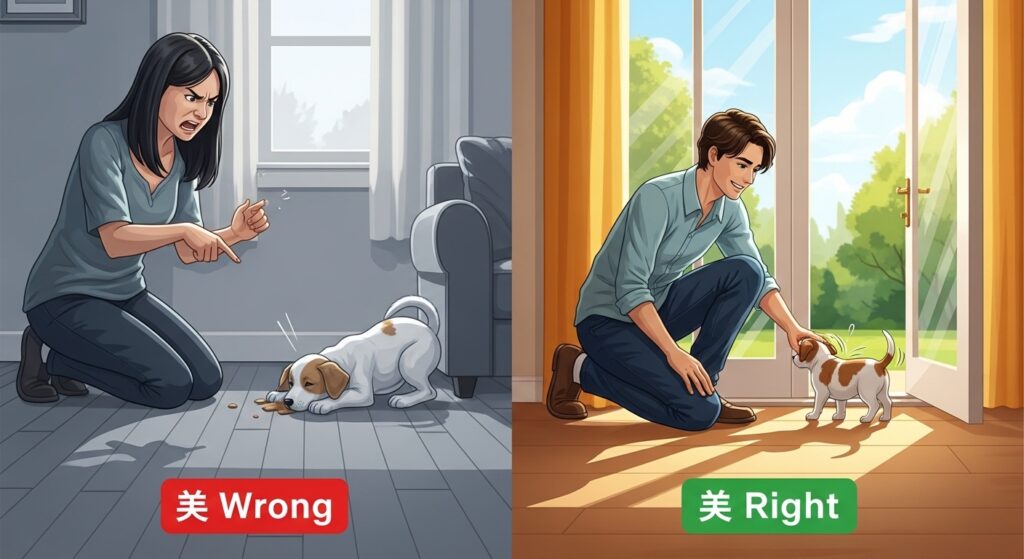
If you catch your puppy in the act indoors, interrupt calmly with a sharp “ah-ah!” or hand clap — enough to pause them — then immediately carry or guide them to the outdoor elimination spot. If they finish outside, reward enthusiastically.
Never punish after the fact. If you find a poop and your puppy isn’t actively eliminating, punishment is completely ineffective and harmful. Dogs cannot connect a correction to an event that happened minutes or hours ago. Punishment after the fact only teaches your puppy to fear you near feces — it doesn’t teach them where to go.
Enzymatic Cleaners and Scent Elimination
Standard household cleaners do not break down the organic compounds in dog waste. Even if you can’t smell it, your puppy absolutely can — and that residual scent pulls them back to the same spot. Use an enzymatic cleaner specifically formulated for pet waste (look for products containing live enzyme cultures or bacterial agents). Spray generously, let sit for the recommended time, and blot dry. Repeat as necessary.
Crate Training as a House-Training Tool
A properly sized crate (large enough for the puppy to stand, turn around, and lie down — no bigger) is not cruel; it’s one of the most effective house-training tools available. Puppies instinctively avoid soiling where they sleep. Use the crate during overnight hours and any time you cannot directly supervise.
The crate-to-outdoor pipeline: crate → leash on → directly outside to elimination spot → reward → then freedom indoors. Every single time.
For a deeper dive into behavioral consistency tools, the American Kennel Club’s official house training guide offers breed-specific timing recommendations and crate sizing charts that align with the protocol above.
Common Mistakes That Make This Problem Worse
Going Back Inside Too Soon
This is the #1 mistake. Owners take the puppy out for 5 minutes, nothing happens, and they go back in — where the puppy promptly poops. The puppy learns that waiting means they get to go inside. Instead, extend outdoor time to 15–20 minutes per session during retraining. Boring, still, leash-only time.
Punishing After the Fact
Already addressed above, but worth repeating: delayed punishment creates fearful, confused dogs — not trained ones. Studies in veterinary behavioral science consistently show that punishment-based methods for house training are associated with longer training times, increased anxiety, and higher rates of submissive urination.
Inconsistent Schedule and Multiple Handlers
If one family member follows the schedule strictly and another lets the puppy roam freely, training stalls. Everyone in the household must follow the same protocol. Post the schedule on the refrigerator. Make it non-negotiable for every person who interacts with the puppy.
Special Scenarios and Troubleshooting
Puppy Poops Right After Coming Back Inside
This is the clearest sign of outdoor anxiety or distraction suppressing elimination. The fix: extend outdoor time, reduce stimulation (quieter area, less foot traffic), and ensure the leash-only, no-play rule during elimination sessions.
Some trainers recommend a “sniffy walk” protocol — 10 minutes of free sniffing on leash before going to the elimination spot. This reduces arousal and allows the parasympathetic nervous system to take over, making elimination more likely.
Puppy Only Poops at Night Indoors
Nighttime indoor accidents typically relate to two issues: an elimination window that’s too long overnight, or a puppy who is too settled and comfortable to signal. Solutions include a late-night elimination trip (10–11 PM), an early morning trip (6–7 AM), and limiting water intake 2 hours before bed.
Puppy Refuses to Poop in Rain or Cold
Surface discomfort is a real deterrent. A puppy who finds wet grass or cold pavement aversive will avoid elimination there. Solutions: create a sheltered elimination area (under a roof overhang, or use a small covered pen), use a rain jacket for cold/wet-sensitive breeds, and increase treat value dramatically in bad weather. Make it worth it.
Small Breeds and Toy Dogs
Chihuahuas, Pomeranians, Yorkshire Terriers, and other toy breeds are statistically harder to house train, partly due to a higher metabolism (more frequent elimination needs) and partly due to owner behavior — small dogs are often carried rather than walked out, or allowed indoor pad use longer than larger breeds. The same protocol applies, but with more frequent outdoor trips and extra patience.
For a broader resource on small breed behavioral quirks, the ASPCA’s comprehensive behavioral resource library covers house soiling with specific notes on small breed considerations.
When to See a Vet
Contact your veterinarian if:
- Your puppy is straining to defecate outdoors or indoors
- Stool is consistently loose, bloody, or mucous-streaked
- Your puppy seems in pain when eliminating
- There’s been no improvement after 4–6 weeks of consistent training
- Your puppy is losing weight or showing signs of lethargy
Parasites (roundworms, hookworms, Giardia) are common in puppies and cause bowel urgency that makes behavioral training nearly impossible. A fecal test is inexpensive and should be part of every puppy’s early veterinary routine.
Long-Term House Training Success Tips
- Track progress: Keep a simple log of when your puppy poops and where. Patterns reveal windows you might be missing.
- Gradually increase freedom: As your puppy succeeds, slowly extend indoor unsupervised time — 5 minutes, then 10, then 20. Don’t rush this phase.
- Transition away from pads gradually: If you’ve been using indoor pads, move them progressively closer to the door, then outside, then eliminate them entirely. Abrupt removal often causes relapse.
- Celebrate loudly: Dogs are highly responsive to their owner’s energy. Your enthusiasm at the right moment is one of the most powerful reinforcers you have.
- Expect setbacks: Regression is normal, especially during developmental fear periods (8–11 weeks and 6–14 months). Maintain the routine and don’t overreact to accidents.
Frequently Asked Questions
How long does it take to train a puppy to poop outside? Most puppies show significant improvement within 2–4 weeks of consistent retraining. Full reliability typically takes 4–6 months, with some individual variation by breed and prior conditioning history.
Should I use puppy pads during retraining? It depends. If your goal is outdoor-only elimination, pads can extend the learning timeline by maintaining the indoor substrate preference. If you must use pads due to your living situation, work on transitioning them gradually outdoors.
My puppy pees outside but won’t poop — why? Urination is a simpler reflex and occurs more frequently, making it easier to catch and reward outdoors. Defecation is less frequent and requires more specific environmental conditions for many puppies. The targeted spot, scent priming, and extended leash time are especially important for this issue.
Is it normal for a 10-week-old puppy not to poop outside? Yes, completely. At 10 weeks, puppies have very little bowel control and strong conditioning from their pre-adoption environment. Consistent, patient training from this age yields excellent results.
What are the best treats for outdoor training rewards? High-value, small, soft treats work best: tiny pieces of cooked chicken, freeze-dried meat, or commercial training treats. Save these exclusively for outdoor elimination — the rarity of the reward increases its motivational power.


Very Informative article