

Summary
If your dog refuses kibble but still eats treats, first rule out dental pain, nausea, or another medical problem—especially if the change was sudden. If your dog is otherwise healthy, offer measured meals at consistent times, remove uneaten food after 15–20 minutes, and stop replacing refused meals with treats. You can also soften kibble with warm water or add a small amount of nutritionally complete wet dog food. Treats and toppers should provide no more than 10% of your dog’s daily calories. The article How to Feed a Picky Dog give indepth guide about your picky-eating dog.
Contact a Veterinarian First If:
- Your dog’s appetite changed suddenly
- Your dog refuses all food, not just kibble
- There is vomiting, diarrhea, lethargy, or weakness
- Your dog has abdominal pain or swelling
- Your dog is losing weight
- Eating appears painful, or food falls from the mouth
- There is excessive drooling or difficulty swallowing
- Your dog is a young puppy, a very small breed, or has a medical condition
A dog accepting treats does not prove that the dog is healthy. Highly appealing food may still be accepted when pain, nausea, or illness reduces the appetite for normal meals.
Table of Contents
- Understanding Why Dogs Refuse Kibble But Accept Treats
- Medical Reasons Your Dog Won’t Eat Kibble
- Behavioral and Psychological Causes
- How Treats Ruin a Dog’s Appetite for Kibble
- How to Get Your Dog to Eat Kibble Again
- Transitioning to a New Food
- When to See a Veterinarian
- Preventing Picky Eating in the Future
- Special Cases: Puppies, Senior Dogs, and Small Breeds
- Frequently Asked Questions
Understanding Why Dogs Refuse Kibble But Accept Treats
The Palatability Problem: Kibble vs. Treats
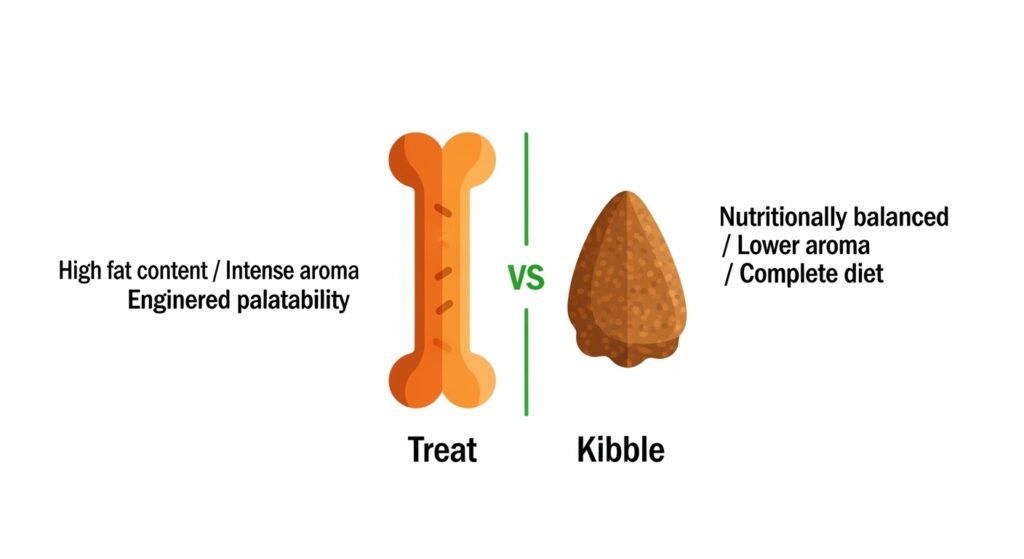
At the heart of this issue lies a concept called palatability — how appealing a food is to a dog’s senses of smell, taste, and texture. Commercially produced dog treats are specifically engineered to be hyper-palatable. They are manufactured with elevated fat content, intensified flavor compounds, real meat proteins, and aromatic additives that make them almost irresistible to a dog’s highly sensitive nose, which contains up to 300 million olfactory receptors.
Kibble, by contrast, is formulated primarily for nutritional completeness rather than sensory excitement. The extrusion process used to make dry dog food — where ingredients are cooked under extreme heat and pressure — can diminish the natural aroma and flavor of ingredients. The result is a food that smells significantly less stimulating than a soft, meaty treat.
This palatability gap is the number one reason dogs develop a preference for treats over their regular meals. From the dog’s perspective, refusing kibble in hopes of getting something better is a perfectly logical strategy — especially if it has worked before.
What “Picky Eating” Really Means in Dogs
The term “picky eater” applied to dogs is often misleading. True physiological pickiness in dogs is relatively rare. What looks like a picky eater is almost always one of three things:
- A dog that has learned it can hold out for better food
- A dog experiencing a medical issue affecting appetite
- A dog whose diet has been disrupted by inconsistent feeding practices
Understanding which category your dog falls into is the critical first step before attempting any intervention.
Medical Reasons Your Dog Won’t Eat Kibble
Dental Pain and Oral Health Issues
One of the most frequently overlooked causes of kibble refusal is dental disease. Dry dog food requires chewing, and if a dog has sore gums, a broken tooth, periodontal disease, or oral infections, the act of crunching kibble becomes painful. Soft treats, meanwhile, require little to no chewing — making them the path of least resistance.
Signs your dog’s food refusal may be dental in origin include:
- Dropping food from the mouth while eating
- Preferring to eat only on one side of the mouth
- Bad breath or visible tartar buildup
- Pawing at the face or mouth
Gastrointestinal Issues
Nausea, acid reflux, inflammatory bowel disease (IBD), and other gastrointestinal conditions can suppress appetite for regular meals, while a dog might still eat small, flavorful treats. This is because nausea lowers overall appetite, but the strong olfactory signal from a highly palatable treat can temporarily override nausea suppression.
Aging and Sensory Decline
Senior dogs commonly experience olfactory decline — a reduced ability to smell. Since smell is the primary driver of appetite in dogs, a diminished sense of smell can make kibble seem even less appealing. Simultaneously, aging can bring arthritis in the jaw, dental deterioration, and metabolic changes that affect appetite.
Food Allergies and Sensitivities
A dog may be associating its kibble with discomfort from a food allergy or intolerance. Common culprits include chicken, beef, wheat, corn, and soy — all of which appear in many mainstream kibble formulas. If the treats you offer happen to be free from these allergens, the dog may accept them while refusing the kibble that causes digestive upset.
Behavioral and Psychological Causes
Learned Food Refusal: The “Holding Out” Strategy
Dogs are masters of operant conditioning — they quickly learn which behaviors produce desirable outcomes. If your dog has ever refused its kibble and subsequently received treats, table scraps, or a different “better” food, it has learned that refusal is a rewarding strategy. This is not stubbornness or spite; it is simple, effective learning.
Behaviorally, this is called food-motivated selective eating or conditioned food refusal. Once established, this pattern can be remarkably persistent.
Anxiety, Stress, and Environmental Factors
Dogs are highly sensitive to environmental changes and emotional stress. Factors that can trigger appetite suppression for regular meals include:
- A new home, pet, or family member
- Changes in the owner’s schedule or absence
- Loud noises (construction, fireworks, thunderstorms)
- Conflict with other pets, especially around the food bowl
- A change in feeding location or routine
Interestingly, the distraction and excitement of receiving a treat from a person’s hand can override anxiety-related appetite suppression temporarily — explaining why a dog may take treats even when ignoring its bowl.
Boredom and Food Fatigue
Neophilia — the preference for new things — is observed in dogs’ food preferences. Dogs fed the same kibble for extended periods may simply experience food fatigue. This is more pronounced in some breeds and individual dogs than in others. The novelty of a treat activates dopamine-related reward pathways in the canine brain more strongly than a familiar food stimulus.
How Treats Ruin a Dog’s Appetite for Kibble
The Treat Threshold Effect
When a dog consumes high-calorie, high-fat treats throughout the day, it not only reduces caloric hunger at mealtime but also raises its internal palatability threshold — meaning ordinary kibble now seems even less appealing by comparison. This creates a self-reinforcing cycle:
- Dog refuses kibble → Owner offers treat → Dog eats treat
- Dog’s palatability threshold rises → Kibble seems worse → Dog refuses more strongly
- Owner gives more or better treats → Threshold rises further
Over time, this cycle produces a dog that genuinely will not eat kibble — not because it cannot, but because its reward expectations have been recalibrated upward.
Nutritional Imbalance from Over-Treating
Most dog treats are not nutritionally complete. They are designed as supplements, not staples. A dog receiving a significant portion of its calories from treats may be:
- Deficient in essential vitamins and minerals
- Receiving excess fat and sodium
- Missing the balanced omega-3 to omega-6 ratio present in quality kibble
- Lacking adequate dietary fiber for digestive health
According to veterinary nutritional guidelines, treats should constitute no more than 10% of a dog’s total daily caloric intake. Many owners dramatically exceed this threshold without realizing it.
How to Get Your Dog to Eat Kibble Again
Strategy 1: The Tough Love Approach (Food Deadline Method)
The most effective behavioral intervention for a healthy dog with no underlying medical issues is controlled meal presentation:
- Offer kibble for 15–20 minutes at scheduled mealtimes
- If the dog does not eat, remove the bowl without comment or reaction
- Offer no treats, table scraps, or alternative foods until the next scheduled mealtime
- Repeat consistently
Most healthy dogs will begin eating within 2–3 days. This method should only be used after ruling out medical causes with a visit to a veterinarian.
Strategy 2: Enhancing Kibble Palatability
You can bridge the palatability gap between kibble and treats using several evidence-based techniques:
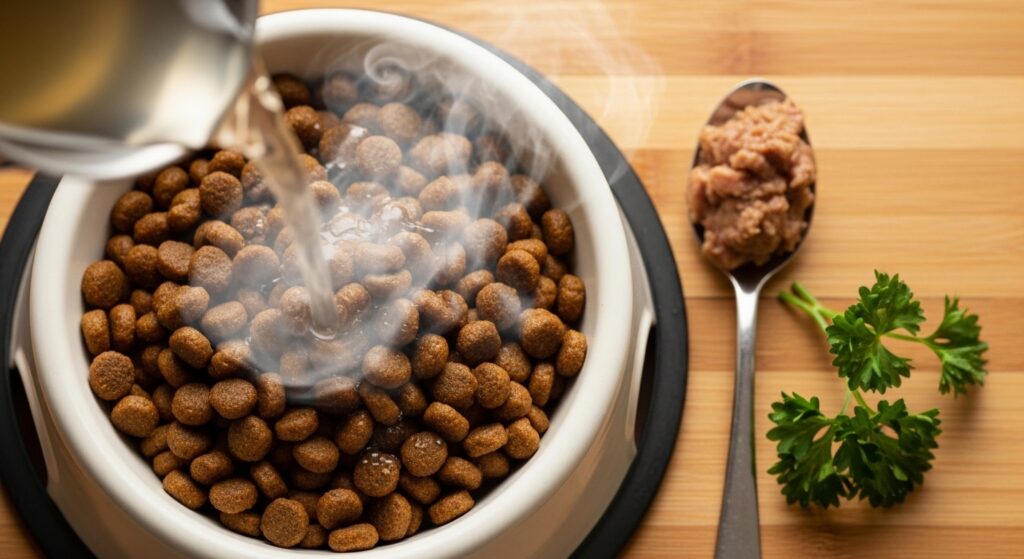
Warm the kibble: Adding a small amount of warm (not hot) water to dry kibble releases volatile aromatic compounds and softens the texture. This single intervention resolves kibble refusal in many dogs.
Top with low-sodium broth: A tablespoon of unsalted chicken or beef broth over kibble dramatically increases palatability without significantly disrupting nutritional balance.
Mix in a small amount of wet food: A spoonful of high-quality wet or canned dog food mixed through the kibble adds moisture, aroma, and flavor. Gradually reduce the wet food topper over 1–2 weeks as the dog re-accepts plain kibble.
Use kibble as treats: Feed your dog its daily kibble allowance by hand or use it as training reward treats. This removes the behavioral distinction between “exciting treat food” and “boring bowl food.”
Strategy 3: Adjusting the Feeding Environment
Sometimes food refusal is environmental rather than about the food itself:
- Move the food bowl away from high-traffic areas
- Feed dogs in multi-pet households separately to eliminate competition anxiety
- Use a slow-feeder bowl to add novelty and engagement
- Establish a consistent feeding schedule — twice daily at fixed times
- Eliminate free-feeding (leaving food out all day), which reduces appetite cues
Strategy 4: Food Rotation and Meal Variety
If food fatigue is the underlying issue, consider implementing protein rotation — switching between two or three nutritionally complete kibble formulas on a regular basis. This approach, supported by many canine nutritionists, maintains a dog’s interest in mealtimes and reduces the likelihood of selective eating developing.
You might also be interested in exploring how other foods affect your dog’s diet and nutrition — for example, many owners wonder whether fruits can safely supplement a dog’s meals. For a detailed look at one popular option, see this helpful resource: Can Dogs Eat Strawberries?
Transitioning to a New Food
The 7–10 Day Transition Protocol
If you have determined that your dog’s current kibble is the problem — whether due to a formula change, quality concerns, or food sensitivity — switching to a new food should be done gradually to avoid gastrointestinal upset:
| Day | Old Food | New Food |
|---|---|---|
| 1–2 | 75% | 25% |
| 3–4 | 50% | 50% |
| 5–6 | 25% | 75% |
| 7–10 | 0% | 100% |
Dogs with sensitive stomachs may require a 14-day transition. Signs that the transition is moving too fast include loose stools, vomiting, or gas.
Choosing a Higher-Quality Kibble
Not all kibble is created equal. When selecting a new formula, look for:
- A named protein source as the first ingredient (e.g., “chicken”, not “poultry by-product”)
- AAFCO nutritional adequacy statement for your dog’s life stage
- No artificial colors, flavors, or excessive preservatives
- Appropriate fat-to-protein ratio for your dog’s activity level and age
For evidence-based guidance on canine nutrition standards, the World Small Animal Veterinary Association (WSAVA) Nutritional Guidelines offer a thorough framework for evaluating commercial pet foods.
When to See a Veterinarian
Red Flags That Require Immediate Attention
Food refusal accompanied by any of the following symptoms warrants urgent veterinary evaluation:
- Weight loss of more than 10% body weight
- Lethargy, weakness, or collapse
- Vomiting or diarrhea lasting more than 24 hours
- Blood in stool or vomit
- Distended or painful abdomen
- Excessive drooling or difficulty swallowing
- Sudden food refusal with no behavioral explanation
Diagnostic Tools Your Vet May Use
A thorough workup for a dog refusing food may include:
- Complete blood count (CBC) — to identify infection, anemia, or immune issues
- Blood chemistry panel — to assess organ function (liver, kidney, pancreas)
- Urinalysis — to screen for urinary tract or metabolic disorders
- Dental examination — often under sedation for a complete oral assessment
- Abdominal ultrasound or X-ray — to identify masses, obstructions, or organ abnormalities
For guidance on when appetite changes in pets require professional intervention, the American Veterinary Medical Association (AVMA) provides excellent resources on pet health monitoring.
Preventing Picky Eating in the Future
Building Healthy Feeding Habits from Puppyhood
Prevention is significantly easier than correction. Establishing positive kibble associations early in a dog’s life dramatically reduces the likelihood of selective eating developing. Key practices include:
- Introduce variety early: Expose puppies to different proteins and textures before 16 weeks of age, during the critical socialization and food imprinting window
- Limit treat calories strictly: Adhere to the 10% treat rule from day one
- Never use food as emotional compensation: Avoid giving treats when the dog is anxious, upset, or as a reaction to refusal behavior
- Maintain feeding schedules: Consistent meal timing supports healthy appetite regulation through circadian digestive rhythms
Reducing Treat Dependency
Gradually restructure your reward system so that your dog is not entirely dependent on high-value food treats for motivation and engagement. Incorporate:
- Praise, play, and affection as primary rewards
- Life rewards (walks, access to favorite spaces) are tied to good behavior
- Kibble or low-calorie training treats for food-reward training sessions
Special Cases: Puppies, Senior Dogs, and Small Breeds
Puppies Who Won’t Eat Kibble
Puppies have unique nutritional demands — they need significantly higher protein and calcium levels than adult dogs. A puppy refusing kibble is a more urgent concern than an adult dog doing the same, as prolonged food refusal in a young dog can rapidly affect growth and development.
For puppies, consider:
- Moistening kibble with warm water or puppy-safe broth immediately
- Ensuring the kibble is appropriately sized for the puppy’s jaw
- Ruling out the stress of a new home as a contributing factor (common in the first 3–7 days post-adoption)
Senior Dogs and Appetite Decline
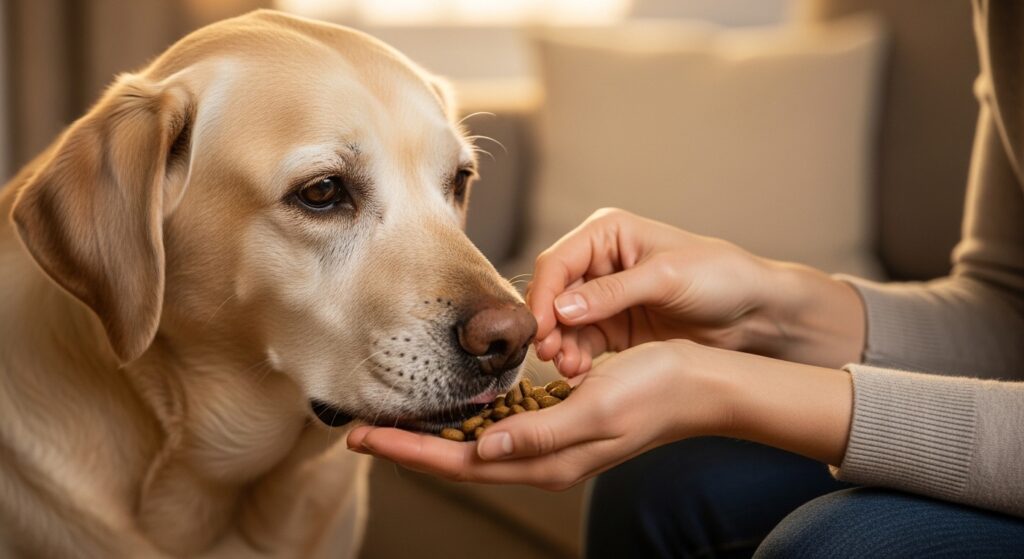
Natural appetite decrease is common in older dogs due to reduced metabolic rate, dental deterioration, and olfactory decline. Senior-specific kibble formulas are designed with these factors in mind — they typically feature a stronger aroma, smaller kibble size, higher protein to counteract muscle loss, and adjusted caloric density.
Warming the food and adding moisture is especially effective for senior dogs experiencing smell-related appetite suppression.
Small and Toy Breeds
Small breeds are disproportionately represented among dogs labeled as “picky eaters.” Part of this is physiological — their smaller stomach capacity means they reach satiety faster and are more easily full from treats. Part of it is behavioral — small dogs are often more frequently offered treats and table scraps, reinforcing selective eating more rapidly.
Small breed-specific kibble (with a smaller kibble diameter) and strict treat portion control are the primary interventions for these dogs.
Frequently Asked Questions
How long can a dog go without eating kibble?
A healthy adult dog can safely go 24–48 hours without eating. Beyond 48–72 hours, dehydration, hypoglycemia, and weight loss become concerns. Puppies, very small breeds, and dogs with underlying health conditions should not go more than 12–24 hours without food before a veterinary consultation.
Should I add wet food to kibble?
Yes, as a transitional strategy, mixing wet food into kibble is an effective and safe method to increase palatability. However, ensure the total daily caloric intake remains appropriate for your dog’s weight and activity level, as wet food adds calories.
Is it okay if my dog only eats treats?
No. Treats are not nutritionally complete and should not replace a balanced diet. Regular consumption of treats as a primary food source leads to nutrient deficiencies, dental disease from soft food residue, obesity, and behavioral issues.
What are the best kibble toppers to encourage eating?
Effective and safe kibble toppers include: plain cooked chicken (no seasoning), low-sodium bone broth, a spoonful of plain pumpkin puree (excellent for digestion), a small amount of plain yogurt (if not lactose intolerant), or a spoonful of wet dog food. Always calculate toppers as part of the dog’s daily caloric budget.
Can a dog starve itself by refusing kibble?
In very rare circumstances — particularly in cases of severe behavioral food refusal or underlying psychological conditions — a dog may refuse food long enough to develop hepatic lipidosis (fatty liver disease), especially in overweight dogs. This is not common with typical selective eating, but it underscores the importance of resolving kibble refusal promptly.
This article is intended for informational purposes only and does not constitute veterinary advice. Always consult a licensed veterinarian before making significant changes to your dog’s diet or if you have concerns about your dog’s health.